*Correspondence: Manish Kumar Gupta. Institute of Pharmacy, HCPG College, Varanasi – 221002. E-mail: [email protected]; [email protected]
A
vol. 48, n. 4, oct./dec., 2012
Biodegradable microparticulate drug delivery system of
diltiazem HCl
Manish Kumar Gupta
1,*, Deepak Prakash
1, Brahmeshwar Mishra
21Institute of Pharmacy, Harish Chandra Post Graduate College, Varanasi, India, 2Department of Pharmaceutics, Indian Institute of Technology, Banaras Hindu University, Varanasi, India
The eficacy of a drug in a speciic application requires the maintenance of appropriate drug blood level concentration during a prolonged period of time. Controlled release delivery is available for many routes of administration and offers many advantages (as microparticles and nanoparticles) over immediate release delivery. These advantages include reduced dosing frequency, better therapeutic control, fewer side effects, and, consequently, these dosage forms are well accepted by patients. Advances in polymer material science, particle engineering design, manufacture, and nanotechnology have led the way to the introduction of several marketed controlled release products and several more are in pre-clinical and clinical development. The objective of this work is to prepare and evaluate diltiazem HCl loaded albumin microparticles using a factorial design. Albumin (natural polymer) microparticles were prepared by emulsion heat-stabilization method. Selected formulations were characterized for their entrapment eficiency, particle size, surface morphology, and release behavior. Analysis of variance for entrapment eficiency indicates that entrapment eficiency is best itted to a response surface linear model. Surface morphology was studied by scanning electron microscopy. Scanning electron microscopy of the microparticles revealed a spherical, nonporous and uniform appearance, with a smooth surface. The geometric mean diameter of the microparticles was found to be 2-9 μm, which more than 75% were below 3.5 μm and drug incorporation eficiency of 59.74 to 72.48% (w/w). In vitro release proile for formulations containing diltiazem HCl loaded BSA microparticles with heat stabilization technique shows slow controlled the release of the drug up to 24 hours. The release pattern was biphasic, characterized by an initial burst effect followed by a slow release. All selected microparticles exhibited a prolonged release for almost 24 hours. On comparing regression-coeficient (r2) values for Hixson Crowel, Higuchi and Peppas kinetic models, different batches of microparticles showed Fickian, non-Fickian, and diffusion kinetics. The release mechanism was regulated by D:P ratio. From the statistical analysis it was observed that as the drug:polymer (D:P) ratio increased, there was a signiicant increase in the encapsulation eficiency. Based on the particle size, entrapment eficiency and physical appearance, DTM-3 formulations were selected for in vivo release study and stability study. The in vivo result of drug loaded microparticles showed preferential drug targeting to liver followed by lungs, kidneys and spleen. Stability studies showed that maximum drug content and closest in vitro release to initial data were found in the formulation stored at 4 ºC. In present study, diltiazem HCl loaded BSA microparticles were prepared and targeted to various organs to satisfactory level and were found to be stable at 4 ºC.
Uniterms: Diltiazem HCl loaded microparticles/preparation. Diltiazem HCl loaded microparticles/ release proile/evaluation. Albumin/microparticles. Microparticles batches/diffusion kinetics.
modiicada e vários outros se encontram em desenvolvimento pré-clínico e clínico. O objetivo do presente trabalho foi preparar e avaliar o fármaco cloridrato de diltiazem associado a micropartículas de albumina utilizando planejamento fatorial. As micropartículas de albumina, um polímero natural, foram preparadas por método de emulsão empregando estabilização por calor. As formulações selecionadas foram caracterizadas no que se refere à sua eiciência de encapsulamento, tamanho médio de partículas, morfologia de superfície e peril de liberação do fármaco. A análise de variância relativa à eiciência de encapsulamento indicou superfície de resposta linear. Com referência à morfologia supericial, essa foi avaliada empregando microscopia eletrônica de varredura. Essa análise revelou micropartículas esféricas, não porosas e de aparência uniforme, com superfície lisa. O diâmetro médio das micropartículas foi entre 2 e 9 μm, sendo que mais de 75% das micropartículas se apresentaram abaixo de 3,5 μm. Além disso, a eiciência de encapsulamento foi entre 59,74 e 72,48%. Quanto ao ensaio para avaliação do peril de liberação in vitro do fármaco associado às micropartículas, as formulações apresentaram liberação lenta até 24 horas. O comportamento foi caracterizado por liberação inicial (efeito burst) seguida por liberação lenta. Todas as fórmulas selecionadas apresentaram liberação prolongada por aproximadamente 24 horas. Na comparação entre os valores de coeicientes de regressão (R2), os modelos propostos por Hixson Crowel, Higuchi e Peppas, para diferentes formulações de micropartículas, demonstraram cinética de liberação de acordo com modelo Fickiano e não-Fickiano. O mecanismo de liberação do fármaco foi regulado pela razão entre o fármaco e o polímero. A análise estatística revelou signiicativo aumento da eiciência de encapsulamento quando essa razão aumentou. As avaliações relativas à análise dimensional das micropartículas, à eiciência de encapsulamento do fármaco e à morfologia permitiram a seleção da formulação DTM-3 para os ensaios de liberação in vivo e para o estudo da estabilidade. O ensaio de liberação in vivo do fármaco associado às micropartículas demonstrou sítio-alvo preferencial no fígado, seguido pelos pulmões rins e baço. No presente estudo, as micropartículas de albumina contendo cloridrato de diltiazem foram adequadamente preparadas e orientadas satisfatoriamente para vários órgãos. Além disso, a formulação selecionada apresentou estabilidade físico-química a 4 oC.
Unitermos: Cloridrato de diltiazem/associado a micropartículas/preparação. Cloridrato de diltiazem/ associado a micropartículas/avaliação do peril de liberação. Albumina/micropartículas. Formulações de micropartículas/cinética de liberação.
INTRODUCTION
The eficacy of a drug in a speciic application re
-quires the maintenance of appropriate drug blood level concentration during a prolonged period of time. However, the conventional administration of drugs, gives a poor control of the concentration of these substances in plasma because of variations in the concentration of the bioactive product, once a speciic dose has been administered. The conventional dosage systems can rise to alternative periods of ineficacy or toxicity. These dificulties have been called for the development of new administration techniques for bioactive compounds, directed towards attaining the steady state plasma concentration. In the recent years, considerable attention has been focused on the development of Novel Drug Delivery Systems (NDDS). The reason for this para
-digm shift is due to the low development cost and time re
-quired for developing a NDDS for the existing drugs rather developing a new drug molecule. In the form of NDDS, existing drug molecule can get a new life, thereby increasing the market value and product patent life. Controlled release, prolonged action, sustained release, extended release, depot dosage forms are terms used to identify these drug delivery systems that are designed to achieve prolonged therapeutic
effected by continuously releasing medication over an extended period of time after administration of single dose (Chinna et al., 2010). The therapeutic beneits of new sys
-tems include increased eficacy of the site-speciic delivery, decreased toxicity/side effects, increased convenience, shorter hospitalizations, variable treatments for previously incurable diseases, potential for prophylactic applications and lower healthcare costs–both long term and better patient compliance (Lee et al., 2000; Lalla, 1991). In a majority
of studies the homo and copolymer have been used for drug delivery application because they can be fabricated into a variety of morphologies, including ilms, rods, and microparticles by compression molding, solvent casting, solvent evaporation technique and phase separation tech
-nique (Chinna et al., 2010).
Biodegradable polymers have been of long interest in controlled release technology because of the ability of these polymers to be reabsorbed by the body. This allevi
-ates the need for removal, often surgically, of a drug release device. Knowledge and skill in the ield of biodegradable
polymer technology is progressing rapidly enough that
researchers have at their disposal a substantial number of degradable polymers with a range of degradation rates. Not
or blend, but also they may use a combination of polymers. These polymers, which have been prepared as ilms, mic
-roparticles, rods, and other forms, display a bulk erosion hydrolysis (Pappas et al., 1995; Mansour et al., 2010).
While biodegradable microparticles have proven to be useful in a wide range of controlled drug delivery applications, several research groups have investigated opportunities for utilizing biodegradable microparticles in composite or hybrid systems with other biodegradable or non-degradable systems. The release rates and proiles of both hydrophilic drugs and hydrophobic drugs have shown to be signiicantly changed when the biodegradable
microparticles containing these drugs are incorporated
into silicone (nondegradable) or gelatin (degradable) ilms. The drug released from the microparticles within the silicone ilms does not exhibit the initial high burst of release in vitro from free microparticles (Pappas et al.,
1995).Naturally derived polymers are abundant and usu
-ally biodegradable. Their principal disadvantages lie in the development of reproducible production methods, because their structural complexity often renders modiication and puriication dificult. Additionally, signiicant batch-to-batch variations occur because of their ‘biopreparation’ in living organisms (Nela et al., 1999).
Microparticulates in the size range of about 1-100
μm, consisting of biodegradable or bioerodible solids with embodied therapeutic agents, represent a prominent class of delivery systems. Their administration is most commonly by local injection of suitable dispersions but applications to the respiratory tract or peroral delivery are equally inter -esting. In particular, there is much interest currently in the
use of biodegradable polymers for the preparation of mic
-roparticles containing a wide range of therapeutic agents, which can, of course, be used for parenteral administration. Solid biodegradable microparticles incorporating a drug dispersed throughout the particle matrix have the potential
for the controlled release of the drug from this system after
i.m. injection. Microparticles designed for parenteral drug delivery can be composed of a variety of materials with different physical characteristics such as biocompatible, biodegradable, injectable, sterile, compatible with diluents, and pharmaceutically stable. Depending on the used mic
-roparticulate material, its size distribution and degradation or erosion kinetics, various delivery proiles are feasible (Merkle et al., 2002; Nanjwade et al., 2011).
The therapeutic and economic success of
micropar-ticulates as a delivery platform is related closely to the advent of therapeutics from biotechnological sources. For future development, the following prospects for this class of drug delivery systems are envisaged (Merkle et al., 2002):
• Innovations for novel biodegradable and biocom
-patible materials and additives for better control of delivery kinetics;
• Improvements of manufacturing techniques in terms of narrow particle size distribution, high loading eficiency, aseptic manufacturing technologies and drug stability;
• Development of microparticulates as tools in tissue engineering, for example, to establish localized
gradients of mitogenic or morphogenic agents and
support organized tissular development;
• Exploration of novel therapeutic opportunities
through the use of microparticulates for systemic
and localized delivery;
• Innovations regarding novel materials and surface modiications to improve on biocompatibility and
targeting features of microparticulates;
• Design of microparticulates for optimized delivery
of antigens to professional antigen-presenting cells.
Several techniques can be used to prepare polymeric microparticles providing controlled drug delivery. Most commonly, organic solvent evaporation and/or extraction methods are applied. Depending on the solubility of the drug simple or multiple emulsion technique, oil-in-water (o/w) and water-in-oil-in-water (w/o/w) methods are used. In the irst case, a lipophilic drug is dissolved together with the polymer in an organic phase, which is dispersed into outer aqueous phase. Upon contact, the organic solvent diffuses into the external water phase and evaporates at its surface. Consequently, the polymer precipitates and entraps the drug. If a drug hydrophilic is to be incorporated, it can generally not be dissolved within organic phase and drug loss into the external aqueous phase tends to be remarkable, resulting in low encapsulation eficiencies. To overcome this restric
-tion w/o/w techniques can be applied, avoiding the direct contact of the drug containing phase with the outer water phase. An aqueous solution of the drug is emulsiied into an organic phase containing the dissolved polymer. This w/o emulsion is dispersed into an outer aqueous phase. Upon solvent diffusion/evaporation, the polymer precipitates and incorporates the drug (Perez et al., 2003).
Albumin microparticles are biodegradable particles that can be produced in a size range of 1 to 200 μm in diameter, by either physical or chemical solidiication of an albumin emulsion in an organic phase. Bovine serum albumin (BSA) is widely used for microparticles prepara
-tion because it is non-antigenic, biodegradable, free from toxicity, able to control the physicochemical characteris
Microparticles of bovine serum albumin (BSA) may be prepared using an emulsion of aqueous BSA in oil. Suf
-icient elevation of the temperature of the emulsion will set the BSA microparticles or polymerization of polymer by using cross-linking agents. Any drug may be included, either in solution along with the BSA or in suspension, for water-insoluble drugs. The microparticles are cooled and then washed with ether (or another appropriate solvent) and collected usually by iltration or centrifugation (Birn
-baum et al., 2003).
Diltiazem hydrochloride, a calcium channel blocker, is widely used for the treatment of angina pectoris, hyperten
-sion and arrhythmias. It is administered orally (tablets, cap
-sules, sustained release tablets/capsules) and parenterally (intravenous). Diltiazem hydrochloride is a water-soluble cardiovascular drug. The usual dose of diltiazem is 90-120 mg. The conventional tablet and capsule is administered 3 or 4 times a day due to its short biological half-life of about 6 h. The problems of frequent administration and variable low bioavailability (30-45%) after oral administration of conventional tablet or capsules have been attenuated by designing diltiazem in the form of sustained release tablet or capsules. The sustained release forms are administered two
times a day due to its limited residence time in the
gastroin-testinal tract. These limitations of diltiazem hydrochloride in conventional dosage form, sustained release tablet or cap
-sules can be overcome by administrating diltiazem hydro
-chloride by other route of administration (Das et al., 2008).
The purpose of the present study is to prepare
diltia-zem hydrochloride microparticles using bovine serum al
-bumin (biodegradable natural polymer) by emulsiication-heat stabilization technique and to investigate the effect of
microparticle structure and drug release from them.
MATERIAL AND METHODS
Material
Diltiazem hydrochloride BP was supplied by Neu
-land Laborotaries Ltd., Hyderabad (A.P., India) and Bo
-vine serum albumin (BSA fraction V) was purchased from
LOBA Chemie Pvt. Ltd. (Mumbai, India). Cottonseed oil was purchased from Acros organics (New Jersey, USA).
Formulation of microparticles of diltiazem HCl (Dandagi et al., 2006; Kristina et al., 2001; Tuncay et al., 2000; Arshady, 1990)
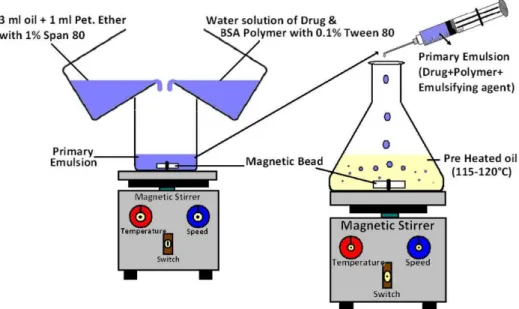
Table I represents the design of various formulations developed. BSA microparticles containing diltiazem HCl were prepared by emulsiication-heat stabilization technique (Figure 1: show the systemic diagram of emulsiication-heat stabilization technique). One hundred ifty milligrams BSA was dissolved in 3 mL deionised water containing 0.1% (v/v) Tween 80, to which 100 mg diltiazem hydrochloride was added and used as the aqueous phase. The oil phase comprised of 3 mL cottonseed oil and 1 mL petroleum ether with 1% (v/v) Span 80 (as emulsiier), which mixed together and allowed to stir for 15 min at 1000 rpm on a magnetic stirrer. The aqueous phase was added drop wise to the oil phase and stirred for 45 min to form the primary emulsion. This primary emulsion was then added to 100 mL of cot
-tonseed oil preheated to 115–120 ºC using 21 No. needle and stirred at 1200 rpm for 1 hours to allow the formation and solidiication of microparticles. The suspension was then allowed to cool to room temperature with continuous stirring using a magnetic stirrer for 3 hours. On cooling, 150 mL of anhydrous ether was added. The suspension contain
-ing the microparticles was centrifuged at 3500 rpm for 15 min and the settled microparticles were washed three times with ether to remove traces of oil on microparticles surfaces. The obtained microparticles were then vacuum dried in a desiccator overnight and stored at 4 ºC in dark. Four batches of microparticles were prepared by the above-mentioned methods and labeled as DTM-1, DTM-2, DTM-3, and DTM-4. (Table I).
Characterization of microparticles
Calculation of percentage yield of microparticles
(Salem et al., 2011; Yeo et al., 2004)
The yield of each formula was calculated by divid
-TABLE I - Formulation design, drug entrapment eficiency & average size distribution of microparticles of different formulations
Batch Formula (Drug:Polymer) % yield Drug Entrapment
Eficiency in % (w/w) Average particle size in µm
DTM-1 1:1.50 65.46 59.74 2.17
DTM-2 1:1.75 66.78 64.26 2.34
DTM-3 1:2.00 70.84 69.51 2.48
FIGURE 1 - General diagram of Emulsiication-Heat Stabilization technique for Microparticles formulation.
ing the final weight of the microparticles produced by the weight of the BSA added. The yield was calculated according to this equation:
% Yield = (WM / WBSA+ Drug)× 100
where, the WM is the inal weight of the microparticles
after drying whilst W BSA+ Drug is the sum of initial weight
of BSA and drug.
Entrapment efficiency: (Dandagi et al., 2006; Yeo et
al., 2004; Thakkar et al., 2005; Gupta et al., 2009)
• Unentrapped drug:Ten milliliter of pH 7.4 phos
-phate buffer saline (PBS) was added to 10 mg of microparticles and this mixture was kept in an ul
-trasonicator for 1 minute. After centrifugation, the supernatant was iltered through a 0.45 μm ilter and the iltrate was suitably diluted with buffer solution. The absorbance of resulting solution was measured at 237 nm by using UV-visible spectrophotometer. The standard calibration curve of diltiazem HCl was carried out by using UV-visible spectrophotometer and HPTLC. (Figure 2)
• Entrapped drug: The residue obtained on centri
-fugation was mixed with 5 mL 0.1 N hydrochloric acid containing 2% w/v pepsin and allowed to stand for 24 hours. The dispersion was then shaken with methylene chloride to extract diltiazem HCl. The organic extract was evaporated to dryness and the residue dissolved in methanol. The absorbance of the resulting solution was measured at 240 nm on a UV-visible spectrophotometer to determine the
amount of Diltiazem HCl present in the micropar -ticles.
Drug entrapment eficiency = (M actual / M theoretical) x 100%
Particle size distribution and morphology of
microparticles (Mathew et al., 2007; Dandagi et al.,
2006; Yeo et al., 2004; Gupta et al., 2009)
Size and morphology (shape and surface characteris
-tics) were characterized by scanning electron microscopy using JEOL-T330A scanning microscope (Japan). Dry mi
-croparticles were placed on an electron microscope brass stub and coated with gold in an ion sputter. Pictures of microparticles were taken by random scanning of the stub. The diameter of about 100 microparticles was measured from optical microscope of each batch. Finally, average mean diameters were obtained (Table I).
In vitro drug release studies (Salem et al., 2011; Gupta et al., 2009; Oner et al.,1993; Shenoy et al., 1997)
Drug-loaded microparticles equivalent to 50 mg of drug were weighed and transferred in to a 100 mL conical flask. To this 50 mL of 7.4 pH PBS was added, then the flasks were kept in a metabolic shaker and the shaker was adjusted to 50 horizontal shakes/min at 37±0.5 ºC. One milliliter of the drug releasing media was withdrawn at various time intervals of 15 min, 1, 2, 4, 6, 8, 12, 16, 20 and 24 h and replaced by the same volume of phosphate buffer saline (PBS). These samples were iltered though 0.45 μm membrane ilter. The iltrate was diluted suitably. The drug was estimated in each batch by UV–Vis spectro
-photometer at 237 nm. For batch DTM-1, the drug release study was carried by HPTLC method for comparing the results, which are coming from UV-Visible spectroscopy.
In vivo drug distribution studies (Dandagi et al., 2006;
Gupta et al., 2009; Oner et al.,1993; Shenoy et al.,
1997)
This study was carried out to compare the targeting eficiency of drug-loaded microparticles and controlled release with that of the free drug in terms of percentage increase in targeting to various organs of reticule endothe
-lial system like liver, lungs, kidney and spleen.
Thirty healthy adult Albino mice weighing 35-40 g were selected, a constant day and night cycle was maintained and they were fasted for 12 h. The animals were divided into six groups each containing ive mice. Groups I, II and III received microparticles equivalent to 700 µg of diltiazem HCl intravenously in the tail vein after
re-dispersing in sterile phosphate buffer saline solution. Microparticles from batch DTM-3 were selected for the study. Groups IV and V received 700 µg of pure diltiazem
HCl drug intravenously and Group VI was kept as solvent control and received only saline phosphate buffer.
After 1 h the Groups I, IV and VI mice were sacriiced and their liver, lungs, kidney and spleen were isolated. The Group V was sacriiced after 2 h and Groups II and III were sacriiced after12 and 24 h, respectively. The individual organs of each mice were homogenized with adding small quantity of phosphate saline buffer pH 7.4 and 0.1 N HCl, then kept in fridge for 12 h to precipi
-tate protein and then centrifuged at 15,000 rpm to obtain the supernatant. The supernatant was iltered though an ultrailter membrane of pore size 0.2 μm and drug content was estimated using UV spectrophotometer at 237 nm.
Stability study(Oliva et al., 1999; Kulkarni et al., 2004)
All the eight batches of Diltiazem HCl micropar
-ticles were tested for stability. All the preparations were di
-vided into three sets and were stored at 4 ºC (refrigerator), ambient temperature/humidity and 40 ºC (thermostatic oven). After 15, 30 and 60 days, drug content of all the formulations was determined by the method discussed pre
-viously in entrapment eficiency section. In vitro release
study was also carried out of the best one formulation.
RESULTS
Microparticles based on the biodegradable polymer bovine serum albumin (BSA) have been extensively in
-vestigated as controlled drug delivery system because of their excellent biocompatibility and biodegradability. In recent years, a continued interest in BSA microparticles has been triggered by their application for the controlled release of different variety of drugs.
In the present study BSA microparticles encapsu
-lated with Diltiazem HCl were prepared by emulsiication-heat stabilization and emulsiication-polymerization tech
-nique. When the primary emulsion is unstable, encapsula
-tion eficiency is low because the internal aqueous phase tends to merge with the neighboring aqueous continuous phase. Stability of the primary emulsion can be enhanced by including emulsifying agents such as PVA, Tween-80, or Span-80 either in the internal aqueous phase or in the
polymer phase.
The percentage practical yield value of micropar
-ticles prepared with Bovine Serum Albumin was in range of 65.46% to 72.82% (Table I). The yield value increased
as the amount of polymer added to each formulation
in-creased. Maximum yield was found to be 72.82% (w/w) in DTM-4.
The encapsulation (drug loading) eficiency for the formulated microparticles are summarized in Table I. the amount of drug bound per 10 mg microparticles was de
-termined in the prepared all four batches. The maximum drug loading was found in DTM-4 (72.48%).
In the present investigation, the particle size dis
-tribution of the microparticles prepared with BSA could be changed by simple altering the drug to polymer ratio. When related factors such as emulsiication stirring speed, heating time, solvent to polymer ratio and surfactant/sta
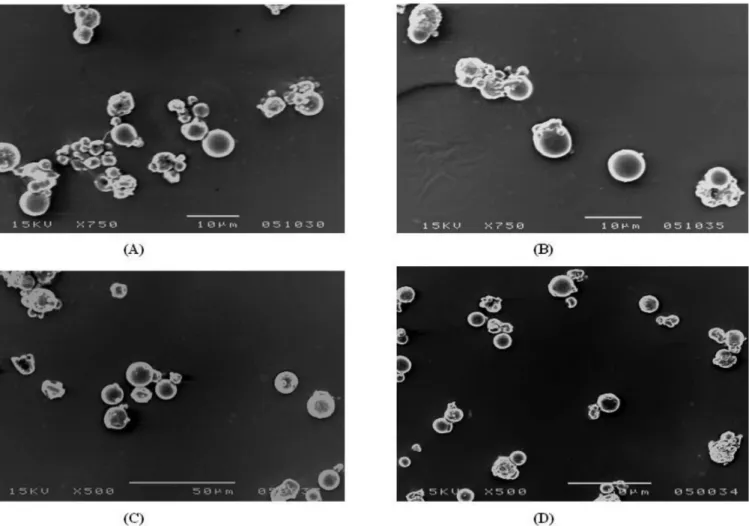
-FIGURE 3 - Scanning Electron Microscopy (SEM) of diltiazem HCl microparticles, DTM-1 (A), DTM-2 (B), DTM -3 (C) and
DTM -4 (D).
graphs (Figure 3) of the microparticles reveal that they are spherical, nonporous, and uniform with a smooth surface, which was prepared by heat stabilization technique. The particles appeared to be aggregate in nature without evi -dence of any collapsed particles.
The cumulative percent drug release of pure drug was found to be 97.95% at 2 hours. Cumulative percent of drug release after 24 hours was 89.42%, 87.48%, 76.65%, and 74.83% for DTM-1, DTM-2, DTM-3 and DTM-4 respectively by using UV spectroscopy. It was observed that the drug release from the formulations decreased with
increase in the amount of polymer added in each
formula-tion (Figure 4). The in vitro release of all the batches of microparticles showed a bi-phasic release with an initial burst effect. The drug release from BSA microparticles can usually be divided into an initial release (burst) phase followed by a slower continuous release phase. The initial release, which plays an important role in the therapeutic ef
-icacy of microparticles, is normally deined as the amount of drug released during the irst hour. The initial release is
commonly attributed to the release of drug located close
to the surface of microparticles. It is related to the
micro-structure (porosity) of the microparticles. In the irst hour, drug release was 24.82%, 26.67%, 27.28% and 28.92% for DTM-1, DTM-2, DTM-3 and DTM-4 formulations respectively. Afterwards the drug release followed a steady pattern approximating zero order release. An alternative
method to estimate the drug release concentration of
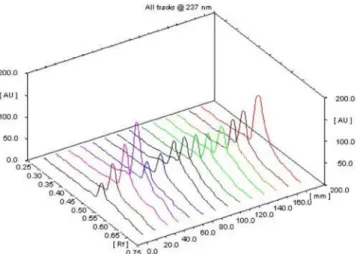
for-mulation DTM-1 was carried out by HPTLC. The graph of HPTLC is shown in Figure 5.
The regression coeficient for formulations DTM-1, DTM-2, DTM-3, and DTM-4 of zero-order plot was found to be 0.9339, 0.9551, 0.9633 and 0.9973 respectively. The regression coeficient for formulations 1 to DTM-4 of irst-order plot was found to be −0.9882, −0.9933, −0.9901 and −0.9767 respectively. The regression coef
-ficient for formulations DTM-1 to DTM-4 of Higuchi Matrix plot was found to be 0.9871, 0.9929, 0.9959 and 0.9871 respectively. Hixson Crowell plot regressions coef
−0.9775, −0.9908, −0.9935 and −0.9808 respectively. The slope ‘n’ values in Peppas model for DTM-1 to DTM-4
were 0.355, 0.324, 0.296 and 0.242 respectively, which is less than 0.45.
The average drug distribution eficiency of drug-loaded microparticles was found to be 15.22% in liver,
7.86% in lungs, 6.50% in spleen and 4.47% in kidneys after 24 hours, whereas accumulation of pure drug in liver was 5.89%, in lungs it was 3.48%, in spleen 2.06% and in kidneys 1.43% of the injected dose after 2 hours (Table II).
In vitro release studies revealed that the formula
-tion (DTM-3) stored at 4 oC showed 76.84% release, the
one which was stored at ambient temperature/humidity showed 78.27% and 40 oC batch showed 78.68% release
after 24 hours.
DISCUSSION
In the present study, an attempt is made to formulate
diltiazem HCl as micro-particulate drug delivery system in order to localize drug at the absorption site, enhances its bioavailability, reduces dose, thereby improving patient compliance. Microparticulate system of diltiazem HCl was formulated using BSA (natural polymer) as carrier by emulsiication–heat stabilizing method. Prior to for
-mulation, preformulation studies were carried out in order to establish compatibility between drug and polymer by FTIR spectroscopy.
Percentage practical yield was found to be maxi
-mum in formulation DTM-4. Percentage practical yield
increased as the amount of polymer added to each
formu-lation increased, although it may not be dependent upon drug concentration in the formulation. Particle size of the drug-loaded microparticles revealed that the particles were in micron range. The particle size of the albumin microparticles is 2-9 μm. The microparticles describes in this study were spherical, smooth surfaced and without porous which prepared by heat stabilization technique. The microparticles appeared to be aggregate in nature without evidence of any collapsed particles. Drug entrap
-ment eficiency was found to be maximum in DTM-4. It is observed that drug entrapment eficiency increased with
increase drug-polymer ratio.
Release of diltiazem HCl from BSA microparticles was prolonged with a slight burst release in the irst hours (Figure 4). The release from microparticles continued for
TABLE II - In vivo tissue distribution studies of bovine serum albumin microparticles of diltiazem HCL and Pure drug (diltiazem HCl).
Organs
Drug Content (% in w/v)
Microparticles of diltiazem HCl Pure drug
Group I After 1 h Group II After 12 h Group III After 24 h Group IV After 1 h Group V After 2 h
Liver 30.16 27.68 15.22 17.76 5.89
Lungs 16.48 14.52 7.86 13.18 3.48
Kidney 13.42 11.63 6.50 9.83 2.06
Spleen 10.62 9.28 4.67 6.96 1.43
FIGURA 4 – Plots of cumulative % drug released vs. time (in vitro release proile) (zero order kinetics).
FIGURE 5 - 3D view of HPTLC of in vitro release proile of
at least 24 hours and it a zero order release pattern. Within 24 hours, about 90% of loaded drug in microparticles was released. Cumulative percent of drug release with respect to time was found to be highest for formulation DTM-1 and the lowest for formulation DTM-4. Based on the regression coeficient values, the best-it model for DTM-1, DTM-2 and DTM-3 was irst order and DTM-4 followed zero-order release. Results of Hixson Crowell plot indicated that DTM-3 and DTM-4 appear to it this model. It was also observed that DTM-3 followed Higuchi matrix suggesting drug release by diffusion. The ‘n’ values
of Peppas suggest Fickian release and Hixson Crowell regression data show that formulations also appear to re
-lease drug by erosion mechanism and the re-lease is drug
dissolution limited.
Figure 7 shows degradation of the microparticles by
erosion and hydrolysis mechanism. The photograph on 0
hour (A) shows the appearance of microparticle before erosion. The surface of microparticles becomes irregular and porous during the erosion (B) after irst hour. It was noticed in photograph on 24 hours (C) that microparticles had broken down to small fragments due to erosion.
Overall, the curve itting into various mathematical models was found to be good and the in vitro release, of formulations, best itted into the Peppas model followed by Higuchi’s and Hixson Crowell model (Figure 6). On the basis of drug content, particle size morphology, in vitro release kinetics, formulation DTM-3 was selected as
an optimum formulation for in vivo and stability studies.
Figure 5, 3D view of HPTLC of in vitro release
pro-ile of DTM-1 formulation. First four tracks for standard calibration peak, tracks 5-13 are drug release samples and last track for maximum drug concentration in the formula
-tion. The ifth track of the igure indicates burst effect and
6th to 13th track indicate zero order release pattern.
The present study shows that the targeting eficiency of drug-loaded microparticles over free drug was higher, which may provide increased therapeutic eficacy. More
-FIGURE 6 – Plots of cumulative % drug released vs. root time (in vitro release studies) (Higuchi matrix).
FIGURE 7 – Scanning electron microscopy of before and after in vitro release microparticles of DTM-2: before erosion (A), after
1 h erosion (B) and after 24 h (C).
over, higher concentration of drug targeted to various or
-gans may help in reduction of dose required for the therapy and thereby dose related side effects could be minimized.
The in vivo drug targeting studies revealed the following
order of targeting (tissue distribution): liver > lungs > kidneys > spleen.
Drug content data of stability studies indicate that maximum drug was retained by formulation DTM-3 when stored at 4 ºC. Drug content of the formulation DTM-3 stored at various temperature conditions reduced in the following order: 4 ºC > RT > 40ºC. In vitro release data
of stability studies indicate that very less variation in release was found at 4 ºC followed by room temperature and 40 ºC.
CONCLUSION
We showed that microparticles of biodegradable polymer were promising as a controlled-release drug delivery system of diltiazem HCl. Bovine serum albumin which are biocompatiable and biodegradable, have stud
experimental results obtained with respect to particle size and prolonged drug release, it may be concluded that the developed bovine serum albumin (biodegradable) mic
-roparticles could be useful for once-a-day intravenous (IV) administration of diltiazem HCl. Further, pharmacokinetic and drug release model studies are required to conirm the
application of these microparticles for IV administration.
From the above studies, it can be concluded that 4 ºC is the most suitable temperature for storage of diltiazem HCl
microparticles.
ACKNOWLEDGEMENTS
Authors wish to thank Neuland Laboratories Ltd, AP, India for providing gift samples of diltiazem HCl BP,
Principal, Institute of Pharmacy, HCPG College, Varanasi
and HOD, Department of Pharmaceutics, IIT, BHU, Vara
-nasi, for providing necessary facilities.
REFERENCES
ARSHADY, R. Albumin microspheres and microcapsules:
methodology of manufacturing techniques. J. Control.
Release, v.14, n.2, p.111-131, 1990.
BIRNBAUM, D.T.; PEPPAS, L.B. Microparticle drug delivery systems. In: BROWN, D. M. (Ed.). Drug delivery systems in cancer therapy. Totowa: Humana Press, 2003. p.117-136.
CHINNA, G.; SHYAM, S.; VARMA, V.K.; SLEEVA, R.; SAI, K. Formulation and Evaluation of Indomethacin Microspheres using natural and synthetic polymers as
Controlled Release Dosage Forms. Int. J. Drug Discovery,
v.2, n.1, p.8-16, 2010.
DANDAGI, P.M.; MASTIHOLIMATH, V.S.; PATIL, M.B.; GUPTA, M.K. Biodegradable microparticulate system of Captopril. Int. J. Pharm, v.307, n.1, p.83-88, 2006.
DAS, M.K.; MAURYA, D.P. Evaluation of Diltiazem HCl-Loaded Mucoadhesive microspheres prepared by
emulsiication-internal gelation technique. Acta Pol. Pharm.
Drug Res., v.65, n.2, p.249-259, 2008.
GUPTA, M.K.; MISHRA, B.; PRAKASH, D.; RAI, S.K.
Nanoparticulate drug delivery system of cyclosporine. Int.
J. Pharm. Pharm. Sci, v.1, n.2, p.81-92, 2009.
KRISTINA, M.; LJILJANA, K.; EMILIJA, F.K.; MAJA, G.D.; EMILIJA, J.I.; KATERINA, G. Crosslinked gelatin microspheres containing BSA as a vaccine formulation: biodegradation and drug release control in the presence of trypsin. Bull. Chem. Technol. Macedonia, v.20, n.2,
p.151-156, 2001.
KULKARNI, G.T.; GOWTHAMARAJAN, K.; SURESH, B. Stability testing of pharmaceutical products: an overview.
Indian J. Pharm. Educ., v.38, n.11, p.194-202, 2004.
LALLA, J.K. Introduction to controlled release and oral
controlled drug delivery systems. East. Pharm., v.45, n.7,
p.25-28, 1991.
LEE, T.W.; ROBINSON, J.R. Controlled release drug delivery
systems. In: GENNARO, A.R. 20.ed. Remington: the
science and practice of pharmacy. Philadelphia: Lippincott Williams and Wilkinsi, 2000. v.l, p.903-928.
MANSOUR, H.M.; SOHN, M.; AL-GHANANEEM, A.; DELUCA, P.P. Materials for pharmaceutical dosage forms: molecular pharmaceutics and controlled release drug
delivery aspects. Int. J. Mol. Sci., v.11, n.9, p.3298-3322,
2010.
MATHEW, S.T.; DEVI, S.G.; SANDHYA, K.V. Formulation and evaluation of ketorolac tromethamine-loaded albumin microspheres for potential intramuscular administration.
AAPS Pharm. Sci. Tech., v.8, n.1, p.71-79, 2007.
MERKLE, H.P.; GANDER, B.; MEINEL, L.; WALTER, E.
Novel opportunities of microparticulates for the delivery of therapeutics and vaccines. London: Touch Health Sciences,
2002. p.1-6.
NANJWADE, B.K.; BECHRA, H.M.; NANJWADE, V.K.; DERKAR, G.K.; MANVI, F.V. Formulation and characterization of hydralazine hydrochloride biodegraded microspheres for intramuscular administration. J. Bioanal. Biomed., v.3, n.1, p.32-37, 2011.
NELA, A.; DAVID, H. Rationalizing the design of polymeric
biomaterials. Tibtech., v.17, n.10, p.409-421, 1999.
OLIVA, A.; SANTOVENA, A.; LLABREWS, M.; FARINA, J.B. Stability study of human serum albumin pharmaceutical preparations. J. Pharm. Pharmacol., v.51, n.4, p.385-392,
ONER, L.; GROVES, M.J. Properties of human albumin microparticles prepared by a chilled cross linking technique.
J. Pharm. Pharmacol., v.45, n.10, p.866-870, 1993.
PEPPAS, B.L. Recent advances on the use of biodegradable microparticles and nanoparticles in controlled drug delivery.
Int. J. Pharm., v.116, n.1, p.1-9, 1995.
PEREZ, M.H.; SIEPMANN, J.; ZINUTTI, C.; LAMPRECHTC, A.; UBRICHA, N.; HOFFMANA, M.; BODMEIERB, R.; MAINCENTA, P. Non-degradable microparticles containing a hydrophilic and/or a lipophilic drug:
preparation, characterization and drug release modeling. J.
Control. Rel., v.88, n.3, p.413-428, 2003.
RAHIMNEJAD, M.; JAHANSHAHI, M.; NAJAFPOUR, G.D. Production of biological nanoparticles from bovine serum
albumin for drug delivery. African J. Biotechnol., v.5, n.20,
p.1918-1923, 2006.
SALEM, H.F.; FAHMY, A.; ALI, A.M.A. Extended immunization of rats using microencapsulated cobra
venom. Br. J. Pharmacol. Toxicol., v.2, n.1, p.43-50, 2011.
SHENOY, B.D.; KINI, D.; UDUPA, N. Formulation and in vitro evaluation of centchoman-loaded biodegradable microspheres. Indian J. Pharm. Sci., v.60, n.1, p.41-44,
1997.
THAKKAR, H.; SHARMA, R.K.; MISHRA, A.K.; CHUTTANI, K.; MURTHY, R.R. Albumin microspheres as carriers for
the antiarthritic drug celecoxib. AAPS Pharm. Sci Tech.,
v.6, n.1, p.65-73, 2005.
TUNCAY, M.; CALIS, S.; KAS, H.S.; ERCAN, M.T.;
PEKSOY, I.; HINCAL, A.A. In vitro and in vivo evaluation
of Diclofenac sodium loaded albumin microspheres. J.
Microencapsul., v.17, n.2, p.145-155, 2000.
YEO, Y.; PARK, K. Control of encapsulation eficiency and
initial burst in polymeric microparticle systems. Arch.
Pharm. Res., v.27, n.1, p.1-12, 2004.
Received for publication on 26th October 2011