Abstract
Objective: To evaluate the possible associations between different sociodemographic, clinical, and healthcare factors and the number of unmet needs among people being treated for schizophrenia. Methods: The sample was made up of 141 subjects who were being treated at eight mental health service networks throughout Chile. Unmet need was assessed with the Camberwell Assessment of Need, which was specifically created for people with severe mental disorders. A multiple linear regression analysis was also applied. Results: It was found a direct association with clinical variables: score in the Positive and Negative Syndrome Scale, global functioning at diagnosis, and change in global functioning at diagnosis from diagnosis to interview. However, sociodemographic (ethnicity, education level, and number of people who live with subject) and other clinical variables (age at diagnosis, and annual rate of relapse) were indirectly associated with unmet needs. Conclusions: Our results can be applied in order to coordinate and improve the effectiveness of mental health services in Chile.
Keywords: schizophrenia; needs assessment; mental health services.
Resumo
Objetivo: Avaliar as possíveis associações entre diversos fatores sociodemográficos, clínicos e de cuidado à saúde e o número de necessidades não atendidas entre pessoas que estão sendo tratadas devido à esquizofrenia. Métodos: A amostra foi composta por 141 indivíduos que estavam sendo tratados em oito redes de serviço de saúde mental por todo o Chile. A necessidade não atendida foi avaliada pela Camberwell Assessment of Need, que foi especificamente criada para pessoas com distúrbios mentais graves. Também foi aplicada uma análise de regressão linear múltipla. Resultados: Encontrou-se associação direta com variáveis clínicas: escore na Positive and Negative Syndrome Scale, funcionamento global ao diag-nóstico e mudança no funcionamento global ao diagdiag-nóstico desde o diagdiag-nóstico à entrevista. Entretanto, variáveis socio-demográficas (etnia, nível educacional e número de pessoas que moram com o indivíduo) e clínicas (idade no momento do diagnóstico e taxa anual de recidiva) foram indiretamente associadas com as necessidades não atendidas. Conclusões: Os presentes resultados podem ser aplicados para coordenar e aprimorar a eficácia dos serviços de saúde mental no Chile.
Palavras-chave: esquizofrenia; determinação de necessidades de cuidados de saúde; serviços de saúde mental.
Factors associated with unmet needs in
individuals with schizophrenia in Chile
Fatores associados com as necessidades não satisfeitas em
indivíduos com esquizofrenia no Chile
Rubén Alvarado
1, Francisco Torres González
2, Sara Schilling
3, Francisca Alvarado
4, Carlos
Domínguez
4, Berta Moreno Küstner
5, Francisco Aliste
6Study carried out at University of Chile, Santiago de Chile – Chile.
1Professor at the School of Public Health, Faculty of Medicine, University of Chile – Santiago de Chile, Chile.
2Senior Researcher at CIBERSAM (Network of Biomedical Research on Mental Health Centers), University of Granada – Granada, Spain. 3Current MPH Student at the School of Public Health, Faculty of Medicine, University of Chile – Santiago de Chile, Chile.
4Medical Students at the Faculty of Medicine, University of Chile – Santiago de Chile, Chile. 5Professor at the Faculty of Medicine, University of Málaga – Málaga, Spain.
6Department Head of the Department of Psychiatry and Mental Health at Hospital Padre Hurtado – Santiago, Chile.
Mailing address: Rubén Alvarado – School of Public Health, Faculty of Medicine, University of Chile – Independencia 938, Santiago, Chile – E-mail: [email protected]
INTRODUCTION
Assessment of need has become an important indicator, both to evaluate healthcare systems, and to measure the re-sults of clinical investigations. It has special relevance in the process of psychiatric treatment reform, since the move from hospital-centered care to a system focused on the community has changed the criteria used to evaluate care. he goal is to move beyond simple clinical results in order to achieve a greater number of satisied needs, successful social reinser-tion, and improved quality of life.
Torres Gonzalez et al.1 stated that planning treatment and
services for individuals with severe mental illnesses should begin with the identiication of patients’ needs and clear deinition of the desired outcomes, in order to coordinate patient-speciic care. Wing et al.2 wrote that the optimal outcome is the minimization
of the individuals’ social disability, in which social disability is deined as the decline of physical, psychological, and social abili-ties in the context of a society or particular group of people.
During the 1990s, more research began to evaluate needs by focusing on their existence, and the degree to which they were met.
Studies performed in several countries with severe mental disorders individuals (the majority with schizophrenia) showed that the number of needs varies between 4 and 10, and that be-tween a half and a quarter of those needs are unmet. Categories that most oten become needs are psychotic symptoms, psy-chological distress, daytime activities, company, food, looking ater home, and information on condition and treatment3-8.
he majority of the studies did not ind diferences based on sex or age8. While there were no diferences in the
num-ber of needs based on gender, there was one in type of need (women had more unmet clinical needs, and men had more unmet social needs)8,9. he results regarding educational level
have been inconsistent, with some studies reporting that there is an association and others stating that there were not.
he relationship between satisfaction of needs and other outcome variables in patients and caregivers has been ex-plored in multiple studies10,11. here are associations between
variables related to clinical presentation and number of unmet needs, such as duration and chronicity of the illness, global functioning level, and psychopathological severity8,9.
Many studies demonstrate a strong inverse relationship between the number of unmet needs and quality of life8,12,13.
Evidence tends to show that satisfaction of needs is relatively stable over time and only partially depends on the reduction of psychotic symptoms8,12. Improvement of unmet needs is
closely related to the individual’s quality of life13.
Similarly, assessment of need has been used to evaluate the efectiveness of health services. he PRISM Psychosis Study, for example, compared two forms of community-based services
(one standard and one intensive) using several parameters, one of which was the assessment of need14. he investigators found
that patients in both types of services had a reduced number of needs (from 77 to 70% in Nunhead, London, and from 74 to 67% in Norwood, London). here was a relationship between unmet needs and satisfaction with services, as well as be-tween the type of needs and that of services15,16.
Another study, performed in Sweden17, compared the
change in number of needs (total and unmet) in a group of individuals with severe mental disorders, who were being treated in health services, which had undergone psychiatric care reform. he results showed a decrease in these two indi-cators of needs (total and unmet), between the initial and the second assessment, which had occurred ive years earlier17.
he aforementioned studies motivated us to investigate the factors associated with the number of unmet needs in in-dividuals undergoing treatment for schizophrenia in Chile, a middle-income country that has been developing psychiatric care reform for more than ten years.
MATERIALS AND METHODS
This was an observational and analytical study, which used a sample of people who were being treated in mental health services in Chile diagnosed with schizophrenia or a related disorder.
The sample was selected from a pool of individuals who were being treated in eight mental health networks in Chile diagnosed with schizophrenia or a related psychotic disor-der (codes F20 – F29 in the International Classification of Diseases – ICD-10). Their initial diagnosis was given be-tween April 1, 2001 and March 31, 2003 and did not change in the entire period leading up to this study. The interviews were performed in 2005, i.e., around two or three years after the initial diagnosis. The reference population for the eight service networks was equivalent to 23.7% of the total Chilean population that is treated under the country’s public health system.
here were 178 individuals who it the inclusion criteria for the study. Of those, 33 refused to be interviewed (corre-sponding to 18.5% of the total identiied cases), and 4 were unable to fully complete the questionnaires. he inal sample was composed of 141 people, who signed an informed con-sent form before entering the study.
Clinical history and received care: age at irst diagnosis of schizophrenia, level of global functioning at diagno-sis (GAF)18, annual rate of relapse, number of
hospitaliza-tions since diagnosis, change in GAF between diagnosis and interview, and number of psychosocial interventions (psychotherapy, psychoeducation, etc.) that the patient has received since diagnosis.
Social support was measured with the Scale of Social Support of the Mental Health Department of California, which is made up of six items that explore the number of people whom the subject can go to in various salutations (to share problems, to receive help, to interact socially, etc.)19. In
Chile, the discriminate validity of the scale has been studied to contrast results of individuals with common mental disor-ders with a control, and there were signiicant diferences in the current support score20. Likewise, the convergent validity
was tested with the Afective Balance Scale, and a signiicant correlation was found21.
Clinical status at the time of interview was measured with the Positive and Negative Syndrome Scale (PANSS), an instru-ment that evaluates negative and positive symptoms seen in schizophrenia, along with other general psychopathological elements. It was developed by Kay et al.22 and was validated in
Spanish23, with 30 items.
The number of unmet needs was evaluated with the Camberwell Assessment of Need (CAN)24-26. The
instru-ment is based on the conceptual framework that views needs in conjunction with the interventions used to meet them and, therefore, is useful to evaluate health services. “Needs” are designated when a patient’s level of function-ing in an area is below an established standard, and when there is also an effective intervention to correct the dis-crepancy. A need is considered met, or covered, when it has undergone the most effective intervention known to date; conversely, it is unmet when no intervention has been put in place, or when there was an intervention but other more effective interventions exist, and so the need was not satisfied27. The CAN evaluates 22 areas of need:
accom-modation, food, looking after the home, self-care, daytime activities, physical health, psychotic symptoms, informa-tion on condiinforma-tion and treatment, psychological distress, safety to self, safety to others, alcohol, drugs, company, intimate relationships, sexual expression, child care, basic education, telephone, transportation, money, and benefits.
he validity and reliability data of CAN were originally published by the authors of the assessment25, who reported
that the instrument has good face and content validity. he inter-judge reliability for professionals was a kappa of 0.90, and for patients it was 0.87. he test-retest reliability was
lower, with a kappa of 0.51 for patients and 0.61 for profes-sionals. he instrument was translated into Spanish by the Mental Health Research Group of the University of Granada, following the protocol of simultaneous translation and back-translation. he group reported preliminary data from a Spanish sample with similar values: a kappa of 0.91 for the inter-judge reliability of both professionals and patients, and with test-retest reliability, a kappa of 0.60 for professionals, and 0.62 for patients26.
Data analysis began with an overview of the variables and then proceeded with a multivariate analysis based on the con-struction of several multiple linear regression models, with the number of unmet needs (based on the 22 areas evaluated in CAN) as the dependent variable. Since the variables under investigation corresponded to diferent times, more multiple linear regression models were created for the signiicant vari-ables, based on what had been included in the inal models from the previous analysis. Analysis ended with a proposal for a model of variables that are associated directly and indirectly with the quality of life of the subjects.
Ethical considerations
he project was approved by the Ethical Committee of Sótero del Río Hospital, in Southeast Santiago. he study aims and instruments were explained to potential participants, and written informed consent was obtained.
RESULTS
Sociodemographic characteristics
Sociodemographic data are presented in Table 1.
he inal sample included 141 people, with 96 men (68.1%) and 45 women (31.9%). he mean age was 27.2±7.6 years-old, and the age range was from 17 to 55 years-old. With respect to civil status, 131 of the individuals were single (92.9%), 6 were married at the time of the interview (4.3%), and 4 were divorced (2.8%).
he mean number of people who lived with the subject (includ-ing subject) was ive, and the range was from 1 to ten individuals.
Regarding ethnic identity, the large majority of the sub-jects (in 136 of 141 cases, or 96.5%) identiied themselves as Chilean. Only ive individuals (3.5%) identiied themselves as belonging to an ethnic minority group (Mapuche or Aymara).
With respect to educational level, the average number of years spent in school was 9.9±2.8 years; the median number was 10, and the range was between 1 and 17.
Clinical history and received care
Clinical history and received care data are shown in Table 2. he mean age of the individuals at irst diagnosis was 23.7±7.5 years-old, with a range from 13 to 51.
he mean GAF score at time of diagnosis was 36.8±11.3 points; the median was 35, and the range of the scores was from 15 to 91. With respect to the change in GAF score be-tween initial diagnosis and interview, it was found that there was an average increase of 31.7 points in global functioning. In 138 cases (97.9%), there was an increase in GAF score; only in one case there was a decrease in the GAF score (0.7%), and in the two other ones there were no changes (1.4%).
Regarding the subjects’ clinical evolution, it was found that only in 18.4% of the cases there was not a relapse ater the irst psychotic episode. In the entire studied group, there was a mean of 2.1±1.6 relapse episodes during the illness’ evolution (the period from diagnosis until the study’s interview). he
average annual rate of relapse episodes was 0.6±0.5 episodes; the median was 0.5, with a range between 0 and 2.7 per year.
here was an average of 1.4±1.4 episodes of hospitaliza-tions per subject, with a median of one hospitalization and a range between zero and eight. Only in 27.7% of the cases, there was no hospitalization during the evolution of the disorder.
With respect to psychosocial interventions, the most used one was psychoeducation for the patient (in 61.7% of the cases), followed by other psychological interventions (in 60.3% of cases). he third most frequently ones were family interventions (in 54.6% of cases), and inally, in fourth, there were psychosocial rehabilitation programs (used in 42.6% of cases). Table 2 presents the distribution of patients accord-ing to the number of types of psychosocial interventions they underwent. One can see that 22.0% of the patients did not undergo any type of psychosocial education, and 22.5% par-ticipated in all four types of interventions that were examined.
Table 1. Sociodemographic characteristics of people diagnosed with schizophrenia who were treated in eight mental health service networks in Chile (n=141)
Sex
Male 96 (68.1%)
Female 45 (31.9%)
Age
mean 27.2±7.6 years-old
median 25 years-old
range between 17 and 55 years-old
Civil status
single 131 (92.9%)
married 6 (4.3%)
separated 4 (2.8%)
Number of people in the family group
median 5
range between 1 and 10
Ethnic identity
considers self Chilean 136 (96.5%)
considers self part of ethnic
minority group 5 (3.5%)
Education level (years of study)
mean 9.9±2.8 years
median 10 years
range between 1 and 17 years
Occupational situation
student 14 (9.9%)
with a stable job 13 (9.2%)
with occasional work 27 (19.1%)
unemployed 64 (45.4%)
other 23 (16.3%)
Social support
mean 10.7±6.6 points
median 10 points
range between 0 and 27 points
Table 2. Characteristics of clinical evolution and received treatment in people diagnosed with schizophrenia who were treated at eight mental health service networks in Chile (n=141)
Age at diagnosis
mean 23.7±7.5 years-old
median 21.5 years-old
range between 13 and 51 years-old
GAF at diagnosis
mean 36.8±11.3 points
median 35 points
range between 15 and 91 points
Annual rate of relapse
mean 0.6±0.5
median 0.5
range between 0 and 2.7
Number of hospitalizations
mean 1.4±1.4
median 1
range between 0 and 8
Change in GAF score
increase 138 (97.9%)
no change 2 (1.4%)
decrease 1 (0.7%)
Number of psychosocial interventions
none 31 (22.0%)
one 17 (12.1%)
two 23 (16.3%)
three 34 (24.1%)
four 36 (25.5%)
Score on PANSS
mean 45.3±15.7 points
median 40 points
range between 30 and 123 points
Social support
he average score from the Scale of Social Support of the Mental Health Department of California was 10.7±6.6 points; the median was 10, and the range was between 0 and 27 points.
Clinical status at time of intervention
Table 2 also shows the results of the different sub-scales of the PANSS, along with the total value. For the latter, one can see that the group obtained an average score of 45.3±15.7 points, with an average of 40 and a range be-tween 30 and 123 points.
Unmet needs
here was an average number of 1.2 areas of unmet need per person, with a standard deviation of 1.5; the median was 1, and the number of unmet needs ranged from 0 to 8. In the group, 45.4% had no unmet needs. Of the 54.6% of subjects that had at least one area of unmet need, the majority had between one and two types of unmet need (39.7% of cases).
Multivariate analysis for the number of unmet needs he construction of multiple linear regression models in-volved: creation of an initial model with all key variables and their possible interactions; identiication of the preliminary parsimonious model; analysis of multicollinearity (variance inlation factor – VIF indicator); evaluation of the model; study of the possible existence of inluential variables; and obtainment of the inal parsimonious model.
he inal model for the number of unmet needs had a R2
of 0.3580 (with p<0.001) and incorporated three principal variables: the score on the PANSS, the GAF score at diagno-sis, and the change in GAF score between diagnosis and the
study’s interview, as well as a variable of interaction between the last two variables.
he inal model for the PANSS score had a R2 of 0.3582 (with
p<0.001) and was made up of ive key variables: the number of people who lived with the patient, the number of years of school-ing at diagnosis, the GAF score at the moment of diagnosis, the change in GAF score between diagnosis and the interview, and the annual rate of relapse.
he inal model for the annual rate of relapse, in turn, had a R2 of 0.0795 (with p=0.033), and it was composed of two
main variables: the age of the patient at the time of diagnosis and his or her GAF score at that moment.
In the case of the GAF score at diagnosis, the inal model had a R2 of 0.0983 (with p=0.001) and it was made up of two
main variables: age of the subject at diagnosis and number of people who lived with the subject.
With respect to the change in GAF between diagnosis and interview, the inal model had a R2 of 0.3221 (with p<0.001),
and it was composed of three key variables: ethnic identity, GAF score at diagnosis, and annual rate of relapse.
Finally, the model for the age of the patient at diagnosis had a R2 of 0.3582 (with p<0.001), and it was composed of two
main variables: number of years of schooling at diagnosis and number of people who lived with the patient.
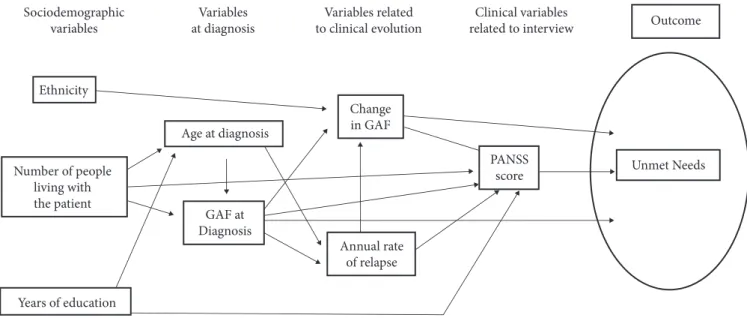
In summary, we were able to identify various variables corresponding to the socioeconomic environment, moment of diagnosis, evolution of the disorder, and clinical status at interview, which are associated with the number of unmet needs. Some of those variables are directly associated, and others are associated indirectly (through other variables). Figure 1 shows these associations in a graphic representation.
GAF: global functioning at diagnosis; PANSS: Positive and Negative Syndrome Scale.
Figure 1. Factors associated with number of unmet needs in people diagnosed with schizophrenia (n=141)
Sociodemographic variables
Ethnicity
Variables at diagnosis
Variables related to clinical evolution
Clinical variables related to interview
Unmet Needs Outcome
Years of education
Age at diagnosis
GAF at Diagnosis
Change in GAF
Annual rate of relapse
PANSS score Number of people
DISCUSSION
he present results show that the number of unmet needs is only signiicant associated with a few variables related to the evo-lution of the illness and clinical status: GAF at diagnosis, change in GAF between diagnosis and interview, and PANSS score. We found an indirect association of patients’ identiication with an ethnic minority group, and the number of people who lived with the patient, with the number of years of schooling, the age of the patient at diagnosis, and the annual rate of relapse.
hese results tend to be consistent with those reported in the majority of studies, which found that there is little association between the number of unmet needs and sociodemographic characteristics and a greater association with clinical variables.
Rosales Varo et al.4 reported that there is no association
between the total number of needs and sex, age, residential zone (urban versus rural), civil status, or if the patient lives with his or her nuclear family. here is, however, one with educational level and work situation: patients with lower level of education and those with a disability pension had a greater number of needs. he authors of that study only reported a bivariate analysis; therefore, it was not possible to identify the indirect actions of variables.
Furthermore, Ochoa et al.9,28 reported a strong association
be-tween psychopathological severity (measured by PANSS) and num-ber of total and unmet needs, which is consistent with our results.
Korkeila et al.29 similarly found a signiicant correlation
between the number of needs and level of functioning (mea-sured by GAF), as well as between the number of needs and clinical severity. hey did not ind an association with age of the patient, nor with age at diagnosis or duration of the illness. All of these results are consistent with the ones in the present study.
In this work, we chose to construct a multivariate model to identify the variables that are directly associated with the number of unmet needs in order to later generate various multiple linear regression models with intermediate variables. his enabled us to understand, with great detail, the mecha-nism through which all of the variables interact. We were able
to identify which variables and how (directly or indirectly) they are associated with unmet need, as well as the diferent moments at which the variables act (in the two or three-year period from diagnosis until the interview).
hus, we conclude that only clinical variables were directly associated with unmet needs (global functioning at diagnosis, change in GAF, and the severity of clinical symptoms at time of interview), and that the rest of the variables acted indirectly through them. Figure 1 shows a diagram of all of the associa-tions (direct and indirect) that were found.
Interestingly, we did not ind an association between receiving a greater number of psychosocial interventions and the number of unmet needs. hese results could explain why patients treated in community-based service networks, which generally ofer more psychosocial interventions, are more adherent to treatment than those treated in hospital-centered services, despite having worse social conditions and more severe psychopathology30. However, another possible
explanation is that the psychosocial interventions were not of suicient quality, due to a lack of resources or of training30.
his should be explored in future studies, since it is important to ensure the efectiveness of mental health services.
We believe that the application of this type of model, with directly – and indirectly-associated variables, is valuable for it represents the complexity of psychosocial phenomenon and allows one to better understand the processes and mecha-nisms inluencing the number of unmet needs. In the future, this model should serve as a hypothesis to be empirically tested through a longitudinal study.
Finally, we believe that the results relect the reality of what is happening with individuals who have been diagnosed with schizo-phrenia in the nation’s current health system, and they are useful to generate and implement mental health policies. Considering that this is the irst time patients’ needs have been evaluated in this way, and that mental health policy in Chile is moving towards a more community-centered model, our indings are signiicant for the continued development of mental health services in Chile.
1. Torres González F, Rosales Varo C, Moreno Küstner B, Jiménez Estévez JF. Evaluación de las necesidades de los enfermos mentales. In: Bulbena Vilarrasa A, Berrios G, Fernández de Larrinoa P, editors. Medición clínica en psiquiatría y psicología. Barcelona, Spain: Masson; 2000. p. 545-54.
2. Wing JK, Cooper JE, Sartorius N. he measurement and classiication of psychiatric symptoms. London, UK: Cambridge University Press; 1974.
3. Ochoa S, Haro JM, Autonell J, Pendàs F, Teba F, Màrquez M et al. Met and unmet needs of schizophrenia patients in a Spanish sample. Schizophr Bull. 2003;29(2):201-10.
REFERENCES
4. Rosales Varo C, Torres González F, Luna del Castillo J, Baca Baldomero E, Martínez Montes G. Evaluación de necesidades de personas con enfermedad esquizofrénica (CAN). Actas Esp Psiquiatr. 2002;30:182-8.
5. Moreno Küstner B, Jimenez Estévez JF, Godoy García JF, Torres González F. Assessment of needs for care of a schizophrenic patient simple from the Granada South Mental Health Care Area. Actas Esp Psiquiatr. 2003;31(6):325-30.
7. Kallert TW, Leisse M, Winiecki P. Needs for care of chronic schizophrenic patients in long-term community treatment. Soc Psychiatry Psychiatr Epidemiol. 2004;39(5):386-96.
8. Wiersma D. Needs of people with severe mental illness. Acta Psychiatr Scand Suppl. 2006;113(Suppl. 429):115-9.
9. Ochoa S, Usall J, Haro JM, Araya S, Autonell J, Busquets E, et al. Estudio comparativo de las necesidades de pacientes con esquizofrenia en función del género. Actas Esp Psiquiatr. 2005;29:165-71.
10. Becker T, Knapp M, Knudsen HC, Schene A, Tansella M, hornicrot G, et al. he EPSILON study of schizophrenia in ive European countries. Design and methodology for standardizing outcome measures and comparing patterns of care and service costs. Br J Psychiatry. 1999;175:514-21.
11. Meijer K, Schene A, Koeter M, Knudsen HC, Becker T, hornicrot G, et al. Needs for care of patients with schizophrenia and the consequences for their informal caregivers: results from the EPSILON multi centre study on schizophrenia. Soc Psychiatry Psychiatr Epidemiol. 2004;39(4):251-8.
12. Lasalvia A, Bonetto C, Malchiodi F, Salvi G, Parabiaghi A, Tansella M, et al. Listening to patients’ needs to improve their subjective quality of life. Psychol Med. 2005;35(11):1655-65.
13. Slade M, Leese M, Cahill S, hornicrot G, Kuipers E. Patient-rated mental health needs and quality of life improvement. Br J Psychiatry. 2005;187:256-61.
14. hornicrot G, Strathdee G, Phelan M, Holloway F, Wykes T, Dunn G, et al. Rationale and design. PRiSM Psychosis Study 1. Br J Psychiatry. 1998;173:363-70.
15. hornicrot G, Wykes T, Holloway F, Johnson S, Szmukler G. From eicacy to efectiveness in community mental health services. PRISM Psychosis Study 10. Br J Psychiatry. 1998;173:423-7.
16. Leese M, Johnson S, Slade M, Parkman S, Kelly F, Phelan M, et al. User perspective on needs and satisfaction with mental health services. PRISM Psychosis Study. Br J Psychiatry. 1998;173:409-15.
17. Arvidsson H. Met and unmet needs of severely mentally ill persons. he Psychiatric Care Reform in Sweden. Soc Psychiatry Psychiatr Epidemiol. 2003;38(7):373-9.
18. Goldman HH, Skodol AE, Lave TR. Revising axis V for DSM-IV: a review of measurement of social functioning. Am J Psychiatry. 1992;149(9):1148-56.
19. Páez D. Suceso vital, soporte social, recursos e identidades sociales como factores explicativos de la depresión y ansiedad. In: Páez D, eds. Salud Mental y Factores Psicosociales. España: Editorial Fundamentos; 1982. p. 83-127.
20. Alvarado R, Asún D, Alfaro A, Vega A, Toledo MI, Serrano F, et al. Comparación de variables psico-sociales entre un grupo con trastornos emocionales y uno control. Rev Psiquiatría. 1992;9:1141-52.
21. Alvarado R, Vera A. La Escala de Balance Afectivo y su relación con algunas variables psicosociales. Rev Psiquiatría. 1995;12:174-8.
22. Kay SR, Fiszbein A, Opler LA. he Positive and Negative Syndrome Scale (PANSS) for schizophrenia. Schizophr Bull. 1987;13:261-76.
23. Peralta Martín V, Cuesta Zorita MJ. Validation of positive and negative symptom scale (PANSS) in a sample of Spanish schizophrenic patients. Actas Luso Esp Neurol Psiquiatr Cienc Aines. 1994;22(4):171-7.
24. Slade M, Lotus L, Phelan M, hornicrot G, Wykes T. he Camberwell Assessment of Need. London: Gaskell; 1999.
25. Phelan M, Slade M, hornicrot G, Dunn G, Holloway F, Wykes T, et al. he Camberwell Assessment of Need: the validity and reliability of an instrument to assess the needs of people with severe mental illness. Br J Psychiatry. 1995;167(5):589-95.
26. Rosales Varo C, Torres González F, Luna Del Castillo J, Jiménez Estévez J, Martínez Montes G. Reliability of the Spanish version of the Camberwell Assessment of Needs (CAN). Actas Esp Psiquiatr. 2002;30(2):99-104.
27. Jiménez Estévez JF, Moreno Küstner B, Torres González F, Luna del Castillo JD, Phelan M. Evaluación de necesidades en enfermos mentales crónicos: el cuestionario de evaluación de necesidades de Camberwell. Arch Neurobiol. 1997;60(2):113-24.
28. Ochoa S, Haro JM, Usall J, Autonell J, Vicens E, Asensio F, et al. Needs and its relation to symptom dimensions in a sample of outpatients with schizophrenia. Schizophr Res. 2005;75(1):129-34.
29. Korkeila J, Heikkilä J, Hansson L, Sorgaard K, Vahlberg T, Karlsson H. Structure of needs among persons with schizophrenia. Soc Psychiatry Psychiatr Epidemiol. 2005;40:233-9.
30. Markkula N, Alvarado R, Minoletti A. Adherence to guidelines and treatment compliance in the Chilean national program for irst-episode schizophrenia. Psychiatr Serv. 2011;62(12):1463-9.