INTRODUCTION
Heat shock protein 90 (Hsp90) is an abundant and ubiquitous molecular chaperone that inter-acts dynamically with a diverse but specific group of inherently unstable substrates (client proteins), many of which are involved in signal transduc-tion (R i c h t e r and B u c h n e r, 2001; N o l l e n and M o r i m o t o , 2002). Although the molecular interaction network of the Hsp90 chaperone system is still poorly understood (Z h a o and H o u r y, 2007), Hsp90 has been proved to be a very useful folding machine required to switch these proteins on or off (R i c h t e r and B u c h n e r, 2001). By promoting the activity of numerous signaling pro-teins in many different developmental pathways, Hsp90 plays a key role in regulating multiple cellular and developmental processes, including cell cycle and transcription control, chromatin remodeling, organism development, and responses to environ-mental stresses (Yo u n g et al., 2001; Te r a s a w a et al., 2005; R u t h e r f o r d et al., 2007).
Although essential for the proper folding of its clients under physiological conditions, Hsp90 can
also participate in the refolding of other proteins under conditions of denaturing stress (N a t h a n et al., 1997; Yo u n g et al., 2001). Because of its dual role in signal transduction and stress response, Hsp90 is hypothesized to “link developmental program to environmental contingency” (R u t h e r f o r d and L i n d q u i s t , 1998). Specifically, Hsp90 during stress becomes redirected from its usual substrates to other stress-damaged proteins, thereby reducing the signaling activity of its substrates through numer-ous target pathways. Depending upon the stress intensity and the availability of free chaperones, modulation of the chaperone and target function of Hsp90 can lead to either buffering or expression of the cryptic genetic variation that is accumulated in genomes under normal environmental conditions (R u t h e r f o r d , 2003).
The role of the Hsp90 chaperone system in developmental buffering against genetic and non-genetic perturbations has recently become a topic of increased interest (R u t h e r f o r d and L i n d q u i s t , 1998; Q u e i t s c h et al., 2002; M i l t o n et al., 2003, 2006; D e b a t et al., 2006; M a n i t a š e v i ć
Linking Hsp90 function to micro-environmentaL and stocHastic
variation in fLoraL organs of IRIS PUMILA L.
BRANKA TUCIĆ1, S. MANITAŠEVIĆ2, A. VULETA1, GORDANA MATIĆ2
1Department of Evolutionary Biology , “Siniša Stanković” Institute for Biological Research, 11060 Belgrade, Serbia 2Department of Biochemistry, “Siniša Stanković” Institute for Biological Research, 11060 Belgrade, Serbia
Abstract — Hsp90 is an environmentally responsive molecular chaperone that was found to play a key role in buffering against genetic and non-genetic perturbations in the model organisms Arabidopsis and Drosophila. Here we analyzed the buffering capacity of Hsp90 against two kinds of non-genetic factors – stochastic noise and micro-environmental varia-tion of floral organ traits in naturally growing Iris pumila plants. We found no statistical associavaria-tion between the endog-enous level of Hsp90 and the floral organ radial symmetry produced by stochastic developmental noise. Conversely, floral organ plasticity in response to micro-environmental variation tended to be greater with decrease in Hsp90b isoform expression.
Key words: Hsp90, Iris pumila, environmental variation, floral organs, plasticity, radial asymmetry, stochastic noise
UDC 582.572.7:575.2:577.1
et al., 2007; S a n g s t e r et al., 2007). However, there is still no full concensus about what compo-nent of total phenotypic variance of a given trait (genetic, stochastic, or environmental) should be buffered in particular. Contrary to theoretical pre-dictions that genetic and non-genetic buffering should share a common mechanism(s) (Wa g n e r et al., 1997; M e i k l e j o h n and H a r t l , 2002; K l i n g e n b e r g , 2005), it has been documented in the fruit fly Drosophila that non-genetic sources of variation in the phenotype (measured as differences between the left and right sides of several bilater-ally symmetrical bristle and wing traits) were unaf-fected in outbred individuals treated with an Hsp90 inhibitor or across a series of the Hsp90 mutant heterozygotes (Hsp83/+) (M i l t o n et al., 2003). Conversely, Hsp90 did protect against the expres-sion of extreme morphogenic phenotypes specific to particular genetic backgrounds or environments, suggesting that genetic and non-genetic buffering by Hsp90 are separable (M i l t o n et al., 2003). It has been recently revealed that Hsp90 effects are remarkably specific to the most invariable and highly discrete quantitative traits, e.g., traits such as the number of scutellar (SC) and thoracic (TH) bristles in Drosophila (M i l t o n et al., 2006). For these two particular traits, Hsp90 simultaneously buffered quantitative variation specific to genetic backgrounds, as well as variation from stochastic developmental and environmental effects. Since in other, normally-variable wing and bristle traits non-genetic variation remained relatively unaffected by Hsp90, this indicates that robustness against genetic and environmental influences is not a property gov-erned by any single „canalizing“ gene, but evolves or emerges „from the topology of connections between interacting genes“, independently and specifically for each organismal trait (M i l t o n et al., 2006).
The role of Hsp90 in buffering genetic variation in morphogenetic pathways appears to be strict-ly conserved among biological kingdoms. Several recent studies have emphasized the importance of this molecular chaperone for plant development and responsiveness to environmental cues (Q u e i t s c h et al., 2002; S a n g s t e r and Q u e i t s c h , 2005; S a n g s t e r et al., 2007; M a n i t a š e v i ć et al.,
2007). Partial inhibition of the Hsp90 function in accessions and recombinant lines of Arabidopsis thaliana produced a number of morphological phe-notypes that were found to be specific to underlying genetic backgrounds (Q u e i t s c h et al., 2002). The robust health of most seedlings exhibiting strong phenotypes indicates that the level of impairment of Hsp90 required to uncover specific polymor-phisms was lower than that necessary to interfere with its „housekeeping“ functions (Q u e i t s c h et al., 2002). Phenotypic analyses of an A. thaliana
line with constitutively reduced Hsp90 expression by RNAi targeting revealed that Hsp90 reduction affects an array of quantitative life-history traits, including flowering time and total seed set, and decreases the developmental stability of repeated traits (S a n g s t e r et al., 2007). Recent reports indi-cating altered environmental sensitivity in Hsp90-reduced Arabidopsis lines (revealed by genome-wide expression analyses) have widened the functions of Hsp90 to include the „genesis and maintenance of plastic responses“ as well (S a n g s t e r et al., 2007).
The purpose of this study was to investigate the effect of the molecular chaperone Hsp90 on two sources of non-genetic variation in the same set of floral organ traits from a sample of distinct Iris pumila genotypes naturally growing in the wild. Within-flower variation, i.e., deviations from radial symmetry of identical floral organ parts, results from stochastic perturbations (developmental noise) in repeated floral organ parts as they develop within a single floral whorl of the same flower and environ-ment. Environmental variation, i.e., variation in trait expressions among different flowers within the same clonal individual, arises due to heterogeneity of the micro environments experienced by each flower of a given clone.
The main questions addressed were: (1) Is there covariation of floral organ radial asymmetry (RA) in
MATERIAL AND METHODS
The studied species
Iris pumila L. is a rhizomatous perennial herb widely distributed in the Deliblato Sands, a sandy area situated about 50 km northeast of Belgrade (44o
47’ 39” N/ 21o 20’ 00” E to 45o 13’ 10” N/ 28o 26’ 08”
E). In its natural habitats, the species forms round shaped clones, markedly polymorphic for flower color. Because the flower color distinctiveness of I. pumila clones is specified by segregation at several gene loci, each of the flower color variants com-monly found in the population can be regarded as a unique genotype (Tu c i ć et al., 1988).
Like other congeneric taxa, Irispumila has flow-ers that display a highly specialized morphology. The perianth (the outer, sterile whorls of a flower) is not differentiated into the calyx (the outermost perianth whorl) and the corolla (the inner perianth whorl). Instead, all of the perianth elements are similar in appearance (color, shape) and hence are collectively termed the tepals. The tepal whorls are radially symmetrical and united towards the base, forming a floral tube. The interior, fertile whorls of the flower
consist of the male sex organs or stamens (anthers plus filaments), which are sheltered beneath the overarching style arms (part of the female sex organ) below the stigmatic lip. In I. pumila, the upper sur-face of the falls is equipped with a beard consisting of short fine hairs. Because all of the tepals from the same whorl are essentially identical in size and shape, such flower morphology is said to be actino-morphic (meaning “ray-formed”) or regular.
Flower harvesting and measurement
In April of 2004, at the peak of blooming phase, 10 large clones differing in flower color (distinct genotypes) were randomly chosen over an exposed dune site and marked with plastic pegs. Thereafter, two or three just opened flowers (in the early male stage) were randomly harvested from each of these clones and placed individually in a 0.5-l-bottle of 70% ethanol for storage until dissection. Later, in the laboratory, each flower was cut up at the base of the perianth, and its upper parts, the falls and the stan-dards, were flattened over a transparent glass plate covered with 50% glycerol. Digital images of the floral organs were recorded using an optical
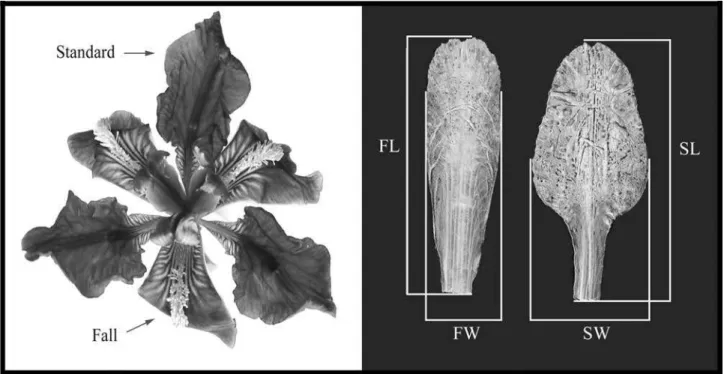
ner (HP ScanJet 3800; 600 dpi resolution). Analyses of digital images were conducted using IT software (UTHSCSA Image Tool, Version 3.0, San Antonio, Texas). The floral organ traits analyzed in this study were fall length (FL), fall width (FW), standard length (SL), and standard width (SW), all expressed in mm (Fig. 1). All measurements were performed blind with respect to clone genotype. To reduce measurement error, the size of each floral organ was taken two times from the same digital pictures by the same person (AV). Repeated measurement of the whole sample was conducted after the first mea-surement was completed.
Most floral traits are quantitative in nature, which means they are influenced by multiple gene loci with small additive effects, as well as by various sources of environmental heterogeneity, including random developmental noise (C o n n e r , 2002). Environmental heterogeneity originates from fluc-tuations in external environmental conditions, while developmental noise results from the stochastic nature of cellular processes regularly occurring even in a homogeneous environment. In this study, sensi-tivity to stochastic noise (developmental instability) was measured by radial asymmetry (RA), defined as random deviations away from radial symmetry and expressed in terms of within-flower standard devia-tion of the repeated floral organ parts. Plasticity (PL) of a floral trait was estimated as the absolute dif-ference between the means of repeated floral parts measured on different flowers from the same clone. This measure is an estimate of the effects of micro-environmental variation on floral trait expressions within a given clone, where environmental robust-ness decreases as PL increases.
leaf sample collection
Simultaneously with flower harvesting, a fully
expanded leaf from two ramets per each clone was collected and immediately frozen in liquid nitrogen. Samples were transported to the laboratory and stored at -70 ºC until preparation.
Tissue extract preparation
Tissue extracts were prepared by pulverization of frozen leaves under liquid nitrogen, followed by sonification on ice in 2 volumes (w/v) of 0.1 M Tris buffer, pH 7.6, containing 1 mM EDTA and 1 mM dithiothreitol. The samples were centrifuged at 12000 x g at 4ºC for 15 min. The supernatants were re-centrifuged and analyzed for total protein content by the method of S p e c t o r (1978) with bovine serum albumin used as a standard.
SDS-pAGE and immunoblotting
Aliquots of tissue extracts containing 40 µg of proteins were mixed with an equal volume of 2X
SDS-sample buffer, boiled for 5 min at 100ºC, and loaded onto 7.5% SDS-polyacrylamide gels (L a e m m l i , 1970). Proteins were separated by electrophore-sis at 120 V and 4ºC using a Mini-Protean II Electrophoresis Cell (Bio-Rad Laboratories, Hercules, CA). Myosin (205 kDa), β-galactosidase
(116 kDa), phosphorylase b (97 kDa), bovine serum albumin (66 kDa), and carbonic anhydrase (29 kDa) were used as molecular mass references.
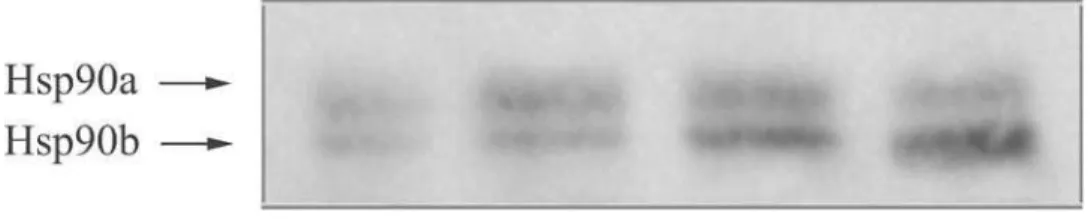
mM Na2HPO4, 2.7 mM KCl, and 0.14 M NaCl, pH 7.2,) containing 0.25% nonfat dry milk. Isoforms of Hsp90 were detected with the aid of mouse monoclo-nal antibody SPA-830 (1:2000; StressGen, Canada). Immunoreactive bands were visualized and quanti-fied by an enhanced chemifluorescence (ECF) detec-tion system using STORM Imager and ImageQuant software (Amersham Biosciences Limited, UK). In order to make quantitative comparisons between multiple immunoblots reliable, an internal refer-ence sample, the leaf extract of an I. pumila plant growing independently of the studied populations, was run on each gel. Prior to any comparison, the intensity of each analyzed immunospecific band was normalized to the intensity of the respective internal reference band on the same blot. A representative immunoblot is presented in Fig. 2.
Statistical analyses
Floral measurements from three replicate flow-ers were taken individually to assess RA and PL or were averaged together within each clone to obtain genotypic means of floral organ traits. Genotypic means for each floral organ trait and the correspond-ing means for Hsp90 levels were used to estimate the Pearson product moment correlation coefficients.
RESULTS AND DISCUSSION
Flowers of most angiosperms consist of four types of specialized organs (sepals, petals, stamens, and carpels) that are arranged in a series of concen-tric rings or whorls. Development of these organs
is under the control of several classes of regulatory genes (A, B, C, and E), each of which is expressed in spatially restricted positions within the floral meristem (We i g e l and M e y e r o w i t z , 1993; B o w m a n , 1997; K r i z e k and F l e t c h e r, 2005). Apart from class E genes (which specify identity of all organ types), sepal identity is directed by class A genes, petal identity by classes A + B, stamen by classes B + C, while carpel identity is specified by the expression of class C genes. The molecular and genetic mechanisms that control flower develop-ment are to a large extent similar between eudicots and monocots, suggesting that all angiosperms employ homologous genes to specify the iden-tity of their floral organ primordia (K r i z e k and F l e t c h e r, 2005).
The flower is a highly evolved plant structure that manifests a considerable degree of robustness to perturbations from genetic and non-genetic sources. This is visible in the relatively constant floral type within populations and the enormous pheno-typic diversity among species and higher taxa.
Table 1 summarizes the results of correlation analysis, which mirrors the strength of statistical associations among RAs of four floral organ traits (FL, FW, SL, and SW) in I. pumila. Although all of these traits share the same precursor tissue - the flo-ral meristem - and, as in other monocots, their iden-tities are specified by the combined expression of A + B class genes (see B o w m a n , 1997 for details), none of the correlation coefficients between floral
Trait RAFW (N = 28) RASL (N = 28) RASW (N = 28)
Fall length
(RAFL) 0.170 (0.388) 0.314 (0.103) 0.021 (0.917)
Fall width
(RAFW) -0.168 (0.394) 0.043 (0.830)
Standard length
(RASL) 0.123 (0.514) Table 1. Pearson correlation coeicients (P-values in parenthe-sis) between radial asymmetries (RA) of loral organ traits in
Iris pumila; N = sample size.
Trait PLFW (N = 10) PLSL (N = 10) PLSW (N = 10)
Fall length
(PLFL) 0.896 (0.0005) 0.921 (0.0002) 0.867 (0.0012)
Fall width
(PLFW) 0.758 (0.0111) 0.809 (0.0046)
Standard length
RAs was statistically significant, implying that small random perturbations of cellular processes produc-ing asymmetry of repeated floral parts exerted their effects very locally and separately.
Unlike RAs, plasticities in response to micro-environmental variation of floral traits appeared to
be strongly correlated in I. pumila, especially between two length traits: FL and SL (Table 2). Plastic corre-lations are thought to originate between traits that exhibit similar sensitivity to a given environmental factor, exert the same function, and/or have a shared genetic basis (S c h l i c h t i n g , 1989; J u e n g e r et al., 2005). These comparative plastic responses are Trait PLFL (N = 10) PLFW (N = 10) PLSL (N = 10) PLSW (N = 10)
Fall length (RAFL) 0.441 (0.202) 0.437 (0.206) 0.318 (0.370) 0.058 (0.874)
Fall width (RAFW) 0.138 (0.704) 0.205 (0.571) 0.333 (0.347) 0.310 (0.384)
Standard length (RASL) -0.181 (0.617) -0.124 (0.734) -0.351 (0.320) -0.362 (0.303)
Standard width (RASW) 0.106 (0.770) -0.111 (0.759) 0.225 (0.532) 0.294 (0.409) Table 3 Pearson correlation coeicients (P-values in parenthesis) between radial asymmetry (RA) and plasticity (PL) of loral organ traits in Iris pumila; N = sample size.
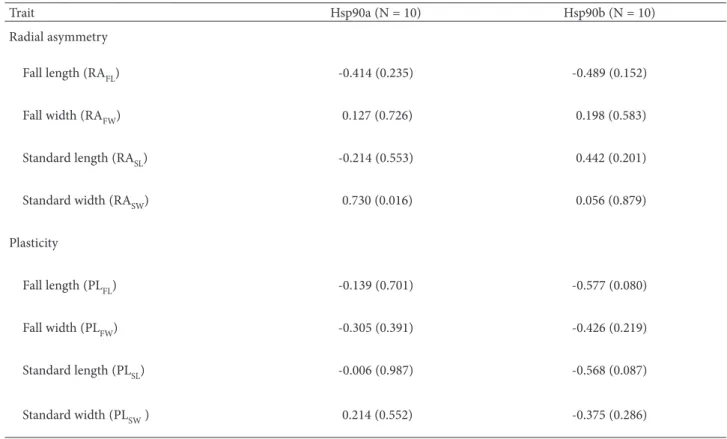
Trait Hsp90a (N = 10) Hsp90b (N = 10)
Radial asymmetry
Fall length (RAFL) -0.414 (0.235) -0.489 (0.152)
Fall width (RAFW) 0.127 (0.726) 0.198 (0.583)
Standard length (RASL) -0.214 (0.553) 0.442 (0.201)
Standard width (RASW) 0.730 (0.016) 0.056 (0.879)
Plasticity
Fall length (PLFL) -0.139 (0.701) -0.577 (0.080)
Fall width (PLFW) -0.305 (0.391) -0.426 (0.219)
Standard length (PLSL) -0.006 (0.987) -0.568 (0.087)
Standard width (PLSW ) 0.214 (0.552) -0.375 (0.286)
postulated to promote the maintenance of an inte-grated phenotype in the face of changing environ-mental conditions (S c h l i c h t i n g , 1989).
Associations between the parts of fully formed morphological structures can originate in two differ-ent ways: by direct connections between the develop-mental pathways that produce these structures, or by parallel variation of separate pathways that respond to the same extrinsic factors (K l i n g e n b e r g , 2005). In the first case, a developmental precursor can be partitioned into two or more descendant organs or tissues, or there can be inductive signal-ing from one developsignal-ing part to another. In either of these cases, perturbations that occur during the interaction or variation that has arisen in the com-mon upstream part of the pathway can be shared or passed down through the partitioning step to multiple parts simultaneously (K l i n g e n b e r g , 2005). The main feature of covariation caused by direct interaction of developmental pathways is that variation arising within the pathways themselves is the source of covariation between traits.
In contrast to covariation due to direct con-nections between the developmental pathways, the mechanism of parallel variation in independent developmental pathways is based on the action of a shared variable step, such as an allelic variation of a gene that is involved in both pathways, or an envi-ronmental factor to which both pathways respond simultaneously but separately (K l i n g e n b e r g , 2005). In this case, the factor responsible for the association between traits lies outside the individu-als.
Table 3 shows the Pearson correlation coef-ficients between RA and PL of the same floral traits in I. pumila. Since none of these coefficients approached statistical significance, it suggests that the mechanism maintaining the stability of floral organ phenotypes against stochastic noise is not the same as that buffering environmental variation.
Molecular chaperone proteins belonging to the Hsp90 family are reported to be components of a buffering mechanism against genetic and envi-ronmental perturbations in the model organisms
Arabidopsis and Drosophila (R u t h e r f o r d and L i n d q u i s t , 1998; Q u e i t s c h et al., 2002; M i l t o n et al., 2003, 2006; S a n g s t e r et al., 2007). In I. pumila, Hsp90 was found to buffer cryptic genetic variation that can be uncovered dur-ing environmental stress (M a n i t a š e v i ć et al., 2007).
In spite of significant progress achieved during the last years in elucidating the functions of Hsp90s across biological kingdoms, the relationship between processes buffering against genetic, environmental, and stochastic variation are mostly unidentified, especially in wild plants. To determine whether Hsp90 controls robustness of I. pumila flowers under physiological conditions, we contrasted natural vari-ation in the level of two Hsp90 isoforms with the strength of two kinds of non-genetic perturbations, developmental noise and micro-environmental vari-ation within a wild populvari-ation of this species. Table 4 presents the magnitude of correlations between the level of expression of Hsp90 isoforms designated Hsp90a and Hsp90b (M a n i t a š e v i ć et al., 2007), and stochastic and micro-environmental variation in four floral organ traits of I. pumila. Our study provides evidence that with the exception of a highly significant positive correlation between RASW and Hsp90a (r = 0.73; P = 0.02), Hsp90 did not affect the asymmetry of any floral trait, suggesting that it can-not be a general buffer against random perturbations in I. pumila. In contrast to RA, PL of floral organs in
et al., 2007). Previous reports on the participation of Hsp90 in standard plastic responses such as the response to light and gravitropism, together with recent genome-wide expression analyses, clearly indicate that “Hsp90's effects on plant plasticity are generalizable to many different stimuli and that Hsp90 plays a global role in the environmental responsiveness of plants” (S a n g s t e r et al., 2007).
Acknowledgments — This study was supported by the Ministry of Science of the Republic of Serbia (Grants # 143033 and 143003).
REFERENCES
Bowman, J. l. (1997). Evolutionary conservation of angiosperm flower development at the molecular and genetic levels.
J. Biosci. 22, 515-527.
Conner, J. K. (2002). Genetic mechanisms of floral trait correla-tions in a natural population. Nature420, 407-410.
Debat, V., milton, C. C., Rutherford, S., Klingenberg, C. p., and A. A. Hoffmann (2006). Hsp90 and the quantitative varia-Hsp90 and the quantitative varia-tion of wing shape in Drosophila melanogaster. Evolution 60, 2529-2538.
Juenger, T., perez-perez, J.m., Bernal, S. and J. l. micol (2005). Quantitative trait loci mapping of floral and leaf mor-phology traits in Arabidopsis thaliana: evidence for modular genetic architecture. Evol. Devel. 7, 259-271.
Klingenberg, C. p. (2005). Developmental constraints, modules, and evolvability, In: Variation: a Central Concept in Biology (Eds. B. Hallgrímsson and B. K. Hall), 219-247. Elsevier, Burlington.
Krizek, B. A., and J. C. Fletcher (2005). Molecular mechanisms of flower development: an armchair guide. Nat. Rev. Genet.
6, 688-698.
laemmli, u. K. (1970). Cleavage of structural proteins during the assembly of the head of bacteriophage T4. Nature 227, 680-685.
manitašević, S., Dunđerski, J., matić, G., and B. Tucić (2007). Seasonal variation in heat shock protein Hsp70 and Hsp90 expression in an exposed and a shaded habitat of
Iris pumila. plant Cell Env. 30, 1-11.
meiklejohn, C. D., and D. l. Hartl (2002). A single mode of canalization. Trends Ecol. Evol. 17, 468-473.
milton, C. C., Huynh, B., Batterham, p., Rutherford, S., and A. A. Hoffmann (2003). Quantitative trait symmetry inde-pendent of Hsp90 buffering: distinct modes of genetic canalization and developmental stability. proc. Natl. Acad. Sci. USA 100: 13396-13401.
milton, C. C., ulane, C. m., and S. l. Rutherford (2006). Control of
canalization and evolvability by Hsp90. plos ONE1, e75.
Nathan, D. F., Vos, m. H., and S. lindquist (1997). In vivo func-tion of the Saccharomyces cerevisiae Hsp90 chaperone.
proc. Natl. Acad. Sci. uSA94, 12949-12956.
Nollen, E. A., and R. I. morimoto (2002). Chaperoning signaling pathways: molecular chaperones as stress-sensing „heat shock“ proteins. J. Cell Sci. 115, 2809-2816.
Queitsch, C., Sangster, T. A., and S. lindquist (2002). Hsp90 as aHsp90 as a capacitor of phenotypic variation. Nature417, 618-624.
Richter, K., and J. Buchner (2001). Hsp90: Chaperoning signalHsp90: Chaperoning signal transduction. J. Cell. physiol. 188, 281-290.
Rutherford, S. l., and S. lindquist (1998). Hsp90 as a capatitor for morphological evolution. Nature396, 336-342.
Rutherford, S. l. (2003). Between genotype and phenotype: protein chaperone and evolvability. Nature Rev. Genet.
4, 263-274.
Rutherford, S., Knapp, J. R., and p. Csermely (2007). Hsp90 and developmental networks, In: molecular Aspects of the Stress Response: Chaperone, membranes, and Networks
(Eds. P. Csermely and L. Vígh), 190-197. Landes Bioscience, Austin.
Sangster, T. A., and C. Queitsch (2005). The HSP90 chaperoneThe HSP90 chaperone complex, an emerging force in plant development and phenotypic plasticity. Curr. Opin. plant Biol. 8, 86-92.
Sangster, T. A., Bahrami, A., Wilczek, A., Watanabe, E., Schellenberg, K., mslellan, C., Kelley, A., Kong, S. W., Queitsch, C., and S. lindquist (2007). Phenotypic diver-Phenotypic diver-sity and altered environmental plasticity in Arabidopsis thaliana with reduced Hsp90 levels. plos ONE7, e648.
Schlichting, C. (1989). Phenotypic integration and evolutionary change. BioScience39, 460-464.
Spector, T. (1978). Refinement of the coomassie blue method of protein quantification. Anal. Biochem.86, 142-146.
Terasawa, K., minami, m., and Y. minami (2005). Constantly updat-ed knowlupdat-edge of Hsp90. J. Biochem. (Tokyo) 137, 443-447.
Tucić, B., milojković, S., Vujčić, S., and A. Tarasjev (1988). Clonal diversity and dispersion in Iris pumila. Acta Oecol./Oecol. plant.9, 211-219.
Wagner, G. p., Booth, G., and H. Bagheri-Chaichian (1997). A popula-tion genetic theory of canalizapopula-tion. Evolution 51, 329-347.
Weigel, D., and E. m. meyerowitz (1993). Activation of floral homeotic genes in Arabidopsis. Science261, 1723-1726.
Young, J. C., moarefi, I., and F. H. Hartl (2001). Hsp90: a specialized but essential protein-folding tool. J. Cell Biol.154, 267-273.
повезаност функције Hsp90 са микро-срединским
и случајним варирањем цветних органа IRIS PUMILA L.
БРанка ТУЦИЋ1, С. МанИТаШЕВИЋ2, а. ВУЛЕТа1, и ГОРДана МаТИЋ2
1Одељење за еволуциону биологију, Институт за биолошка истраживања ”Синиша Станковић”, 11000 Београд, Србија
2Одељење за биохемију, Институт за биолошка истраживања ”Синиша Станковић”, 11000 Београд, Србија
Молекларни шаперон Hsp90 има кљн лог нетралисањ генетиких и негенетиких пореме-ћаја код модел организама Arabidopsis и Drosophila. У овом рад анализирали смо заштитни капацитет Hsp90 однос на две врсте негенетиких фактора – стохастико и микро-срединско варирање особина цвета природној поплацији Iris pumila. Утврдили