doi:10.5194/acp-12-2429-2012
© Author(s) 2012. CC Attribution 3.0 License.
Chemistry
and Physics
Measurement-based modelling of bromine-induced oxidation
of mercury above the Dead Sea
E. Tas1,2, D. Obrist3, M. Peleg1, V. Matveev1, X. Fa¨ın3, D. Asaf1,2, and M. Luria1
1The Institute of Earth Sciences, The Hebrew University, Jerusalem, Israel
2Department of Environmental Sciences and Energy, The Weizmann Institute of Science, Rehovot, Israel
3Division of Atmospheric Sciences, Desert Research Institute, 2215 Raggio Parkway, Reno, Nevada, 89512, USA
Correspondence to:E. Tas ([email protected])
Received: 13 June 2011 – Published in Atmos. Chem. Phys. Discuss.: 31 August 2011 Revised: 7 February 2012 – Accepted: 19 February 2012 – Published: 5 March 2012
Abstract. Atmospheric mercury depletion events (AMDEs) outside the polar region – driven by high levels of gaseous Br and BrO (i.e., BrOx) – were observed recently in the
warm Dead Sea boundary layer. The efficient oxidation of gaseous elemental mercury (GEM) under temperate condi-tions by BrOxwas unexpected considering that the thermal
back dissociation reaction of HgBr is about 2.5 orders of magnitude higher under Dead Sea temperatures compared to polar temperatures, and hence was expected to significantly slow down GEM oxidation under warm temperatures. The goal of this modelling study was to improve understanding of the interaction of reactive bromine and mercury during Dead Sea AMDEs using numerical simulations based on a comprehensive measurement campaign in summer 2009.
Our analysis is focused on daytime AMDE when chemical processes dominate concentration changes. Best agreements between simulations and observa-tions were achieved using rate constants for kHg+Br
and kHg+BrO of 2.7× 10⁻¹³cm3molecule−1s−1 and
1.5 ×10⁻¹³cm3molecule−1s−1, respectively. Our
model also predicted that a rate constant kHg+BrO of
5.0×10⁻¹⁴cm3molecule−1s−1 may be considered as a
minimum, which is higher than most reported values. These rate constants suggest that BrO could be a more efficient oxidant than Br in the troposphere as long as [Br]/[BrO] ratios are smaller than ∼0.2 to 0.5. Under Dead Sea conditions, these kinetics demonstrate a high efficiency and central role of BrOxfor AMDEs, with relative contributions
to GEM depletion of more than ∼90 %. Unexpectedly, BrO was found to be the dominant oxidant with relative contributions above 80 %. The strong contribution of BrO
could explain why the efficiency of GEM oxidation at the Dead Sea does not critically depend on Br and, therefore, is comparable to that in cold polar regions. In order to confirm the suggested kinetics, additional studies, particularly for temperature-dependence of rate constants, are required.
1 Introduction
Atmospheric mercury is a persistent and toxic global pollu-tant, and the major contributions of mercury loadings in re-mote locations are due to atmospheric deposition (Lu et al., 2001; Driscoll et al., 2007). Most atmospheric mercury oc-curs as gaseous elemental mercury (GEM;>95 %) – a form which is relatively inert, has a low deposition velocity, and shows global lifetime of∼1 yr (Lindberg et al., 2007). Field measurements in polar regions showed that GEM can be ox-idized rapidly to reactive forms (reactive gaseous mercury: RGM and particulate Hg: HgP)after polar sunrise, followed
BrOx=BrO + Br) as well as other reactive halogen species
(RHS) (Lu et al., 2001; Lindberg et al., 2001; Ariya et al., 2004; Brooks et al., 2006). As a result, AMDEs generally correlate with ozone depletion events (ODEs) (Bottenheim et al., 1986). It is well known that reactive halogens also can exist outside of polar regions at temperate, mid-latitude locations such as over salt lakes and in the marine bound-ary layer (MBL) (Hebestreit et al., 1999; Saiz-lopez et al., 2004). Due to the important role that BrOxplays in GEM
oxidation, several studies, including modelling, focused on interactions of BrOx with atmospheric mercury in the
po-lar region (Calvert and Lindberg, 2003; Skov et al., 2004; Hedgecock et al., 2008; Xie et al., 2008; Durnford et al., 2011; Subir et al., 2011; Stephens et al., 2012), in the MBL at mid-latitudes (Hedgecock and Pirrone, 2001, 2004; Hedge-cock et al., 2003, 2005, 2008; Holmes et al., 2006, 2009), and in urban areas (Shon et al., 2005). Holmes et al. (2006) cal-culated a global chemical lifetime of atmospheric mercury of 0.5–1.7 yr against oxidation by Br, implying that Br is a significant oxidant of GEM on a global scale, and Holmes et al. (2009) found that oxidation of GEM by Br accounts for 35–60 % of the MBL RGM source.
There are still significant uncertainties in regard to the re-action of BrOxwith Hg (see Ariya et al., 2008; Calvert and
Lindberg, 2004; and Xie et al., 2008). Reaction rates of Br and BrO with GEM are not well defined; it is not clear which is the dominant oxidant; and chemical pathways and prod-ucts of RGM formation are unclear. Additional uncertainties exist regarding the role of other halogens such as I and IO (Raofie et al., 2008), ClOx(Stephens et al., 2012), O3 and
OH (Xie et al., 2008 and references within), and temperature-dependence of rate constants (Ariya et al. 2008; Xie et al., 2008).
Recently, it was observed that strong AMDEs are not lim-ited to the polar region but also occur in the mid-latitudes under temperate conditions: near-complete (up to ∼90 %) conversion of GEM to RGM was observed in the Dead Sea atmosphere under temperatures of 40◦
C and over (Peleg et al., 2007; Obrist et al., 2011). These pronounced Dead Sea AMDEs, which strongly correlated with high BrOx, were
unexpected given that the dissociation of HgBr (formed by GEM oxidation by Br), a rate limiting step in GEM oxidation by Br, is considered strongly temperature dependent (Good-site, 2004).
The objective of our study was to improve understanding of the BrOx-Hg interaction at the Dead Sea by combining
results from a comprehensive measurement campaign with detailed modelling analysis. Due to the elevated [Br−
] and [Br−
]/[Cl−
] ratio of the seawater (Niemi et al., 1997), low pH (<6; Tas et al., 2005), and moderate anthropogenic pol-lution (Tas et al., 2005), extremely high levels of BrOxare
formed almost daily at the Dead Sea (e.g., Tas et al., 2006). Due to regularly high BrOxlevels, the Dead Sea provides
ex-cellent conditions for studying the interaction of BrOxwith
atmospheric mercury at mid-latitudes. We used the MECCA
box model (Sander et al., 2005) heterogeneous mechanism, focusing on identifying reaction rates of BrO and Br with GEM, the relative importance of BrOx and other oxidants,
and oxidation sensitivity to temperature.
2 Experimental
2.1 Field measurements
Model simulations are based on a comprehensive measure-ment campaign that took place at Ein Bokek, Israel (lat-itude 31.20◦N, longitude 35.37◦E) on the shore of the Dead Sea, between 29 June and 28 July 2009. Measure-ments are described in detail in Obrist et al. (2011), and additional details on methodology are found in Matveev et al. (2001) and Tas et al. (2005). In summary, measurements included speciated atmospheric mercury (GEM, RGM, and HgP) using Tekran Model 2537, Model 1130, and Model
1135 analyzers (Tekran Inc.; Toronto, Canada), O3 (TEII,
Model 49C), NO-NOx(TEII, Model 42i), SO2(TEII, Model
43C), CO (TEII, Model 48i), and particulate sulfates (TEII, Model 5020i, all Thermo Environment Instrument Incorpo-rated, Waltham, MA, USA). Meteorological conditions in-cluding wind speed and direction, temperature, relative hu-midity (RH), barometric pressure, and solar radiation were measured using meteorological instruments (Met-One In-struments Inc. Grants Pass, Oregon, USA). Long-path dif-ferential optical absorption spectroscopy (LP-DOAS) tech-nique (Model HMT DOAS Measuring System; Hoffmann Messtechnik, Rauensberg, Germany) was used to quantify BrO (detection limit as low as 3 pmol mol−1), O
3
(detec-tion limit generally<7.3 nmol mol−1), and NO
2 (detection
limit generally <0.5 nmol mol−1). The LP-DOAS system
was placed in the top floor of an air-conditioned hotel room (18 m above water level and the same location as above in-struments), and the DOAS reflector mirror was situated at the eastern side of an evaporation pond directly above the water surface, resulting in an 11.8 km light path traveling over the Dead Sea water. Details of the DOAS system and signal re-trieval are described in Stutz and Platt (1996) and Peleg et al. (2007).
2.2 Model description
The model used in this analysis is the comprehensive hetero-geneous MECCA box model (Sander et al., 2005). MECCA includes an explicit kinetic heterogeneous chemical mecha-nism, accounting for gas and aqueous phase reactions and heterogeneous reactions for two aerosol modes. In the gas phase, species are subjected to photochemical decomposition and dry deposition; aerosol processes include both scaveng-ing and new particle formation. Gas-aerosol partitionscaveng-ing is performed based on Henry’s law and kinetic limitations for coarse soluble and accumulation soluble aerosol modes. The O-H-C-N-S-Cl-Br-I chemical mechanism includes 186 gas
Table 1. Photochemical and meteorological ambient conditions. Several measured chemical and meteorological average (avr.), maximal (max.) and minimal (min.) values that were obtained during daytime (06:00–20:00 LT) are presented for Julian days 188 and 201.
Parameter Julian day 188 (avr./max./min.) Julian day 201 (avr./max./min.)
NO2(nmol mol−1) 1.2/4.2/0.1 1.8/6.7/0.3
O3(nmol mol−1) 37.2/69.4/<7.5∗ 50.9/61.0/33.0
Wind speed (m s−1) 2.3/12.0/0.7 4.9/10.9/0.9
Relative humidity (%) 31.8/42.1/29.1 28.7/39.4/25.2
Temperature (K) 310.9/313.1/302.7 313.5/316.2/304.8
Pressure (pascal) 104 924/105 058/104 658 104 764/105 058/104 525
∗
O3concentrations dropped below the instrument detection limit which was equal or lower than 7.5 nmol mol−1.
phase reactions capturing 58 photolysis reactions, 266 aque-ous reactions, and 154 heterogeneaque-ous reactions based on the default MECCA mechanism (http://www.mpch-mainz.mpg. de/∼sander/messy/mecca/). The mercury chemical mecha-nism was added to the model for gas phase (Supplement Table S1), aqueous (Supplement Table S2), aqueous equi-librium (Supplement Table S3), and heterogeneous reac-tions (Supplement Table S4) involving sea salt and sulphate aerosols. Photolysis rate coefficients are calculated using the method described in Landgraf and Crutzen (1998) and were updated at each time step (1 min) representing real time and location of the measurement site.
The initial sea salt aerosol composition was based on the Dead Sea water composition accounting for Br− and Cl− concentrations, as reported by Tas et al. (2005). In MECCA, the averaged mass transfer coefficient for each aerosol mode is based on integration over a lognormal shape distribution of the particle radius for each aerosol mode (Kerkweg et al., 2007). Dependence of average sea salt aerosol number con-centrations on in situ measured wind speeds was taken into account using Eq. 4 in Gong et al. (1997) on five-minute time resolution. Average sulphate aerosol number concentrations were determined based on in situ measurements (Sect. 2.1) using reported densities (Karg et al., 1995) and radius depen-dency on RH (Yue, 1979) and were updated in the model on time resolution of 5 min.
2.3 Model simulations
Initial model runs showed that reactive bromine production via aerosols is limited to RH higher than 28 %. Therefore, aerosol chemistry in our simulations was activated only for RH above 28 %. Smoydzin and von Glasow (2009) found that due to low pH, direct release from the seawater is likely an additional source for BrOx at the Dead Sea. A BrOx
source representing direct Br2release from the seawater via
the bromine explosion mechanism (Vogt et al., 1996) was parameterized in the model with a first order rate constant of 1.0×10⁻³s−1, as described in Obrist et al. (2011).
Simulation days showed dominant daytime local wind di-rection from the east and south (i.e., directly from the Dead
Sea) so that no significant sources from land were expected during mid-day AMDEs where we focused our investigation; however, during nighttime, morning, and evening advection and possibly other sources occur as explained below. Simu-lations were updated on a 5-min. time resolution using the following real-time measured parameters: temperature, RH, wind speeds, and mixing ratios for NO, NO2, SO2, and 13
different hydrocarbon species (based on HC measurements; see Tas et al., 2006). Table 1 presents typical measured val-ues of chemical and meteorological parameters used during our simulations. Boundary layer height was determined us-ing a 1-D meteorological model (McNider and Pielke, 1981) and was continuously updated. Photolysis rate coefficients were calculated by the MECCA model, representing clear sky conditions for the Dead Sea. Using the above in the model enabled to obtain relatively good agreements with measurements for O3and BrO diurnal profiles (Sect. 3.1).
Our analysis is focused on daytime-AMDEs, during which GEM concentrations are mainly controlled by chemical pro-cesses, rather than other source or sink processes (such as advection or emission) which could not be well described by the used box model. Our measurements indicate that once AMDE/ODEs are terminated, both GEM and O3are quickly
advected back as indicated by sharp decrease in BrO and sharp rebounds of O3 and GEM to background levels. To
account for this, O3and GEM fluxes were added for 30 min
at the end of AMDE/ODEs to simulate these rebounds. For Julian day (JD) 197, GEM fluxes were added instead be-tween 07:30–08:00, and during JD=188 fluxes were also added between 07:30 and 13:30 (see Sect. 3.2). It is impor-tant to note that no fluxes were added during the simulation of AMDEs which is the main focus of our study. Hence, our model simulations focused on the chemical and kinetic pro-cesses during AMDEs, as opposed to propro-cesses such as ad-vection, surface emissions, or pollution inputs – all of which affect Hg and O3 concentrations during non-AMDEs
peri-ods.
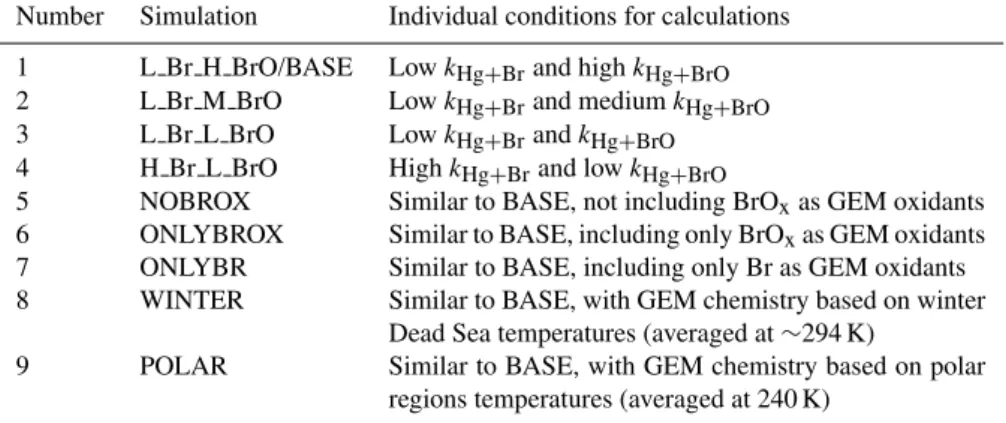
Table 2. Key to different simulation types. Simulations 1–4 were performed for four different days from the measurement campaign
(Julian days 188, 197 and 201) using different combinations for the rate of Hg with Br and BrO: low and highkHg+Br (=2.7×10⁻¹³
and 1.1×10⁻¹²×(T /298)−2.37cm3molecule−1s−1)for “L Br” and “H Br”, respectively, based on Donohoue et al. (2006) and Goodsite
et al. (2004); kHg+BrO=1×10⁻¹⁵ and 5×10⁻¹⁴cm3molecule−1s−1 for “L BrO” and “M BrO,” respectively, based on Raofie and
Ariya (2003); andkHg+BrO=1.5×10⁻¹³cm3molecule−1s−1for “H BrO”. “L Br H BrO”, is referred to as “BASE” simulation due to
best agreement with measurements. Simulations 5–10 were performed for Julian days 188 and 201 which represent typical days of relatively high Dead Sea BrO levels (see additional details in Sect. 3.1).
Number Simulation Individual conditions for calculations
1 L Br H BrO/BASE LowkHg+Brand highkHg+BrO
2 L Br M BrO LowkHg+Brand mediumkHg+BrO
3 L Br L BrO LowkHg+BrandkHg+BrO
4 H Br L BrO HighkHg+Brand lowkHg+BrO
5 NOBROX Similar to BASE, not including BrOxas GEM oxidants
6 ONLYBROX Similar to BASE, including only BrOxas GEM oxidants
7 ONLYBR Similar to BASE, including only Br as GEM oxidants
8 WINTER Similar to BASE, with GEM chemistry based on winter
Dead Sea temperatures (averaged at∼294 K)
9 POLAR Similar to BASE, with GEM chemistry based on polar
regions temperatures (averaged at 240 K)
Table 2). Based on a literature review and sensitivity analysis (Sect. 3.2), simulations were based on low and high values for kHg+Br, with values of 2.7×10⁻¹³cm3molecule−1s−1
and 1.1×10⁻¹²×(T /298)−2.37cm3molecule−1s−1(termed
“L Br” and “H Br”, respectively). For kHg+BrO, we used
values of 1×10⁻¹⁵ and 5×10⁻¹⁴cm3molecule−1s−1
(termed “L BrO” and “M BrO”) plus a value of 1.5 × 10⁻¹³cm3molecule−1s−1 (termed “H BrO”).
“L Br H BrO” led to best agreement with measurements and is termed “BASE” simulation, although it useskHg+BrO
which is higher than the upper limit of previously reported theoretical and laboratory studies.
Additional detailed simulations were performed for Ju-lian days 188 and 201 (Table 2). Simulation “NOBROX” is identical to the “BASE” simulation, except that all di-rect reactions of Hg with BrOx were switched off.
Simu-lations “ONLYBROX” and “ONLYBR” are identical to the “BASE” simulation except that they include only BrOxand
Br as GEM oxidants, respectively. All above simulations used real-time in situ measured summer Dead Sea tempera-tures (which averaged∼310 K during the summer). In addi-tion, “WINTER” and “POLAR” simulations are identical to the “BASE” simulation, except that typical winter Dead Sea temperatures (294 K) and polar temperatures (240 K) were used instead of real-time summer temperatures.
3 Results and discussion
3.1 Model verification
The primary, non-halogen, gas-phase oxidants of GEM con-sidered in the urban and lower troposphere boundary layer are O3, H2O2, and OH (Hedgecock et al., 2005; Holmes et
al., 2009; Sillman et al., 2007; Spivakovsky et al., 2000). In the marine boundary layer and upper troposphere, halo-gens are presumed to be the dominant oxidants (Lin et al., 2006). Atomic bromine is a major global sink for GEM, es-pecially in the middle and upper troposphere where relatively cold temperatures suppress thermal back-decomposition of the HgBr intermediate (Holmes et al., 2006; Lin et al., 2006). During AMDEs in the polar regions, RHS, particularly BrOx,
dominate the rate of GEM depletion (e.g., Xie et al., 2008). At the Dead Sea, AMDEs are strongly linked to BrOxlevels
as well (Obrist et al., 2011), primarily due to the very high concentrations of reactive bromine species compared to reac-tive chlorine species which are not expected to play a signif-icant role at the Dead Sea (Tas et al., 2006). In addition, io-dine concentrations are generally low when bromine species are active (Zingler and Platt, 2005). Still, our model was con-figured to include a detailed account of multiphase chemical reactions involving all halogens (reactive bromine, chlorine, and iodine; based on the actual Dead Sea water composition Sect. 2.2) plus non-halogen oxidants.
Figure 1 shows good agreements between simulated and measured O3 concentrations during AMDEs for JD=188
and 201, the two main days used for analysis. Model eval-uation also showed good agreement of BrO concentrations (Figs. 2, 3 and Supplement Fig. S1), particularly during the occurrence of mid-day AMDEs. We focused further de-tailed analyses on comparing results for JDs 188 and 201 as they are characterized by inherently different BrOxlevels
and associated [Br]/[BrO] ratios, with maximum BrO levels of∼90 pmol mol−1(JD 188) – as frequently observed over
the Dead Sea – and levels of∼30 pmol mol−1(JD 201), as
typically observed in the polar boundary layer.
28
Fig. 1.Simulated and LP-DOAS measured O3mixing ratios.
Com-parisons are shown for Julian days 201 (panela) and 188 (panelb).
3.2 Reaction rates of GEM with Br and BrO
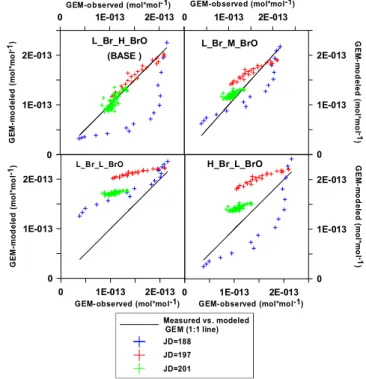
We performed sensitivity analyses to calibrate the model with respect to reaction rates of Br and BrO with GEM (Figs. 2–4 and Supplement Fig. S1). Note that for JD=188, GEM depletions occurred too early and were too intense for most combinations of rate constants (Fig. 2b), except in one case (L Br L BrO) when GEM depletion could not be simu-lated to its full extent. We chose to constrain GEM concen-trations between 07:30 and 13:30 LT (i.e., prior to the onset of the AMDE; Fig. 2c); the reason for the elevated measured GEM levels is unknown but is likely due to entrainment of GEM from other areas or from other sources that are not ac-counted in our chemical box model. Figure 4 shows scatter plots of measured GEM concentrations (x-axis) with corre-spondingly simulated concentrations (y-axis) during mid-day AMDEs for all combinations of reaction rates for the three days of simulations, and Table 3 shows corresponding sum-mary statistics. GEM depletions were best reproduced when employing “BASE” (“LBr HBrO”) and L Br M BrO simu-lations. Values ofkHg+BrO smaller than used in these two
cases yielded fair agreement only for the day with high BrO levels and a high [Br]/[BrO] ratio (i.e., JD 188), and strongly underestimated GEM depletion for the days with lower BrO levels (i.e., JD 197 and 201). Figure 4 emphasizes that the
29
!
"
#"
$" $ $" $" $ $" %$" $ $" $" $%$" " " " #" & ' ( "
)
*
"
) ) ) )
*
$" $%$"
$" $ $" $" $ $" %$" $ $" '
Fig. 2.Simulated and measured diurnal profiles of GEM and BrO.
(a)Measured and simulated diurnal profiles of BrO, and simulated
diurnal profile of [Br]/[BrO] for Julian day 188. (b)GEM diurnal
profiles for different combinations ofkGEM+BrOandkGEM+Br
val-ues.(c)Same as(b)with simulated GEM mixing ratios being
con-strained between 07:30 and 13:30 LT. Note that constrains of fluxes were not added during AMDEs which was the main emphasis of our analyses.
“BASE” simulation (i.e., L Br H BrO) achieves best agree-ment under moderate BrO concentrations (i.e., JD=197 and 201; BrO<∼45 pmol mol−1), while L Br M BrO
ap-pears to achieve better results on JD 188 with very high BrOx(BrO>80 pmol mol−1). High BrO levels on JD 188
cause correspondingly low O3 and high [Br]/[BrO] ratios,
while [Br]/[BrO] ratios for JDs 197 and 201 are lower. On these days, using kHg+BrO values smaller than M BrO
greatly underestimates GEM depletions. This suggests that
kHg+BrOshould be at least as high as in L Br M BrO (i.e.,
5×10⁻¹⁴cm3molecule−1s−1) and could be as high as in
“BASE” simulation (i.e., 1.5×10⁻¹³cm3molecule−1s−1,
see below).
We attribute overestimation of GEM depletion on JD 188 to under-estimation of simulated O3during that AMDE
31 )
) ) )
*
"
!
"
#"
$" $ $" %$" $ $" " " " #" & ' (
"
$" $ $" %$" $ $" $" $%$"
Fig. 3.Simulated and measured diurnal profiles of GEM and BrO.
(a)Measured and simulated diurnal profiles of BrO and simulated
diurnal profile of [Br]/[BrO] for Julian day 201.(b)Different
com-binations of values forkGEM+BrOandkGEM+Brwere used to
eval-uate the simulated GEM diurnal profiles.
depletion of GEM by Br at the expense of BrO. The good fit of GEM depletion for the “BASE” simulation on days 197 and 201 – two days with quite different [Br]/[BrO] ratios – suggest that the rate constants used by “BASE” fit observations quite well. We suggest that a value of 2.7×10⁻¹³cm3molecule−1s−1 for k
Hg+Br and a lower
and upper limit of 5×10⁻¹⁴cm3molecule−1s−1and 1.5×
10−13cm3molecule−1s−1 for k
GEM+BrO seem reasonable
rate coefficients to reproduce observed AMDEs at the Dead Sea. It should be emphasized that improved knowledge of kintetics, particularly temperature-dependence of rate con-stants (Ariya et al., 2008; Xie et al., 2008) are needed to confirm the above suggested rate constants.
Previous studies (Goodsite et al., 2004; Ariya et al., 2002; Calvert and Lindberg, 2004; Peleg et al., 2007) indicated that GEM oxidation by Br predominates over oxidation by BrO, since theoretical kinetic calculations suggest that the reac-tion of BrO with Hg is endoergic and, therefore, unlikely to occur in the atmosphere (Tossell et al., 2003; Holmes et al., 2006; Shepler et al., 2007). Experimental studies, however, found conflicting data on the energetics of the species existing in the vapor over heated HgO(s) (Tossell
et al., 2006), suggesting that oxidation of GEM by BrO may be significant. Stephens et al. (2012) found that while Br had the greatest overall contributions to GEM deple-tion in the Arctic, BrO on some occasions nearly matched the importance of Br. Overall, a wide range of reaction rates have been published during the last decade, suggest-ing that GEM oxidation by Br ranges between a high value
32
* +
*
",
* +
*
+
* - (
.&/
.&/ 01
.&/
$" $ $"
* +
*
$" $ $"
* +
*
%$" $ $" $" $%$"
Fig. 4. Comparison between measured (x-axis) and simulated (y-axis) GEM mixing ratios during midday AMDEs.
Table 3. Correlation and average error during AMDEs as an in-dicator for simulated GEM agreement with measured GEM during AMDEs.
Julian L Br H BrO L Br M BrO L Br L BrO H Br L BrO
day (BASE)
188 0.79/33.83 0.80/46.86 0.66/68.25 0.80/55.40
197 0.90/25.27 0.94/6.36 0.85/53.60 0.85/37.56
201 0.75/27.33 0.76/8.52 0.75/68.73 0.76/34.30
of 1×10⁻¹³−3×10⁻¹²cm3molecule−1s−1 (see Ariya et
al., 2008 and references within) and lower oxidation rates by BrO of 10−13–10−15cm3molecule−1s−1(Raofie and Ariya,
2003; Spicer et al., 2002). Recently, Xie et al. (2008) showed that model simulations could best reproduce observed corre-lations between GEM and O3for rate constants of GEM
ox-idation by Br and BrO on the magnitude of 3×10⁻¹³ and ≤1.0×10⁻¹⁵cm3molecule−1s−1, respectively, which are
different than values proposed in our study (see above). One reason for the discrepancy between theirs and our rate con-stants may be that they used correlations between GEM and O3to assess GEM and O3depletion rates by BrOx.
Correla-tions between O3and GEM, however, are subject to absolute
O3, GEM, and BrOxlevels (e.g., Fig. 5). In our study, GEM
depletion rates were not based on correlations to O3but on
ratios of [Br]/[BrO] to assess relative influences of BrO and Br on GEM depletion rates.
0 40 80 120 160 200 GE M (f mo l* m o l -1) 0 10 20 30 40 _ _ 0 5 10 15 20 25 ( fmo l* mo l-1 /p m o l* m o l-1 ) 0 40 80 120 ( fmo l* mo l-1 /p m o l* m o l-1 ) 0 10 20 30 40 ( fm ol *m ol -1 /p m o l* m o l-1 )
-ΔΔGEMBrO
GEM
10-20 20-30 30-40 40-50 50-60 O3 (nmol*mol-1)
0-10
1.25 0.57 0.29 0.48 0.16 0.09 0.05
-Δ GE M Δ Br O -Δ GE M Δ Br O -Δ GE M Δ Br O -Δ GE M Δ Br O 60-65 [Br]/[BrO] a b c d BASE Measured L_Br_L_BrO H_Br_L_BrO (f m o l*mo l-1 /pmol*mol -1 )
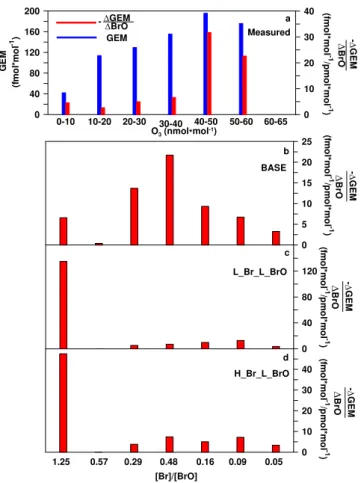
Fig. 5.Relative importance of Br and BrO to GEM-oxidation based
on underlying LP-DOAS O3mixing ratios.(a)Measured GEM
de-pletion per unit BrO (i.e.,1GEM/1BrO) is presented as a function
of O3.1GEM/1BrO was calculated for all campaign days and
av-eraged for respective O3values. (b–d)Simulated1GEM/1BrO
as a function of [Br]/[BrO] for simulations L Br H BrO (i.e.,
“BASE”;b), L Br L BrO(c), and H Br L BrO(d). Measured O3
are expected to correspond to [Br]/[BrO] ratios in simulations due
to known correlations between the two. Simulated1GEM/1BrO
values were calculated only for periods of1BrO>0 based on
Ju-lian days 188, 197, and 201.
Figure 5a shows relationships between measured GEM, BrO, and O3. We graphed GEM depletion per unit change
in BrO (i.e., 1GEM/1BrO) as a function of respective O3concentrations, and only daytime values and data when
1BrO>0 were used. Clearly,1GEM/1BrO increases with higher O3 levels. Ratios of [Br]/[BrO], however, are
ex-pected to anti-correlate with O3 (e.g., Wayne et al., 1995;
Tas et al., 2008); therefore we expect that oxidation of GEM by BrO will increase at the expense of oxidation by Br for high O3 levels (Xie et al., 2008). Figure 5a implies that
GEM oxidation by BrO predominates over oxidation by Br, in agreement with model results in Fig. 6. We rule out that these patterns are caused by correspondingly different GEM concentrations (blue bars in Fig. 5a) as these did not well correlate with1GEM/1BrO.
Figure 5b–d shows simulated 1GEM/1BrO for Julian days 188, 201, and 197. In these graphs,1GEM/1BrO is graphed as a function of [Br]/[BrO] (which is based on, and hence analogous to, O3levels in panel a). Our results
indi-cate that modeled1GEM/1BrO versus [Br]/[BrO] is sim-ilar to observed patterns only for the “BASE” simulation (Fig. 5b). Even for this case, however, 1GEM/1BrO ra-tios tend to peak at somewhat lower O3, which may
sug-gest that the ratio of rate constants for BrO and Br (e.g.,
kGEM+BrO/kGEM+Br) still may be underestimated for the
“BASE” simulation. For simulations “H Br L BrO” and “L Br L BrO”, 1GEM/1BrO was greatly overestimated for O3 levels below 10 nmol mol−1, which is expected if
kGEM+BrO/kGEM+Br is underestimated. This result further
suggests that the rate constant for L BrO is too low to ac-curately represent observed results. Possibly, a decrease in efficiency of GEM depletion by BrO at O3levels above∼30–
40 nmol mol−1as observed in the “BASE” simulation may
be due to the importance of O3for GEM oxidation at high
O3levels.
3.3 Relative contributions of oxidants to GEM depletions
Figure 6 shows relative contributions of various oxidants to GEM depletion rates and associated GEM lifetimes for Ju-lian days 188 and 201 using the “BASE” simulation. This figure demonstrates that BrOx contributed more than 90 %
and 85 %, respectively, to GEM depletion on a 24-h basis. Most of the GEM oxidation (>80 %) was caused by BrO, es-pecially under lower BrOxlevels associated with higher O3
levels and hence low [Br]/[BrO] ratios. The associated diur-nal average GEM lifetime against oxidation by BrO for Ju-lian day 188 is 41.2 min, equivalent to a lifetime of 6.86 min for the daily peak BrO level of 90 pmol mol−1. Under lower
BrOxconcentrations, the relative contributions of Br and Br2
are comparable due to relatively lower [Br]/[BrO] ratios. The integrated sum contribution of NO3, O3, and OH was
be-tween∼4 and 8 % on a 24-h basis for these simulation days. The similarity in rate constants of the reactions of Br and BrO with GEM, using the rate constants of the “BASE” sim-ulation, suggests that the role of BrO in GEM oxidation may dominate over Br as long as [Br]/[BrO] remains below∼0.2– 0.5, which is expected for O3>4–5 nmol mol−1 (Fig. 5).
35 0
1 )
1
1 1
0
)
0
6
6 0
6
6 1
6
6 )
6 6 6 6
7
"
" % 8 % 8
*
9
" : %8 8 ;
0 1 )
) 1
1 )
) 1
)
)
6
6 0
6
6 1
6
6 )
6 6 6
7
"
" " : % 8 % 8 %8 8 ;
*
9
Fig. 6. Relative contributions of various oxidants to GEM depletion. Relative contributions (in %) of different species to GEM oxidation
and associated GEM lifetimes for Julian days 201(a)and 188(b), based on “BASE” simulation. Maximum mixing ratios of 20 pmol mol−1
were used for NO3.
36
)
*
<;: =
> ,=
*
", : "= ?
: @"=
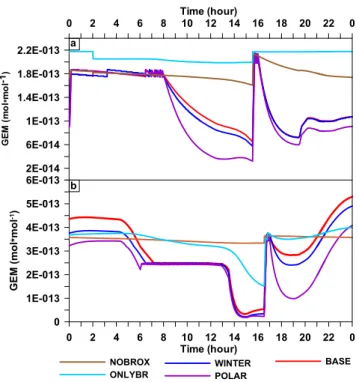
Fig. 7.Influence of BrOxand temperature on GEM depletion. The GEM diurnal profiles are shown for the “BASE”, “WINTER”, “PO-LAR”, “NOBROX”, and “ONLYBR” simulations for Julian days
188(a)and 201(b).
3.4 Temperature effects
Temperature can significantly influence the efficiency of GEM oxidation by BrOxin the gaseous and aqueous phases.
Temperature-dependencies for many mercury reactions are unknown, but the thermal back-dissociation of HgBr is ex-pected to significantly slow down GEM oxidation in the gas phase (Goodsite et al., 2004). Using the rate coefficient given by Goodsite et al. (2004) for the back dissociation rate of HgBr, the thermal back-dissociation of HgBr is∼2.6 orders of magnitude higher under the average Dead Sea summer temperature measured during the campaign (∼310 K) com-pared to typical temperatures in the polar regions (240 K). Hence, if Br plays a major role in GEM oxidation one should expect significantly slower oxidation of GEM by BrOxat the
Dead Sea compared with the polar regions.
Figure 7 presents the GEM diurnal profile obtained for “BASE”, “WINTER”, and “POLAR” simulations in order to investigate temperature effects on GEM oxidation. Only direct effects of temperature on the Hg-involved chemical reactions were investigated, while indirect effects of tem-perature – for instance, on the release of BrOx into the
gas phase (Sander et al., 2006) – were ignored here. Fig-ure 7b demonstrates that under relatively moderate BrO lev-els (∼40–50 pmol mol−1; JD 201), oxidation of GEM
un-der typical polar temperatures was more efficient than for the Dead Sea summer by 69.9 % on average, and by 10.1 % between typical Dead Sea winter and summer temperatures. Figure 7a shows that temperature effects were lower under high BrOxlevels (JD 188), where differences in GEM
deple-tions averaged 19.7 % between Dead Sea summer and polar
temperatures and 10.9 % between typical Dead Sea winter and summer temperatures. We attribute these differences to the fact that GEM depletion becomes highly limited by low GEM concentrations in the presence of high BrOx
concen-trations.
Obrist et al. (2011) showed that RGM formation by BrOx
at the Dead Sea occurred even at low BrO concentrations between∼4 and 6 pmol mol−1(and possibly below because
lower BrO could not be measured due to the DOAS detection limits), suggesting that BrOxhas important implications for
GEM depletions above oceans in the mid-latitudes and trop-ics. The present analysis indicates that GEM depletions in such areas may not be subject to strong temperature depen-dencies; at low BrOxlevels (e.g., BrO<∼6.5 pmol mol−1,
Saiz Lopez et al., 2004), [Br]/[BrO] ratios are expected to be significantly lower than∼0.2–0.5 (e.g., Fig. 5; Wayne et al., 1995), and thus BrO may be a dominant GEM oxidant if our proposed rate constants are confirmed for these areas.
4 Summary and conclusions
This study demonstrates that best agreement between model simulations and observed AMDEs at the Dead Sea was ob-tained by using kHg+Br and kHg+BrO of 2.7×10⁻¹³ and
1.5×10⁻¹³cm3molecule−1s−1, respectively (“BASE”
ki-netics). A valuekHg+BrOof 5.0×10⁻¹⁴cm3molecule−1s−1
is suggested as a minimum value. The “BASE” kinetics sug-gests a high efficiency and central role of BrOx with
day-time relative contribution of more than∼90 % for AMDEs at the Dead Sea, with BrO being the dominant oxidant with relative contributions above∼80 %. Using the “BASE” ki-netics, BrO was found to be the dominant GEM oxidant for [Br]/[BrO] ratios below∼0.2–0.5, which is usually the case in the troposphere. It should be emphasized that these rate constants are based on best agreements of observations and model results during AMDEs under Dead Sea conditions, and kinetic studies are necessary in order to confirm these suggested rate constants. High contributions of BrO to GEM oxidation suggests a low temperature dependency of GEM oxidation by BrOx, indicating that BrOx-induced GEM
de-pletion can be important outside of the polar region even un-der relatively low BrOxlevels.
Supplementary material related to this article is available online at:
http://www.atmos-chem-phys.net/12/2429/2012/ acp-12-2429-2012-supplement.pdf.
Acknowledgements. We thank R. Sander for use of the MECCA model; the Dead Sea Works for site logistics; J. Zingler, J. Lenvant, and U. Corsmeier for meteorological data; Roger Kreidberg for editorial support to this manuscript; and reviewers and editors for suggestions that greatly improved this manuscript. The study was funded by the US National Science Foundation (no. 0813690 to
D. O. and M. L.) and has benefited from an US Environmental Protection Agency Star-to-Achieve grant (R833378).
Edited by: J. W. Bottenheim
References
Ariya, P., Dastoor, A., Amyot, M., Schroeder, W.H., Barrie, L., Anlauf, K., Raofie, F., Ryzhkov, A., Davignon, D., Lalonde, J., Steffen, A.: The Arctic: A sink for mercury, Tellus, 56B, 397-403, 2004.
Ariya, P. A., Khalizov, A., and Gidas, A.: Reaction of gaseous mercury with atomic and molecular halogens: Kinetics, product studies, and atmospheric implications, J. Phys. Chem. A, 106, 7310–7320, 2002.
Ariya, P. A., Skov, H., Grage, M. M. L., and Goodsite, M. E.: Gaseous elemental mercury in the ambient atmosphere: Review of the application of theoretical calculations Calculated and ex-perimental studies for determination of reaction coefficients and mechanisms with halogens and other reactants, Adv. Quantum. Chem., 55, 43–55, 2008.
Aspmo, K., Gauchard, P.-A., Steffen, A., Temme, C., Berg, T., Bahlmann, E., Banic, C., Dommergue, A., Ebinghaus, R., Fer-rari, C., Pirrone, N., Sprovieri, F., and Wibetoe, G.: Measure-ments of atmospheric mercury species during an international
study of mercury depletion events at Ny- ˚Alesund, Svalbard,
spring 2003. How reproducible are our present methods? Atmos. Environ., 39, 7607–7619, 2005.
Berg, T., Sekkesæter, S., Steinnes, E., Valdal, A.-K., and Wibetoe, G.: Springtime depletion of mercury in the European Arctic as observed at Svalbard, Sci. Total Environ., 304, 43–51, 2003. Bergan, T. and Rodhe, H.: Oxidation of elemental mercury in the
atmosphere: Constraints imposed by global scale modeling, J. Atmos. Chem., 40, 191–212, 2001.
Bottenheim, J. W., Gallant, A. C., and Brice, K. A.: Measurements
of NOyspecies and O3 at 82◦N latitude, Geophys. Res. Lett.,
13, 113–116, 1986.
Brooks, S., Saiz-Lopez, A., Skov, H., Lindberg, S., Plane, J. M. C., and Goodsite, M. E.: The mass balance of mercury in the springtime polar environment, Geophys. Res. Lett., 33, L13812, doi:10.1029/2005GL025525, 2006.
Byun, Y., Ko, K. B., Cho, M., Namkung, W., Koh, D. J., Lee, K., Hamilton, I. P., and Shin, D. N.: Insight into the Unique Oxi-dation Chemistry of Elemental Mercury by Chlorine-Containing Species: Experiment and Simulation, Environ. Sci. Technol., 44, 1624–1629, 2010.
Calvert, J. G. and Lindberg, S. E.: A modeling study of the mecha-nism of the halogen-ozone-mercury homogeneous reactions in the troposphere during the polar spring, Atmos. Environ., 37, 4467–4481, 2003.
Calvert, J. G. and Lindberg, S. E.: The potential influence of iodine-containing compounds on the chemistry of the troposphere in the polar spring: II. Mercury depletion, Atmos. Environ., 38, 5105– 5116, 2004.
Clever, H., Johnson, S. A., Derrick, E. M.: The solubility of mer-cury and some sparingly soluble mermer-cury salts in water and aque-ous solutions, J. Phys. Chem. Ref. Data., 14, 631–680, 1985. Donohoue, D. L., Bauer, D., Cossairt, B., and Hynes, A. J.:
reaction of Hg with Br and the reaction of Br with Br: a pulsed laser photolysis-pulsed laser induced fluorescence study, J. Phys. Chem. A, 110, 6623–6632, 2006.
Driscoll, C. T., Han, Y. J., Chen, C. Y., Evers, D. C., Lambert, K. F., Holsen, T. M., Kamman, N. C., Munson, R. K.: Mercury contamination in forest and freshwater ecosystems in the north-eastern United States, Bioscience, 57, 17–28, 2007.
Durnford, D. and Dastoor A.: The behavior of mercury in the cryosphere: A review of what we know from observations, J. Geophys. Res., 116, D06305, doi:10.1029/2010JD014809, 2011 Ebinghaus, R., Jennings, S. G., Schroeder, W., Berg, T., Donaghy, T., Guentzel, J., Kenny, C., Kock, H. H., Kvietkus, K., Landing, W., M¨uhleck, T., Munthe, J., Prestbo, E. M., Schneeberger, D. R., Slemr, F., Sommar, J., Urba, A., Wallschl¨ager, D., and Xiao, Z.: International field inter-comparison measurements of atmo-spheric mercury species at Mace Head, Ireland, Atmos. Environ., 33, 3063–3073, 1999.
Ebinghaus, R., Kock, H. H., Temme, C., Einax, J. W., L¨owe, A. G., Richter, A., Burrows, J. P., and Schroeder, W. H.: Antarc-tic springtime depletion of atmospheric mercury, Environ. Sci. Technol., 36, 1238–1244, 2002.
Evans, M. J., Jacob, D. J., Atlas, E., Cantrell, C. A., Eisele, F., Flocke, F., Fried, A., Mauldin, R. L., Ridley, B. A., Wert, B., Talbot, R., Blake, D., Heikes, B., Snow, J., Welega, J.,
Weinheimer, A. J., and Dibb, J.: Coupled evolution of BrOx
-ClOXHOX-NOxchemistry during bromine-catalyzed ozone
de-pletion events in the Arctic boundary layer, J. Geophys. Res., 108, 8368, doi:10.1029/2002JD002732, 2003.
Gong, S. L., Barrie, L. A., and Blachey, J.-P.: Modelling sea-salt aerosols in the atmosphere. 1. Model development, J. Geophys. Res., 102, 3805, doi:10.1029/96JD02953, 1997.
Goodsite, M., Plane, J. M. C., and Skov, H.: A theoretical study of
the oxidation of Hg0to HgBr2in the troposphere, Environ. Sci.
Technol., 38, 1772–1776, 2004.
Hebestreit, K., Stutz, J., Rosen, D., Matveev, V., Peleg, M., Luria, M., and Platt, U.: First DOAS Measurements of Tropospheric Bromine Oxide in Mid Latitudes, Science, 283, 55–57, 1999. Hedgecock, I. M. and Pirrone, N.: Mercury and photochemistry in
the marine boundary layer-modelling studies suggest the in situ production of reactive gas phase mercury, Atmos. Environ., 35, 3055–3062, 2001.
Hedgecock, I. M. and Pirrone, N.: Chasing quicksilver: Modeling the atmospheric lifetime of Hg0 (g) in the marine boundary layer at various latitudes, Environ. Sci. Technol., 38, 69–76, 2004. Hedgecock, I. M., Pirrone, N., Sprovieri, F., and Pesenti, E.:
Re-active gaseous mercury in the marine boundary layer: Modeling and experimental evidence of its formation in the Mediterranean region, Atmos. Environ., 37, S41–S49, 2003.
Hedgecock, I. M., Trunfio, G. A., Pirrone, N., and Sprovieri, F.: Mercury chemistry in the MBL: Mediterranean case and sensi-tivity studies using the AMCOTS (Atmospheric Mercury Chem-istry over the Sea) model, Atmos. Environ., 39, 7217–7230, 2005.
Hedgecock, I. M., Pirrone, N., and Sprovieri, F.: Chasing quick-silver northward: Mercury chemistry in the Arctic troposphere, Environ. Chem., 5, 131–134, 2008.
Holmes, C. D., Jacob, D. J., and Yang, X.: Global lifetime of elemental mercury against oxidation by atomic bromine in the free troposphere, Geophys. Res. Lett., 33, L20808,
doi:10.1029/2006GL027176, 2006.
Holmes, C. D., Jacob, D. J., Mason, R. P., and Jaffe, D. A.: Sources and deposition of reactive gaseous mercury in the marine atmo-sphere, Atmos. Environ., 43, 2278–2285, 2009.
Karg, E., Uhl, J., and Heyder, J.: Particle Density of Sulfite and Sulfate Test Aerosols, J. Aerosol Sci., 26, Suppl. 1, S611–S612, 1995.
Kerkweg, A., Sander, R., Tost, H., J¨ockel, P., and Lelieveld, J.: Technical Note: Simulation of detailed aerosol chemistry on the global scale using MECCA-AERO, Atmos. Chem. Phys., 7, 2973–2985, doi:10.5194/acp-7-2973-2007, 2007.
Kim, S. Y., Talbot, R., Mao, H., Blake, D. R., Huey, G., and
Wein-heimer, A. J.: Chemical transformations of Hg◦ during Arctic
mercury depletion events sampled from the NASA DC-8, Atmos. Chem. Phys. Discuss., 10, 10077–10112, doi:10.5194/acpd-10-10077-2010, 2010.
Landgraf, J. and Crutzen, P. J.: An efficient method for online cal-culations of photolysis and heating rates, J. Atmos. Sci., 55, 863– 878, 1998.
Landis, M. S., Stevens, R. K., Schaedlich, F., and Prestbo, E. M.: Development and characterization of an annular denuder methodology for the measurement of divalent inorganic reac-tive gaseous mercury in ambient air, Environ. Sci. Technol., 36, 3000–3009, 2002.
Lin, C.-J. and Pehkonen, S. O.: Aqueous free radical chemistry of mercury in the presence of iron oxides and ambient aerosol, Atmos. Environ., 31, 4125–4137, 1997.
Lin, C.-J. and Pehkonen, S. O.: Oxidation of elemental mercury by aqueous chlorine (HOCl/OCl-): Implications for tropospheric mercury chemistry, J. Geophys. Res., 103D, 28093–28102, 1998. Lin, C.-J. and Pehkonen, S. O.: Aqueous phase reactions of mercury with free radicals and chlorine: Implications for atmospheric mercury chemistry, Chemosphere, 38, 1253–1263, 1999. Lin, C.-J., Pongprueksa, P., Lindberg, S. E., Pehkonen, S. O.,
Byune, D., and Jang, C.: Scientific uncertainties in atmospheric mercury models I: Model science evaluation, Atmos. Environ., 40, 2911–2928, 2006.
Lindberg, S., Bullock, R., Ebinghaus, R., Engstrom, D., Feng, X., Fitzgerald, W., Pirrone, N., Prestbo, E., and Seigneur, Ch.: A synthesis of progress and uncertainties in attributing the sources of mercury in deposition, Ambio, 36, 19–32, 2007.
Lindberg, S. E., Brooks, S., Lin, C.-J., Scott, K., Meyers, T., Cham-bers, L., Landis, M., and Stevens, R. K.: Formation of Reactive
Gaseous Mercury in the Arctic: Evidence of Oxidation of Hg◦
to Gas-Phase Hg-II Compounds after Arctic Sunrise, Water Air Soil Pollut., 1, 295–302, 2001.
Lindberg, S. E., Brooks, S., Lin, C.-J., Scott, K. J., Landis, M. S., Stevens, R. K., Goodsite, M., and Richter, A.: Dynamic oxida-tion of gaseous mercury in the Arctic troposphere at polar sun-rise, Environ. Sci. Technol., 36, 1245–1256, 2002.
Lu, J. Y., Schroeder, W. H., Barrie, L. A., and Steffen, A.: Mag-nification of atmospheric mercury deposition to polar regions in springtime: The link to tropospheric ozone depletion chemistry, Geophys. Res. Lett., 28, 3219–3222, 2001.
Mao, H., Talbot, R. W., Sigler, J. M., Sive, B. C., and Hegarty, J. D.:
Seasonal and diurnal variations of Hg◦over New England,
At-mos. Chem. Phys., 8, 1403–1421, doi:10.5194/acp-8-1403-2008, 2008.
Mao, H., Talbot, R., Sive, B., Kim, S. Y., Blake, D. R., and
Weinheimer, A. J.: Arctic mercury depletion and its quantitative link with halogens, J. Atmos. Chem., 65, 145–170, 2010. Matveev, V., Peleg, M., Rosen, D., Tov-Alper, D. S., Hebestreit, K.,
Stutz, J., Platt, U., Blake, D., and Luria, M.: Bromine oxide-ozone interactions over the Dead Sea, J. Geophys. Res, 106, 10375–10387, 2001.
McNider, R. T. and Pielke, R. A.: Diurnal boundary-layer develop-ment over sloping terrain, J. Atmos. Sci., 38, 2198–2212, 1981. Munthe, J.: The aqueous oxidation of elemental mercury by ozone,
Atmos. Environ. A-Gen., 26, 1461–1468, 1992.
Niki, H., Maker, P. D., Savage, C. M., and Breithnbach, L. P.: A long-path Fourier transform study of the kinetics and mechanism for the HO-radical initiated oxidation of dimethyl mercury, J. Phys. Chem, 87, 4978–4981, 1983.
Obrist, D., Tas, E., Peleg, M., Matveev, V., Fa¨ın, X., Asaf, D., and Luria, M.: Bromine-induced oxidation of mercury in the mid-latitude atmosphere, Nat. Geosci., 4, 22–26, 2011.
Pal, B. and Ariya, P. A.: Gas-phase HO-initiated reactions of ele-mental mercury: Kinetics, product studies, and atmospheric im-plications, Environ. Sci. Technol., 38, 5555–5566, 2004a. Pal, B. and Ariya, P. A.: Studies of ozone initiated reactions of
gaseous mercury: Kinetics, product studies, and atmospheric im-plications, Phys. Chem. Chem. Phys., 6, 572–579, 2004b. Pehkonen, S. O. and Lin, C.-J.: Aqueous photochemistry of
mer-cury with organic acids, J. Air. Waste. Manage., 48, 144–150, 1997.
Peleg, M., Matveev, V., Tas, E., and Luria, M.: Mercury Deple-tion Events in the Troposphere in Mid-Latitudes at the Dead Sea, Israel, Environ. Sci. Technol., 41, 7280–7285, 2007.
Petersen, G., Munthe, J., Pleijel, K., Bloxam, R., and Kumar, A. V.: A comprehensive Eulerian modeling framework for airborne mercury species: Development and testing of the tropospheric chemistry module (TCM), Atmos. Environ., 32, 829–843, 1998. Pleijel, K. and Munthe, J.: Modelling the atmospheric mercury cy-cle – chemistry in fog droplet, Atmos. Environ., 29, 1441–1457, 1995.
Poissant, L. and Pilote, M.: Time series analysis of atmospheric mercury in Kuujjuarapik/Whapmagoostui (Qu’ebec), J. Phys. IV France, 107, 1079–1082, 2003.
Pszenny, A. A. P., Moldanov´a, J., Keene, W. C., Sander, R., Maben, J. R., Martinez, M., Crutzen, P. J., Perner, D., and Prinn, R. G.: Halogen cycling and aerosol pH in the Hawaiian marine bound-ary layer, Atmos. Chem. Phys., 4, 147–168, doi:10.5194/acp-4-147-2004, 2004.
Raofie, F. and Ariya, P. A.: Kinetics and products study of the re-action of BrO radicals with gaseous mercury, J. Phys. IV France, 107, 1119–1121, 2003.
Raofie, F., Snider, G., and Ariya, P. A.: Departments of Chemistry and Atmospheric and Oceanic Sciences, McGill University, 801 Sherbrooke St. W., Montreal, QC H3A 2K6, Canada, 2008. Saiz-Lopez, A., Plane, J. M. C., and Shillito, J. A.: Bromine oxide
in the mid-latitude marine boundary layer, Geophys. Res. Lett., 31, L03111, doi:10.1029/2003GL018956, 2004.
Sander, R., Rudich, Y., von Glasow, R., and Crutzen., P. J.: The
role of BrNO3in marine tropospheric chemistry: A model study,
Geophys. Res. Lett., 26, 2857–2860, 1999.
Sander, R., Kerkweg, A., J¨ockel, P., and Lelieveld, J.: Technical note: The new comprehensive atmospheric chemistry module MECCA, Atmos. Chem. Phys., 5, 445–450,
doi:10.5194/acp-5-445-2005, 2005.
Sander, R., Burrows, J., and Kaleschke, L.: Carbonate precipitation in brine – a potential trigger for tropospheric ozone depletion events, Atmos. Chem. Phys., 6, 4653–4658, doi:10.5194/acp-6-4653-2006, 2006.
Schroeder, W. H. and Munthe, J.: Atmospheric mercury – An overview, Atmos. Environ., 32, 809–822, 1998.
Schroeder, W. H., Yarwood, G., and Niki, H.: Transformation pro-cesses involving mercury species in the atmosphere – Results from a literature survey, Water Air Soil Pollut., 56, 653–666, 1991.
Schroeder, W. H., Keeler, G., Kock, H., Roussel, P., Schneeberger, D., and Schaedlich, F.: International field inter-comparison of atmospheric mercury measurement methods, Water Air Soil Pol-lut., 80, 611–620, 1995.
Schroeder, W. H., Anlauf, K. G., Barrie, L. A., Lu, J. Y., Steffen, A., Schneeberger, D. R., and Berg, T.: Arctic springtime depletion of mercury, Nature, 394, 331–332, 1998.
Seigneur, C., Wrobel, J., Constantinou, E., Gillespie, P., Bergstrom, R. W., Sykes, I., Venkatram, A., and Karamchandani, P. A.: Chemical kinetic mechanism for atmospheric inorganic mercury, Environ. Sci. Technol., 28, 1589–1597, 1994.
Shepler, B. C., Balabanov, N. B., and Peterson, K. A.:
Hg+Br→HgBr recombination and collision-induced
dis-sociation dynamics, J. Chem. Phys., 127, 164–304,
doi:10.1063/1.2777142, 2007.
Shon, Z.-H., Kim, K.-H., Kim, M.-Y., and Lee, M.: Modeling study of reactive gaseous mercury in the urban air, Atmos. Environ., 39, 749–761, 2005.
Sillman, S., Marsik, F. J., Al-Wali, K. I., Keeler, G. J., and Landis, M. S.: Reactive mercury in the troposphere: Model formation and results for Florida, the northeastern United States, and the Atlantic ocean, J. Geophys. Res., 112, D23305, doi:10.1029/2006JD008227, 2007.
Skov, H., Christensen, J. H., Goodsite, M. E., Heidam, N. Z., Jensen, B., W˚ahlin, P., and Geernaert, G.: Fate of elemen-tal mercury in the Arctic during atmospheric mercury depletion episodes and the load of atmospheric mercury to the Arctic, En-viron. Sci. Technol., 38, 2373–2382, 2004.
Smith, R. M. and Martell, A. E.: Critical stability constants Inor-ganic Complexes, vol. 4, Plenum, New York, 1976.
Smoydzin, L. and von Glasow, R.: Modelling chemistry over the Dead Sea: bromine and ozone chemistry, Atmos. Chem. Phys., 9, 5057–5072, doi:10.5194/acp-9-5057-2009, 2009.
Sommar, J., Hallquist, M., Ljungstrom E., and Lindqvist, O.: On the gas phase reactions between volatile biogenic mercury species and the nitrate radical, J. Atmos. Chem., 27, 233–247, 1997. Sommar, J., W¨angberg, I., Berg, T., G˚ardfeldt, K., Munthe, J.,
Richter, A., Urba, A., Wittrock, F., and Schroeder, W. H.: Cir-cumpolar transport and air-surface exchange of atmospheric
mer-cury at Ny- ˚Alesund (79◦N), Svalbard, spring 2002, Atmos.
Chem. Phys., 7, 151–166, doi:10.5194/acp-7-151-2007, 2007. Spicer, C. W., Satola, J., Abbgy, A. A., Plastridge, R. A., and
Cowen, K. A.: Kinetics of gas-phase elemental mercury reac-tions with halogen species, ozone, and nitrate radical under at-mospheric conditions: Tallahassee, FL, Florida Department of Environmental Protection, 1–20, 2002.
C., Brenninkmeijer, C. A. M., Prather, M. J., Wofsy, S. C., and McElroy, M. B.: Three-dimensional climatological distribution of tropospheric OH: Update and evaluation, J. Geophys. Res., 105, 8931–8980, doi:10.1029/1999JD901006, 2000.
Steffen, A., Douglas, T., Amyot, M., Ariya, P., Aspmo, K., Berg, T., Bottenheim, J., Brooks, S., Cobbett, F., Dastoor, A., Dom-mergue, A., Ebinghaus, R., Ferrari, C., Gardfeldt, K., Goodsite, M. E., Lean, D., Poulain, A. J., Scherz, C., Skov, H., Sommar, J., and Temme, C.: A synthesis of atmospheric mercury deple-tion event chemistry in the atmosphere and snow, Atmos. Chem. Phys., 8, 1445–1482, doi:10.5194/acp-8-1445-2008, 2008. Stephens, C., Shepson, P. B., Steffen, A., Bottenheim, J. W., Liao,
J., Huey, L. G., Apel, E. C., Weinheimer, A. J. J., Hall, S. R., Cantrell, C. A., Sive, B. C., Knapp, D., Montzka, D., and Horn-brook, R. S.: The relative importance of Chlorine and Bromine radicals in the oxidation of atmospheric Mercury at Barrow, AK, J. Geophys. Res., doi:10.1029/2011JD016649, in press, 2012. Stutz, J. and Platt, U.: Numerical analysis and estimation of the
sta-tistical error of differential optical absorption spectroscopy mea-surements with least-squares methods, Appl. Optics, 35, 6041– 6053, 1996.
Subir, M., Ariya, P. A., and Dastoor, A. P.: A review of uncertain-ties in atmospheric modeling of mercury chemistry I. Uncertain-ties in existing kinetic parameters – Fundamental limitations and the importance of heterogeneous chemistry, Atmos. Environ., 45, 5664–5676, 2011.
Tas, E., Peleg, M., Matveev, V., Zingler, J., and Luria, M.: Fre-quency and extent of bromine oxide formation over the Dead Sea, J. Geophys. Res., 110, D11304, doi:10.1029/2004JD005665, 2005.
Tas, E., Peleg, M., Pedersen, D. U., Matveev, V., Pour Biazar, A., and Luria, M.: Measurement-based modeling of bromine chem-istry in the boundary layer: 1. Bromine chemchem-istry at the Dead Sea, Atmos. Chem. Phys., 6, 5589–5604, doi:10.5194/acp-6-5589-2006, 2006.
Tas, E., Peleg, M., Pedersen, D. U., Matveev, V., Biazar, A. P., and Luria, M.: Measurement-based modeling of bromine chemistry
in the Dead Sea boundary layer – Part 2: The influence of NO2
on bromine chemistry at mid-latitude areas, Atmos. Chem. Phys., 8, 4811–4821, doi:10.5194/acp-8-4811-2008, 2008.
Tokos, J. J. S., Hall, B., Calhoun, J. A., and Prestbo, E. M.:
Homo-geneous gas-phase reaction of Hg0with H2O2, O3, CH3I, and
(CH3)2S: Implications for atmospheric Hg cycling, Atmos.
Env-iron., 32, 823–827, 1998.
Tossell, J. A.: Calculation of the energetics for oxidation of gas-phase elemental Hg by Br and BrO, Phys. Chem. A, 107, 7804– 7808, 2003.
Tossell, J. A.: Calculation of the energetics for the oligomerization of gas phase HgO and HgS and for the solvolysis of crystalline HgO and HgS, J. Phys. Chem. A, 110, 2571–2578, 2006. Van Loon, L., Mader, E., and Scott, S. L.: Reduction of the aqueous
mercuric ion by sulfite: UV spectrum of HgSO3and its
intra-molecular redox reaction, J. Phys. Chem. A, 104, 1621–1626, 2000.
Van Loon, L. L., Mader, E. A., and Scott, S. L.: Sulfite stabiliza-tion and reducstabiliza-tion of the aqueous mercuric ion: Kinetic deter-mination of sequential formation constants, Phys. Chem. A, 105, 3190–3195, 2001.
Vogt, R., Crutzen, P. J., and Sander, R.: A mechanism for halo-gen release from sea- salt aerosol in the remote marine boundary layer, Nature, 383, 327–330, 1996.
Wang, Z. and Pehkonen, S. O.: Oxidation of elemental mercury by aqueous bromine: Atmospheric implications, Atmos. Environ., 38, 3675–3688, 2004.
Wayne, R. P., Poulet, G., Biggs, P., Burrows, J. P., Cox, R. A., Crutzen, P. J., Haymann, G. D., Jenkin, M. E., Bras, G. L., Moortgat, G. K., Platt, U., and Schindler, R. N.: Halogen ox-ides: Radicals, sources and reservoirs in the laboratory and in the atmosphere, Atmos. Environ., 29, 2675–2884, 1995. Xiao, Z. F., Munthe, J., Stromberg, D., and Lindqvist, O.:
Pho-tochemical behavior of inorganic mercury compounds in aque-ous solution, in: Mercury as a Global Pollutant – Integration and Synthesis, edited by: Watras, C. J. and Huckabee, J. W., Lewis Publishers, 581–592, 1994.
Xie, Z.-Q., Sander, R., P¨oschl, U., and Slemr, F.: Simulation of atmospheric mercury depletion events (AMDEs) during polar springtime using the MECCA box model, Atmos. Chem. Phys., 8, 7165–7180, doi:10.5194/acp-8-7165-2008, 2008.
Yue, G. K.: On the Characteristics of Sulfate Aerosols formed in the Presence of Ion Sources, J. Aerosol Sci., 10, 387–393, 1979. Zingler, J. and Platt, U.: Iodine oxide in the Dead Sea Valley: Ev-idence for inorganic sources of boundary layer IO, J. Geophys. Res., 110, D07307, doi:10.1029/2004JD004993, 2005.