Recebido em 18/02/2013. Texto final em 25/02/2013.
consumables
(Desenvolvimento de procedimentos de soldagem seguros e otimizados para aços temperados e revenido de alta resistência com consumíveis austeníticos)
Lenka Kuzmikova, Huijun Li, John Norrish, Zengxi Pan and Nathan Larkin University of Wollongong, NSW, Australia
Abstract
High strength quenched and tempered (Q&T) steels offer obvious economic beneits originating from their advantageous strength to
price and weight ratios. These steels are usually welded using ferritic consumables and for this combination the risk of hydrogen assisted
cold cracking (HACC) is high. The use of austenitic stainless steel (ASS) consumables has great potential to signiicantly improve
this issue. Yet, there are no guidelines for determination of safe level of preheat for welding ferritic steels with ASS consumables. For
this reason manufacturers adopt this parameter from procedures developed for conventional ferritic consumables thus signiicantly limiting the beneits ASS consumables are capable to deliver. Productivity could be further enhanced by identifying the upper interpass
temperature threshold, thus reducing the stand-off times. Aim of this work is to develop safe highly optimised procedures for welding of high strength Q&T steel with ASS consumable.
Resumo
Aços temperados e revenidos de alta resistência (Q&T) oferecem vantagens econômicas óbvias originadas de sua benéica razão resistência e custo ou peso. Estes aços são normalmente soldados com consumíveis ferríticos e, por esta causa, apresentam alto risco de trinca de hidrogênio. O uso de consumíveis de aços inoxidáveis austeníticos representa um grande potencial para melhorar este aspecto. Entretanto, não há recomendações técnicas para determinar um nível seguro de temperatura de pré-aquecimento para soldagens de aços ferríticos com consumíveis austeníticos. Por isto, fabricantes adotam para este parâmetro os tirados de procedimentos desenvolvidos para consumíveis ferríticos convencionais, consequentemente reduzindo os benefícios que os consumíveis austeníticos poderiam fornecer. Produtividade poderia ser intensiicada pela identiicação da temperatura de interpasse, reduzindo os tempos mortos. O objetivo do presente trabalho foi o de desenvolver procedimentos seguros e altamente otimizados para soldagens dos aços temperados e revenidos de alta resistência com consumíveis de aços inoxidáveis austeníticos.
Introduction
In fabrication of steel structures productivity and
cost-effectiveness of the welding process signiicantly affect the price of the inal product. Therefore, ways of improving these factors
are constantly being reviewed and advanced solutions are being implemented.
The main concern when welding Q&T steels is the risk HACC. Common practice to avoid this defect from occurring is to
employ suficient pre or post heating of the weldment. However,
both these treatments represent an additional step in the welding
process, signiicantly reduce productivity and increase fabrication
costs. Further, post weld heat treatment is not recommended for Q&T steels due to stress relief cracking [1].
Industry partner initially welded high strength Q&T steel in high hardness condition with ferritic consumables and preheating
was necessary even for thin sections to reduce the cooling rate and allow additional time for hydrogen to diffuse out of the
joint. Despite this measure the risk of HACC was still very high as it was dificult to ensure that these restricted procedures were
narrowly followed in every day manufacturing practice. The use
of lux-cored ASS consumable offered optimum solution to this
problem as it has got much higher solubility and considerably
lower diffusivity of hydrogen compared to ferritic illers.
However the level of preheat remained unchanged due to the lack of guidance on welding ferritic steel with ASS consumable provided by welding standards.
Various methods of determination of minimum level of preheat ensuring freedom from HACC are summarised in ISO/ TR 17844 [2]. For a given chemistry and heat treatment history this standard advises to use so called CET method. Following this method the minimum preheat temperature was calculated to be 78°C. This value is in good agreement with the preheat temperature range used in the industry practice (80-120°C)
originally developed for ferritic iller. This document further
across the weldment. Lower levels of preheat are also permissible for multi-pass welding if adequately high inter-pass temperature is maintained in between the deposition of the single passes assisting the diffusion of hydrogen out of the areas of previous passes. However, no indication of the lower safe threshold for welding ferritic steels with austenitic stainless steel consumable is provided.
Further to reduce the risk of HACC adequate inter-pass temperature in between deposition of the single passes has to be maintained. Inter-pass temperature range is typically identical with preheat. High strength Q&T steels are not only prone to
HACC but also to excessive softening of heat-affected zone
(HAZ) and over-tempered region that can compromise the properties of the welded structure. From productivity view point
it is beneicial to employ highest inter-pass temperature that does not produce extensively wide areas with high degree of softening.
However when designing welding procedures the selection of inter-pass temperature ensures only freedom from HACC and the
upper threshold is not usually explored. This is not necessary for
conventional manual and semi-automatic welding. The customers demand to increase the production outputs indicated necessity to
explore fully automatic processes utilising welding robots that
can achieve very high welding speeds, thus information about the higher inter-pass temperature thresholds became desirable.
Productivity could be further improved by employing metal-cored wire instead of currently used lux-metal-cored. Flux-metal-cored wire
produces slag deposit on the surface of the weld. In case of multi-pass welding, the slag needs to be removed before deposition
of the subsequent pass. This introduces additional dificulty for
automation and is disadvantageous in terms of both productivity
and cost. Additionally, the lux also has the potential to pick-up
hydrogen from the surrounding atmosphere if the consumable is stored inappropriately or over a long period of time. This hydrogen can be absorbed by the weld pool, increasing the risk of HACC. Other advantages of the metal-cored wire include higher duty cycles, faster travel speeds, low fume formation and very good cost effectiveness. This makes this wire ideal candidate for automated processes.
The objective of this work was to develop safe highly
optimised procedures for fully automated welding of high strength Q&T steel with metal-cored ASS consumable by identifying the lower preheat and upper inter-pass temperature threshold.
Materials
The chemical composition of the investigated high strength
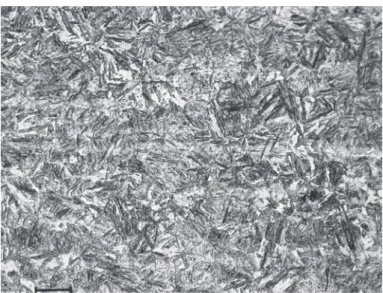
Q&T steel is listed in Table 1. The microstructure of the plate in Q&T condition consists of tempered martensite with an average hardness of 519 HV and is shown in Figure 1.
The alloy design of this steel utilises the novel low manganese approach in order to reduce centreline segregation of MnS inclusions and thus improve mechanical properties and weldability. The steel is microalloyed with Nb, Ti, V, and B in order to increase hardenability and enhance the HAZ properties.
Figure 1 Representative microstructure of investigated steel in
Q&T condition. Note the micron bar represents 20μm.
Metal-cored consumable AWS A5.9 EC308Mo type is ideal candidate for fully automated welding and was selected for this investigation. It is a versatile gas shielded, seamless wire capable
of out of position welding and exhibits enhanced productivity
and wetting action when compared to equivalent solid wire.
Experimental procedure 3.1 Welding set-up
To determine the lower preheat temperature threshold, single
pass illet weld coniguration was selected and is shown in
Figure 2 - a. This arrangement is the most susceptible to HACC as the HAZ is not tempered by the subsequent passes. Samples were welded with following levels of preheat 5°C (simulating ambient temperature during winter periods), 20°C and 80°C (current industry practice).
Table 1 Chemical composition of 8.5mm HHA steel in wt % max.
Element
C
Mn
Si
Ni
Cr
Mo
S
P
Wt% max
0.32
0.4
0.35
0.35
1.15
0.3
0.005
0.02
Element
Cu
Al
Nb
Ti
V
B
CE
IIWP
cmFigure 2 Macrophotograph showing the weld geometry and orientation of hardness traverses for: a – single and b - multi-pass weldments.
The deposition of multiple passes can result in formation
of extensively wide softened zones especially when high
heat inputs or inadequately high inter-pass temperatures are employed. Therefore to optimise the inter-pass temperature
multi-pass corner joint coniguration shown in Figure 2 – b was
used for this investigation. Inter-pass temperatures of 120°C (current industry practice), 200°C and 250°C were selected for this study. Any higher inter-pass temperature would not have
a practical beneit (especially for longer weld sections) as the
weld initially cools very rapidly and only during the later stages
the cooling rate is signiicantly reduced.
After completion of welding samples were prepared according to standard procedures for metallographic investigation and Vickers hardness testing
3.2 Weld thermal history
Resultant microstructure and hence mechanical properties of the HAZ are function of chemical composition of the steel, peak
temperature and cooling cycle experienced during welding.
Coarse-grain (CG) HAZ is the most susceptible to HACC out of
all HAZ subzones. To demonstrate the effect of various levels of preheat on CGHAZ microstructure thermal proiles were
acquired using technique of embedding thermocouples.
Weld thermal history of multi-pass joints was acquired to provide
information about effects of various inter-pass temperatures on cooling rate and cooling times of the over-tempered region of
the welded joint. For this purpose the thermocouples were
spot-welded 15 mm from the edge of the plate.
Results
To conirm safety of the proposed welding procedures with
reduced (ideally removed) preheat and increased inter-pass temperatures the information about the effect of various levels of these two temperatures on the HAZ microstructure and hardness is essential.
4.1 Optimisation of preheat temperature
Weld thermal history
From HACC view point the most important part of the
thermal history is the cooling leg that will inluence resultant
microstructure, diffusible hydrogen level and also the residual stresses formed as a consequence of welding process. As
mentioned previously CGHAZ is the most susceptible subzone thus the aim was to acquire thermal proile of this area. Measured
peak temperature listed in Table 2 was in the range of 1349°C
to 1411°C conirming that acquired thermal history was the
measured in the CGHAZ.
Cooling time from 800°C to 500°C (t8/5) is usually selected
to deine the cooling cycle of a weldment. The susceptibility to
HACC for various heat inputs and preheat conditions can be directly assessed based on this parameter. However the continuous cooling transformation investigation of the high strength steel used in this investigation revealed that transformation of HHA steel occurs in the temperature interval of 600°C to 200°C [3]. Therefore cooling time t6/2 more accurately represents cooling conditions crucial for evolution of microstructure. The hydrogen diffusion is the most active at high temperatures but continues to take place at lower temperatures at slower rate. The HACC typically occurs when temperature of the weldment drops below 200°C; therefore overall cooling time from the peak temperature to 100°C (tp/1) most precisely describes the conditions for hydrogen diffusion.
Table 2 Cooling cycle characteristics (cooling time t8/5, t6/2 average cooling rate through 800°C - 500°C, and tp/1)
measured for coarse-grain HAZ of single pass ilet weldments
preheated to 5°C, 20°C and 80°C.
Preheat temperature (ºC) Tp (ºC) t8/5 (s) t6x2 (s) tp/1 (s)
5 1348 9.3 81 353
20 1411 9,7 97 410
Figure 3 Weld hardness proiles of the 1 pass ilet joints welded
employing preheat temperatures of 5°C, 20°C, and 80°C.
CGHAZ microstructure
The microstructure of the CGHAZ of the 1 pass illet weld
is presented in Figure 4. Samples preheated to 80°C consisted
of mixture of upper and lower bainite and lath martensite. Ferrite was also present in the form of very ine ferritic laths of
From data presented in Table 2 it is obvious that increasing the preheat temperature resulted in longer cooling times and slower cooling rates through the whole course of cooling. The value of conventional parameter describing the cooling conditions t8/5 increased from 9.3 s to 12.6 s with increasing the preheat temperature from 5°C to 80°C. The cooling time through the transformation region t6/2 doubled with increasing the level of preheat from 5°C to 80°C. The overall cooling time from peak temperature to 100 °C tp/1 increased by 72% with increasing the level of preheat from 5°C to 80°C.
Weld hardness proiles
Fundamental trend in hardness was gradual increase in across the entire weldment, with respect to decreasing the preheat temperature. This is due to the formation of harder microstructures as a result of increased cooling rate. From the graph presented in Figure 3 it can be observed that CGHAZ hardness increased
by approximately 50 HV with decreasing preheat temperature
from 80°C to 5°C. The hardness of over-tempered (OT) region gradually increased by 30HV and the width decreased by 3 mm with decreasing preheat from 80°C to 5°C.
Figure 4 Microstructure of the coarse-grained HAZ subzone of the 1 pass illet welds deposited using various levels of preheat: a -
upper bainite. When 20°C preheat temperature was employed ferritic laths were no longer present in the structure of coarse-grained region. Lowering the preheat temperature favoured the formation of higher volume fraction of harder phases and the
microstructural features became iner. The amount of martensite increased at the expense of bainite with lowering the preheat
temperature.
4.2 Optimisation of inter-pass temperature
The cooling time data presented Table 3 show that increasing inter-pass temperature from 120°C to 250°C reduced the
welding time (from the peak temperature of the irst cap pass [tp(1st pass)] until the peak temperature of the inal pass was reached [tp(inal pass)]) from 923s to 203s. These data are particularly signiicant to industry and are a useful tool to gauge
productivity gains during fabrication. Increasing the inter-pass temperature to 200° and 250°C resulted in reduction in cooling
time of approximately 10 minutes (66%) and 12 minutes (78%). Overall cooling time (from the peak temperature of the irst cap
pass [tp(1st pass)] until 100°C was reached after completion of
welding [t100˚C(inal pass)]) was gradually reduced from 1904s
to 1400s with the increase of inter-pass temperature from 120°C to 250°C. Overall cooling time data is important in assessing time taken for cooling with respect to diffusion of hydrogen out of the weldment during the welding process.
Table 3 Cooling times of the cap passes of the corner joint.
Interpass temperature (ºC) 120 200 250
Cooling time {tp(1st pass)
to tp(3rd pass)} [sec] 923 315 203
Cooling time {tp(1st pass)
to t100ºC(3rd pass)} [sec] 1904 1486 1400
Weld hardness proiles
It was observed that with an increase in inter-pass temperature, a gradual decrease in HAZ hardness was found to occur, as a result of slower cooling rates in transformation region
promoting formation of softer microstructures. The maximum
difference between HAZ hardness at 120°C and 250°C was
approximately 150HV. In addition, the HAZ widths for all
inter-pass temperatures were very similar, with only slight increases
of maximum 0.5mm. Hardness proiles measured in the OT
region were found to be almost identical with only very slight decrease in hardness with increasing the inter-pass temperature
to 200°C. Further increase to 250°C resulted in somewhat higher
degree of softening of maximum 50 HV. The width of the OT
increased with increasing cooling rate from 120°C to 250°C by 3.5mm
Figure 5 Weld hardness proiles measured in B orientation of the multi pass corner joints welded with interpass temperatures
of 120°C, 200°C and 250°C.
Microstructure of OT region
When welding high strength steel in Q&T condition the deposition of multiple passes can result in formation of
extensively wide softened regions especially when high
inter-pass temperatures or high heat inputs are employed. Therefore
the microstructure of OT region was subjected to close examination and micrographs are presented in Figure 7.
The microstructure of all investigated weldments consisted predominantly of tempered martensite. Increasing interpass temperature for 120°C to 250°C appears to have little to no effect on the microstructure of OT region. This observation is consistent with hardness data presented in previous section.
Discussion
5.1 Optimisation of preheat
To be able to conirm the safety of proposed lower preheat temperature is necessary to assess the inluence preheat reduction
on all three factors contributing to HACC (microstructure, diffusible hydrogen and weld residual stresses).
Microstructure and hardness
From microstructural view point decreasing the preheat temperature from 80°C to 5°C produces slightly harder structures. However GGHAZ of the weldments produced employing both levels of preheat comprises of hard and brittle bainitic and martensitic constituents. The difference between the
two levels of preheat is that joint simulating preheat temperature
of 5°C contains higher martensite to bainite ratio compared to the one welded utilising 80°C preheat. Also HAZ hardness of
the joints welded employing both preheats is very high, well
about the level considered to be safe from HACC view point. The AS/NZS 1554.4 standard [4] states that even when welding
Q&T steels employing low hydrogen consumable, maximum
utilising ferritic consumable. However, the industry procedures previously used for welding this high strength Q&T steel employed ferritic consumable in combination with 80°C that resulted in HAZ hardness levels above 500 HV. Slightly higher hardness obtained in the HAZ as a result of elimination of
preheat is expected to be compensated by the ability of austenitic
stainless steel weld metal to accommodate higher hydrogen and stress levels.
Diffusible hydrogen level
Results of previous work [5] revealed that weldments produced employing identical metal-cored austenitic stainless steel consumable as used in present study resulted in very low levels of diffusible hydrogen of 0.5 ml of hydrogen per
100g of weld metal. In fact previously used lux-cored ferritic
consumable introduced 18 times more diffusible hydrogen
into the weld pool compared to austenitic stainless steel iller.
The study further revealed that preheat level in range of 5°C to 80°C had only minor effect on the value of the measured diffusible hydrogen measured for welds produced utilising ASS consumable.
Weld residual stresses
Austenite has considerably higher coeficient of thermal contraction than ferrite (typically 18 and 14 x 10-6 /°C in the range of 1°C – 100°C for austenitic and ferritic steel respectively) thus the overall contraction is higher than that of ferritic weld metal. However ASS weld metal possesses increased ability to yield and hence compensate thermal contraction resulting in limited evolution of residual stresses compared to ferritic weld metal
[6]. Due to these phenomena residual stresses in joints welded
with ASS consumable are likely to be lower compared to ferritic consumables, even though the lower preheat temperature is employed. In addition, on cooling HAZ of the parent material undergoes martensitic transformation that is accompanied by
volume expansion which to certain extent compensates the
thermal shrinkage.
5.2 Optimisation of inter-pass temperature
Microstructure and hardness
Increasing inter-pass temperature to 250°C had a beneicial
inluence on HAZ through slightly reducing the hardness levels.
Formation of softer microstructures especially in coarse-grained
region could have beneicial effects with respect to reducing
the potential risk of HACC.Hardness of OT region exhibited
only minor degree of softening with increasing inter-pass temperature from 120°C to 200°C. Slightly higher softening was observed with further increase of inter-pass temperature to 250°C. However this temperature was investigated as the
worst case scenario to expand the temperature window when
depositing short welds.
The main concern when employing higher inter-pass temperatures for welding high strength Q&T steel is formation
of wide extensively softened areas in the over-tempered region
that could compromise the mechanical properties of the welded structure. On the other hand resulting prolonged cooling times
after deposition of inal pass favour the diffusion of the hydrogen
and also temper rehardened HAZ areas thus reducing the risk of HACC. These effects are likely to compensate implication resulting from employing proposed lower level of preheat for
multi-pass joints.
Conclusions
Results of this and previous work suggest that for welding high strength Q&T steel with ASS consumable decreasing preheat temperature from 80°C to 5°C is safe in terms of HACC. Further in case of multi-pass welding the implications of increased cooling rate resulting from preheat reduction are likely to be compensated by employing proposed higher inter-pass temperature. The nature of an austenitic stainless steel
iller has the potential to remove the preheat requirement, what would allow great beneits during welding fabrication in terms
of time and costs for industry as the whole technological step of preheating could be avoided.
Findings of this investigation also revealed that increasing inter-pass temperature up to 250°C does not lead to formation
of wide extensively softened areas when compare to weldments
produced employing inter-pass temperature of 120°C. Employing higher inter-pass temperature would also have a great positive impact on productivity.
References
[1] WTIA, WTIA Technical Note No. 15 - Welding & fabrication of quenched and tempered steel 1996, WTIA.
[2] ISO/TR 17844: Welding — Comparison of standardised
methods for the avoidance of cold cracks. 2004, International
Organization for Standardization: Geneva.
[3] Kuzmikova, L., et al., A Study of the Continuous Cooling Behaviour of High Strength Quenched and Tempered Steel in 63rd Annual Assembly & International Conference of the International Institute of Welding. 2010: Istanbul, Turkey. [4] AS/NZS 1554.4:2010: Structural steel welding - Welding of high strength quenched and tempered steels 2010, Standards Australia.
[5] Kuzmikova, L., et al., Research to establish a systematic
approach to safe welding procedure development using
austenitic iller material for fabrication of high strength steel,
in 16th International Conference on the Joining of Materials.
2011: Helsinki, Denmark.