• Nenhum resultado encontrado

Soldag. insp. vol.18 número4

N/A
N/A
Protected

Academic year: 2018

Share "Soldag. insp. vol.18 número4"

Copied!
7
0
0

Texto

(1)

Recebido em 04/05/2013, texto inal em 08/07/2013.

(Caracterização de revestimentos de ligas de CoCrWC e CoCrMoSi processadas por PTA)

Adriano Scheid

1

, Ana Soia Clímaco Monteiro de Oliveira

2

1,2

Federal University of Paraná, Department of Mechanical Engineering, Curitiba, Paraná, Brazil,

[email protected]

,

[email protected]

Abstract

CoCrWC alloys are widely used to protect components that operate under wear and high temperature environments. Enhanced

performance has been achieved with the CoCrMoSi alloys but processing this alloy system is still a challenge due to the presence of

the brittle Laves phase, particularly when welding is involved. This work evaluated Plasma Transferred Arc coatings processed with

the Co-based alloy CoMoCrSi – Tribaloy T400, reinforced with Laves phase, comparing its weldability to the CoCrWC – Stellite

6, reinforced with carbides. Coatings were also analyzed regarding the response to temperature exposure at 600°C for 7 days and

subsequent effect on microstructure and sliding abrasive wear. Coatings characterization was carried out by light and scanning electron

microscopy, X-ray diffraction and Vickers hardness. CoCrWC coatings exhibited a Cobalt solid solution dendritic microstructure and

a thin interdendritic region with eutectic carbides, while CoCrMoSi deposits exhibit a large lamellar eutectic region of Laves phase

and Cobalt solid solution and a small fraction of primary Laves phase. Although phase stability was observed by X-ray diffraction,

coarsening of the microstructure occurred for both alloys. CoCrMoSi showed thicker lamellar Laves phase and CoCrWC coarser

eutectic carbides. Coatings stability assessed by wear tests revealed that although the wear rate of the as-deposited CoCrMoSi alloy

was lower than that of CoCrWC alloy its increase after temperature exposure was more signiicant, 22% against 15%. Results were

discussed regarding the protection of industrial components in particular, bearings in 55AlZn hot dip galvanizing components.

Keywords

: CoMoCrSi Alloy, CoCrWC Alloy, Plasma Transferred Arc, Temperature Stability

Resumo

Ligas CoCrWC são largamente usadas para a proteção de componentes que operam sob condições agressivas de desgaste e elevada

temperatura. Desempenho melhor tem sido obtido com ligas CoCrMoSi, entretanto, o processamento destas ligas ainda representa

um desaio devido à presença de fase Laves frágeis, particularmente quando processos de soldagem estão envolvidos. Este trabalho

avaliou revestimentos processados por Plasma com Arco Transferido com as ligas CoCrMoSi – Tribaloy T400 reforçada com fase

Laves, comparando a sua soldabilidade à da liga CoCrWC – Stellite 6, reforçada com carbonetos. Os revestimentos foram também

analisados considerando o impacto da exposição à temperatura de 600°C durante 7 dias sobre a microestrutura e o comportamento em

desgaste abrasivo por deslizamento. A caracterização dos revestimentos foi realizada por microscopia ótica e eletrônica de varredura,

difração de raios-X e dureza Vickers. Revestimentos CoCrWC apresentaram microestrutura dendrítica de solução sólida em Cobalto e

região interdendrítica reinada com carbonetos eutéticos enquanto os depósitos CoCrMoSi apresentaram uma região eutética lamelar

predominante com fase Laves e solução sólida em Cobalto e pequena quantidade de fase primária de Laves. Embora a estabilidade de

fases tenha sido observada por difração de raios-X, o coalescimento da microestrutura ocorreu para as duas ligas. A liga CoCrMoSi

apresentou lamelas mais espessas de fase Laves enquanto a liga CoCrWC apresentou coalescimento dos carbonetos eutéticos. A

estabilidade medida por meio dos testes de desgaste revelou que embora o coeiciente da liga CoCrMoSi na condição como depositada

tenha sido menor que o da CoCrWC, a primeira apresentou aumento mais signiicativo como consequência da exposição à temperatura,

22% perante os 15% da segunda. Os resultados foram discutidos considerando a proteção de componentes industriais que operam em

banhos de galvanização por imersão a quente com liga 55AlZn.

Palavras-chave

: Liga CoMoCrSi, Liga CoCrWC, Plasma com Arco Transferido, Estabilidade em Alta Temperatura

1. Introduction

(2)

ind applications in the chemical, petrochemical, food processing

and steelmaking facilities. These properties are associated with

the presence of Chromium as a solid solution strengthener and

carbide formation, the former contributing forms an oxide ilm

that enhances corrosion resistance and the latter, together with

W, the good wear resistance [2]. However, performance under

wear and corrosion-wear conditions is still an issue whenever

parts operate in aggressive environments. Corrosion-wear can

cause loss of material from solid surface phase as a result of

mechanical-chemical action that is enhanced by the wear debris

reducing the service life of components as found in the molten

metal corrosion in hot dip galvanizing pot hardware [3, 4].

To face this demanding service conditions alloy selection

should be carried out considering its ability to be processed and

to perform under a complex set of variables.

The CoCrWC alloy system can be use to fabricate

components that meet a wide range of service requirements.

Moreover, these alloys exhibit a good weldability facilitating

hardfacing procedures. However, under harsh environments

the response of components produced with alloys from the

CoCrMoSi system has been reported to show better results. These

two alloy systems have different features: the carbide reinforced

CoCrWC (Stellite) alloys show a hypoeutectic structure with

a Co-rich solid solution (FCC) dendrites surrounded by an

eutectic lamellar of a Co-rich phase and carbide phase (M

7

C

3

and/or M

23

C

6

, M being Cr or W). The intermetallic Laves phase

reinforced CoCrMoSi alloys (Tribaloy) exhibit hard intermetallic

Laves phase in a eutectic lamellar of a Co-rich solid solution and

Laves phase. The intermetallic phase formed is the close-packed

hexagonal (hcp) compound of Co, Mo and Si, as Co

3

Mo

2

Si and/

or CoMoSi.

Considering the extreme service conditions of 55AlZn

hot dip galvanizing pot hardware where temperature, wear

metal attack resistant CoCrMoSi alloys, an alloy with reduced

Cr and Si has been developed, the Tribaloy T400. However there

is a lack of information on its weldability and performance.

This work aims to reduce the gap of information on the

weldability and performance of this alloy. The weldability of

CoCrMoSi (Tribaloy T400) alloy coatings processed by Plasma

Transferred Arc was analyzed and correlated with CoCrWC

(Stellite 6) coatings; characteristics were also assessed by the

stability of microstructure and wear performance after a

long-term exposure at 600°C.

2. Materials and Methods

Atomized CoCrWC and CoCrMoSi alloys, grain size within

the range 90-150 μm, with the chemical composition shown

in Table 1, were processed. Plasma Transferred Arc (PTA)

hardfacing on AISI 316L stainless steel 12,5 mm thick plate

was carried out as single layers with the processing parameters

summarized in Table 2. Coatings were characterized in the

as-deposited condition and after temperature exposure in an air

furnace at 600 ºC for 7 days (168 h).

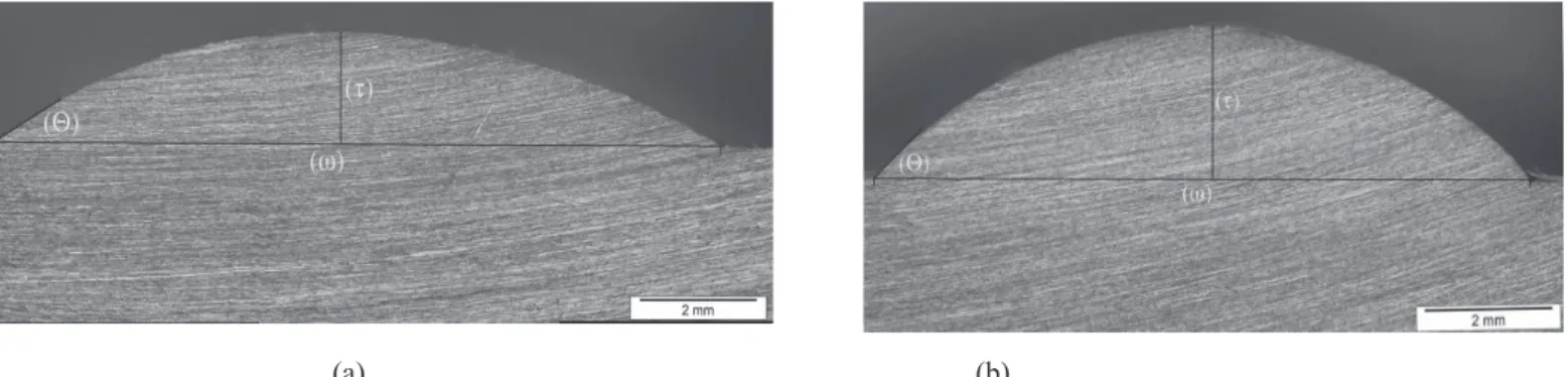
Geometry of welding overlays was analyzed by light

microscopy using a software to measure the thickness (t), width

(w), and wettability angle (Q), Figure 1. Dilution was determined

for single layer deposits on the transverse cross section as the

ratio between the substrate molten area and the total molten area.

Microstructure analysis included light and scanning electron

microscopy on the transverse cross section and X-ray diffraction

(XRD) analysis on the top surface of coatings. XRD used K

a

Cu

from 20 to 120º with time of exposed channel of 3 s. The Vickers

hardness of coatings, before and after exposure at 600 ºC was

measured under 0,5 kgf load as the average of 10 measurements.

Table 1. Chemical Composition of the materials used (wt.%)

Co-Based Alloys

Alloy / Element

Co

Cr

W

Mo

C

Fe

Ni

Si

Mn

CoMoCrSi (Tribaloy T400)

Bal.

8,8

....

29,1

0,05

0,4

0,6

2,4

....

Alloy / Element

Co

Cr

W

Mo

C

Fe

Ni

Si

Mn

CoCrWC (Stellite 6)

Bal.

27,9

4,7

0,2

1,3

1,8

2,1

1,2

0,4

Stainless Steel

Substrate

%C

%Mn

%Si

%P

%S

%Cr

%Ni

%Mo

%Al

(3)

Table 2. Plasma Transferred Arc processing parameters.

Parameters

Plasma gas low rate (l/min)

2

Protection gas (l/min)

15

Powder feeding gas (l/min)

2

Main arc current (A)

150

Powder feed rate

Constant in volume

Travel speed (mm/min)

100

Distance torch / substrate (mm)

10

Electrode diameter (mm)

3,125

Nozzle constriction diameter (mm)

4,76

Welding Position

Flat

Abrasive sliding wear tests were carried out on a pin-on-disc

sliding apparatus against silicon carbide paper (#320) assembled

on a 63 HRC hardness metal disc, under 1kgf axial load and

tangential speed of 1,5 m/s. Pins with a transverse section of

4 x 4 mm were removed and machined from the deposited

coatings. Wear was measured by the mass loss of pins, weighting

before every test and after each 250 m sliding distance up to

1000 m at room temperature and the results presented as the

average of 5 measurements.

3. Results and discussion

3.1. Soundness

The weldability of both Co-based alloys was good when

assessed by the soundness of coatings. Visual inspection of

the coatings processed with the two alloys revealed a smooth

surface without welding defects. No evidences of spatter,

undercut, porosity or cracks were found. This macroscopic

evaluation is coherent with the literature predictions that the

Tribaloy T400 has an improved weldability compared to other

Cr and Si richer CoCrMoSi alloys. However, limited data is

available on the response of the T400 to the effects of dilution

and the solidiication rate imposed by welding processes and in

particularly PTA hardfacing.

Notwithstanding the soundness of coatings processed with

both Co-based alloys, differences on the geometry of single

track deposits were measured and associated with the wettability

of each alloy, Figure 1. For the processing parameters used, the

CoCrMoSi alloy resulted on coatings with a lower wettability,

conirmed by the higher Θ, higher overlay thickness and shallower

width compared to coatings processed with the CoCrWC alloy. A

good wettability is of relevanc e whenever is required to protect

large areas by the overlapping of tracks. A low wettability can

cause porosity between tracks compromising the soundness of

the coated areas. In order to minimize the deleterious effects of

wettability, larger overlapping areas between track or further

optimization of the processing parameters are among the

procedures that can be used though both will contribute to a

higher dilution.

Processing the CoCrWC – Stellite 6 and CoCrMoSi –

Tribaloy T400 alloys with the listed parameters resulted on

coatings with a thickness ranging from 1.75 to 2.20 mm and

a dilution with the substrate below 15% (14,7% for CoCrWC

and 14,4% for CoCrMoSi alloy), conirming the superior quality

of the PTA deposits processed when compared to conventional

welding processes.

3.2. Temperature exposure

Albeit weldability is typically associated with the

soundness of coatings in this study it was extrapolated in order

to be assessed by the stability of the microstructure and wear

behavior of coatings. The consequences of PTA hardfacing were

assessed by the microstructure stability of coatings processed

with both Co-based alloys, by comparing coatings in the

as-deposited condition and after a long term exposure at 600°C.

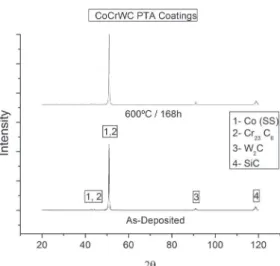
X-ray diffraction analysis, Figure 2 and Figure 3, showed phase

stability which, on itself might suggest that the measured dilution

did not compromise the microstructural stability of neither one

of the alloys.

Evidences of a distinct response to temperature exposure

of each alloy coating were given by hardness measurements,

Figure 4. The high hardness of CoCrMoSi coatings measured

in the as-deposited coatings was not altered after the 7 days at

600°C contrasting with the 28,5% hardness increase exhibited

by the as-deposited CoCrWC coatings .

(a) (b)

(4)

Figure 2. X-ray diffraction analysis on CoCrWC coating in the

as-deposited condition and after temperature exposure.

Figure 3. X-ray diffraction analysis on CoMoCrSi coating

in the as-deposited condition and after temperature

exposure.

Figure 4. Vickers Hardness of coatings in the as deposited

condition and after temperature.

of a lamellar eutectic and low amount of primary Laves phase

dendrites and Laves free regions of cobalt solid solution, Figure

5b. The observed microstructure and phase distribution as well

as the measured hardness agree with literature results [2].

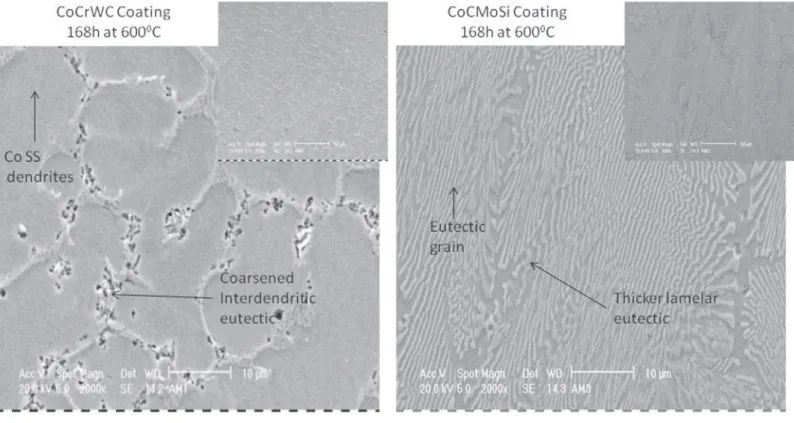
Temperature exposure at 600ºC for 7 days induced

microstructure changes in the coatings as observed on the

transverse section, Figures 6a and 6b. CoCrWC alloy coatings

showed a coarser and network of eutectic lamellar when

compared to the as-deposited condition, which can be attributed

to the carbides coarsening and solid solution precipitation.

Although no phase changes were identiied signiicant alterations

on their distribution and size account for the measured hardness

differences. CoCrMoSi alloy coatings showed thicker eutectic

lamellar Laves phase. Nevertheless microstructure changes were

not signiicant enough to induce signiicant hardness changes.

3.3. Wear Behavior

Further assessment of the response of each alloy to

hardfacing was analyzed by the wear behavior of coatings. As

describe in the literature the wear performance is a consequence

of a complex set of variables involving testing parameters and

the materials features. Aiming to identify the inluence of PTA

deposition on the response of each coating to abrasive sliding

wear, coatings were tested before and after exposure at 600 °C

for 7 days with a constant set of testing parameters.

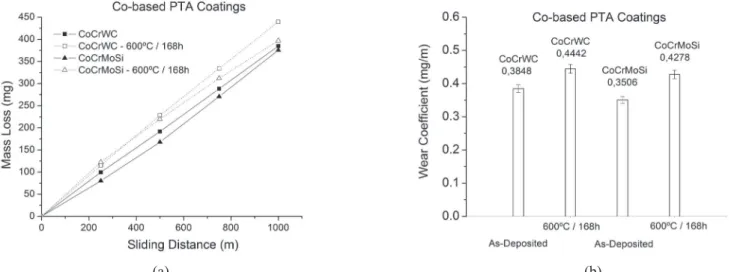
The mass loss changes with sliding distance for two

Co-based alloy coatings and the wear coeficients (mg/m) are shown

in the Figure 7. Under the conditions tested a linear correlation

between sliding distance and mass loss and a near constant wear

rate were measured with increasing sliding distance.

The chemical composition of each alloy had a role on

the mass loss rate of the coatings, the CoCrWC coatings

exhibiting a higher rate (0,3848 mg/m) than CoCrMoSi coatings

(0,3506 mg/m). Differences can be associated with the higher

measured hardness and the eutectic lamellar microstructure with

a high volume fraction of hard intermetallic Laves phase [5, 6].

Both Co-based alloys coatings showed an increase on the

mass loss following temperature exposure, and although the

CoCrMoSi coating exhibited a lower wear rate changes induced

by temperature were more signiicant on these coatings, a 22 %

(5)

(a)

(b)

Figure 5. Cross-section microstructures of as-deposited Co-based PTA coatings: (a) CoCrWC and (b) CoCrMoSi. Inserts in each

micrograph show a general view of the microstructure.

(a)

(b)

(6)

resistance. However, microstructure observations revealed

that the lamellar structure coarsened when exposed at 600 °C

reducing the reinforcement effect of the eutectic Laves phase.

The reduced stability of the microstructure of both alloys can

be associated with the fast solidiication rate imposed by PTA

deposition and with eventual chemical composition luctuations

due to the diffusion of the elements from the stainless steel AISI

316L substrate.

Concerning the industrial applications where the major

technological challenge is found and hardfacing with CoCrMoSi

alloy (Tribaloy T400) might be used to protect components, this

study conirmed that weldability is not a major dificulty for,

when compared to the CoCrWC (Stellite 6) alloy. Therefore

material selection for the protection of equipment should be

carried out considering the imposed demands on parts. If wear

is the major demand the CoCrMoSi alloy coatings showed an

enhanced performance compared to Stellite 6. However, if

operation temperature is an issue, the degradation it induces

on the CoCrMoSi microstructure might create a challenge.

On the other hand, under speciic corrosion conditions, such

as molten metal corrosion as observed in galvanizing plants,

previous results have shown the large areas of Laves phases

contribute to a superior performance [7, 8]. Hot dip galvanizing

facilities represent one of the most challenging service

conditions that result on the accelerated degradation of parts.

It has been associated with wear, temperature and reactivity of

mechanical components in contact with molten alloy. Die cast

processes must stop periodically for maintenance because of

die material degradation and also galvanizing lines designed to

produce 55AlZn coatings stop weekly for Co-based bearings

replacement. Material used for sink roll bearings is exposed

to 600 ºC temperature and operates for not more than 7 days

(168 h) [3 - 6]. These hostile environments require parts to

perform at elevated temperature, under abrasive wear and molten

metal attack. Under this service conditions and according to the

evaluation carried out, further optimization of the deposition

parameters should be performed to evaluated the stability of

Laves phases.

(a)

(b)

Figure 7. Wear curves for both alloy systems tested (a) and the wear coeficient with the error bars as the standard deviation (b).

4. Final Remarks

This study analyzed the weldability of the Co-based alloy

CoCrMoSi - Tribaloy T400, processed by plasma transferred arc

hardfacing and included a correlation with the CoCrWC - Stellite

6 known for its good weldability. Weldability was assessed by

the soundness of coatings and further characterization included

the effect of temperature on their microstructure and wear

performance. The main contributions can be summarized as

follows:

- The Co-based alloys showed a good weldability when

processed by plasma transferred arc on an AISI 316L stainless

steel plate. Sound coatings with low dilution were obtained.

- Exposure at 600

0

C for 7 days did not altered the phases

identiied in each coating but caused coarsening of the

structure though it only affected the hardness of the CoCrWC

coatings.

- The effects of hardfacing on each alloy assessed by sliding

abrasive wear behavior showed that in the as-deposited

condition the chemical composition determined the better

wear resistance of the CoCrMoSi coatings. However, dilution

effects and the fast solidiication rate imposed by PTA

hardfacing made the effects of the 7 days exposure at 600

0

C

more pronounced on the degradation of the wear behavior of

CoCrMoSi coatings.

-

Although this study conirmed the good weldability of both

Co-based alloys studied it also adverts to the higher impact of

dilution and solidiication rate on the temperature stability of

CoCrMoSi coatings.

5. References

[1] GONÇALVES, R.H., DUTRA, J.C. PTA-P Process -

A Literature Review as Basis for Innovations. Part 1 of 2:

Constructive Elements. Soldagem & Inspeção. v.17. p.076-085,

2013.

(7)

Control in Superalloys. In: MICHIGAN AND MATERIALS

TECHNOLOGY ASSOCIATES. Clinton: NEW YORK.

p.479-508

[3] KIM, H.; YOON, B.; LEE, C. Sliding wear performance

in molten Zn-Al bath of cobalt-based overlayers produced by

plasma transferred arc weld-surfacing. Wear. v.254, p.408–414,

2003.

[4] HOU, Q.Y.; GAO, J.S., ZHOU, F. Microstructure and

wear characteristics of cobalt-based alloy deposited by plasma

transferred arc weld surfacing. Surface Coatings and Technology.

v.194. p238-243, 2005.

[5] ZHANG, K. On the Selection of Materials for Improved

Performance of Pot Bearings. in: IRON AND STEEL

TECHNOLOGY CONFERENCE, 2005, Charlotte. Proceedings

in Charlotte: USA. 2005. p. 475–481.

[6] ZHANG, K. Wear of cobalt-based alloys sliding in molten

zinc, Wear. v.255. p.545–555, 2003.

[7] YAO, M.X., WU, J.C.B., LIU, R. Microstructural

characteristics and corrosion resistance in molten Zn–Al bath

of Co–Mo–Cr–Si alloys. Materials Science and Engineering A.

v.407 p.299–305, 2005.

Imagem

Table 1. Chemical Composition of  the materials used (wt.%) Co-Based Alloys
Table 2. Plasma Transferred Arc processing parameters.
Figure 2. X-ray diffraction analysis on CoCrWC coating in the  as-deposited condition and after temperature exposure.
Figure 6. Cross-section microstructures of Co-based PTA coatings after long-term exposure at 600ºC.
+2

Referências

Documentos relacionados

Analysis of the chemical composition, hardness and wear tests showed that the effect of bead overlapping on coating features is most pronounced in the first and second beads.

Los resultados de dureza Vickers presentados en la Tabla 2, muestran valores muy similares para las tres muestras de Au-Si, lo que muestra que a nivel global las aleaciones

- Correlation with the cast sample of IN 625 alloy revealed that the impact of characteristics of the steel substrates on coatings can be described as three fold: it alters the

Higher hardness values were obtained for the samples processed free-standing (mini billets) with respect to the coatings and they were independent of the processing

The expected hypereutectic microstructure comprised of primary Laves phase and eutectic lamellar with Laves phase and Cobalt solid solution observed on cast CoCrMoSi alloy T400

The chemical composition of the Ni-based C276 alloy developed on coatings inluenced the mass loss rate, being the processed with 120 A deposition current (lower dilution) the

WC inserts were used as substrates to improve the mechanical and tribological properties of TiN/TiAlN multilayered coatings compared to other types of coatings

However, when wear – corrosion tests were performed the lifetime of coatings deposited on nitrided alloy was signi fi cantly re- duced compared to that deposited onto bare alloy,