(Received in 02/09/2009; Final Text in 03/06/2009).
Based on paper published on the Welding & Material Testing 3/2008 (Romania). Re-printed under the consent of Welding & Material Testing.
(Problemas com a coniabilidade e segurança de estruturas de aço galvanizadas a quente)
L. Mraz1; J. Lesay2
1Welding Research Institute – Industrial Institute SR, Racianska 71, 832 59 Bratislava, Slovakia 2ZIN, s.r.o., Čapkova 2, 811 04 Bratislava, Slovakia.
E-mail: [email protected]
Abstract
Hot dip galvanizing is very effective means of protection against corrosion. Some recommendation concerning the steel quality are generally known and accepted. The process consists of cleaning (pickling or sand blasting) and dipping the structures or pieces into liquid zinc bath. The case study of hot dip galvanized steels is presented. Some recent failures of hot dip galvanized welded structures and hot dip galvanized high strength steel screws are presented. Structures were made of S355 grade steel and MIG/MAG process was applied for welding. Large cracks were observed in the vicinity of welds after hot dip galvanizing process. The presence of both hydrogen and liquid metal embrittlement was identiied and associated mainly with higher hardness of HAZ or the quenched and tempered steels. Possible cracking mechanisms are discussed. The inluence of chemical composition and production process (welding, heat treatment) was analyzed according to data published in literature. The solutions and recommendations for avoiding the failure in hot dip galvanized structures are proposed.
Keywords:steel, welding, cracking, hot dip galvanizing
Resumo:Galvanização a quente é um meio muito efetivo de proteção contra a corrosão. Recomendações relativas a qualidade do aço são geralmente conhecidas e aceitas. O processo consiste de limpar (decapagem ou jateamento) e mergulhar as estruturas ou partes destas em um banho de zinco líquido. O presente trabalho apresenta casos de falhas recentes em estruturas soldadas e em parafusos de aços de alta resistência galvanizados a quente. As estruturas foram fabricadas com aço do grau S355 e o processo MIG/MAG foi usado para a soldagem. Os parafusos foram fabricados com aço de alto carbono. Grandes trincas foram observadas nas proximidades das soldas após o processo de galvanização a quente. A ocorrência de fragilização tanto por hidrogênio como por metal líquido foi identiicada e associada com a dureza elevada tanto da ZTA como dos aços temperados e revenidos. Os possíveis mecanismos de issuração são discutidos. A inluência da composição química e processo de fabricação (soldagem e tratamento térmico) é analisada de acordo com dados publicados na literatura. Soluções e recomendações para evitar a falha em estruturas galvanizadas a quente são propostas.
Palavras-Chave:Aço, Soldagem, issuração, galvanização a quente
1. Introduction
Hot dip galvanizing is very important production process used for steel protection against corrosion. This process seems to be even more economical and effective compared to protection by painting. Hot dip galvanizing is used for protection of
steel products for more than 100 years. During application of
this process the recommendations have been developed for
steel speciication. These recommendations should assure the technological reliability and also the quality of zinc layer.
Recommendations for constructions to be galvanized (such as
ventilation etc.) are the basic requirement for the continuous galvanized process. The quality of hot dip galvanizing also inluence not only the technological conditions (bath chemical composition, cleaning process etc.) but also chemical
composition of the steels.
The quality requirements and the procedures for quality assessment of hot dip galvanized process are speciied in EN ISO 1461 [1] and the construction requirements are given in EN ISO 14713 [2].
The inluence of Si and P in the steel to be galvanized on the thickness and quality of zinc layer is generally known. This requirement for the content of both Si a P is speciied in the standards of structural steels EN 10025 - 1 to 6 [3] for the normalized and also for the quenched and tempered but also for TMCP steels.
The stresses and also the effect of strain level on the quality of steel products were studied. It is generally known that there is no remarkable problem with galvanizing mild steels.
Cracking of steels has been observed in steels with the yield strength over 1000 MPa [4]. Speciic problem was observed with high strength steel fasteners [4]. Fracture was not observed for the fasteners without zinc layer. Some failures in welded structures of hot dip galvanized steel are reported in [6-9]. The main reasons for this failure are indicated the following parameters such as high residual stresses, local plastic strain and
local hardening.
The subject of this contribution is to attain an overview on possible fracture mechanisms which were observed during hot
dip galvanizing of steel constructions.
2. Failures of hot dip galvanized steel products
There were three basic embrittlement mechanisms observed according to [4] when the hot dip galvanized steel structure failed. It is:
liquid metal embrittlement
-
hydrogen embrittlement and -
strain ageing embrittlement. -
McDonald [5] supposed also the inluence of Fe - Zn
intermetallic layer on the fracture. The role of all mechanisms is complex and one of them may miss in the actual case.
The liquid metal embrittlement caused by zinc and cadmium was studied by Arrata at el [6] in liquid Cd, Zn and Cd + 5 % Zn, Cd + 50 % Zn alloys. The authors identiied that liquid metal inluences the plasticity of steels. The ductility decreases with increasing Zn content (Figure 1). The change of plasticity was associated with the actual fracture mechanism
from transcrystalline to intercrystalline. They also observed
that the fracture associated with the liquid metal embrittlement takes place when the minimum stress level and or deformation
is applied (Figure 2).
Figure 1. Inluence of Cd and Zn on the steel elongation [6].
Pavlidis et al. [7] found out, that the pure zinc does not change the ductility of steels within the temperature range from 450 to 500°C. The liquid metal embrittlement is remarkably inluenced by the presence of Pb in the liquid metal.
Friehe a Hankel [8] also identiied that iron is more susceptible to intercrystalline liquid metal embrittlement at
475°C than the killed and also not killed steel.
Steel welded structures are hot dip galvanized very often. Mainly mild steel are used for these structures. Liquid metal embrittlement caused by zinc has also been observed in welded steel structures galvanized after welding. This problem, related with steel bridge structures was studied by Abe H. et al. [9].
Figure 2. Inluence of load on liquid metal embrittlement [6].
The inluence of chemical composition was identiied for hot dip galvanized steel failure. The following equation was developed by the regression analysis [10]:
Steels with C < 0.12 %
S LM-400 = 201-370C–22Si–51Mn–35P+33S-28Cu–22Ni–87Cr–
123Mo–275V-182Nb-82Ti-24Al-1700N-155000B (1)
Steels with C > 0.12 %
S LM-400 = 227-320C–10Si–76Mn–50Cu–30Ni–92Cr–88Mo–
220V-200Nb+200Ti (2)
where S LM-400 is the parameter which identiies the inluence of liquid metal at 470°C on the notched strength – R m in zinc /R m without zinc x 100 %, and also zinc carbon equivalent (CEZ):
CEZ = C+Si/17+Mn/7.5+Cu/13+Ni/17+Cr/4.5+Mo/3+V/1.5+ Nb/2+Ti/4.5+420B (3)
Japanese authors also supposed that liquid zinc
embrittlement is caused by diffusion of zinc along the primary austentic grain boundaries due to thermal and residual stresses. They also concluded that embrittlement can be reduced by the presence of ferrite on the HAZ grain boundaries.
There are no serious problems when the steels of yield strength in the range from 235 to 460 MPa are galvanized according to [12]. It is also recommended that the killed steels resistant to strain ageing or ine grained steel grades should be
used for steel structures containing bent parts. For the steels
with yield strength higher than 460 MPa it is recommended
to use shorter pickling time in order to avoid the hydrogen
both Sn and Pb should not be higher than 1.3 % and the content of Bi should be 1.0 % max.
The cracking phenomenon is expected according to [13] when hardness would exceed the level of 34 HRC or 340 HV due to hydrogen. Unfortunately, these criteria are not mentioned in the standard EN 14713.
Hydrogen embrittlement during hot dip galvanizing process
is discussed also in [14], [15]. The guideline [14] considers the
hydrogen embrittlement as one of the fracture mechanism of
galvanized structures. The steel production process, welding and
pickling are possible sources of diffusible hydrogen. No criteria such as maximum hardness can be found in this document. The
EN 1011-2 standard is recommended to follow, in order to avoid
the hydrogen induced cracking. Usually inhibitors are added to
liquid metal for avoiding this problem. Anyway, liquid metal embrittlement is expected when steels of the yield strength higher than 355 MPa are used for welded structures.
According to the literature related to cracking of welded structures after hot dip galvanizing, it is supposed that the liquid metal embrittlement is associated with local strain or stress seems to be the main mechanism for the failure. The inluence
of hydrogen is expected but there are no criteria given in order to reduce the hydrogen induced cracking.
3. Failed steel structures after hot dip galvanizing
Several failed welded structures of zinc coated steels and steel products have been analyzed in the last few years. The welded structures were fabricated from structural steel grade 355 MPa and welded by using MIG/MAG process.
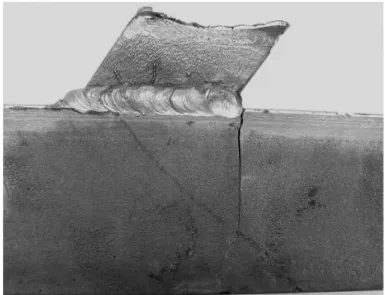
First example of failed steel structure is a weldment in 6 m length fabricated from L proiles in dimension 6 x 80 x 80 mm and 5 x 50 x 50 mm. The cracks sometimes attaining almost 70 mm in length were observed after hot dip galvanizing (Figure 3). These cracks initiated close to the illet welds and propagated perpendicularly to the proile surface (Figure 4). No cracks were identiied by visual testing just after welding.
Figure 3. Fracture in a welded steel structure close to L proile weld.
Figure 4. Fracture surface in L – proile.
Figure 5. Fracture of circumferential weld between the tube
and plate.
Figure 6. Crack morphology in a circumferential weld between
Second failed steel structure consisted of a tube welded to 10 mm steel plate. The plate 10 mm in thickness was made of S355 steel grade. Several cracks were identiied perpendicularly to the circumferential weld (Figure 5). A number of cracks has been identiied by using dye penetrant test when the zinc layer was removed by grinding. The crack surface was covered by zinc layer and it propagated both, in plate and tube as well
(Figure 6).
Third case of hot dip galvanized steel structure was the fracture of a sizable steel structure containing multi-pass welds.
The structure failed in the location of stress concentration
(Figure 7).
Figure 7. Crack in zinc coated welded steel structure.
3.1 Investigation of the failed welded steel structures
Fracture mechanism of steel structures was investigated
using optical microscope METAVAL. The specimens for
investigation were cut from the broken welds. These specimens were prepared for microscopical analysis by grinding, polishing
and etching. Also Vickers hardness measurements of base
metal and HAZ were performed at the load of 49.05 N (HV 5).
Chemical composition of steels used for failed steel structures is
given in Table 1.
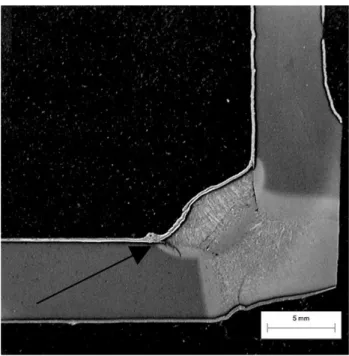
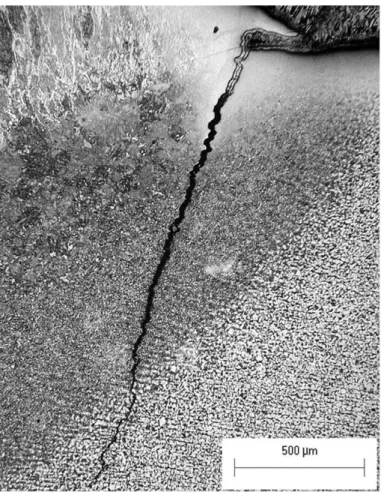
Macrostructure of the L – proile illet weld is shown in Figure 8. The cracks initiated in the notch at the interface between the weld and base metals, e. g. in the HAZ. The crack length is shown in Figures 9 and 10. The cracks propagated perpendicularly to the L-proile length from the HAZ into base metal. The cracks were trans- and intergranular in the HAZ and
intergranular in the base metal. The crack surface is covered by
zinc layer (Figure 11).
Table 1. Chemical composition of steels used for steel structures.
Parent material Composition (weight. %)
C Mn Si P S Al N CE*
tube 0.080 - 0.01 0.014 0.006 0.034 0.005
-plate 0.207 1.41 0.41 0.010 0.020 - - 0.440
proile 80 x 6 mm 0.181 1.30 0.37 0.019 0.011 0.045 - 0.397
S355J2G3 Max. 0.27 Max. 1.70 Max.0.60 Max.0.055 0.055Max. - - max.0.55
* CE = C + Mn/6 + (Cr+Mo)/5 + (Ni+Cu)/6
Figure 8. Location of crack initiation (arrow).
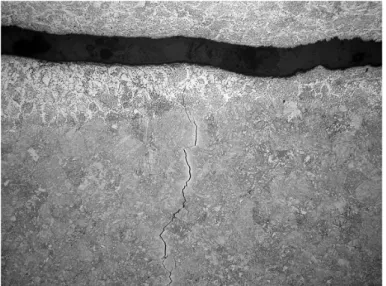
Macrostructure of the tube to plate circumferential weld is shown in Figure 12. The cracks were oriented perpendicularly to the circumferential weld (Figure 13) and propagated into plate
and also into the tube. In some areas the cracks oriented parallel
to weld seam were observed. Fine trans- and intergranular microcracks were observed in the HAZ close to the main circumferential crack (Figure 14). The intergranular cracks were
observed in the base metal.
The presence of cracks was identiied in a large weldment in the vicinity of multi-pass welded joint located in the stress concentration area. Cracks initiating from the weld surface and weld root were identiied in one cross-section (Figure 15). The crack initiation area could not be identiied. The cracks of branched type were observed with intergranular propagation in the base metal and illed also by zinc layer (Figure 16).
Figure 11. Crack propagation in the base metal.
Figure 12. Cross-section of the circumferential weld.
Figure 13. Crack in the circumferential weld. Figure 9. Crack initiation and propagation.
Figure 14. Crack in the circumferential weld.
Figure 15. Crack location in the steel welded structure.
Figure 16. Crack propagation in the base metal.
4. Discussion
The analysis of failed steel structures after hot dip
galvanizing has shown some common features. The fracture
initiation has always been observed in the vicinity of welds. Hardness level higher than 270 HV 5 has been measured in coarse grained HAZ. All failed structures were made of S355 steel grade. The crack surface was always covered by a zinc layer.
Trans- and intergranular fracture close to the fracture initiation and intergranular fracture in the crack propagation direction
were identiied by microscopic examination. The presence of
transgranular fracture suggested that most probably hydrogen embrittlement of the HAZ region is responsible for crack
initiation and liquid metal embrittlement (intergranular fracture) and for crack propagation in the base metal. Nevertheless,
the local strain during hot dip galvanizing cannot be excluded as a possible factor responsible for the fracture initiation and propagation.
Failures of welded structures have appeared in zinc coated
applications. It seems that coating process unanimously affects
the reliability of products. In case of welded structures, failures appeared before putting the structure into service and were associated with higher hardness, diffusible hydrogen, liquid zinc and also local residual stresses as the consequences of welding. Based on the presented case studies, we assume that the local stresses, high hardness and diffusible hydrogen are the
main factors responsible for failures of zinc coated products in
general. The presence of active, diffusible, hydrogen may be affected by the steel production, welding process but we assume
that in case of steel structures mainly by the pickling. This process is used for cleaning the structures prior to coating.
Anyway, according to literature survey also local strains
may increase the risk of failure due to non-uniform heating during hot dip galvanizing. This local strain can increase the risk that LME could also appear as the main fracture mechanism.
We assume that in presented cases the LME is active in the
crack propagation range but not in the crack initiation range.
The failures have shown that there is a need for criteria for hot dip galvanized steel structures welded prior to galvanizing, in order to avoid the cracking occurrence. We suppose that the HAZ hardness limit or choice of suitable steel with lower CE
can be helpful to avoid the crack occurrence. Of course such recommendations are highly dependent on other factors such as
structure rigidity which is responsible for local strains during
hot dip galvanizing. More data are necessary in order to estimate such criteria.
5. Conclusions
Several failures of zinc coated steel products have been presented in this paper. The investigation of the failed steel
structures have shown that the main factor responsible for
fracture initiation seems to be the hydrogen embrittlement due to presence of high-hardness microstructure and residual or external stresses. The active diffusible hydrogen appears mainly
from the coating process – pickling, which is used for cleaning
prior to galvanizing. The LME is supposed as the mechanism for
6. Acknowledgement
The paper has been prepared according to the literature
survey and to the analysis of practical cases within the project APVT-P06705 inanced by APVV.
7. References
[1] EN ISO 1461 Hot dip galvanized coatings on fabricated iron and steel articles. Speciications and test methods (ISO 1461:1999)
[2] EN ISO 14713 Protection against corrosion of iron and steel in structures. Zinc and aluminium coatings (ISO 14713:1999) [3] EN 10025 - 1 to 6 Hot rolled products of structural steels, Part 1 to Part 6
[4] GALVAINFO
[5] McDonald R. D.: Steel embrittlement problems associated with hot dip galvanizing – causes, mechanisms, controls, and selected references, Materials Performance, January 1975 [6] Arata Y., Ohmori A., Okamoto I., Ogawa H.: Study on liquid metal embrittlement of carbon steels, Transactions of JWRI, Vol. 11, No. 1982
[7] Pavlidis Chr., Schulz R., Fricke M.: Zum Problem der Rissentstehnung an Feuerverzinkungskesseln, Maschinenbau 52, (1979) Heft 1
[8] Friehe W., Hankel A.: Stand der Kentnisse űber die Entstehnung interkrystalliner Risse an Verzinkungskesseln, Stahl und Eisen 94 (1974) Nr. 7
[9] Abe H., Ieazawa T., Kanaza K., Zamashita T., Aihara S., Kanazawa S.: Study of HAZ cracking of hot-dip galvanizing steel bridges, IIW Doc. IX-1795-94
[10] Interpretation zinc assisted cracking on big scale steel structures and preventive methods, 2001, in ILZRO Project ZC-21-2
[11] Katzung W., Schulz W.-D.: Zum Feuerverzinken von Stahlkonstruktionen – Ursachen and Lösungsvorschläge zum Problem der Rissbildung, Stahlbau 74 (2005), Heft 4, Bericht Nr. 152, Gemeinschaftausschuss Verzinken e. V., GAV-Nr. FC22/1, [12] Empfehlung zur Vermeidung der Rissbildung an feuerverzinkten Stahlkonstruktionen, Deutscher Stahlbauverband
DSTV
[13] Schmidt J.: Bewertung zu den Entwürfen DIN EN ISO 1460 a DIN EN ISO 14713, Schweisstechnik and mehr
[14] Guidance note: The design, speciication and fabrication of structural steelwork that is to be galvanized, Guidance note, British constructional steelwork association, May 2003
http://www.steelconstruction.org/static/assets/source/ Guidance%20Note%20-%20Final%20-%20Issued%2030-05-03.pdf
[15] Liquid metal penetration during hot dip galvanizing, TWI
![Figure 1. Inluence of Cd and Zn on the steel elongation [6].](https://thumb-eu.123doks.com/thumbv2/123dok_br/18858281.417452/2.892.471.831.204.446/figure-inluence-cd-zn-steel-elongation.webp)