The Journal of Clinical Pharmacology 2017, 00(0) 1–7
C
2017, The American College of Clinical Pharmacology
DOI: 10.1002/jcph.986
Polymorphism of
IL10, IL4, CTLA4
, and
DAO
Genes in Cross-Reactive Nonsteroidal
Anti-inlammatory Drug Hypersensitivity
Luciana Mabel Ferreira Vasconcelos, MSc
1, Raphael de Oliveira Rodrigues, MSc
1,
Andressa Almeida Albuquerque
1, Gabrielle Dantheias Barroso
1,
Greyce Luri Sasahara
1, Janaira Fernandes Severo Ferreira, MD
2,
Eudiana Vale Francelino, MSc
3, Cynthia Chester Cardoso, PhD
4, Silvia Helena Barem
Rabenhorst, PhD
5, Thereza L ´ucia Prata de Almeida, MD, MSc
6,
and Aparecida Tiemi Nagao-Dias, PhD
1Abstract
Our aim was to evaluate genetic polymorphism of molecules involved in immunoregulatory/allergic processes in patients who presented with cutaneous hypersensitivity caused by chemically unrelated nonsteroidal anti-inlammatory drugs. Polymorphisms atIL10(–1082 G>A),IL4(–589 C>T),CTLA4 (+49A>G), andDAO(+8956 C>G) genes were studied in 55 cases and 97 controls by the polymerase chain reaction-restriction fragment length polymorphism technique. With regard to the polymorphism atIL10 –1082, higher frequencies of the AG genotype (57% vs 39%) and G allele carriers (70% vs 48%) were found among the patients, indicating a risk effect (odds ratio [OR]=2.56 andP=.01 for AG genotype and OR=2.52;P=.01 for AG/GG). For theCTLA4+49 A/G single-nucleotide polymorphism (SNP), AG genotype (31.0%) (P=.02) and G carrier (54.0%) (P=.05) frequencies were found to be signiicantly lower in the patient group compared with the control group (51.0% and 69.0%, respectively). The SNPDAO+8956 C>G was associated with a strong protective effect, with OR values of 0.83 for CG and 0.11 for GG genotype (P=.04 for the codominant model), suggesting an allele dose effect. The combination ofIL10andDAOSNPs in a multivariate model did not alter the OR values, suggesting independent effects for both SNPs. The results are striking. In conclusion, these results suggest that polymorphisms in regulatory targets of the immune response and inDAOgene could modulate an individual’s susceptibility to nonsteroidal anti-inlammatory drug hypersensitivity reactions. Further studies will be necessary to complement our results.
Keywords
NSAIDS, drug hypersensitivity, genetic polymorphisms, cytokines
According to the World Health Organization, over the last few decades, morbidity and mortality associated with drug use have been considered a major public health problem throughout the world.1 Adverse
reactions to nonsteroidal anti-inlammatory drugs (NSAIDs) affect 0.5% to 1.9% of the general population and account for about 20% to 25% of all adverse reactions.2 The main causative drugs
are NSAIDs, β-lactam antibiotics, sulfonamides, contrast agents, and antiretrovirals.3,4 The frequency
of hypersensitivity reactions to NSAIDs may vary according to the population studied, the diagnostic method used, and the type of clinical manifestation.5In many countries some of these drugs (eg, acetylsalicylic acid, paracetamol, ibuprofen) are sold over the counter. For this reason irrational use of NSAIDs is a frequent cause of adverse events.6–8 Hypersensitivity reactions
to NSAIDs include nonallergic and allergic reactions. Urticaria and/or angioedema induced by multiple NSAIDs occurs after the administration of nonstruc-turally related NSAIDs in the absence of baseline respiratory or cutaneous diseases.9,10It is hypothesized
that the main mechanism enrolled in this category is inhibition of COX-1.2
In the last decade much attention has been paid to genetic factors as predisposing and triggering
fac-1Department of Clinical and Toxicological Analysis, Faculty of Pharmacy,
Universidade Federal do Ceara, Fortaleza, Brazil
2Department of Pediatric Allergy and Immunology, Hospital Infantil
Albert Sabin, Fortaleza, Brazil
3Department of Pharmacy, Faculty of Pharmacy, Universidade Federal do
Ceara, Fortaleza, Brazil
4Laborat ´orio de Virologia Molecular, Department of Genetics, Instituto
de Biologia, Universidade Federal do Rio de Janeiro, Rio de Janeiro, Brazil 5Laboratory of Molecular Genetics, Department of Pathology and
Forensic Medicine, Universidade Federal do Ceara, Fortaleza, Brazil 6Department of Dermatology, Hospital Universitario Walter Cantidio,
Universidade Federal do Ceara, Fortaleza, Brazil
Submitted for publication 15 February 2017; accepted 21 June 2017.
Corresponding Author:
Aparecida Tiemi Nagao-Dias, PhD, Laboratory of Immunology, De-partment of Clinical and Toxicological Analysis, Faculty of Pharmacy, Universidade Federal do Cear´a, Rua Capit˜ao Francisco Pedro, 1210, Rodolfo Te ´oilo, CEP 60430-370 Fortaleza, Cear´a, Brazil
tors of hypersensitivity reactions.8,11 Research on the
genetics of hypersensitivity to NSAIDs has increased dramatically, particularly for respiratory diseases acerbated by NSAIDs and for chronic urticaria ex-acerbated by aspirin.11,12 Nonetheless, there are few
studies regarding acute urticaria induced by NSAIDs.8
Genetic polymorphisms that increase or dysregulate the expression of genes involved in the production of cysteinyl leukotrienes8,11,13,14 or in the metabolism
of the histamine15 may be considered risk factors for
hypersensitivity induced by various NSAIDs. Ayuso et al15found that the+8956C/G polymorphism and
con-sequent His645Asp substitution are responsible for the decrease in the enzymatic activity of diamino oxidase. The enzyme metabolizes histamine, and a decrease of its activity would lead to more histamine available in the milieu.
Although it is suspected that mechanisms that lead to hypersensitivity to multiple NSAIDs are not allergic, there is some evidence in the literature that shows that there may be some contribution of immunological mechanisms, either by increasing or decreasing the risk.16 In the present work we evaluate the
polymor-phism of molecules generally involved in immunoreg-ulatory processes (eg, cytotoxic T lymphocyte antigen [CTLA]-4 and Interleukin [IL]-10) or in allergic mani-festations (eg, IL-4) and in the metabolism of histamine (ie, diamino oxidase) in a case-control study compar-ing patients who presented cutaneous hypersensitivity caused by nonstructurally related NSAIDs and those who were tolerant to these drugs.
Methods
The study was approved by the Research Ethics Com-mittee of the Walter Cant´ıdio University Hospital in Fortaleza, Cear´a, Brazil, under approval number 550.608. The work was a case-control study. All the participants (patients and controls) were invited to sign an informed consent form.
Subjects
Patients aged 18 to 80 years (n=55) were selected at the Dermatology Outclinics, Walter Cant´ıdio University Hospital/Federal University of Cear´a. The patients experienced as least 2 episodes of urticaria and/or angioedema in their lifetime with 2 or more chemi-cally unrelated NSAIDS including strong COX-1 in-hibitors. Clinical evaluation was done by an allergist. According to Romano et al,17 patients who present adverse reaction against unrelated NSAIDs should not be rechallenged unless probable causative factors such as food might also be suspected. NSAID-tolerant controls, matched by age and sex, were selected at a blood bank, HEMOCE (Hemocentro do Cear´a).
The controls comprised individuals who take NSAIDs for a long time without experiencing any episode of hypersensitivity reactions to the drugs. After the project was explained and informed consent was obtained, a questionnaire was applied. Pregnant women were excluded from the study. Patients taking β-blockers or angiotensin-converting enzyme inhibitors, and those with severe infections or with underlying heart disease were also excluded from the study.9,18
It is a consensus in the literature that NSAID-exacebated respiratory/cutaneous diseases and urticaria and/or angioedema induced by NSAIDs probably share similar nonallergic mechanisms, that is, overproduction of leukotrienes. Therefore, skin tests are not recommended for these groups, and provocation tests could be performed to search for safe therapeutic alternatives.5,19 At the end of the clinical
evaluation, the patients were instructed to avoid strong COX-1 inhibitors.
DNA Extraction
Genomic DNA was extracted from whole individ-ual blood samples collected in EDTA tubes. DNA extraction was performed using the commercial kit HiPurATM Multi Sample DNA puriication (Himedia
Laboratories, India) according to the manufacturer’s recommendations.
Single Nucleotide Polymorphism Genotyping of IL10 (–
1082 A>G),IL4(–589 C>T),CTLA4(+49 A>G), andDAO
(+8956 C>G)
Genetic polymorphisms of IL10 (–1082 A>G), IL4
(–589 C>T), CTLA4 (+49 A>G), and DAO (+8956 C>G) were analyzed by the polymerase chain reaction (PCR)-restriction fragment length polymorphism tech-nique, as described in Table 1.
The PCR reaction was done in a 20-µL reaction vol-ume. The mixture contained 25 ng DNA TopTaq PCR Master Mix (Qiagen, Germany) with 0.01% bovine serum albumin as well as 10 µM primers for IL-10, 12.5 µM primers for IL-4, and 10 µM primers for CTLA-4. The reaction was performed using 2720 Ther-mal Cycler 96-well (Applied Biosystems, Life Tech-nologies, Carlsbad, California). The annealing step conditions for each PCR reaction are mentioned in Table 1.
Table 1.Primers Used in the Polymorphism Genotyping of Cytokines, Diamino Oxidase, and Regulatory Molecule CTLA-4 and Annealing Temperatures Used in the Polymerase Chain Reaction
SNP Position Primers Reference
Annealing Temperature
IL-10 F: 5’-CCAAGACAACACTACTAAGGCTCCTTT-3’ Oliveira et al34 56°C, 35 s
(–1082 G>A) R: 5’-GCTTCTTATATGCTAGTCAGGTA-3’
IL-4 F: 5΄-ACTAGGCCTCACCTGATACG-3΄ Oliveira et al34 59°C, 1 min
(-589C>T) R: 5΄-GTTGTAATGCAGTCCTCCTG-3΄
CTLA-4 F: 5′-AAGGCTCAGCTGAACCTGGT-3’ Rodrigues et al34 58°C, 30 s
(+49 A>G) R: 5′-CTGCTGAAACAAATGAAACCC-3′
DAO F: 5´-GGTCACCTGAACCCGGTTAAC-3´ Ayuso et al15 61°C, 1 min
(+8956 C>G) F: 5´- TTGTGACCTCTGAACTTGCCG-3´
CTLA indicates cytotoxic T lymphocyte antigen; DAO, diamino oxidase; F, forward; IL, interleukin; R, reverse; SNP, single nucleotide polymorphism.
Table 2.Restriction Fragment Length Polymorphism Technique:Polymorphism Position,PCR Products,Restriction Enzymes,and Size of the Restriction Fragments
Polymorphism Position PCR Products (Base Pairs) Restriction Enzyme Digestion Fragments (Base Pairs)
IL-10 (-1082 G>A) 377 XagI 280+97 (allele A) 253+97+27 (allele G)
IL-4 (-589C>T) 195 Ava II 195 (allele T) 174+21 (allele C)
CTLA-4 (+49 A>G) 152 BstEII 152 (allele G) 130+22 (allele A)
DAO (+8956 C>G) 476 Ava II 369+107 (allele C) 252+117+107 (allele G)
CTLA indicates cytotoxic T lymphocyte antigen; DAO,D-amino acid oxidase; IL, interleukin; PCR, polymerase chain reaction; SNP, single nucleotide polymorphism.
Statistical Analysis
Comparisons between cases and controls were per-formed using unconditional logistic regression models controlling for the potential confounders sex and age (continuous). All SNPs were analyzed under dominant and codominant models. A stepwise logistic regression analysis was performed to select the SNPs and covari-ates for a multiple model. Interactions between SNPs were assessed by including interaction terms in logistic regression models. The Cochran-Armitage trend test was used to determine possible allele dose effects. All analyses were performed using R for windows, version 2.14.1, with the packages “genetics” and “coin.”
Additionally, Hardy-Weinberg equilibrium was tested for each SNP using Michael H. Court’s (2005-2008) online calculator.20 The odds ratio (OR) with a
conidence interval of 95% was calculated in order to evaluate the risk associated with genotypes (individual or combined). We considered a value of Pࣘ.05 to be statistically signiicant.
Results
Frequency of SNPs at IL10,IL4,CTLA4,and DAO Genes
in Cases and Controls and Association With NSAID Hypersensitivity
Genotype distribution and allele frequencies of IL10
–1082 A>G,IL4 –589 C>T, CTLA4+49 A>G, and
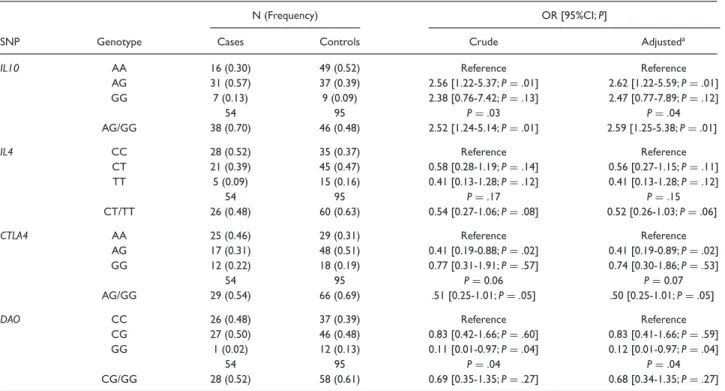
DAO+8956 C>G in cases and controls are shown in Table 3. No deviations from Hardy-Weinberg equilib-rium were observed in the control group. Results of lo-gistic regression models showed an association between
IL10–1082 A>G and increased risk of hypersensitivity reaction (Table 3), with OR values of 2.57 for AG and 2.38 for GG carriers (P=.03 for the codominant model). Accordingly, analysis under a dominant model showed increased risk of hypersensitivity reaction for allele G carriers (AG/GG; OR=2.52;P=.01).
By contrast, the SNPDAO+8956 C>G was asso-ciated with a strong protective effect, with OR values of 0.83 for CG and 0.11 for GG genotype (P =.04 for the codominant model), suggesting an allele dose effect (Table 3). The frequency of heterozygotes was similar in cases (0.50) and controls (0.48), whereas GG homozygotes showed a very low frequency among cases (0.02) as compared to controls (0.13). Accordingly, results of the dominant model were not statistically signiicant, suggesting that the effect may be speciic for homozygotes. However, this trend was not supported by the Cochran-Armitage trend test (P=.07). Similar results were obtained for CTLA4 +49 A>G SNP, with OR values suggesting a protective effect for AG genotype (OR=0.41;P=.02) and G carriers (AG/GG; OR=0.51;P=.05).
The frequency of IL4–589 C/T was also increased among controls, suggesting a protective effect. How-ever, no signiicant results were observed (Table 3). Results obtained for all SNPs remained virtually the same after adjustment for age and sex (Table 3).
Gene-Gene Interaction and Multivariate Analysis
Table 3.Association Between Candidate SNPs atIL10,IL4,CTLA4,andDAOGenes and Hypersensitivity to NSAIDs
N (Frequency) OR [95%CI;P]
SNP Genotype Cases Controls Crude Adjusteda
IL10 AA 16 (0.30) 49 (0.52) Reference Reference
AG 31 (0.57) 37 (0.39) 2.56 [1.22-5.37;P=.01] 2.62 [1.22-5.59;P=.01]
GG 7 (0.13) 9 (0.09) 2.38 [0.76-7.42;P=.13] 2.47 [0.77-7.89;P=.12]
54 95 P=.03 P=.04
AG/GG 38 (0.70) 46 (0.48) 2.52 [1.24-5.14;P=.01] 2.59 [1.25-5.38;P=.01]
IL4 CC 28 (0.52) 35 (0.37) Reference Reference
CT 21 (0.39) 45 (0.47) 0.58 [0.28-1.19;P=.14] 0.56 [0.27-1.15;P=.11]
TT 5 (0.09) 15 (0.16) 0.41 [0.13-1.28;P=.12] 0.41 [0.13-1.28;P=.12]
54 95 P=.17 P=.15
CT/TT 26 (0.48) 60 (0.63) 0.54 [0.27-1.06;P=.08] 0.52 [0.26-1.03;P=.06]
CTLA4 AA 25 (0.46) 29 (0.31) Reference Reference
AG 17 (0.31) 48 (0.51) 0.41 [0.19-0.88;P=.02] 0.41 [0.19-0.89;P=.02]
GG 12 (0.22) 18 (0.19) 0.77 [0.31-1.91;P=.57] 0.74 [0.30-1.86;P=.53]
54 95 P=0.06 P=0.07
AG/GG 29 (0.54) 66 (0.69) .51 [0.25-1.01;P=.05] .50 [0.25-1.01;P=.05]
DAO CC 26 (0.48) 37 (0.39) Reference Reference
CG 27 (0.50) 46 (0.48) 0.83 [0.42-1.66;P=.60] 0.83 [0.41-1.66;P=.59]
GG 1 (0.02) 12 (0.13) 0.11 [0.01-0.97;P=.04] 0.12 [0.01-0.97;P=.04]
54 95 P=.04 P=.04
CG/GG 28 (0.52) 58 (0.61) 0.69 [0.35-1.35;P=.27] 0.68 [0.34-1.35;P=.27]
NSAID indicates nonsteroidal anti-inlammatory drug; OR, odds ratio; SNP, single nucleotide polymorphism.
aResults were adjusted for age and sex.
Table 4.Multivariate Analysis
Gene Genotype OR [95%CI] P-Valuea
IL10 AA Reference .03
AG 2.61 [1.22-5.55]
GG 2.38 [0.75-7.58]
DAO CC Reference .04
CG 0.86 [0.42-1.76]
GG 0.12 [0.01-0.96]
OR indicates odds ratio.
aP=.03 for comparisons between a model including onlyIL10and the multiple model.
regression models. Statistically signiicant interactions were not observed for any pair (data not shown). Finally, a stepwise logistic regression analysis was per-formed to deine the best model to explain NSAIDs hypersensitivity considering the genetic and nongenetic variables investigated in the study. Results of mul-tivariate logistic regression models including IL10 – 1082 A>G andDAO+8956 C>G SNPs are shown in Table 4. The OR values obtained for IL10and DAO
genotypes were similar to those observed in univariate models. Taken together, these results suggest thatIL10
andDAOSNPs exert independent effects in susceptibil-ity to NSAID hypersensitivsusceptibil-ity.
Discussion
In the last decade the most frequent studies related to genetic factors affecting hypersensitivity to
NSAIDs have included leukotriene synthesis and drug metabolism enzymes such as cytochrome P450 isoenzymes, diamino oxidase, and HLA genes.16
Although it is thought that leukotriene overproduction is the main nonallergic mechanism found in hypersensitivity to NSAIDs, there are some events that occur in nonallergic hypersensitivity to NSAIDs cases that are not explained by this type of mechanism. For instance, antihistamine administration is necessary for therapeutic management, although the mechanism of histamine secretion is unknown. After its release, his-tamine may undergo oxidative deamination catalyzed by the diamino oxidase enzyme to imidazole acetaldehyde, which is converted to an imidazoleacetic acid riboside and excreted in urine.21The gene encoding
evaluated theDAO+8956 C>G polymorphism, which causes a substitution on His645Asp,15, and we veriied
that those who were homozygous to GG presented lower risk of having hypersensitivity to NSAIDs (P =.04, OR =0.11, 95%CI =0.01-0.97). Agundez et al22 found increased frequency of the polymorphic
variant in diamino oxidase gene 16 Met allele (rs10156191) and lower ability to metabolize histamine in subjects with hypersensitivity to NSAIDs.
Another intriguing point is the high frequency of certain major histocompatibility complex alleles among patients with cross-reactive hypersensitivity to NSAIDs. Quiralte et al23 found a higher frequency
of HLA-DR11 alleles in cases compared to controls. Some hypotheses are proposed for the role of major histocompatibility complex molecules in drug allergy but not in nonallergic hypersensitivity.24
Kurosawa et al25 demonstrated that the frequency of TT/CT genotypes in IL-13 polymorphism –1111 was higher than that of the CC genotype in NSAID-exacerbated asthma disease compared to an aspirin-tolerant group and controls. Interleukin-13 is a cytokine derived from Th2 cells that induces IgE production by B cells and retains a main role in allergic-induced asthma. According to Cameron et al,26 the
–1112 T allele drives IL-13 transcription in the Th2 milieu. Regarding this subject, we decided to analyze the polymorphism of IL-10, IL-4 cytokines, and the CTLA-4 molecule in nonallergic hypersensitivity to NSAIDs.
IL-10 is an important cytokine in the immunoregula-tion and control of inlammaimmunoregula-tion because it inhibits the production of Th1 and Th2 cytokine proiles.27IL-10 is a key cytokine of the regulatory T proile produced by T and B lymphocytes and other cells. In the presence of IL-10, T lymphocytes do not proliferate and do not produce cytokines in response to an allergen. The IL-10 gene contains 5 exons and is located on the long arm of chromosome 1, between 1q31 and 1q32.28
In the proximal promoter region of the IL-10 gene, 3 SNPs located at the –1082 (A>G), –819 (T>C), and –592 (C>A) positions can be found. The level of production of the cytokine is mainly determined by the synthesis rate of mRNA, which in turn depends on the polymorphism in the promoter.29 Regarding the –1082
position of the IL-10 promoter region, studies have shown that the GG genotype drives a high production of this cytokine, the GA genotype an intermediate production of IL-10, and the AA genotype a low production of the cytokine.30With regard to theIL10
–1082 polymorphism, the G allele carriers were found to be signiicantly associated with hypersensitivity to NSAIDs (P=.01). This would mean that high produc-tion of IL-10 would be a risk factor for nonallergic hy-persensitivity (OR=2.52; 1.24-5.14). We have observed
in a previous report that the –1082 AA genotype was much more frequent in HIV-positive patients allergic to efavirenz than in nonallergic patients (P = .019; OR=3.625; 95%CI=1.210 to 10.860).31 Comparing our present work with previous reports, one can hy-pothesize that low production of IL-10 is a risk factor for drug allergy but a protection against nonallergic hypersensitivity.
IL-4 is a cytokine that plays a central role in the development of allergic asthma and atopy. Rosenwasser et al32 found that patients homozygous for the
poly-morphic T allele (–589 C/T) presented higher produc-tion of IL-4. Therefore, gene polymorphisms of this cytokine can alter its transcription and translation, inluencing the pathogenesis of allergic diseases.33 The
IL4gene is located on chromosome 5q31, and to date, about 19 polymorphisms in this gene are known. We found a combined association of the IL-4 –589T allele (TT+CT) with the IL-10 –1082A allele (AG+AA) in allergy to efavirenz (P =.015; OR =15.970, 95% CI=0.8477-300.9),34that is, association between high
IL-4 and low IL-10 production in efavirenz allergy. In the present study, we found no association between cases and controls for genotype and allele frequencies in IL4 –589 C>T. However, after adjustment for age and sex, it was observed that T carrier subjects (CT+TT) showed a tendency for lower risk of presenting adverse hypersensitivity to NSAIDs (OR=0.52, 95%CI= 0.26-1.03;P=.06).
The CTLA-4 molecule is a member of the im-munoglobulin superfamily expressed on activated T cells. It binds to the B7 molecule on the surface of antigen-presenting cells, resulting in negative signals to the T cell, affecting activation, proliferation, cytokine production, and immune response.35,36Polymorphisms in theCTLA4gene, especially in the+49 A>G coding region, affect immunoregulation and augment the risk of autoimmune and allergic diseases. The G allele is related to a lower expression of CTLA-4 molecules on the surface of T cells, interfering in downregulation of cellular activation. It was found that this polymorphism was associated with some autoimmune diseases such as Graves disease, thyroiditis of Hashimoto, multiple scle-rosis, systemic lupus erythematosus,37,38 asthma, and
rhinitis as well.39 Our results showed that, forCTLA4 +49 SNP, G allele carriers (AG+GG) presented a lower risk of having hypersensitivity to NSAIDs (OR=0.51, 95%CI=0.25-1.01;P=.05).
models, suggesting that the effects of these SNPs are independent.
In conclusion, these results suggest that polymor-phisms in regulatory targets of the immune response and in DAO gene could modulate an individual’s susceptibility to NSAID hypersensitivity reactions. Further studies will be necessary to complement our results.
Acknowledgments
We thank all the participants from the GPUIM (Grupo de Prevenc¸˜ao do Uso Indevido de Medicamentos) for their direct and indirect contributions to this work.
Contributions of Authors
All authors made substantial contributions to conception, analysis, and interpretation of data for this work.
Author Disclosure Statement
No competing inancial interests exist.References
1. World Health Organization. The importance of pharma-covigilance: safety monitoring of medicinal products. Geneva, Switzerland WHO, 2002. http://apps.who.int/medicinedocs/pdf/ s4893e/s4893e.pdf. Accessed October 20, 2016.
2. Kowalski ML, Makowska JS, Blanca M, et al. Hypersensitivity to nonsteroidal anti-inlammatory drugs (NSAIDs)–classiica tion, diagnosis and management: review of the EAACI/ENDA# and GA2LEN/HANNA*.Allergy. 2011;66:818-829.
3. Khan DA, Solensky R. Drug allergy.J Allergy Clin Immunol. 2010;125:S126-S137.
4. Thong BY, Tan TC. Epidemiology and risk factors for drug allergy.Br J Clin Pharmacol. 2011;71:684-700.
5. Kowalski ML, Asero R, Bavbek S, et al. Classiication and practical approach to the diagnosis and management of hy-persensitivity to nonsteroidal anti-inlammatory drugs.Allergy. 2013;68:1219-1232.
6. Asero R. Clinical management of adult patients with a history of nonsteroidal anti-inlammatory drug-induced ur-ticaria/angioedema: update. Allergy Asthma Clin Immunol. 2007;3:24-30.
7. S´anchez-Borges M. NSAID hypersensitivity (respiratory, cuta-neous, and generalized anaphylactic symptoms).Med Clin North Am. 2010;94:853-864.
8. Cornejo-Garc´ıa JA, Jagemann LR, Blanca-L ´opez N, et al. Ge-netic variants of the arachidonic acid pathway in non-steroidal anti-inlammatory drug-induced acute urticaria.Clin Exp Al-lergy. 2012;42:1772-1781.
9. Do ˜na I, Blanca-L ´opez N, Cornejo-Garc´ıa JA, et al. Character-istics of subjects experiencing hypersensitivity to non-steroidal anti-inlammatory drugs: patterns of response.Clin Exp Allergy. 2010;41:86-95.
10. Hizawa N. The search for genetic links in NSAID-induced acute urticaria and the arachidonic acid pathway.Clin Exp Allergy. 2012;42:1660-1663.
11. Kim SH, Park HS. Genetic markers for differentiating aspirin-hypersensitivity.Yonsei Med J. 2006;47:15-21.
12. Torres-Galvan MJ, Ortega N, Sanch´ez-Garcıa F, et al. LTC4-synthase A-444C polymorphism: lack of association with
NSAID-induced isolated periorbital angioedema in a Span-ish population. Ann Allergy Asthma Immunol. 2001;87:506-510.
13. Mastalerz L, Setkowicz M, Sanak M, et al. Hypersensitivity to aspirin: common eicosanoid alterations in urticaria and asthma. J Allergy Clin Immunol. 2004;113:771-775.
14. S´anchez-Borges M, Acevedo N, Vergara C, et al. The A-444C polymorphism in the leukotriene C4 synthase gene is associated with aspirin-induced urticaria.J Investig Allergol Clin Immunol. 2009;19:375-382.
15. Ayuso P, Garc´ıa-Mart´ın E, Mart´ınez C, et al. Genetic variability of human diamine oxidase: occurrence of three nonsynonymous polymorphisms and study of their effect on serum enzyme activity.Pharmacogenet Genomics.2007;17:687-693.
16. Oussalah A, Mayorga C, Blanca M, et al. Genetic variants asso-ciated with drugs-induced immediate hypersensitivity reactions: a PRISMA-compliant systematic review.Allergy. 2016;71: 443-462.
17. Romano A, Torres MJ, Castells M, et al. Diagnosis and manage-ment of drug hypersensitivity reactions.J Allergy Clin Immunol. 2011;127:S67-S73.
18. Caimmi S, Caimmi D, Bousquet PJ, et al. How can we bet-ter classify NSAID hypersensitivity reactions? Validation from a large database. Int Arch Allergy Immunol. 2012;159:306-312.
19. Brockow K, Garvey LH, Aberer W, et al. Skin test concentrations for systemically administered drugs-an ENDA/EAACI Drug Allergy Interest Group position paper. Allergy. 2013;68:702-712.
20. Court MH. Michael H. Court’s (2005-2008) online calculator. Tufts University Web site 2012.
21. Garc´ıa-Mart´ın E, Ayuso P, Mart´ınez C, et al. Histamine phar-macogenomics.Pharmacogenomics. 2009;10:867-883.
22. Ag ´undez JA, Ayuso P, Cornejo-Garc´ıa JA, et al. The diamine oxidase gene is associated with hypersensitivity response to non-steroidal anti-inlammatory drug.PLoS One. 2012;7:e47571. 23. Quiralte J, S´anchez-Garc´ıa F, Torres MJ, et al. Association
of HLA-DR11 with the anaphylactoid reaction caused by nonsteroidal anti-inlammatory drugs.J Allergy Clin Immunol. 1999;103:685-689.
24. Bharadwaj M, Illing P, Theodossis A, et al. Drug hypersensi-tivity and human leukocyte antigens of the major histocom-patibility complex.Annu Rev Pharmacol Toxicol. 2012;52:401-403
25. Kurosawa M, Sutoh Y, Yukawa T, et al. Hypothetical mech-anism of aspirin-exacerbated respiratory disease based on re-cent investigations of gene polymorphisms in Japanese patients. J Allergy Ther.2016;7:1-10.
26. Cameron L, Webster RB, Strempel JM, et al. Th2 cell-selective enhancement of human IL13 transcription by IL13 –1112C>T, a polymorphism associated with allergic inlammation.J Immunol 2006;177:8633-8642.
27. Guglielmi L, Fontaine C, Gougat C, et al. IL-10 promoter and IL4-R gene SNPs are associated with immediateβ-lactam allergy in atopic women.Allergy.2006;61:921-927.
28. Qiao HL, Wen Q, Gao N, et al. Association of 10 level and IL-10 promoter SNPs with speciic antibodies in penicillin-allergic patients.Eur J Clin Pharmacol. 2007;63:263-269.
29. Edwards-Smith CJ, Jonsson JR, Purdie DM, et al. Interleukin-10 promoter polymorphism predicts initial response of chronic hepatitis C to interferon alfa.Hepatology1999;30:526-530. 30. Turner DM, Williams DM, Sankaran D, et al. An investigation
of polymorphism in the interleukin-10 gene promoter.Eur J Immunogen. 1997;24:1-8.
patients infected with human immunodeiciency virus.Braz J Infect Dis. 2014;18:445-448.
32. Rosenwasser LJ, Klemm DJ, Dresback J, et al. Promoter poly-morphisms in the chromosome 5 gene cluster in asthma and atopy.Clin Exp Allergy Suppl.1995;2:74-78.
33. Kamali-Sarvestani E, Ghayomi MA, Nekoee A. Association of TNF-α–308 G/A and IL-4 –589 C/T gene promoter polymor-phisms with asthma susceptibility in the south of Iran.J Investig Allergol Clin Immunol. 2007;17:361-366.
34. Rodrigues RO, Rabenhorst SH, de Carvalho PG, et al. As-sociation of IL10, IL4, IFNG and CTLA4 gene polymor-phisms with efavirenz hypersensitivity reaction in patients in-fected with human immunodeiciency virus.Jpn J Infect Dis. In press.
35. Milicic A, Brown MA, Wordsworth BP. Polymorphism in codon 17 of the CTLA-4 gene (+49 A/G) is not associated with
susceptibility to rheumatoid arthritis in British Caucasians. Tissue Antigens. 2001;58:50-54.
36. Lee YH, Kim YR, Ji JD, et al. Polymorphisms of the CTLA-4 exon 1 and promoter gene in systemic lupus erythematosus. Lupus. 2001;10;601-605,
37. Pavkovic M, Georgievskib B, Cevreska L, et al. CTLA-4 exon 1 polymorphism in patients with autoimmune blood disorders. Am J Hematol.2003;72:147-149.
38. M¨aurer M, Loserth S, Kolb-M¨aurer A, et al. A polymorphism in the human cytotoxic T-lymphocyte antigen 4 (CTLA4) gene (exon 1+49) alters T-cell activation.Immunogenetics. 2002;54:1-8.