ISBN 978-0-7277-6067-8
© The authors and IGS: All rights reserved, 2019 doi: 17ecsmge-2019-Y-XXXX
Degradation assessment of recycled aggregates from
Construction and Demolition Waste through wet-dry
cycles
Évaluation de la dégradation des agrégats recyclés provenant des
Déchets de Construction et de Démolition par des cycles de
mouillage-séchage
P. M. Pereira, C. S. Vieira, M. L. LopesCONSTRUCT-Geo, Departmant of Civil Engineering, Faculty of Engineering of the University of Porto, Porto, Portugal
ABSTRACT: In recent years, several studies and applications of recycled aggregates coming from
Construc-tion and DemoliConstruc-tion Waste (CDW) have been carried out, but the knowledge related to the long-term behaviour of these alternative materials is still fairly limited. The breakage of CDW particles is commonly pointed out as an issue for the use of these recycled materials. This paper studies the change of the particle size distribution of a recycled aggregate coming from CDW due to degradation agents simulated trough 10 wet-dry cycles under controlled conditions. The effects on particle density, water absorption, shape index, flakiness index, sand equivalent value, Los Angeles abrasion, aggregate crushing value, water-soluble sulphate content are assessed. Wet-Dry cycles have degraded the mixed recycled aggregate, increasing the amount of particles with small di-mensions, however the changes in its mechanical and physical behaviour are not very significant. LA abrasion loss of this recycled aggregate is high making its use on unbound pavement layers difficult.
RÉSUMÉ: Ces dernières années, plusieurs études et applications d'agrégats recyclés provenant de déchets de
construction et de démolition (DCD) ont été réalisées, mais les connaissances relatives au comportement à long terme de ces matériaux de remplacement sont encore assez limitées. La fragmentation des particules DCD est généralement considérée comme un problème lors de l’utilisation de ces matériaux recyclés. Cet article étudie l'évolution de la distribution granulométrique des agrégats recyclés provenant de DCD en raison des agents de dégradation simulés au travers de dix cycles de mouillage-séchage dans des conditions contrôlées. Les effets sur la masse volumique réelle, le coefficient d’absorption d'eau, le coefficient de forme, le coefficient d’aplatissement, la valeur équivalente de sable, la résistance à la fragmentation, la valeur du concassage des granulats, la teneur en sulfate hydrosoluble sont évalués. Les cycles de mouillage-séchage ont dégradé la granu-lométrie du agrégat recyclé, le rendant plus fin, mais les changements de comportement mécanique et physique ne sont pas très importants. Le coefficient de Los Angeles de cet agrégat recyclé est élevé, ce qui le rend diffi-cile à utiliser sur des couches de chaussée non liées.
Keywords: Environmental sustainability; Recycled aggregates; Construction and demolition waste; Wet-dry
1 INTRODUCTION
With population growth and rapid industrialization, large amount of waste materials are being generated from human activities. A significant proportion of these waste materials are produced from the con-struction industry. Concon-struction and demolition wastes (CDW) are wastes derived from construction, reconstruction, cleaning of the work site and earth-works, demolition and collapse of buildings, maintenance and rehabilitation of existing constructions.
Considering the need to find new ways of avoiding landfilling of inert waste and preserving natural resources, recent studies have been carried out on the use of recycled aggregates in concrete (Silva et al., 2016) and base layers of transport infrastructures (Arulrajah et al., 2013; Vieira & Pereira, 2015). However, the long term performance of these alternative materials is a major concern and a barrier to their use in some European countries.
The knowledge related to the long-term behaviour of these alternative materials is still fairly limited. Some studies have been carry out on the effects of use recycled aggregates on the durability of concrete (Guo et al. 2018). Studies regarding the long-term behaviour of recycled aggregates in geotechnical and pavement applications are very scarce.
The breakage of CDW particles is commonly pointed out as an issue in the use of these recycled materials as filling material of structural embankments and base layers of transport infrastuctures.
This paper studies the changes of the particle size distribution of a recycled aggregate coming from CDW due to degradation agents simulated trough several wet-dry (W-D) cycles under controlled conditions. The effects on particle density, water absorption, shape index, flakiness index, sand equivalent value, Los Angeles abrasion, crushing resistance and water-soluble sulphate content are also analysed.
Most of the studies found in the literature have been carried out on selected recycled aggregates:recycled concrete aggregates, crushed bricks, reclaimed asphalt pavement (Arulrajah et al. 2013; Rahman et al. 2014). However, the present study was performed with a mixed recycled aggregate (concrete, mortar, ceramics,…) which corresponds to the materials actually available on the Portuguese market.
In the following sections the materials are described and test results are presented and discussed.
2 MATERIALS AND METHODS
2.1 Material
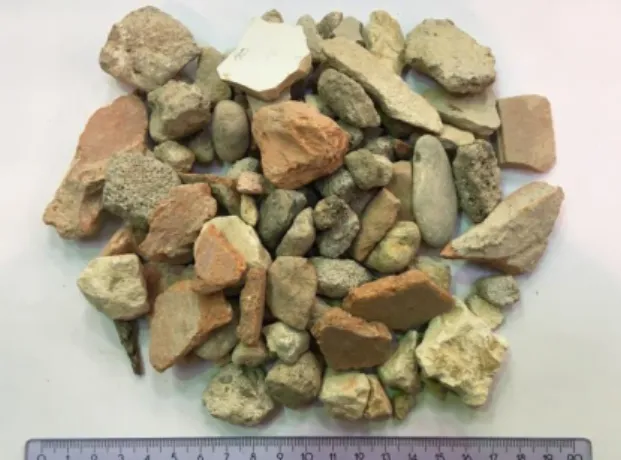
The recycled aggregate was collected from a Portuguese recycling plant located in the centre of the country, resulting from the recovery of mixed CDW coming mainly from the demolition or rehabilitation of housing buildings. Figure 1 illustrates one sample of the recycled aggregate used in this study. Its constituents will be described in 3.1.
Figure 1. Sample of recyled aggregate used in this study (ruler in centimetres)
2.2 Test procedures
To evaluate the suitability of the recycled CDW aggregate for pavement applications, a
laboratory program was carry out, involving the tests currently performed on granular materials. The change of physical, mechanical and chemical properties of recycled CDW aggregate induced by several W-D cycles was evaluated.
The potential degradation effect was induced by 10 W-D cycles. One W-D cycle consists of placing a specimen into an electric oven under a temperature (T) of 60ºC for 7 days, and then putting it in a humidity chamber (T = 20ºC and relative humidity close to 100%) for another 7 days period. Thus, each W-D cycle lasts 2 weeks.
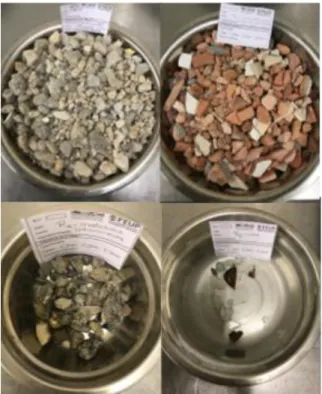
The constituents of the myxed recycled aggregate were classified according to the European Standard EN 933-11 (2009) by hand sorting particles of different constituents (concrete, concrete products, mortar, concrete masonry units; unbound aggregate, natural stone, hydraulically bound aggregate; clay masonry units, calcium silicate masonry units; bituminous materials; glass; soils) – Figure 2.
Figure 2. Example of the constituents of the recycled aggregate after hand sorting
The grain size distribution was determined by the sieving method with washing of the aggregates to remove clay particles and others aggregate fine particles following the standard EN 933-1 (2012).
Geometrical characteristics of the recycled aggregate were evaluated by the flakiness index (Figure 3a) as recommended in EN 933-3 (2012) and the shape index according to EN 933-4 (2008). Particle density and water absorption (Figure 3b) were determined according to EN 1097-6 (2013).
Figure 3. Characterization of the recycled aggre-gate: a) determination of flakiness index; b) determi-nation of particle density and water absorption
The assessment of fines of the material under study was evaluated through the sand equivalent test, SE (10) (EN 933-8, 2012). This test is performed on a 0/2 mm test specimen of aggregates with a maximum fines content of 10 %.
The sand equivalent test intends to show the relative proportions of fine dust or clay-like ma-terials in fine aggregates (or granular soils). The term “sand equivalent” expresses the concept that most fine aggregates are mixtures of desira-ble coarse particles (e.g., sand) and generally undesirable clay or plastic fines and dust.
The mechanical behaviour of the recycled aggregate was evaluate through Los Angeles (L.A.) abrasion test and the crushing test. Los
Angeles abrasion test is a common test used to indicate aggregate toughness and abrasion characteristics. It is based on the degradation of the aggregate when placed in a rotating drum with steel spheres. During drum rotation the aggregate degrades by abrasion and impact with other aggregate particles and steel spheres.
The Los Angeles coefficient was estimated based on the European Standard EN 1097-2 (2010)
The aggregate crushing value (ACV) was evaluated according to the British Standard BS 812-110 (1990). The aggregate crushing value gives a relative measure of the resistance of an aggregate to crushing under a gradually applied compressive load.
3 RESULTS AND DISCUSSION
3.1 Constituents of the recycled aggregate
The constituents of the recycled CDW aggregate obtained by hand sorting of the particles (Figure 2) are listed on Table 1.Table 1. Classification of recycled CDW aggregate constituents
Constituents CDW
Unbound aggregates, natural stone, Ru (%) 35.8
Concrete and mortar, Rc (%) 31.9
Masonry, Rb (%) 20.7 Soil, Rs (%) 9.6 Bituminous materials, Ra (%) 0.7 Glass, Rg (%) 0.2 Others, X (%) 0.7 Floating particles, FL (cm3/kg) 0.8
The recycled aggregate consists mainly of unbound aggregates, crushed concrete (concrete products, mortar, concrete masonry units), and masonries (clay masonry units, calcium silicate masonry units, aerated non-floating concrete). A significant percentage of soils was also record-ed.
3.2 Geometrical properties of the recycled
aggregate
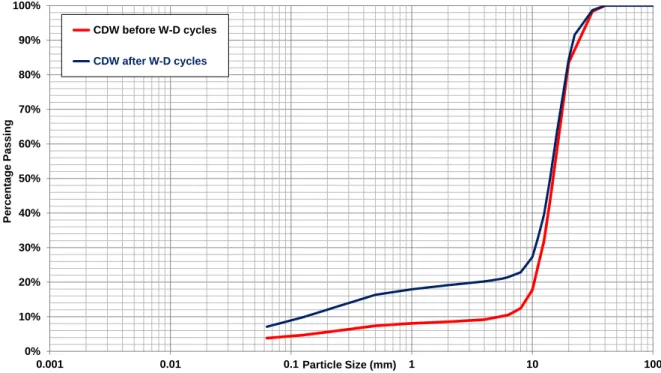
The results of the grain size distribution per-formed on the recycled CDW aggregate before and after the W-D cycles are presented in Figure 4. Each curve represents the mean curve of 3 tested samples.
In general, after the W-D cycles the aggregate has become more fine, ie, with higher content of small particles. However, the changes in the size range 14 - 31.5mm are not relevant, which re-veals that changes of temperature and humidity have reduced influence on the larger particles of the recycled aggregate. However, after the W-D cycles the recycled aggregate presents a higher percentage of particles with dimensions lower than 14 mm. For example, the percentage of par-ticles lower than 4 mm increased from 9% to 20% after the W-D cycles and for 1 mm aperture sieve the percentage passing increased from 8% to 18% after the W-D cycles. Notwithstanding, the percentage of fine particles (< 0.063mm) in-creased from 4% to 7%.
Figure 4 shows that the disaggregation of the particles induced by W-D cycles occurred manly for particles lower than 14 mm.
The geometrical characteristics of the aggre-gate was also evaluated through the Flakiness index (FI) and Shape index (SI). FI indicates the mass percentage of flat particles (with smaller dimension lower than half of the major dimen-sion), while SI is the mass of particles having a ratio between the maximum and minimum size greater than 3.
Figure 5 illustrates the values obtained in the laboratory characterization for FI and SI for samples before and after W-D cycles. After ex-posure to 10 W-D cycles, FI decreased from 19 % to 16 % and SI reduced from 27 % to 20 %. The reduction of these indexes shows that the mass of flat (not spherical) particles tend to reduce after the degradation effects, which is in agreement with the changes in the grain size dis-tribution shown in Figure 4. Notwithstanding this evidence should be carefully analysed since
the tests are carried out only for particles re-tained in the sieve 4 mm which means that, for the same mass, the number of particles really analysed is smaller for samples after W-D cy-cles.
Table 2 presents the mean values of the sand equivalent (SE (10)) of three samples tested be-fore and after the W-D cycles.
Figure 4. Grain size distribution for recycled CDW aggregate before and after W-D cycles
Figure 5. Comparative analysis of FI and SI of the studied material (before and after W-D cycles)
There is a reduction in the equivalent value from 19.7% to 11.5% with the exposure of the recycled aggregate to the W-D cycles. This reduction was expected, since there is an increase of the fine particles after the W-D cycles (Figure 4).
Table 2. Sand equivalent results for recycled aggre-gate before and after W-D cycles
CDW SE(10) (%) Before W-D Cycles 19.7 After W-D Cycles 11.5 0% 10% 20% 30% 40% 50% 60% 70% 80% 90% 100% 0.001 0.01 0.1 1 10 100 Per cen tag e Passing Particle Size (mm) CDW before W-D cycles CDW after W-D cycles 19% 27% 16% 20% 0% 5% 10% 15% 20% 25% 30% 35% 40%
Flakiness index Shape index
CDW before W-D Cycles CDW after W-D Cycles
ECSMGE-2019 – Proceedings 6 IGS
3.3 Mechanical and physical properties of
the recylced aggregate
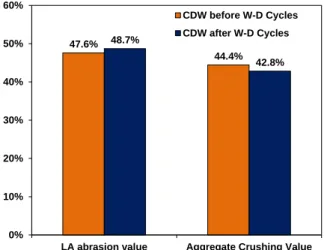
The Los Angeles (LA) abrasion coefficient and the aggregate crushing value of the recycled ag-gregate are summarized in Figure 6. Figure 6 shows that there is no significant change in the mechanical resistance of this recycled aggregate induced by the W-D cycles. However the abra-sion loss value obtained for this recycled aggre-gate is quite high and even higher than the value of 36 for a crushed brick aggregate investigated by Arulrajah et al. (2013).
An LA abrasion maximum value of 40-45 is adopted by Portuguese specifications for unbounded pavement layers, which would make unfeasible the use of this recycled aggregate for this specific application. Nevertheless it meets the requirements for concrete production.
Figure 6. Comparative analysis of the mechanical properties of the studied material
The mean values and the coefficients of varia-tion of the particle density and water absorpvaria-tion obtained on three samples of the recycled CDW aggregates (after and before the W-D cycles) are presented in Table 3. The tests were carried out on two different particle size fractions (4.0/31.5 mm and 0.063/4.0 mm).
The values for particle density are in accord-ance with those usually obtained for natural
ag-gregates. Regarding the water absorption, the values obtained for this recycled material are higher than those of natural materials. Neverthe-less, the W-D cycles did not induce significant changes in the particle density and water absorp-tion values (for particle size fracabsorp-tion 4.0/31.5).
The high coefficient of variation for water ab-sorption of particles in the size particle fraction 0.063/4.0 mm could be explained by the fact that when the sample is placed in the pycnome-ter and filled with wapycnome-ter the finer particles tend to settle and fill all the voids. This stops the oc-cluded air between the particles from rising to the surface, leading to incorrect results
.
Even if most of the fine particles are removed by washing, the porous nature of the fine recy-cled aggregate allows many particles to remain after washing (some clayish with cohesive char-acteristics) and others to be produced by the dis-aggregation of bigger particles during the drying process.
Considering that much of the very fine mate-rial is clays, efforts have been made to find a way to avoid their cohesion and the erroneous results of water absorption.
Sodium hexametaphosphate is a well-known clay dispersant used to prepare clay suspensions in Geotechnical Engineering. To avoid cohesion of the particles, sodium hexametaphosphate was diluted in the demineralized water used in the particles density and water absorption tests. A concentration of 1 g/L was used as suggested by Rodrigues et al. (2013).
The mean values and the coefficients of varia-tion of particle density and water absorpvaria-tion tests, carried out on the fine fraction (0.063/4.0 mm) of the recycled CDW aggregate after the W-D cycles, using sodium hexameta-phosphate dispersant are presented on Table 4.
The values of the particles density were not influenced by the use of the dispersant, but the value of the water absorption increased by 2% using sodium hexametaphosphate. The coefficient of variation of the results decreased significantly. 47.6% 44.4% 48.7% 42.8% 0% 10% 20% 30% 40% 50% 60%
LA abrasion value Aggregate Crushing Value CDW before W-D Cycles CDW after W-D Cycles
Table 3. Test results of particles density and water absorption of the recycled aggregate for different particle size fractions
Parameters Particle size fraction
CDW before W-D cycles
CDW after W-D cycles
Apparent particle density (Mg/m3)
4.0/31.5
2.573 (0.5%)* 2.575 (0.3%)
Particle density on an oven-dried basis (Mg/m3) 2.205 (0.4%) 2.205 (0.3%)
Particle density on a saturated and superface-dried basis (Mg/m3)
2.348 (0.4%) 2.349 (0.3%) Apparent particle density (Mg/m3)
0.063/4.0
2.693 (0.9%) 2.731 (2.9%) Particle density on an oven-dried basis (Mg/m3) 2.506 (1.9%) 2.441 (4.7%)
Particle density on a saturated and superface-dried basis (Mg/m3)
2.575 (1.5%) 2.547 (3.7%)
Water absorption (%)
4.0/31.5 6.5 (0.9%) 6.5 (0.7%) 0.063/4.0 2.8 (17.3%) 4.4 (32.5%)
* Value in round brackets is the coefficient of variation
Table 4. Test results of recycled aggregate after W-D cycle, using a sodium hexametaphosphate solution (particle size fraction 0.063/4.0 mm).
Parameters CDW after W-D cycles
Apparent particle density (Mg/m3) 2.739 (0.3%)*
Particle density on an oven-dried basis (Mg/m3)
2.332 (2.4%) Particle density on a saturated and
superface-dried basis (Mg/m3)
2.481 (1.4%)
Water absorption (%) 6.4 (17.3%)
* Value in round brackets is the coefficient of variation
3.4 Water-soluble sulphate content
Water-soluble sulphate content was estimated for original samples and samples submitted to 10 W-D cycles. The results are summarized in Table 5.
Water-soluble sulphate contents are well below the limit of 0.7% recommended by Portuguese specifications for use of recycled aggregates in roadway layers. The effect of W-D cycles was negligible.
Table 5. Water-soluble sulphate content for recycled aggregate before and after W-D cycles
CDW Water-soluble sulphate content (%)
Before W-D cycles 0.115 After W-D cycles 0.135
4 CONCLUSIONS
This study was undertaken to investigate the degradation effects induced by temperature and humidity changes on the geometrical, mechani-cal, physical and chemical properties of a select-ed CDW recyclselect-ed aggregate.
After 10 W-D cycles under controlled conditions, the amount of particles smaller than 14 mm has increased due to the disaggregation of bigger particles. Notwithstanding coarse particles have not changed significantly.
The effects of the W-D cycles on physical, mechanical and chemical properties of the CDW recycled aggregate are not relevant. Neverthe-less, LA abrasion loss of this recycled aggregate is very high.
ECSMGE-2019 – Proceedings 8 IGS Fine particles of recycled CDW aggregates
tend to exhibit cohesive or bonding properties, making the implementation of the procedure de-scribed in the European standard EN 1097-6 (2013) for determination of particle density and water absorption difficult. To attenuate these specificities, sodium hexametaphosphate was used as particle dispersant and satisfactory re-sults were achieved.
5 ACKNOWLEDGEMENTS
This work was financially supported by: Project POCI-01-0145-FEDER-030452 funded by FEDER funds through COMPETE2020 - Programa Operacional Competitividade e Internacionalização (POCI) and by national funds (PIDDAC) through FCT/MCTES.
6 REFERENCES
Arulrajah, A., Piratheepan, J., Disfani, M., Bo,
M. 2013. Geotechnical and
Geoenvironmental Properties of Recycled Construction and Demolition Materials in Pavement Subbase Applications, Journal of
Materials in Civil Engineering 25(8),
1077-1088.
BS 812-110: 1990. Testing aggregates. Methods for determination of aggregate crushing value (ACV), BSI.
EN 933-11: 2009. Tests for geometrical properties of aggregates - Part 11: Classification test for the constituents of coarse recycled aggregate, CEN.
EN 933-1: 2012. Tests for geometrical propertie of aggregates - Part 1: Determination of particle size distribution - Sieving method, CEN.
EN 933-3: 2012. Tests for geometrical propertie of aggregates - Part 3:
Determination of particle shape. Flakiness index, CEN.
EN 933-4: 2008. Tests for geometrical propertie of aggregates - Part 4: Determination of particle shape. Shape index, CEN.
EN 933-8: 2012. Tests for geometrical propertie of aggregates - Part 8: Assessment of fines. Sand equivalent test, CEN.
EN 1097-2: 2010. Tests for mechanical and physical properties of aggregates – Part 2: Methods for the determination of resistance to fragmentation, CEN.
EN 1097-6: 2013. Tests for mechanical and physical properties of aggregates – Part 6: Determination of particle density and water absorption, CEN.
EN 1744-1: 2019. Tests for chemical properties of aggregates – Part 1: Chemical analysis, CEN.
Guo H., Shi C., Guan X., Zhu J., Ding Y., Ling T.-C., Zhang H., Wang Y. 2018. Durability of recycled aggregate concrete – A review. Cement and Conc. Composites 89, 251-259. Rahman M.A., Imteaz M.A., Arulrajah A., Disfani M.M. 2014. Suitability of recycled construction and demolition aggregates as alternative pipe backfilling materials. Journal of Cleaner Production 66, 75-84 Rodrigues, F., Evangelista, L., Brito, J. 2013. A
new method to determine the density and water absorption of fine recycled aggregates. Materials, 16(5), 1045-1051. Silva RV, Brito J, Dhir RK 2016. Establishing a
relationship between modulus of elasticity and compressive strength of recycled aggregate concrete. Journal of Cleaner Production 112, 2171–2186
Vieira, C.S., Pereira, P.M. 2015. Use of recycled construction and demolition materials in ge-otechnical applications: A review,
Resources. Conservation and Recycling 103, 192-204.