Address for correspondence E-mail:
Acknowledgements
This work was funded (in part) by National Funds through the FCT – Fundação para a Ciência e a Tecnologia (Portuguese Foundation for Science and Technology) within the strategic project of CIIE, ref: PEst-OE/CED/ UI0167/2014.
Review of the literature
One of the characteristics of children on the autism spectrum is that they have difficulty understanding the rules that regulate interactions (Wing, 2006). Cripe et al (1993) stated that: “Initiating and maintaining a social interaction with a peer is a basic skill for the develop-ment of friendship. In a relationship, the behaviour of each person influences the other” (page 460).
Quill’s definition (2000) of social competence also encompassed imitation and non-verbal social behav-iours, for example eye contact, gestures and facial expressions. Children on the autism spectrum have difficulty initiating interactions, combining eye contact and gestures to orchestrate turn-taking in an interaction or to influence the behaviour of others (for example, to make a request) and these impairments hamper their participation in social interaction.
Introduction
Some studies have shown that inclusive education of children on the autism spectrum can facilitate the social-isation process, concluding that experiences with other children in school play an essential role in the social, emotional and moral development of those children (Chamberlain et al, 2007; Payne, 2010). Other studies, however, highlight some limitations to the school inclu-sion of children on the autism spectrum, particularly with regard to the quantity and quality of interactions between these children and their peers (Goldstein et al, 1992; Rotheram-Fuller, 2006). These studies, combined with our professional experience, prompted us to invest- igate the social interactions of children on the autism spectrum. The main objective of the study is to invest- igate the types of social interactions that occur between children on the autism spectrum and their neurotypical peers in everyday social contexts in school.
Children on the autism
spectrum: a study of social
interactions in school
Ana Luísa Fernandes Pereira da Silva and Preciosa
Fernandes,
Portugal
Editorial comment
Ana Luísa Fernandes Pereira da Silva is a speech therapist and Preciosa Fernandes is a professor of Psychology in Portugal. In this paper, the authors explored how children with autism interact with their neurotypical peers in a school setting, what features might make this more difficult and how the experience can be improved. They found that in group settings, children with autism sometimes have difficulties with conversation, maintaining social relationships and participating in symbolic play. The authors showed that if their neurotypical peers were accepting and encouraging, the children with autism were more likely to be included in activities. This led to children on the autism spectrum becoming more comfortable in these settings and spending more time in these groups later on. The authors advocate helping neurotypical children understand the features of autism, so that they can be more accepting in their play. This is a small study, but it highlights some important factors which can lead to a better experience in school for children with autism.
autism spectrum, despite their difficulties in interpreting the intentions and feelings of others, seemed to be aware of rejection, ignorance and bullying by their peers (Hartup, 1992). Consistent with earlier studies (Attwood, 1998; Frith, 1989; Sigman and Capps, 1997), Ochs et al (2001) found that as they grow, many children on the autism spectrum increasingly express frustration and difficulty adapting to their peer group.
Rotheram-Fuller (2006) studied the social relationships among 33 children on the autism spectrum and 718 neurotypical peers, comparing two educational levels: kindergarten to 2nd grade (level one – 5 to 8 years old) and 3rd to 5th grade (level two – 9 to 11 years old). Children at level one were generally less rejected and more often included in social networking than children at level two, although they had fewer emotional bonds with their peers than older children with similar problems. The level of cognitive and social development, as well
as lower social understanding and the consequent difficulty in taking another’s perspective were cited as a possible explanation for these findings.
Chamberlain et al (2007) studied the involvement of 17 children (particularly with high-functioning autism and Asperger syndrome) in mainstream classes from 2nd to 5th grades, a total of 398 children. They found that “overall, the average level of social network centrality…
was lower for the children on the autism spectrum than for their peers, they were less accepted, and they had fewer reciprocal friendships among their ‘Top three’ and ‘best friend’ nominations” (Kasari and Rotheram-Fuller, 2007, page 239).
Humphrey and Symes (2011) highlight the interaction patterns of children on the autism spectrum, such as having spent “more time engaged in solitary behaviours, less time engaged in cooperative interaction with peers, and more time engaging in reactive aggression toward peers”, along with more moments of verbal aggression from peers (page 397). Yet a recent study by Hebron and Humphrey (2014) with adolescents on the autism spectrum showed behavioural problems and increasing age as higher risk factors associated with bullying and positive social relationships as protective factors.
Simple behaviours such as sitting side by side or approaching other children are referred to in the litera-ture as ‘basic forms’ of social interaction (Kiernan and Reid, 1987). Kiernan and Reid (1987) referred to other behaviours used in social interaction to express and manipulate emotions, such as crying, smiling or hitting the other. They play an important role in mediating social interactions, not only influencing the conclusion or continuation of the interaction but also acceptance or rejection by peers. Deficits in verbal and non-verbal communication are closely related to the social difficul-ties experienced by children on the autism spectrum. Camargo and Bosa (2009) considered that “social competence are a set of behaviours learned during social interactions, especially in interaction with peers” (page 66) and relates to the performance of the individ-ual in a given social situation. Cripe et al (1993) argued that because children with severe disabilities sometimes use forms of interaction that their peers find difficult to interpret (eg approaching without performing any other action), it is important that their peers are taught to understand these behaviours and interpret them as ways of starting or maintaining a social interaction. Humphrey and Symes (2011) suggest that a specific instruction coming from other children may help them understand when they are trying to initiate an interaction, how to respond to it and initiate social contact in a way that children on the autism spectrum can perceive it. An evaluation by Goldstein et al (1992) of a peer
mediated intervention targeting the social interaction of pre-school children on the autism spectrum and their peers has provided important information about the behaviours observed in children with and without autism. The authors reported that “during baseline, the frequency of interaction between peers and the target children was quite low. In the five minute play sessions, typically no more than an average of five social behaviours were directed to a target child’ (Goldstein et al, 1992, page 296–297).
In an investigation of how peers deal with the inadequate social behaviours of children on the autism spectrum, Ochs et al (2001) studied 16 children with high functioning autism attending public schools in the USA. They found that high functioning children on the
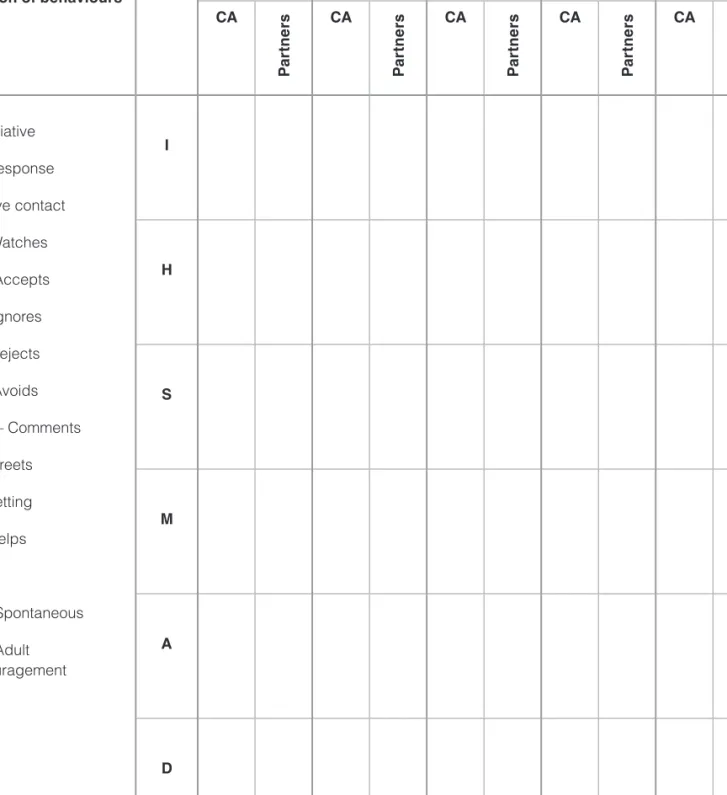
Figure 1 Interaction behaviours checklist Checklist/
Caption of behaviours Child Monday Tuesday Wednesday Thursday Friday
CA Pa rtn ers CA Pa rtn ers CA Pa rtn ers CA Pa rtn ers CA Pa rtn ers I – Initiative R – Response E – Eye contact W – Watches Ac – Accepts Ig - Ignores Rj – Rejects Av – Avoids Com – Comments G – Greets P – Petting H – Helps Sp – Spontaneous Ad – Adult encouragement I H S M A D
Notes: CA – child on the autism spectrum; numbers (1,2,…) are used to indicate children who interact with the child on the autism spectrum.
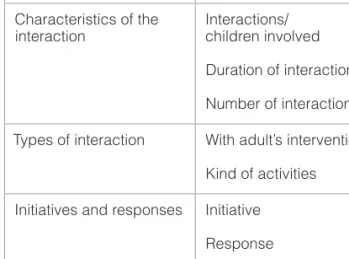
Table 1 Categories and subcategories of analysis relating to participant observation
Categories of analysis Subcategories
Characteristics of the
interaction Interactions/ children involved Duration of interactions Number of interactions Types of interaction With adult’s intervention
Kind of activities Initiatives and responses Initiative
Response
Results and discussion
Characteristics of the interactionThe data in Table 2 confirm the existence of similari-ties and differences amongst the six children on the autism spectrum in the study. We found an association between the duration of interactions and the number of ‘routine’ interactions. The data revealed that children who took part in fewer ‘routine’ interactions also had the tendency to have brief interactions. Children M, S and H, whose interactions were mostly brief, also interacted
with other children less frequently than children A, D
and I whose interactions with other children lasted
longer. We were unable to determine whether there was a direct association or causal relationship between these. Nevertheless, our data indicate that children with more ‘routine’ interactions have a closer relationship with other children, which increases the time spent in interaction and joint activities. The following field note provides support for this interpretation:
tried to initiate play with other children, chasing them. When the children realized that wanted to play, they agreed to his participation, hugging him, talking to him and helping him to hide (Field note 4, February 14, 2013).
Sample and methods
The study focused on the interactions between six children on the autism spectrum and their peers in a Structured Teaching Unit (STU), integrated within a public school (grades 1 to 4, 6 to 10 years old) in north-ern Portugal. Authorisation for the research was sought from the Ethics Committee for Health, the Directorate General for Education and the families.
Data were collected through participant observation (Merriam, 1988; Bogdan and Biklen, 1994) in informal school contexts (playground, cafeteria and study visits) and recorded in the form of field notes (Wayne et al, 2006; Montgomery and Bailley, 2007). We aimed to explore the interactions between children on the autism spectrum and their peers, including how interactions were initiated, and characterised the different types of interactions. Observations were made daily for six months. We created a checklist that allowed a contex-tualised record of encounters. The checklist was based on a number of reference scales: Childhood Autism
Rating Scale (CARS; Schopler et al, 1988); Preverbal Communication Schedule (PVCS; Kiernan and Reid,
1987); Modified Checklist for Autism in Toddlers (M-CHAT; Robins et al, 1999) and the observation guidelines of Transdisciplinary Play-Based Assessment (TPBA; Linder, 2008). The checklist was named the
Interaction Behaviours Checklist (IBC) and is shown in Figure 1.
The observations were made in two phases. The first phase was the daily log of the interaction behaviour using the IBC. Each record corresponded to a situation of interaction between a child on the autism spectrum and other children. These daily records were then compiled into weekly grids containing encounters records in different contexts (playground; cafeteria; study visit). The second phase involved exploring the temporal structure of interactions, using the field notes on daily encounters to highlight elements of behaviour related to before, during and after the interaction, thus providing a contextualised view of the observations. The data resulting from the participant observation were organised into categories (see Table 1) and content analysis (Krippendorf, 2003) was performed.
found that more severely impaired children had fewer friends and less reciprocity in their friendship networks. Child I’s social and communication skills were similar
in many respects to those of M, S and H; but like the
children with better social and communication skills (A and D), she maintained lengthy interactions with a
group of children she was interested in, in a ‘routine’ way. Our observation indicates that I’s more prolonged
inter-actions and regular participation in play with the other children, when compared to children on the autism spec-trum with similar communicative and social impairments, was due to her peers’ positive attitude and acceptance. The following field notes illustrate this assertion:
interacted with his classmates, initiating and responding to other children’s initiatives: they talked and played together (Field note 5, November 23, 2012).
The observation data also helped identify another factor that may be involved in the putative association between the frequency and duration of interactions: children M, S and H had the greatest communication impairments,
at both social and motor levels, and it can be inferred that the development of these children presents major differences from the normal developmental course, which may influence the type and duration of their inter-actions with other children. This assumption is consistent with the results obtained by Rotheram-Fuller (2006) who
Table 2 Characteristics of interaction, by child and observation context Child Observed
situation Interactions/children involved interactionsDuration of interactionsNumber of
In te ra ct ion w ith s ev eral ch ild re n ( ≥3 ) In te ra ct ion w ith f ew ch ild re n ( <3 ) ‘R ou tin e’ in te ra ct ion s (w ith th e sa m e ch ild re n) N o i nt er ac tio n (d ur in g a ll o r m os t o f t he ob se rv at ion s) B rie f Lo ng Fe w in te ra ct ion s (< 3) Se ve ral in te ra ct ion s (≥ 3) A Playground/OA 9 14 12 5 13 14 9 15 Cafeteria 3 6 8 0 7 2 9 0 M Playground/OA 19 3 0 8 20 3 10 12 Cafeteria 6 3 1 0 9 0 8 1 D Playground/OA 12 3 17 3 0 20 1 19 Cafeteria 1 1 2 2 2 1 1 2 S Playground/OA 10 12 5 2 19 5 12 11 Cafeteria 3 5 6 0 8 0 5 3 I Playground/OA 12 7 22 0 0 24 11 13 Cafeteria 3 6 7 0 7 2 8 1 H Playground/OA 11 10 8 13 18 7 11 12 Cafeteria 2 3 0 6 5 0 2 3
We found that interactions taking place at lunchtime were typically short (brief conversations, momentary assistance, …), as evidenced in the field notes:
The behaviour of ’s classmates during lunch was of help and incentive: whenever made a gesture to communicate (finish, help, give me) children said “well done!”. (Field note 10, November 30, 2012)
The importance of this context seems to be related to the greater contact between classmates that provides a space for mutual aid and greater awareness of other children about the difficulties and abilities of children on the autism spectrum, which matches results obtained by Ochs et al (2001), that tell us that the positive inclu-sion is more related with knowledge about capacities and limitations of these children, by other children.
Interaction types
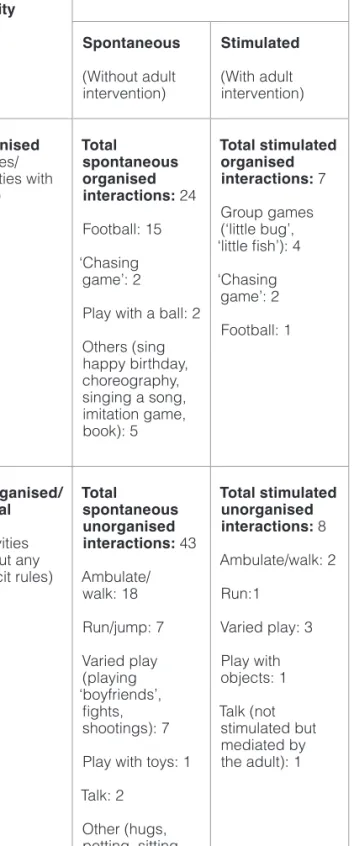
A comprehensive analysis of the types of interaction observed in playground situations is presented in Table 3. We recorded the number of times each type of inter- action (spontaneous or stimulated and organised or not organised) was observed.
The majority of children on the autism spectrum were involved in unorganised spontaneous interactions. The following field note provides an illustration of this:
(...) was approached by the girl who usually stays with him at lunch. [She] started tickling him and then took him for a walk. Then she left him and went to play with other children. didn’t show any reaction... (Field note 8, November 28, 2012)
These data may indicate that the difficulties with under-standing social rules and verbal and motor imitation, which characterise these children (Quill, 2000), limited their participation in social games and organised activi-ties, characterised by Linder (2008) as ‘games with rules’. Quill (2000) stated that active teaching of socially appropriate behaviours is necessary for a child with autism to integrate them into his or her behavioural repertoire. Our observational data corroborated this. We found that the assistance of their peers, particularly
Her classmates showed interest in . In the playground, they played with her: she showed herself passive, accepting other children’s behaviour and sometimes making eye contact (Field note 12, December 2, 2012). In the playground, was always with her three classmates (Field note 13, December 5, 2012).
These field notes highlight the importance of the atti-tudes of peers, which is consistent with Humphrey and Symes’ thesis (2011) that indicates that the existence of committed peers in developing positive relationships with children on the autism spectrum may be crucial for the improvement of social skills and these children’s relationships. We found that the duration and frequency of children on the autism spectrum interactions were more closely related to social, communication, motor and autonomy skills than their age. The data also indicated that the difficulties they had in initiating and maintaining regular, age-appropriate interaction were related to the inability of their peers to interpret their signals. The following field note provides support for this hypothesis:
tried to follow the play of other children in their class (running races) but the other kids did not realise that he was trying to play with them... and he was left out of the game, running alone (Field note 27, January 9, 2013).
The data are consistent with the results of Chamberlain et al’s (2007) study of children with high functioning autism or Asperger syndrome in which they observed that peers’ lack of understanding of these children’s social cues increased the risk of loneliness.
In the cafeteria, all of the children on the autism spectrum, except D and H, always interact with other
children, with their own class, compared to playground/ other activities. The exceptions to the cafeteria peer interaction norm have a fairly plausible explanation: the conversational difficulties of child D severely limited his
communication with other children; child H’s
interac-tions with her peers at meal time were compromised because she relied on an adult to help her eat, and therefore she was physically separated from peers.
through perseverance with interaction and modelling behaviour during playground games, allowed children on the autism spectrum to participate more actively in organised activities, as illustrated by this excerpt from a field note:
The children played (rehearsing a song), taking along with them. While dancing, the girls helped , to work on her choreography. (Field note 12, December 2, 2012)
Throughout the observation phase of the study, adults emerged not only as promoters of more organised activities, but also had a role in explaining the behaviour of children on the autism spectrum to the other child- ren, helping them to understand how to best interact with them. In this respect our observational data are consistent with the results of Ochs et al (2001), who found that the positive inclusion of these children at school is associated with a greater knowledge of their impairment, while lack of knowledge is an obstacle to establishing relationships with these children. Also consistent with the results, Symes and Humphrey (2010) refer to the importance of the adult, mainly the school’s psychologist, as a promoter of peer accept-ance, through training and advice to school and peers.
Initiatives and responses
The category initiatives and responses was divided into two subcategories:
a) initiative – a child performs attempts deliberately
to initiate interaction with others
b) response – a child interprets another’s behaviour
as an invitation to interaction, accepts the invitation and maintains the interaction
Responses were categorised as follows:
fails to respond – the child interprets the behaviour
of the other as an invitation to interaction, but rejects it and does not continue the interaction
not observed – situations where the interaction was
already underway when we started watching, and we were unable to observe who had started it
Table 3 Types of interaction and the frequency with which they were observed
Type of
activity Adult involvement
Spontaneous (Without adult intervention) Stimulated (With adult intervention) Organised (games/ activities with rules) Total spontaneous organised interactions: 24 Football: 15 ‘Chasing game’: 2
Play with a ball: 2 Others (sing happy birthday, choreography, singing a song, imitation game, book): 5 Total stimulated organised interactions: 7 Group games (‘little bug’, ‘little fish’): 4 ‘Chasing game’: 2 Football: 1 Unorganised/ casual (Activities without any explicit rules) Total spontaneous unorganised interactions: 43 Ambulate/ walk: 18 Run/jump: 7 Varied play (playing ‘boyfriends’, fights, shootings): 7 Play with toys: 1 Talk: 2 Other (hugs, petting, sitting on lap, tickling, etc.): 8 Total stimulated unorganised interactions: 8 Ambulate/walk: 2 Run:1 Varied play: 3 Play with objects: 1 Talk (not stimulated but mediated by the adult): 1
in initiating interaction with some of the children with autism, probably because of the difficulties these children have with oral verbal comprehension. This indicates how important it is for other children to under-stand the nonverbal behaviours used by children on the autism spectrum in interactions, as also referred by Humphrey and Symes (2011).
We considered non-occurrence of interaction as method- ologically equivalent to unobserved interactions, so we included in this category situations in which there was no interaction with the children on the autism spectrum. The observational data from field notes were
reorganised into synthesis grids. Table 4 summarises the initiatives and responses of the six children on the autism spectrum and the other children with whom they interacted.
Table 4 indicates that most interactions involving
children on the autism spectrum were initiated by other children, and that the majority of these initiations received a positive response from these children with autism. The initiations from these children, although fewer in number, also received a positive response from the other children most of the time, which is consistent to Humphrey and Symes (2011), who in their study verified that when children on the autism spectrum made social initiations, those were accepted by peers. These data seem to indicate that interaction attempts between children with on the autism spectrum and their neurotypical peers are, at least, somewhat effective. Obviously, the number of effective interactions cannot be considered in isolation from the types of interactions which occur, as discussed above.
The data also show situations in which there was an attempt at interaction by a child on the autism spec-trum, which was not understood by the other children and therefore failed. This situation is captured by the following field note:
Three children were playing with a car and ... was following these children, but without making any attempt to begin interacting... the other children, although looking at , remained involved in their play, without initiating interaction with him, he followed them with his eyes. (Field note 27, April 9, 2013)
Our observational data relating to the social perfor-mance of children on the autism spectrum mostly non-verbal social behaviours corroborates the findings of Ochs et al (2001). We noted that the verbal initia-tives for children without autism proved less effective
Table 4 Initiatives and responses per child
Child Number of observations CA initiates, SA responds CA initiates, SA fails to respond SA initiates, CA responds SA initiates, CA fails to respond Not observed
A 35 15 WAH: 1 4 15 WAH: 3 5 8 M 32 7 WAH: 3 3 11 16 5 D 28 8 2 5 WAH: 1 0 23 S 31 2 1 26 7 2 I 33 9 WAH: 1 0 28 2 3 H 35 4 1 14 WAH: 4 16 7 Total 50 11 107 46 48
Notes: CA: Child on the autism spectrum SA: Child/children without autism WAH: With adult’s help
Another conclusion is that adult intervention was an impor-tant element in stimulating interactions between children on the autism spectrum and their peers. Our conclusions are consistent with those of Ochs et al (2001) for whom the positive inclusion of these children in schools is related to greater knowledge about their problems.
Concluding comments
In summary, three central ideas emerge from this study: 1. Children on the autism spectrum have
a predisposition to isolation, manifested in difficulties with maintaining social
relationships, developing topics of conversation, understanding non-literal meanings and
participating in symbolic play.
2. The interaction between these children and other children is always favourable to their social development.
3. School is an important facilitator of interactions between children on the autism spectrum and other children, but it is necessary to take certain measures so that other children may understand and accept these children.
By the time we finished our research, we had found few studies that specifically levied on the characteristics and types of interactions from children on the autism spectrum. However, we did find comparable studies such as Ochs et al (2001) and Hebron and Humphrey (2013), since our study showed that effective inclusion practices are based mainly on how other children inter-act with these children and their skills and difficulties. From this study, we realised the importance of a positive attitude on behalf of the other children and the difficulty they had in understanding the needs of children on the autism spectrum and how to best meet them. Thus, it seems to us that the adults have the responsibility to mediate these relationships and interactions increasing their frequency and quality, in order to best contribute to their success and expand social networks of children on the autism spectrum. Adults should also encourage participation in group activities and help them improve their social skills which can in turn result in less isolation and discrimination situations.
Summary of findings
This study intended to address the following questions: 1. What types of interactions do neurotypical
children initiate and maintain with children on the autism spectrum in informal situations?
2. How do children on the autism spectrum react to other children in informal situations?
With regard to our first question, we found that children on the autism spectrum have levels of interaction with other children that differ according to their social, communication, motor and autonomy skills, but it is difficult to draw general conclusions about the pattern of interactions. In general, our observations allowed us to conclude: a) there is an association between ‘routine’ interactions and more prolonged interactions, probably due to the greater physical proximity between children, which makes the children on the autism spectrum feel more comfortable and puts the other children at greater ease; b) most interactions were simple playing such as walking or jumping and occurred predominantly as unorganised activities, ie activities with no rules; c) the majority of the interactions were initiated by the other children and not by children on the autism spectrum. With regard to the second question, we found that in most cases when children on the autism spectrum started an interaction they received accepting, positive responses from other children. Similarly, these children usually responded positively to the interaction initia-tives of other children. These observations allowed us to conclude that the reaction of children on the autism spectrum to other children is positive; they aren´t only responding to their initiatives but also, more rarely, initiate interaction with them.
The data confirmed Quill’s (2000) and Wing’s (2006) hypotheses relating the social and communicative impairments of children on the autism spectrum to their level of participation in activities with other children of the same age. We found that the neurotypical children who were more attentive and receptive to children on the autism spectrum facilitated interactions with them and increased the effectiveness of these interactions.
Krippendorf, K (2003) Content analysis: An introduction to its
methodology SAGE: Thousand Oaks.
Linder, T (2008) Transdisciplinary play-based assessment Baltimore: Paul H. Brookes Publishing Co.
Merriam, S B (1988) The case study research in education San Francisco: Jossey-Bass.
Montgomery, P and Bailey, P H (2007) Field notes and theoretical memos in grounded theory Western Journal
of Nursing Research 29 (1) 65–79.
Ochs, E, Kremer-Sadlik, T, Solomon, O and Sirota, K G (2001) Inclusion as social practice: Views of children with autism Social Development 10 (3) 399–419.
Payne, A A (2010) Successful reintegration into a special school Good Autism Pratice 11 (1) 16–22.
Quill, K A (2000) Do-watch-listen-say: Social and
communication intervention for children with autism
Baltimore: Paul H Brookes Publishing Co.
Robins, D, Fein, D and Barton, M (1999) Modified checklist
for autism in toddlers (M-CHAT) available from www2.gsu.
edu/~psydlr/Diana_L._Robins,_Ph.D._files/M-CHAT.pdf (accessed 20 April 2011).
Rotheram-Fuller, E J (2006) Age-related changes in the social inclusion of children with autism in general education classrooms Dissertation Abstracts International 66 (7-A) 2493. Schopler, E, Reichler, R J and Renner, B R (1988)
Childhood Autism Rating Scale (CARS) Los Angeles:
Western Psychological Services.
Sigman, M and Capps, L (1997) Children with autism:
A developmental perspective Cambridge, MA: Harvard
University Press.
Stoer, S and Cortesão, L (2000) Levantando a pedra: Da
pedagogia intermulticultural às políticas educativas numa época de transnacionalização Porto: Edições Afrontamento.
Symes, W and Humphrey, N (2010) Peer-group indicators of social inclusion among pupils with autistic spectrum disorders (ASD) in mainstream secondary schools: A comparative study
School Psychology International 31 (5) 478–494.
Wayne, J, Bogo, J M and Raskin, M (2006) Field notes: The need for radical change in field education
Journal of Social Work Education 42 (1) 16–169.
Wing, L (Ed) (2006) What´s so special about autism? London: The National Autistic Society.
References
Attwood, T (1998) Asperger’s Syndrome: A guide for parents
and professionals London: Jessica Kingsley Publishers.
Bardin, L (1979) Análise de conteúdo Lisboa: Edições 70. Baron-Cohen, S (1988) Social and pragmatic deficits in autism: Cognitive or affective? Journal of Autism and
Developmental Disorders 18 (3) 379–380.
Bogdan, R and Biklen, S (1994) Investigação qualitativa em
educação: Uma introdução à teoria e aos métodos Porto:
Porto Editora.
Camargo, S P and Bosa, C A (2009) Competência social, inclusão escolar e autismo: Revisão crítica da literatura
Psicologia & Sociedade 21 (1) 65–74.
Chamberlain, B, Kasari, C and Rotheram-Fuller, E (2007) Involvement or isolation? The social networks of children with autism in regular classrooms Journal of Autism and
Developmental Disorders 37 (2) 230–242.
Correia, L M and Cabral, M C (1997) Uma nova política em Educação, in L M Correia (Ed) Alunos Com
Necessidades Educativas Especiais Nas Classes Regulares Porto: Porto Editora.
Cripe, J, Slentz, K and Bricker, D (1993) Assessment,
evaluation, and programming system (AEPS) for infants and children Baltimore: Paul H. Brookes Publishing.
Frith, U (1989) Autism: Explaining the enigma Oxford: Blackwell.
Goldstein, H, Kaczmarek, L, Pennington, R and Shafer, K (1992) Peer-mediated intervention: Attending to, commenting on, and acknowledging the behavior of preschoolers with autism Journal of Applied Behavior Analysis 25 (2) 289–305. Hartup, W W (1992) Friendships and their developmental significance, in H McGurk (Ed) Childhood Social
Development Gove: Erlbaum.
Hebron, J and Humphrey, N (2013) Exposure to bullying among students with autism spectrum conditions: A multi-informant analysis of risk and protective factors
Autism: The International Journal of Research and Practice 18 (6) 618–630.
Humphrey, N and Symes, W (2011) Peer interaction patterns among adolescents with autistic spectrum disorders (ASDs) in mainstream school setting Autism : The International
Journal of Research and Practice 15 (4) 397–419.
Kiernan, C and Reid, B (1987) The preverbal communication