
Avaliação de controlo de sessões multicast em redes com contexto
134
0
0
Texto
(2)
(3) Universidade de Aveiro Departamento de Electrónica, Telecomunicações e Informática 2009. Tiago Silvestre Condeixa. AVALIAÇÃO DE CONTROLO DE SESSÕES MULTICAST EM REDES COM CONTEXTO. Dissertação apresentada à Universidade de Aveiro para cumprimento dos requisitos necessários à obtenção do grau de Mestre em Engenharia Electrónica e Telecomunicações, realizada sob a orientação científica da Prof. Dra. Susana Sargento, Professora auxiliar do Departamento de Electrónica, Telecomunicações e Informática da Universidade de Aveiro, e do Prof. Dr. Augusto Neto, Professor adjunto do Instituto de Informática da Universidade Federal de Goiás, Brasil, e colaborador no Instituto de Telecomunicações de Aveiro..
(4)
(5) Dedico este trabalho aos meus Pais, Irmã e Namorada..
(6)
(7) O júri Presidente. Orientadora. Vogal. Prof. Doutor Nuno Miguel Gonçalves Borges de Carvalho. Professor Associado do Departamento de Electrónica, Telecomunicações e Informática da Universidade de Aveiro.. Prof. Doutora Susana Isabel Barreto de Miranda Sargento. Professora Auxiliar do Departamento de Electrónica, Telecomunicações e Informática da Universidade de Aveiro.. Prof. Doutora Maria João Mesquita Rodrigues da Cunha Nicolau Pinto. Professora Auxiliar do Departamento de Sistemas de Informação da Escola de Engenharia da Universidade do Minho..
(8)
(9) Agradecimentos. Antes de mais gostaria de agradecer à minha família que sempre me apoiou e me deu força para superar esta etapa tão importante da minha vida. À minha namorada que esteve sempre presente nos momentos mais difíceis, mostrando ser muito compreensiva e carinhosa. Ao Nuno Coutinho e ao João Mateiro que me ajudaram imenso através da experiência obtida, estando sempre disponíveis para me ajudar a compreender questões técnicas relativas ao simulador e até mesmo questões mais conceptuais. Ao Rui Valbom que foi um amigo e companheiro com o qual partilhei muitas horas no desenvolvimentos do nosso projecto no Simulador de Redes. Ainda um muito obrigado aos colegas do meu laboratório que se mostraram sempre prestáveis em tirar dúvidas mais genéricas na elaboração do trabalho. À professora Susana Sargento e ao Augusto Neto que se mostram uns verdadeiros orientadores, estando sempre disponíveis para qualquer dúvida que surgisse. Agradeço a forma como me cativaram e me apoiaram ao longo de todo o trabalho, imprescindíveis para contornar problemas e encontrar soluções. Finalmente um muito obrigado a todas as pessoas que por diferentes razões, directa ou indirectamente, contribuíram para que esta dissertação fosse realizada.
(10)
(11) Palavras-chave. Multicast, Mobilidade, QoS, IPT, NUM, MTO, CB, Contexto, AP, NS.. Resumo. Os utilizadores pretendem aceder, cada vez mais, a serviços multimédia com requisitos mais exigentes e personalizados. As limitações impostas pelos ambientes existentes (internet, 3G) para fornecer estes serviços levam à procura de melhores soluções, nomeadamente uma gestão eficaz das sessões multiparty. Neste tipo de soluções é normalmente utilizado o multicast, já que este permite reduzir os recursos utilizados, diminuindo o número de pacotes na rede. Contudo, o multicast não está consistente ao nível dos cenários de mobilidade, fundamentais nas redes de próxima geração. Actualmente existe uma vasta gama de tecnologias de acesso sem fios como WiFi, GPRS, UMTS e WiMAX. No futuro estas tecnologias diferentes complementar-se-ão convergindo numa infra-estrutura heterogénea capaz de fornecer um melhor serviço aos utilizadores, denominadas de redes 4G. A evolução dos terminais móveis também permitirá que estes se liguem simultaneamente a várias redes de acesso. Para uma melhor distribuição dos serviços dos utilizadores pelas redes de acesso disponíveis são necessários novos mecanismos de selecção. Uma nova selecção da rede baseada em informação de contexto (entidades e ambiente) tem tido grande relevo na comunidade científica. Assim, aplicações e rede reagem a alterações de contexto para uma melhor selecção da mesma. A dissertação apresentada encontra-se no âmbito do transporte multiparty com informação de contexto e reserva de recursos, permitindo a entrega do conteúdo de uma forma personalizada e com Qualidade de Serviço a vários utilizadores móveis, independentemente da tecnologia de acesso de cada um e da própria tecnologia da rede. Em suma, é utilizada uma arquitectura de rede baseada em informação de contexto e que reage eficazmente a alterações do mesmo. De forma a implementar a proposta apresentada recorreu-se à criação de várias entidades no simulador de redes NS-2. Os resultados foram obtidos usando diferentes cenários, avaliando a influência de cada parâmetro individualmente. Demonstrou-se que a arquitectura implementada permite suportar uma entrega dos conteúdos de uma maneira personalizada e independente da tecnologia utilizada. Obteve-se ainda uma boa gestão dos recursos da rede e uma melhoria na experiência percepcionada pelo utilizador através da selecção total da rede com base numa entidade de controlo central. A introdução do overlay de transporte multiparty melhora o comportamento geral da rede, minimizando as reconfigurações frequentes necessárias..
(12)
(13) Keywords. Multicast, Mobility, QoS, IPT, NUM, MTO, CB, Context, AP, NS.. Abstract. Nowadays, more and more users want to access multimedia services with strong and personalized requirements. The limitations intrinsic to current environments (Internet and 3G) to provide this type of services motivate the research for an efficient management of multiparty sessions. The solution can also be based on multicast implementation, since it reduces resources utilization, decreasing the number of packets in the network. However, current multicast is not a strong solution in mobility scenarios, essential in next generation networks. Currently there is a wide range of wireless access technologies such as WiFi, GPRS, UMTS and WiMAX. In the future, these different technologies will converge in a complementary manner forming a heterogeneous infrastructure able to offer a better service to its users, usually named 4G. The evolution of mobile terminals will also allow them to connect simultaneously to several access networks. In order to a better distribution of the users services throughout available access networks, new selection mechanisms are required. A new network selection based on context information (entities and environments) is having a relevant role in scientific community. So, applications and networks react according to context changes, improving network selection. This Thesis is in the scope of context-aware multiparty transport with resources allocation, allowing the delivery of content in a personalized way with Quality of Service to several users, independently of the technology and the network. Resuming, the solution implements a context-aware network architecture that reacts efficiently to its changes. In order to implement this architecture, new entities were created in the network simulator NS-2. The results were obtained using different scenarios, evaluating the influence of each parameter independently. It was demonstrated that the integration of several components, allows a delivery of contents in a personalized manner and independently of the technology. The results showed a better management of the network resources and users experience, throughout the total network selection, based on a central control unit. The multiparty transport overlay improves the network behaviour, minimizing the necessary frequent reconfigurations..
(14)
(15) Table of Contents Index of Figures ........................................................................................................... iii Index of Tables ............................................................................................................ vii Acronyms .....................................................................................................................ix 1.. Introduction ....................................................................................................... 1 1.1.. Motivation ........................................................................................................................... 1. 1.2.. Objectives ............................................................................................................................ 2. 1.3.. Contribution of this work..................................................................................................... 3. 1.4.. Organization of the Thesis ................................................................................................... 4. 2.. State of the Art .................................................................................................. 5 2.1.. Multicast Concept and Protocols......................................................................................... 5. 2.2.. Mobility ................................................................................................................................ 8. 2.2.1.. Mobile IP .................................................................................................................... 8. 2.2.2.. Multicast Mobility Solutions .................................................................................... 10. 2.3.. QoS..................................................................................................................................... 14. 2.3.1.. Multicast Resource Allocation Mechanisms ............................................................ 15. 2.3.2.. Network Resources Allocation in Wireless Networks .............................................. 19. 2.4.. Context-Aware Network Selection ................................................................................... 23. 2.5.. Summary ............................................................................................................................ 27. 3.. Context-aware Multiparty Transport and Network Resources Control .............. 29 3.1.. General Concepts and Ideas .............................................................................................. 29. 3.2.. Components and Architecture .......................................................................................... 30. 3.3.. Access Network Selection .................................................................................................. 41. 3.4.. Summary ............................................................................................................................ 45. 4.. Architecture Implementation ........................................................................... 47 4.1.. Network Simulator (NS 2.31) ............................................................................................. 47 i.
(16) 4.1.1.. Overview................................................................................................................... 47. 4.1.2.. Limitations and Incompatibilities ............................................................................. 48. 4.1.3.. Understand Support Implementations .................................................................... 49. 4.2.. 4.2.1.. MTO .......................................................................................................................... 49. 4.2.2.. MTO&AMT Controller .............................................................................................. 53. 4.2.3.. IPT Changes .............................................................................................................. 56. 4.2.4.. Wireless Emulation................................................................................................... 56. 4.2.5.. TNCP ......................................................................................................................... 58. 4.2.6.. Context-Aware Access Network Selection ............................................................... 63. 4.2.7.. Others Relevant Changes ......................................................................................... 64. 4.3.. 5.. Summary ............................................................................................................................ 65. Architecture Evaluation .................................................................................... 67 5.1.. General Considerations ..................................................................................................... 67. 5.2.. Influence of MTs Numbers ................................................................................................ 69. 5.3.. Influence of APs Numbers ................................................................................................. 76. 5.4.. Influence of Unicast Core Nodes ....................................................................................... 81. 5.5.. Influence of Core ONs ........................................................................................................ 84. 5.6.. Study of Subgrouping......................................................................................................... 86. 5.7.. Access Network Selection Methods (Random, Without CoS, CoS) ................................... 88. 5.8.. Bad Receive Feedback ....................................................................................................... 94. 5.9.. Comparing with MIRA ........................................................................................................ 96. 5.10.. 6.. Extension of Simulator ....................................................................................................... 49. Conclusions .................................................................................................................... 98. Conclusion and Future Work ........................................................................... 101. References................................................................................................................ 103. ii.
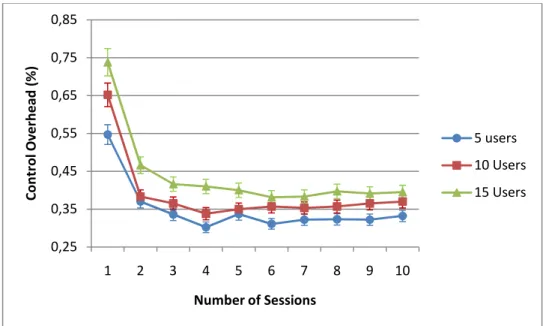
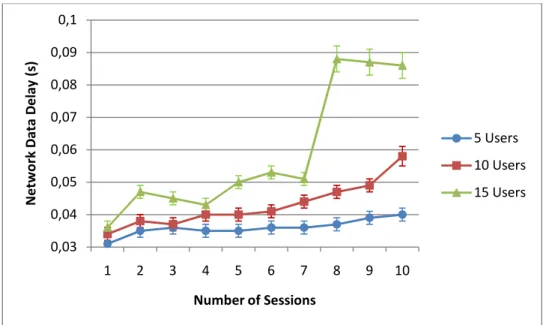
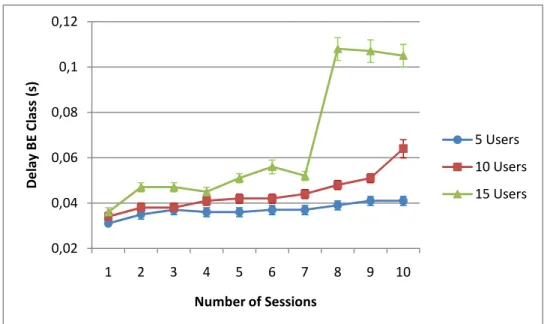
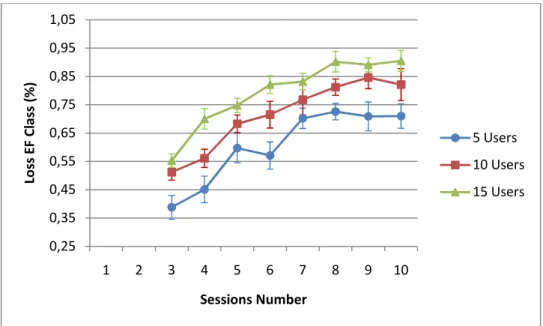
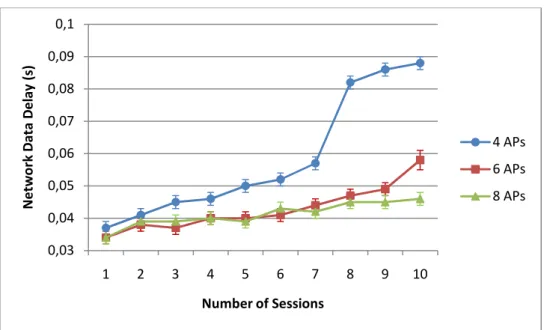
(17) Index of Figures Figure 1- Unicast (left) and Multicast (right) models ......................................................................... 6 Figure 2 - MIP scenario....................................................................................................................... 9 Figure 3 – Asymmetric routing influence in QoS-aware multicast distribution trees...................... 17 Figure 4 - End-to-End AMTs and interiors Sub-AMTs [64] ............................................................... 33 Figure 5 – General project scenario [64] .......................................................................................... 36 Figure 6 - Successful Session Setup Request .................................................................................... 37 Figure 7 - Successful ON proxy configuration (add or remove) ....................................................... 38 Figure 8 – Successful reservation of resources and build of multicast tree .................................... 39 Figure 9 - Successful release of resources and remove of multicast tree........................................ 40 Figure 10 - Proxy block ON diagram ................................................................................................. 50 Figure 11 – AMT&MTO delivering messages ................................................................................... 51 Figure 12 - Signalling to build multicast AMTs and sub-AMTS......................................................... 52 Figure 13 - Delay in Wireless Scenario ............................................................................................. 57 Figure 14 - Packet Loss in Wireless Scenario.................................................................................... 57 Figure 15 - Block User diagram ........................................................................................................ 62 Figure 16 - Example of an evaluated scenario ................................................................................. 68 Figure 17 – Control Overhead (Kbytes) per number of sessions, with several number of users .... 70 Figure 18 – Control Overhead (%) per number of sessions, with several number of users ............ 71 Figure 19 - Blocked Flows per number of sessions, with several number of users ......................... 71 Figure 20 - Network Data Delay per number of sessions, with several number of users................ 72 Figure 21 – Network Data Loss per number of sessions, with several number of users ................. 72 Figure 22 - EF Class Delay per number of sessions, with several number of users ......................... 73 Figure 23 - BE Class Delay per number of sessions, with several number of users ......................... 74 Figure 24 - EF Class Loss per number of sessions, with several number of users............................ 75 Figure 25 - BE Class Loss per number of sessions, with several number of users ........................... 75 Figure 26 – Control Overhead (%) per number of sessions, with several numbers of users ........... 76 Figure 27 – Blocked Flows per number of sessions, with several numbers of users ....................... 77 Figure 28 - Network Data Delay per number of sessions, with several numbers of users .............. 78 Figure 29 - Network Data Loss per number of sessions, with several numbers of users ................ 78 Figure 30 – EF Class Delay per number of sessions, with several numbers of users ....................... 79 iii.
(18) Figure 31 - BE Class Delay per number of sessions, with several numbers of users........................ 79 Figure 32 - EF Class Loss per number of sessions, varying the number of APs ................................ 80 Figure 33 - BE Class Loss per number of sessions, varying the number of APs................................ 80 Figure 34 – Control Overhead (%) per number of sessions, varying the number of unicast nodes 82 Figure 35 - Rate of unicast data packets per number of sessions, varying the number of unicast nodes ................................................................................................................................................ 82 Figure 36 - Network Data Delay per number of sessions, varying with the number of unicast nodes .......................................................................................................................................................... 83 Figure 37 - Network Data Loss per number of sessions, varying with the number of unicast nodes .......................................................................................................................................................... 83 Figure 38 – Control Overhead (Kbytes) per number of sessions, varying the number of core ONs 85 Figure 39 – Receive Back Time per number of sessions, varying the number of core ONs ............. 85 Figure 40 - Fixed parameters to evaluate influence of subgrouping ............................................... 86 Figure 41 - Network Data Delay per number of sessions, varying with the weight of Subgrouping 87 Figure 42 - Control Overhead (Kbytes) per number of sessions, varying the weight of Subgrouping .......................................................................................................................................................... 88 Figure 43 - Network load (Mbits/s) per number of sessions, varying with the weight of Subgrouping ..................................................................................................................................... 88 Figure 44 – Control Overhead (%) per number of sessions, varying Network Access Selection ..... 89 Figure 45 – Control Overhead (Kbytes) per number of sessions, varying Network Access Selection .......................................................................................................................................................... 90 Figure 46 – Network Data Delay per number of sessions, varying Network Access Selection ........ 91 Figure 47 – Network Data Loss per number of sessions, varying Network Access Selection .......... 91 Figure 48 – Delay of EF Class per number of sessions, varying Network Access Selection ............. 92 Figure 49 – Delay of BE Class per number of sessions, varying Network Access Selection ............. 92 Figure 50 – Loss of EF Class per number of sessions, varying Network Access Selection................ 93 Figure 51 - Loss of BE Class per number of sessions, varying Network Access Selection ................ 93 Figure 52 – Overhead of Control per number of sessions, with and without Bad Receive ............. 95 Figure 53 - Delay of EF Class per number of sessions, with and without Bad Receive .................... 95 Figure 54 – Loss of EF Class per number of sessions, with and without Bad Receive ..................... 96 Figure 55 - Control Overhead (Kbytes) per number of sessions, with MIRA and proposed solution .......................................................................................................................................................... 97 Figure 56 - Network Delay (s) per number of sessions, with MIRA and proposed solution ............ 97. iv.
(19) Figure 57 – EF Class Delay (s) per number of sessions, with MIRA and proposed solution............. 98. v.
(20)
(21) Index of Tables Table 1 - Possible PoA properties..................................................................................................... 43 Table 2 - Possible weight distribution according to user profiles .................................................... 44 Table 3 - ON proxy database ............................................................................................................ 51 Table 4 - Fields of the reserve and release messages header.......................................................... 54 Table 5 - Fields of the proxy message header .................................................................................. 54 Table 6 - Reserves database ............................................................................................................. 55 Table 7 - Proxy database .................................................................................................................. 55 Table 8 - Wireless Scenario Characteristics...................................................................................... 57 Table 9 - Parameters of the Error Model ......................................................................................... 58 Table 10 - User database .................................................................................................................. 59 Table 11 - Fields of the User Context message header .................................................................... 60 Table 12 - Fields of the warning messages header .......................................................................... 60 Table 13 – Database of the minimum QoS values per CoS .............................................................. 61 Table 14- APs database .................................................................................................................... 64 Table 15 - Fields of the Traffic Application Context message header .............................................. 64 Table 16 - Fixed parameters to evaluate the influence the Number of MTs ................................... 69 Table 17 - Fixed parameters to evaluate influence of APs Numbers ............................................... 76 Table 18 - Fixed parameters to evaluate influence of non-multicast core nodes ........................... 81 Table 19 - Fixed parameters to evaluate influence of core ONs number ........................................ 84 Table 20 - Fixed parameters to evaluate influence of Access Network Selection Methods............ 89 Table 21 - Fixed parameters to evaluate the influence of Bad Receive Feedback .......................... 94 Table 22 - Fixed parameters to compare proposed solution with MIRA ......................................... 96. vii.
(22)
(23) Acronyms Acronym. Description. A AAA. Authentication, Authorization and Accounting. ABC. Always Best Connected. AF. Assure Forwarding. AHP. Analytic Hierarchical Process. ALM. Application Layer Multicast. AMT. Abstract Multiparty Transport. AP. Access Point. ASM. Any Source Multicast. ASN. Access Service Network. B BE. Best Effort. BS. Base Station. BT. Bi-directional Tunnelling. BU. Binding Update. CB. Context Broker. CBT. Core Base Tree. C-CAST. Context-casting. C. CID. Communication Identification. CN. Correspondent Node. CoA. Care of Address. CoS. Class of Service. CS. Circuit Switched. CSN CTMS. Connectivity Service Network Constraint Tree Migration Scheme. ix.
(24) CxP. Context Providers. DCF. Distributed Coordination Function. D. DHCP DM DMSP DVMRP. Dynamic Host Configuration Protocol Dense Mode Designated Multicast Service Provider Distance Vector Multicast Routing Protocol. E EDCA. Enhanced Distribution Coordinate Access. EF. Expedited Forwarding. ESS. Extended Service Set. FA. Foreign Agent. FFD. First Fit Decreasing. FMIP. Fast Mobile Internet Protocol. GGSN. Gateway GPRS Support Node. GPRS. General Packet Radio Services. F. G. GW. gateway. HA. Home Agent. HC. Hybrid Coordinator. H. HCCA HCF HMIP HMMCT. Controlled Channel Access Hybrid Coordination Function Hierarchical Mobile Internet Protocol Hierarchical Mobile Multicast Concept Transfer. I IGMP. x. Internet Group Management Protocol. IP. Internet Protocol. ISP. Internet Service Provider.
(25) L LMA. Local Mobility Anchor. MA. Mobile Agent. MAC. Medium Access Control. M. MADCAP MADM. Multicast Address Dynamic Client Allocation Protocol Multiple Attribute Decision Making. MAG. Mobile Access Gateway. MBGP. Multiprotocol Border Gateway Protocol. MBMS. Multimedia Broadcast Multicast Service. MEW. Multiplicative Exponent Weighting. MIP. Mobile Internet Protocol. MIRA. Multi-service Resource Allocation. MLD. Multicast Listener Discovery. MMROP MN MobiCast MoM. Mobile Multicast with Routing Optimization Mobile Node Multicast Scheme for Wireless Networks Mobile Multicast. MOSPF. Multicast Open Shortest Path First. MRIB. Multicast Routing Information Base. MS. Mobile Station. MSS. Multicast Subscription System. MT. Mobile terminal. MTO. Multiparty Transport Overlay. NAM. Network Animator. NGN. Next Generation Networks. NRS. Neglected Reservation Sub-tree. NS. Network Simulator. N. NUM. Network Use Management. xi.
(26) O ON OSMAR. Overlay Node Overlay for Source-Specific Multicast in Asymmetric Routing. P PCF. Point Coordination Function. PDA. Personal Digital Assistance. PDB. Per-domain Behaviour. PDP. Packet Data Protocol. PHB. Per-Hope Behaviour. PIM. Protocol Independent Multicast. PMIP. Proxy Mobile Internet Protocol. PoA. Point of Access. PS. Packet Switched. PTM. point-to-multipoint. PTP. point-to-point. QAP. QoS-Access Point. QoE. Quality of Experience. QoS. Quality of Service. RAT. Radio Access Technology. RIB. Routing Information Base. RO. Route Optimization. RP. Rendezvous Point. RS. Remote Subscription. Q. R. RSVP. Resource Reservation Protocol. SAM. Scalable Adaptive Multicast. SAW. Simple Additive Weighting. SDU. Service Data Unit. S. xii.
(27) SF. Service Flow. SFM. Source Filtered Multicast. SM. Session Management. SS. Subscribe Station. SSM. Source Specific Multicast. TIM. Traffic Indication Messages. TNCP. Terminal Network Context Provider. T. TOPSIS TS. Technique for Order Preference by Similar to Ideal Solution Traffic Streams. TSPEC. Traffic Specification. TXOP. Transmission Opportunities. U UE. User Equipment. UP. User Priorities. W WLAN. Wireless Local Area Network. xiii.
(28)
(29) 1. Introduction 1.1. Motivation Nowadays, Internet Service Providers (ISPs) focus their efforts in defining new types of services to attract customers, who are more and more demanding. Due to the increasing demand of multimedia content by groups of users, efficient solutions are under investigation, aiming to allow the efficient management of multiparty sessions, such as IPTV, file sharing and push media. The limitation of existing network architectures to efficiently fulfil the strong resource requirements of such real-time multimedia sessions (IPTV, video-conferencing) motivate the research community to propose new network functionalities. Mobility makes part of our lives, having a more and more relevant role in future networks. Costumers want to receive multimedia content in everywhere at any time, never losing the connectivity, while they move around the world. NGNs have to be envisioned, taking into account totally mobile scenarios, changing to a new configuration at each moment. Multicast is a good solution to avoid performance degradation and save resources in the network, since the routers in the network just duplicate packets when needed. The integration of multicast and mobility is crucial in future network environments. However, multicast is not yet consistent in mobile scenarios, and this should be solved, since next generation terminals equipments are essentially mobile. Over the last few years, various access technologies, such as WiFi, GPRS, UMTS and WiMAX, have been deployed and are available or even yet integrated in mobile devices, which are increasingly equipped with several interfaces to the different technologies (multihomed). Due to these developments, the Next Generation Networks (NGNs) are envisaged to support a large range of multimedia sessions independently of the underlying network technologies. Addressing current limitations of the network, new approaches emerged: contextawareness has recently attracted attention by the research community, since a wide number of information can be available, describing specific characteristics of entities and environments, such as devices, applications and places. This kind of information will have a strong influence on the services and their characteristics. Context-aware applications and networks should react to context changes to efficiently compute decisions according to the environment, session, users/terminals and networks characteristics. Always best connected (ABC) concept takes advantage of the context-awareness to select the best access point considering not only network 1.
(30) Avaliação de Controlo de Sessões Multicast em Redes com Contexto. resources and application requirements, but also user situation and preferences, environment conditions, etc. In a more traditional networking viewpoint, efficient re-routing can be deployed when changes in context of networks and users/terminals are detected, such as link failures and terminal handovers, respectively. In the envisioned scenarios, preferences of users, their characteristics, location, mobility, and the environment, e.g. weather, noise, can influence the network attachment choice, re-routing and any other changes in the network. To provide efficient real-time applications based on context information, it is important to create mechanisms in order to deliver personalized multiparty content through the chosen networks taking into account context information, and ensuring Quality-of-Service (QoS) guarantees: to reserve multicast paths and build multicast trees, it is necessary to choose an appropriate Access Point (AP) and the adequate core path, taking into account all context information, not only QoS information, but also users profiles/preferences and environment characteristics. Besides, it is necessary to assure that these mechanisms can be used independently of the core transport technology (IPv4/IPv6 and Unicast/Multicast) and access technology (WiFi, WiMAX, UMTS). Finally, the network needs to deal efficiently with all context changes, providing minimal impact in the network nodes.. 1.2. Objectives This Msc. Thesis is in the scope of the Context Casting (C-CAST) [1] project, more precisely the Context-aware Multiparty Transport and Network Resources Control components of the mentioned project. C-CAST proposes to design a new approach to allow personalized session content delivery to multiple mobile users with guaranteed resources, independent of the underlying network access and transport technologies, and taking into account context sources and information to optimize the content delivery. In this Thesis, context-awareness is considered to allow the collection and delivery of information about mobile terminals, network and environment. This way, dynamic events can trigger session and network reactions, such as service and network re-configuration, multiparty session content delivery and re-negotiation, and seamless context-aware mobility. Resuming, the aim is to have a cognitive network driven by context, to efficiently react to context information and changes. The aggregation of components, interfaces and functionalities for context-aware multiparty transport sub-system has to fulfil the aforementioned requirements. This can be made 2.
(31) Introduction. by including capabilities to collect and make available context information, dynamically match and establish multiparty content sessions, allocate network resources in a scalable manner with support to self-organizing operations for resilience, and control terminal mobility seamlessly. This thesis implements a new architecture based on a centralized approach, where a centralized intelligent entity performs decisions with respect to the best way to deliver data to users. Another central unit keeps all information (users profile, sources characteristics, environmental conditions and network resources) collected by terminals sensors. It uses an overlay layer to allocate resources and build multicast trees across the selected paths, and another to permit transparency to users in concerns to access technology and core configurations. It then builds the concept of abstract trees to prevent the change of the network due to the change in context: whenever it is possible to perform all required changes just resorting to local reactions, the abstract trees are not changed and the central nodes remain free to support other tasks. This architecture permits not only a correct delivery of the data content with minimum resources as possible and QoS guarantees, but also allows users and network operators to make their decisions according to their own preferences and policies. In order to evaluate the proposed solution, Network Simulator (NS-2) was used. The use of simulation allows the evaluation of several scenarios with many different characteristics. It allows scalability performance assessment of the developed work which is not always possible with real hardware. Therefore, it was necessary to create and add new entities to NS in order to simulate the proposal architecture.. 1.3. Contribution of this work As a result of the accomplishment of the above proposed objectives, this work provides the following set of contributions: - The development of a network architecture in the ns-2, which enables a NGN that supports efficient schemes to provide scalable content transport with QoS guarantees to several fixed/mobile terminals simultaneously. - An evaluation, via simulation, of the global architecture performance in different fields and its response in different situations, in order to test the robustness and reliability of the developed solution.. 3.
(32) Avaliação de Controlo de Sessões Multicast em Redes com Contexto. 1.4. Organization of the Thesis The research work developed in this Thesis is organized in six main chapters. Each one explains briefly the work performed in different phases of the research, introduction, state-of-theart, conceptual ideas, implementation, evaluation of the architecture and conclusion/future work. Current chapter contextualizes the thesis in the current situation of the next generation networks paradigms. It also presents the goals and contributions of this Thesis. The second chapter describes the current state-of-the-art developments in this research field. It consists in an overview of the multicast concepts and protocols, mobile IP and mobile multicast solutions, as well as current work in QoS and context-aware network selection mechanisms. An analysis of the developed work related with this Thesis is also presented. The third chapter presents the main ideas, concepts, components and architecture of the C-CAST project. It also contextualizes this work in the project with the in-depth exposition of the guidelines and requirements. The fourth chapter presents the architecture implementation performed in the Network Simulator (NS 2.31). This chapter is divided in sub-chapters, according to the different architecture components. The fifth chapter presents an evaluation of the implementation made by testing the efficiency of the scheme as well as the performance of the network in several scenarios and conditions. Finally, the last chapter summarizes the main results and a description of the performed research. It also describes future work to be carried out after this Thesis, issued from an evaluation of the deficiencies and possible improvements.. 4.
(33) 2. State of the Art In our days, more and more new multimedia applications have appeared to satisfy different costumer demands, which require high bandwidth, low delay and small losses. As a result, it should be applied multicast in multimedia applications, in order to avoid redundant packets in the network, and consequently performance loss. QoS is strongly required in multimedia application progress, ensuring end-to-end requirements by efficiently distributing the different application flows throughout network resources. Mobility makes part of our lives, and Mobile Internet Protocol in version 4 (MIPv4) or version 6 (MIPv6) has a more and more relevant role in future networks. Recently, the concept of context-aware motivates large interests in scientific community, since it can consider all kind of environment and entities information, like places, applications and devices. Section 2.1 will describe the concept of multicast as well as the protocols that support its functionalities. Section 2.2 will specially focus in MIPv4/MIPv6 and Multicast Mobility. Section 2.3 is related with network resources allocation in wired and wireless networks and its integration with multicast. Section 2.4 will analyse the existing proposals of network selection mechanisms based on context-awareness. Finally, Section 2.5 resumes this chapter.. 2.1. Multicast Concept and Protocols Multicast is centred in the concept of group, and multicast protocols are responsible for the delivery of information to multiple listeners without the need of sending several times the same data, increasing the efficiency and reducing costs, since it consumes less bandwidth. Listeners need to send a message identifying the multicast group, in order to receive the correspondent datagram that they desire, so the routers in the network just duplicate packets when needed. A unicast connection is based on a flow of information for each request, so if it has many hosts interested in receiving the same data flow, the data source will send many copies, one for each interested host. Obviously, unicast has a worst network performance compared with multicast, thus it is not the best solution for multimedia applications provided to several users simultaneously (Figure 1).. 5.
(34) Avaliação de Controlo de Sessões Multicast em Redes com Contexto. Figure 1- Unicast (left) and Multicast (right) models. Every multicast group is represented by an IP address from a well-defined range. In an IPv4 network, multicast IP uses the addresses of class D (224.0.0.0 to 239.255.255.255), while in IPv6, multicast addresses start with the hexadecimal prefix ff00:: / 8. In spite of the advantages, the multicast process requires complex control mechanisms between network equipments. First, routers in the network need to support multicast protocols, in order to construct a multicast tree for each group and to forward and replicate multicast packets. Multicast routing is implemented by protocols such as: Multicast Open Shortest Path First (MOSPF) [2], Distance-Vector Multicast Routing Protocol (DVMRP) [3], Core Based Tree (CBT) [4], and the most used, Protocol Independent Multicast (PIM) [5]. PIM presents two different versions, Sparse Mode (SM) and Dense Mode (DM), from different scenarios. While communication between routers is assured by the protocols mentioned, the communication between routers and hosts, or hosts and routers, is achieved by Internet Group Management Protocol (IGMP) [6] in IPv4 networks, or Multicast Listener Discovery (MLD) [7] in IPv6 networks. With a proper protocol, IGMP or MLD, sources inform their neighbour routers that they will send data to a certain group, and listeners, using the same protocol, inform their neighbour routers that they wish to join that group. By their turn, routers use a configured protocol to create or extend the multicast distribution tree of the desired group. Routers keep information about who. 6.
(35) State of the Art. joins a certain group and the respective interfaces that they should use to forward packets to that group. If a user wishes to stop receiving the data flow, he leaves the group by sending an IGMP/MLD prune message to the neighbour router. If this user is the last in the group, the neighbour router informs its above routers, sending a prune message, to stop forwarding packets in its direction. Recent IGMPv3 [8] or MLDv2 [9] protocols, where listeners can specify the source from which they want to receive, caused the appearance of the new multicast model, named Source Specific Multicast (SSM) [10]. The SSM models were proposed to solve the problems related to access control, address allocation, and handling of well-known sources generated by the Any-Source Multicast (ASM) and its deviation, the Source-Filtered Multicast (SFM). PIM-SSM became the preferred SSM model due to its simple architecture implementation, especially supported by the fact that it does not require a Rendezvous Point (RP). PIM-SSM creates the multicast distribution trees in a receiverdriven approach, based on a routing table called Multicast Routing Information Base (MRIB) [5], and relies on an underlying topology-gathering protocol for its population. Usually, the unicast Routing Information Base (RIB) is used to get information about the multicast paths; however, they can also be provided by Multiprotocol Border Gateway Protocol (MBGP) [11] or other different protocols. The MRIB aims to provide the next-hop along a multicast-capable path so that any PIM Join message is sent to create the tree. Contrary to the RIB, MRIB gives reverse path information and indicates the itinerary that a multicast signalling packet would take from hosts to the data sources. Recently, Application Layer Multicast (ALM) [12] [13] appears due to the very limited multicast support in routers within internet, being an attempt to use “multicast”. ALM uses some ideas of IP multicast as it transmits only one copy-packet per flow between end hosts via unicast, and just replicates the packets at end hosts. The ALM approach can be very motivating since it is not required an infrastructure to support intermediate nodes, and it does not cause any modification to the current network. Despite the flexibility and the easy deployment that ALM provides, it introduces performance issues and less stability comparing with multicast distribution trees [14]. The ALM is not scalable in large-scale networks due to its low bandwidth efficiency and heavy control overhead in comparison with a full multicast capable environment, caused by synchronization of transport at end hosts. Besides, it is difficult for an ISP to control member access and measure the bandwidth used by the group, because memberships and multicast. 7.
(36) Avaliação de Controlo de Sessões Multicast em Redes com Contexto. distribution trees are totally managed at end hosts. Consequently, the ALM models have a difficult or even impossible implementation cost [15], being not as efficient as IP multicast.. 2.2. Mobility The internet architecture is structured in protocol stack, which one of the most important protocols/layer is the IP. IP addresses are associated with the identification and localization of a terminal connected to the internet. This is the big problem that should be addressed with mobility concepts and ideas, trying to dissociate localization from identification. Networking base technologies were created on the assumption that the terminals would be stationary. If the terminal is connected to its home network and it wants to move to a new network, it is needed a reconfiguration of the IP address and gateway based on a new location, losing the network connections and communications during the process. The NGN offers a heterogeneous environment focusing in the widespread of the mobile terminals (MT), always requiring constant network connectivity. Concerning these future environments, ABC services require an efficient mobility protocol to assure that their decision mechanisms can be executed seamlessly without downgrading the service provided. This section will describe the current state-of-the-art of the Mobility, with special attention to Mobile IP (v4 and v6) and their solutions to multicast environments.. 2.2.1.. Mobile IP. The MIP protocol was first developed in the context of IPv4 [16] and presented as the first solution for the global mobility issue, being suitable for large movements. The architecture of this protocol is composed by Mobile Node (MN), Correspondent Node (CN), Home Agent (HA), Foreign Agent (FA) and the addresses Home Address (HoA) and Care-of Address (CoA). MN is the terminal that moves through the different networks, changing its access network. CN is the terminal that communicates with the MN. HA is typically a router in the home network of MN, which is responsible for registering the MN location, and FA is also a router, which is visited by the MN. HoA is the MN IP address in its home, and CoA is a temporary IP address acquired when the MN visits the foreign network. In this protocol we have to use two different IP addresses, in order to maintain the MN reachable in the visited network. The home address is necessary when other hosts want to. 8.
(37) State of the Art. communicate with the MN and it is permanently associated to it. The aim of the MIP protocol is to redirect, through IP tunnels, the packets received in the home network, to the foreign network, where the MN is temporary located. IP-in-IP tunnels (in MIPv4) are dynamically managed, in order to allow the mobile host to appear accessible from its home address. MIP permits that applications designed for the traditional non-mobile Internet will continue to work even in mobile environments. The purpose of MIP protocol is to allow applications to keep communications between hosts, while roaming between different IP networks. While in standard IPv4 a movement would result in a loss of connectivity to the mobile host’s, with MIP only a short disruption is perceived.. Figure 2 - MIP scenario. When a MN moves to a foreign network, the packets have to continue to be delivered to home network, and the receptive HA is responsible for sending them to the FA through an IP tunnel. When MN receives the packets, it replies to CN directly from its new location, creating a triangle routing (Figure 2). This is a weakness concerning the performance of MIP protocol, which can be solved by introducing a feature in the original protocol, named Route Optimization (RO) [17]. In original MIP scenario, CN never knows if MN moves from its home network, but with RO, CN gains the capacity of communicating directly with the MN. MN moves to a foreign network. 9.
(38) Avaliação de Controlo de Sessões Multicast em Redes com Contexto. and it sends a Binding Update (BU) message to the CN and the current location to HA at the same time. In order to know the current location of MNs, CN needs to create a database with all CoAs of MNs, named Binding Cashes. If MN’s CoA does not appear in CN database, CN uses the original process by sending all information to the HA of the MN. The introduction of the RO feature causes a loss of transparency in the process (CN always knows current MN IP address), but it increases the efficiency and reduces delays and resources allocation. The MIPv6 protocol [18] was developed in combination with IPv6, to solve the lack of efficiency caused by no native MIPv4 in the IPv4. This protocol is based on the same MIPv4 concepts, but with a better performance, due to the improvements of IPv6, comparing with IPv4, and also with the inclusion of RO as a native solution to the triangle routing. Besides, it does not require the FA to detect if it is in a foreign network, due to the simple use of IPv6 router advertisements. MN generates by itself the CoA when it moves to another network, using the stateless auto-configuration mode. This process is a new IPv6 feature that automatically obtains the needed information so that the MN may connect automatically when arriving to foreign network. The MIPv6 is adopted as a standard solution for the global mobility support in the NGN, since it is an efficient solution that provides security and optimization features.. 2.2.2.. Multicast Mobility Solutions. Standard multicast protocols do not implement mobility in a native way, being necessary to use turn-around solutions to integrate mobility and multicast. This problem is solved with the introduction of minimal standard solutions as the Bi-directional Tunnelling (BT) and Remote Subscription (RS). Several publications propose a mixture of both solutions, implementing BT for source mobility and the RS for listener mobility. These mixed approaches, named Agent-based solutions, are the preferred ones by the research community to develop Mobile Multicast solutions [19]. BT solution proposes that mobile multicast source (MN) uses tunnels to redirect multicast data flow to its HA. When the HA receives the multicast packets from the tunnel, it sends packets using IP Multicast Routing on behalf of the mobile multicast source. This mobile multicast solution has the advantage of hiding all mobile multicast source movements, since the HA and multicast. 10.
(39) State of the Art. trees remain static. Besides the transparency of BT with mobile multicast listeners and sources, this solution has a loss of performance due to its overhead on the network and a large delay of data delivering. The RS strategy adopts an opposite solution that delivers all movement reconfiguration to multicast routing, in order to create/expand the multicast tree to new MN IP address. When a MT enters a foreign network, it re-subscribes to its desired multicast group and the respective foreign multicast router has to join the multicast group to the multicast tree. This strategy offers an optimum routing: the multicast packets are sent directly to the respective local multicast router by an IP multicast. However, this solution could lead to significant overheads due to the reconstruction of the delivery multicast tree in case of frequent handovers. This strategy forces the mobile node to re-initiate multicast distribution subsequent to handover. This approach of tree discontinuation relies on multicast dynamics to adapt to network changes, resulting in a rigorous service disruption and leading to mobility-driven changes of source addresses. In result, RT cannot be the solution to support session persistence under multicast source mobility. Thereby, since these both approaches have their disadvantages, Agent-based solutions attempt to balance between the two mechanisms. Static agents typically act as local tunnelling proxies. Different types of Multicast Agent (MA) approaches have been proposed in order to reduce the reconstruction of the multicast tree. These agents join the multicast group on behalf of the multicast listeners along the different networks, providing multicast source movement transparency. When a multicast source moves and changes its current IP address to a new CoA, the multicast tree only needs to be re-established from the MA to the multicast source. Therefore, this reduces the multicast tree reconstruction, and consequently, the service disruption time. Unlikely, many of the proposed protocols are based on foreign agents and also on Mobile Ipv4 paradigm. As the Mobile IPv6 does not have any foreign agents, these protocols cannot be directly derived to IPv6 multicast mobility scenarios. There are some alternatives or extensions to the basic Mobile IP and IP multicast interoperability approaches proposed by the IETF. Each one of these examples improves the basic mechanisms, but further refinement is needed before these solutions can be widely deployed. For the specific case of the multicast listener mobility, new approaches appear attempting to solve the related problems, dividing into Agent Assistance, Multicast Encapsulation and Hybrid Architecture.. 11.
(40) Avaliação de Controlo de Sessões Multicast em Redes com Contexto. Agent Assistance: Agent assistance proposals use host-based mobility, since it complements the unicast real-time mobility existing infrastructures of Fast MIPv6 (FMIPv6) [20] and Hierarchical MIPv6 (HMIPv6) [21], becoming Multicast-FMIPv6 (M-FMIPv6) [22][23] and Multicast-HMIPv6 (MHMIPv6)[24]. These solutions presume that the context information is saved in a node accessible before and after the movement. However, when a MN moves from one operator to another, it loses contact with the previous network, and it is necessary to find a solution to recover from loss of connectivity and context based on the node alone. Proxy MIPv6 (PMIPv6) is a network based on mobility management that becomes multicast transparent in the sense that the MN experiences a point-to-point home link fixed at its (static) Local Mobility Anchor (LMA). This virtual home link is composed of a unicast tunnel between the LMA and the current Mobile Access Gateway (MAG), and a point-to-point link connecting the current MAG to the MN. A PMIPv6 domain thereby inherits MTU-size problems from spanning tunnels at the receiver site. Besides, some avalanche problems can be easily identified. The LMA may be required to tunnel data to a large number of MAGs, while a MAG may be needed to forward the same multicast stream to many MNs via individual point-to-point links. Future optimizations and extensions to share links preferably adapt native multicast distribution towards the edge network, possibly using a local routing option, including context transfer between access gateways to assist IP-mobility-agnostic MNs.. Multicast Encapsulation: Encapsulation of multicast data packets is a recognized method to shield mobility and to enable access to remotely located data services, like streams from the home network. Applying generic packets tunnelling in IPv6 using a unicast point-to-point method will also allow multicastagnostic domains to be transited, but does inherit the tunnel convergence problem and may result in traffic multiplication. Multicast enables environments to take advantage of point-to-multipoint encapsulation, such as generic packet tunnelling, using an appropriate multicast destination address in the outer header. Such multicast-in-multicast encapsulated packets similarly enable reception of remotely located streams, but do not suffer from the scaling overhead from using unicast tunnels. The tunnel entry point performing encapsulation should provide fragmentation of data packets, to avoid issues resulting from MTU size constraints within the networks supporting the tunnels.. 12.
(41) State of the Art. Hybrid Architectures: There has been recent interest in seeking methods that avoid the complexity at the Internet core network, like application layer and overlay proposals for (mobile) multicast. The possibility of integrating multicast distribution (overlay) into the network layer is also being considered by the IRTF Scalable Adaptive Multicast (SAM) Research Group (RG). An early hybrid architecture using reactively operating proxy-gateways located at the Internet edges was introduced by Garyfalos and Almeroth [25]. The authors presented an Intelligent Gateway Multicast as a bridge between mobility-aware native multicast management in access networks and mobility group distribution services in the Internet core, which may be operated on the network or application layer. The Hybrid Shared Tree approach [26] introduced a mobility-agnostic multicast backbone on the overlay. Current work in the SAM RG is developing general architectural approaches for hybrid multicast solutions [27] that will require a detailed design in the future work.. Mobile Multicast (MoM) Protocol: MoM Protocol [28][29] is based on BT approach and it focus on solving the tunnel convergence trouble with the development of the Designated Multicast Service Provider (DMSP). Each multicast group is associated with a particular DMSP, that is a HA between several HAs that forward packets to the visit network with the specific multicast IP group, and it is chosen by foreign network.. Mobile Multicast with Routing Optimization (MMROP): MMROP [30] is supported by RS and it has a better routing efficiency and no packet roaming losses, since it applies a Mobility Agent (MA), which is a FA that forwards (via IP tunnel) lost packets to neighbouring networks.. Constraint Tree Migration Scheme (CTMS): CTMS [31] is a new global multicast protocol based on the development of Core Based Tree to allow a dynamic multicast configuration. CMTS is applied to mobile multicast listeners and it automatically changes multicast trees to better ones, while maintaining the QoS guarantees specified by mobile users.. 13.
(42) Avaliação de Controlo de Sessões Multicast em Redes com Contexto. Multicast Scheme for Wireless Networks (MobiCast): MobiCast [32] is based on RS and its key extension is the introduction of the Domain Foreign Agent (DFA), which serves many small adjacent wireless cells. A hierarchy is introduced with small cells being organized into one Dynamic Virtual Macrocell (DVM). Therefore, micro mobility is hidden from the global multicast mechanism, which does not require reconfiguration when handovers occur within the same DVM.. Mobile IPv6 Multicast with Dynamic Multicast Agent: Mobile IPv6 Multicast with Dynamic Multicast Agent [33] approach tries to solve the problems of delivering IPv6 multicast traffic to MN. This approach combines the advantages of BT and RS, selecting a new multicast agent based on both movement and distance dynamically, and the new selected agent is responsible for forwarding multicast data to the MN. Such design optimizes the multicast routes and reduces handoff frequency. Besides releasing triangle route problem and diminishing the influence of handoff to multicast, it can also provide global mobility without limitations of the network topology.. Hierarchical Mobile Multicast Context Transfer (HMMCT): HMMCT [34] is a new approach to reduce the signalling cost and reduce the packet loss, especially in case of macro mobility. This solution integrates HMIPv6 for the intra-domain mobility, with Mobile context transfer for the inter-domain mobility. The design assumes that the foreign network is a HMIPv6 environment so there will be a special router called Mobility Anchor Point (MAP), responsible for controlling the group membership for multicast listeners and receive the multicast packets intended to the mobile node then the it encapsulates them to the MN. HMMCT provides seamless handovers and reduces the disruption for the mobile nodes whether they move within the same or different MAP domains, and it allows MN to efficiently receive the packets during the handover, especially in real-time services and applications.. 2.3. QoS QoS is crucial to any network architecture and given the challenges envisioned for the NGNs, the provision of QoS in these environments will be a complex task. The implementation of this concept is achieved by increasing the priority of some flows and limiting the priority of other flows. Congestion management tools are able to distinguish flows with different priorities and 14.
(43) State of the Art. dispose them in different queues that have different ways of treatment. The queue management mechanism avoids congestion of queues by dropping lower-priority flows before higher-priority flows. Policing and shaping are also important QoS features to provide priority to a flow by limiting the throughput of other flows. Link efficiency tools limit large flows to show a preference for small flows. Service levels refer to the actual end-to-end QoS capabilities, meaning the ability of the network to serve, according to agreed insurances, a specific kind of traffic from the source to the terminal or edge to edge. The services differ in their level of QoS strictness, which describes how tightly the service can be bound by specific bandwidth, delay, jitter, and loss characteristics. To assure QoS in the network, it is deeply necessary to implement mechanisms to allocate and control resources. This section will particularly explain mechanisms to allocate multicast resources in wired networks, and also gives a brief overview about this thematic in wireless networks.. 2.3.1.. Multicast Resource Allocation Mechanisms. Multicast resource allocation is the set of methods that control the assignment of available multicast paths to correctly transport the incoming flows throughout multicast distribution trees. The control functions to create multicast distribution trees are usually receiverdriven encompassing messages which traverse a multicast-capable path. These messages carry multicast control information, which is the support to setup the packet replication on each node along the reverse-path of the Join messages, so that the data flows along the multicast-capable path. Before building a multicast distribution tree, it is necessary to allocate a multicast IP address to indentify the group. Multicast IP addresses can be dynamically allocated by using standard solutions, such as the Multicast Address Dynamic Client Allocation Protocol (MADCAP) [35]. MADCAP efficiently controls the dynamic allocation of multicast IP addresses, operating similarly to Dynamic Host Configuration Protocol (DHCP). However, MADCAP under SSM environments has significantly optimization problems of multicast address allocation, being well-known with many issues in multi-source scenarios. The allocation of multicast resources in IP multicast is implemented in a per-flow basis, meaning that a multicast distribution tree is allocated to each micro-flow and created on-demand (e.g. for each Join received). The dependence of the number of flows poses scalability limitations to IP multicast in large-scale systems. For instance, the routing operation and forwarding slow. 15.
(44) Avaliação de Controlo de Sessões Multicast em Redes com Contexto. down with the increasing number of multicast state, due to the saturation of memory in the routers. Moreover, the excessive control overhead of IP multicast increases the bandwidth consumption and overloads CPU processing in each network node [36]. IP multicast has another barrier with regard to the competition of multicast groups, which leads to address space constraints in network layer protocols, such as IPv4. In order to efficiently deploy QoS-aware multicast communications, it is required to implement solutions to control the allocation of QoS and multicast network resources, which is generally implemented separately, due to contradicting deployment concepts. With regard to multicast solutions, IP multicast is more deployed over the Internet and feasible for large-scale environments than ALM. The integrated deployment of differentiated services (DiffServ) [37] and IP multicast is promising, since the former allows a scalable QoS approach while the latter saves the bandwidth utilization by preventing packet duplication [37]. However, the integration of DiffServ and multicast is not trivial as will be described. Whereas in the DiffServ model the scalability is achieved by pushing unavoidable complexity to network edges and maintaining per-class state in core nodes, multicast operates on a per-flow basis throughout the network. Furthermore, the dynamic addition of new members of the multicast group using DiffServ can adversely affect other existing traffic if resources were not explicitly allocated before use. This problem, called the Neglected Reservation Sub-tree (NRS), endangers or even violates the quality of the session in communication paths toward other receivers with previous correct reservations. Another reason that makes DiffServ and multicast integration difficult, deals with the reluctance of ISPs to deploy and provide multicast [15]. In spite of allowing the reduction in bandwidth utilization, many technical and marketing reasons make IP multicast (and its performance improvement extensions, such as multicast aggregation) still far from being widely deployed over the Internet. The most critical reasons include: • The state scalability problems in large-scale networks; • The lack of support in access control; • The requirement of global deployment of multicast-capable IP routers; • The lack of appropriate pricing models. The deployment of real-time group communications with efficient use of network resources implies that multicast data should always travel in the best possible path. To accomplish this, routing asymmetries, as well as QoS requirements, should be considered when building multicast trees. However, these requirements are not accomplished by most IP multicast routing protocols. One of the reasons is that those protocols build multicast trees from the receivers to. 16.
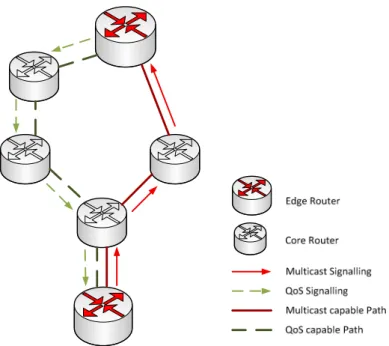
(45) State of the Art. the sender, while data travels in the reverse direction. The result is that data are forced to travel in a path that is not optimized and sometimes not even suitable (Figure 3). This fact may lead to a loss of performance and to the failure to deliver the quality levels expected by the users. The routing asymmetries that cause this situation are a usual presence in the Internet [38] and can happen due to distinct factors, such as different paths for each direction, same path but different bandwidth for each direction in the same link, as well as quality of service or network access restrictions. Routing policies and traffic engineering may also cause routing asymmetry [39].. Figure 3 – Asymmetric routing influence in QoS-aware multicast distribution trees. The limited functionalities supported by DiffServ to provide QoS guarantees require the implementation of external resource allocation mechanisms, since resource reservation and admission control is required at least to deploy Per-Domain Behaviour (PDB) and services based on the Expedited Forwarding (EF) Per-Hop Behaviour (PHB). However, the integration of DiffServ and resource allocation mechanisms introduces performance issues. On one hand, the scalability achieved in DiffServ, allowing per-class control, is adverse to the performance degradation taken by per-flow resource allocation mechanisms currently deployed in the Internet through Resource Reservation Protocol (RSVP)[40]. On the other hand, the addition of new mechanisms increases system complexity and endangers its performance, which is not desirable. DiffServ was originally. 17.
(46) Avaliação de Controlo de Sessões Multicast em Redes com Contexto. conceived for wired networks, but its aggregation QoS control concept was also extended for wireless networks. Aiming to solve some issues related to QoS-aware multicast communications, it will be given a brief explanation of two mechanisms that will be used in this work to control resources allocation and multicast trees. The first one is the Overlay for Source-Specific Multicast in Asymmetric Routing environments (OSMAR) [39], which focus on asymmetric routing problem and propose a solution to solve this situation like an overlay for SSM protocols. The second mechanism is the Multi-service Resource Allocation (MIRA) [41] that controls Class-of-Service (CoS) resources and multicast tree at the same time, considering also the asymmetric routes through the OSMAR over PIM-SSM as the multicast routing protocol. OSMAR [39] aims to be used as an overlay for source-specific multicast protocols, such as PIM-SSM, enabling them to deal with network asymmetries and to provide QoS-aware content distribution, while maintaining their specifications and state machine. To accomplish this, OSMAR changes the values of the MRIB tables, used by the multicast routing protocol to build the multicast tree considering the path from source to receivers (data path) contrary to the greatest existing multicast protocols. OSMAR allows the creation of multicast branches according to the connectivity and the QoS characteristics configured for each source-receiver data path. OSMAR works with asymmetric routes, either intra-domain or inter-domains, that increase the scalability of this protocol. Additionally, it allows the adaptation of SSM protocols to asymmetric routes in a distributed manner, in which most of the functionality is done by OSMAR agents residing in edge routers. Also, OSMAR ensures an easy deployment, avoiding any changes in the state machine of the multicast routing protocol and either in terminals. Furthermore, OSMAR can be progressively implanted, because it does not require the installation of agents in all network domains at the same period. MIRA [41] is a possible solution to control the resources of CoSs and multicast trees in a synchronized manner taking into account the problem of asymmetric routes. MIRA assures the quality level requested for each flow of a multi-user session, by adjusting the resources of the selected CoS. Besides, MIRA supports the construction of QoS-aware multicast trees for each session-flow by manipulating the MRIB. The CoS bandwidth and the MRIB are updated in a singlepass operation from the ingress to the egress located in the direction of the access-router of the receiver that asked for the session. In the ingress-router and in each interior router, the configuration of the selected CoS is done in the outgoing interface indicated by the unicast RIB. After configuring the CoS, MIRA updates the MRIB with the IP address of the previous visited. 18.
(47) State of the Art. router. In an egress-router, MIRA configures the selected CoS taking into account the SLS established with the neighbour network, and triggers PIM-SSM after configuring the MRIB. Edgeagents store the definition of session-flows, characterized by different kinds of information, such as available CoSs (e.g., tolerance to loss and delay), the edge-to-edge per-class reservations and the list of interior-routers involved in the reservation-paths. While the edge-to-edge per-class information is used for fast admission control and to support QoS mapping and adaptation functionalities, the list of interior-routers increase the flexibility of process. Updated information about the edge-to-edge per-class state is acquired periodically by querying network resources associated with each class, inside a network or by checking SLSs between networks. Although edge-agents are overloaded with processing and information, this makes possible interior-agents store only per-class reservation state for a trivial control and consequently packet forwarding procedure optimization. The first real demonstrated architecture, containing QoS and mobility of multicast sessions in heterogeneous environments, was developed under the framework of IST FP6 Daidalos II project [42]. This proposal is characterized by a hierarchical structure to support QoS, and extends the current Media Independent Handover standard IEE 802.21 to seamlessly integrate mobility and QoS [43], to enable the support of multicast services in unidirectional technologies, the Multicast Subscription System (MSS) protocol was introduced: this mechanism needs a return channel only for subscription. A new algorithm based on ant colony optimization for QoS mobile multicast routing is presented in [44]. Ant colony optimization algorithm is a new optimization method proposed recently. The algorithm does not rely on mathematical description of the specific issues, but it has a strong global optimization performance. It has gotten better results in solving NP-complete problem such as the Travelling Salesman Problem. According to the general scope of the search path, a suitable orthogonal table is chosen to confirm the effect of the QoS parameters. Thus, the volatility of pheromone is rectified dynamically to speed up the constringency rate and the optimal multicast tree which meets multiple QoS constraints is set up.. 2.3.2.. Network Resources Allocation in Wireless Networks. Wireless Local Area Network (WLAN) is widely deployed as an effective and alternative solution to the LAN and cellular networks from the perspective of bandwidth and mobility. As users experience the convenience of wireless connectivity, they begin to demand support for the. 19.
Imagem
+7

Documentos relacionados
Como intermediários aparecem: os agentes financiadores o CNPq e o PADCT; Ivo Vencato, professor da UFSC, Central de Análises, que resolveu a estrutura; Valderes Drago, professor do
O paciente evoluiu no pós-operatório imediato com progressão de doença em topografia do tumor primário (figura1), sendo encaminhado ao Oncobeda em janeiro de 2017
Figure 1 - Social Network of subjects 1 and 3 (restricted to family members and friends and with substance users. in the network - the number of people in the groups are given
Devemos um agradecimento pelo apoio na investigação através da facilidade de acesso a fundos bibliográ- ficos e documentais, bem como pela reprodução de imagem, às
The probability of attending school four our group of interest in this region increased by 6.5 percentage points after the expansion of the Bolsa Família program in 2007 and
Relativamente aos dados foram usados dados sísmicos (registados a distâncias telesísmicas) e geodésicos (Synthetic Aperture Radar - SAR). Quanto às técnicas foi
Agreements were defined as “a set of specific norms, resulting from consensus agreements among the users of fishing resources found in a certain geographical area, or […] a set
Influence of an increase of clothing and fibres parameters (values range shown in Table 2 ) on temperature and on fraction of bounded water in the inner surface of clothing, during
