0
A Work Project, presented as a part of the requirements for the Award of a Master
Degree in Management from NOVA School of Business and Economics
“What matters?”
The Case of Sustainability Reporting in Spain and Portugal
Market Response and Materiality Mapping of the recently launched Global Reporting Initiative’s (GRI) G4 Guidelines
Julia Wuerzinger
Student Number: 1789
Supervisor: Ana Marques
1
Abstract
This project explores the case of Sustainability Reporting in Spain and Portugal and the recently launched new generation of Global Reporting Initiative Guidelines. The sample of the study is composed of companies included in the “GRI Report list 1999-2015”. In particular 2013 onwards 51 companies that published their G4 Report are taken into consideration. An indirect study is conducted based on the content of the sustainability reports of companies that implemented the Global Report Initiatives (GRI) reporting guidelines in order to identify focus areas of sustainability reporting in Spain and Portugal, analyzing trends and patterns relevant for observation. The project also promotes a discussion of the usability of the G4 guidelines and the adoption of materiality definition.
Table of Contents
Introduction ... 2
Global Reporting Initiative ... 4
Transition of G3.1 to G4 ... 5
Corporate Sustainability vs Corporate Responsibility ... 6
Spain and Portugal ... 7
Legislative Setting ... 7
Non-Financial Reporting Overview ... 8
Literature Review ... 9
Importance of Sustainability Reporting ... 9
The case of Sustainability Reporting in Spain and Portugal ... 12
Reporting 4.0 ... 12
Materiality Definition ... 13
Implications drawn from this analysis are the following: ... 15
What Matters: Spain/Portugal ... 15
Materiality Map Portugal/ Spain ... 18
Discussion ... 19
References ... 20
2
Introduction
Due to several scandals and latest financial crisis, corporations nowadays are expected to demonstrate and prove their social and environmental efforts. Firms are expected to achieve a profit, but also to care about how they achieve their financials goals. The most important issues to be addressed by business in order to increase public trust are “increase of the transparency of business practices” and “measurement and demonstration of positive social and environmental impacts” according to an annually conducted survey by Business for Social Responsibility (BSR) 2014.
In order to demonstrate commitment to non-financial issues corporations provide information to their stakeholders via Corporate (Social) Responsibility (C[S]R) or Sustainability Reporting (Roberts, 1992). Especially in developed economies sustainability reporting is becoming an indispensable practice for business (Bebbington et al., 2008). According to European Sustainability Reporting Association (2008) most of European corporation nowadays publish a Non- Financial report disclosing their social and environmental efforts among others. Public ranking such as the Corporate Responsibility Magazine’s 2015 100 Best Corporate Citizens List (CR Magazine, 2015) put tremendous pressure on organizations to, in the first place provide non-financial information and in the second place improve their performance. Stakeholder pressure however is only one aspect of sustainability. Competitive advantage (Kuosmanen & Kuosmanen, 2009) exploration of market opportunities, risk mitigation as well as cost savings (Kiewiet & Vos, 2007) are the
3
positive trade-off organizations may achieve when responding to those stakeholder demands. The challenge however remains in quantifying such environmental, social and governance (ESG) costs and benefits. As (Werbach, 2009) notes, the connection of business case to sustainability and economic value is often forgotten when referring to sustainability. “Corporate Reputation, pressure from stakeholder side, economic performance, genuine concern and broad social/ cultural reasons” are the main reasons triggering corporation to engage in non-financial reporting according to a study conducted by Idowu and Papasolomou (2007: 144). While prior financial crisis a self-regulatory aspect of sustainability reporting was sufficient (Kemper & Martin, 2010) increasing demand from various stakeholder sides for regulatory approach can be observed. After the financial crisis an increase in reporting can be observed an increase in sustainability reporting (Giannarakis & Theotokas, 2011) most likely triggered by the increasing mistrust from stakeholders and the steep decline in trust from consumer side (Edelman, 2012). The positive trend in sustainability reporting however is shadowed by the lack of tools to evaluate and performance sustainability efforts (Carroll & Shabana, 2010). This work project aims to provide first steps towards making sustainability reports comparable. The idea for this work project was developed during and executed after my internship at the GRI due to the reoccurring need for impact evaluation and mapping of reporting patterns.
A large number of studies investigating CSR disclosure has been conducted in the developed world, including the United States, Australia, Europe including Germany and the United Kingdom (Chen & Bouvain, 2009; Hartman, Rubin, & Dhanda, 2007; Meek, Roberts, & Gray, 1995). However no comparable study can be found for Spain or Portugal.
4
In Europe Spain is one of the most important markets for1 sustainability reports and so far no research has been conducted to in this region. Efforts of mapping sustainability reporting in the respective countries appear to be dammed over the past years as last dated country-wide investigation only date back until 2008 (The European Sustainability Reporting Association, 2008). Hence this project should contribute to give a clear overview of reporting organizations in Spain. In particular this project will investigate the market response in Spain and Portugal to the recently launched GRI G4 guidelines. One the one hand this project provides a clear overview of the institutional setting and focus areas within Spain and Portugal. This can help to identify areas of improvement for initiatives, institutions and consultancies. Moreover, this project contributes to the literature on sustainability reporting for Portuguese and Spanish firms. Finally, by being one of the first projects conducted on the recently launched guidelines, the project provides an insight that corporations can use to benchmark their reporting schemes.
In particular, the research questions are the following:
1. How do Portuguese and Spanish Organizations define material issues to their business actions?
2. What are the material issues in Spain and Portugal? Global Reporting Initiative
The Global Reporting Initiative’s (GRI) guidelines are recognized as the most prevalent sustainability reporting framework (H. S. Brown, De Jong, & Lessidrenska, 2009). Founded in 1997, and operating as a network structured organization it has created five
1
5
generations of sustainability reporting guidelines. The GRI’s mission is to “To make
sustainability reporting standard practice by providing guidance and support to organizations.” (Global Reporting Initiative, 2013).
Transition of G3.1 to G4
The newly revised G4 guidelines have been launched in 2013. In general the GRI guidelines include general disclosures on several aspects of the business and specific standard disclosure focusing on the following categories: Economic, Environmental, Labor
and work Conditions, Social, Human Rights and Product Responsibility. The GRI G4
guidelines consist of 58 standard disclosures, 46 Disclosure on Management Approach and 91 Specific Standard Disclosures. While materiality is not an innovation in the new G4 Guidelines, the new version of the guidelines stresses it’s the most important part of sustainability reporting. Reporting on What matters and where it matters is the crucial aspect of the new guidelines (KPMG International, 2013). GRI aims for completeness and representation of all relevant issues in their guidelines. However, older version of guidelines had to face voices of criticism for overload of information and inconsistent and “over reporting” on issues not relevant to industries or organizations (Moneva, Archel, & Correa, 2006). GRI introduced two options to report on the G4 Guidelines: “Core” and “Comprehensive” substituting the formerly known Application Levels. One substantial difference between the two options is the amount of governance and strategy indicators obligated to be reported defined as General Standard Disclosures. While for the “Core” Version of the guidelines 34 General Standard Disclosures have to be disclosed for the “Comprehensive” option of the G4 Guidelines the transparency level increases as all of the
6
58 Standard Disclosures have to be disclosed. The difference between reports can also be seen in the focus areas of reporting. This focus area is known as Materiality. While general standard disclosures are applicable for all organizations, in the new version of GRI Guidelines only specific standard disclosures related to identified material aspects are expected to be disclosed in a G4-based report. Hence an organization should focus on those areas prior defined as material. The old G3 and G3.1 guidelines will not be provided anymore by GRI from 2015 onwards and GRI will not offer Services for these guidelines anymore. Organizations may still report according to the old guidelines and these reports will still be included on the GRI Database. However, the GRI is encouraging organizations to gradually move towards the new guidelines.
Corporate Sustainability vs Corporate Responsibility
When referring to non- financial reporting the main terminologies appearing are, triple lining reporting, corporate social responsibility (CSR) and corporate sustainability (CS). Hence, it is essential to define these terms. The definition provided by the European Commission of CSR is “a concept whereby companies integrate social and environmental
concerns in their business operations and in their interaction with their stakeholders on a voluntary basis” (European Commission, 2001). Sustainability is referred to as the amount of consumption that can be continued indefinitely without degrading capital stocks— including "natural capital" stocks (Costanza, Daly, & Bartholomew, 1991: 8).
However, in literature the distinction between CSR and CS remains to be quite wage (Montiel, 2008). The majority of organizations refer to CS rather than CSR. Hence, in this
7
project, the term CS will be adopted (Table 1)2. Sustainability includes a broad spectrum of topics including management of scarce resources, reduction of climate impacts, economic stability etc. Any actor in economy will touch upon one of sustainability related issues at some point (Crittenden, Crittenden, Ferrell, Ferrell, & Pinney, 2011). Annual sustainability reports are a tool to represent organizations commitment to sustainability and can be considered as a methodological tool for Sustainability Research (Giannarakis & Theotokas, 2011; Turker, 2009).
Spain and Portugal
Legislative Setting
As pointed out by (Fifka & Drabble, 2012), cultural and socio-economic environment as well as management decisions may influence reporting when comparing on a cross-country level. One substantial difference between Portugal and Spain can be observed in the legislative setting for sustainability disclosure: while in Portugal no legislative or guiding efforts are known of, in Spain several initiatives and guidelines from government bodies or capital markets encourage organization to report on their sustainability performance. There are several initiates/ guidelines or even legislative articles directly referencing or/and encourage representative organization to report according to GRI. Included are for instance the RSE.COOP Reporting Guidelines Programme, 2005-2007, focusing on cooperatives (Confederacion Española Empresarial de la Economia Social, 2005), RSE.PIME,
2 Evaluation has been conducted based on the GRI report list in terms of a keyword search for CSR and
8
2010 Program (Cambres Oficials de Comerç Indústria i Navegació de Catalunya, 2008)
focusing on SMEs, the legislative Article 5 of the CSR law of Extremadura, 2010 (Government of Extremadura, 2010) which requires all companies operating the region of Extremadura to report according to GRI to be recognize as a sustainable entity and the
Strategy 2014-20203 (Ministerio de Empleo y Seguridad Social, 2014) focusing on all companies. Several other initiatives encourage organization to devote efforts to sustainability. Support and/or pressure from government bodies in Spain can be observed in the high amount of sustainability reports produced.
Non-Financial Reporting Overview
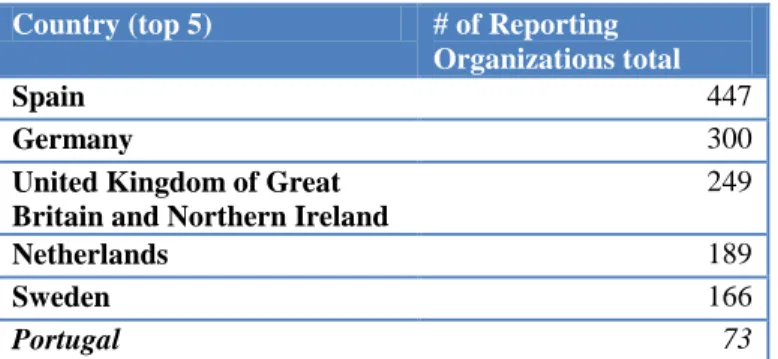
When analyzing the reporting landscape of Europe it becomes clear that Spain plays an important role. With 447 reporting organizations registered on the GRI Database4 Reports Spain is leading in the number of organizations which have at least once produce a non-financial report. In 2014 Spain has produce the highest number. In total for the last year 150 sustainability reports (out of which 6 were non- GRI reports) were registered on the GRI Database (Table 1). Hence the importance of Spain for the non-financial reporting is undeniable. Moreover Spain is market leader in number of organizations reporting to the new G4 Guidelines. With 46 reports produce since the launch of the new guidelines Spain presents itself as the ideal candidate for conducting a first investigation of the G4 Guidelines.
3 Strategy 2014-2020 for businesses, public administrations and other organisations to advance towards a
more competitive, productive, sustainable and inclusive society and economy.
4 Organizations registered on the GRI Database from 1999 until 2015; including non-GRI Reporting
9
Portugal, due to its proximity and the need for further investigation, is included in this project, and serves as a comparison. Overall Portugal is represented with 73 reporting organizations in the GRI Data Base.
Literature Review
Importance of Sustainability Reporting
There are several factors influencing Sustainability Disclosures Practices such as the industry sensitivity, the size of organizations as well as legislative aspects (Meek et al., 1995). CSR is viewed with great skeptics from an economic point of view. Not before too long the idea of profit sacrifices for CSR Investments is considered as not viable when competition is fierce (Baumol & Blackman, 1991). The cost of CSR is seen as unnecessary for the goal of profit maximization. Social and environmental incentives from capital, goods and/or labor markets however are urging firms to peruse CSR and as a consequence companies are rewarded by several stakeholder groups for engaging in CSR. CSR may increase employee effectiveness and productivity as found by Bashir et al.(2012 and Flynn (2005). Prospective employees include CSR as a criteria for their job selection decision (Turban & Greening, 1997). Closer related to the financial benefits of CSR for firms are findings from several other authors. Cost reduction as a result of the evaluation of business actions and supply chain and implementation of environmental friendly activities is recognized as one substantial benefit CSR (Bauman & Skitka, 2012 and Kiewiet & Vos, 2007).
10
Consumers as one important stakeholder group when investigating CSR effectiveness are as well one of the most difficult to face. One the one hand consumers demand corporations to invest in Social and Environmental Concerns, on the other hand Negative CSR activities (T. J. Brown & Dacin, 1997) and perceived misbalance between corporate communication about CSR activities and enacted practices (Elving & van Vuuren, 2010; Jahdi & Acikdilli, 2009) lead to skepticism from consumer side (Sen & Bhattacharya, 2001). The high demand of CSR activities (Carrigan & Attalla, 2001) combined with the high costs of CSR activities encourage corporations to exaggerate on their social and environmental efforts and focus on issues which are not related to the core business (Bazillier & Vauday, 2009). Sustainability reports aim to provide more transparency for all stakeholders. However consumers are not considered as the main target for sustainability reports (O'Dwyer, Unerman, & Hession, 2005). Existing consumers are certainly one of the most important groups when considering CSR activities however as well the most difficult on to address. The willingness to pay more for products sold by corporations which are considered as socially/environmentally friendly remains unclear (Mohr, Webb, & Harris, 2001; Sen & Bhattacharya, 2001). Retraining consumer is influenced by the social and environmental concerns of corporations (Bauman & Skitka, 2012). Exploration of new market opportunities (Kuosmanen & Kuosmanen, 2009) hence an increase in consumer base is seen as another beneficial effect of CSR. When investigating the relationship between sustainable development and CSR (Mohd Taib & Ameer, 2012) state that the actual requirements might be underestimated by sustainability reporting frameworks as they do not reflect the real concerns of environmental and social issues. As observed by (Nguyen & Slater, 2010) more sustainable corporations outperform competitors on aspects such as
11
average return on assets, average revenue growth and average share value appreciation rate. Overall several research papers support the positive effects of CSR for employee satisfaction and attraction, customer retention, cost savings and competitive advantage. As (Margolis & Walsh, 2003) point out that findings of prior research linking CSR to financial performance is inconclusive. While some researchers find a positive relationship between CSR and Financial Performance, a great amount of studies suggest that there is no relationship. Moreover some researches imply that CSR is negatively influencing a firms performance. The inconclusive results may be explained by the lack of a common methodology in measuring CSR activities. So far there is no unified Corporate Social Performance Measurement Tool available hence the approach to measure Corporate Social Performance varies. However one aspect remains crucial for the business case of CSR which is the measurability which may explain the inconclusive results provided in the past. There are several researchers opting to find one standardized method to investigation the case of Corporate Financial Performance and Corporate Social Performance. Several organizations attempt to disclose concrete and over time-period comparable social and environmental performance reports. One case can be observed by Kering Group, and Puma as a front runner (Puma, 2011). An Environmental Profit and Loss Balance Sheet dating back until 2011 aims to provide transparency for stakeholders and comparability of environmental performance. While the relationship of financial performance to sustainability performance is one aspect another crucial factor is the impact measurement of corporations. The creation of this Data Collection for the Portuguese and Spanish region should provide future research the possibility to investigate further relationship between material aspects and a firm´s performance. Most prior research so far was trying to measure
12
CSR in quantifiable terms. Evaluation of performances based on number of topics reported, pages numbers associated, ect may have led organizations to report as much as possible rather than on what is important. The actual one crucial aspect of sustainability report is the careful definition of impact areas. A focus on areas which are most important to the business will on the hand have the most impact to the issues addressed and on the other hand should contribute positively to an organizations performance. As pointed out by (Wolfe and Aupperle, 1999) and as well by more recent researchers such as (Gjølberg, 2009) no single approach to assess CSR performance has been developed and there is a high need for an overall assessment tool for sustainability.
The case of Sustainability Reporting in Spain and Portugal
The aftermath of the financial crisis and the mistrust from consumer side can be observed in the increase in reporting and in particular the increase of independent audited sustainability reports. In the years 2008, 2009 and 2010 a steep increase in assured sustainability reports can be observed with respectively 73%, 75% and 82% of registered reports being assured by a third party or auditor. While before 2008 and after 2010 the percentage of assured sustainability reports remains steady at below 70% (TABLE 2).
Reporting 4.0
The next step includes an in depth evaluation of all of the G4 Reports present on the GRI Sustainability Disclosure Data Base (until 31/March/2015). This analysis should provide a clear insight in which are considered as foci areas by Spanish and Portuguese organizations. In total 51 reports are included in this analysis, which is conducted as an in depth analysis.
13
All information has been extracted from the GRI Sustainability Disclosure Data base and the GRI Reports List. Observed is the timeframe since the launch of the G4 Guidelines referring to years 2013, 2014, 2015. As part of a GRI- Report there is the so-named content index which aims to mirror all of the disclosures reported on in an organizations sustainability report. By gathering the information it is possible to show specific focus areas in regions, industries and benchmark specific corporations. Hence such a data collection may the first step in defining a universal comparison tool for displaying sustainability information.
Materiality Definition
“Only by identifying important issues can Corporate Responsibility be relevant for the
Company’s competitiveness.5” – Sustainability Report Grupo Calvo
Only those issues which attract stakeholder interest and have significant environmental, social and financial impact will be relevant to capital markets participants at one period of time (Global Reporting Initiative, 2013; KPMG International, 2013). The approach of how material issues are defined is crucial in order to mitigate risks and explore opportunities to its fullest. This first part of the project should provide a clear overview of how organizations in Spain conduct their materiality analysis. Most organizations follow a fairly similar pattern for defining the steps for the Materiality Analysis (Table 3).
In the majority of cases the first step is the identification of the issues an organization has to face. In the second step most organization prioritize those issues prior defined. In the final
5
14
step issues are being validated. The method for definition of material topics as well as periodization of topics differs widely. Most common are internal or external evaluation or a combination of both (29).
In total 25 organizations did not specify the methodology of their process of materiality definition. Another crucial aspect is stakeholder engagement. 31 organization do either not engage in their stakeholders in the Materiality decision making process or do not specify which stakeholder they are engaging with. Those engaging with their stakeholder in their materiality evaluation are focusing on customer, Employees or Civil Societies, Investors and Shareholders and Suppliers (Table 4). In order to have a clear overview of the sustainability reporting pattern, it would be crucial to investigate the reporting practices of those organizations in detail and explore the reasons for omitting stakeholder engagement. When conducting stakeholder 8 organizations use surveys/ questionnaires or reunions to investigate the perceived materiality aspects with their stakeholders while most of the organization do not elaborate on the methods used for stakeholder engagement. Several organizations (17) base their initial issue identification on experts in the sustainability field. Those include experts such as the OECD, United Nations Global Compact (UNGC),
Global Reporting Initiative (GRI), Dow Jones sustainability Index (DJSI)6, World Bank,
International Energy Agency, American Petroleum Institute, TSE4 Good Index Series, The European Federation of Financial Analysts Societies (EFFAS), Agency and the World Business Council for Sustainable Development and SASB (Sustainability Accounting Standards Board).
6
15
Within the sample collected one organization outsourced their entire sustainability materiality definition process.
Implications drawn from this analysis are the following:
Only half of the organizations analyzed have defined a clear structured process for defining their material aspects
60% of organization either do not actively engage stakeholder in their materiality definition process or do not specify which stakeholders have been engaged in the process.
What Matters: Spain/Portugal
This analysis should provide a clear overview of what is considered as material to organizations in the region of Portugal and Spain. Comparability is one of the biggest issue when researching about sustainability (Carroll & Shabana, 2010). Moreover this tools aims to be the first step towards a broad benchmarking tool for which organizations will be able to benchmark their reporting patterns towards competitors and actors in the same industry. On average a Spanish or Portuguese firm reports on 43 specific disclosures (out of 91). Each corporations has conducted an in depth materiality analysis as stated in their reports. More than half (61 %) of the organization are not only reporting according to GRI Guidelines but as well include other sustainability frameworks in their reports. The majority of those organizations are including the United Nations Global compact Principles in their report. On average an organization reporting according to the comprehensive option of the guidelines discloses on average 54 specific disclosures while organization reporting to the core guidelines disclosure 30 specific disclosures. When investigating disclosures
16
dedicated to report on the economic performance and figures of organization we find that overall the majority of organization considers this category to be material to their organizations. 78% of organization report on their Economic Performance, in particular on their direct economic value generated and distributed and on financial assistance received from government. While the indicator seen as least important in Spain and Portugal is the Market Presence with only 48% of reporting rate. Regarding environmental reporting we are able to observe that reporting on emissions as well as on energy are from high priority to Portuguese and Spanish companies. 67% of organization considers the Energy
consumption within their organization as material and report on this indicator. While only
few organizations consider environmental grievance mechanism material to their business. The social component of the guidelines is split up in several subcategories. The first one can be named as labor practices and decent work. Within this category Spanish and Portuguese firms consider employment, occupational health and safety, training and
education and equal remuneration as highly material to their corporations. More than 70%
of organizations report on each of these disclosures. In general it appears as if Portuguese and Spanish firms consider Human Rights Aspects as not as a priority in their materiality analysis. In particular less than 30% of organizations consider child labor and indigenous rights as material to their business. Socio-economic and cultural settings have to be taken into consideration for sustainability reporting (Fifka & Drabble, 2012) hence this is not surprising given the socio-economic setting and development status of the countries analyzed. Social Communities on the other side are considered as highly relevant to organizations as well as anti-corruptions. In the category product responsibility organizations consider product labeling and compliance (55%)as most relevant. In specific
17
51% of organizations disclose the results of consumer satisfaction survey. Environmental, social and governance risk often lies deep in the supply-chain, hence a careful supplier evaluation is necessary to evaluate this types of risk. Similar to the findings of (Carter & Rogers, 2008) we observe that organizations devoting highest priority to address
environmental issues when assessing their suppliers while social issues as well as human
18
19
The table below shows a concrete overview of the foci areas in Portugal and Spain for sustainability reporting. Due to the underrepresentation of Portugal in numbers of sustainability reports no concrete conclusion for a difference in reporting pattern can be observed. Hence the below listed materiality foci are listed as the sum both countries.
To sum up, the highest importance in the Spanish and Portuguese market is devoted to focus areas such as economic performance 78%, training and education 78%, employment 75%, diversity and equal opportunity 73%, emissions 71%, occupational health and safety, 71%, energy 69%, local communities 65%, water 63%, indirect economic impacts 61%.
Discussion
In order to have a clear broader understanding of sustainability focus an industry wide analysis and globally conducted evaluation would reveal greater insights on focal issues considered. Such an analysis may be the first way to measure the actual impact of sustainability efforts. Although the new G4 Guidelines have been launched in 2013 an evaluation and research based on the guidelines appears to be premature. Spain as the country with the highest uptake for the G4 Guidelines appeared to be the optimal choice for a pilot for such a project however one further generation of G4 reports will be necessary to find conclusive evidence of the impact of the new guidelines. This projects aims to provide guidance for all reporting organization as well as institutions and legislative bodies supporting sustainability reporting to explore areas for improvement. Moreover it should
20
provide GRI an insight in how Materiality is interpreted by reporting organizations as well as the usability of the content index. In particular guidance for stakeholder engagement and the procedure of materiality definition would benefit first of all organization when defining their materiality aspects as well as favor a dialogue between all actors.
References
Bashir, Rizwana, Hassan, Atif, & Cheema, FEA. (2012). Impact of Corporate Social
Responsibility Activities over the Employees of the Organizations: An exploratory study. Journal of Management and Social Sciences, 8(2), 11-21.
Bauman, Christopher W, & Skitka, Linda J. (2012). Corporate social responsibility as a source of employee satisfaction. Research in Organizational Behavior, 32, 63-86.
Baumol, William J, & Blackman, Sue Anne Batey. (1991). Perfect markets and easy virtue:
Business ethics and the invisible hand: Blackwell Cambridge, MA.
Bazillier, Rémi, & Vauday, Julien. (2009). The greenwashing machine: is csr more than communication.
Bebbington, Jan, Larrinaga, Carlos, & Moneva, Jose M. (2008). Corporate social reporting and reputation risk management. Accounting, Auditing & Accountability Journal, 21(3), 337-361.
Brown, Halina Szejnwald, De Jong, Martin, & Lessidrenska, Teodorina. (2009). The rise of the Global Reporting Initiative: a case of institutional entrepreneurship. Environmental
Politics, 18(2), 182-200.
Brown, Tom J, & Dacin, Peter A. (1997). The company and the product: corporate associations and consumer product responses. The Journal of Marketing, 68-84.
BSR. (2014). BSR/GlobeScan State of Sustainable Business Survey 2014. from
http://www.bsr.org/reports/BSR_GlobeScan_Survey_2014.pdf
Cambres Oficials de Comerç Indústria i Navegació de Catalunya. (2008). RSE.PIME, 2008-2010. . from http://www.rsepime.cat/index.php
Carrigan, Marylyn, & Attalla, Ahmad. (2001). The myth of the ethical consumer–do ethics matter in purchase behaviour? Journal of consumer marketing, 18(7), 560-578. Carroll, Archie B, & Shabana, Kareem M. (2010). The business case for corporate social
responsibility: a review of concepts, research and practice. International Journal of
21
Carter, Craig R, & Rogers, Dale S. (2008). A framework of sustainable supply chain
management: moving toward new theory. International journal of physical distribution
& logistics management, 38(5), 360-387.
Chen, Stephen, & Bouvain, Petra. (2009). Is corporate responsibility converging? A comparison of corporate responsibility reporting in the USA, UK, Australia, and Germany. Journal of Business Ethics, 87(1), 299-317.
Confederacion Española Empresarial de la Economia Social. (2005). RSE.COOP Reporting Guidelines Programme, 2005-2007., from
www.cepes.es/listado.cfm?padre=389&idSeccion=390&idsec=sec_11
Costanza, Robert, Daly, Herman E, & Bartholomew, Joy A. (1991). Goals, agenda, and policy recommendations for ecological economics. Ecological economics: the science and
management of sustainability. Columbia University Press, New York, 1-20.
CR Magazine. (2015). CR’s 100 Best Corporate Citizens 2015. from
http://www.thecro.com/files/100%20Best%20List%202015.pdf
Crittenden, VictoriaL, Crittenden, WilliamF, Ferrell, LindaK, Ferrell, O. C., & Pinney,
ChristopherC. (2011). Market-oriented sustainability: a conceptual framework and propositions. Journal of the Academy of Marketing Science, 39(1), 71-85. doi: 10.1007/s11747-010-0217-2
Edelman. (2012). Global Consumer Survey. Retrieved November 29, 2013, from
http://purpose.edelman.com/
Elving, W, & van Vuuren, M. (2010). Communicating corporate social responsibility to suspicious audiences: beyond identity washing.
European Commission. (2001). Green Paper. Promoting a European framework for Corporate Social Responsibility.
Fifka, Matthias S, & Drabble, Maria. (2012). Focus and standardization of sustainability reporting–a comparative study of the United Kingdom and Finland. Business Strategy
and the Environment, 21(7), 455-474.
Flynn, Francis J. (2005). Identity orientations and forms of social exchange in organizations.
Academy of Management Review, 30(4), 737-750.
Giannarakis, Grigoris, & Theotokas, Ioannis. (2011). The effect of financial crisis in corporate social responsibility performance. International Journal of Marketing Studies, 3(1), p2. Gjølberg, Maria. (2009). Measuring the immeasurable?: Constructing an index of CSR
practices and CSR performance in 20 countries. Scandinavian Journal of Management,
25(1), 10-22.
Global Reporting Initiative. (2013). Reporting Principles and Standard Disclosures Government of Extremadura. (2010). CSR law of Extremadura, 2010. . from
https://cordis.europa.eu/partners/web/dglabor/partnership-requests?p_p_id=profileviewrequestproposals_WAR_partnersrequestforcallofproposa lportlet&p_p_lifecycle=0&p_p_state=normal&p_p_mode=view&p_p_col_id=public-
22
oposalportlet_view=showDetails&_profileviewrequestproposals_WAR_partnersreque stforcallofproposalportlet_requestProposalId=16353
Hartman, Laura P, Rubin, Robert S, & Dhanda, K Kathy. (2007). The communication of corporate social responsibility: United States and European Union multinational corporations. Journal of Business Ethics, 74(4), 373-389.
Idowu, Samuel O, & Papasolomou, Ioanna. (2007). Are the corporate social responsibility matters based on good intentions or false pretences? An empirical study of the motivations behind the issuing of CSR reports by UK companies. Corporate
Governance: The international journal of business in society, 7(2), 136-147.
Jahdi, Khosro S, & Acikdilli, Gaye. (2009). Marketing communications and corporate social responsibility (CSR): marriage of convenience or shotgun wedding? Journal of Business
Ethics, 88(1), 103-113.
Kiewiet, Derk Jan, & Vos, Janita FJ. (2007). Organisational sustainability: a case for formulating a tailor-made definition. Journal of Environmental Assessment Policy and
Management, 9(01), 1-18.
KPMG International. (2013). GRI’s G4 Guidelines: the impact on reporting. from
https://www.kpmg.com/Global/en/IssuesAndInsights/ArticlesPublications/Documents /g4-the-impact-on-reporting-v2.pdf
Kuosmanen, Timo, & Kuosmanen, Natalia. (2009). How not to measure sustainable value (and how one might). Ecological Economics, 69(2), 235-243.
Margolis, Joshua D, & Walsh, James P. (2003). Misery loves companies: Rethinking social initiatives by business. Administrative science quarterly, 48(2), 268-305.
Meek, Gary K, Roberts, Clare B, & Gray, Sidney J. (1995). Factors influencing voluntary annual report disclosures by US, UK and continental European multinational corporations.
Journal of international business studies, 555-572.
Ministerio de Empleo y Seguridad Social. (2014). Strategy 2014-2020 for businesses, public administrations and other organisations to advance towards a more competitive, productive, sustainable and inclusive society and economy., from
http://www.empleo.gob.es/es/sec_trabajo/EERSE_WEB.pdf
Mohd Taib, Erina, & Ameer, Rashid. (2012). Relationship between corporate sustainability practices and financial performance: Evidence from the GRI reporting companies.
Rashid, Relationship between Corporate Sustainability Practices and Financial Performance: Evidence from the GRI Reporting Companies (September 25, 2012).
Mohr, Lois A., Webb, Deborah J., & Harris, Katherine E. (2001). Do Consumers Expect
Companies to be Socially Responsible? The Impact of Corporate Social Responsibility on Buying Behavior. Journal of Consumer Affairs, 35(1), 45-72. doi: 10.1111/j.1745-6606.2001.tb00102.x
Moneva, José M, Archel, Pablo, & Correa, Carmen. (2006). GRI and the camouflaging of
corporate unsustainability. Paper presented at the Accounting forum.
Montiel, Ivan. (2008). Corporate social responsibility and corporate sustainability separate pasts, common futures. Organization & Environment, 21(3), 245-269.
23
Nguyen, Dung K, & Slater, Stanley F. (2010). Hitting the sustainability sweet spot: Having it all.
Journal of Business Strategy, 31(3), 5-11.
O'Dwyer, Brendan, Unerman, Jeffrey, & Hession, Elaine. (2005). User needs in sustainability reporting: Perspectives of stakeholders in Ireland. European Accounting Review, 14(4), 759-787. doi: 10.1080/09638180500104766
Puma. (2011). ENVIRONMENTAL PROFIT AND LOSS ACCOUNT. from
http://about.puma.com/en/sustainability/environment/environmental-profit-and-loss-account
Roberts, Robin W. (1992). Determinants of corporate social responsibility disclosure: an application of stakeholder theory. Accounting, Organizations and Society, 17(6), 595-612.
Sen, Sankar, & Bhattacharya, C. B. (2001). Does Doing Good Always Lead to Doing Better? Consumer Reactions to Corporate Social Responsibility. Journal of Marketing
Research, 38(2), 225-243. doi: 10.2307/1558626
The European Sustainability Reporting Association. (2008). European Sustainability Reporting Association report for Spain. from http://www.sustainablereporting.eu/spain
Turban, Daniel B, & Greening, Daniel W. (1997). Corporate social performance and
organizational attractiveness to prospective employees. Academy of management
journal, 40(3), 658-672.
Turker, Duygu. (2009). Measuring corporate social responsibility: A scale development study.
Journal of business ethics, 85(4), 411-427.
Werbach, Adam. (2009). Strategy fors sustainability. A Business Manifesto, Harvard Business.
Explanatory Tables
Country (top 5) # of Reporting
Organizations total
Spain 447
Germany 300
United Kingdom of Great Britain and Northern Ireland
249
Netherlands 189
Sweden 166
Portugal 73
24
Table 2 Trend Analysis: Third Party Assurance in Sustainability Reporting
I Step II Step III Step
IV Step Identification of issues
(23)
Evaluation importance for the various stakeholders (1) Analysis of value chain (1) Analysis and assessment of issues (1) Prioritization (19) Revision of political practices (1) Identification of issues relevant (1) Analysis of the treatment of material issues from a competitor perspective (1) Dialogue with stakeholders (1) External Assement (1) Identification of issues relevant (1) Selection (1) Validation (12) Prioritization(2) Consultation with Stakeholder (1) Review (2) Consultation with Senior Management (1) Validation/ Review (4) Definition (1)
Table 3 Materiality Definition Process
64% 73% 75% 82% 67% 57% 68% 53% 0% 50% 100% 2007 2008 2009 2010 2011 2012 2013 2014
Stakeholder Engagement in Materiality Definition Employees (11) Investors and shareholders (6) Unions (2) Media (3) Local Communities (5) Governmental bodies/ Public authorities (3) Auditors/ Financial Analyst (3)
Civil society/ NGO (4)
Suppliers (8)
Customers (9)
25 empresarial-2013-interactiva.pdf Acciona http://www.acciona.es/junta_general_2014/documentacion/memoria_sostenibilidad.pdf ADIF http://www.adif.es/es_ES/conoceradif/doc/CA_MS_2013.pdf AGBAR http://www.masdesarrollosostenible.com/es/informe-ds-2013/rendicion-de-cuentas/indice-gri/contenidos-basicos-generales AGUAS DE ALBACETE http://www.aguasdealbacete.com/DOC/MEMORIA_ES_AGUAS_baja.pdf
Aplitelc Bergueda http://ca.gsrural.org/upload/apartat/memoria-2013aplitelc.pdf
Atresmedia http://www.atresmediacorporacion.com/informe-anual/2013/INFORME_ANUAL_Y_DE_RC_2013.pdf
Balearic Islands Port Authority http://www.portsdebalears.com/memoriasost2013/files/assets/downloads/APB2013-memoria_report.pdf BMN https://www.bmn.es/BMN_/BMN/docs/InfoCorporativa/Informe_Responsabilidad_Corporativa_2013_FIN AL_junio_2014.pdf CLH http://www.clh.es/docs2/RSC_13_EN4.pdf Corresponsables http://www.corresponsables.com/download/Informe_Integrado_Sostenibilidad_Corresponsables_2013_2014 .pdf DKV Seguros http://dkvseguros.com/Almacen/Publicaciones/Memorias/Informe_Sostenibilidad_2013.pdf Ecoembes http://www.ecoembes.com/sites/default/files/informe_anual_ecoembes_2013.pdf FCC Aqualia http://www.aqualia.es/static/WAqualia/eng/RSC/2013/index.html FCC Construccion http://comunicacion-fccco.fcc.es/salacon/wcm/idc/groups/public/documents/document/mdaw/mdc1/~edisp/cscp092614.pdf Fomento de Construcciones Y Contratas (FCC) http://www.fcc.es/fccweb/wcm/idc/groups/public/documents/document/mdaw/mdcz/~edisp/cscp089873.pdf Forética http://www.foretica.org/memoria_foretica_2013.pdf Fundació Ramon Noguera http://www.grupfrn.cat/pdf/rsc2013.pdf
Gas Natural SDG http://www.gasnaturalfenosa.com/servlet/ficheros/1297142041347/IRC_ing_2013_acc.pdf,0.pdf
Grupo Banco Popular http://www.grupobancopopular.com/EN/cr/DocumentacionCR/Documents/Informes%20RSC/Integrated%2 0Report%202013%20-%20Grupo%20Banco%20Popular.pdf
GRUPO CALVO http://grupocalvo.com/memoria/CALVO_report_2013_ing.pdf
Grupo Correos http://www.correos.es/InformeAnual2013/docs/Informe%20anual%202013.pdf
Grupo Leche Pascual http://www.calidadpascual.com/informeCVC/docs/informe_pascual.pdf
Grupo TRAGSA http://www.tragsa.es/es/comunicacion/publicaciones/Documents/MEMORIAS/Memoria%20Sostenibilidad %202013%20Grupo%20Tragsa.pdf
HOSPITALES UNIVERSITARIOS VIRGEN MACARENA - VIRGEN DEL ROCIO
http://activos-salud.com/memoria2013/memoria2013.pdf Iberdrola https://www.iberdrola.es/webibd/gc/prod/en/doc/IA_InformeSostenibilidad13.pdf IMPLASER 99 SLL http://www.implaser.com/senalizacion_de_seguridad_pdf/memoria_actual.pdf Inditex http://www.inditex.com/documents/10279/18789/Inditex_Group_Annual_Report_2013.pdf/88b623b8-b6b0-4d38-b45e-45822932ff72 Indra Javierre S.L. http://www.unglobalcompact.org/system/attachments/90321/original/MEMORIA_DE_SOSTENIBILIDAD _JAVIERRE_2013.pdf LaVola https://publisher.wizness.com/es/reports/memoria-de-sostenibilidad-2013/tabla-de-gri-y-pacto-mundial/indice-de-contenidos-e-indicadores MAS Business - Managing A Sustainable Business http://www.mas-business.com/informes/Informe_Sostenibilidad_2013.pdf
26
Table 2 List of Organizations included in the analysis
Meliá Hotels International
http://www.meliahotelsinternational.com/sites/default/files/informes-financieros/Informe%20Anual%20%26%20RSC%202013%20MHI.pdf
Northgate España http://www.northgateplc.es/documentacion/Memoria_RSC_2014.pdf
Prosegur http://www.prosegur.com/web/groups/corporativo/documents/gestion_web/prwebc028712.pdf Realia http://www.realia.es/realia/Portals/0/Ficheros/REALIA_2013-WEB/PDFs/ENG/Annual%20and%20CR%20Report%20REALIA%202013.pdf Santalucia SIGAUS http://www.sigaus.es/media/1165239/fb_memoria_2013_10-7-14_baja.pdf SIGRE http://www.memoriasigre.es/2013/wp-content/uploads/2014/04/Resumen_Sigre_Baja.pdf TECHNICAL UNIVERSITY OF MADRID (UPM)-SCHOOL OF INDUSTRIAL ENGINEERING (ETSII) http://www.industriales.upm.es/la_escuela/responsabilidad_social/MemoriaRS_1113.pdf TÉCNICAS REUNIDAS (TRSA) www.tecnicasreunidas.es/recursos/doc/ingles/shareholders/sustainability-memory/sustainability-report-2013.pdf
Vodafone Espana http://www.vodafone.es/static/fichero/pro_ucm_mgmt_604373.pdf
Abengoa http://www.abengoa.com/export/sites/abengoa_corp/resources/pdf/en/gobierno_corporativo/informes_anual es/2014/Tomo2/2014_Volume2_AR.pdf Mapfre http://www.mapfregrupo.com/doc/2015/es/pdf/3_RESPONSABILIDAD-SOCIAL.pdf Águas do Douro e Paiva http://www.addp.pt/FileUpload/files/Downloads/Relatorio_Sustentabilidade_%202013_AdDP.pdf
Auchan Portugal http://alencastre.ipapercms.dk/Auchan/ComunicaoInterna/relatoriosustentabilidadeAuchan2013/
Banif Financial Group http://www.banif.pt/xsite/Particulares/Institucional/PoliticaSocial.jsp?CH=3733
CAIXA GERAL DE DEPOSITOS https://www.cgd.pt/Institucional/Sustentabilidade/Reporting-desempenho/Relatorios-de-Sustentabilidade/2013/Documents/Relatorio-Sustentabilidade-CGD-2013.pdf EPAL http://www.epal.pt/EPAL/docs/default-source/epal/relatorio-sustentabilidade/relatorio-sustentabilidade_2013.pdf?sfvrsn=8.pdf
Porto de Sines http://www.portodesines.pt/pls/portal/go
Portugal Telecom http://www.telecom.pt/NR/rdonlyres/9233D364-6A22-46C9-AA4A-E6A8EB5DB89E/1469936/PTSUSTAINABILITYREPORT2013.pdf