INTERVENTIONS FOR PREVENTING HOSPITAL-ACQUIRED
LEGIONNAIRES’ DISEASE
Dissertação apresentada à Universidade Católica Portuguesa para
obtenção do grau de mestre em
INFECÇÃO EM CUIDADOS DE SAÚDE
Por
Dejanira Alexandra de Almeida
INTERVENTIONS FOR PREVENTING HOSPITAL-ACQUIRED
LEGIONNAIRES’ DISEASE
Dissertação apresentada à Universidade Católica Portuguesa para
obtenção do grau de mestre em
INFECÇÃO EM CUIDADOS DE SAÚDE
Por
Dejanira Alexandra de Almeida
Sob a orientação de
Professora Doutora Teresa Marques (Orientadora)
e
Professor Doutor Joaquim Ferreira (Co-Orientador)
(Lisboa, 2013)
Interventions for Preventing Hospital-Acquired Legionnaires’ Disease i
T A B L E O F C O N T E N T S
ABSTRACT ……….. 1 BACKGROUND ………. 2 OBJECTIVES ………... 3 METHODS ……….. 3 RESULTS ………. 5 Figure 1. ……… 5 Figure 2. ……… 7 Figure 3. ……… 7 DISCUSSION ………... 8 AUTHORS’ CONCLUSIONS ………. 9 ACKNOWLEDGEMENTS ……… 9 REFERENCES ……… 10 CHARACTERISTICS OF STUDIES ………... 14DATA AND ANALYSES ……… 19
Interventions for Preventing Hospital-Acquired Legionnaires’ Disease (Review)
1
[Intervention Review]
INTERVENTIONS
FOR
PREVENTING
HOSPITAL-ACQUIRED
LEGIONNAIRES’ DISEASE
A B S T R A C T Background
Legionnaires’ Disease (LD) has been recognized as a significant source of morbidity and mortality in many hospitals worldwide. Legionella in the hospital water distribution system has been epidemiologically linked to acquired LD. Despite the several disinfection methods available the optimal method to control hospital-acquired LD has not been established yet.
Objectives
To assess the efficacy of interventions for preventing hospital-acquired LD in hospitalized patients at high risk of developing the disease and the effect on environmental colonization associated to the risk of developing hospital-acquired LD.
Search Methods
We searched The Cochrane Central Register of Controlled Trials (CENTRAL) in The Cochrane Library and MEDLINE (PubMed). We also handsearched the reference lists of all primary studies identified by the initial search.
Selection Criteria
All controlled studies investigating the efficacy of interventions for the prevention of hospital-acquired LD, in hospitalized patients at high-risk for developing LD, were eligible for inclusion.
Data collection and analysis
Two authors independently assessed the trials and extracted data. Data was analysed using statistical software, Review Manager 5.2.
Results
Three controlled trials, two assessing copper-silver ionization and one assessing ultraviolet light (UVL), met the inclusion criteria. The meta-analysis showed a significant benefit in using copper-silver ionization rather than no intervention for Legionella positivity in distal sites, with RR = 0.04 (95% CI Fixed Effects 0.001, 0.29). One study demonstrated benefit of UVL versus no intervention with a RR = 0.03 (95% CI 0.00, 0.41) for Legionella positivity in water samples.
Authors’ conclusions
Our review demonstrates that copper-silver ionization and UVL are beneficial, compared with no treatment, to prevent hospital-acquired LD. However the quality of the body of evidence identified does not allow a robust conclusion regarding the effectiveness of interventions for preventing hospital-acquired LD.
Interventions for Preventing Hospital-Acquired Legionnaires’ Disease (Review)
2
B A C K G R O U N D
Description of the condition
Definition
Legionnaires' disease (LD) is a severe multisystem illness and potentially fatal form of pneumonia, caused by bacteria of the genus Legionella (Silva 1996). The main clinical manifestations include sudden onset of pneumonia with high fever, myalgia, headache, dyspnea, nonproductive cough as well as systemic manifestations such as diarrhea, nausea, vomiting and neurological changes. Important laboratory data includes liver function abnormalities, hyponatremia and hypophosphatemia (Mandell 2010; Pedro-Botet 2011 Sabria 2002). Although this symptom complex does occur in LD it is not sufficiently distinctive to clinically differentiate it from other causes of pneumonia (Murdoch; Silva 1996). The key to diagnosis relies on the use of specialized laboratory methods, when a patient is in a high-risk category (Mudoch 2003).
Epidemiology
Legionella spp are small, gram-negative bacilli, obligate
aerobes, with fastidious growth requirements (Fields 2002; McDade 1977). Water is the major reservoir for
Legionella, and the bacteria are ubiquitous in natural and
artificial water environments worldwide and survive in a large variety of habitats and conditions. Legionella multiplies at temperatures between 25 and 42ºC, with an optimal growth temperature of 35ºC (Fields 2002; Newton 2010).
The environmental factors involved in outbreaks or isolated cases of Legionella infection are not completely understood, but certain events are considered prerequisites for this infection. These factors include the presence of virulent strains in an aquatic environment, the amplification of the bacteria to obtain an infectious dose, a mean for dissemination, such as by aerosolization, and transmission of the bacteria through contaminated water, to a human host susceptible to the disease.
The main mode of transmission of LD is inhalation of microorganisms in aerosols spread mainly from showers and taps, cooling towers and condensers of air conditioning systems, equipment used in respiratory therapy and hot tubs. Another form of transmission is microaspiration of contaminated water into the lung. There is no evidence of the possibility of direct transmission, person-to-person (Mandell 2010; Murray 1995; Silva 1996).
Although Legionella strains can cause disease in apparently healthy individuals, the likelihood of being infected and progressing to serious illness is dependent firstly on the type and intensity of exposure and secondly on individual susceptibility. Host risk factors for LD include male gender, age older than 50 years,
smoking, underlying chronic disease, immunosuppression associated in particular to solid organ transplantation and therapy with high doses of corticosteroids (Fields 2002; Silva 1996).
Hospital-acquired LD
LD is recognized as an important hospital-acquired disease because the natural habitat of these organisms is water and they are widespread in institutional water systems (Lin 2011a; Sabria 2002). The complex networks of pipes of water distribution systems provide ideal conditions for Legionella replication. Hospitals represent ideal settings for the transmission of the disease also because people with predisposing risk factors, such as immunocompromised and cancer patients, are more likely to be present and in high number. Furthermore, hospitals are places in which medical devices, that can disseminate Legionella into the lower respiratory tract, are used routinely such as respiratory therapy equipment (Sabria 2002).
In the decade since its initial description, LD pneumonia has been recognized as a significant source of morbidity and mortality in many hospitals worldwide. Reports of epidemics and outbreaks of hospital-acquired LD pneumonia occurring in association with Legionella colonization of potable water systems of hospitals have become commonplace (Lin 2011a; Sabria 2002). Therefore, hospitals have a special responsibility for preventing LD.
Since it is not possible to eradicate Legionella in a hospital environment it is necessary to minimize their proliferation and thus decrease the risk of infection. The best way to prevent the disease lies in early diagnosis of cases and intervention on the potential sources of infection.
Impact
True incidence of hospital-acquired infections is not known because LD is diagnosed and under-reported in all countries (Murdoch 2003; Sabria 2002). Despite increased awareness and the advances in the treatment of these infections, the mortality rate for hospital-acquired Legionella pneumonia, according to World Health Organization, remains in the range of 40 and 80% in immunocompromised patients, when left untreated. In cases correctly diagnosed in which directed therapy is applied in time, the rate may be reduced to 5-30%. In individuals with immune response capacity, the death rate varies between 10-15% (WHO 2011).
Description of the intervention
Measures to prevent Legionella in hospitals can be considered primary and secondary. First line prevention measures, i.e., measures to prevent Legionella with no previous documented cases of hospital-acquired LD, are appropriate laboratory diagnostic methods and a
Interventions for Preventing Hospital-Acquired Legionnaires’ Disease 3
water system well designed and maintained in accordance with national standards.
Secondary prevention, i.e., preventing further cases occurring when a case has been confirmed, should include an investigation to exclude the hospital water system as a source.
Legionella in the hospital water distribution system has
been epidemiologically linked to hospital-acquired LD (Lin 2011a; Stout 2007). The assessment of the risk of infection must take into account the different reservoirs in hospital plumbing systems such as hot and cold water, cooling systems (cooling towers, air conditioning, humidifying systems) and equipment used in respiratory therapy (Silva 1996).
Disinfection of water systems reduces the numbers of
Legionella, algae, fungi, protozoa and other bacteria that
may provide nutrients for the growth of Legionella. Several methods of disinfection are available and have been used either singly or in combination such as temperature control, copper-silver ionization units, chlorination (hyperchlorination, chlorine dioxide, monochloramine), ultraviolet light (UVL) and point-of-use filtration.
Temperature control was the first method used to control Legionella in hospital water systems. Cold water systems should be maintained at a temperature <20°C, while hot water should be stored above 60°C. Superheat-and-flush can be used for emergency control of Legionella because it requires no special equipment and can be initiated expeditiously Care is needed to avoid much higher temperatures because of the risk of scalding. (Kim 2002; Lin 1998).
Copper and silver ions are bactericidal in vitro against
Legionella. The disinfecting action is attributed to the
positively charged copper and silver ions which form electrostatic bonds with negatively charged sites on the bacteria’s cell wall. These electrostatic bonds create stresses leading to distorted cell wall permeability. This action, coupled with protein denaturation, leads to cell lysis and death (Kim 2002; Lin 2011b).
Chlorination includes strategies such as hyperchlorination, chlorine dioxide and monochloramine. Hyperchlorination implies that additional chlorine is added to water with an existing chlorine residual. Chlorine dioxide is a gas in solution that kills microorganisms by disruption of the transport of nutrients across the cell wall. Monochloramine is a chemical produced when ammonia is added to chlorinated water. Monochloramine can kill bacteria by penetration of the cell wall and blockage of the metabolism (Kim 2002; Lin 2011b).
UV light is an attractive option for disinfection since no chemicals are added to the water distribution system. Ultraviolet light kills bacteria by disrupting cellular DNA synthesis. When UV energy is absorbed by the reproductive mechanisms of bacteria, the genetic material is rearranged and they can no longer reproduce (Kim 2002; Lin 2011b).
Point-of-use filters are physical barriers, specially used for high risk patients, in intensive care units and transplant units (Lin 2011b).
Despite the several methods available the optimal method to control hospital-acquired LD has not been established yet
.
Why it is important to do this review
Interventions for prevention hospital-acquired LD should be mandatory in every hospital due to morbidity and mortality rates associated with this disease. In times of financial resources contention in healthcare, the correct implementation of effective measures will be both life-saving and less expensive in the long run. Infection control committee should play the leadership role in selecting and evaluating the specific disinfection modality. Recommendations for prevention in Hotels and other tourist accommodation (2005), were elaborated by EWGLI and later approved by the European Commission, but nothing has been published by this particular group or by the recently created ELDSNET of ECDC, regarding Prevention in Hospitals.Hospitals are increasingly faced with the decision of choosing a Legionella disinfection method. Accordingly, is important to review evidence regarding the efficacy of these interventions.
O B J E C T I V E S
To assess the efficacy of interventions for preventing hospital-acquired LD in hospitalized patients at high risk of developing the disease and the effect on environmental colonization associated to the risk of developing hospital-acquired LD.
ME T H O D S
Criteria for considering studies for this
review
Types of studies
We considered controlled studies for inclusion, investigating the efficacy of interventions preventing hospital-acquired LD and the effect on environmental colonization by Legionella.
Types of participants
We considered hospitalized patients at high risk of developing hospital-acquired LD (male gender, age older than 50 years, smoking, underlying chronic disease, immunosuppression associated in particular to
Interventions for Preventing Hospital-Acquired Legionnaires’ Disease 4
solid organ transplantation and therapy with high doses of corticosteroids).
Types of interventions
Eligible interventions include:
Temperature control versus no intervention; Copper-silver ionization versus no intervention; Chlorination versus no intervention;
Ultraviolet light (UVL) versus no intervention; Point-of-use filtration versus no intervention
Types of outcome measures
Primary outcome
a) Number of cases of hospital-acquired LD based on active clinical surveillance.
Secondary outcomes
b) Rate of Legionella positivity in environmental samples;
Search methods for identification of
studies
Electronic searches
We identified eligible studies by searching the following databases:
The Cochrane Central Register of Controlled Trials (CENTRAL) in The Cochrane Library using the search strategy described in Appendix 1;
MEDLINE (PubMed) using the search strategy described in Appendix 2.
Both searches were limited to studies published in the English and Spanish languages.
Searching other resources
We handsearched the reference lists of all primary studies identified by the initial search, to identify further published studies for possible inclusion in the review.
Data collection and analysis
Selection of studies
One author (Almeida D) initially screened the titles and abstracts of the search results and retrieved potentially
relevant reports in full-text for further assessment. Two review authors (Almeida D, Cristovam E) independently reviewed all relevant reports according to the pre-defined inclusion criteria to determine which studies satisfied the inclusion criteria. We resolved any disagreements by consensus
.
Data extraction and management
Data from studies satisfying the inclusion criteria were extracted by two review authors independently (Almeida D, Cristovam E). The characteristics of the study design, setting, participants, type of interventions (carefully extracting as many details as possible about the nature of the intervention) outcomes, results and risk of bias, were extracted using data extraction forms.
Assessment of risk of bias in included studies
This was conducted using the recommended approach for assessing risk of bias in studies included in Cochrane Handbook for Systematic Reviews of Interventions (Higgins 2011). We evaluate the following components for each included study: 1. Sequence generation;
2. Allocation concealment;
3. Blinding of personnel and outcome assessors; 4. Incomplete outcome data;
5. Selective outcome reporting; 6. Other bias.
The validity of each study was assessed as at low risk of bias (low risk of bias for all key domains) unclear risk of bias (unclear risk of bias for one or more key domains) or high risk of bias (high risk of bias for one or more key domains)
We decided not to exclude studies based on risk of bias assessment.
Assessment of heterogeneity
Heterogeneity was assessed with I² statistic, which provides a measure of the strength of evidence for heterogeneity in the studies’ results. Heterogeneity was considered statistically significant if P value was < 0.05. A rough guide to the interpretation of I2 is: 0 to 40%
might not be important, 30 to 60% may represent moderate heterogeneity, 50 to 90% may represent substantial heterogeneity, 75 to 100% considerable heterogeneity (Higgins 2011).
Interventions for Preventing Hospital-Acquired Legionnaires’ Disease 5
Data synthesis
A comparison between intervention and control groups from controlled trials was made. Data was analysed using statistical software, Review Manager 5.2. Results were presented with 95% confidence intervals (CI). Estimates for dichotomous outcomes were reported as risk ratios (RR). Methods of synthesizing the studies depended upon design and heterogeneity. Studies of similar comparisons reporting the same outcome measure were subjected to meta-analysis. In the absence of heterogeneity, a fixed effect model was applied to pooled data. Where meta-analysis was not applicable a narrative approach was undertaken.
R E S U L T S
Description of studies
See: Characteristics of included studies; Characteristics
of excluded studies
Results of the search
The results of electronic database and handsearching are outlined in Figure 1. There were no disagreements between authors about the number of studies eligible for inclusion.
Interventions for Preventing Hospital-Acquired Legionnaires’ Disease (Review)
6
Included studies
Tree controlled trials, retrieved by electronic databases searches, met the inclusion criteria. Two studies contributed to the assessment of copper-silver ionization (Chen 2008, Liu 1994) and one study contributed to the assessment of UVL (Farr 1988) for preventing hospital-acquired LD. Please see Characteristics of included studies for more details of the study conditions and Risk of bias assessments for each study.
Design
All the three studies were prospective controlled trials. Setting
The study by Chen 2008 was performed in a 1266-bed medical centre, consisted of three buildings, located in Taiwan.
The study by Farr 1988 was performed in two wards of the University of Virginia hospital, USA.
The study by Liu 1994 was performed in a 541-bed VA medical centre in Pennsylvania, USA.
Participants
In all of the three included studies the term "participants" refers to environmental samples subjected to microbiological testing.
Chen 2008 assessed 25 distal sites from three hospital buildings. The total number of samples collected is not reported. We assumed that the number of samples is equal to number of distal sites tested.
Farr 1988 studied 16 rooms used by renal transplant patients, including a total of 166 hot water samples. Liu 1994 assessed 47 distal sites (showerheads and inner surfaces of water spigots). The total number of samples collected is not reported. We assumed that number of samples is equal to number of distal sites tested.
Interventions
In Chen 2008
,
a copper-silver ionization system was installed at the point-of-entry of buildings A and B, to treat a large volume of both hot and cold water, and building C was the control building without ionization. Swab samples were taken from distal sites (21 in test buildings and 4 in the control building) and were cultured for Legionella. The swab samples were taken before the ionization start-up, monthly for first the six months and bi-monthly thereafter.In the study of Farr 1988
,
they have evaluated the effects of an UVL system in hospital water. Two UVL systems were installed so both hot and cold water pipesleading into eight rooms, used by renal transplant patients, would be exposed to UVL before reaching the taps. Eight comparable rooms on the same two hospital wards served as control without UVL. Hot water samples were taken approximately weekly unless they were in use at the sampling time.
The intervention evaluated in Liu 1994 was a copper-silver ionization system installed on the hot recirculation line. Two buildings were chosen as the test and control (without ionization) buildings. Swabs of the surfaces of showerheads and inner surfaces of water spigots were cultured. Samples were obtained before start-up, a week after the system was installed and monthly thereafter.
Outcomes
All included studies (Chen 2008; Farr 1988; Liu 1994) reported the rate of Legionella positivity in environmental samples.
Excluded studies
Twenty-five studies were excluded because they violated the inclusion criteria. Twenty-four studies were not controlled trials (Best 1983; Best 1984; Biurrun 1999; Blanc 2005; Borau 2000; Darelid 2002; Fisher-Hoch 1981; Hall 2003; Helms 1988; Mietzner 1997; Mòdol 2007; No authors listed 2000; Ragull 2006; Rohr 1999; Sidari 2004; Snyder 1990; Squier 2005; Srinivasan 2003; Stout 1998; Stout 2003; Triassi 2006; Vincent-Houdek 1993; Wilczek 1987; Zhang 2007). The study by Vincent-Houdek 1993 had no control group and the participants were confirmed cases of LD. The study by Johnson 1985 was excluded because the control group had a recent prior disinfection.
Risk of bias in included studies
A risk of bias table was completed for each included study (Risk of bias in included studies).
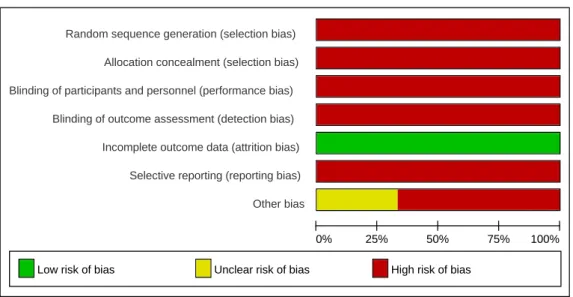
Results are presented graphically by domain over all studies (Figure 2) and by study (Figure 3).
Interventions for Preventing Hospital-Acquired Legionnaires’ Disease 7
Figure 2. Risk of bias graph: review authors' judgements about each risk of bias item presented as percentages across all included studies.
Figure 3. Risk of bias summary: review authors' judgements about each risk of bias item for each included study.
Random sequence generation (selection bias)
Allocation concealment (selection bias)
Blinding of participants and personnel (performance bias)
Blinding of outcome assessment (detection bias)
Incomplete outcome data (attrition bias) Selective reporting (reporting bias) Other bias
0% 25% 50% 75% 100%
Low risk of bias Unclear risk of bias High risk of bias
Ra nd om s eq ue nc e ge ne rat io n (se le ct io n bi as ) Chen 2008 – Farr 1988 – Liu 1994 – Allo ca ti on c on ce al m en t (se le ct io n bi as ) – – – Blin di ng o f pa rti cip an ts a nd p er so nn el ( pe rfo rm an ce b ia s) – – – Blin di ng o f ou tc om e as se ssm en t (de te ct io n bi as ) – – – In co m pl et e ou tc om e da ta ( at tr it io n bi as ) + + + Sel ec ti ve r ep or ti ng ( rep or ti ng b ia s) – – – O th er b ia s – – ?
Interventions for Preventing Hospital-Acquired Legionnaires’ Disease (Review)
8
Random sequence generation
None of the included studies gave a clear description about the method used to generate the allocation sequence. We assumed that random sequence generation was not performed.
Allocation concealment
None of the included studies described the method used to conceal the allocation. We assumed that allocation concealment was not performed.
Blinding of personnel and outcome assessors
None of the included studies described measures used to blind personnel and outcome assessors from knowledge of which intervention a participant received. We assumed that blinding was not performed.
Incomplete outcome data
None of the included studies had missing outcome data.
Selective reporting
All studies fail to include results for the primary outcome in the review (number of cases of hospital-acquired LD based on active clinical surveillance).
Other biases
In Chen 2008 the test and control group were not comparable (21 distal sites cultures for Legionella in experimental group versus 4 distal sites in control group).
The Farr 1988
study
had a potential source of bias related to the disinfection procedure undertaken during the intervention period.Information about factors such as, delay between samples collection and microbiological testing and the exact number of samples collected (in Chen 2008 and Liu 1994) was insufficient to assess whether an important risk of bias exists.
All studies were rated as at high risk of bias.
Effects of interventions
Copper-silver ionization versus no intervention Primary outcome measure
a) Number of cases of hospital-acquired LD based on active clinical surveillance.
None of the studies reported this outcome.
Secondary outcome measure
b) Rate of Legionella positivity in environmental samples.
Two studies (Chen 2008, Liu 1994), involving 72 distal sites samples, compared copper-silver ionization versus no intervention. The studies had different durations (Chen 2008 12 months and Liu 1994 6 months) which could have led to different interventions results once that the longer the duration of intervention the greater the possibility of reducing Legionella positivity in environmental samples. The meta-analysis showed a significant benefit in using copper-silver ionization rather than no intervention for Legionella positivity in distal sites, with RR = 0.04 (95% CI Fixed Effects 0.001, 0.29) There was no evidence of heterogeneity between studies' results, I² = 0% (Analysis 1.1) However, both trials were assessed as high risk of bias
Ultraviolet light versus no intervention Primary outcome measure
a) Number of cases of hospital-acquired LD based on active clinical surveillance.
The only included study assessing UVL did not report this outcome.
Secondary outcome measure
b) Rate of Legionella positivity in environmental samples.
One study (Farr 1988), involving 166 hot water samples, demonstrate benefit of ultraviolet light versus no intervention with a RR = 0.03 (95% CI 0.00, 0.41) for Legionella positivity in water samples (Analysis 2.1). However, this trial was assessed as high risk of bias.
D I S C U S S I O N
The focus of this review was to assess the efficacy of interventions preventing hospital-acquired LD in hospitalized patients and the effect on environmental colonization which is associated with the risk of developing hospital-acquired LD. We found three controlled studies meeting our inclusion criteria. None of the included studies reported the primary outcome measure. These studies were based on environmental surveillance, reporting the impact of preventive measures on the colonization of the water distribution
Interventions for Preventing Hospital-Acquired Legionnaires’ Disease 9
systems and not on cases of human infection. Data obtained from environmental surveillance is important in this type of interventions
because knowledge of
Legionella positivity in hospital water
constitute asignificant means to risk assessment. However these data alone do not always allow us to assess comprehensively the effectiveness of interventions and predict future cases of disease. Therefore, an active clinical surveillance, that allows to accurately identify cases of disease, is important and the number of hospital-acquired LD should be considered a relevant outcome measure to evaluate the efficacy of interventions.
The findings from our review demonstrate that copper-silver ionization and ultraviolet light are more effective in reducing Legionella positivity in environmental samples, compared with no treatment. However primary studies showed methodological weaknesses. The quality of the body of evidence identified does not allow a robust conclusion regarding the effectiveness of interventions for preventing hospital-acquired LD. The limited number of controlled trials investigating the effectiveness of measures to prevent hospital-acquired LD may be due to several factors. The feasibility of conducting a trial for the evaluation of a hospital preventive measure for LD is challenging because of the great diversity and particular features of water distribution systems, environmental variability of
Legionella contamination, opportunity of having a
control group, the absence of any established standard for comparison, the need for accurate in-house laboratory methods and high costs and effort involved in conducting this type of investigation. Another important aspect, which can lead to lack of information regarding this subject, is the fact that LD is an under-diagnosed and under-reported disease in all countries.
Legionella prevention is a complex and developing field
of public health where decision makers, hospital planners and specially infection control practitioners, need to be kept informed of the best evidence available from around the world. Therefore, well design and high quality studies for assessing preventive modalities in evidence-based medicine are recommended.
Potential biases in the review process
We searched only for published data, imposed language restrictions (English and Spanish languages) and could not retrieved 7 studies, which titles appeared to be potentially relevant to our review. For these reasons we might have missed trials on prevention of hospital-acquired LD and potential biases in the review process cannot be excluded.A U T H O R S ’ C O N C L U S I O N S
Implications for practice
Our review demonstrates that copper-silver ionization and ultraviolet light are beneficial, compared with no treatment, to prevent hospital-acquired LD. Policy makers, providers and users of prevention strategies for hospital-acquired LD may find this information useful. However there is insufficient evidence to make strong recommendations about their use. The current lack of research evidence forces a reliance on evidence derived from those studies.
Implications for research
Further research with well design and high quality studies is needed to determine whether the eligible interventions are beneficial in the prevention of hospital-acquired LD. Future studies may also include factors for which we have little information such as an health economic evaluation, to provide evidence on the most cost-effective approach, and implications of drug toxicity and development of microbial drug resistance.
A C K N O W L E D G E M E N T S
Thanks go to Teresa Marques, PhD, for her consistent step-by-step support and expertise; to Joaquim Ferreira, PhD, for his experienced guidance and advice.We would also like to thank the following people for assistance and collaboration along the way: Ana Godinho, MD, Isabel Faria, MD, João Dias, MD, Alberto Monteiro, Manuel Luis Capelas, PhD, Zúzeca Magalhães, MD, Cristina Toscano, MD, Baptista Fernandes, MD, João Faro Viana, MD, Ricardo Rodrigues, MD.
The help and patience of all staff of Laboratório de Microbiologia e Biologia Molecular of Centro Hospitalar de Lisboa Ocidental is gratefully acknowledged.
Moreover, we would like to thank Sue Mietzner and Frank Sidary, two study authors, for providing their full-text articles.
Interventions for Preventing Hospital-Acquired Legionnaires’ Disease 10
R E F E R E N C E S
References to studies included in this review
Chen 2008
Chen YS, Lin YE, Liu Y-C, Huang WK, Shih HY, Wann SR, et al. Efficacy of point-of-entry copper-silver ionisation system in eradicating Legionella pneumophila in a tropical tertiary care hospital: implications for hospitals contaminated with Legionella in both hot and cold water. Journal of Hospital Infection 2008;68:152-158.
Farr 1988
Farr BM, Gratz JC, Tartaglino JC, Getchell-White SI, Groschell DHM. Evaluation Of Ultraviolet Light For Disinfection Of Hospital Water Contaminated With Legionella. The Lancet 1988;669-671.
Liu 1994
Liu Zemig, Stout JE, Tedesco L, Boldin M, Hwang C, Diven WF, et al. Controlled Evaluation of Cpper-Silver Ionization in Eradicating Legionella pneumophila from a Hospital Water Distribution System. The Journal of
Infectious Diseases 1994;169:919-922.
References to studies excluded in this review
Best 1983
Best M, Stout JE, Muder RR, Yu VL, Goetz A, Taylor F. Legionellaceae In the Hospital Water-Supply. Epidemiological Link with Disease and Evaluation of a Method for Control of Nosocomial Legionnaires’ Disease and Pittsburgh Pneumonia. The Lancet 1983;307-310.
Best 1984
Best M, Goetz A, Yu VL. Heat eradication measures for control of nosocomial Legionnaires' disease. Implementation, education and cost analysis. American
Journal of Infection Control 1984;12:26-30.
Biurrun 1999
Biurrun A, Caballero L, Pelaz C, León E, Gago A. Treatment of a Legionella pneumophila - Colonized Water Distribution System Using Copper-Silver Ionization and Continuous Chlorination. Infection Control and
Hospital Epidemiology 1999;20:426-428.
Blanc 2005
Blanc DS, Carrara P, Zanetti G, Francioli P. Water disinfection with ozone, copper and silver ions, and temperature increase to control Legionella: seven years of experience in a university teaching hospital. Journal of
Hospital Infection 2005;60:69-72.
Borau 2000
Borau J, Czap RT, Strellrecht KA, Venezia RA. Long-Term Control of Legionella Species in Potable Water After a Nosocomial Legionellosis Outbreak in an Intensive Care Unit. Infection Control and Hospital
Epidemiology 2000;21:602-603.
Darelid 2002
Darelid J, Lofgren S, Malmvall B-E. Control of nosocomial Legionnaires' disease by keeping the circulating hot water temperature above 55ºC: experience from a 10-year surveillance programme in a district general hospital. Journal of Hospital Infection 2002;50:213-219.
Fisher-Hoch 1981
Fisher-Hoch SP, Bartlett CL, Tobin JO, Gillett MB, Nelson AM, Pritchard LE, et al. Investigation and control of an outbreak of Legionnaires' Disease in a district general hospital. The Lancet 1981;1:932-936.
Hall 2003
Hall KK, Gianetta ET, Getchell-White SI, Durbin LJ Farr BM. Ultraviolet Light Disinfection of Hospital Water for Preventing Nosocomial Legionella Infeccion: a 13-Year Follow-Up. Infection Control and Hospital
Epidemiology 2003;24:580-583.
Helms 1988
Helms CM, Massanari RM, Wenzel RP, Pfaller MA, Moyer NP, Hall N. Legionnaires' Disease Associated With a Hospital Water System. A Five-Year Progress Report On Continuous Hyperchlorination. JAMA 1988;259:2423-2427.
Interventions for Preventing Hospital-Acquired Legionnaires’ Disease 11
Johnson 1985
Johnson JT, Yu VL, Best MG, Vickers RM, Goetz A, Wagner R, et al. Nosocomial legionellosis in surgical patients with head-and-neck cancer: implications for epidemiological reservoir and mode of transmission.
The Lancet 1985;2:298-300.
Marchesi 2011
Marchesi I, Marchegiano P, Bargellini A, Cencetti S, Frezza G, Miselli M, et al. Effectiveness of different methods to control legionella in the water supply: ten-year experience in an Italian university hospital. Journal
of Hospital Infection 2011;77:47-51.
Mietzner 1997
Mietzner S, Schwille RC, Farley A, Wald ER, Ge JH, States SJ, et al. Efficacy of thermal treatment and copper-silver ionization for controlling Legionella
pneumophila in high-volume hot water. American Journal Infection Control 1997;25:452-457.
Mòdol 2007
Mòdol J, Sabrià M, Reynaga E, Pedro-Botet ML, Sopena N, Tudela P, et al. Hospital-Acquired Legionnaires Disease in University Hospital: Impact of the Copper-Silver Ionization System. Clinical Infectious
Disease 2007;44:263-265.
No authors listed 2000
No authors listed. Case study of a silver/copper ionisation water treatment system in a district general hospital. Health Estate Journal 2000;54:10-12.
Ragull 2006
Ragull S, Pedro-Botet ML, García-Núñez M, Esteve M, Sopena N, Joly CR, et al. Superheat-and-flush effect on the control of hospital-acquired Legionella infection [Choque térmico como medida de control de un brote de legionelosis hospitalaria]. Medicina Clínica (Barc) 2006;127(6):211-213.
Rohr 1999
Rohr U, Senger M, Selenka F, Turley R, Wilhelm M. Four Years of Experiences with Silver-Copper Ionization for Control of Legionella in a German University Hospital Hot Water Plumbing System.
Clinical Infection Disease 1999;29:1507-1511.
Sidari 2004
Sidari FP, Stou JE, VanBriesen JM, Bowman AM, Grubb D, Neuner A, et al. Keeping Legionella out of Water Systems. American Water Works Association 2004;96:111-119.
Snyder 1990
Snyder MB, Siwicki M, Wireman J, Pohlod D, Grimes M, Bowman-Riney S, et al. Reduction in Legionella
pneumophila through heat flushing followed by
continuous supplemental chlorination of hospital hot water. Journal of Infectious Disease 1990;162:127-32.
Srinivasan 2003
Srinivasan A, Bova G, Ross T, Mackie K, Paquette N, Merz W, et al. A 17-Month Evaluation Of A Chlorine Dioxide Water Treatment System To Control Legionella Species In A Hospital Water Supply. Infection Control and
Hospital Epidemiology 2003;24:575-579.
Stout 1998
Stout JE, Lin Y-SE, Goetz MA, Muder RR. Controlling Legionella in Hospital Water Systems: Experience with a Superheat-and-Flush Method and Copper-Silver Ionization. Infection Control and Hospital Epidemiology 1998;19:911-914.
Stout 2003
Stout JE, Yu VL. Experiences of the First 16 hospitals Using Copper-Silver Ionization for Legionella Control: Implication for the Evaluation of Other Disinfection Modalities. Infection Control and Hospital Epidemiology 2003;24:563-568.
Triassi 2006
Triassi M, Papolo AD, D'Alcalà GR, Albanese Z, Cuccurullo S, Montegrosso S, et al. Clinical and environmental distribution of Legionella pneumophila in a university hospital in Italy: efficacy of ultraviolet disinfection. Journal of Hospital Infection 2006;62:494-501.
Vincent-Houdek 1993
Vincent-Houdek M, Muytjens HL, Bongaerts GPA, Ketel RJ. Legionella monitoring: a continuing story of nosocomial infection prevention. Journal of Hospital
Interventions for Preventing Hospital-Acquired Legionnaires’ Disease 12
Wilczek 1987
Wilczek H, Kallings I, Nistrom B, Hoffner S. Nosocomial Legionnaires' Disease Following Renal Transplantation. Transplantation 1987;43:847-851.
Zhang 2007
Zhang Z, McCann C, Stout JE, Piesczynski S, Hawks R, Vidic R, et al. Safety and Efficacy of Chlorine Dioxide for Legionella Control in a Hospital Water System. Infection Control and Hospital Epidemiology 2007;28:1009-1012.
Additional references
Fields 2002
Fields BS, Benson RF, Besser RE. Legionella and Legionnaires' Disease: 25 years of investigation. Clinical
Microbiology Reviews 2002;15:506-526.
Higgins 2011
Higgins JPT, Green S (editors). Cochrane Handbook for Systematic Reviews of Interventions Version 5.0.2. The Cochrane Collaboration. http//www.cochrane-handbook.org updated March 2011.
Kim 2002
Kim BR, Anderson JE, Mueller SA, Gains WA, Kendall AM. Literature review - efficacy of various disinfectants against Legionella in water systems. Water
Research 2002;36:4433-4444.
Lin 1998
Lin YE, Stout JE, Yu VL, Vidic RD. Disinfection of Water Distribution Systems for Legionella. Seminars in
Respiratory Infections 1998;13:147-159.
Lin 2011a
Lin YE, Stout JE, Yu VL. Prevention of hospital-acquired legionellosis. Current Opinion in Infectious
Diseases 2011;24:350-356.
Lin 2011b
Lin YE, Stout JE, Yu VL. Controlling Legionella in Hospital Drinking Water: An Evidence-Based Review of Disinfection Methods. Infection Control and Hospital
Epidemiology 2011;32:166-173.
Mandell 2010
Mandell GL, Bennett JE, Dolin R.. Principles and practice of infectious diseases. 7th edition. Churchill Livingstone, 2010
McDade 1977
McDade JE, Shepard CC, Fraser DW, Tsai TR, Redus MA, Dowdle WR. Legionnaires' Disease: Isolation of a bacterium and demonstration of its role in other respiratory disease. New England Journal of Medicine 1977;297:1197-203.
Murray 1995
Murray PR, Baron EJ, Pfaller MA, Tenover FC, Yolken RH. Manual of Clinical Microbiology. 6th edition. ASM Press, 1995.
Murdoch 2003
Murdoch DR. Diagnosis of Legionella Infection. Medical
Microbiology 2003;36:64-69.
Newton 2010
Newton HJ, Ang DKY, Driel IR, Hartland EL. Molecular Pathogenesis of Infections Caused by
Legionella pneumophila. American Society for Microbiology
2010;23:274-298.
Pedro-Botet 2011
Pedro-Botet ML, Stout JE, Yu VL. Clinical manifestations and diagnosis of Legionella infection. UpToDate.
http://www.uptodate.com/contents/clinica-manifestations-and-diagnosis-of-legionella-infection (accessed 18 January 2012) 2011.
Sabria 2002
Sabria M, Yu VL. Hospital-acquired legionellosis: solutions for a preventable infection. The Lancet 2002;2:368-373.
Silva 1996
Silva MT. Contribuição para o estudo do género
Legionella e sua ocorrência em Portugal. PhD
Interventions for Preventing Hospital-Acquired Legionnaires’ Disease 13
Stout 2007
Stout JE, Muder RR, Mietzner S, Wagener MM, Perri MB, DeRoss K, et al. Role of Environmental Surveillance in Determining the Risk of Hospital-Acquired Legionellosis: A National Surveillance Study With Clinical Correlations. Infection Control and Hospital
Epidemiology 2007;28:818-824.
WHO 2011
WHO. Legionellosis. World Health Organization. http://www.who.int/mediacentre/factsheets/fs285/en (accessed 8 November 2011) 2011.
Interventions for Preventing Hospital-Acquired Legionnaires’ Disease (Review)
14
C H A R A C T E R I S T IC S O F S T U D I E S
Characteristics of included studies
[ordered by study ID]Chen 2008
Methods Location: Taiwan.
Study design: Prospective controlled trial.
Setting:1266-bed medical centre which provides a full range of medical services and transplantation programmes for kidney, heart, lung and bone marrow. The hospital consists of three buildings: Building A, a clinical building, including all patient wards and intensive care units (ICUs); Building B, an outpatient building, including clinics and offices for outpatient services; Building C, an emergency building, including the emergency department and a Burn ICU. There are four water storage tanks, built at the point of entry. Buildings A and B were supplied from three underground 500 m3 water storage tanks which were interconnected to each other. Building C was supplied from a separate 250 m3 water storage tank.
Participants 21 distal sites.
Interventions Copper-silver ionization installed at the point of entry to treat a large volume of both hot and cold water. Three copper-silver ionization systems (LiquiTech Inc., Bolingbrook, IL, USA) were installed at the water storage tanks that supplied Buildings A and B. Each system contained eight electrodes made from specially formulated copper-silver alloy. The output current was set at 4 A/60 V. The electrodes were cleaned twice a month to prevent scale accumulation on the surface of electrodes. The release of copper and silver ions was controlled by a controller with solid-state microprocessor circuitry. From month 1 to month 6, the controller was set at continuous mode which the ionization chamber was supplied at 4 A continuous. From month 7 to month 12, the controller was set at ‘Copper Analyzer’ mode. The analyser measured the copper concentration and the value was relayed to the controller that regulated the current automatically to increase or decrease the ion production to meet the target ion concentration in the storage tanks.
Twenty-five distal sites (21 in test buildings, 4 in the control building) were cultured for Legionella. The swab samples were taken from the culture sites before the ionization start-up, monthly for the first six months and bi-monthly thereafter.
Microbiological testing: Culture, latex test and DFA Duration of intervention: 12 months
Outcomes Rate of Legionella positivity in environmental samples.
Notes
Risk of bias
Item Authors’ Judgement Description Random sequence generation
(selection bias) High risk Information about the sequence generation process is not described.
Allocation concealment
(selection bias) High risk Information about the sequence generation process is not described.
Blinding of participants and
Interventions for Preventing Hospital-Acquired Legionnaires’ Disease 15
Blinding of outcome assessment
(detection bias) High risk Information about blinding of outcome assessment is not described.
Incomplete outcome data
(attrition bias) Low risk No missing outcome data. Selective reporting
(reporting bias) High risk Primary outcome and one of the secondary outcomes were not reported.
Other bias High risk Test and control groups not comparable; Insufficient information to assess if another important risk of bias exists.
Farr 1988
Methods Location: Virginia, USA.
Study design: Prospective controlled trial. Setting: University of Virginia Hospital.
Participants 166 hot water samples from 16 rooms.
Interventions Two model A 2400 UVL fittings were installed in November, 1985, so both hot and cold water pipes leading into eight rooms used by renal transplant patients on two hospital floors, would be exposed to UVL before reaching the taps. New copper pipes were installed from the main hot and cold lines to UVL fittings and from them to the eight rooms being served. The taps and showerheads in patients’ rooms were not replaced . The UVL fitting was equipped with an electronic monitor visually indicating the level of emission and connected to an audio alarm, which sounded when there was a malfunction resulting in reduced irradiation. Water filters with pore size of 5µm were installed 35cm before each lamp to remove debris from the water. The filter was removed and replaced every 2 months. In December, 1985, all piped leading to all rooms on the two floors, including the eight study rooms, were disinfected (1liter sodium hypochlorite and 125ml hydrogen peroxide).Water was flushed through each tap until the disinfectant solution was detected by means of a chemical dipstick indicator. The tap was then closed and left undisturbed for 2h. After this period all taps on the wards were flushed until the disinfectant could no longer be detected.
Hot water samples were taken from the four private rooms with UVL-treated water and from four comparable private rooms with unUVL-treated hospital water on each of the two involved hospital wards. Rooms were sampled approximately weekly unless they were in use at the sampling time.
Microbiological testing: Culture (BCYE) and DFA. Duration of intervention: 9 months.
Outcomes Rate of Legionella positivity in environmental samples.
Notes
Risk of bias
Item Authors’ Judgement Description Random sequence generation
Interventions for Preventing Hospital-Acquired Legionnaires’ Disease 16
Allocation concealment
(selection bias) High risk Information about the sequence generation process is not described.
Blinding of participants and
personnel (performance bias) High risk Information about the sequence generation process is not described.
Blinding of outcome assessment
(detection bias) High risk Information about blinding of outcome assessment is not described.
Incomplete outcome data
(attrition bias) Low risk No missing outcome data. Selective reporting
(reporting bias) High risk Primary outcome and one of the secondary outcomes were not reported.
Other bias High risk Potential source of bias related to the disinfection procedure undertaken during the intervention period; Insufficient information to assess if another important risk of bias exists.
Liu 1994
Methods Location: Pennsylvania, USA.
Study design: Prospective controlled trial. Setting: 541-bed VA medical center.
Participants 47 distal sites (showerheads and inner surfaces of water spigots).
Interventions Two buildings were chosen as the test and control buildings. Both had the same water supply with two instantaneous steam heating units. Two copper-silver ionization flow cells were installed in parallel on the hot water recirculation line at the test building. The output current is adjustable at the control unit and was set at 3 A, 40 V. The electrodes were cleaned once a month and whenever the amperage dropped to <2 A or the copper concentration level was <0.1 ppm. Both copper and silver ion concentrations were subsequently determined by atomic absorption spectroscopy. The copper-silver ionization system was activated without prior disinfection of the piping and distal sites. One pair of electrodes was connected. At 4 and 6 weeks, additional pairs of electrodes were installed because of suboptimal copper and silver concentrations. Finally, a higher power output controller was installed at 8 weeks (maximum; 5.0 A, 50 V). Swabs of the surfaces of showerheads and inner surfaces of water spigots were cultured. Samples were obtained before start-up, I week after the system was installed, and monthly thereafter. Water samples were collected from the recirculation line before and after the water passed through the ionization units.
Microbiological testing: Standardized culture protocol. Duration of intervention: 6 months.
Outcomes Rate of Legionella positivity in environmental samples.
Notes
Risk of bias
Item Authors’ Judgement Description Random sequence generation
(selection bias) High risk Information about the sequence generation process is not described.
Allocation concealment
Interventions for Preventing Hospital-Acquired Legionnaires’ Disease 17
Blinding of participants and
personnel (performance bias) High risk Information about the sequence generation process is not described.
Blinding of outcome assessment
(detection bias) High risk Information about blinding of outcome assessment is not described.
Incomplete outcome data
(attrition bias) Low risk No missing outcome data. Selective reporting
(reporting bias) High risk Primary outcome and one of the secondary outcomes were not reported.
Other bias Unclear risk Insufficient information to assess whether an important risk of bias exists.
Interventions for Preventing Hospital-Acquired Legionnaires’ Disease (Review)
18
Characteristics of excluded studies
[ordered by study ID]Study Reason for exclusion
Best 1983 Not a controlled study Best 1984 Not a controlled study Biurrun 1999 Not a controlled study Blanc 2005 Not a controlled study Borau 2000 Not a controlled study Darelid 2002 Not a controlled study Fisher-Hoch 1981 Not a controlled study Hall 2003 Not a controlled study Helms 1988 Not a controlled study
Johnson 1985 Recent prior intervention on control group Marchesi 2011 Not a controlled study
Mòdol 2007 Not a controlled study Mietzner 1997 Not a controlled study Ragull 2006 Not a controlled study No authors listed 2000 Not a controlled study Rohr 1999 Not a controlled study Snyder 1990 Not a controlled study Srinivasan 2003 Not a controlled study Stout 1998 Not a controlled study Stout 2003 Not a controlled study Triassi 2006 Not a controlled study
Vincent-Houdeck 1993 Not a controlled study ; Participants had pre-existing LD Wilczek 1987 Not a controlled study
Interventions for Preventing Hospital-Acquired Legionnaires’ Disease (Review)
19
D A T A A N D A N A L Y S E S
Analysis 1.1.
Comparison 1: Copper-silver ionization versus no intervention Outcome b): Rate of Legionella positivity in environment samples
Analysis 2.1.
Comparison 2: Ultraviolet light versus no intervention
Interventions for Preventing Hospital-Acquired Legionnaires’ Disease (Review)
20
A P P E N D I C E S
Appendix 1. Search strategy for the Cochrane Central Register of Controlled Trials