DOI: 10.1590/1808-057x201804760
*Paper presented at the Annual Meeting of the American Accounting Association, New York, NY, United States of America, August 2016, and at the XVII USP International Conference on Accounting, São Paulo, SP, July 2016.
Original Article
A Safari in Brazil: evidence regarding the Framework-Based
Approach to Teaching*
Patrícia de Souza Costa
Universidade Federal de Uberlândia, Faculdade de Ciências Contábeis, Uberlândia, MG, Brazil Email: [email protected]
Gilvania de Sousa Gomes
Universidade Federal de Uberlândia, Faculdade de Ciências Contábeis, Uberlândia, MG, Brazil Email: [email protected]
Guillermo O. Braunbeck
Universidade de São Paulo, Faculdade de Economia, Administração e Contabilidade, Departamento de Contabilidade e Atuária, São Paulo, SP, Brazil Email: [email protected]
Maria Eduarda Gomes Santana
Universidade Federal de Uberlândia, Faculdade de Ciências Contábeis, Uberlândia, MG, Brazil Email: [email protected]
Received on 12.05.2016 – Desk acceptance on 01.12.2017 – 2nd version approved on 08.22.2017
ABSTRACT
Th is study aims to present the results of using the Open Safari case for teaching in the Accounting Sciences course of a Brazilian public university, and obtain evidence regarding its eff ectiveness in developing the skills and competencies needed for learning and applying International Financial Reporting Standards (IFRS), by analyzing the results in light of the Bloom Taxonomy. Th e use of cases for teaching has been shown to be an effi cient mechanism for developing and improving skills and competencies, and IFRS Education considers the method conducive to teaching based on the Conceptual Framework of the International Accounting Standards Board (IASB). Th e research was carried out with the participation of 159 students enrolled in the Accounting Th eory (AT) discipline in 2013 and 2014. In addition, fi ve focus groups were formed, with an average of eight students each. Th e results of the research suggest that in the students’ perception the Open Safari case helps in developing skills and competencies, especially those related to exercising judgment and accounting choices associated with IFRS and the critical ability to consider diff erent possibilities, which is a typical scenario in the corporate environment. Th e skills indicated as being the most improved are linked to the ability to consider more than one solution for real problems, to interpreting scenarios, to consolidating various contents of the discipline and the course, to associating these with practice, and developing critical thinking and an individual responsibility for one’s own learning. Th e case was even shown to be effi cient in accessing more sophisticated levels of the Cognitive Domain of acquisition and consolidation of knowledge of the Bloom Taxonomy. Th is study contributes by reinforcing the idea that the Open Safari case fulfi lls the aims of IFRS Education for the Framework-Based Approach to Teaching.
Keywords: conceptual framework, IFRS Education, Open Safari case, teaching accounting, Framework-Based Approach to Teaching.
Correspondence address:
Patrícia de Souza Costa
1. INTRODUCTION
Th is study aims to verify the eff ectiveness of the Open Safari case in developing skills and competencies needed for understanding and applying International Financial Reporting Standards (IFRS), in light of the Bloom Taxonomy. Th e material Stage 3 – Non-fi nancial assets: the Open Safari case study (Wells & Tarca, 2014a) is an integral part of those developed by the educational initiative of the International Accounting Standards Board (IASB) within the scope of the IFRS teaching approach known as the Framework-Based Approach to Teaching (FBAT).
Th e use of cases for teaching and learning based on problems, known as Problem-Based Learning (PBL), has increased in accounting teaching due to its usefulness in developing or improving skills and competencies (Weil, Oyelere, Yeoh, & Firer, 2001) and Open Safari forms part of the movement that recognizes the importance of using the method to achieve this aim. Such techniques have commonly been used in management accounting; however fi nancial accounting also represents fertile terrain for applying this type of strategy, especially aft er IFRS convergence. Th ese standards require abilities from accounting professionals to carry out estimates and judgments with a high degree of subjectivity.
Th e PBL method is aligned with the principles of experimental learning since it enables students, by means of concrete situations, to reproduce decision-making environments (Dewey, 1981). Taking questions linked to philosophy and psychology into account, this author acted in constructing the Experimental Th eory of Knowledge. According to this theory, the knowing, wanting, feeling, and other states of consciousness are defi ned in terms of acts and attitudes contained in the experience, which should be considered synonymous with education. According to this author, experiences are genuinely educational and can be acquired using active methodologies, such as cases for teaching (Nath, 2005).
The Accounting Education Change Commission (AECC, 1990) suggests that using cases for teaching can help in the development of abilities that are desirable for accounting professionals, such as intellectual, interpersonal, attitudinal and communication skills, as well as general knowledge and business and accounting knowledge. Based on this proposition, Weil et al. (2001) tried to verify whether students in South Africa who used cases for teaching thought that the method was more eff ective in developing skills and comeptencies than students subjected to conventional teaching techniques, such as reading, seminars, tutorials, and
tradiational classes. Th is investigation was motivated by the preliminary study by Weil, Laswad, Frampton, and Radford (1999), which analyzed the perception of students in Malaysia with regards to the use of cases for teaching management accounting. Th ese authors found that the main benefi t perceived by the students when cases were used for teaching was the integration and application of the knowledge in solving real-world problems; that is, interating theory and practice.
According to the International Accounting Standards Board (IASB, 2015), 116 jurisdictions, including Brazil, require the fi nancial statements of all (or most) entities that must publish accounts publicly to be elaborated in compliance with IFRS. Th us, considering that IFRS adoption is a reality for an expressive number of countries in the world, its teaching has come to be the object of increasing interest, particularly due to the challenge that this accounting standard presents in terms of professional training to carry out the judgments needed for its application (Hodgdon, Hughes, & Street, 2011). In this context, the FBAT is evaluated by various authors (Bonnier, Demerens, Hossfeld, & Le Mahn, 2013; Coetzee & Schmulian, 2013; Hilton & Johnstone, 2013; Jackling, De Lange, & Natoli, 2013) as being effective in the development of these skills.
In light of above, teaching IFRS requires the development of specifi c skills and competencies, cases for teaching have been used as an effi cient mechanism for this purpose, and the Open Safari case was also created with this aim. Also, no evidence of empirical results was found in the literature for the application of the Open Safari case in accounting courses. Brought to the context, these factors reveal the research gap and opportunity. Th us, the question that the results aim to answer is linked to the eff ectiveness of the Open Safari case in developing the skills and competencies needed to understand and apply IFRS.
Th e aim of this research is to analyze whether the Open Safari case is appropriate for improving skills and competencies required for learning and applying IFRS, using the experience of applying the case in a Brazilian federal public university, and based on the reference framework for using cases as an appropriate tool and the educational objectives laid out by the Bloom Taxonomy.
understanding and interpretation, since reports on its application are not yet frequent, as well as results related to its use in teaching IFRS and in improving the skills and competencies that the case proposes.
Also, this study can be useful for teachers and students all over the world in presenting the results of the experience of applying the Open Safari case in the Accounting Sciences course of a Brazilian public university, especially in the Accounting Th eory (AT) discipline. In this area, the students benefi t by improving their experience of learning IFRS and acquiring new abilities, which results in advantages for the market in the form of better trained professionals. In turn, teachers can gain from the possibility of having viable alternatives on hand for use in teaching accounting content related to IFRS, which is an element that is also refl ected in benefi ts to the teaching institution in terms of the quality of their training.
In addition, the research confi rms that the use of cases for teaching, specifi cally the Open Safari case, is useful for developing skills and competencies, and is thus consistent with studies such as those by Weil et al. (2001). Moreover, it was possible to establish correlations
between the aims of the IASB’s educational initiative and the consolidation of the learning process described in the Bloom Taxonomy, confi rming not only the usefulness of the case as an important didactic resource, but also in relation to the eff ective learning of the contents of the AT discipline and to the integration with contents addressed in other disciplines of the course, showing the interdisciplinary reach of the Open Safari case for teaching accounting. Furthermore, it is verifi ed that it fulfi lled its proposed role of being valid for teaching non-fi nancial assets, with reasoning developed based on the Conceptual Framework.
Two contributions from the research lie here: (i) theoretical, by adding to the literature the result of applying the Open Safari case to the list of studies on this teaching-learning mechanism, especially within the sphere of fi nancial accounting, and by associating, via the presentation of results, the didactic aim of the cases for teaching, calculated here using the instruments proposed by Weil for the Bloom Taxonomy, intertwined in the Open Safari case since its conception; and (ii) practical, in demonstrating how much using the case is useful for teaching accounting contents in an interdisciplinary way.
2. THEORETICAL PLATFORM
2.1 Educational Initiative and the Framework-Based Approach to Teaching
In the fi rst years of the IASB’s existence, it was already possible to observe concerns that went beyond issuing high quality international accounting standards. Th e coherent application of these standards in the diff erent jurisdictions and countries that adopt them or allow their application in the elaboration of the fi nancial statements of their entities is already observable in the strategic actions of the International Accounting Standards Committee (IASC), the entity that supports IASB. Th us, in 2005 (IASC Foundation, 2006) teaching materials started to be developed that could off er support to teachers in teaching IFRS. And one of the ways is to prepare free teaching materials designed to enable the students to develop the skills to carry out the judgments and estimates needed to apply IFRS (IASB, 2014). Here lies a fundamental point in the Framework-Based Approach to Teaching: the Conceptual Framework of the IFRS (a fundamental pillar of the FBAT), designed to provide the concepts needed for the development of the IFRS standards and their application (IASB, 2014), states laconically that: “to a great extent, fi nancial reports are based on estimates,
judgments, and models, and not on exact representations” (IASB, 2013, A22).
Th e enormous educational challenges that underlies the adoption of standards that are predictive in character (i.e., focused on informational utility) and based on principles has already been observed by Schipper (2003) when analyzing the impacts of their adoption in the particular case of the Generally Accepted Accounting Principles in the United States – US GAAP, which share a similar conceptual framework to that used by the IASB in the elaboration of IFRS. While the existence of a robust conceptual framework is not a suffi cient condition for a set of principles-based standards, it is understood that it is a necessary condition, for which reason we aim to evaluate the eff ectiveness of the FBAT as a way of facing the educational challenge observed by Schipper (2003). Th e view that a robust conceptual framework is the foundation for a set of principles-based standards was developed by Kabureck (2016).
and carry out estimations that enable fi nancial reports to “translate” the future cash fl ow expectations presented in them.
By rooting teaching in the concepts concerning the accounting standards, Wells (2011) indicates that the FBAT sets the foundations for a more robust and cohesive understanding of the accounting requirements by IFRS students. By understanding the “whys” before the “whats” and “hows”, the specifi c accounting requirements contained in each IFRS will be better understood in a full set of IFRS and based on the objective of fi nancial reports, which off ers a more robust basis for carrying out the judgments and estimates needed to apply IFRS. Th is view is consistent with that of Jackling (2013), who concludes that teaching fi nancial accounting should start with an understanding of the Conceptual Framework, given that it establishes the concepts underlying the preparation and presentation of fi nancial statements for external users. In other words, as the IFRS standards are principles-based and therefore require the use of professional judgment and estimations in expressive doses, an understanding of the aims and concepts before the specifi c principles and rules for specifi c events and transactions enables the development of the skills needed to apply the specifi c requirements contained in the IFRS (Hodgdon et al., 2011).
Wells (2011) suggests that the Framework-Based Approach to Teaching basically covers three sequential stages at any moment in teaching fi nancial accounting, namely: 1st stage: addressing the economic fundamentals
of the transaction or event, especially as the object of the class or course; 2nd stage: discussing what would
be the information regarding the transaction or event in particular that is being studied that off ers investors and creditors useful content concerning the resources (or demands) resulting from this transaction and that therefore give them the opportunity to evaluate its eff ects on future cash fl ows for the entity; 3rd stage: addressing the
specifi c requirements of IFRS with regards to identifying, recognizing, measuring, presenting, and reporting the transaction or event that is being studied.
It bears mentioning that in the 3rd stage situations can
arise in which the specifi c accounting requirement of an IFRS may not be coherent with the concepts established in the Conceptual Framework. In connection with this, Wells (2011) warns that applying the Framework-Based Approach to Teaching is not complete in situations in which the requirements for a specifi c transaction or event are incoherent with the concepts of the Conceptual
Framework. However, it is observed that in the materials produced by the educational initiative, these situations of inconsistency between the concepts of the Conceptual Framework and requirements of particular standards are addressed and employed as part of the learning of the standards that address a transaction or event individually.
As examples of learning via situations in which there is incoherence between a specifi c requirement and the Conceptual Framework (Wells & Tarca, 2014b), it is possible to identify the case studies developed by Braunbeck and Wells (2015) and Wells and Tarca (2013). In the fi rst case (Wells & Tarca, 2014a), the authors present a situation in which the company loses the control of an asset, but that asset continues to generate future benefi ts. It is observed that under IAS 16 Fixed Assets the asset that is no longer controlled should not be written off . Th is is because on one hand IAS 16 requires an item that has been disposed of, or one in which there are no longer expectations of future benefi ts, to be written off (i.e., there is no mention with regards to control). In the case of the asset analyzed, there was no disposal nor were the expectations of future economic benefi ts lost. On the other hand, according to the Conceptual Framework, an asset must be a resource over which the entity maintains control, which would not be present in the case discussed. Th ere is therefore an inconsistency between the criteria for the existence of an asset in the Conceptual Framework (control) and the requirements for writing off a fi xed asset in IAS 16 (which does not mention control).
2.2 The Open Safari Case and the Bloom Taxonomy
Given the need to learn critical thinking in order to employ the international standards, in practical terms of applying the FBAT to fi xed assets and other non-fi nancial assets, its creators claim that this can be implemented at all levels in which IFRS are taught (Wells & Tarca, 2014b). As the number of IFRS requirements addressed and the level of integration with other IFRS topics and related disciplines (for example, fi nance, tax accounting, economics, and statistics) vary, depending on the course objectives and the level at which the standards are taught, the FBAT establishes teaching objectives regarding IFRS estimates and other judgments that begin with “awareness”, move on to “understanding”, and reach the highest level of “competency”.
Based on this idea of progressive growth, which begins with awareness and reaches its highest level at competency,
the Framework-Based Approach to Teaching divides an accountant’s path of teaching into three stages, namely: stage 1 (Awareness) – applicable to the fi rst course(s) in fi nancial accounting; stage 2 (Understanding) – applicable to course(s) in fi nancial accounting lying in the middle of the path towards professional certification as an accountant; and stage 3 (Competency) – applicable in the course(s) immediately prior to professional certifi cation as an accountant.
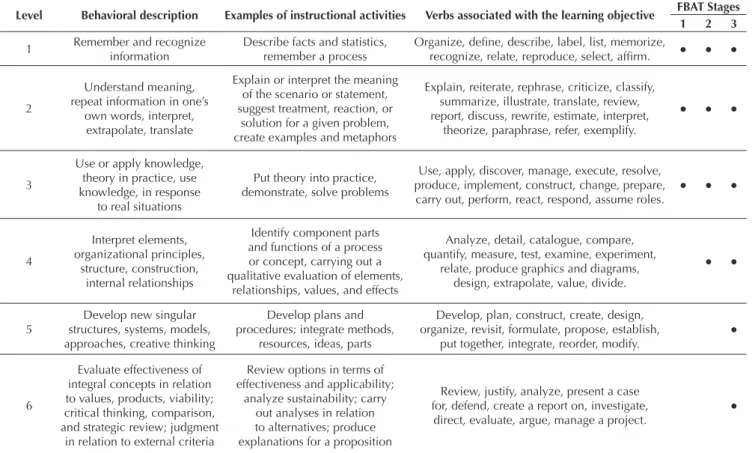
While it is not explicitly referred to by its authors, the FBAT is compatible with the idea of the learning objectives, as systemized by Rothwell and Kazanas (1992) when they describe the objectives of the learning domains (particularly the Cognitive Domain), based on the Bloom Taxonomy for diff erent levels. Table 1 systemizes the possible correlation to be established with the learning objectives in the Cognitive Domain, in their diff erent levels and stages of the FBAT.
Table 1 Correlation between the Stages of the FBAT and the levels of the learning objectives in the cognitive domain of the Bloom Taxonomy
Level Behavioral description Examples of instructional activities Verbs associated with the learning objective FBAT Stages
1 2 3
1 Remember and recognize information
Describe facts and statistics, remember a process
Organize, defi ne, describe, label, list, memorize,
recognize, relate, reproduce, select, affi rm. ● ● ●
2
Understand meaning, repeat information in one’s
own words, interpret, extrapolate, translate
Explain or interpret the meaning of the scenario or statement, suggest treatment, reaction, or
solution for a given problem, create examples and metaphors
Explain, reiterate, rephrase, criticize, classify, summarize, illustrate, translate, review, report, discuss, rewrite, estimate, interpret,
theorize, paraphrase, refer, exemplify.
● ● ●
3
Use or apply knowledge, theory in practice, use knowledge, in response
to real situations
Put theory into practice, demonstrate, solve problems
Use, apply, discover, manage, execute, resolve, produce, implement, construct, change, prepare,
carry out, perform, react, respond, assume roles. ● ● ●
4
Interpret elements, organizational principles,
structure, construction, internal relationships
Identify component parts and functions of a process or concept, carrying out a qualitative evaluation of elements,
relationships, values, and effects
Analyze, detail, catalogue, compare, quantify, measure, test, examine, experiment,
relate, produce graphics and diagrams, design, extrapolate, value, divide.
● ●
5 structures, systems, models, Develop new singular approaches, creative thinking
Develop plans and procedures; integrate methods,
resources, ideas, parts
Develop, plan, construct, create, design, organize, revisit, formulate, propose, establish,
put together, integrate, reorder, modify.
●
6
Evaluate effectiveness of integral concepts in relation to values, products, viability; critical thinking, comparison, and strategic review; judgment
in relation to external criteria
Review options in terms of effectiveness and applicability;
analyze sustainability; carry out analyses in relation to alternatives; produce explanations for a proposition
Review, justify, analyze, present a case for, defend, create a report on, investigate,
direct, evaluate, argue, manage a project. ●
According to the approach suggested by Wells and Tarca (2014b), stage 1 corresponds to the fi rst course in fi nancial reports that a student should have. In this stage, they suggest that the learning process uses passages from the Conceptual Framework (objective, qualitative characteristics, defi nitions of the elements, and recognition criteria) and from the most important principles of the standard that should be applied to the phenomenon under analysis, merely aiming to raise awareness for judgments and estimates at this level.
As the fi rst contact with the Conceptual Framework (excerpts) and the main principles of a standard, the application of this approach in stage 1 will require: “recognizing” transactions and events [e.g., in example 1, in Wells and Tarca (2014c), a piece of equipment is described and the student must recognize that this involves an asset based on the defi nition of the Conceptual Framework]; “relating/classifying” these transactions (e.g., also in example 1, the student should relate the characteristics of the acquired asset with the fi xed asset, which will ultimately determine its accounting classifi cation); and “applying/ preparing/implementing” [Wells and Tarca (2014c) suggest a tutorial via which it is proposed to the students that they apply the concepts and requirements of IFRS to a maritime transport company in order to record the fi xed asset, its depreciation, and impairment losses, as well as preparing the corresponding accounting entries]. Th ese learning activities reveal the relationship with levels 1 to 3 in Table 1, in correlation with the stages of the FBAT and the levels of the learning objectives.
Stage 2, according to Wells and Tarca (2014b), is fundamentally diff erent to stage 1 due to the deeper development of the abilities to carry out the judgments and estimates needed to apply IFRS. Th is is evident, for example, when the authors suggest the Basis for Conclusions as reference material, a document in which the IASB lays out the accounting treatment alternatives analyzed in the study phase and preparation of the standard, and the motives for the choices made, among other information that helps the student in more broadly and systemically understanding the standard (know why).
The authors also suggest the use of the financial statements of real companies as well as decisions and interpretations of the accounting standards by regulators. Th is increase in the width of the overview of the specifi c normative requirements goes on to demand from the students the development of their ability to “analyze” and “relate” elements studied up to here in isolation, in the hope of “understanding the structure of the standard and the relationship between the parts and the whole”, which connects with level 4 of Table 1 with regards to the
correlation with the stages of the FBAT and the learning objective levels.
At stage 3, the application of case studies is suggested (Wells & Tarca, 2014b) as a tool to develop the competency required for carrying out the judgments and estimates needed to apply IFRS. Th is stage, according to the authors, diff ers from the former in the “integration”, whether this is integration with other IFRS standards or topics, or with other disciplines. In the case studies, the maximum level of exercising judgment is required as well as carrying out estimates to address, for example, situations in which there are no standards that prescribe the accounting treatment to be used and for which the student should “develop/construct” a new accounting policy (e.g., in the case of Open Safari, there is a situation of a future sales contract for wood for which there is no standard that can be directly applied, and so analogies need to be sought and a compatible accounting policy constructed using the concepts of the Conceptual Framework).
Also, stage 3 characterizes the “investigation and critical evaluation” of situations in which the standards off er answers that are incompatible with the Conceptual Framework (e.g., in the Open Safari case, the student is presented with a concrete situation of government subsidies to eliminate lantana camara where the limited response off ered by IAS 20 is discussed, showing clear signs of “ageing” of this standard, and comparatively, the informational virtues of the accounting answers produced for this same phenomenon by the IFRS for Small and Medium-Sized Companies, which is more recent and compatible with the Conceptual Framework). In this context, it is understood that stage 3 presents a correlation with levels 5 and 6 of Table 1, which associates the stages of the Framework-Based Approach to Teaching and the learning objective levels.
Th e use of case studies without standardized solutions in IFRS teaching is indicated by Bonnier et al. (2013) as a way of developing the students’ ability to carry out judgments. Th ese authors, also based on the Bloom Taxonomy, indicate that IFRS teaching should allow for a migration from a traditional model of repetition of accounting rules and requirements (repeat mode) to an analytical training model that enables the evaluation of scenarios and carrying out syntheses (fi nd mode), which denotes the adequacy of instruments such as case studies in the pursuit of this aim.
of consciousness are defi ned in terms of acts and attitudes contained in the experience, which should be considered synonymous with education. According to Dewey (1981), experiences are genuinely educational.
When referring to Dewey’s Th eory, LeBlanc, Léger, Lang, and Lirette-Pitre (2015) mention that the learning consists of the ability to evaluate a given experience and also that by means of inquiry this process becomes refl ective and assigns meaning to the experiences via awareness, which can occur individually or collectively. Th ese authors analyzed the use of cases for teaching as a pedagogical approach based on this theory. Th e intention was to test the active methodology and its contribution to the learning process, from the perspective of the students, teachers, and teaching institution. Th e conclusions of this study proved the eff ectiveness of using cases and can be considered a motivational element for students, teachers, and teaching institutions to rethink the educational processes.
Experiential learning was also tested in the area of management in the second year of an undergraduate course (Marin, 2015). Th e emphasis of the study was to analyze skills and competencies developed by the students in diff erent dimensions. Th e students participated in simulations and inverted classes and then answered a questionnaire. Th e main conclusions were that the students acquired genuine knowledge via the experiences derived from the simulations.
In addition, one of the reasons for which cases became
prominent as a teaching tool is that their use agrees with constructivist philosophy of education (Nath, 2005). Many educators think that cases provide a much more constructivist way of teaching, in which the instructors do not simply transfer knowledge to students, but rather help them to construct their own knowledge (Nath, 2005).
In the particular case of teaching fi xed assets and other non-fi nancial assets, the Open Safari case study was developed by Wells and Tarca (2014a) to support the teaching of judgments and estimates needed to apply IFRS related to this group of assets, and it should be used in stage 3 of the Framework-Based Approach to Teaching. Th is case involves the economic transactions and events of a fi ctitious company called Open Safari, which specializes in tourism in Africa, covering 10 fi nancial years. Aft er explaining the context of each period or grouped periods, questions are presented for discussion. In order to answer the questions, the students need to carry out surveys, simulate scenarios, and think conceptually. Besides integrating diff erent areas of judgments and estimates in the context of various non-fi nancial assets that form part of a corporate activity (the Open Safari conglomerate), a substantial portion of the situations presented in the case study is atypical. Th is requires the students to identify the underlying concepts of the IFRS in the search for and development of “accounting answers” that enable an understanding of the informational objectives of the IFRS reports and of the requirements of the specifi c IFRS standards.
3. THE DATA COLLECTION INSTRUMENT AND THE BLOOM TAXONOMY
The Bloom Taxonomy addresses three domains through which the learning process is consolidated: cognitive, aff ective, and pscychomotor. Th e cognitive level refers to the domain of some knowledge or the acquisition of new knowledge and covers the categories of complexity Knowledge, Understanding, Application, Analysis, Synthesis, and Evaluation (Ferraz & Belhot, 2010). Th e Aff ective Domain covers postures and feelings and its categories are Receiving, Responding, Valuing, Organization, and Characterization (Ferraz & Belhot, 2010). Th e Pscychomotor Domain includes the abilities and movements related to non-verbal communciation and its categories are Imitation, Manipulation, Articulation, and Naturalization (Ferraz & Belhot, 2010).
It is hoped that by means of this study it is possible to analyze how the Open Safari case contributes, according to the students’ perception, to the development of skills and competencies belonging to the Cognitive and Aff ective
learning domains of the Bloom Taxonomy. Indications will thus be obtained of how this case appropriately responds to the demands of the Framework-Based Approach to Teaching in terms of providing the means for the construction of knowledge in the solution to problems.
for a more robust analysis of the data of this research; and (ii) in the respondent characterization section, indications were included regarding whether the students work and whether it is the fi rst time they are taking the discipline. Th e groups of
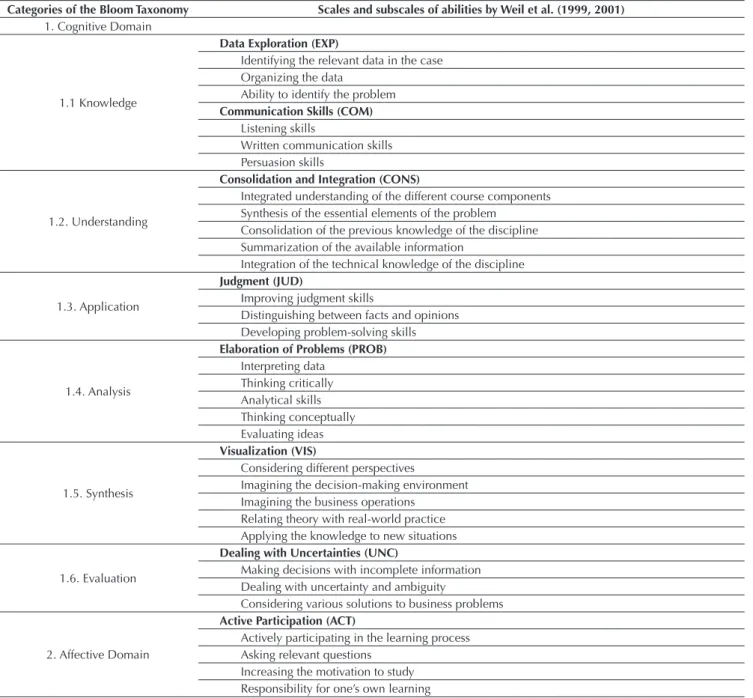
skills and competencies highlighted in the questionnaire were compared for the purposes of this research with the domains from the Bloom Taxonomy learning process (Table 2).
Table 2Correlation between the scales of the data collection instrument and the learning objective levels of the Bloom Taxonomy Categories of the Bloom Taxonomy Scales and subscales of abilities by Weil et al. (1999, 2001)
1. Cognitive Domain
1.1 Knowledge
Data Exploration (EXP)
Identifying the relevant data in the case Organizing the data
Ability to identify the problem
Communication Skills (COM)
Listening skills
Written communication skills Persuasion skills
1.2. Understanding
Consolidation and Integration (CONS)
Integrated understanding of the different course components Synthesis of the essential elements of the problem
Consolidation of the previous knowledge of the discipline Summarization of the available information
Integration of the technical knowledge of the discipline
1.3. Application
Judgment (JUD)
Improving judgment skills
Distinguishing between facts and opinions Developing problem-solving skills
1.4. Analysis
Elaboration of Problems (PROB)
Interpreting data Thinking critically Analytical skills Thinking conceptually Evaluating ideas
1.5. Synthesis
Visualization (VIS)
Considering different perspectives
Imagining the decision-making environment Imagining the business operations
Relating theory with real-world practice Applying the knowledge to new situations
1.6. Evaluation
Dealing with Uncertainties (UNC)
Making decisions with incomplete information Dealing with uncertainty and ambiguity
Considering various solutions to business problems
2. Affective Domain
Active Participation (ACT)
Actively participating in the learning process Asking relevant questions
Increasing the motivation to study Responsibility for one’s own learning
Th is comparison was carried out with the intention of verifying whether by resorting to this data collection instrument it would be possible to collect perceptions regarding the usefulness of the case at all levels of knowledge, especially the Cognitive level of the Bloom Taxonomy. For each one of the questions the students had to give a score from 1 to 10 according to their level of agreement in relation to the development of skills and competencies.
As the questionnaire from Weil et al. (1999) was adopted in full as the instrument for calculating the students’ perception regarding the development of
the skills and competencies reported in the second column of Table 2, it is observed that few of them are related to the Affective Domain and so the greatest emphasis of the discussions has concentrated on the Cognitive Domain. Nonetheless, this emphasis does not reduce the importance of that domain within the scope of this study and the questionnaire used to gather the data is wholly valid for calculating the students’ perception with regards to improving skills of the affective order.
4. RESEARCH PROCEDURES
In order to achieve the research objective, data was gathered through questionnaires and focus groups. At the higher education institution (HEI) analyzed, the AT discipline is obligatory and taught in the sixth semester of the course, when the students have already taken the core disciplines (Introductory Accounting I, Introductory Accounting II, Intermediate Accounting I, Intermediate Accounting II, and Advanced Accounting), as well as ethics, statistics, and fi nancial mathematics. Th us, when the Open Safari case is applied, it was considered not to be the students’ fi rst contact with the topics addressed in it. According to the course specifi cations, in the Accounting Th eory discipline the students are expected to be able to establish associations between the theory and practice in a critical way and exercise the use of judgments and estimates.
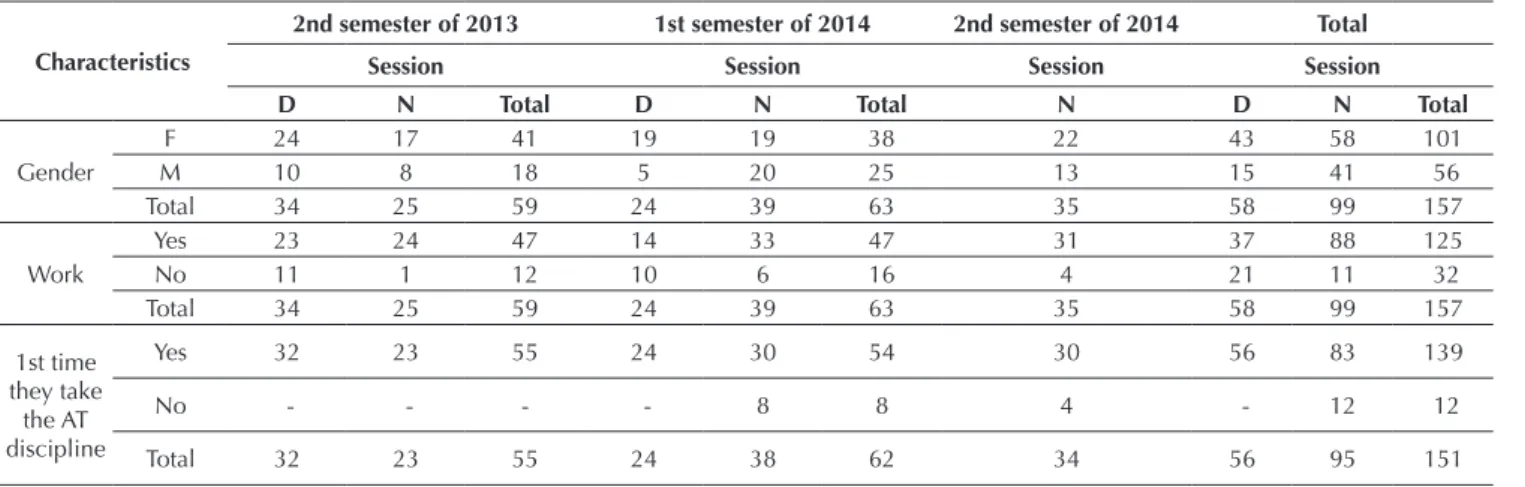
Th e Open Safari case was applied for three semesters to fi ve classes, two during the day and three in the evening (Table 3). One hundred fi ft y-nine students took part
in the study by answering the questionnaire, with only 157 mentioning gender and whether they work or not and 151 mentioning whether it is the fi rst time they are taking the discipline (Table 3). Most (139 students) were enrolled in the sixth period of the course (they were taking the discipline for the fi rst time). Th e average age of the students was 22.
In all of the classes, groups were formed of approximately eight elements each to develop the stages of the case. During each class session, the stages of the case were implemented by the students and handed in to the professor, in written form. Over the course of the semester, the contents of the discipline were addressed, inserting classes for discussions and clarifying doubts with the professors. At the end of the semester, some classes were reserved for the fi nal presentation of the case, when the discussion and closure of the case also occurred in the form of a plenary between professors and students.
Table 3Characterization of the respondents of the questionnaire
Characteristics
2nd semester of 2013 1st semester of 2014 2nd semester of 2014 Total
Session Session Session Session
D N Total D N Total N D N Total
Gender
F 24 17 41 19 19 38 22 43 58 101
M 10 8 18 5 20 25 13 15 41 56
Total 34 25 59 24 39 63 35 58 99 157
Work
Yes 23 24 47 14 33 47 31 37 88 125
No 11 1 12 10 6 16 4 21 11 32
Total 34 25 59 24 39 63 35 58 99 157
1st time they take
the AT discipline
Yes 32 23 55 24 30 54 30 56 83 139
No - - - - 8 8 4 - 12 12
Total 32 23 55 24 38 62 34 56 95 151
After concluding the case activities, but before publishing the fi nal scores, a questionnaire was given (Weil et al., 2001) to the students in order to gather their perception regarding the use of the case as a teaching strategy in the AT discipline, as well as the achievement of the objectives of the Framework-Based Approach to Teaching and the accomplishment of the learning objectives inscribed in the Bloom Taxonomy.
In order to triangulate the analysis of this study and collect evidence regarding the use of the Open Safari case in the teaching-learning process, especially to give depth to the analyses regarding the development of skills and competencies using the tool in the AT discipline, fi ve focus groups were carried out, two in the fi rst semester (2013/2), of application of the case, two in the second (2014/1), and one in the third semester (2014/2). Each one of the focus groups was composed of students from the full-time and evening sessions who decided to take part voluntarily in the study. Precautionary ethical measures were taken with regards to protecting the image of the volunteers by providing clarifi cations concerning the research and its purpose, and the students expressed their agreement by signing a consent form (also obtained for the respondents of the questionnaire).
Th e focus groups were conducted by a moderator who carried out the role of encouraging the discussion of the questions and the presentation of personal opinions and could interfere when necessary with the aim of including topics for debate in order to promote or further some other one raised by the participants during the discussions. Th e main topics driving the debates were: (i) development of
the skills and competencies; (ii) motivation; (iii) individual study and research or in group; (iv) practical corporate overview; (v) teamwork; (vi) diffi culties and limitations; and (vii) performance in the discipline.
If the discussion did not develop from the fi rst question, the moderator had at least two alternative questions that could be asked until achieving the objective or exhausting the debate. All of the focus groups were recorded, in audio and on video, and transcribed, enabling the analysis of their content and comparison with the answers to the questionnaires.
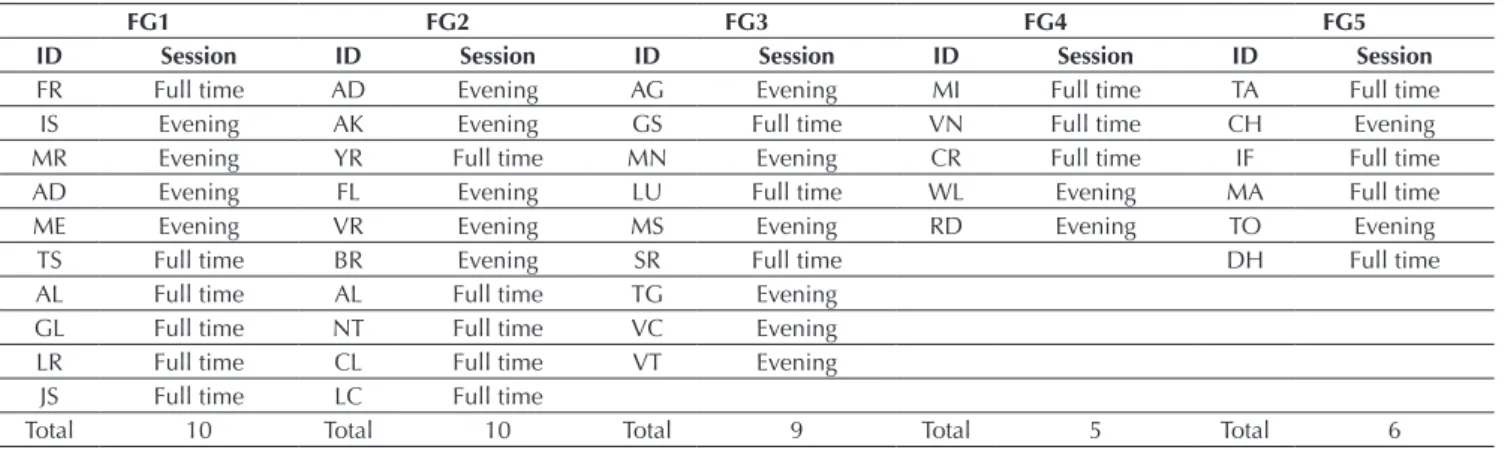
Forty students took part voluntarily in the focus groups, which were not uniform in terms of numbers (Table 4). Th e percentage of female participants was 68% and that of males was 32%. Th e average age among the focus group participants was the same as the respondents of the questionnaire (22 years-old, without statistically signifi cant diff erences). Also, 51% of the participants were full-time and 49% were from the evening session.
In order to protect the participants’ image, their names were substituted by identifi cation initials composed of two letters. Th us, over the course of the discussion of the results, when the participants’ statements were presented, codes composed of the initial identifying the student were used together with the focus group and the respective semester (FG1; FG2; FG3, FG4, and FG5). For example, when there is a need to refer to the fi rst student of the list (Table 4), who participated in the fi rst focus group carried out in semester 2013/2, the code FRFG1 will be used. Th e qualitative data were analyzed by means of content analysis.
Table 4Composition of the focus groups (FG)
FG1 FG2 FG3 FG4 FG5
ID Session ID Session ID Session ID Session ID Session
FR Full time AD Evening AG Evening MI Full time TA Full time
IS Evening AK Evening GS Full time VN Full time CH Evening
MR Evening YR Full time MN Evening CR Full time IF Full time
AD Evening FL Evening LU Full time WL Evening MA Full time
ME Evening VR Evening MS Evening RD Evening TO Evening
TS Full time BR Evening SR Full time DH Full time
AL Full time AL Full time TG Evening
GL Full time NT Full time VC Evening
LR Full time CL Full time VT Evening
JS Full time LC Full time
Total 10 Total 10 Total 9 Total 5 Total 6
The statistical treatment of the data was operationalized using the Statistical Package for the Social Sciences (SPSS) program. In order to verify the statistical significance of the average perceptions of the students regarding the 31 skills and competencies, as well as the average perceptions of the students grouped into the Bloom Taxonomies, the non-parametric Wilcoxon test was applied. This test was used due to the study variables being ordinal and the non-normality
of these variables identified using the Kolmogorov-Smirnov test. The confidence interval was 95% and the level of significance, used for all the tests, was 5%. Thus, for the Wilcoxon test, if the results presented a p-value > 0.05, it will be considered that there are no significant differences. But if p-value < 0.05, it will be considered that there are significant differences between the averages perceptions of the students.
5. RESULTS
Th e students’ perception regarding the usefulness of the Open Safari case for the development of the 31 skills
and competencies listed in the questionnaire of the study is summarized in Table 5.
Table 5 Ranking of skills and competencies
Rank Skills and competencies n x̅ Mo SD EU (%)
Weil et al. (2001)
Rank M
1 INC Considering various solutions 159 8.4 10 1.9 57 2 6.18
2 VIS Practical overview of the decision-making process 159 8.0 10 2.1 44 1 6.18 3 CONS Integration of different subjects of the discipline 159 7.7 8 1.9 63 6 5.50
4 PROB Interpretation 159 7.7 8 2 54 15 5.02
5 VIS Relating theory and practice 159 7.7 8 2.1 51 3 5.78
6 JUD Judgment 159 7.5 8 1.9 62 19 5.00
7 ACT Responsibility for one’s own learning 159 7.5 7 1.9 50 14 5.12
8 PROB Critical thinking 159 7.5 8 2 53 9 5.22
9 VIS Application of the knowledge 159 7.5 7 1.8 52 5 5.51
10 PROB Thinking conceptually 159 7.5 8 2.1 51 15 5.02
11 CONS Technical knowledge 159 7.5 8 1.9 54 20 4.98
12 PROB Analysis 159 7.5 8 1.9 42 10 5.16
13 EXP Identifi cation of relevant data 159 7.4 8 1.9 43 11 5.14
14 CONS Consolidation of previous knowledge 159 7.4 8 2.1 49 11 5.14
15 PROB Evaluating ideas 159 7.3 8 1.8 32 15 5.02
16 VIS Overview of the workings of a company 159 7.3 8 2.1 52 8 5.31
17 JUD Problem solving 158 7.3 8 1.9 40 18 5.01
18 JUD Distinguishing facts from opinions 159 7.2 8 2 40 4 5.55
19 VIS Considering different perspectives and users 158 7.2 8 2.1 70 7 5.35
20 EXP Organization of information 159 7.1 7 2.1 45 27 4.78
21 INC Dealing with uncertainty and ambiguity 159 7.1 8 1.9 45 24 4.88
22 EXP Identifi cation of problems 159 7.1 7 2 58 21 4.96
23 CONS Summarizing information 159 7.0 8 1.9 75 22 4.92
24 COM Written information 159 7.0 7 2.1 63 31 4.16
25 CONS Synthesis 159 7.0 7 1.9 47 22 4.92
26 INC Decision making with incomplete information 159 7.0 7 1.9 49 11 5.14
27 COM Listening skills 159 6.9 8 2.3 56 28 4.73
28 ACT Relevant questions 159 6.9 8 2.1 42 24 4.88
29 ACT Active participation 158 6.8 7 2.3 51 26 4.86
30 COM Persuasion 159 6.8 8 2 45 29 4.57
31 ACT Motivation 159 6.1 7 2.6 45 30 4.49
SD = standard deviation; EU = extremely useful (proportion of respondents that attributed a score 8, 9, or 10 on the scale for each question, considering the EU case for the development of the skill and competency); Mo = mode; n = number of respondents.
The mean between 6.1 and 8.4 (above 5 for all the questions) suggests that the students positively perceived the usefullness of the case for developing the skills and competencies, thus corroborating with the AECC objectives (1990) that using cases serves the students in developing their communicative, intellectual, interpersonal, and attitudinal aptitudes, as well as general, business, and accounting knowledge, all of which are contained and ranked in Table 5. It bears mentioning that Weil et al. (2001) calculated a mean between 4.16 and 6.18 for the 31 skills described in Table 5, suggesting that the African students negatively perceived the development of some skills and competencies, such as using cases for teaching (for example, motivation, persuasion, listening skills, active participation, synthesis, and written communciation). Th e diff erence between the means of the African students’ perceptions and those of the students in this study may be an indication of the eff ectiveness of the Open Safari case in developing skills and competencies needed to understand and apply IFRS.
It bears mentioning that the objectives of the FBAT and of the Open Safari of developing skills to think conceptually, make judgments, take decisions, and think critically (Hodgdon et al., 2011; IASB 2014; Jackling, 2013; Wells, 2011), feature among the 10 highest ranked skills and competencies by the students (positions 1, 6, 8, and 10). Th ese results indicate the eff ectiveness of the Open Safari case in achieving the FBAT objectives.
The first question in the ranking is related with the students’ exposure to the accounting choice process, considering various solutions for the same problem. In the students’ reports, the possible existence of more than one answer in some situations was one of the greatest differences experienced, as reported by LUFG3: “It was really difficult for me because I still like a correct, defined answer. And the case went against what I liked” and MNFG3: “You discover new things, you open your mind to subjects you’re not used to, but what’s new always makes you uncertain. You aren’t sure whether you’re going in the right direction”. In contrast, student JSFG1 stressed that
it’s not always going to be very clear when you’re in the company.
You’re going to have to use some judgment, even if subjective. So that really obliges us to think critically. I think that is the most interesting point in Open Safari.
In addition, at various points in the debates it was common for the participants to makes statements such as “I was reading by stage and I suddenly thought ‘it’s always the same question!’” (VTGF2) or “And it’s not the same answer!” (GSFG3). It is perceived that the fact that the
solutions to the questions of the Open Safari case are not standardized enables the discussion of various alternatives solutions to the same question. According to Bonnier et al. (2013), this is a way of developing the students’ ability to make judgments, as the FBAT prescribes.
Th e second position in the ranking is occupied by the Visualization skill, which refers the students to the company environment, enabling them to establish associations with real situations and with these they are able to apply their knowledge. It is observed that this skill lies in the second highest degree of learning of Bloom’s Cognitive Domain, called Synthesis (Table 2).
Besides expressions of an improvement in this skill in the questionnaire, it was possible to collect other expressions such as “Open Safari provided more reality. It is a practical case. Even though we aren’t there, it provides details from Open that makes us sit down there within it and take decisions” (MEFG1) to reveal the perceived proximity with the case environment and with the associations that can be established with other practical contexts, such as “in the practice itself we will not experience a case like this… It covers more than what we will experience when we join the labor market” (ALFG1). It was possible to calculate that some students in fact perceived themselves to be within a decision-making environment, such as: “We work as if we were really in the company, having to come up with a solution. And if the boss comes and says that your work is wrong, even if it is you have to defend it” (TGFG3). Th is passage also indicates the development of the communication skill as well as the argumentation part. Th e aptitudes in the communication area occupied positions 24, 27, and 30, based on the answers to the questionnaires; however, despite the classifi catory order, the average score attributed to the development of this class of skill reached an average close to 7. Th is skill is included in Bloom’s fi rst cognitive level – Knowledge.
Although in the answers to the questionnaires no great importance was attributed to the development of the communication skill, in the focus group this was sometimes mentioned in relation to the fact that not only did a decision need to be taken, but “knowing how to argue why you are taking take decision” (MRFG1). In addition, “exchanging opinions helped me to defi ne, recognize, form my opinion, my view” (FRFG1); “we had to know in depth what we had done in order to be able to speak” (MEFG1); “I think that in the reading and interpretation part of the CPC it helps quite a lot, because you start to have another vision, even of the way that you lay out the data” (VNFG4); and “the discussion, the group work is good for that reason, it makes us think in both ways, not just my way” (MAFG5).
integrate the learning of contents of the discipline was observed, the respective Cognitive Domain category for this being Understanding. In addition, it is possible to perceive the importance of the aptitude in consolidating components by means of statements such as: “we observed the evolution of our knowledge and of our analysis skills” (VTFG3) and also “Yes, it (the case) is well linked to Accounting Th eory, but it could also be used in International Accounting, as it concerns IFRS and the international standards and also involves other currencies and other places in the world” (RDFG4). It is also perceived that the case could be applied in other disciplines or periods of the course, depending on the curricular structure of each course.
Th e Judgment ability, one of the most sought by IFRS Education when elaborating the case, appears in sixth place in the ranking. Th is competency is developed in the third phase of the learning process of the Cognitive Domain (Application) and relates to the ability to distinguish between facts and opinions and with mastering problem solving. Based on Table 6, it bears mentioning that 62% of the respondents considered the case to be extremely useful for developing this skill. Likewise and taking into account the classes of statistically equal results shown in Table 6, the Judgment skills feature in positions 5, 6, and 7, always with an average greater than 7 and mode equal to 8 in all the related questions; that is, they are evaluated by the students as extremely useful.
Some students mentioned that exercising judgment was one of the most diffi cult tasks in the execution of the case, and TSFG1 stressed:
We are used to wanting a more exact answer, and it is something that comes from the international standards, the question of judging and you have to decide what you are going to do, you have to, based on something theoretical.
In addition, the indication from MEFG1 stands out in stating that “accounting has a lot of that, what is for one isn’t for another, so it’s down to your judgment... in the Open Safari case you have to judge at all times”.
Great importance was also attributed to developing the ability to interpret data (fourth place in the ranking in Table 5), which is also connected to the aptitude of analyzing and thinking conceptually and critically evaluating ideas. This concerns the fourth category of Bloom`s Cognitive Domain, called Analysis (Table 2). For one student, the case contributed to the FBAT, since
Not only with the adaptation of IFRS, but we had an initial idea and the Open Safari case proposes a methodology and a totally new, totally updated concept. It presents practical examples, but it always wants to highlight the conceptualization. (WLFG4)
Another participant also stressed with regards to the ability to think conceptually and critically that:
I was studying defi nitions of business combinations. Oh, you have to acquire a company. So, what is a company? Th ere has to be inputs, outputs, and processes. What are inputs? Th e result of outputs. What is a process? Th e result of inputs and outputs… (SRFG3)
leading to the understanding that there is a driving force towards the process of conceptual rationalization. In addition, expressions such as:
It was sad for me to discover that assets were not a set of goods and rights, I was disappointed and shocked. Up until then, from the fi rst period, I had that concept… So, it was much easier for me aft er I understood the concept. (TAFG5)
indicate the need to learn to think conceptually starting from the fi rst disciplines of the course. Th ese results are consistent with the one laid out by Wells (2011) regarding the ability of the FBAT to entrench the teaching in the concepts underlying the accounting standards, enabling the students to understand the standards via an understanding of the concepts that gave rise to them. And they are also connected with the thinking of Street (2002) with regards to the need to teach the students to think.
Th e students also reported that they improved their ability to relate with each other in groups, “it was an opportunity for us to converse with other people… and with regards to teamwork, one particular ability that was developed was patience” (MRFG1), “we criticized and that person that was being criticized did not feel off ended” ((TGFG3) and also coming together through dialogue “the tasks do that, we get to know the person better; sometimes, you don’t even like the person, but when you’re going to do the work you discover who the real person is, you even become friends” (TAFG5). Th ere were also reports of a break with behavioral patterns:
Th at is something that I didn’t expect to say. It’s a source of pride. So, in this task, I had to say: I don’t know. Help me. In a way, it helps with rapport, because, for example, where I work, there are many times I don’t know and pride prevents me from asking. In this case, I developed that part. (MEFG1)
Th e writing skill was also reported in some fragments such as “I oft en had to defend myself in writing, and when you were speaking… you had to give the impression you were right” (GSFG3).
from CHFG5 also explains a defi ciency of teaching based on the teacher-centered, transmissive model:
Although the professor is there teaching in the lecture, although you are learning something, you forget. But when the theory is linked to the practice, what the professor teaches is in the practice, and I would learn much more.
Moreover, with relation to evaluation mechanisms “the greatest motivational factor was the way it was evaluated. I have great difficulty in written evaluations, exams, but with presentations, with speaking I am more at ease” (IFFG5).
It is also observed that attitudinal skills (ACT), except “responsibility for one’s own learning” – seventh place –, represented the bottom positions in the ranking in relation to the other skills and competencies, which does not represent a negative result in itself, since the averages and mode were higher than 6.
The participants’ narratives also indicated the consolidation with previous knowledge – a skill that occupied 14th place in the ranking – derived from the
other disciplines of the course, as can be seen through the following passage:
It is precisely due to the fact that Open Safari covers various disciplines and diff erent informationthat were absent in the previous periods. We worked on things one by one. If fi xed assets were mixed with intangibles in a single exercise it caused discomfort. In Open Safari we are obliged to have that broad overview. (AGFG3).
Others also emphasized that the case “encourages the student to know more, to search for that research. Th e research is forced on the student, it isn’t a decision to want to search” (WLFG4), reinforced by the opinion of AGFG3: “I think that Open Safari despite its complexity, and precisely because of it, makes us more dedicated. Searching and trying to solve, I think that is good. It’s tiring, but it’s worth it.” (AGFG3).
Occupying the last position in the ranking elaborated based on the questionnaires, motivation was also a highlight in the group debate and thinking of the case as an initiative of the IASB instigated one student to state “We asked ourselves: do a case that is globally known in the degree?! Do we have the ability to do that? So, when we got it right, boy!” (MNFG3). Th e motivation also came from the incentive of other classmates: “my answer was not totally suffi cient. But, with a bit from so-and-so and
another bit from someone else, it became the complete answer… So that provides motivation!” (TGFG3). In addition, statements such as “Open Safari made us open our minds” (MSFG3) and “independently of the score you wanted to learn” (FRFG1) were considered expressions associated with motivation.
Motivation occupied the next-to-last position (average of 4.49) in the ranking of the study by Weil et al. (2001). One of the explanations for motivation occupying the last position in the ranking of this study (despite the positive average of 6.1) may be the fact that the students had contact with the FBAT philosophy, for the fi rst time, in the sixth semester of the course in the AT discipline. Th e teaching on the Accounting Sciences course at the university, which is the object of this study, is based on the traditional methodology, characterized by the transmission of information, fragmented disciplines, evaluations that require memorizing, and on the professor as the spreader of knowledge. In this context, when the Open Safari case was applied, the students were exposed to a methodology that required research, causing insecurity and demotivation.
In light of this, the need is stressed for an accountant’s training to be carried out in the three stages prescribed by Wells and Tarca (2014a): Awareness (introductory disciplines), Understanding (intermediate disciplines), and Competency (advanced disciplines). Th at is, the FBAT philosophy should be applied from the start of the Accounting Sciences course, as suggested by TAFG5:
In conceptual terms, I’ll speak for myself, at the beginning of the active period it was a set of goods and rights and then I understood that it was a past event that generates future benefi ts and is controlled. So, it was much easier for me aft er I understood the concept.
The report from TAFG5 reflects the argument concerning the eff ect of the fi rst contact with the case: “in the beginning we get a shock because in our heads there is that conservatism, which is technical. Th e debit and the credit. And Open Safari makes you think, for example, is it an asset?”
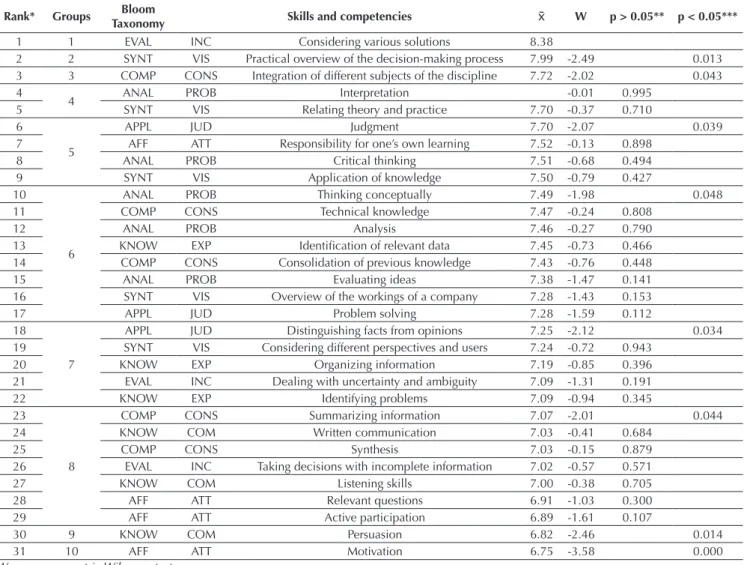
Table 6 Analysis of the ranking of the skills and competencies by significance Rank* Groups Bloom
Taxonomy Skills and competencies W p > 0.05** p < 0.05***
1 1 EVAL INC Considering various solutions 8.38
2 2 SYNT VIS Practical overview of the decision-making process 7.99 -2.49 0.013 3 3 COMP CONS Integration of different subjects of the discipline 7.72 -2.02 0.043 4
4 ANAL PROB Interpretation -0.01 0.995
5 SYNT VIS Relating theory and practice 7.70 -0.37 0.710
6
5
APPL JUD Judgment 7.70 -2.07 0.039
7 AFF ATT Responsibility for one’s own learning 7.52 -0.13 0.898
8 ANAL PROB Critical thinking 7.51 -0.68 0.494
9 SYNT VIS Application of knowledge 7.50 -0.79 0.427
10
6
ANAL PROB Thinking conceptually 7.49 -1.98 0.048
11 COMP CONS Technical knowledge 7.47 -0.24 0.808
12 ANAL PROB Analysis 7.46 -0.27 0.790
13 KNOW EXP Identifi cation of relevant data 7.45 -0.73 0.466
14 COMP CONS Consolidation of previous knowledge 7.43 -0.76 0.448
15 ANAL PROB Evaluating ideas 7.38 -1.47 0.141
16 SYNT VIS Overview of the workings of a company 7.28 -1.43 0.153
17 APPL JUD Problem solving 7.28 -1.59 0.112
18
7
APPL JUD Distinguishing facts from opinions 7.25 -2.12 0.034 19 SYNT VIS Considering different perspectives and users 7.24 -0.72 0.943
20 KNOW EXP Organizing information 7.19 -0.85 0.396
21 EVAL INC Dealing with uncertainty and ambiguity 7.09 -1.31 0.191
22 KNOW EXP Identifying problems 7.09 -0.94 0.345
23
8
COMP CONS Summarizing information 7.07 -2.01 0.044
24 KNOW COM Written communication 7.03 -0.41 0.684
25 COMP CONS Synthesis 7.03 -0.15 0.879
26 EVAL INC Taking decisions with incomplete information 7.02 -0.57 0.571
27 KNOW COM Listening skills 7.00 -0.38 0.705
28 AFF ATT Relevant questions 6.91 -1.03 0.300
29 AFF ATT Active participation 6.89 -1.61 0.107
30 9 KNOW COM Persuasion 6.82 -2.46 0.014
31 10 AFF ATT Motivation 6.75 -3.58 0.000
W = non-parametric Wilcoxon test.
* Rank grouped by statistically identical means; ** p-value for the Wilcoxon test; *** p-value for the Wilcoxon test by statistically identical group. Source: Elaborated by the authors.
Th e data were paired in the following way: the mean of 8.38 from the “considering various solutions” question was paired with the mean of 7.99 from the “practical overview of the decision-making process” question to verify whether these means are equal. Th e result of the Wilcoxon test (z = -2.49; sig = 0.013) suggests that the means are diff erent. Th us, the three highest ranked questions presented a statistically diff erent mean (p = 0.013 and 0.043, respectively), as shown in Table 6. Th e fi rst question is related with the student’s exposure to the accounting choice process, considering various solutions for the same problem. Th e second uses the case to enable the student to visualize the reality and the diffi culties faced by company decision-makers, associating theory and practice. Th e third refers to the students’ perception that the case can help in integrating the various contents addressed in the AT discipline.
Of the 10 highest ranked questions analyzed in light of the Bloom Taxonomy, three form part of the synthesis group (SYTH) and another three form part of the Analysis group (ANAL). Th ese skills and competencies are related with the third stage of the FBAT. Moreover, the strategy of using the Open Safari case aims for a progressive evolution of the students with regards to establishing IFRS estimates and other judgments that begin with awareness, move on to understanding, and reach the highest level, which is that of competency (third stage).
Bloom’s Knowledge group (KNOW) is the only group that does not feature among the 10 highest ranked questions (Table 6). However, the mean of question 24, which occupies the 10th position, does not diff er
statistically from the next seven questions (up to the 17th position). Th us, it is possible to conclude that in
Table 7Skills and Competencies from Weil (2001) and Bloom Taxonomy
Weil (2001) Bloom Taxonomy
Ranking skills and competencies Cognitive Domain
1. Knowledge 2. Understanding 3. Application 4. Analysis 5. Synthesis 6. Evaluation
1 Uncertainty X
2 Visualization X
3 Consolidation X
4 Elaboration of Problems X
5 Visualization X
6 Judgment X
8 Elaboration of Problems X
9 Visualization X
10 Elaboration of Problems X
Source: Elaborated by the authors.
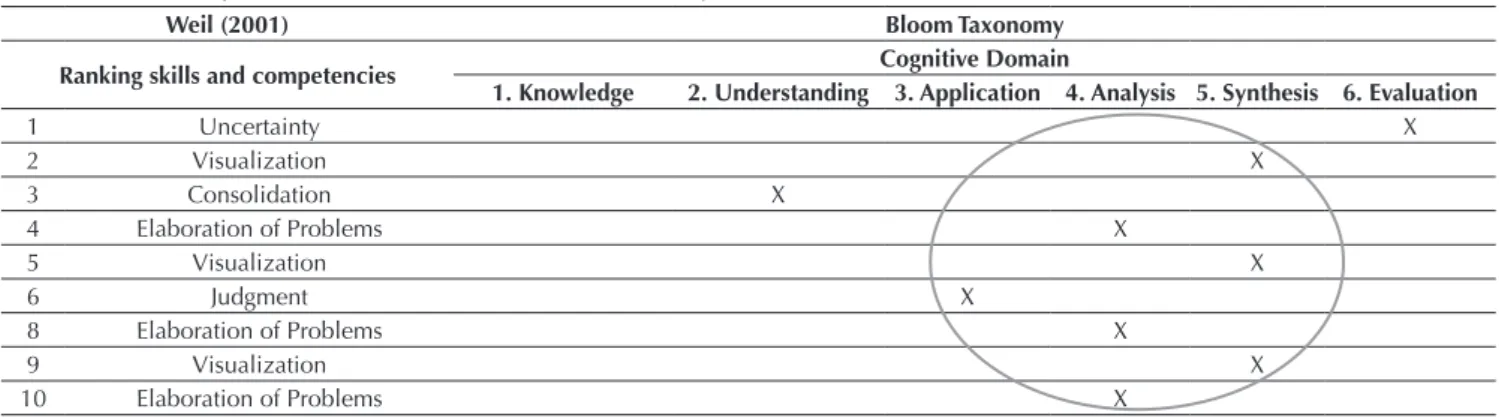
the development of skills and competencies of all of the Bloom Taxonomy groups, as can be seen in Table 7, by achieving their main objective of improving the students’ ability to carry out judgments and estimates (6th place in the ranking) needed to apply IFRS (9th place
in the ranking) in the accounting treatment of economic transactions and events, as well as helping the students to think conceptually (10th place in the ranking).
The joint analysis of the ranking of the skills and competencies developed enables it to be inferred that the first place is occupied by the ability to Deal with Uncertainties, which includes the presence of
incomplete information, ambiguity, and the possible existence of more than one solution to a problem in a given context. This ability is contained in the highest level of learning of the Cognitive Domain, that is, at the Evaluation level, and in this stage it can be considered that the effective consolidation of knowledge or the legitimacy of learning a particular content has been achieved. This means that the Open Safari case fulfills its educational objectives, and besides accessing the most sophisticated levels of the Cognitive Domain, it does more intensely.
Th e means of the students’ perceptions by categories of the Bloom Taxonomy and Weil et al. (2001) are presented in tables 8 and 9, respectively. Th e means of the Synthesis, Evaluation, and Analysis categories are not statistically diff erent (Table 8). Th us, the students consider the Open Safari case to be useful especially for the development
of skills and competencies that involve these abilities. Th e Application and Knowledge categories show similar means to each other and are statistically diff erent from the other categories. Knowledge and Aff ective Domain have the lowest means and these are statistically diff erent from those of the other groups.
Table 8 Mean per group – Bloom Taxonomy
Category Initial W p > 0.05 p < 0.05
Synthesis SYNT 7.53
Evaluation EVAL 7.49 -0.903 0.367
Analysis ANAL 7.48 -0.589 0.556
Application APPL 7.34 -2.502 0.012
Understanding UND 7.32 -0.250 0.803
Knowledge KNOW 7.20 -3.740 0.000
Affective Domain AFF 6.84 -2.850 0.004
W = non-parametric Wilcoxon test. Source: Elaborated by the authors.
Weil et al. (2001) separate Bloom’s Aff ective Domain category into two: Communication Skills and Active
Table 9 Mean per group - Weil(2001)
Category Initial W p > 0.05 p < 0.05
Visualization VIS 7.53
Dealing with Uncertainties INC 7.49 -0.903 0.367
Elaboration of Problems PROB 7.48 -0.589 0.556
Judgment JUD 7.34 -2.502 0.012
Consolidation and Integration CONS 7.32 -0.250 0.803
Exploring Data EXP 7.20 -1.446 0.148
Skills and Competencies COM 6.90 -4.245 0.000
Active Participation ACT 6.84 -1.323 0.186
W = non-parametric Wilcoxon test. Source: Elaborated by the authors.
Th e students were questioned regarding the three main benefi ts of the Open Safari case in the list of 31 skills and competencies. Th e results, reported in Table 10, are consistent with the mean of the students’ perception
for each benefi t of the case, denoting that the students perceived the visualization of problems of the company environment, the ability to deal with uncertainties, and the analysis of data as the main benefi ts of the case.
Table 10Three main skills and competencies developed with the case Weil
(2001) Bloom Taxonomy 1
st place 2nd place 3rd place
C C M Q % Rank Q % Rank Q % Rank
VIS 7.53 SYNT 7.53 28 25 2 39 32 1 29 23 1
INC 7.49 EVAL 7.49 30 27 1 28 23 2 24 19 3
PROB 7.48 ANAL 7.48 16 15 3 19 15 3 27 21 2
JUD 7.34 APPL 7.34 11 10 4 9 7 5 11 9 5
CONS 7.32 COMP 7.32 9 8 5 12 10 4 16 13 4
EXP 7.20 KNOW 7.20 5 5 6 6 5 6 7 6 7
COM 6.90 KNOW 7.20 2 2 7 2 2 7 2 2 8
ACT 6.84 EFFE 6.84 9 8 5 8 7 5 10 8 6
110 100 123 100 126 100
C = Category; Q = Quantity of students. Source: Elaborated by the authors.
Th e students attributed a score of 7.73 (mean) to the Open Safari case and most (mean of 7.59) recommend that the case is applied in the AT discipline. It bears mentioning that in the curricular structure of the HEI that is the object of this study, the AT discipline is taught in the sixth semester of the course, when the students have already concluded the introductory, intermediate, and advanced disciplines of accounting (that is, aft er fi nishing stage 3 proposed by the FBAT). Perhaps for institutions in which the AT discipline is taught in the second period of the course, for example, the application of the Open Safari
case would not be suitable.
Nevertheless, the students believe that the case can be used in another discipline, provided there is the foundation derived from the introductory, intermediate, and advanced disciplines, which could take place in diff erent semesters in the degree courses in accounting. According to MEFG5, “the case mixes Accounting Th eory with International Accounting, and that helps quite a lot in the development of the work”. Th is comment refl ects the contribution of the case to the disciplines studied in the sixth semester at the HEI in question.
6. FINAL REMARKS
Convergence with IFRS has resulted in a need for professional development in exercising choices, judgments, and estimates, due to the degree of subjectivity contained in these standards. IFRS Education has thus made eff orts to produce formative material that can meet this demand.
Th e Open Safari case is one of these and the case study mentioned was produced to serve as an FBAT instrument in teaching related to non-fi nancial assets.