Auditory Brainstem Implant:
surgical technique and early
audiological results in patients
with neurofibromatosis type 2
Summary
Ricardo Ferreira Bento1, Rubens Vuono Brito
Neto2, Robinson Koji Tsuji3, Marcos Queiroz Telas
Gomes4, Maria Valéria Schmidt Goffi-Gomez5
1 Full Professor of Otorhinolaryngology at Faculdade de Medicina da USP. 2 Associate Professor of Otorhinolaryngology at Faculdade de Medicina da USP. 3 Graduate student, assistant-physician at the Otorhinolaryngology Clinic at HC-FMUSP.
4 Assistant-physician in the course of Neurosurgery at Faculdade de Medicina da USP. 5 PhD. Speech and hearing therapist at the Otorhinolaryngology Clinic at HC-FMUSP. Course of Otorhinolaryngology at Faculdade de Medicina da Universidade de São Paulo. Send correspondence to: Rubens de Brito Neto - Av. Angélica 1968 cj. 91 Higienópolis SP SP 01228-200. This paper was submitted to the RBORL-SGP (Publishing Manager System) on 18 April 2007. Code 4463.
The article was accepted on 11 August 2007.
A
uditory Brainstem Implants were developed to partially restore the hearing capabilities of patients without cochlear nerves bilaterally. Aim: this paper aims to discuss the clinical and surgical findings of four ABI patients. Materials and method: four patients diagnosed with bilateral schwannomas received auditory brainstem implants (ABI) and had one of their tumors resected in the same surgical procedure. Clinical aspects, surgical technique, anatomic landmarks, and outcomes were analyzed. Results: the anatomic landmarks were identified in all four patients in relation to the foramina of Luschka. Two patients had CSF leaks. The electrodes were well positioned and hearing sensation was good enough to allow for sound recognition and assist patients perform lip reading. Conclusion: the outcomes observed in our patients were quite encouraging and offer great perspectives for those suffering from deep bilateral deafness and impaired central auditory pathways.Keywords: surgery, auditory brain stem implantation, neurofibromatosis type 2, results.
original article
INTRODUCTION
Auditory Brainstem Implants were developed to partially restore the hearing capabilities of patients without
cochlear nerves bilaterally1. They were first developed as a
one-channel electrode at the House Ear Institute (HEI), in Los Angeles, California. This first model was implanted in 25 patients between 1979 and 1992, producing precarious
clinical results2. A multichannel device was then developed
from this experience by HEI in partnership with the Co-chlear Corporation (Englewood, Colorado) and the Hun-tington Medical Research Institute (Pasadena, California). The device was made up by an internal unit containing a silicone cable with disc-shaped platinum electrodes and an interface to a Nucleus Mini-22 speech processor.
Patients classically benefitting from this electronic, surgically-implanted hearing aid are those diagnosed with neurofibromatosis type 2 (NF-2), bilateral vestibular schwannomas, and children with cochlear nerve conge-nital aplasia. Today the indication for auditory brainstem implants has been extended to patients with damaged VIII nerves and those who are ineligible for conventional coch-lear implants such as post-meningitis patients with ossified
cochleas3,4. Although the first implantation procedure dates
back from 1979, only in October of 2000 was it approved for clinical use by the Food and Drug Administration.
OBJECTIVES
This paper aims to discuss the clinical and surgical findings pertaining to the first four ABI patients treated in our institution, looking at indication criteria, surgical technique, and outcomes.
MATERIALS AND METHOD
Four patients diagnosed with bilateral vestibular schwannomas received auditory brainstem implants (ABI) and had one of their tumors resected in the same surgi-cal procedure. This study was approved by the medisurgi-cal ethics committee at our institution under permit M.16-196/2007.
The translabyrinthine approach was chosen to re-move the tumors and expose the cochlear nerve on the lateral wall of the IV ventricle (foramina of Luschka). Each patient was implanted one Cochlear N24® ABI internal unit. The VII, IX, X and XI nerves were monitored through continuous electrophysiology during surgery. Electric res-ponse brainstem audiometry was used to check whether the electrodes had been properly put in place.
Free field audiometry tests were conducted to check patient hearing after three months of activation.
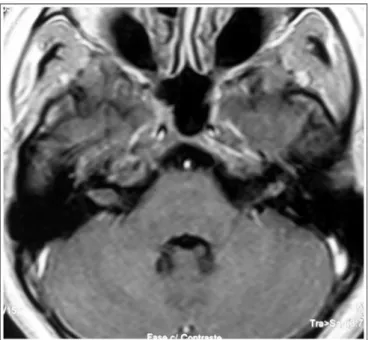
Patient, surgery, and external unit activation data can be seen on Table 1. Figures 1 to 4 show X-ray images of the removed tumors.
Table 1. Patients, surgery, and external unit activation data.
Patient Age Gender Diagnosis Tumor Size Surgery Date Activation Date
1 28 M NF2 3,5 cm Jan 2006 Feb 2006
2 25 F NF2 IC Mar 2006 Apr 2006
3 25 M NF2 4.0 cm Mar 2006 Apr 2006
4 26 M NF2 2.0 cm Dec 2006 Jan 2007
Figure 1. MRI (T1 contrast-enhanced) case 1 preoperative axial view.
RESULTS
Activation was carried out on average at 30 days after surgery, with the patients in a surgical setting with cardiac monitoring. Except for patient 1, who experienced sound sensation in only one electrode, all others made reference to hearing sensation in more than 12 electrodes. Side effects were observed in 88% of the upper, lower limbs, and abdomens and in 12% of all heads and necks (throat and nausea). Graph 1 shows the hearing outcomes as observed in tone free field audiometry tests carried out three months after activation.
Figure 3. MRI (T1 contrast-enhanced) case 3 preoperative axial view.
Figure 4. MRI (T1 contrast-enhanced) case 4 preoperative axial view.
Figure 2. MRI (T1 contrast-enhanced) case 2 preoperative axial view.
Graph 1. Hearing thresholds of ABI patients three months after ac-tivation
DISCUSSION
The concepts related to auditory brainstem implants are similar to those applicable to the currently available cochlear implants, except for the electrode setup which, in the first case, is designed to be introduced at the level of the cochlear nerve and not at the cochlear tympanic ramp. Patients who for functional or anatomic reasons are unable to receive electric stimuli in their inner ears are the best candidates for this treatment. In more socially advanced countries, the main cause of bilateral structural loss of peripheral auditory pathways is neurofibromatosis type 2, a condition that typically evolves into bilateral
vestibular schwannomas5. That however is not the case
for Brazil. Infection is still the main etiology for deafness,
meningitis certainly being the main culprit6. Some 23.9%
And meningitis goes against both factors. Firstly, it is the etiology that most destroys cochlear hair cells and coch-lear nerve neurons; secondly, it will often lead to some degree of ossification in the otic capsule. Apart from the functional involvement, meningitis was also responsible for all six cases of failed electrode positioning during sur-gery, with consequent removal of the internal unit and a second procedure to implant new electrodes. This infection only comes to greatly increase the need for an alternative to conventional cochlear implants in Brazil. Neurofibro-matosis type 2 patients are rare, even at reference care centers. Nonetheless, when taking into account the tragic, progressive slow evolution of this disease, the impact for the patients of having some of his or her hearing restored is extremely relevant.
In our few first cases, we tried to perform surgery on patients with the so-called classic indication for both tumor removal and electrode implantation. Patient 1 was first selected for having extensive knowledge on the proce-dure, as he has for years informally studied NF2 and gone through a number of surgical procedures previously. Full awareness of the possibilities and limitations of the pro-posed procedure is a key factor in fine-tuning the patients’ expectations and consequent post-operative satisfaction. Both patients and their families must be well-informed of the natural history of NF2, the surgical procedure itself, and of the possibility of there being partial hearing restoration after implantation. Patients and families go through a rigo-rous psychological and social evaluation, not to mention medical and audiological screening.
There are two main approaches for auditory brains-tem implant placement: suboccipital retrosigmoid and
translabyrinthine7. The elected approach should provide
for ample enough visualization to allow for the precise identification of the anatomic landmarks used as refe-rence for accurate electrode placement. Surgeons base their choice on their own personal experience. Most ENT surgeons pick the translabyrinthine approach to remove large vestibular schwannomas or when treating patients with deteriorated hearing. As tumors had to be removed and electrodes implanted on one same surgical procedure, this was the approach we chose. The surgical technique used to place the electrodes is similar to the one used to remove vestibular schwannomas. The cochlear nucleus complex, made up by the ventral and dorsal cochlear nuclei, is the site for electrode placement. The ventral cochlear nucleus is the main nucleus for neural impulse transmission from the VIII nerve, and its axons form the main ascending pathway of the cochlear nerve. Neither the ventral nor the dorsal nucleus can be seen during surgery, and their location can only be inferred from the identification of anatomic landmarks adjacent to them. The lateral end of the IV ventricle, the foramina of Luschka, is located between the outputs of the glossopharyngeal and
facial nerves. As the floculus is moved away, the surgeon can visualize a depression between the above mentioned cranial nerves, which is the site where the electrode is to be inserted. Usually only one stump of the cochlear nerve can be identified. It may also be used as a landmark for the lateral recess. One should bear in mind that the removal of large tumors often introduces changes to the anatomy of the area, mainly in relation to the emergence of the VIII nerve from the pons which becomes hard to identify as the integrity of the nerve is lost during surgery and re-mains of the arachnoid are still present. Observation of the anatomically preserved structures, besides the distal and proximal tumor site, and intraoperative electromyography are undoubtedly useful parameters during electrode place-ment. In our four cases the anatomic landmarks were well preserved, as seen mainly in the first two patients whose tumors were smaller. Patient 1 had a small tumor that did not project itself into the posterior cerebral fossa, thus leaving the surface of the brainstem intact and, therefore, with easily identifiable landmarks. The main landmarks for patient 2 were the bulb cranial nerves and the cerebellar floculus, with a well-preserved foramina of Luschka.
Patient 2 had bilateral intracanal lesion and recent deep dysacusis, turning her into an excellent candidate for the first case, both from the surgical standpoint, as the anatomic landmarks for the foramina of Luschka would not be deformed by the tumor, and for her improved hearing prognosis due to the recent onset of sensorial deprivation. Although this analysis stood correct, the patient evolved to a rather uncommon condition after surgery, as she had a CSF leak that did not respond to a lumbar shunt. She thus had to be operated again to surgically close the fistula. Her routine CSF test showed tumor cells further described by the pathologist as coming from a choroid plexus papilloma. The aggressive evolution of the tumor and the consequent need for chemotherapy and radio-therapy led the patient to stop using the implant during treatment. Today the patient is stable and clinically well, and went back to using the implant daily. Metastasis in the inner ear meatus is rarely observed, and seldom can it be radiologically differentiated from small vestibular schwannomas. This rare differential diagnosis is something we should all have in mind, as one of the approaches for small ear tumors is clinical follow-up.
Patients 3 and 4 had larger tumors, thus making it harder to identify the foramina of Luschka as anatomic changes were present in the area. Once it was found, the electrodes could be well positioned in both cases.
perceive environment sounds and perform speech recog-nition assisted by lip reading can be restored with this
type of implant8,9. Although the outcomes provided by
the auditory brainstem implants were compared against
those of one-channel cochlear implants10, the early free
field audiometry test results were positively surprising, mainly in terms of patient compliance and daily use of the hearing aid.
CONCLUSION
In spite of the early-stage results gathered, we be-lieve the outcomes observed in our patients were quite encouraging and offer great perspectives for those suffe-ring from deep bilateral deafness and impaired central auditory pathways.
REFERENCES
1. Toh EH, Luxford WM. Cochlear and brainstem implantation. Otola-ryngol Clin N Am 2002;35:325-42.
2. Brackmann DE, Hitselberger WE, Nelson RA, Moore J, Waring MD, Portillo F, Shannon RV, Telishi FF. Auditory brainstem implant: issues in surgical implantation. Otolaryngol Head Neck Surg 1993;108:624-33.
3. Colletti V, Fiorino FG, Carner M, Miorelli V, Guida M, Colletti L. Auditory brainstem implant as a salvage treatment after unsuccessful cochlear implantation. Otol Neurotol 2004;25:485-96.
4. Grayeli AB, Bouccara D, Kalamarides M, Ambet-Dahan E, Coudert C, Cyna-Gorse F, Sollmann WP, Rey A, Sterkers O. Auditory brainstem implant in bilateral and completely ossified cochleae. Otol Neurotol 2003;24:79-82.
5. Briggs RJS, fagan P, Atlas M, Kaye AH, Sheehy J, Hollow R, Shaw S, Clark GM. Multichannel auditory brainstem implantation: the Aus-tralian experience. J Laryngol Otol 2000;114:46-9.
6. Bento RF, Brito Neto RV, Castilho AM, Goffi Gomez MA, Giorgi SB, Guedes MC. Resultados auditivos com o implante coclear multica-nal em pacientes submetidos a cirurgia no Hospital das Clínicas da Faculdade de Medicina da Universidade de São Paulo. Rev Bras Otorrinolaringol 2004;70:632-7.
7. Vautrin R, Mertens P, Streichenberger N, Ceruse P, Truy E. Abord et repárage oto-neuro-chirugicaux des noyaux cochléairesw. Intérêt dans lïmplantation auditive du tronc cerebral. Rev Laryngol Otol Rhinol 1998;119:171-6.
8. Nevison B, Laszig R, Sollmann WP, Lenarz T, Sterkers O, Ramsden R, Fraysse B, Manrique M, Rask-Anderson H, Garcia-Ibanez E, Col-letti V, Wallenberg E. Results from a European Clinical Investigation of the Nucleus Multichannel Auditory Brainstem Implant. Ear Hear 2002;23:170-83.
9. Sollmann WP, Laszig R, Marangos N. Surgical experiences in 58 cases using the Nucleus 22 multichannel auditory brainstem implant. J Laryngol Otol 2000;114:23-6.