Article
J. Braz. Chem. Soc., Vol. 22, No. 11, 2115-2120, 2011. Printed in Brazil - ©2011 Sociedade Brasileira de Química
0103 - 5053 $6.00+0.00
A
*e-mail: [email protected]
Action of Successive Heat Treatments in Bovine Milk Fatty Acids
Edvaldo N. Costa, Ellen C. Q. Lacerda, Suian M. S. Santos, Carilan M. S. Santos, Marcelo Franco, Robério R. Silva and Julliana I. Simionato*
Departamento de Estudos Básicos e Instrumentais, Universidade Estadual do Sudoeste da Bahia, Praça Primavera No. 40, 45700-000 Itapetinga-BA, Brazil
O estudo mostra a ação sucessiva dos tratamentos térmicos de pasteurização (75 oC por 15 s)
e esterilização comercial por troca indireta de calor (140 oC for 6 s) sobre o perfil lipídico de leite
bovino. Amostras de leite cru foram submetidas à pasteurização e então, à esterilização comercial (ultra-alta temperatura, UHT). A gordura de amostras de leite cru, de leite pasteurizado e de leite esterilizados comercialmente foi extraída. Após transesterificação, os ésteres metílicos dos ácidos graxos (FAMEs) foram analisados por cromatografia gasosa com detecção por ionização de chama (GC-FID). A quantificação revelou que para a maioria dos ácidos graxos (FA) encontrados não houve diferença significativa (p > 0,05) entre as amostras de leite cru e leite pasteurizado. Entretanto, foram encontradas diferenças significativas para 21 dos 26 ácidos graxos analisados (p > 0,05) para as amostras de leite cru e de leite esterilizado, incluindo o isômero predominante no leite do ácido linoléico conjugado (CLA-c9t11). Este fato evidencia a ação sucessiva dos tratamentos térmicos no perfil lipídico do leite.
The action of successive pasteurization thermal treatments (75 oC for 15 s) and commercial
sterilization by indirect heat exchange (140 oC for 6 s) was analyzed on the lipid profile of bovine
milk. Raw milk samples were submitted to pasteurization and then were submitted to sterilization (ultra-high temperature, UHT). The fat of raw milk, pasteurized milk and commercially sterilized milk samples was extracted. After transesterification, the fatty acid methyl esters (FAMEs) were analyzed by gas chromatography with flame ionization detector (GC-FID). The quantification of fatty acids (FA) revealed that for most of the found fatty acids there was no significant difference (p > 0.05) between raw milk and pasteurized milk. However, it was found significant differences for 21 of the 26 analyzed fatty acids (p > 0.05) for the raw and sterilized milks, including the predominant isomer of the conjugated linoleic acid (CLAc9t11) of the milk. This fact evidences the successive action of heat treatments on milk lipid profile.
Keywords: milk, pasteurization, commercial sterilization, conjugated linoleic acid
Introduction
Currently, there is a growing the demand for high quality dairy products, leading to a trend of gradual adaptation by the dairy industry to the needs dictated by the consumers. In this context, there are challenges such as considering the preventive role that healthy eating habits have on certain pathologies.1
As a result, nutraceutical substances present in foods have been studied. However, most compounds that show some anticarcinogenic activity are of plant origin.2 In the
decade of 1980, conjugated linoleic acid isomers (CLA) were found in animal fats, with different physiological
effects and confirmed biological activity.3,4 Isomer t10c12
acted on the redistribution of fat of the muscle, being able to reduce body fat and to increase lean body mass.5-7
Isomer c9t11 presented antitumor properties, acting in the reduction of breast cancer.4,8 These factors are causing
more and more producers to seek a supplementary diet of their animals in order to increase the amount of these beneficial compounds in the final product.
Another widely used treatment is the commercial sterilization (ultra-high temperature, UHT), which is more advantageous than pasteurization due to its practicality of conservation and use.10
Works concern the influence of slow pasteurization on the lipid profile of human milk have been described in the literature and show that it is not changed by pasteurization.11
Similar results were also obtained in studies on the effect of the conventional heat treatment on bovine milk.12
However, no study was found about the successive action of heat treatments on the same sample. Thus, the objective of this study was to verify the effect of successive action of pasteurization and commercial sterilization (UHT) heat treatments on the fatty acids (FA) of a same sample of bovine milk.
Experimental
Sampling
Eleven milk samples from different lots were obtained from September to November 2010 in a dairy industry in Itapetinga City (Bahia, Brazil). The raw milk samples were submitted to pasteurization (75 oC for 15 s) and then
to sterilization (ultra-high temperature, UHT). Samples were collected and immediately frozen for later duplicate analysis (n = 22).
Analysis of fatty acids
The analyses were carried out by Center of Chromatographic Analysis of Universidade Estadual do Sudoeste da Bahia (Itapetinga City). Lipid extraction followed the methodology proposed by Folch et al.13 and
the transesterification was carried out according to Bannon et al.,14 with modifications according to
Simionato et al.15
Fatty acid methyl esters (FAMEs) were analyzed by gas chromatography in Thermo model Trace-GC-Ultra, equipped with a flame ionization detector (GC-FID) and a fused silica capillary column BPX-70 (120 m × 0.25 mm i.d.).
The established operating parameters after checks of best resolution condition were: injector and detector temperatures, 250 and 280 °C, respectively. Column temperature was set at 140 °C for 10 min, followed by a first ramp at 15 °C min-1
until 200 °C for 1 min. The second ramp was at 10 °C min-1
until 230 °C for 1 min, the third ramp at 0.4 °C min-1 until
233 °C for 3 min and the fourth ramp at 0.5 °C min-1 until
238 °C for 2 min. Total analysis time was 41.50 min. Gases flow rates (White Martins) were 30 mL min-1 for hydrogen,
30 mL min-1 for nitrogen and 250 mL min-1 for synthetic air.
Injections of 1.2 µL were performed in duplicate. The peak areas of FAMEs were determined by ChromQuest 4.1 software.
Identification and quantification of fatty acids
The identification of fatty acids was performed after verification of the equivalent length of the chain of peaks and comparison of retention times of samples with the standards of methyl esters of fatty acids (189-19, O-5632 and O-5626, Sigma, EUA), according to Simionato et al.15
Quantification of FA (in mg g-1 of total lipids) was made
in relation to the internal standard, methyl tricosanoate (23:0) (Sigma). The sample FA concentrations were calculated according to Joseph and Ackman16, using
equation 1:
(1)
where AX = FAME area, A23:0 = internal standard area,
M23:0 = internal standard mass added to the sample (mg),
MA = sample mass (g), TRF = theoretical response factor of
FAMEs and CF = conversion factor to express the results
in mg fatty acids per g total lipids (TL).
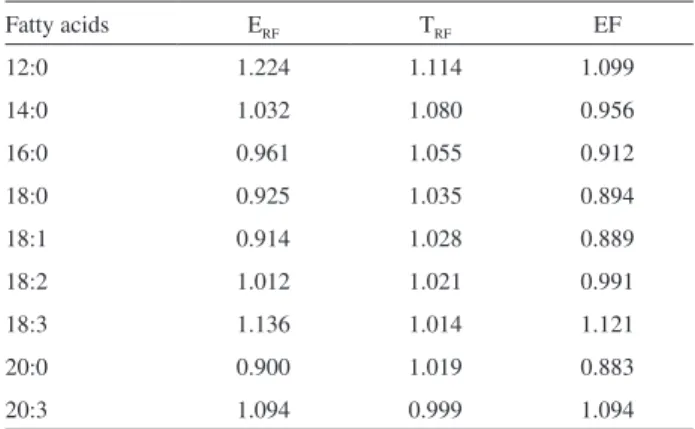
To assess the response of the FID, the theoretical response factors were calculated and the agreement verification between theoretical and experimental response factors was performed, as described by Simionato et al.15
Statistical analysis
The results were submitted to variance analysis (ANOVA) at 5% probability and means were compared by Tukey test with the software Statistical version 7.0.17
Results and Discussion
The quantification of fatty acids using internal standards has been widely applied to provide reliable results that can be easily interpreted. However, when using FID, the differential response must be considered and the correction factors must be increased.18 Thus, it is necessary
to validate the used equipment to verify the agreement between the theoretical response factors (TRF) from those
experimentally obtained (ERF). The ideal situation is to get
results in which the error factor is close to unity, so that the results have high accuracy. After verifying the agreement between ERF and TRF, the theoretical factors were used for
Based on the equivalent chain length and the comparison with standard FA, 26 fatty acids in fat of milk were tentatively identified (Figure 1) and quantified to assess the interference of successive heat treatments.
Table 1 lists the saturated fatty acids (SFA) that were found in the samples. There was no significant difference (p > 0.05) between raw and pasteurized milk samples for all SFAs. These results agree with Herzallah et al.,12 who evaluated
the influence of the low pasteurization process on the lipid profile of milk. Souza et al.20 also evaluated the composition
and profile of raw and pasteurized milk fatty acids in mini dairies and found no significant difference (p > 0.05) for the influence of pasteurization heat treatment on raw milk.
Evaluating the commercial sterilization process by indirect heat exchange (UHT), only the obtained values for tridecanoid acid (13:0) and palmitic (16:0) SFA on different
thermal treatments were not different (p > 0.05), evidencing that successive heat treatments have no influence in these substances. In contrast, all other analyzed SFA showed values statistically different (p > 0.05) between raw and sterilized milk samples. This indicates that successive heat treatments influenced these substances.
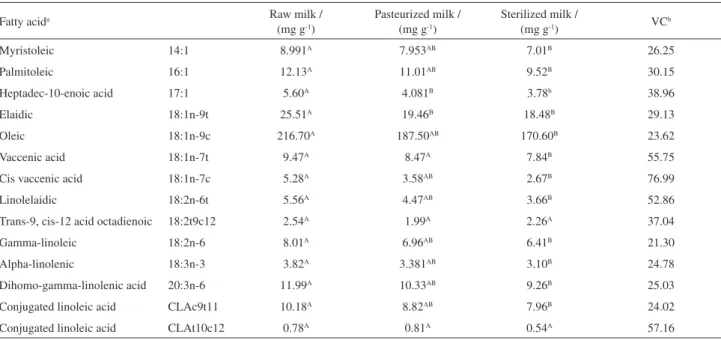
From the obtained data for unsaturated fatty acids (UFA) of the analyzed samples, it was observed that, there was no statistical difference (p > 0.05) between raw and pasteurized milk samples, as for SFA (Table 2). Exceptions were observed for heptadec-10-enoic acid (17:1) and elaidic acid (18:1n-9t) fatty acids, with decreasing of ca. 27% (from 5.600 to 4.081 mg g-1) and
24% (from 25.51 to 19.46 mg g1), respectively, between
raw and pasteurized milk samples. However, as noted for SFA, most analyzed UFA presented statistically different values (p > 0.05) between raw and sterilized milk samples, indicating the action of successive heat treatments on these FA. Exceptions were observed for vaccenic (18:1n-7t) and trans-9-cis-12-octadienoic (18:2t9c12) acids and t10c12 isomer of the conjugated linoleic acid (18:2t10c12), in which heat treatment action was not statistically verified.
There was a significant reduction (ca. 21.80%) between raw and UHT milk samples for CLAc9t11 (from 10.18 to 7.96 mg g-1). Herzallah et al.12 found CLA levels in
pasteurized milk (according to high temperature, short time (HTST) and low temperature, long time (LTLT) processes) lower than those found in raw milk. According to the same author, the trend in reduction of CLA could be attributed to an oxidation process, resulting in hydroperoxides that could cause the conversion or degradation of CLA.12 This
study evidences and confirms the action of successive heat treatments on this fatty acid.
Figure 1. Gas chromatogram obtained for milk samples, the lipid profile: (1) 4:0, (2) 6:0, (3) 8:0; (4) 10:0, (5) 12:0, (6) 13:0, (7) 14:0, (8) 14:1, (9) 15:0, (10) 15:1, (11) 16:0, (12) 16:1, (13) 17:0, (14) 17:1, (15) 18:0, (16) 18:1n-9t, (17) 18:1n-7t, (18) 18:1n-9, (19) 18:1n-7, (20) 18:2t9t12, (21) 18:2t9c12, (22) 18:2c9c12, (23) 20:0, (24) 18:3n-3, (25) 18:2c9t11, (26) 18:2t10c12 and (*) 23:0 (standard).
Table 1. Saturated fatty acids (mg g-1) of lipids for raw, pasteurized and sterilized milk samples
Fatty acida Raw milk / (mg g-1) Pasteurized milk / (mg g-1) Sterilized milk / (mg g-1) VCb
Butyric 4:0 34.25A 31.38AB 23.36B 38.59
Caproic 6:0 21.29A 19.93A 14.70B 37.53
Caprylic 8:0 11.77A 10.81AB 8.39B 37.99
Capric 10:0 22.46A 20.71AB 17.09B 32.68
Lauric 12:0 25.52A 23.03AB 19.35B 30.98
Tridecanoic acid 13:0 0.84A 0.98A 0.64B 61.53
Myristic 14:0 93.78A 82.31AB 72.60B 29.30
Pentadecenoic 15:0 13.80A 12.03AB 10.90B 27.40
Palmitic 16:0 251.70A 222.40A 198.60B 24.82
Margaric 17:0 8.07A 7.08AB 6.71B 25.00
Stearic 18:0 103.90A 89.38AB 83.41B 22.16
Arachidic 20:0 1.66A 1.41AB 1.310B 26.73
Figure 2 shows octadienoic acid profiles to raw, pasteurized and sterilized milk samples. It is evidenced the significant difference between raw and UHT milks for CLAc9t12 and 18:2c9c12 and no difference between raw and UHT milks for CLAt10c12.
Fanti et al.21 report that CLA content in fat milk is
usually between 0.3 and 1.0%. Data from this study are higher than these, but close to those found by Kelsey et al.22
The found difference in conjugated linoleic acid contents may be caused by season, feed, breed, food supplied to the animal, lactation phase and thermal processing.23
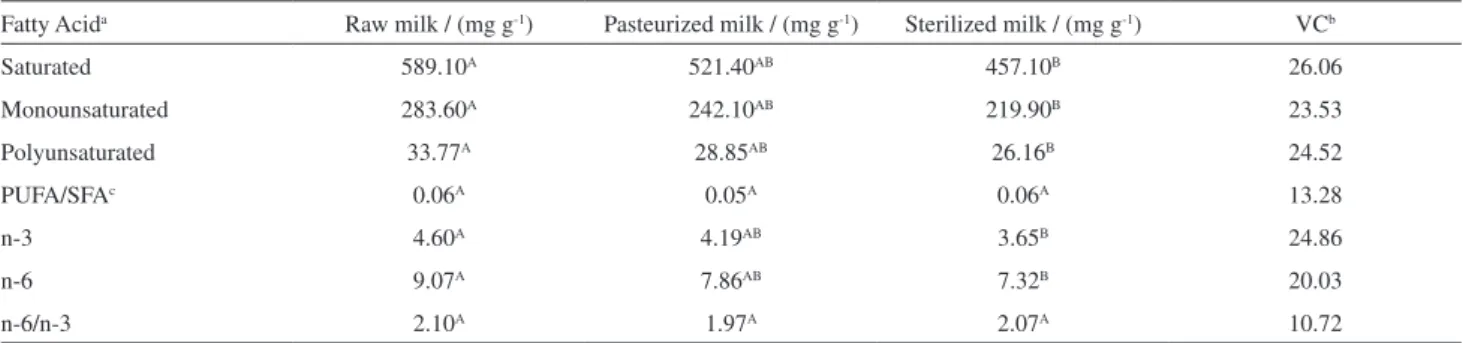
Table 3 shows the sums of saturated (4:0, 6:0, 8:0, 10:0, 12:0, 13:0, 14:0, 15:0, 16:0, 17:0, 18:0, 20:0), monounsaturated (14:1, 16:1, 17:1, 18:1n9t, 18:1n9c, 18:1n7t, 18:1n7c) and polyunsaturated (18:2n6t, 18:2t9c12,
18:2n-6, 18:3n-3, CLAc9t11, CLAt10c12, 20:3n-6) fatty acids, the relation between polyunsaturated and saturated fatty acids (AGPI/AGS), the sums of omega-3 (18:3n-3, 20:3n-3) and omega-6 (18:2n-6, 20:3n-6) fatty acid series and the relation between the fatty acids of these series (n-6/n-3).
The same trend previously reported was observed in the present article, i.e., there are no significant differences (p > 0.05) for the sums of saturated, monounsaturated and polyunsaturated fatty acids and omegas 6 and 3 between raw and pasteurized milks. However, significant difference was found (p > 0.05) between raw and sterilized milk samples. Successive action of pasteurization and sterilization treatments generally decreased the fatty acids in milk, but not to the point of interfering in the ratios between omegas 3 and 6 and between saturated and polyunsaturated fatty acids, as evidenced by the statistical similarity of the results.
The ratios between the omega-6 and omega-3 fatty acids in the samples that were subjected to different heat treatments were equal to 2.10, 1.97 and 2.07 for raw, pasteurized and commercially sterilized milks, respectively. Simopoulos24 suggests that this ratio cannot be over than 4.
The United Kingdom Department of Health25 suggests that
the intake ratio of omega-6 and omega-3 is between 5 and 10. The values from this study show that milk despite of presenting high levels of saturated fatty acids is still a great source of essential fatty acids. Results indicate that there was no significant difference between raw, pasteurized and UHT milks in the ratio of n-6/n-3. Moreover, there were no significant differences for most analyzed fatty acids, as Table 2. Mono and polyunsaturated fatty acids (mg g-1) of lipids for raw, pasteurized and sterilized milk samples
Fatty acida Raw milk /
(mg g-1)
Pasteurized milk / (mg g-1)
Sterilized milk /
(mg g-1) VC
b
Myristoleic 14:1 8.991A 7.953AB 7.01B 26.25
Palmitoleic 16:1 12.13A 11.01AB 9.52B 30.15
Heptadec-10-enoic acid 17:1 5.60A 4.081B 3.78b 38.96
Elaidic 18:1n-9t 25.51A 19.46B 18.48B 29.13
Oleic 18:1n-9c 216.70A 187.50AB 170.60B 23.62
Vaccenic acid 18:1n-7t 9.47A 8.47A 7.84B 55.75
Cis vaccenic acid 18:1n-7c 5.28A 3.58AB 2.67B 76.99
Linolelaidic 18:2n-6t 5.56A 4.47AB 3.66B 52.86
Trans-9, cis-12 acid octadienoic 18:2t9c12 2.54A 1.99A 2.26A 37.04
Gamma-linoleic 18:2n-6 8.01A 6.96AB 6.41B 21.30
Alpha-linolenic 18:3n-3 3.82A 3.381AB 3.10B 24.78
Dihomo-gamma-linolenic acid 20:3n-6 11.99A 10.33AB 9.26B 25.03
Conjugated linoleic acid CLAc9t11 10.18A 8.82AB 7.96B 24.02
Conjugated linoleic acid CLAt10c12 0.78A 0.81A 0.54A 57.16
aUsual nomenclature; bvariation coefficient; means in the same row followed by different letters differ by Tukey test (p > 0.05).
confirmed by Ford and Thompson.26 According to these
authors, there are no alterations of nutritional importance on lipid content after UHT processing, although there might be some unsaturated fatty acid loss in milk lipids.26
The results from that study indicate that in milk obtained from animals fed with special diets (aimed to increase such substances), the thermal processing will not negatively affect the quality of the final product as to the presence of essential fatty acids.
However, results also show that, when a final product rich in CLA is desirable (either by animal supplementation or direct addition), one must be careful with the processing since it was found significant differences after successive heat treatments, the evidence of the reduction of the isomer c9t11. The isomer c9t11 according to Kelsey et al.22 is the
most abundant, corresponding to 75 to 90% of total CLA in milk fat.
Conclusions
Pasteurization does not significantly alter the quality and quantity of fatty acids in milk. However, significant differences can be found when raw milk passes through successive heat treatments of pasteurization and commercial sterilization. These differences were found in 21 of the 26 analyzed fatty acids, including the predominant isomer of conjugated linoleic acid (CLA) in milk. This evidenced the action of successive heat treatments on the lipid profile of milk.
Supplementary Information
Experimental (ERF) and theoretical (TRF) correction
factors and error factor (EF) of the TRACE GC Ultra Gas
Chromatograph Thermo Scientific are available free of charge as PDF file at http://jbcs.sbq.org.br.
Acknowledgements
The authors would like to thank Coordenação de Aperfeiçoamento de Pessoal de Nível Superior (CAPES), Conselho Nacional de Desenvolvimento Científico e Tecnológico (CNPq) and Fundação de Apoio à Pesquisa do Estado da Bahia (FAPESB) for financial support.
References
1. Reis, G. L.; Alves, A. A.; Lana, A. M. Q.; Coelho, S. G.; de Souza, M. R.; Cerqueira, M. M. O. P.; Penna, C. F. A. M.; Mendes, E. D. M.; Ciênc. Rural2007, 37, 1134.
2. Santos, F. L.; Lana, R P.; Silva, M. T. C.; Biotecnologia Ciênc. Desenvolv. 2002, 24, 42.
3. Seçkin, A. K.; Gursoy, O.; Kinik, O.; Akbulut, N.; LWT--Food Sci. Tech. 2005, 38, 909.
4. Sieber, R.; Collomb, M.; Aeschlimann, A.; Jelen, P.; Eyer, H.; Int.Dairy J.2004, 14, 1.
5. Fuente, M. A.; Luna, P.; Juárez, M.; TrAC,Trends Anal. Chem. 2006, 25, 917.
6. Mourão, D. M.; Monteiro, J. B. R.; Costa, N. M. B.; Stringheta, P. C.; Minin, V. P. R.; Dias, C. M. G. C.; Braz. J. Nutr. 2005, 18,391.
7. Roach, J. A. G.; Mossoba, M. M.; Yurawecz, M. P.; Kramer, J. K. G.; Anal. Chim. Acta2002, 465, 207.
8. Ou, L.; Ip, C.; Lisafeld, B.; Ip, M. M.; Biochem. Biophys. Res. Commun. 2007, 356, 1044.
9. Pereda, J. A.; Jaramillo, D. P.; Quevedo, J. M.; Ferragut, V.; Guamis, B.; Trujillo, A. J.; Int. Dairy J.2008, 18, 826. 10. Muir, D. D.; J. Soc. Dairy Techol. 1996, 49, 24.
11. Moltó-Puigmartí, C.; Permanyer, M.; Castellote, A. I.; López-Sabater, M. C.; Food Chem.2011, 124, 697.
12. Herzallah, S. M.; Humeid, M. A.; Al-Ismail, K. M.; J. Dairy Sci.2005,88, 1301.
13. Folch, J.; Lees, M.; Stanley, G. H. S.; J. Biol. Chem. 1957, 226, 497.
Table 3. Totals of saturated, monounsaturated and unsaturated fatty acids; ratio unsaturated/saturated fatty acids, omega-3, omega-6 and ration between omega-6 and omega-3 (mg g-1) of lipids for raw, pasteurized and sterilized milk
Fatty Acida Raw milk / (mg g-1) Pasteurized milk / (mg g-1) Sterilized milk / (mg g-1) VCb
Saturated 589.10A 521.40AB 457.10B 26.06
Monounsaturated 283.60A 242.10AB 219.90B 23.53
Polyunsaturated 33.77A 28.85AB 26.16B 24.52
PUFA/SFAc 0.06A 0.05A 0.06A 13.28
n-3 4.60A 4.19AB 3.65B 24.86
n-6 9.07A 7.86AB 7.32B 20.03
n-6/n-3 2.10A 1.97A 2.07A 10.72
14. Bannon, C. D.; Craske, J. D.; Hai, N. T.; Harper, N. L.; O’Rourke, K. L.; J. Chromatogr., A 1982, 247, 71
15. Simionato, J. I.; Garcia, J. C.; dos Santos, G. T.; Oliveira, C. C.; Visentainer, J. V.; Souza, N. E.; J. Braz. Chem. Soc. 2010, 21, 520.
16. Joseph, J. D.; Ackman, R. G.; J. AOAC Int. 1992, 75, 488. 17. Statsoft, Inc.; Statistica 7.0 Software;Tucksa: USA, 2005.
18. Ackman, R. G.; Progr. Chem. Fats Other Lipids 1972, 12, 165. 19. Bannon, C. D.; Craske, J. D.; Hilliker, A. E.; J. Am. Oil Chem.
Soc. 1986, 63,105.
20. Souza, L.G.; Santos, G. T.; Damasceno, J. C.; Matsushita, M.; Sakaguti, E. S.; Ribas, N. P.; Villalba, R. G.; Acta Sci. Anim. Sci. 2003, 25, 331.
21. Fanti, M. G. N.; Almeida, K. E.; Rodrigues, A. M.; Silva, R. C.; Florence, C. R.; Gioielli, L. A.; Oliveira, M. N.; Ciênc. Tecnol. Alim.2008, 28, 259.
22. Kelsey J. A.; Corl, B. A.; Collier, R. J.; Bauman, D. E.; J. Dairy Sci.2003, 86,2588.
23. Prandini, A.; Sigolo, S.; Tansini, G.; Brogna, N.; Piva, G.; J. Food Compos. Anal. 2007, 20, 472.
24. Simopoulos, A. P.; Biomed. Pharmacoth.2006,60, 502. 25. United Kingdom Department of Health, Committee on Medical
Aspects of Food Policy; Nutritional Aspects of Cardiovascular Disease, Report on Health and Social Subjects, No. 46; HMSO:
London, 1994.
26. Ford, J.E.; Thompson, S. Y.; In: International Dairy Federation. New monograph on UHT milk. Brussels, 1981.
Submitted: June 27, 2011
Supplementary Information
Printed in Brazil - ©2011 Sociedade Brasileira de Química0103 - 5053 $6.00+0.00S
I
*e-mail: [email protected]
Action of Successive Heat Treatments in Bovine Milk Fatty Acids
Edvaldo N. Costa, Ellen C. Q. Lacerda, Suian M. S. Santos, Carilan M. S. Santos, Marcelo Franco, Robério R. Silva and Julliana I. Simionato*
Departamento de Estudos Básicos e Instrumentais, Universidade Estadual do Sudoeste da Bahia, Praça Primavera No. 40, 45700-000 Itapetinga-BA, Brazil
Table S1. Experimental (ERF) and theoretical (TRF) correction factors and error factor (EF) for the gas chromatograph thermo trace-GC-ultra
Fatty acids ERF TRF EF
12:0 1.224 1.114 1.099
14:0 1.032 1.080 0.956
16:0 0.961 1.055 0.912
18:0 0.925 1.035 0.894
18:1 0.914 1.028 0.889
18:2 1.012 1.021 0.991
18:3 1.136 1.014 1.121
20:0 0.900 1.019 0.883
20:3 1.094 0.999 1.094