Article
J. Braz. Chem. Soc., Vol. 24, No. 1, 115-120, 2013. Printed in Brazil - ©2013 Sociedade Brasileira de Química 0103 - 5053 $6.00+0.00
A
*e-mail: [email protected]
Synthesis and Testing of 3-Acetyl-2,5-Disubstituted-2,3-Dihydro-1,3,4-oxadiazole
Derivatives for Antifungal Activity Against Selected
Candida S
pecies
Cledualdo S. de Oliveira,a Bruno F. Lira,a José M. Barbosa-Filho,b Jorge G. F. Lorenzo,b Camilla P. de Menezes,b Jessyca M. C. G. dos Santos,b Edeltrudes de O. Limab and
Petrônio F. de Athayde-Filho*,a
aDepartamento de Química, Universidade Federal da Paraíba, 58051-900 João Pessoa-PB, Brazil
bDepartamento de Ciências Farmacêuticas, Universidade Federal da Paraíba,
58051-900 João Pessoa-PB, Brazil
Uma série de 21 derivados, 1,3,4-oxadiazolinas, foi sintetizada pela ciclização de N-acilhidrazonas com anidrido acético e avaliada in vitro quanto à sua atividade antifúngica contra seis espécies de Candida: Candida albicans (ATCC 90028 e LM V-42), Candida krusei (ATCC 6258 e LM 12 C) e Candida tropicalis (ATCC 13803 e LM 14). As espécies de Candida foram consideradas sensíveis a uma série dos compostos, os quais inibiram o crescimento de 50 a 90%, com um intervalo de concentração inibitória mínima (MIC) de 64 a 512 µg mL-1.
As estruturas dos compostos foram totalmente confirmadas e caracterizadas pelas técnicas de infravermelho com transformada de Fourier (FTIR), ressonância magnética nuclear (NMR) de
1H e 13C, e espectrometria de massa (MS).
A series of 21 1,3,4-oxadiazoline derivatives was synthesized by cyclization of N-acylhydrazones with acetic anhydride and evaluated for their in vitro antifungal activity against six Candida strains: Candida albicans (ATCC 90028 and LM V-42), C. krusei (ATCC 6258 and LM 12 C) and C. tropicalis (ATCC 13803 and LM 14).The Candida strains were found to be sensitive to some of the compounds, which inhibited the growth by 50-90%, with minimum inhibitory concentration (MIC) in the range of 64-512 µg mL-1. The compounds’ structures were fully confirmed and
characterized by Fourier transform infrared spectroscopy (FTIR), 1H and 13C nuclear magnetic
resonance (NMR) and mass spectrometry (MS).
Keywords: 1,3,4-oxadiazoline, antifungal activity, Candida species, N-acylhydrazones
Introduction
Due to the development of resistant fungous strains and no-longer effective medications, the incidence of systemic fungal infections (with its consequent morbidity and mortality) has been gradually increasing over the last three
decades.1 The resulting requirement for investigation,
research and discovery of new antimicrobial agents that are both safer and more effective is of the utmost importance. Derivatives of 1,3,4-oxadiazoline have recently gained importance (for serving as building blocks) for both organic synthesis and medicinal chemistry when developing new therapeutic agents. It has been noted that compounds containing the 1,3,4-oxadiazoline motif generally exhibit excellent antimicrobial activity.2-12
Therefore, taking into consideration our ongoing research and the importance of the 1,3,4-oxadiazoline scaffold as a good source for the discovery of new and biologically active molecules, our group synthesized new 1,3,4-oxadiazoline heterocyclic compounds, (specifically 3-acetyl-2,5-diaryl-2,3-dihydro-1,3,4-oxadiazoles), and pre-screened these compounds for candidacy as novel antifungal agents.
Results and Discussion
Chemistry
N-acylhydrazones (NAH) belong to the azomethine
particularly versatile for synthesis of compounds containing nitrogen.15 With this in mind, it was planned the synthesis of the 1,3,4-oxadiazoline target molecule from the versatile
N-acylhydrazone substrate, using the strategy of closing
the acyclic chain to give the 1,3,4-oxadiazoline core. The strategy is efficient to obtain the 1,3,4-oxadiazoline target molecule (Figure 1).
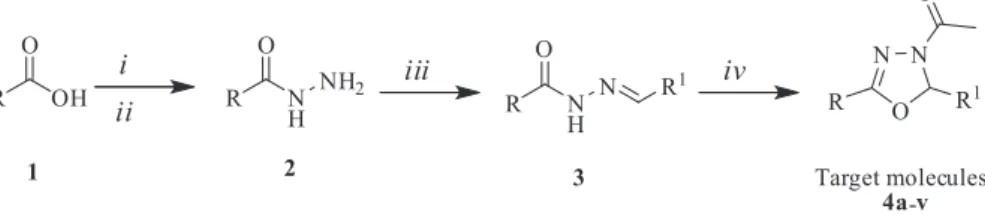
Target molecules 4a-v were obtained as racemic
mixtures in four synthetic steps according to Scheme 1.
The N-acylhydrazone compounds (3) were obtained from
a condensation reaction between acylhydrazides, and aromatic/hetero-aromatic aldehydes according to the literature.2 The cyclization reaction of the derivatives (3) with acetic anhydride afforded 1,3,4-oxadiazoline
derivatives 4a-v in yields that were moderate to good
(45.4-81.2%).
Twenty-one 1,3,4-oxadiazoline compounds were synthesized and divided into three congener sets as follows:
series 1
(2-aryl-3-acetyl-5-(pyridin-4-yl)-2,3-dihydro-1,3,4-oxadiazole, 4a-l), containing the pyridin-4-yl group fixed in 5-position of the 1,3,4-oxadiazoline ring, with varied electron- donating and electron-withdrawing groups
linked to the aromatic ring at the 2-position of the core 1,3,4-oxadiazoline, series 2
(2-(4-acetoxyphenyl)-3-acetyl-5-aryl-2,3-dihydro-1,3,4-oxadiazole, 4m-q), in which the
p-acetoxyphenyl group remained fixed at the 2-position of
the 1,3,4-oxadiazoline ring, and series 3 (2-(5-nitrofuran-2-yl)-3-acetyl-5-aryl-2,3-dihydro-1,3,4-oxadiazole, 4r-v) having the group 5-nitrofuran-2-yl fixed at the 2-position of the 1,3,4-oxadiazoline ring. In both series 2 and 3, electron-donating and electron-withdrawing groups are located at the para position of the aromatic ring and at the 5-position of the 1,3,4-oxadiazoline core, (Figure 2).
Compounds 4a, 4c-g and 4i are known structures.16,17
Compounds of series 2 (4m-q) and compounds 4b, 4h,
4j and 4l are new structures. Compounds of series 3 (4r-v)
were recently reported by our research group.2 The purity
of the compounds was verified examining their melting ranges and by gas chromatography (GC-MS) (Table 1). Interestingly, all the compounds contain an acetyl group (which is polar) in the 3-position of the 1,3,4-oxadiazoline core, which gives to these compounds an intermolecular hydrogen bonding site with bio-macromolecules.
Characterization of the final products
The structures of the compounds were fully characterized and confirmed by using spectroscopic techniques (Fourier transform infrared (FTIR)
spectroscospy and 1H and 13C nuclear magnetic resonance
(NMR)) and mass spectrometric (MS) studies. The 1H and
13C NMR spectroscopic techniques were sufficient to
confirm the formation of the 1,3,4-oxadiazoline ring
Figure 1. Retrosynthetic analysis of 1,3,4-oxadiazoline.
Figure 2. The chemical structures of the 1,3,4-oxadiazoline compounds.
because of its very characteristic signals.2,17 For example, in the 1H NMR spectra of compounds of the series 1 (4a-l), two typical signals were observed, one assigned to the methyl protons of the acetyl group linked to the nitrogen atom N-3 in the aliphatic region of 2.27 to 2.30 ppm, and another assigned to methinic protons H-2 in the aromatic
region 7.17 to 7.63 ppm. In the 13C NMR spectra, signals
characteristic of C=O around 167 ppm, and methyl carbon
atom CH3 in the range of 20.1-22.7 ppm, as well as the
oxadiazole ring signal C-2 around 88.7 to 92.9 ppm, and C-5 around 152.5 to 163.4 ppm were observed, thus confirming its formation.
In the
1-(2-(4-fluorophenyl)-5-(pyridin-4-yl)-1,3,4-oxadiazol-3(2H)-yl)ethanone, (4f) spectrum, it was
observed doublets corresponding to couplings 13C-19F, whose
coupling constants for one bond 1J
CF 245.0 Hz, two bonds
2J
CF 32.0 Hz and three bonds
3J
CF 9.0 Hz were assigned
respectively to couplings C-F in d 162.4 (C-14), d115.4
(C-11,15) and d 128.8 (C-12,16) ppm.In the 1H NMR
spectra for series 2 (4m-q) compounds, it was observed
the characteristic signals: a singlet for hydrogen 3 (acetyl group linked to nitrogen (N-3)) in the aliphatic region of 2.25 to 2.27 ppm, a singlet for hydrogen 3 (acetoxy group linked to the benzene ring) in the aliphatic region of (2.26 to 2.30 ppm), and singlet for hydrogen 1 (H-2) in the aromatic
region of 7.17 to 7.26 ppm. In the 13C NMR spectra, the
characteristic signals observed were: two carbon atoms of the 1,3,4-oxadiazoline core (C-2 and C-5) in the regions of 91.0 to 92.3 ppm and 153.2 to 154.7 ppm, respectively. The chemical shifts of C=O of the acetyl group linked to nitrogen atom (N-3), and the C=O of the acetoxy group were observed in the range of 166.6 to 167.2 ppm and 168.8 to 169.2 ppm, respectively. The characterization of series
3 (4 r-v) compounds was recently reported by our group.2
In the infrared spectrum, compounds 4a-q showed
amide C=O absorption bands from 1662 to 1674 cm-1,
C−O−C absorption stretches (oxadiazole ring) from 1095
to 1240 cm-1, and C=N absorptions (oxadiazole ring) from
1604 to 1635 cm-1. The compound
4-(3-acetyl-5-(pyridin-4-yl)-2,3-dihydro-1,3,4-oxadiazol-2-yl)phenyl acetate
4l and all compounds of series 2 (4m-q) also showed
absorption bands in the 1755 to 1759 cm-1 range for C=O
(acetoxy group).
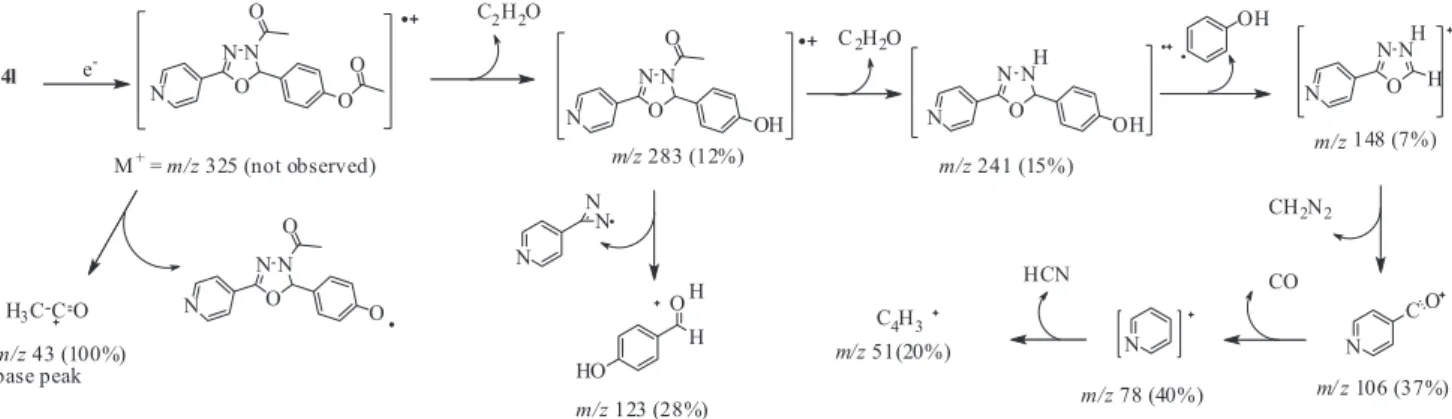
The fragmentation most observed in the mass spectra of the new compounds (4b, 4g, 4j, 4l and 4m-q) is exemplified
by compound 4l. In the mass spectrum of compound 4l,
it was not detected a peak related to the molecular ion
(m/z 325), this due to the presence of an acetyl radical
which easily promotes the loss of one ketene molecule, and the transfer of a hydrogen to form a phenol. However, the radical cation (m/z 283) originating from the first breaking of the molecular ion, and corresponding to the elimination
of a neutral ketene, was not observed. The peak at m/z 241
originates from the radical cation (m/z 283) through loss
of a second neutral ketene molecule. The base peak was
assigned to the acylium ion (m/z 43). In Scheme 2, it is
outlined a fragmentation pattern proposal for that observed
in the mass spectrum of compound 4l.
Antifungal activity
The in vitro antifungal activity of compounds 4a-v was evaluated by the microdilution method against six strains
of pathogenic fungi, Candida albicans (ATCC 90028 and
LM V-42), Candida krusei (ATCC 6258 and LM 12 C) and
Candida tropicalis (ATCC 13803 and LM 14), using nystatin as the drug standard (Table 2). The compounds
were tested at concentrations from 32 to 1024 µg mL-1, and
solubilized in dimethylsulfoxide, DMSO (Sigma Chemical) to 10% to avoid interferences with the microorganisms. The antifungal activity of the products was interpreted, and considered active or not, according to the following
Table 1. Physical and chemical properties of novel 1,3,4-oxadiazolines 4b, 4h, 4j, 4l and 4m-q
Compound Molecular formula Exact mass mp / °C Yield / % GC-MS
tr / min
4b C18H19N3O2 309.15 92-94 66 23.4
4h C15H12BrN3O2 345.01 120-121 59 24.1
4j C17H17N3O4 327.12 186-188 57 24.3
4l C17H15N3O4 325.11 162-164 72 24.5
4m C18H16N2O4 324.11 140-141 75 24.3
4n C19H18N2O4 338.13 154-156 70 25.3
4o C18H15N3O6 369.10 192-194 64 25.8
4p C18H15ClN2O4 358.07 158-160 71 25.7
parameters: 50-100 µg mL-1 = good activity;
100-500 µg mL-1 = moderate activity; 500-1000 µg mL-1 = low
activity; greater than 1000 µg mL-1 = inactive product.18
From the 21 compounds tested, compounds 4a-m and
4o-q showed no inhibitory activity against the mentioned
yeasts in the bioassays. Compound 4n showed moderate
inhibitory effect against Candida albicans (LM V-42), and
Candida krusei (ATCC 6258) at a minimum concentration
of 128 µg mL-1. The Candida species were sensitive to
compounds of series 3 (4r-v), these compounds inhibited
the growth by 50 to 90% (MIC range of 64-512 µg mL-1). The
best results were against Candida albicans (ATCC 90028)
exhibited by compounds 4r and 4v with an MIC of 64 µg
mL-1, while compounds 4u and 4v exhibited the best results
against Candida krusei, and Candida tropicalis with an
MIC of 64 µg mL-1, respectively. Candida krusei (LM 12C)
showed no sensitivity to any of the tested compounds. The
standard drug, nystatin at 100 IU mL-1 inhibited the growth of four (67%) of the Candida strains. The results therefore were considered between good and moderate in terms of biological activity, and taking into account the parameters established.18 The results show that compounds 4r-v may be considered promising for possible development of new antifungal agents, and, that the 5-nitrofuranyl group in these compounds is important for their activity.
Conclusions
In this work, it was synthesized a series of twenty-one 1,3,4-oxadiazoline compounds, and their structures were
confirmed by the techniques FTIR 1H and 13C NMR and
MS. For in vitro antifungal activity against Candida
strains, compounds 4r-v showed good to moderate
activity, inhibiting the growth of the strains used by
Table 2. Antifungal activity of 1,3,4-oxadiazoline 4m-q and 4r-v
Compounds
Minimum inhibitory concentration (MIC) / (µg mL-1)
Candida Strains
C. albicans
ATCC 90028
C. albicans
LM V-42
C. krusei
ATCC 6258
C. krusei
LM 12C
C. topicalis
ATCC 13803
C. topicalis
LM 14
4m R 1024 R 1024 R R
4n R 128 128 R R R
4o R R R R R R
4p R R R R R R
4q R R R R R R
4r 64 64 256 R 512 512
4s 128 128 128 R R 128
4t 128 R 256 R R 256
4u 512 128 128 R R 64
4v 64 128 64 R 128 128
Control yeast + + + + + +
Nystatin − − − + + −
R: resistant; +: growth of the microorganism; −: no growth of the microorganism.
50-90% with an MIC of 64-512 µg mL-1. These may
be promising compounds for the development of new
antifungal agents.
Experimental
Chemistry
All used reagents and solvents were purchased from commercial sources (Sigma-Aldrich, Brazil), and used without a further purification. The purification of the compounds was performed by re-crystallization in ethanol, and confirmed by determining the melting range on an MQAPF-3 hotplate, and by gas chromatography with low resolution mass spectrometer (GC-MS-QP2010) Shimadzu. The FTIR spectra were obtained on an FTIR spectrometer model IRPrestige-21-Shimadzu, using KBr
pellets. 1H and 13C NMR spectra were obtained on two
different machines: a Varian 200 NMR (200 and 50 MHz
for 1H and for 13C, respectively), and a Varian 500 NMR
(500 and 125 MHz for 1H and 13C, respectively),
deuterated dimethyl sulphoxide (DMSO-d6) was used
as the solvent and tetramethylsilane (TMS) was used for
the internal standard. Chemical shifts (d) were measured
in parts per million (ppm) and the coupling constants
(J) in Hz.
Antifungal activity
Microorganisms
The microbiological assays used: Candida albicans
(ATCC 90028 and LM V-42), C. krusei (ATCC 6258 and
LM 12 C) and C. tropicalis (ATCC 13803 and LM 14).
The strains were acquired from the Institute Adolfo Lutz of São Paulo and Mycology Laboratories of the Departments of Pharmaceutical Sciences at the University of Sao Paulo and the Federal University of Paraiba, respectively. The fungal strains were maintained in appropriate medium, Sabouraud Dextrose Broth-SDB (DIFCO Laboratories, France-USA), and stored at 4 °C and 35 °C. The suspension of microorganisms was prepared according to the 0.5 McFarland scale tube, and adjusted by means of a spectrophotometer (Leitz-Photometer 340-800) to 90% T (530 nm) corresponding to approximately 106 UFC mL-1.19-21
Culture medium
The antifungal activity assays were performed in Sabouraud Dextrose Broth-SDB (DIFCO Laboratories, France-USA), which was prepared and used according to manufacturer instructions.
Determination of minimum inhibitory concentration (MIC)
The MIC value was determined by the microdilution method, using 96 well microtiter plates with background in a “U” and in duplicate. To each well of the plate, it was added 100 µL of liquid medium SDB doubly concentrated. Then, 100 µL of the product solution (also doubly concentrated) were dispensed into the wells of the first line of the plate. By means of serial dilution (ratio of two), it was obtained
concentrations from 2,048 to 64 µg mL-1, so that in the
first row of the plate, the highest concentration, and in the latter, the lower concentrations. Finally, 10 µL of inoculum were added to the wells where each column of the plate referred specifically to a strain. The same was also done in the culture medium with fungal drug nystatin (100 UI). The plates were incubated at 37 °C for 24-48 h. For each strain, MIC was defined as the lowest concentration able to inhibit fungal growth visually observed in the wells, when compared to the control. All tests were performed in duplicate, and the results were expressed as the geometric
mean of the MIC values obtained in the two trials.21-23
Acknowledgments
This work was supported by the following Brazilian agencies: Conselho Nacional de Desenvolvimento Científico e Tecnológico (CNPq) and Coordenação de Aperfeiçoamento de Pessoal de Nível Superior (CAPES). The English in this article was reviewed by David Peter Harding.
Supplementary Information
Supplementary information is available free of charge at http://jbcs.sbq.org.br as PDF file.
References
1. Scotti, L.; Scotti, M. T.; Lima, E. O.; Silva, M. S.; Lima, M. C. A.; Pitta, I. R.; Moura, R. O.; Oliveira, J. G.B.; Cruz, R. M. D.; Mendonça Jr., F. J. B.; Molecules2012, 17, 2298. 2. Oliveira, C. S.; Lira, B. F.; Falcão-Silva, V. S.; Siqueira-Junior,
J. P.; Barbosa-Filho, J. M.; Athayde-Filho, P. F.; Molecules2012,
17, 5095.
3. Sahin, G.; Palaska, E.; Ekizoglu, M.; Ozalp, M.; Il Farmaco
2002, 57, 539.
4. Fuloria, N. K.; Singh, V.; Shaharyar, M.; Ali, M.; Molecules
2009, 14, 1898.
5. Kumar, S.; J. Chil. Chem. Soc.2010, 55, 126.
6. Sangshetti, J. N.; Chabukswar, A. R.; Shinde, D. B.; Bioorg. Med. Chem. Lett.2011, 21, 444.
8. Bakht, M. A.; Yar, M. S.; Abdel-Hamid, S. G.; Qasoumi, S. I.; Samad, A.; Eur. J. Med. Chem.2010, 45, 5862.
9. Kumar, R.; Kumar, A.; Jain, S.; Kaushik, D.; Eur. J. Med. Chem.
2011, 46, 3543.
10. Li, Z.; Zhu, A.; Mao, X.; Sun, X.; Gong, X.; J. Braz. Chem. Soc. 2008, 19, 1622.
11. Savariz, F. C.; Formagio, A. S. N.; Barbosa, V. A.; Foglio, M. A.; Carvalho, J. E.; Duarte, M. C. T.; Filho, B. P. D.; Sarragiotto, M. H.; J. Braz. Chem. Soc. 2010, 21, 288.
12. Oliveira, C. S.; Lira, B. F.; Barbosa-Filho, J. M.; Lorenzo, J. G. F.; Athayde-Filho, P. F.; Molecules2012, 17, 5095. 13. Silva, Y. K. C.; Augusto, C. V.; Barbosa, M. L. C.; Melo, G. M. A.;
Queiroz, A. C. Dias, T. L. M. F.;Júnior, W. B.; Barreiro, E. J.; Lima, L. M.; Moreira, M. S. A.; Bioorg. Med. Chem.2010,
18, 5007.
14. Rollas, S.; Küçükgüzel. S. G.; Molecules 2007, 12, 1910. 15. Sugiura, M.; Kobayashi, S.; Angew. Chem., Int. Ed. 2005, 44,
5176.
16. Maccioni, E.; Alcaro, S.; Cirilli, R.; Vigo, S.; Cardia, M. C.; Sanna, M. L.; Meleddu, R.; Yanez, M.; Costa, G.; Casu, L.; Matyus, P.; Distinto, S.; J. Med. Chem. 2011, 54, 6394. 17. Cerioni, G.; Maccioni, E.; Cardia, M. C.; Vigo, S.; Mocci, F.;
Magn. Reson. Chem.2009, 47, 727.
18. Holetz, F. B.; Howes, M. J.; Lee, C. C.; Steventon, G.; Mem. Inst. Oswaldo Cruz. 2002, 97, 1027.
19. National Committee for Clinical and Laboratory Standards
(NCCLS); Performance Standards for Antimicrobial Disk Susceptibility Tests, 7th ed.; NCCLS: Villanova, PA, 2000. 20. Hadacek, F. Greger, H.; Phytochem. Anal. 2000, 11, 137. 21. Cleland, R.; Squires, E. In Lorian ,V. M. D.; Willians & Wilkins:
Baltimore, USA, 1991, p. 739. 22. Eloff, J. N.; Planta Med.1978, 64, 711.
23. Souza, E. L.; Stamford, T. L. M.; Lima, E. O.; Trajano, V. N.;
Food Control, 2007, 18, 409.