Article
J. Braz. Chem. Soc., Vol. 25, No. 8, 1331-1337, 2014. Printed in Brazil - ©2014 Sociedade Brasileira de Química 0103 - 5053 $6.00+0.00
A
*e-mail: [email protected]
Microwave-Assisted Synthesis and Antileishmanial Activity of
3-methoxycarbonyl-γ
-butyrolactone Derivatives
Marcos F. Pinatto-Botelho,a Antonio E. M. Crotti,a Julia M. de Souza,b Lizandra G. Magalhãesb and Paulo M. Donate*,a
aDepartamento de Química, Faculdade de Filosofia, Ciências e Letras de Ribeirão Preto, Universidade de São Paulo, Avenida Bandeirantes, 3900, 14040-901 Ribeirão Preto-SP, Brazil
bNúcleo de Pesquisa em Ciências Exatas e Tecnológicas, Universidade de Franca, Avenida Dr. Armando Salles de Oliveira 201 Parque Universitário, 14404-600 Franca-SP, Brazil
Descrevemos a síntese assistida por micro-ondas de dez derivados de 3-metoxicarbonil-γ -butirolactona e a avaliação in vitro da atividade leishmanicida desses compostos contra formas promastigotas de Leishmaniaamazonensis. A síntese forneceu a maioria dos compostos com 80-95% de rendimento e as reações duraram cerca de 10-20 min. A maior parte dos compostos apresentaram valores de IC50 superiores a 400 uM. Os compostos 5 (trans-3-(p
-metoxi)benzil-4-metil-3-metoxicarbonil-γ-butirolactona) e 10 (trans-3-(p
-metoxi)benzil-4-benzil-3-metoxicarbonil-γ-butirolactona) foram as exceções, pois exibiram valores de IC50 de 170,4 e 179,6 µM,
respectivamente, o que sugere que a atividade leishmanicida das 3-metoxicarbonil-γ-butirolactonas pode estar relacionada com a natureza e o tamanho do substituinte na posição C-4.
We describe the microwave-assisted synthesis of ten 3-methoxycarbonyl-γ-butyrolactone derivatives and evaluate their in vitro antileishmanial activity against promastigote forms of Leishmania amazonensis. The synthesis furnished most of the compounds in 80-95% yield and reactions lasted about 10-20 min. Most of the compounds displayed IC50 values higher than 400 µM. Compounds 5 (trans-3-(p-methoxy)benzyl-4-methyl-3-methoxycarbonyl-γ-butyrolactone) and 10 (trans-3-(p -methoxy)benzyl-4-benzyl-3-methoxycarbonyl-γ-butyrolactone) were the exceptions: they displayed IC50 values of 170.4 and 179.6 µM, respectively, suggesting that the leishmanicidal activity of
3-methoxycarbonyl-γ-butyrolactones may be related to the nature and size of the substituent at position C-4.
Keywords: γ-butyrolactone, multicomponent reaction, microwave-assisted synthesis,
Leishmania amazonensis
Introduction
Protozoan parasites of the Leishmania genus cause a group of diseases known as Leishmaniasis, a parasitosis that affects more than 12 million people worldwide and accounts for high mortality rates in tropical and subtropical countries.1,2 It is estimated that two to three million new
leishmaniasis cases emerge each year, and that some 350 million people are at risk of infection.3 The parasites of the
genus Leishmania can infect humans and several species of mammals. The infection manifests itself in three main typical ways: visceral, cutaneous, and mucocutaneous leishmaniasis.4
Pentavalent antimonials were first used in the clinical setting at the beginning of the last century; they remain the first-choice drugs to treat leishmaniasis. However, these compounds are toxic and poorly tolerated, require daily injections for up to 28 days, and are becoming ineffective due to proliferation of resistant parasites.5
Second-line drugs, like amphotericin B and pentamidine, are options in combined therapy or in cases of antimony treatment failure.6,7 Therefore, the development of new
antileishmanial compounds is imperative.1
γ-Butyrolactones are a structural feature of a diversity of natural products, such as sesquiterpene lactones8-10
and lignan lactones.11,12 The γ-lactone subunit has been
actions,16 among several other biological activities.17-19 In
this scenario, the interest in developing new methodologies to synthesize compounds bearing γ-butyrolactones in their structures has increased, with emphasis on multicomponent reactions (MCRs).20-24 MCRs are advantageous: they
incorporate most, if not all atoms of the reagents in the final product in few steps, usually involve a one-pot reaction, and allow for facile product purification.25 A few
synthetic γ-butyrolactones have been evaluated for their antileishmanial activity.
Microwave irradiation has gained popularity in the past decade as a powerful tool to rapidly and efficiently synthesize a variety of compounds. This process is advantageous over conventional thermal heating: it reduces reaction times, improves yields, and suppresses the generation of side products.26-28
As part of our ongoing project on the synthesis and biological activities of γ-butyrolactones,29-32 in this
paper we report the use of microwave irradiation as heat source to promote the fast and efficient synthesis of a series of 3,3,4-trisubstituted and 3,3,4,4-tetrasubstituted 3-methoxycarbonyl-γ-butyrolactone derivatives obtained by the multicomponent reaction previously developed by Le Gall and co-workers.33 Here, we have also evaluated the
antileishmanial activity of these compounds.
Results and Discussion
We obtained the target compounds by MCR (see Scheme 1), preferably using microwave irradiation as heat source. Only compound 9 could not be achieved by microwave irradiation, but was obtained in good yield after 3 h under conventional heating. Table 1 summarizes the results of these reactions.
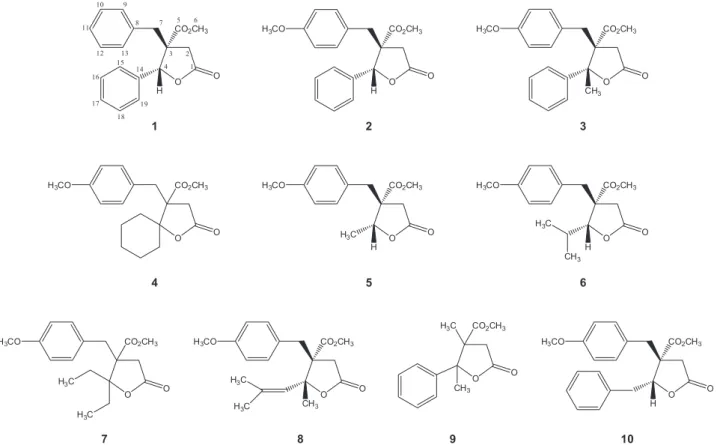
Figure 1 shows the chemical structures of the 3-methoxycarbonyl-γ-butyrolactones 1-10. Compounds
1-4 have been synthesized previously,33 but compounds
5-10 are new.
We identified the structures of the synthesized compounds on the basis of 1H and 13C NMR data, as well
as two-dimensional NMR techniques (HMQC, HMBC and
1H-1H COSY). We assigned the relative stereochemistry
of these compounds on the basis of NOE difference spectroscopy, by irradiating the signal of the hydrogen at C-4 (for compounds 1, 2, 5, 6, and 10) or the methyl group at C-4 (for compounds 3, 8, and 9) with respect to the hydrogen at C-2.
In the biological assays, we tested all the compounds as mixtures of enantiomers. Table 2 lists the results of the in vitro evaluation of the leishmanicidal activity of the 3-methoxycarbonyl-γ-butyrolactones 1-10
against promastigote forms of Leishmania amazonensis (MHOM/BR/PH8). Most of the tested compounds did not cause significant lysis at concentrations lower than 50 µM (data not shown). The most active compounds at 50 µM
Table 1. Yields obtained in the synthesis of compounds 1-10 produced via Scheme 1a
Compound
Conventional heating at 60 oC (oil bath)
Microwave irradiation at 60 oC and 150 W
Reaction time
/ min Yield / %)
b Reaction time
/ min Yield / %) b
1 180 35 20 85
2 60 70 10 96
3 60 13 20 82
4 180 20 20 80
5 120 18 10 81
6 180 24 10 88
7 180 13 10 86
8 60 30 10 85
9 180 78 10-30 0
10 60 83 20 90
aThe reactions were conducted under argon atmosphere with 5 mL of acetonitrile, zinc powder (0.8 g, 12 mmol), dimethyl itaconate (2 g, 13 mmol), an aldehyde or a ketone (2.5 mmol), and the aryl bromide (4 mmol). After brief stirring at room temperature, cobalt bromide (0.13 g, 0.6 mmol), trifluoroacetic acid (0.03 mL), and 1,2-dibromoethane (0.05 mL) were successively added. The reaction mixture was heated at 60 °C for 1-3 h in an oil bath, or irradiated for 10-20 min in a CEM Discovery® focused microwave oven at 60 oC and 150 W; bisolated yield.
were 2 (11.4 ± 8.2% lysis), 3 (14.2 ± 5.8% lysis), and 5
(15.8 ± 4.6% lysis). On the other hand, γ-butyrolactone 8
was found to be the most active among the tested compounds at 100 µM, causing 38.4 ± 2.8% lysis. These data indicated that compound 8 did not display a dose-dependent effect at concentrations lower than 100 µM. The γ-butyrolactones
5 (68.8 ± 4.8%) and 10 (81.3 ± 0.8%) afforded the highest lysis value at 400 µM; their IC50 (Inhibitory Concentration)
values were 170.4 µM and 179.6 µM, respectively, much higher than that of amphothericin B (IC50 = 13.7 µM), used
as positive control.
When we related the IC50 values to the structures
of the γ-butyrolactone derivatives, we noticed that the antileishmanial activity decreased when the aromatic ring did not bind to the β-methyl group, as in the case of compound 9. The methoxyl group at the aromatic moiety did not seem to increase the leishmanicidal action, as evidenced by the comparison between the IC50 values of
compounds 1 and 2. In addition, comparison among the IC50
values of compounds 2-8 and 10 clearly indicated that the leishmanicidal activity of these compounds depended on the nature of the substituent at C-4. Although these results demonstrated that the methyl and benzyl groups at position γ play a key role in the leishmanicidal activity of compounds
5 and 10, further studies are necessary to investigate the mechanism through which these substituents affect the leishmanicidal activity of this class of compounds.
Conclusion
In summary, our results indicated that the microwave-assisted synthesis significantly increased the product yields
Table 2. In vitro leishmanicidal activity of the 3-methoxycarbonyl-γ-butyrolactone derivatives 1-103,34
Compound % Lysis ± SD/concentration / µM a
IC50
50 100 200 400
1 5.6 ± 5.1 29.6 ± 2.7 40.1 ± 4.9 42.3 ± 5.7 412.2
2 11.4 ± 8.2 28.5 ± 6.1 35.6 ± 7.2 46.0 ± 4.3 414.9
3 14.2 ± 5.8 25.0 ± 7.3 29.1 ± 1.8 30.0 ± 0.7 467.4
4 4.9 ± 1.9 9.6 ± 4.4 43.5 ± 6.4 49.5 ± 2.4 401.9
5 15.8 ± 4.6 38.1 ± 8.9 57.7 ± 4.7 68.8 ± 4.8 170.4
6 0 0 22.1 ± 4.5 40.8 ± 7.7 415.6
7 0 0 20.61 ± 4.4 21.9 ± 4.1 1045
8 0 38.4 ± 2.8 35.0 ± 0.7 44.0 ± 3.1 405.1
9 0 1.8 ± 3.1 3.0 ± 5.2 8.8 ± 8.6 1989
10 6.2 ± 2.1 22.2 ± 4.3 54.2 ± 1.5 81.3 ± 0.8 179.6 aPercentages of lysis at concentrations of 6.25, 12.5, and 25 µM were not statistically significant for compounds 1-3. No lyses were observed at these concentrations for compounds 4-10. Positive control: Amphotericin B (12 µM): IC50 = 13.7 µM.
and reduced reaction time as compared with the conventionally heated systems. Moreover, the antileishmanial activity of the 3-methoxycarbonyl-γ-butyrolactone derivatives was not so strong as compared with that of amphotericin B and other antileishmanial drugs currently employed in the clinical setting. However, compounds 5 and 10, which proved to be the most active among the evaluated compounds, should be further investigated, mainly because their synthesis by microwave-assisted synthesis reduced reaction times and improved yields.
Experimental
General
Mass spectra were acquired on an UltroTOF-Q mass spectrometer (Bruker Daltonics, Billerica, MA, USA) fitted with an ESI operating in the positive ion mode. Accurate masses were obtained using TFA-Na+
(sodiated trifluoroacetic acid) as the internal standard.
1H-NMR spectroscopy was performed using a Bruker
DPRX-400 instrument (Bruker, Fällanden, Switzerland) operating at 400 MHz for 1H and at 100 MHz for 13C. TMS was
used as internal standard. The chemical shifts are reported in ppm (d); coupling constants (J) values are given in Hertz (Hz). Signal multiplicities are represented by: s (singlet), d (doublet), dd (double doublet), dq (double quadruplet), m (multiplet). Unless noted otherwise, all the solvents and reagents were commercially available and used without further purification.
General procedure for the synthesis of compounds 1-10
The 3-methoxycarbonyl-γ-butyrolactones 1-10 were synthesized using the one-pot multicomponent methodology described by Le Floch and co-workers.33 All the reactions
were performed in duplicate: one employed a conventional thermal heating with an oil bath; the other used microwave radiation as heat source. A 25-mL round-bottomed flask under argon atmosphere was charged with previously purified34 acetonitrile (5 mL), zinc dust (0.8 g, 12 mmol),
dimethyl itaconate (2 g, 13 mmol), an aldehyde or a ketone (2.5 mmol), and the aryl bromide (4 mmol). This mixture was briefly stirred at room temperature. Cobalt bromide (0.13 g, 0.6 mmol), trifluoroacetic acid (0.03 mL), and 1,2-dibromoethane (0.05 mL) were then added successively to the previous mixture. The reaction mixture was heated at 60 °C for 1-3 h in an oil bath, or irradiated for 10-20 min in a CEM Discovery® focused microwave oven at 60 °C and
150 W. The reaction mixture was monitored by thin-layer chromatography until consumption of the aryl bromide was complete (between 1 and 3 h for conventional thermal heating, and between 10 and 20 min for microwave irradiation
heating). Next, the reaction mixture was then filtered through Celite®, which was then washed several times with anhydrous
diethyl ether. The organic fractions were combined and concentrated under reduced pressure. The crude reaction product was purified by flash column chromatography through silica gel (n-hexane/ethyl acetate, 7:3 v/v), to afford a mixture of stereoisomers of the butyrolactone with yields ranging from 13 to 83% for conventional thermal heating, and from 80 to 96% for microwave-assisted heating, with the exception of compound 9, which was not obtained by microwave irradiation.
t r a n s- 3 - B e n z y l - 4 - p h e n y l - 3 - m e t h ox y c a r b o n y l -γ -butyrolactone (1)
Yields: 35% (conventional thermal heating), 85% (microwave radiation); IR (KBr) ν/cm-1 3460, 1786, 1736,
1216; 1H NMR (CDCl
3, 400 MHz): d 7.45 (m, 2H, 2Ar-H),
7.43 (m, 2H, 2Ar-H), 7.35 (m, 2H, 2Ar-H), 7.23 (m, 2H, 2Ar-H), 6.95 (m, 2H, 2Ar-H), 5.67 (s, 1H, CH), 3.75 (s, 3H, CH3), 3.12 (d, 1H, J 17.6 Hz, CH2), 2.86 (d, 1H, J 13.9 Hz,
CH2), 2.71 (d, 1H, J 17.6, Hz CH2), 2.17 (d, 1H, J 13.9 Hz,
CH2);
13C NMR (CDCl
3, 100 MHz): d 74.5, 173.0, 135.7,
134.3, 129.5, 129.1, 128.5, 127.3,126.5, 85.7, 56.3, 52.9, 39.0, 35.6; ESI-MS m/z calcd. for C19H18NaO4
+: 333.1103,
found: 333.1097 [M+Na]+.
trans-3-(p
-Methoxy)benzyl-4-phenyl-3-methoxycarbonyl-γ-butyrolactone (2)
Yields: 70% (conventional thermal heating), 96% (microwave radiation); 1H NMR (CDCl
3, 400 MHz): d 7.43
(m, 2H, 2Ar-H), 7.42 (m, 1H, Ar-H), 7.35 (m, 2H, 2Ar-H), 7.23 (m, 2H, 2Ar-H), 6.85 (d, 2H, J 8.1 Hz, 2Ar-H), 6.74 (d, 2H, J 8.1 Hz, 2Ar-H), 5.73 (s, 1H, CH), 3.76 (s, 3H, OCH3),
3.73 (s, 3H, CH3), 3.12 (d, 1H, J 17.7 Hz, CH2), 2.80 (d, 1H,
J 13.8 Hz, CH2), 2.69 (d, 1H, J 17.7 Hz, CH2), 2.12 (d, 1H,
J 13.8 Hz, CH2);
13C NMR (CDCl
3, 100 MHz): d 174.6,
173.1, 158.8, 134.4, 130.6, 129.1, 128.6, 127.6, 126.6, 114.0, 86.0, 56.4, 55.6, 52.8, 38.5, 35.7; ESI-MS m/z calcd. for C20H20NaO5+: 363.1208, found: 363.1201 [M+Na]+.
trans-3-(p -Methoxy)benzyl-4-methyl-4-phenyl-3-methoxy-carbonyl-γ-butyrolactone (3)
Yields: 13% (conventional thermal heating), 82% (microwave radiation); IR (KBr) ν/cm-1 3450, 2980, 1782,
1768, 1734, 1730, 1512, 1250; 1H NMR (CDCl
3, 400 MHz): d 7.34 (m, 2H, 2Ar-H), 7.33 (m, 1H, Ar-H), 7.30 (m, 2H, 2Ar-H), 7.00 (d, 2H, J 8.6 Hz, 2Ar-H), 6.80 (d, 2H, J 8.6 Hz, 2Ar-H), 3.77 (s, 3H, OCH3), 3.65 (d, 1H, J 13.4 Hz, CH2),
3.31 (s, 3H, CH3), 2.91 (d, 1H, J 17.4 Hz, CH2), 2.77 (d,
1H, J 13.4 Hz, CH2), 2.62 (d, 1H, J 17.4 Hz, CH2), 1.95 (s,
158.8, 140.5, 131.0, 128.4, 128.3, 127.6, 125.0, 114.0, 89.2, 60.1, 55.2, 52.0, 37.0, 35.7, 22.9; ESI-MS m/z calcd. for C21H22NaO5+: 377.1365, found: 377.1367 [M+Na]+.
trans-3-(p -Methoxy)benzyl-4,4-cyclohexyl-3-methoxy-carbonyl-γ-butyrolactone (4)
Yields: 20% (conventional thermal heating), 80% (microwave radiation); IR (KBr) ν/cm-1 3440, 1730, 1704,
1500, 1250; 1H NMR (CDCl
3, 400 MHz): d 6.88 (d, 2H,
J 8.8 Hz, 2Ar-H), 6.74 (d, 2H, J 8.8 Hz, 2Ar-H), 3.71 (s, 3H, OCH3), 3.67 (s, 3H, CH3), 3.32 (d, 1H, J 13.4 Hz, CH2),
3.00 (d, 1H, J 17.9 Hz, CH2), 2.50 (d, 1H, J 17.9 Hz, CH2),
2.48 (d, 1H, J 13.4 Hz, CH2), 2.00 (m, 2H, CH2), 1.65 (m,
2H, CH2), 1.56 (m, 2H, CH2), 1.25 (m, 2H, CH2), 1.15 (m,
2H, CH2); 13C NMR (CDCl3, 100 MHz): d 173.9, 171.5,
158.4, 130.5, 127.3, 113.8, 87.3, 58.2, 54.9, 52.0, 36.3, 34.9, 33.2, 30.2, 25.0, 22.3, 21.8; ESI-MS m/z calcd. for C19H24NaO5
+: 355.1521, found: 355.1523 [M+Na]+.
trans-3-(p
-Methoxy)benzyl-4-methyl-3-methoxycarbonyl-γ-butyrolactone (5)
Yields: 18% (conventional thermal heating), 81% (microwave radiation); 1H NMR (CDCl
3, 400 MHz): d 7.02
(d, 2H, J 8.6 Hz, 2Ar-H), 6.84 (d, 2H, J 8.6 Hz, 2Ar-H), 4.54 (q, 1H, J 6.5 Hz, CH), 3.80 (s, 3H, CH3), 3.76 (s, 3H,
OCH3), 3.35 (d, 1H, J 14.0 Hz, CH2), 2.90 (d, 1H, J 17.7 Hz,
CH2), 2.73 (d, 1H, J 14.0 Hz, CH2), 2.55 (d, 1H, J 17.7 Hz,
CH2), 1.35 (d, 3H, J 6.5 Hz, CH3);
13C NMR (CDCl 3,
100 MHz): d 173.5, 171.9, 159.0, 130.9, 127.4, 114.2,81.8, 56.0, 55.3, 52.5, 40.0, 35.3, 16.6; ESI-MS m/z calcd. for C15H18NaO5+: 301.1052, found: 301.1028 [M+Na]+.
trans-3-(p
-Methoxy)benzyl-4-isopropyl-3-methoxycarbonyl-γ-butyrolactone (6)
Yields: 24% (conventional thermal heating), 88% (microwave radiation); IR (KBr) ν/cm-1 3450, 2940, 1778,
1734, 1500, 1250; 1H NMR (CDCl
3, 400 MHz): d 7,00
(d, 2H, J 8.7 Hz, 2Ar-H), 6.81 (d, 2H, J 8.7 Hz, 2Ar-H), 4.13 (d, 1H, J 5.7 Hz, CH), 3.77 (s, 3H, OCH3), 3.74
(s, 3H, CH3), 3.43 (d, 1H, J 14.0 Hz, CH2), 2.80 (d, 1H,
J 17.6 Hz, CH2), 2.73 (d, 1H, J 14.0 Hz, CH2), 2.56 (d, 1H,
J 17.6 Hz, CH2), 1.96 (dq, 1H, J 5.7, 6.7 Hz, CH), 1.12 (d,
3H, J 6.7 Hz, CH3), 0.95 (d, 3H, J 6.7 Hz, CH3); 13C NMR
(CDCl3, 100 MHz): d 174.7, 172.2, 158.9, 131.0, 127.4,
114.0, 90.9, 55.2, 55.1, 52.4, 41.8, 36.5, 30.5, 20.3, 17.7; ESI-MS m/z calcd. for C17H22NaO5
+: 329.1365, found:
329.1341 [M+Na]+.
3-(p-Methoxy)benzyl-4,4-diethyl-3-methoxycarbonyl-γ -butyrolactone (7)
Yields: 13% (conventional thermal heating), 86%
(microwave radiation); IR (KBr) ν/cm-1 3500, 2950, 1778,
1726, 1510, 1248; 1H NMR (CDCl
3, 400 MHz): d 6.92 (2H,
d, J 8.6 Hz, 2Ar-H), 6.74 (2H, d, J 8.6 Hz, 2Ar-H), 3.71 (3H, s, CH3), 3.65 (3H, s, OCH3), 3.38 (1H, d, J 13.2 Hz, CH2),
2.96 (1H, d, J 18.0 Hz, 2Ar-H), 2.57 (1H, d, J 13.2 Hz, 2Ar-H), 2.55 (1H, d, J 18.0 Hz, CH2), 1.94 (1H, dq, J 11.9 Hz,
7.3, CH2), 1.92 (1H, dq, J 14.9 Hz, 7.5, CH2), 1.70 (1H, dq,
J 14.9 Hz, 7.5, CH2), 1.55 (1H, dq, J 11.9 Hz, 7.3, CH2),
1.04 (3H, d, J 7.3 Hz, CH3), 0.90 (3H, d, J 7.5 Hz, CH3); 13C NMR (CDCl
3, 100 MHz): d 174.2, 172.0, 158.7, 131.0,
127.7, 114.0, 91.2, 58.7, 55.2, 52.2, 37.3, 36.5, 26.3, 24.8, 8.30, 8.06; ESI-MS m/z calcd. for C18H25O5
+: 321.1702,
found: 321.1694 [M+H]+.
3-(p -Methoxy)benzyl-4-methyl-4-isopentenyl-3-methoxy-carbonyl-γ-butyrolactone (8)
Yields: 30% (conventional thermal heating), 85% (microwave radiation); IR (KBr) ν/cm-1 3500, 2950, 1782,
1732, 1515, 1252; 1H NMR (CDCl
3, 400 MHz): d 6.88 (d,
2H, J 8.8 Hz, 2Ar-H), 6.73 (d, 2H, J 8.8 Hz, 2Ar-H), 5.51 (s, 1H, =CH), 3.70 (s, 3H, OCH3), 3.68 (s, 3H, CH3), 3.39
(d, 1H, J 14.0 Hz, CH2), 2.95 (d, 1H, J 17.9 Hz, CH2), 2.46
(d, 1H, J 17.9 Hz, CH2), 2.39 (d, 1H, J 14.0 Hz, CH2), 1.83
(s, 3H, CH3), 1.77 (s, 3H, CH3), 1.64 (s, 3H, CH3);
13C NMR
(CDCl3, 100 MHz): d 174.1, 172.0, 158.7, 136.6, 130.7,
128.0, 121.0, 114.1, 88.2, 59.0, 55.2, 52.4, 38.1, 34.3, 28.0, 24.6, 19.2; ESI-MS m/z calcd. for C19H25O5+: 333.1702,
found: 333.1695 [M+H]+.
3,4-Dimethyl-4-phenyl-3-methoxycarbonyl-γ-butyrolactone (9)
Yields: 78% (conventional thermal heating), 0% (microwave radiation); IR (KBr) ν/cm-1 2960, 1788, 1732,
1230; 1H NMR (CDCl
3, 400 MHz): d 7.34 (s, 1H, Ar-H),
7.33 (m, 2H, 2Ar-H), 7.32 (m, 2H, 2Ar-H), 3.27 (s, 3H, CH3), 3.12 (d, 1H, J 17.4 Hz, CH2), 2.55 (d, 1H, J 17.4 Hz,
CH2), 1.78 (s, 3H, CH3), 1.54 (s, 3H, CH3); 13C NMR
(CDCl3, 100 MHz): d 174.3, 172.5, 140.3, 128.2, 128.1,
124.5, 89.2, 54.4, 52.1, 39.9, 23.8, 19.2; ESI-MS m/z calcd. for C14H16NaO4
+: 271.0946, found: 271.0957 [M+Na]+.
trans-3-(p
-Methoxy)benzyl-4-benzyl-3-methoxycarbonyl-γ-butyrolactone (10)
Yields: 83% (conventional thermal heating), 90% (microwave radiation); IR (KBr) ν/cm-1 3450, 1784, 1722,
1500, 1230; 1H NMR (CDCl
3, 400 MHz): d 7.32 (m, 2H,
2Ar-H), 7.30 (m, 2H, 2Ar-2Ar-H), 7.20 (m, 1H, Ar-2Ar-H), 7.03 (d, 2H, J 8.6 Hz, 2Ar-H), 6.86 (d, 2H, J 8.6 Hz, 2Ar-H), 4.55 (dd, 1H, J 3.1 Hz, CH), 3.77 (s, 3H, OCH3), 3.76 (s, 3H, CH3), 3.33 (d,
1H, J 13.9 Hz, CH2), 2.97 (dd, 1H, J 11.6, 3.1 Hz, CH2), 2.82
(dd, 1H, J 11.6, 3.1 Hz, CH2), 2.57 (d, 1H, J 17.5 Hz, CH2); 13C NMR (CDCl
3, 100 MHz): d 174.2, 171.9, 158.9, 136.4,
131.0, 129.3, 128.0, 127.2, 127.1, 114.1, 85.9, 55.6, 55.3, 52.5, 39.8, 37.2, 36.2; ESI-MS m/z calcd. for C21H22NaO5
+:
377.1365, found: 377.1344 [M+Na]+.
Antileishmanial assays
The bioassays were performed using Leishmania amazonensis (MHOM/BR/PH8). Promastigote forms of L. amazonensis were incubated in M199 medium (Gibco), supplemented with L-glutamine (2 mM), NaHCO3 (10 mM),
penicillin (100 UI mL-1), streptomycin (100 µg mL-1), and
20% bovine fetal serum (Gibco). After six days of the initial inoculation, promastigote forms (2 × 10⁶ parasites mL-1) were
incubated in 96-well microtiter plates containing the tested samples. The γ-butyrolactones derivatives were dissolved in dimethyl sulfoxide (DMSO) and diluted into the medium, to give final concentrations of 6.25, 12.5, 25.0, 50.0, 100.0, 200.0, and 400 µM. The plates were incubated at 22 °C for 24 h, and the lysis percentage was determined by an MTT [3-(4,5-dimethylthiazol-2-yl)2,5-diphenyltetrazolium bromide)] (Sigma-Aldrich) colorimetric method.35 The
bioassays were performed in triplicate, using M199 medium with 0.5% DMSO as negative control and amphotericin B (Sigma-Aldrich) as positive control group.
Statistical analysis
The obtained data are represented as mean ± S.D. The data were statistically analyzed by one-way ANOVA using GraphPad Prism 5.0 software, followed by Tukey’s multiple comparison test. The IC50 (inhibitory concentration
necessary to cause lysis of 50% of parasites) values were calculated using sigmoid dose-response curves.
Supplementary Information
1H NMR, 13C NMR, IR and mass spectra of compounds,
and the curves used to calculate the IC50 values, are available
free of charge at http://jbcs.sbq.org.br as a PDF file.
Acknowledgments
The authors would like to thank FAPESP for financial support, and CAPES and CNPq for fellowships.
References
1. Carmo, D. F. M.; Amaral, A. C. F.; Machado, G. M. C.; Leon, L. L.; Silva, J. R. A.; Molecules 2012, 17, 1819.
2. Ueda-Nakamura, T.; Mendonça Filho, R. R.; Morgado-Dias, J. A.; Maza, P. K.; Dias Filho, B. P.; Cortez, D. A. G.; Alviano, D. S.; Rosa, M. S. S.; Lopes, A. H. C. S.; Alviano, C. S.; Nakamura, C. V.; Pararasitol. Int. 2006, 55, 99.
3. Peixoto, J. A.; Silva, M. L. A.; Crotti, A. E. M.; Veneziani, R. C. S.; Gimenez, V. M. M.; Januário, A. H.; Groppo, M.; Magalhães, L. G.; Santos, F. F.; Albuquerque, S.; Silva-Filho, A. A.; Cunha, W. R.; Molecules 2011, 16, 1825.
4. Machado, M.; Santoro, G.; Sousa, M. C.; Salgueiroa, L.; Cavaleiro, C.; Flavour Fragr. J. 2009, 25, 156.
5. Monzote, L.; Garcia, M.; Montalvo, A. M.; Scull, R.; Miranda, M.; Mem. Inst. Oswaldo Cruz 2010, 105, 168. 6. Monzote, L.; Montalvo, A. M.; Almanonni, S.; Scull, R.;
Miranda, M.; Abreu, J.; Barral, A.; Chemotherapy 2006, 52, 130.
7. Santin, M. R.; Santos, A. O.; Nakamura, C. V.; Dias Filho, B. P.; Ferreira, I. C. P.; Ueda-Nakamura, T.; Parasitol. Res. 2009, 105, 1489.
8. Crotti, A. E. M.; Cunha, W. R.; Lopes, N. P.; Lopes, J. L. C.; J. Braz. Chem. Soc. 2005, 16, 677.
9. Sakamoto, H. T.; Laudares, E. P.; Crotti, A. E. M.; Lopes, N. P.; Vichnewski, W.; Lopes, J. L. C.; Heleno, V. C. G.; Nat. Prod. Comm. 2010, 5, 681.
10. Keles, L. C.; Melo, N. I.; Aguiar, G. P.; Wakabayashi, K. A. L.; Carvalho, C. E.; Cunha, W. R.; Crotti, A. E. M.; Lopes, J. L. C.; Lopes, N. P.; Quim. Nova 2010, 33, 2245.
11. Lopes, N. P.; Silva, D. H. S.; Kato, M. J.; Yoshida, M.; Phytochemistry 1998, 49, 1405.
12. Bachmann, T. L.; Ghia, F.; Torssell, K. G. B.; Phytochemistry
1993, 33, 189.
13. Fuchino, H.; Koide, T.; Takahashi, M.; Sekita, S.; Satake, M.; Planta Med. 2001, 67, 647.
14. Choudhary, M. I.; Yousuf, S.; Samreen, S.; Ahmed, S.; Rahman, A. U.; Nat. Prod. Res. 2007, 21, 877.
15. Watanabe, I.; Koike, K.; Satou, T.; Nikaido, T.; Biol. Pharm. Bull. 1999, 22, 1310.
16. Lang’at-Thoruwa, C.; Kirby, G. C.; Phillipson, J. D.; Warhurst, D. C.; Watt, R. A.; Wright, C. W.; J. Nat. Prod. 2003, 66, 1486. 17. Cateni, F.; Zilic, J.; Zacchigna, M.; Bonivento, P.; Frausin, F.;
Scarcia, V.; Eur. J. Med. Chem. 2006, 41, 192.
18. Vasconcellos, M. C.; Rosa, R. M.; Machado, M. S.; Villela, I. V.; Crotti, A. E. M.; Lopes, J. L. C.; Pessoa, C.; Moraes, M. O.; Lopes, N. P.; Costa-Lotufo, L. V.; Saffid, J.; Henriques, J. A. P.; Mutation Res. 2007, 631, 16.
19. Keles, L. C.; Gianasi, F. M.; Souza, R. C.; Brito, B. L.; Schaab, M. G. M.; Carvalho, T. C.; Martins, C. H. G.; Veneziani, R. C. S.; Cunha, W. R.; Crotti, A. E. M.; Nat. Prod. Res. 2011, 25, 326.
21. Hajra, S.; Giri, A. K.; J. Org. Chem. 2008, 73, 3935.
22. Macabeo, A. P. G.; Kreuzer, A.; Reiser, O.; Org. Biomol. Chem.
2011, 9, 3146.
23. Park, B. R.; Kim, S. H.; Kim, Y. M.; Kim, J. N.; Tetrahedron Lett. 2011, 52, 1700.
24. Wu, X.; Cao, W.; Zhang, H.; Chen, J.; Jiang, H.; Deng, H.; Shao, M.; Zhang, J.; Chen, H.; Tetrahedron 2008, 64, 10331. 25. Ugi, I.; Pure Appl. Chem. 2001, 73, 187.
26. Kappe, C. O.; Chem. Soc. Rev. 2008, 37, 1127.
27. Sangi, D. P.; Correa, A. G.; J. Braz. Chem. Soc. 2010, 21, 795. 28. Surati, M. A.; Jauhari, S.; Desai, K. R.; Arch. Appl. Sci. Res.
2012, 4, 645; Jacob, J.; Int. J. Chem. 2012, 4, 29.
29. Royo, V. A.; Santos, F. F.; Souza, V. A.; Pereira, A. C.; Silva, R.; Vinhólis, A. H. C.; Donate, P. M.; Silva, M. L. A.; Albuquerque, S.; Bastos, J. K.; Rev. Bras. Farmacogn. 2003, 13, 18.
30. Donate, P. M.; Silva, R.; Souza, G. H. B.; Silva Filho, A. A.; Souza, V. A.; Pereira, A. C.; Royo, V. A.; Silva, M. L. A.; Araújo, A. L. S. M.; Carvalho, J. C. T.; Bastos, J. K.; Bioorg. Med. Chem. Lett. 2005, 15, 1033.
31. Souza, V. A.; Silva, R.; Pereira, A. C.; Royo, V. A.; Saraiva, J.; Montanheiro, M.; Souza, G. H. B.; Silva Filho, A. A.; Grando, M. D.; Donate, P. M.; Bastos, J. K.; Albuquerque, S.; Silva, M. L. A.; Bioorg. Med. Chem. Lett. 2005, 15, 303.
32. Crotti, A. E. M.; Bronze-Uhle, E. S.; Nascimento, P. G. B. D.; Donate, P. M.; Galembeck, S. E.; Vessecchi, R.; Lopes, N. P.; J. Mass Spectrom. 2009, 44, 1733.
33. Le Floch, C.; Le Gall, E.; Léonel, E.; Koubaa, J.; Martens, T.; Retailleau, P.; Eur. J. Org. Chem. 2010, 1, 5279; Le Floch, C.; Le Gall, E.; Léonel, Martens, T.; Cresteil, T.; Bioorg. Med. Chem. Lett. 2011, 21, 7054.
34. Perrin, D. D.; Amarego, W. L. F.; Purification of Laboratory Chemicals, 5th edition, Elsevier: Oxford, 2009.
35. Muelas-Serrano, S.; Nogal-Ruiz, J. J.; Gómez-Barrio, A.; Parasitol. Res. 2000, 86, 999.
Submitted on: March 21, 2014
Published online: May 23, 2014