
Quim. Nova, Vol. 33, No. 6, 1297-1300, 2010
Artigo
*e-mail: [email protected]
OCCURRENCE OF BIFLAVONES IN LEAVES OF Caesalpinia pyramidalis SPECIMENS
Marcus V. Bahia
Centro de Formação de Professores, Universidade Federal do Recôncavo da Bahia, 45300-000 Amargosa – BA, Brasil Juceni P. David
Faculdade de Farmácia, Universidade Federal da Bahia, 40170-290 Salvador - BA, Brasil Jorge M. David*
Instituto de Química, Universidade Federal da Bahia, 40170-290 Salvador - BA, Brasil
Recebido em 17/9/09; aceito em 2/2/10; publicado na web em 18/6/10
The chloroform partition of methanol extract of leaves of Caesalpinia pyramidalis was submitted to different chromatographic procedures which afforded besides agathisflavone and taxifolin, the minor biflavones loniflavone, amentoflavone, 5’- hydroxyamentolavone and podocarpuslavone A. The structures of the compounds were established on the basis of NMR and MS data analysis. Besides, the content of bilavones of different specimens of C. pyramidalis, which are collected in different habitats of the Brazilian semi-arid region, was determinated by LC-APCI-MS analysis. These analysis demonstrated that only the specimens harvested in Bahia state showed collectively the presence of agathislavone, amentolavone, sequoialavone and podocarpuslavone A.
Keywords: Caesalpinia pyramidalis; bilavones; lavonoid analysis.
INTRODUCTION
Caesalpinia pyramidalis Tul. is a tree belonging to the family Leguminosae-Caesalpinoideae, which is endemic of Brazilian nor-theastern, especially in the caatinga. It is popularly known as “ca-tingueira” or “pau-de-rato” and its leaves are used in the preparation of infusions and decocts, which are used by the local population as diuretic, antidispeptic, stomach aches and for fever.1
Species of this genus are known to present different biological activities. For instance, the extract of seeds of C. bonducella showed antimicrobial activities2 and they are also employed in the treatment of diabetes.3 Extracts ofC. volkensii and C. pluviosa presents anti-malarial activity4 and C. pulcherrima antiviral activity.5 The extract of C. pyramidalis is responsible for antibacterial,6 larvicidal and moluscicidal7 activities.
The presence of diterpenes and lavonoids besides other phenolics is characteristic of this genus as well as the subfamily.8 From the previous studies regarding with C. pyramidalis were isolated phenyl-propanoids, bilavonoids, lignan, lavonoids besides gallic acid.9
In the present study it was reported the isolation and characteri-zation of the minor bilavonoids lonilavone (1), amentolavone (2), 5 -hydroxyamentolavone (3) and podocarpuslavone A (5), besides agathislavone (4) and taxifolin (6) from the leaves of C. pyramidalis (Figure 1). It was also evaluated by LC-MS the composition of bila-vonoids present in leaves of specimens of C. pyramidalis collected in different habitats of Brazilian semi-arid region.
EXPERIMENTAL
General procedures
The NMR spectra were obtained in Varian Gemini 2000, Inova 500 and Bruker AMX500 spectrometers operating at 300 and 500 MHz (1H) and, 75 and 125 MHz (13C), employing CD
3OD, C5D5N and (CD3)2CO as solvents and TMS as internal standard. The MS and the LC-MS analysis were carried out in a Shimadzu chromatographer mod.
Bahia et al.
1298 Quim. Nova
LCMS-2310, with autosampler 5 mLloop. The detection of bilavonoids was obtained in positive and negative APCI mode. The chromatograms were obtained using a VP-ODS (RP18 - 5 mm; 3.9 x 150 mm) column and as mobile phase the isocratic system of MeOH:H2O (75:25), with low rate of 0.2 mL min-1. The pure bilavonoids used as standards were kindly provided by Prof. M. G. de Carvalho (UFRRJ). In the conventional chromatographic methods were used for CC silica gel 60 (63-200 μm) and Sephadex LH-20 and, it was used silica gel TLC plates to monitor the chromatographic fractions which were revealed employing iodine fumes and UV light (254/366 nm).
Plant material
Botanical material of Caesalpinia pyramidalis were collected in the surroundings of Valente (BA), Feira de Santana (BA), Riachão do Jacuípe (BA), Ipirá (BA), Serra Talhada (PE), Sertânia (PE) and Santa Luzia (PB). The specimens were identiied by Prof. Dr. L. P. de Queiróz (Universidade Estadual de Feira de Santana) and Profa. Dra. M. de F. Agra (Laboratório de Tecnologia Farmacêutica UFPB). The vouchers were deposited at Herbário Alexandre Leal da Costa of Instituto de Biologia of Universidade Federal da Bahia under number 240291.
Extraction and isolation
The dried and grounded leaves (680 g) were submitted to extraction with MeOH for 48 h. The methanolic extract was sequentially submit-ted to partition between hexane and MeOH:H2O (9:1) furnishing the hydroalchoolic and hexanic phases (7.5 g). In sequence, it was added H2O in the hydromethanolic solution in order to obtain a solution of MeOH/H2O (6:4). Thus, this hydroalchoolic solution was submitted to a partition between CHCl3 furnishing the CHCl3 phase (23.9 g).
The CHCl3 phase was submitted to a silica gel CC using mix-tures of CHCl3:EtOAc in increasing polarities. The fractions eluted with CHCl3:EtOAc (6:4) were grouped (936.4 mg) after TLC analysis and submitted to a Sephadex LH-20 CC using a mixture of CH2Cl2:(CH3)2CO (1:4) with permitted to obtain enriched phenol fractions (254.4 mg). This mixture was submitted to a silica gel 60 CC and eluted with CHCl3:MeOH (95:5 to 8:2) which permitted to obtain the compounds 1 (7.9 mg), 2 (6.3 mg), 3 (9.3 mg), 4 (100.0 mg), 5 (15.5 mg) and 6 (9.5 mg).
Determination of bilavonoids in specimens of C. pyramidalis
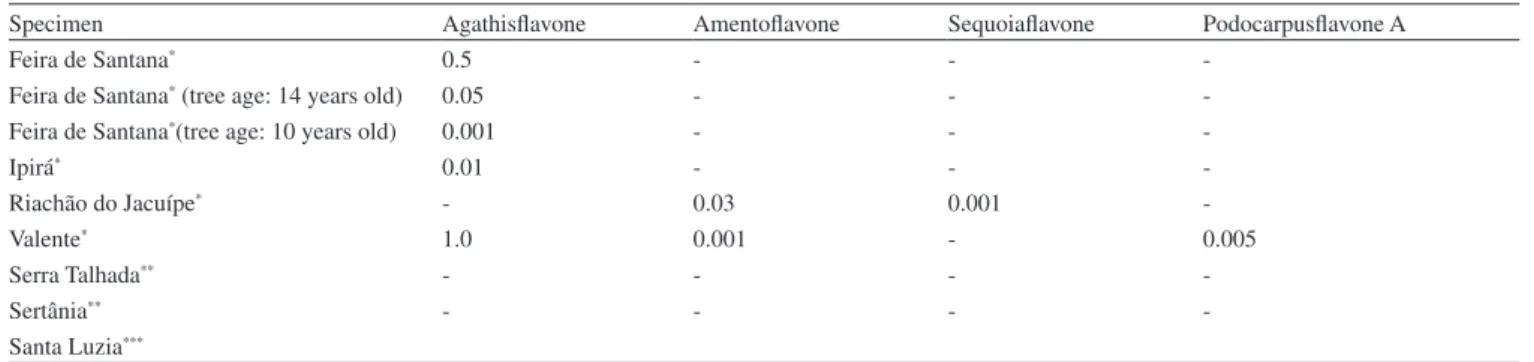
The leaves of C. pyramidalis (100 g) collected in different places were submitted to extraction with hexane and CHCl3. The CHCl3 phase was submitted to CC over silica gel 60 and mixtures of CHCl3:EtOAc (Table 1). The bilavonoid enriched fractions were
eluted with CHCl3: EtOAc (1:1). These fractions were submitted to a LC-MS analysis in order to determinate the content of bilavonoids.
Lonilavone (1). Amorphous yellow power. m. p. 242-244 oC. MS(APCI) m/z= 537 [M - H]-.1H NMR [500 MHz, (CD
3)2CO]: Unity I: d 6.71 (s, 1H, H-3); d 12.92 (s, 1H, H-5); d 6.26 (d, 1H, J = 2.0 Hz, H-6); d 6.54 (d, 1H, J = 2.0 Hz, H-8); d 8.06 (d, 2H, J = 9.0 Hz, H-2’/H-6’); d 7.14 (d, 2H, J = 9.0 and 2.0 Hz, H-3’/H-5’); Unity II: d 6.70 (s, 1H, H-3); d 12.93 (s, 1H, H-5); d 6.27 (d, 1H, J = 2.0 Hz, H-6); d 6.55 (d, 1H, J = 2.0 Hz, H-8); d 7.89 (d, 1H, J = 2.0 Hz, H-2’); d 7.28 (d, 1H, J = 8.0 Hz, H-5’); d 7.91 (dd, 1H, J = 8.0 and 2.0 Hz, H-6’).
Amentolavone (2). Amorphous yellow power. m. p. 254-256 oC. MS(APCI) m/z= 538.1H NMR (300 MHz, CD
3OD): Unity I: d 6.56 (s, 1H, H-3); d 6.22 (s, 1H, H-6); d 7.66 (d, 2H, J = 8.7 Hz, H-2’/H-5’); d 6.58 (d, 2H, J = 8.7 Hz, H-3’/H-5’); Unity II: d 6.49 (s, 1H, H-3); d 5.99 (d, 1H, J = 2.0 Hz, H-6); d 6.05 (d, 1H, J = 2.0 Hz, H-8); d 8.26 (d, 1H, J = 2.3 Hz, H-2’); d 7.09 (d, 1H, J = 8.7 Hz, H-5’); d 7.88 (dd, 1H, J = 8.7 and 2.3 Hz, H-6’). 13C NMR (75 MHz, CD3OD): Unity I: d 165.5 (C, C-2); d 102.7 (CH, C-3); d 182.8 (C, C-4); d 162.4 (C, C-5); d 100.1 (CH, C-6); d 164.2 (C, C-7); d 103.8 (C, C-8); d 156.6 (C, C-9); d 108.5 (C, C-10); d 121.9 (C, C-1'); d 129.3 (CH, C-2'/C-6'); d 115.1 (CH, C-3'/C-5'); d 162.0 (C, C-4'); Unity II: d 165.6 (C, C-2); d 102.9 (CH, C-3); d 183.8 (C, C-4); d 163.5 (C, C-5); d 99.9 (CH, C-6); d 163.5 (C, C-7); d 94.8 (CH, C-8); d 156.6 (C, C-9); d 108.5 (C, C-10); d 122.2 (C, C-1'); d 132.3 (CH, C-2'); 123.1 (C, C-3'); d 161.9 (C, C-4'); d 117.4 (CH, C-5'); d 128.7 (CH, C-6').
5’-Hydroxyamentolavone (3). Amorphous yellow power. m. p. 288-290 oC. MS (APCI) m/z= 554. 1H NMR (500 MHz, C
5D5N): Unity I: d 6.94 (s, 1H, H-3); d 6.75 (d, 1H, J = 1.8 Hz, H-6); d 6.84 (d, 1H, J = 1.8 Hz, H-8); d 8.56 (d, 1H, J = 2.5 Hz, H-2’); d 7.96 (d, 1H, J = 2.5 Hz, H-6’); Unity II: d 6.93 (s, 1H, H-3); d 6.89 (s, 1H, H-6); d 7.89 (d, 2H, J = 8.5 Hz, H2’/H6’); d 7.47 (d, 2H, J = 8.5 Hz, H3’/H5’). Taxifolin (6). Yellow cristals. m. p. 242 oC. 1H NMR (500 MHz, CD3OD): d 4.92 (d, 1H, J = 11.0 Hz, H-2); d 4.50 (d, 1H, J = 11.0 Hz, H-3); d 5.91 (d, 1H, J = 2.0 Hz, H-6); d 5.89 (d, 1H, J = 2.0 Hz, H-8); d 6.86 (dd, 1H, J = 2.0 and 8.0 Hz, H-6’); d 6.81 (d, 1H, J = 8.0 Hz, H-5’); d 6.97 (d, 1H, J = 2.0 Hz, H-2’). RMN 13C (75 MHz, CD3OD): d 85.09 (CH, C-2); d 73.64 (CH, C-3); d 198.37 (C, C-4); d 164.27 (C, C-5); d 97.29 (CH, C-6); d 168.72 (C, C-7); d 96.27 (CH, C-8); d 164.47 (C, C-9); d 101.79 (C, C-10); d 129.82 (C, C-1'); d 115.85 (CH, C-2'); d 116.05 (CH, C-5'); d 147.11 (C, C-4'); d 146.28 (C, C-3'); d 120.88 (CH, C-6').
RESULTS AND DISCUSSION
The structure of compound 1 was elucidated by MS and NMR data analysis. The pseudo-molecular ion observed at m/z 537 [M-H] Table 1. Bilavonoid variation (%) found in diverse specimens of C. pyramidalis
Specimen Agathislavone Amentolavone Sequoialavone Podocarpuslavone A
Feira de Santana* 0.5 - -
-Feira de Santana* (tree age: 14 years old) 0.05 - -
-Feira de Santana*(tree age: 10 years old) 0.001 - -
-Ipirá* 0.01 - -
-Riachão do Jacuípe* - 0.03 0.001
-Valente* 1.0 0.001 - 0.005
Serra Talhada** - - -
-Sertânia** - - -
-Santa Luzia***
Occurrence of bilavones in leaves of Caesalpinia pyramidalis specimens 1299 Vol. 33, No. 6
recorded in negative MS-APCI mode together with 1H and 13C NMR data, including DEPT, permitted to propose the molecular formula C30H18O10 and consequently determinate the bilavonoid nature of compound 1. It was observed two singlets at d 12.93 and 12.92 in the 1H NMR spectra, whose disappeared in presence of D
2O, they were indicative of presence of two lavonoid units bearing hydroxyl groups at the C-5 with hydrogens bonding at carbonyl groups (C-4). The presence of two other singlets (d 6.71 and 6.70) in the same spectra was characteristic of H-3 of lavones. It was also possible to verify the presence of a 1,4-disubstitued B ring for one unity (I) due the doublets observed at d 8.06 and 7.14 (J = 9.0 and 2.0 Hz). For the other B ring unity (II) the spectra showed peaks of an AMX system at d 7.91 (J = 8 and 2 Hz), 7.89 (J =2 Hz) and 7.28 (J =8 Hz). The presence of four doublets for A ring (J = 2 Hz each) indicated the linkages between the two unities of lavones were not placed in these rings. The 13C NMR spectra data (Experimental Section) and the 1H-1H gCOSY showed hydrogen coupling systems and corroborated compound 1 was a bilavone.
The analysis of the HSQC spectra of 1 permitted to verify cor-relations which were important to distinguish the carbons and the respective hydrogens. So, this spectra was important in the identii-cation of the aromatic carbons of 1,4-dissubstitued system of B ring of Unity I. In the same way it contributed to recognize the resonances of aromatic carbons of B ring of Unity II.
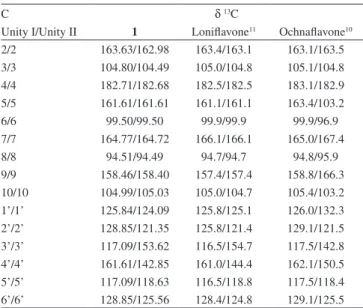
Comparison of NMR data (Table 2) of compound 1 with loni-lavone and ochnaloni-lavone10 (7) was important to propose that the linkage between both units occurred by B rings. The HMBC corre-lations indicated 1 was a C-4’-O-C-4’ bilavone through the observed correlations of H-6’ (d 7.91) and C-4' (d 142.8), H-2'/H-5' and C-3' and C-4' (Figure 2). These indings permitted to identify 1 as being lonilavone. This is the second occurrence of this bilavone, it was previously isolated in Lonicera japonica (Caprifoliaceae).11
Compound 3 was identiied by MS and NMR data analysis and comparison with literature. The molecular ion observed at m/z 554 in the APCI-MS together with 1H and 13C NMR data permitted to propose the molecular formula C30H18O11 and determinate 3 was a bilavonoid. This compound was identify as 5’-hydroxyamentola-vone by comparison with amentola5’-hydroxyamentola-vone12 spectral data and with previously data published to this compound. This compound was formerly isolated from Bartramia ithyphylla (Bartramiaceae)13 and
Rhytidiadelphus squarrosus (Hylocomiaceae)14 but it is the irst occurrence in Leguminosae.
Amentolavone (2), agathislavone (4), podocarpuslavone A (5) and taxifolin (6)15 were identify by spectrometric data analysis and direct comparison with literature.
Since, in previous studies with leaves of C. pyramidalis it was isolated agathislavone and other minor bilavonoids, it was deve-loped a method to determinate the content of these compounds in different specimens of C. pyramidalis whose were collected in diver-se neighborhoods of Brazilian “caatinga” region. For determination of the bilavones was utilized LC-APCI-MS analysis employing detection in negative mode and, agathislavone, amentolavone, sequoialavone (8)16 and podocarpuslavone A were used as stan-dards. So, the CHCl3 extracts of leaves of different specimens of C. pyramidalis were submitted to a CC and the phenolic enriched fractions were injected in the HPLC. Table 1 summarizes the results obtained in these analysis in percentage relation of CHCl3 extracts. In the samples harvested in Santa Luzia-PB, Serra Talhada-PE and Sertânia-PE was not detected the presence of any bilavones in the fractions. In all the specimens collected in Bahia State it was detected the occurrence of these compounds. However in some of them the presence of minor bilavonoids was widely changed. Never-theless in all samples agathislavone (4) was the bilavonoid present in major concentration (0.01-1%) and in one specimen (Riachão do Jacuípe) it was not detected. These preliminary indings indicate the occurrence of bilavonoids in C. pyramidalis can be dependent of habitat (e.g climate, soil composition), physical characteristics (age of tree) or botanical variations. Beside this, the presence of bilavonoids in Leguminosae is still rare. They are restricted only in selected species such as Ormocarpum kirkii,17 Diphysa robinio-ides,18 Lupinus albus19 and Dioclea lasiophylla.20 This is the irst occurrence of 1, 2, 5 and 6 in the Leguminosae family.
SUPPLEMENTARY MATERIAL
Supplementary information as chromatograms of fractions of different specimes of C. pyramidalis and NMR spectra of bilavo-noidsare available free of charge as PDF ile at http://quimicanova. sbq.org.br.
ACKNOWLEDGMENTS
The authors are grateful to Conselho Nacional de Desenvolvi-mento Cientíico e Tecnológico - CNPq (Brasil), IMSEAR (CNPq/ MCT), FAPESB and Fundação Coordenação de Aperfeiçoamento de Pessoal de Nível Superior (CAPES) for fellowship support and grants.
Table 2. 13C NMR data of 1, lonilavone and ochnalavone [125 MHz,
(D3C)2CO, d (ppm)]
C d13C
Unity I/Unity II 1 Lonilavone11 Ochnalavone10
2/2 163.63/162.98 163.4/163.1 163.1/163.5
3/3 104.80/104.49 105.0/104.8 105.1/104.8
4/4 182.71/182.68 182.5/182.5 183.1/182.9
5/5 161.61/161.61 161.1/161.1 163.4/103.2
6/6 99.50/99.50 99.9/99.9 99.9/96.9
7/7 164.77/164.72 166.1/166.1 165.0/167.4
8/8 94.51/94.49 94.7/94.7 94.8/95.9
9/9 158.46/158.40 157.4/157.4 158.8/166.3
10/10 104.99/105.03 105.0/104.7 105.4/103.2
1’/1’ 125.84/124.09 125.8/125.1 126.0/132.3
2’/2’ 128.85/121.35 125.8/121.4 129.1/121.5
3’/3’ 117.09/153.62 116.5/154.7 117.5/142.8
4’/4’ 161.61/142.85 161.0/144.4 162.1/150.5
5’/5’ 117.09/118.63 116.5/118.8 117.5/118.4
6’/6’ 128.85/125.56 128.4/124.8 129.1/125.5
Bahia et al.
1300 Quim. Nova
REFERENCES
1. Bahia, SEPLANTEC - Subsecretária de Ciência e Tecnologia; Inventário de Plantas Medicinais do Estado da Bahia, Salvador, 1979.
2. Saeed, M. A.; Sabi, R. A. W.; Fitoterapia2001, 72, 807; Aqil, F.; Ahmad, I.; J. Microbiol. Biotechnol. 2003, 19, 653.
3. Chakrabarti, S.; Biswas, T. K.; Seal, T.; Rokeya, B.; Ali, L.; Khan, A. K. A.; Nahar, N.; Mosihuzzaman, M.; Mukherjee, B.; J. Ethnopharmacol. 2005, 97, 117; Biswas, T. K.; Bandyopadhyay, S.; Mukherjee, B.; Muklerjee, B.; Sengupta, B. R.; Int. J. Ethnopharmacol. 1997, 35, 261; Grover, J. K.; Vats, V.; Yadav, S.; J. Ethnopharmacol. 2002, 81, 81; Sharma, S. R.; Dwivedi, S. K.; Swarup, D.; J. Ethnopharmacol. 1997, 58, 39.
4. Kuria, K. A. M.; De Coster, S.; Muriuki, G.; Masengo, W.; Kibwage, I.; Hoogmartens, J.; Laekman, G. M.; J. Ethnopharmacol. 2001, 74, 141; Deharo, E.; Bourdy, G.; Quenevo, C.; Munoz, V.; Sauvain, M. A.; J. Ethnopharmacol. 2001, 77, 91.
5. Alanis, A. D.; Calzada, F.; Cervantes, J. A.; Torres, J.; Ceballos, G. M.; J. Ethnopharmacol. 2005, 100, 153.
6. Sant’ana, A. E. G.; Luna, J. S.; Santos, A. F.; Lima, M. R. F.; Andrade, M. C. C.; Genet, J. P.; Márquez, B.; Neuville, L.; Moreau, N.; J. Ethnopharmacol. 2006, 105, 137.
7. Sant’ana, A. E. G.; Luna, J. S.; Santos, A. F.; Lima, M. R. F.; Omena, M. C.; Mendonça, F. A. C.; Bieber, L. W.; J. Ethnopharmacol. 2005, 97, 199. 8. Mors, W. B.; Nascimento, M. C.; Pereira, B. M. R.; Pereira, N. A.; Phytochemistry2000, 55, 627; David, J. M.; David, J. P.; Ferrari, J.; Guimarães, A. G.; Lima, F. W. M.; Souza, G. L. S.; J. Braz. Chem. Soc. 2007, 18, 1585; Correia Júnior, C. A. B.; Santos, M. V.; David, J. M.; David, J. P.; Magalhães, P. J. C.; Lahlou, S.; Vasc. Pharmacol. 2007, 46, 60; Lima, L. S.; Lima, M. V. B.; David, J. P.; Giulietti, A. M.; de Queiróz, L. P.; David, J. M.; J. Braz. Chem. Soc. 2009, 20, 1921; David, J. P.; Da-vid, J. M.; Yang, S.; Cordell, G. A.; Phytochemistry 1999, 50, 443.
9. Bahia, M. V.; Mendes, C. C.; David, J. M.; David, J. P.; Fitoterapia 2000, 71, 205; Bahia, M. V.; Dos Santos, J. B.; David, J. P.; David, J. M.; J. Braz. Chem. Soc. 2005, 16, 1402.
10. Rao, K. V.; Sreeramulu, K.; Rao, C. V.; Gunasekar, D.; J. Nat. Prod. 1997, 60, 632.
11. Kumar, N.; Singh, B.; Bhandari, P.; Gupta, A. P.; Uniyal, S. K.; Kaul, V. K.; Phytochemistry 2005, 66, 2740.
12. Chari, V. M.; Ilyas, M.; Wagner, H.; Neszmelyi, A.; Chen, F. C.; Chen, L. K.; Lin, Y. C.; Lin, Y. M.; Phytochemistry 1977, 16, 1273.
13. López-Saez, J. A.; Pérez, J. A.; Negueruela, A. V.; Z. Naturforsch., C: J. Biosci. 1995,50, 311.
14. Brinkmeier, E.; Geiger, H.; Zinsmeister, H. D.; Phytochemistry 1999, 52, 297.
15. Arriaga, A. M. C.; Castro, M. A. B.; Silveira, E. R.; Braz-Filho, R.; J. Braz. Chem. Soc. 2000, 11, 187.
16. Hameed, N.; Ilyas, M.; Rahman, W.; Okigawa, M.; Kawano, N.; Phyto-chemistry 1973, 12, 1494.
17. Nyandat, E.; Hassanali, A.; De Vicente, Y.; Multari, G.; Galefi, C.; Phytochemistry 1990, 29, 2361.
18. Castro, O.; Valverde, V.; Phytochemistry 1985, 24, 367.
19. Sakasai, M.; Fukui, H.; Kyaw, A. N.; Tahara, S.; Z. Naturforsch., C: J. Biosci. 2000, 55, 165.
Quim. Nova, Vol. 33, No. 6, S1-S8, 2010
Material Suplementar
*e-mail: [email protected]
OCCURRENCE OF BIFLAVONES IN LEAVES OF Caesalpinia pyramidalis SPECIMENS
Marcus V. Bahia
Centro de Formação de Professores, Universidade Federal do Recôncavo da Bahia, 45300-000 Amargosa – BA, Brasil
Juceni P. David
Faculdade de Farmácia, Universidade Federal da Bahia, 40170-290 Salvador - BA, Brasil
Jorge M. David*
Instituto de Química, Universidade Federal da Bahia, 40170-290 Salvador - BA, Brasil
Figure 1S. Especimens of Caesalpinia pyramidalis(photos by J. M. David)
Bahia et al.
S2 Quim. Nova
Figure 3S. APCI-Mass Spectrum of the agathislavone standard
Figure 4S. Chromatogram of the amentolavone standard
Occurrence of bilavones in leaves of Caesalpinia pyramidalis specimens S3
Vol. 33, No. 6
Figure 7S. HPLC chromatogram of the specimen collected at the neighborhood of Riachão do Jacuípe - BA
Figure 8S. APCI - Mass Spectrum of the specimen collected at neighborhood of Jacuípe - BA
Bahia et al.
S4 Quim. Nova
Figure 9S. 1H NMR spectra ofcompound 1 [500 MHz, (D 3C)2CO]
Figure 10S. Expansion of1H NMR spectra ofcompound 1 [500 MHz, (D 3C)2CO]
Occurrence of bilavones in leaves of Caesalpinia pyramidalis specimens S5
Vol. 33, No. 6
Figure 12S. 13C NMR spectra ofcompound 1 [75 MHz, (D 3C)2CO]
Figure 13S. Expantion of13C NMR spectra ofcompound 1 [75 MHz, (D 3C)2CO]
Bahia et al.
S6 Quim. Nova
Figure 15S. gCOSY 1H-1H spectra of compound 1 [500 MHz, (D 3C)2CO]
Occurrence of bilavones in leaves of Caesalpinia pyramidalis specimens S7
Vol. 33, No. 6
Figure 17S. Expansion ofHSQC spectra of compound 1 [500 MHz for 1H and 125 MHz for 13C, (D 3C)2CO]
Bahia et al.
S8 Quim. Nova
Figure 19S. Expansion of HMBC spectra of compound 1 [500 MHz for 1H and 125 MHz for 13C, (D 3C)2CO]
Figure 20S. Expansion of HMBC spectra of compound 1 [500 MHz for 1H and 125 MHz for 13C, (D 3C)2CO]




![Figure 9S. 1 H NMR spectra of compound 1 [500 MHz, (D 3 C) 2 CO]](https://thumb-eu.123doks.com/thumbv2/123dok_br/18985073.458550/8.892.192.655.90.344/figure-s-h-nmr-spectra-compound-mhz-d.webp)
![Figure 12S. 13 C NMR spectra of compound 1 [75 MHz, (D 3 C) 2 CO]](https://thumb-eu.123doks.com/thumbv2/123dok_br/18985073.458550/9.892.169.744.37.1119/figure-s-c-nmr-spectra-compound-mhz-d.webp)
![Figure 15S. gCOSY 1 H- 1 H spectra of compound 1 [500 MHz, (D 3 C) 2 CO]](https://thumb-eu.123doks.com/thumbv2/123dok_br/18985073.458550/10.892.208.631.93.578/figure-s-gcosy-h-h-spectra-compound-mhz.webp)
![Figure 17S. Expansion of HSQC spectra of compound 1 [500 MHz for 1 H and 125 MHz for 13 C, (D 3 C) 2 CO]](https://thumb-eu.123doks.com/thumbv2/123dok_br/18985073.458550/11.892.217.694.105.403/figure-s-expansion-hsqc-spectra-compound-mhz-mhz.webp)
