Article
J. Braz. Chem. Soc., Vol. 24, No. 12, 2050-2058, 2013. Printed in Brazil - ©2013 Sociedade Brasileira de Química 0103 - 5053 $6.00+0.00
A
*e-mail: [email protected]
Preparation of a Composite Particle Electrode by Electroless Plating and Its
Electrocatalytic Performance in the Decolorization of Methyl Orange Dye Solution
Guiping Cao,*,a Feng Xub and Shengan Xiaa
aDepartment of Chemical Engineering, Changzhou Institute of Technology,
Changzhou 213022, China
bChangzhou Advanced Manufacture Technology Research Development & Industrialization Center,
Chinese Academy of Sciences, Changzhou 213164, China
Um eletrodo de partículas compósitas de carbono modificado com níquel níquel (Ni/AC)
foi preparado por deposição sem aplicação de correntecom pré-tratamento livre de paládio para
melhorar o desempenho eletrocatalítico do eletrodo compósito em uma cela eletroquímica. As condições de preparo do eletrodo de partículas compósitas de Ni/AC foram otimizadas usando-se como índice a razão do descoramento de uma solução do corante alaranjado de metila. Os eletrodos de partículas compósitas foram caracterizados por microscopia eletrônica de varredura, difração de raios-X e análises por espectrometria de energia dispersiva. Os desempenhos eletrocatalíticos do eletrodo de partículas Ni/AC foram examinados por meio de vários parâmetros, incluindo dosagem do eletrodo de partículas, concentração de sulfato de sódio, tensão da cela e tempo de eletrólise. Os resultados foram comparados com os de eletrodo de partículas convencionais de carbono ativado (AC). Esses resultados indicaram ser possível preparar um eletrodo de partículas
compósitas de Ni/AC por revestimento electroless com pré-tratamento sem paládio. As condições
ótimas de preparo do eletrodo Ni/AC eram 40 g L-1 NiSO
4·6H2O, 27 g L-1 NaH2PO2·H2O, 50 °C
temperatura de revestimento, e 20 min tempo de revestimento. O desempenho eletrocatalítico do eletrodo Ni/AC foi superior ao do eletrodo AC sob as mesmas condições de eletrólise. A constante de velocidade de oxidação do alaranjado de metila pelo eletrodo Ni/AC foi 1,5 vezes maior que o do eletrodo AC.
A nickel-loaded activated carbon (Ni/AC) composite particle electrode was prepared by electroless deposition with palladium-free pretreatment to improve the electrocatalytic performance of a composite particle electrode in a three-dimensional electrode cell. The preparation conditions of the Ni/AC particle electrode were optimized using the decolorization ratio of methyl orange dye solution as an index. The composite particle electrodes were characterized by scanning electron microscopy, X-ray diffraction, and energy dispersive spectrometry analyses. The electrocatalytic performances of the Ni/AC particle electrode were examined by a series of parameters, including particle electrode dose, sodium sulfate concentration, cell voltage, and electrolysis time. The results were compared with those of conventional activated carbon (AC) particle electrode. These results indicated the feasibility of preparing a Ni/AC composite particle electrode by electroless plating with non-palladium pretreatment. The optimal conditions for preparing the Ni/AC electrode were
40 g L-1 NiSO
4·6H2O, 27 g L-1 NaH2PO2·H2O, 50 °C plating temperature, and 20 min plating time.
The electrocatalytic performance of Ni/AC electrode was superior to that of AC electrode under the same electrolysis conditions. The rate constant of the Ni/AC electrode electrochemical oxidation of methyl orange was 1.5 times larger than that of AC electrode.
Introduction
The control and purification of water pollution is gaining increased attention. The release of dyes into water accounts for only a small proportion of water pollution; however, the presence of dyes in water even at very low concentrations is highly visible and undesirable.1 Therefore,
the decolorization of dye wastewater is one of the indispensable processes in wastewater treatment.2 Several
physical, chemical, and biological decolorization methods have been used to treat dye-containing wastewater. Among the numerous techniques of dye removal from an effluent, adsorption and biological treatment are two of the widely used methods.3 However, adsorption is limited by the high
cost of adsorbents and their regeneration, whereas biological treatment cannot be used to treat non-readily biodegradable pollutants, such as most dyes. Therefore, many alternative oxidation methods of wastewater treatment have been studied, including ozonation, photocatalytic oxidation, and electrochemical oxidation.
Electrochemical oxidation is gaining interest because of its high efficiency and ease of operation, as well as its potential use in enabling “green” processes for the prevention of pollution problems.4 Electrochemical
processes involve the heterogeneous electron transfer between a solid electrode and the ionic species in an electrolytic solution.5 Therefore, the electrochemical
reaction rate depends on the electron transfer rate, which is directly proportional to the specific surface area of an electrode. However, the surface area cannot be readily enlarged in a conventional two-dimensional electrode cell.
Electrochemical technology based on a three-dimensional electrode (TDE) has been proposed to overcome such problem. Compared with a conventional two-dimensional electrode cell, the conversion rate can be increased using a particle electrode with a large specific surface area in the TDE cell.6,7 In recent years, research on
the use of TDEs for organic pollutant removal focuses on the design of the TDE reactor and the preparation of the particle electrode.8–11 The properties of particle electrodes
play the most important role in estimating the performance of the entire system.12 The most commonly used particle
electrode is activated carbon (AC), which has been used to treat dye wastewater and has positive effects.13,14 In
previous studies, the performance of a particle electrode could be further improved by loading certain catalysts. A particle electrode made of ITO mesoporous film coated with TiO2 has been prepared using sol-gel method.15 An
impregnating method has also been used to load catalysts on particle electrodes, such as quartz sand-loaded TiO216
and AC-loaded Sb2O3.17 Calcination at a high temperature
is required in both methods. To our knowledge, similar reports on the preparation of a composite particle electrode by electroless plating are limited.
Electroless nickel plating is an autocatalytic chemical reduction process in which the reducing agent reduces Ni2+ ions to Ni0 atoms on the substrate surface. The
non-catalytic substrate usually is catalyzed to produce non-catalytic nuclei prior to electroless deposition. Conventionally, for materials without a catalytic surface, a sensitization (SnCl2)-activation (PdCl2) step is the most prevalent pretreatment. Ceramic substrate SiC,18 carbon nanotubes,19
porous carbon,20 and graphite21 are some reported examples.
However, Pd is very expensive and PdCl2-SnCl2 colloid is
unstable.22
In the present work, in order to produce a catalytic center, AC particles were activated using oxidation with nitric acid and reduction with KBH4 instead of using
PdCl2-SnCl2 colloid. The feasibility of preparing of a Ni-loaded AC (Ni/AC) particle electrode by electroless plating was further determined. The electrocatalytic performances of the Ni/AC particle electrode prepared by the electroless plating were also discussed and compared with the AC particle electrode.
Experimental
Materials
Commercial granular AC with an average particle size of 4.5 to 6.8 mm was used as a working electrode. The AC particle electrode was washed with boiling water four times and then dried at 100 °C about 4 h before use.
Nitric acid, sodium hydroxide, potassium borohydride and nickel sulfate were purchased from Shanghai Chemical Reagent Co., Ltd. (China). Sodium hypophosphite, sodium citrate, sodium fluoride and ammonia were obtained from Sinopharm Chemical Reagent Co., Ltd. (China). All chemicals are of analytical grade.
Preparation of Ni/AC particle electrode
AC must be pretreated prior to electroless nickel plating. In a typical procedure, AC was initially oxidized with 60 mL of concentrated nitric acid solution at 80 °C for 10 min to create carboxyl surface groups. The unsaturated groups on the AC surface such as hydroxy and aldehyde groups were oxidized into saturated groups (primarily carboxyl) and then soaked in 80 mL of 0.1 mol L-1 NaOH
solution at 80 °C for 10 min to ionize the carboxyl group. After cleaning with distilled water, AC was soaked in 100 mL of 0.2 mol L-1 NiSO
10 min to absorb Ni2+ ions. AC was then soaked in 100 mL
of 5 g L-1 KBH
4 solution for 10 min to reduce Ni2+ ions into
Ni-activated nuclei. Finally, AC was washed with distilled water to remove the KBH4 absorbed on the surface, and can be used for electroless nickel deposition.
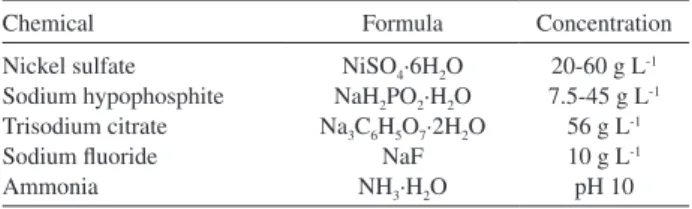
About 10.0 g of the pretreated AC was introduced into 100 mL of an electroless nickel-plating bath, whose composition is given in Table 1. Nickel sulfate was the source of metal ions, sodium hypophosphite was the reducing agent, sodium citrate was the complexing agent, sodium fluoride was the accelerating agent, and ammonia was used to control the pH of the bath during plating. Electroless plating was performed on an hot bath with a stirrer by maintaining the temperature at 30-90 °Cfor 2-75 min. After electroless plating, the Ni/AC particle electrode was thoroughly washed with distilled water several times and dried.
Surface characterization
The surface morphologies of the Ni/AC composite particle electrode were characterized with a scanning electron microscopy (SEM) system (Carl Zeiss SUPRA55) and compared with those of AC particles. The specimens were sprayed with gold prior to analysis. The phase structure of the composite particle electrode was examined by X-ray diffraction (XRD) on a Rigaku D/max 2500PC diffractometer using a Cu Kα radiation generator with
settings of 60 kV and 300 mA. The results were compared with those of AC particles. In addition, the elemental compositions of the Ni/AC particle electrodes were determined on an OXFORD energy dispersive spectrometer (EDS).
Electrolytic experiment
Figure 1 shows a batch rectangular TDE cell. The cell support was made of plastic and had dimensions of 15 cm × 8 cm × 6 cm. The stainless steel anode and cathode (main electrodes) were situated 4.2 cm apart, and a certain amount of particle electrode was packed between the two main electrodes. Compressed air was sparged at a rate of 1.0 L min-1 into the particle electrodes from a micropore
plate located at bottom of the cell. A regulated DC power supply provided electric power.
Prior to electrolysis, the particle electrodes were first soaked in methyl orange solution for 24 h to decrease the effect of the adsorption of particle electrodes on the decolorization ratio. The particle electrodes were then used to degrade methyl orange solution in the TDE cell. The cell was timed after the DC power and compressed air supply were switched on. The treated solution was then subjected to analysis of the remaining methyl orange concentration at selected electrolysis time intervals.
Analysis
The decolorization ratio of methyl orange was used to determine the electrocatalytic performance of the particle electrode in a TDE cell. The amount of methyl orange remaining in the solution after electrolysis was determined with a UV1102 spectrophotometer. The analytical wavelength selected for the absorption measurements was 463 nm. The decolorization ratio was calculated as follows:
where C0 is the initial concentration and Ct is the
concentration of the treated solution after electrolysis time t (min).
Results and Discussion
Optimization of preparation condition
The SnCl2-PdCl2 method is commonly used for the
pretreatment of carbon materials for electroless nickel plating on their surface.23 In the conventional pretreatment
process, the precious metal palladium has been employed as the catalyst to activate the surface of substrates. The biggest weakness of the conventional pretreatment process is that Pd compounds are expensive and can significantly increase the cost of the plating process.24 The
palladium-free electroless method is to activate the substrate without Figure 1. Schematic diagram of a cell with a three-dimensional electrode. 1: support; 2: anode; 3: cathode; 4: particle electrode; 5: micropore plate; 6: compressed air.
Table 1. Chemical composition of the electroless nickel-plating bath
Chemical Formula Concentration
Nickel sulfate Sodium hypophosphite Trisodium citrate Sodium fluoride Ammonia
NiSO4·6H2O NaH2PO2·H2O Na3C6H5O7·2H2O
NaF NH3·H2O
20-60 g L-1
7.5-45 g L-1
56 g L-1
10 g L-1
the use of SnCl2 and PdCl2. In this paper, nickel was
electrolessly plated onto the AC particle surface with the following pretreatment: oxidation with nitric acid, ionization with NaOH, coordination adsorption of Ni2+,
and reduction with KBH4. Through the above steps,
Ni nanoparticles as catalytic centers were produced on carbon materials without precious metal palladium. The palladium-free pretreatment method can lower the processing cost and prevent environmental pollution with the precious metal palladium.
The effect of pretreatment was studied with two kinds of Ni/AC particle electrode: one was prepared with palladium-free pretreatment, and the other was prepared without pretreatment. Table 2 shows the differences in the decolorization ratio of the Ni/AC particle electrode prepared by the two methods. The average decolorization ratio of the particle electrode with pretreatment was higher than that without pretreatment. Furthermore, the decolorization ratio of the particle electrode with pretreatment ranged from 43.8% to 36.9% with increased frequency of use, whereas that of the particle electrode without pretreatment showed a downward trend from 39.7% to 20.3%. In fact, the lifetime of the Ni/AC particle electrode prepared with palladium-free pretreatment was to use a frequency of 16 times. Thus, preparation of a Ni/AC particle electrode by palladium-free electroless nickel plating was feasible. Moreover, pretreatment can enhance the reactivity of the particle electrode and improve the adhesion of catalyst nickel on AC.
More than an oxidizing agent, NiSO4 plays the role of source of Ni2+ ions that, after reduction, provides the Ni0
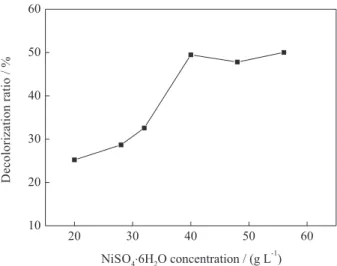
atoms deposited on the activated carbon surface. Figure 2 shows the relationship of the decolorization ratio of the particle electrode with the NiSO4·6H2O concentration. The decolorization ratio of the particle electrode increased with increased NiSO4·6H2O concentration, reached the maximum at 40 g L-1 NiSO
4·6H2O, and maintained this
maximum value from 40 g L-1 to 56 g L-1. The plating
bath appeared cloudy and some sediments were produced when the NiSO4·6H2O concentration exceeded 56 g L-1,
which was produced by the excessive Ni2+ reduction in the
bulk solution besides the occurrence on the AC particles surface. Therefore, the NiSO4·6H2O concentration was set as 40 g L-1 henceforth.
Ni2+ ions adsorbed on the AC surface were reduced by
hypophosphite anion in catalytic center, forming the first layer of metallic Ni on the AC surface. Upon the start of deposition, the plating proceeded as long as sufficient metal ions and reducing agents were available. NaH2PO2 was
used as a reductant in electroless nickel plating. Different concentrations of NaH2PO2·H2O solution such as 8, 15,
27, 37, and 45 g L-1 were chosen to study the effect of
NaH2PO2·H2O concentration. Figure 3 shows the effect of
NaH2PO2·H2O concentration on the decolorization ratio of Ni/AC particle electrode. The decolorization ratio of the particle electrode reached the maximum value at 27 g L-1
NaH2PO2·H2O. NaH2PO2·H2O affected the stability of the
plating solution. When the NaH2PO2·H2O concentration reached 37 g L-1, too much H
2PO2– made the plating
solution unstable, and some nickels were deposited onto the reactor walls. Furthermore, excessive NaH2PO2·H2O
concentration may increase the phosphorus content of the nickel plating layer,25 which affected the performance of
the particle electrode.
NiSO4 and NaH2PO2 are two important components
of electroless nickel plating. The concentration and concentration ratio affect the stability of a plating solution and the electrocatalytic activity of a particle electrode. According to the above results, the appropriate molar Table 2. Decolorization ratio of particle electrode change with its
frequency of use (experimental conditions: 40 g L-1 NiSO
4·6H2O, 27 g L-1
NaH2PO2·H2O, 50 °C, 20 min plating time, 10.0 g particle electrode dose, 12 g L-1 Na
2SO4 and 6 V cell voltage)
Frequency of use Decolorization ratio / % With pretreatment Without pretreatment
1 2 3 4 5 6 7 8
43.2 43.8 42.4 39.7 37.7 40.7 36.9 39.7
39.7 35.5 30.1 28.1 26.1 27.0 24.2 20.3
Figure 2. Effect of NiSO4·6H2O concentration on the decolorization ratio of Ni/AC particle electrode. Experimental conditions: 27 g L-1
NaH2PO2·H2O, 50 °C, 20 min plating time, 10.0 g particle electrode dose,
12 g L-1 Na
ratio of NiSO4·6H2O and NaH2PO2·H2O was about 1:1.7.
Therefore, 27 g L-1 NaH
2PO2·H2O solution was used for
electroless plating.
A higher plating temperature results in a higher rate of plating and deposited layer. However, too high temperature may lead to bath instability and failure to deposit a coating layer on the particles.26 Therefore, the effect of
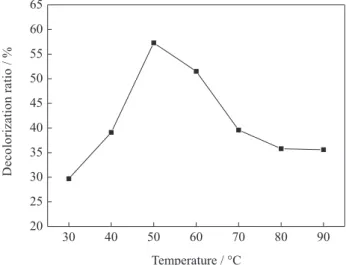
plating temperature on the performance of the composite particle electrode was investigated. The relationship of the decolorization ratio of Ni/AC particle electrode with the plating temperature is shown in Figure 4. The decolorization ratio of the particle electrode rapidly increased with increased plating temperature and reached 57.3% at 50 °C. When the temperature was higher than 50 °C, the decolorization ratio began to decline and decreased to 35.6% at 90 °C. Nickel cannot be easily deposited onto the surface of AC at low temperatures, and the electrocatalytic performance of the particle electrode was poor. The increase in temperature was favorable for nickel deposition. However, the high temperature resulted in too rapid nickel deposition rate easily leading to particulate deposition, and weakened stability of the plating solution which was prone to decompose at high temperature. Therefore, the appropriate temperature should be selected and maintained in a constant-temperature water bath. The temperature of 50 °C was more appropriate in this experiment.
Plating time also affected the performance of the Ni/AC composite particle electrode. Figure 5 shows the relationship between the decolorization ratio of the Ni/AC particle electrode and plating time at a plating temperature 50 °C. The decolorization ratio of the particle electrode increased with increased plating time and reached the highest state at 15 min to 30 min. Given the catalytic activity of
nickel produced during pretreatment, nickel was evenly deposited onto the AC surface and electroless nickel plating continued. However, when electroless plating reached a certain stage, nickel tended to form particles of deposition instead of laminar deposition.27 These particles blocked
the pores of carbon, affected the mass transfer diffusion of methyl orange in the solution, and made the nickel layer be easily stripped down from the AC. The decolorization ratio of the particle electrode declined when the plating time was more than 30 min. Thus, the optimal plating time was deemed to be 20 min.
Surface properties of Ni/AC particle electrode
Figure 6a shows the particles of AC before oxidation. The surfaces of the AC particles were rough because of Figure 3. Effect of NaH2PO2·H2O concentration on the decolorization
ratio of Ni/AC particle electrode. Experimental conditions: 40 g L-1
NiSO4·6H2O, 50 °C, 20 min plating time, 10.0 g particle electrode dose,
12 g L-1 Na
2SO4 and 6 V cell voltage.
Figure 4. Effect of plating temperature on the decolorization ratio of Ni/AC particle electrode. Experimental conditions: 40 g L-1 NiSO
4·6H2O,
27 g L-1 NaH
2PO2·H2O, 20 min plating time, 10.0 g particle electrode dose,
12 g L-1 Na
2SO4 and 6 V cell voltage.
Figure 5. Effect of plating time on the decolorization ratio of Ni/AC particle electrode. Experimental conditions: 40 g L-1 NiSO
4·6H2O, 27 g L-1
NaH2PO2·H2O, 50 °C, 10.0 g particle electrode dose, 12 g L-1 Na2SO4 and
the presence of impurities. After oxidation, the impurities were removed and the surfaces became smooth (Figure 6b), which was favorable for the firm deposition of nickel on the surface. Figure 6c shows that the entire surface was covered by a layer of nickel. In addition, some pores were found to remain after plating, which was conducive to mass transfer during electrolysis. Figure 6d (high magnification) shows that the layer comprised countless particles deposited closely together on the surfaces.
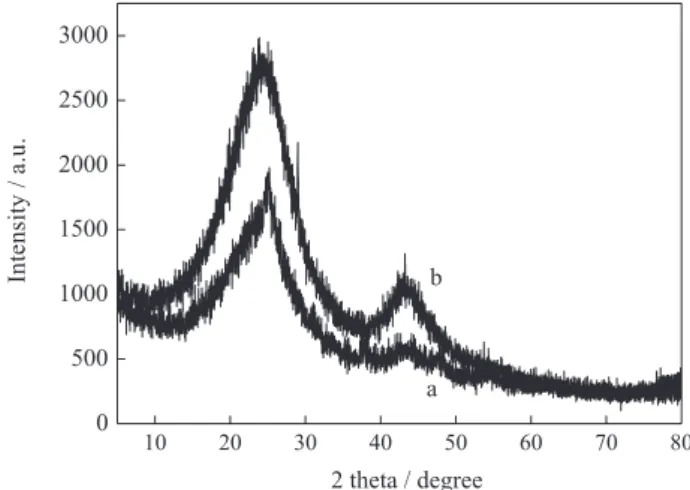
Figure 7 shows the XRD pattern of Ni/AC particle electrode before and after plating. The strong peak at 2θ = 26.3° before plating was a characteristic peak of AC
particles, and this peak increased after plating. The peak at 2θ = 43.6°,which was more clearly observed in Figure 7b
than in Figure 7a, was attributed to Ni deposited onto the AC surface by electroless plating, and indicated the existence of a crystal core in Ni/AC particle electrode. However, this peak was weaker than that at 2θ = 26.3°. The weak peak at
2θ = 43.6° was mainly due to the lower P content and small
distortion of crystalline Ni caused by P atoms.
Figure 8 shows the EDS spectrum of the plated Ni/AC particle electrode. The peak of carbon was from AC, whereas the peaks of nickel and phosphorus were attributed to the deposited layer. Ni2+ adsorbed on AC reacted with
KBH4 to produce Ni0 catalytic center during pretreatment.
Ni0 reduction was immediately initiated to catalyze the
subsequent electroless Ni–P co-deposition. The EDS results proved that the layer contained Ni–P alloy, in which the percentage contents of Ni and P atoms were 11.3% and 2.4%, respectively, and the rest were C atoms.
Electrocatalytic performance of Ni/AC particle electrode
The effect of particle electrode dose on the decolorization ratio of Ni/AC and AC electrodes in the same TDE cell is shown in Figure 9. Under the influence of an electric field at an electrochemical cell, these particles can be polarized to form charged microelectrodes, by means of which, increasing the specific surface area of the electrode, resulting in higher electrolytic efficiency.14 The
decolorization ratios of the two kinds of electrode increased with increased dose of the particle electrode from 5.0 g to 40.0 g. The increased decolorization ratio was attributed to the increased surface area of the electrodes, indicating that the polarization strength was directly related to the filling dose. Furthermore, the decolorization ratio of the TDE filled with Ni/AC electrode was higher than that filled with AC electrode. A decolorization ratio of 68% was obtained using only 30.0 g of Ni/AC, but as much as 40.0 g of AC was necessary to achieve the same ratio (Figure 9). The loaded Ni appeared to enhance the electrochemical activity of AC, resulting in improved decolorization ratio of Ni/AC electrode. The incremental change in the decolorization ratio depended on the dose of the particle electrode added. When the dose was ≤ 10.0 g, the incremental change corresponded to the increase in dose of the particle electrode. However, when the dose added was beyond 10.0 g, the incremental change decreased with increased dose of particle electrode. Figure 6. SEM images of Ni/AC particle electrode: a: untreated, b: after
oxidation, c and d: after plating.
Figure 7. X-ray diffraction pattern of Ni/AC particle electrode: a: before plating, and b: after plating.
Based on these findings, 10.0 g dose of particle electrode was used to study the electrocatalytic performance of Ni/AC particle electrode.
In this study, Na2SO4 was added to the methyl orange
solution as an electrolyte. When a cell is operated controlling the applied voltage, the electrolyte concentration in the cell is important because it primarily determines the electric resistance of the solution and influences the electrolytic current. The enhancement in electrolytic current improved the degradation of wastewater and a complementary reaction such as H2(g) production at the cathode and a side reaction such as O2(g) production at the anode.28 Salt is
usually used to increase the conductivity of water to be treated. However, when the salt concentration reached a certain value, the diffusion flux of ions decreased and thus inhibiting the mass transfer process in the solution.29
Figure 10 shows the decolorization ratio of methyl orange at various Na2SO4 concentrations. The decolorization ratio
of AC particle electrode increased with increased Na2SO4 concentration. However, the decolorization ratio began to decrease significantly at > 12 g L-1 Na
2SO4, and more bubbles
began to appear in the cathode. This observation showed that the increase in solution conductivity also increased the occurrence of H2 and O2 production in the cell beyond
a certain level, which led to the reduction of the current efficiency of AC particle electrode. The decolorization ratio of Ni/AC particle electrode was higher than that of AC electrode under the same Na2SO4 concentration. Furthermore,
Ni/AC electrode maintained a high decolorization ratio when 12 g L-1 to 20 g L-1 of Na
2SO4 was added to the solution,
whereas the decolorization ratio of AC electrode decreased more rapidly. Therefore, Ni/AC particle electrode had good electrocatalytic properties and the ability to eliminate disadvantages resulting from increased salt concentrations.
Cell voltage is a driving force of an electrolytic reaction. The effects of cell voltage on the decolorization ratio of the electrochemical process were investigated, and the results are shown in Figure 11. The decolorization ratio varied with increased cell voltage in a TDE cell using Ni/AC and AC particle electrodes. Based on the figure, the decolorization ratio of AC particle electrode gradually increased with increased cell voltage from 3.0 V to 15.0 V. With increased electric field strength, electrical charges on polarized AC particle electrodes increase.30 The cell
voltage increase can directly and indirectly accelerate the rates of dye decolorization on the electrode surface. In this work, the decolorization ratio markedly increased in Ni/AC electrode with increased cell voltage from 3.0 V to 6.0 V. The increase in the decolorization ratio can be attributed to the increase in the current of the electrode reaction and Figure 9. Effect of particle electrode dose on the decolorization ratio.
Experimental conditions: 40 g L-1 NiSO
4·6H2O, 27 g L-1 NaH2PO2·H2O,
50 °C, 20 min plating time, 12 g L-1 Na
2SO4 and 6 V cell voltage.
Figure 10. Effect of Na2SO4 concentration on the decolorization ratio.
Experimental conditions: 40 g L-1 NiSO
4·6H2O, 27 g L-1 NaH2PO2·H2O,
50 °C, 20 min plating time, 10.0 g particle electrode dose and 6 V cell voltage.
Figure 11. Effect of cell voltage on the decolorization ratio. Experimental conditions: 40 g L-1 NiSO
4·6H2O, 27 g L-1 NaH2PO2·H2O, 50 °C, 20 min
Table 3. Kinetic regression equation and parameters of different particle electrodes
Particle electrode Kinetic regression equations Regression coefficient Kinetic constant / min-1 Half-life / min
Ni/AC AC
ln(c0/ct) = 0.0158t + 0.0583
ln(c0/ct) = 0.0108t + 0.0509
0.992 0.997
0.0158 0.0108
43.9 64.2
Figure 12. Effect of electrolysis time on the concentration. Experimental conditions: 40 g L-1 NiSO
4·6H2O, 27 g L-1 NaH2PO2·H2O, 50 °C, 20 min
plating time, 10.0 g particle electrode dose, 12 g L-1 Na
2SO4 and 6 V
cell voltage.
improvement in electrode performance. However, the decolorization ratio of Ni/AC electrode decreased with increased cell voltage from 6.0 V to 15.0 V because some side reactions such as hydrogen and oxygen evolution occurred on the electrodes with increased cell voltage.31
Consequently, electrolytic efficiency declined. Moreover, the decolorization ratio of Ni/AC electrode was higher than that of AC electrode when the cell voltage ranged from 3.0 V to 9.0 V. The electrocatalytic performance of Ni/AC particle electrode allowed efficient decolorization at low cell voltages, thereby saving electric energy during the decolorization of methyl orange.
Figure 12 illustrates the methyl orange concentration of the treated solution in a TDE cell using different particle electrodes at various electrolysis times. The degradation of methyl orange by the two particle electrodes were basically the same in the first 5 min of electrolysis. However, with increased electrolysis time, the concentration of Ni/AC particle electrode decreased faster than that of AC particle electrode. The highest decolorization ratio obtained was 51% at 40 min. By contrast, the TDE cell with AC particle electrode generated a maximum decolorization ratio of only 37.5%.
In this work, the electrocatalytic decolorization of methyl orange was found to follow pseudo first-order kinetics. Table 3 lists the kinetic regression equations and parameters
determined from the experiment. The rate constant of TDE cell with AC particle electrode was 0.0108 min-1, whereas that
of TDE cell with Ni/AC particle electrode was 0.0158 min-1.
The rate constant of Ni /AC electrode was 1.5 times larger than that of AC electrode. The performance of Ni/AC electrode was superior to that of AC electrode. The synergetic effect was produced between Ni and AC in the Ni/Ac composite particle electrode, leading to the high electrocatalytic activity. Therefore, the combination of a catalytic Ni and three-dimensional particle electrode by electroless plating exerted apparent electrocatalytic effects on the decolorization of methyl orange.
Conclusions
A new method of preparing a composite particle electrode, i.e., electroless plating with non-palladium activation, was successfully applied to prepare a Ni/AC composite electrode. The conventional SnCl2-PdCl2
activation method was replaced by oxidation with nitric acid and reduction with KBH4. Using the decolorization
ratio of methyl orange dye solution as an index, the following optimal parameters for the preparation of Ni/AC electrode were determined: 40 g L-1 NiSO
4·6H2O,
27 g L-1 NaH
2PO2·H2O, 50 °C plating temperature, and
20 min plating time. Compared with the AC particle electrode, improvements in the electrolytic performance of Ni/AC composite electrode were confirmed by a series of parameters, specifically, particle electrode dose, Na2SO4
concentration, cell voltage, and electrolysis time.
Acknowledgements
This work was supported by the Universities Natural Sciences Research Project of Jiangsu Province (12KJD610001) and Science and Technology Program of Changzhou (CJ20120020) for financial support.
References
1. Pavanelli, S. P.; Bispo, G. L.; Nascentes, C. C.; Augusti, R.;
J. Braz. Chem. Soc. 2011, 22, 111.
2. Silva-Stenico, M. E.; Vieira, F. D. P.; Genuário, D. B.; Silva, C. S. P.; Moraes, L. A. B.; Fiore, M. F.; J. Braz. Chem. Soc.
3. de Almeida Filho, C.; Zarbin, A. J. G.; J. Braz. Chem. Soc. 2006, 17, 1151.
4. Janssen, L. J. J.; Koene, L.; Chem. Eng. J. 2002, 85, 137. 5. Fockedey, E.; Lierde, A. V.; Water Res. 2002, 36, 4169.
6. Sun, Y. P.; Qiu, O.; Xu, W. L.; Scott, K.; J. Electroanal. Chem. 2001, 503, 36.
7. Zhang, X. S.; Wu, G. B.; Ding, P.; Zhou, X. G.; Yuan, W. K.;
Chem. Eng. Sci. 1999, 54, 2969.
8. He, P. T.; Wang, L.; Xue, J. J.; Cao, Z. B.; Environ. Technol. 2010, 31, 417.
9. Xiong, Y.; He, C.; Karlsson, H. T.; Zhu, X. H.; Chemosphere
2003, 50, 131.
10. An, T.; Li, G.; Zhu, X.; Fu, J.; Sheng, G.; Kun, Z.; Appl.
Catal. A: Gen. 2005, 279, 247.
11. Yan, L.; Ma, H. Z.; Wang, B.; Wang, Y. F.; Chen, Y. S.;
Desalination 2011, 276, 397.
12. Zhou, M.; Lei, L.; Chemosphere 2006, 65, 1197.
13. Zhao, H. Z.; Sun, Y.; Xu, L. N.; Ni, J. R.; Chemosphere 2010, 78, 46.
14. Xu, L. N.; Zhao, H. Z.; Shi, S. Y.; Zhang, G. Z.; Ni, J. R.; Dyes Pigments 2008, 77, 158.
15. Chen, H. N.; Zhu, L. Q.; Li, W. P.; Liu, H. C.; Mater. Lett. 2010, 64, 781.
16. Zhang, W. B.; An, T. C.; Xiao, X. M.; Fu, J. M.; Sheng, G. Y.; Cui, M. C.; Li, G. Y.; Appl. Catal. A: Gen. 2003, 255, 221. 17. Cao, G. P.; Su, J.; Lu, J. L.; Zhang, J. T.; Liu, Q. J.; J. Chin.
Chem. Soc. 2012, 59, 583.
18. Kretz, F.; Gácsi, Z.; Kovács, J.; Pieczonka, T.; Surf. Coat. Technol. 2004, 180, 575.
19. Kong, F. Z.; Zhang, X. B.; Xiong, W. Q.; Liu, F.; Huang, W. Z.; Sun, Y. L.; Tu, J. P.; Chen, X. W.; Surf. Coat. Technol. 2002, 155, 33.
20. Cheon, S. Y.; Park, S. Y.; Rhym, Y. M.; Lee, D. H.; Curr. Appl. Phys. 2011, 11, 790.
21. Babu, G. V.; Palaniappa, M.; Jayalakshmi, M.; J. SolidState Electrochem. 2007, 11, 1705.
22. Wang, L. J.; Li, J.; Liu, H. B.; WoodSci. Technol. 2011, 45,
161.
23. Chen, X. H.; Xu, J. T.; Peng, J. C.; Compos. Sci. Technol. 2000, 60, 301.
24. Jia, B. Y.; Wang, L. J.; BioRes. 2010, 5, 2248.
25. Bi, H.; Kou, K. C.; Rider, A. E.; Ostrikov, K.; Wu, H. W.; Wang, Z. C.; Appl. Surf. Sci. 2009, 255, 6888.
26. Ayturk, M. E.; Ma, Y. H.; J. Membr. Sci. 2009, 330, 233. 27. Shiue, S. T.; Yang, C. H.; Chu, R. S.; Yang, T. J.; ThinSolid
Films 2005, 485, 169.
28. Uğurlu, M.; Karaoğlu, M. H.; Kula, İ.; Pol. J. Environ. Stud.
2006, 15, 647.
29. Sakakibara, Y.; Nakayama, T.; Water Res. 2001, 35, 768.
30. Wu, X. B.; Yang, X. Q.; Wu, D. C.; Fu, R. W.; Chem. Eng. J. 2008, 138, 47.
31. Šerbula, S. M.; Stanković, V. D.; J. Appl. Electrochem. 2002,
32, 389.
Submitted: June 25, 2013