Review
J. Braz. Chem. Soc., Vol. 24, No. 12, 1891-1912, 2013. Printed in Brazil - ©2013 Sociedade Brasileira de Química 0103 - 5053 $6.00+0.00
*e-mail: [email protected]
New Energy Sources: The Enzymatic Biofuel Cell
Sidney Aquino Neto and Adalgisa R. De Andrade*
Departamento de Química, Faculdade de Filosofia Ciências e Letras de Ribeirão Preto, Universidade de São Paulo, 14040-901 Ribeirão Preto-SP, Brazil
A busca contínua por fontes alternativas de energia, imposta por interesses econômicos e ambientais, tem motivado investigações sobre alternativas limpas e eficientes para a produção de energia. As células a combustível são uma estratégia potencialmente eficaz para a conversão de energia. As biocélulas a combustível constituem uma subclasse das células a combustível, que possuem grande potencial para aplicação em dispositivos de baixa potência (geralmente da ordem de micro a mili watts). Ao invés dos tradicionais catalisadores metálicos, as células a combustível biológicas empregam biomoléculas, tais como enzimas, microrganismos, ou organelas para converter energia química em energia eléctrica. As biocélulas a combustível oferecem várias vantagens frente às baterias tradicionais, incluindo o uso de componentes renováveis e não-tóxicos, seletividade de reação, flexibilidade de combustíveis, e a capacidade de operar em temperaturas brandas e pH neutro. De fato, estudos recentes têm demonstrado características promissoras destes dispositivos; no entanto, apesar dos vários avanços obtidos nesta área, alguns desafios ainda precisa ser enfrentados. Este trabalho de revisão tem como objetivo proporcionar aos leitores do Journal of the Brazilian Chemical Society uma visão geral das biocélulas a combustível enzimáticas, e o
seu desenvolvimento desde a primeira descrição em 1964. Os resultados mais recente da literatura (incluindo a tecnologia implantável), além de uma perspectiva para futuras pesquisas nesta área também são apresentados.
The continuous search for alternative energy sources, imposed by economic and environmental concerns, has motivated investigations into clean and efficient alternatives for energy production. Studies have shown that fuel cells are a potentially efficient strategy for energy conversion. Biofuel cells constitute a subclass of fuel cells with promising application in low-power devices (generally in the order of micro to milli watts). Instead of metallic catalysts, biological power sources employ biological molecules such as enzymes, organelles, or microorganisms to convert chemical energy into electricity. Biofuel cells offer several advantages over traditional batteries, including the use of renewable and non-toxic components, reaction selectivity, fuel flexibility, and ability to operate at lower temperatures and near neutral pH. Indeed, recent papers have demonstrated the promising characteristics of these devices; however, some challenges remains to be faced despite the several advances in this area. This review aims to provide the readers of the Journal of the Brazilian Chemical Society with an overview of enzymatic biofuel cells, their development since its first description in 1964, and the most recent outcomes. The latest papers in this field (including implantable technology) and an outlook for future research in this area are also presented.
Keywords: biofuel cell, enzyme immobilization, sustainable energy source, green energy,
electrocatalysis
1. Introduction
Economic and environmental factors along with the human consumption pattern (which heavily relies on non-renewable fuel sources) have called for “clean” and efficient energy production processes. The increasing energy demand
energy, hydrogen, biomass, biofuels, and fuel cells, are some of the most promising technologies available to generate energy,2 and many research groups have been devoted to
the design of fuel cells over the last decades. These devices consist of a system that can generate electrical energy from electrochemical reactions involving chemical species oxidation and reduction.3 Characterized as a non-polluting
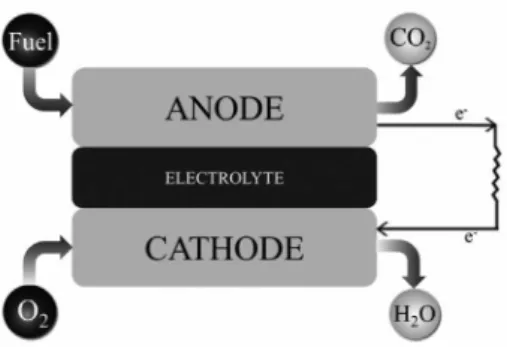
and silent technology, this system converts chemical energy into electricity according to the mechanism illustrated in Figure 1. In general, traditional fuel cells use noble metal catalysts to generate electrons from fuel oxidation (typical fuels are hydrogen or small organic molecules such as methanol, ethanol, and glutaraldehyde, among others).3
After the oxidation step, an external circuit transfer the electrons to the cathode side where the electrons react with an oxidant molecule (usually oxygen), and generate electrical work as well as water and heat.
Different types of basic fuel cells exist, depending on the type of electrolyte and operation temperature. This technology offers considerable advantages over other processes, such as high conversion efficiency and generation of substantial power density.3 Although fuel
cells yield good results, some factors limit their large-scale application: high cost and future scarcity of noble metal catalysts (e.g., platinum, employed as base catalyst in many fuel cell devices), issues regarding electrode passivation, and inability to oxidize some byproducts of the employed fuels.4 Furthermore, hydrogen production, purification,
and storage (hydrogen is one of the fuels that is most often employed in traditional fuel cells) also poses major technical challenges.1
An alternative to conventional fuel cells based on metal catalysts is to turn to biological fuel cells or biofuel cells. This device employs enzymes (enzymatic biofuel cell) or microorganisms (microbial fuel cell) as catalyst instead of the traditional noble metal catalysts.5 These
devices constitute a system that can directly transform chemical energy into electricity through reactions involving
biochemical steps, or even a system in which the activity of the cell (or part of it) stems from the action of biocatalysts.6
The connection between biology and electricity and the concept of a biofuel cell have been known since 1911,7
when MC Potter noted that a culture of the bacterium
E. coli produced electricity in half-cell studies employing
platinum electrodes. After a few decades, the interest in this technology increased; in the 1950s and 1960s, the central idea of the United States space program involved the use biofuel cells in two fronts: to treat waste originating from the aircraft and to obtain electricity from the treated waste.8
Motivated by the possible in vivo application of this device, Yahiro et al.9 were the first to describe a biofuel cell that
used isolated enzymes on the surface of an electrode and to show that it was possible to produce electricity using the enzyme glucose oxidase (GOx). Since then, the number of publications in the area has increased.10 The main
advantages of the biological fuel cells are: the use of clean and renewable catalysts (enzymes or microorganisms), the ability to operate at mild temperatures (20-40 °C) and physiological pH conditions, and the possibility to use several fuels because enzymes and microorganisms offer diversity and specificity. Additionally, scaling up the use of biocatalysts tends to reduce production costs, which is not possible for non-renewable metallic catalysts. All these advantages point to an economically viable process, as judged from the growing research in this field all over the world.8, 11, 12 This review will be only focus on the enzymatic
biofuel cell, aiming to provide the readers of the Journal of the Brazilian Chemical Society with an overview of this enzymatic device, their development since its first description in 1964, and the most recent outcomes. The latest papers in this field (including implantable technology) and an outlook for future research in this area will also be presented.
2. Enzymatic Biofuel Cells
2.1. Application, operation, and key performance parameters
Half a century has elapsed since the first description that enzymes produce electric current.9 Over the last decade, the
development of devices containing enzymes immobilized onto solid surfaces has increased fast,13-16 and has included
large technology companies.17,18 Besides being potentially
applicable as energy source in batteries, biofuel cells can be used in vivo; e.g., pacemakers, neurostimulators, drug carriers, and glucose sensors, among others, which is an attractive feature of this technology.8
At this point, the first questions that arise are: (i) How
can one obtain electrons from an enzyme-catalyzed reaction Figure 1. Representative scheme of the hydrocarbon fuel cell operation
in a biofuel cell device? (ii) How is the energy produced
in this process related to the bioelectrochemical reactions occurring on the surface of an electrode and to the electrons generated in these reactions? Equations 1 to 3 illustrate the electron production mechanism in an enzymatic bioanode that catalyzes ethanol oxidation via NAD+-dependent
dehydrogenase:
(1) (2) (3)
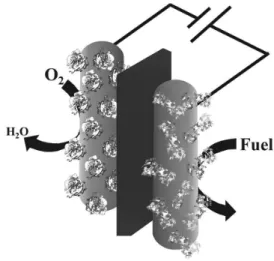
The operation of an enzymatic biofuel cell resembles the functioning of conventional fuel cell: first, a fuel undergoes an enzyme-catalyzed oxidation at the anode side. This reaction releases electrons that reach the cathode side through an external circuit. In the cathode, an oxidant (usually O2) is reduced, producing electrical work (Figure 2). In other words, the electric current flows according to a potential difference and, consequently, an enzyme-catalyzed reaction involving a fuel (substrate) generate power.
An oxidoreductase enzyme can oxidize carbohydrates, alcohols, or even amino acids, and transfer electrons from the fuel to the electrode surface. Considering that enzymatic fuel cells generally employ the aforementioned fuels, it is possible to prepare anode-based electrodes by immobilizing different types of enzymes. For sure, glucose oxidase has been the most often employed enzyme since the first description of a biofuel cell. It’s in vivo application is desirable because different human physiological fluids, such as blood, plasma, saliva, and tears, contain sugar.19, 20 Papers
employing enzymes from hydrogen, ethanol, methanol, and Krebs cycle metabolisms also exist in the literature:
hydrogenase,21 alcohol and aldehyde dehydrogenase,13, 22
cytochrome c,23 cellobiose dehydrogenase, and D-fructose
dehydrogenase,24 pyruvate dehydrogenase, citrate
synthase, aconitase, isocitric dehydrogenase, ketoglutarate dehydrogenase, fumarase, and malate dehydrogenase.25
Scientists are also testing others enzymes, depending on the target fuel.26 As for enzyme-based cathodes, laccase
or bilirubin oxidase usually perform the oxygen reduction reaction.16,17,27-43
The difference between the thermodynamic potential of the cathode and the anode (∆Ec-Ea) expresses the cell voltage,
but this value can decrease by several orders of magnitude due to overvoltage (∆η). ∆η results from (i) slow electron
transfer occurring at both electrode sides; (ii) ohmic drop
(ΣΩ), associated with all the resistances in the system
(film diffusion, membrane, supporting electrolyte); and (iii) electrode wear out (∆£), a parameter that reflects
electrode degradation:
Ecell = ∆Ec-Ea - ∆η −ΣΩ − ∆£
The equation above provides important information about any enzymatic electrode. Maximizing the so-called thermodynamic potential window (Ec - Ea) yields better biofuel cell performance. Therefore, enzymatic biofuel cell researchers aims to prepare/achieve bioelectrodes that facilitate the catalyzed reactions, to increase the open cell voltage (OCV). Moreover, these researchers target better cell design and prototypes that can reduce the overall resistances, making electric current flow more easily through the system. To produce commercial devices, it is also necessary to keep ∆£ as low as possible.
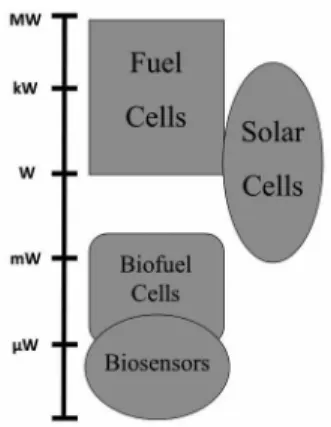
Another crucial parameter associated with the performance of any fuel cell is the power density that this system provides. This parameter reflects the electron generation rate in the enzyme-catalyzed reactions. Unlike traditional fuel cells, which afford power densities of the order of milli to kilo watts, enzymatic biofuel cells generate power densities in the order of micro to some milli watts, which is sufficient for applications in some small electronic devices.17 The representative scheme in Figure 3 shows the
power range of some of the alternative methods of energy production.8
Despite the various advantages and possible applications of enzymatic biofuel cells, to achieve an efficient practical device, it is necessary to consider some crucial factors when developing this type of system. The first major challenge is the fact that enzymes are proteins; therefore, these biomolecules display a weak three-dimensional structure that must be maintained, to ensure that its catalytic activity is reatained.5
they have limited lifetime in solution. Hence, their use in biofuel cells requires a critical step: immobilizing the enzyme onto an electrode surface.44 Achieving electrical contact
between the enzyme and the electrode, is also fundamental, because this is one of the most important processes in the field of bioelectrochemistry. Achieving high electron transfer rate from the active site of an immobilized enzyme to the electrode surface is probably the most critical point when constructing an enzymatic biofuel cell.
2.2. Enzyme immobilization
Immobilizing biomolecules on solid surfaces is a matter of great scientific interest. Numerous possibilities exist when it comes to using enzymes in different biotechnological areas, particularly in the industrial and analytical fields.8,26 It is essential to develop and
improve immobilization techniques, because this step will greatly influence bioelectrode efficiency and protein lifetime. Removing an enzyme from a three-dimensional environment (where the molecules of the substrate and products molecules easily enter and leave the catalytic site) to a solid surface requires methodologies that ensure retention of protein conformation and catalytic properties. Immobilization methodologies must also provide the enzyme with an adequate microenviroment that enables the protein to resist changes in temperature, pH, and solution composition, which often lead to protein denaturation or inactivation. Furthermore, the immobilization process must furnish a mechanically and chemically stable layer without forming a capacitive region on the electrode surface.13, 26 The presence of various functional groups in
the protein structure allows for one to use different enzyme immobilization strategies. In general, immobilization methodologies include chemical and physical methods, depending on the type of interaction between the enzymes and the anchoring agent.
Among chemical methodologies, which elicit direct binding of the enzymes to a solid support, the covalent linkage and cross-linking procedures are noteworthy.44,45
In the case of direct covalent bond between the enzymes and the solid substrate, the procedure generally involves modifying or functionalizing electrode surfaces, which can then covalently bind the enzymes. Researchers choose this design when preparing monolayer systems. In most methods, the amino groups of lysine residues constitute the main reactive groups, but this protocol can also employ carboxyl and sulfhydryl groups.45 Rüdiger et al.21 presented
a good example of this strategy: they developed a method to covalently bind Ni-Fe hydrogenase to gold electrodes modified with a self-assembled 4-aminothiophenol monolayer. Klis et al.46 employed a similar protocol to
immobilize laccase onto gold electrode by covalent binding the enzyme to self-assembled mercaptoundecanoic or mercaptopropionic acid monolayers. Researchers have also bound an enzyme molecule to an electrode surface via cross-linking agents such as glutaraldehyde. Baravik et al.47
described how they immobilized glucose oxidase in the form of a cross-linked composite prepared by electropolymerizing aniline-functionalized carbon nanotubes and thioaniline-modified glucose oxidase on a gold electrode modified with thioaniline monolayer. Despite being simple, this technique has not received much attention for biofuel cell purposes in recent years because the enzymatic activity usually decreases after immobilization.48
Sol-gel matrices have been used to manufacture both biosensors and bioelectrodes for enzymatic biofuel cells, where the proteins are encapsulated and directly connected to the electrode surface. The satisfactory results obtained with this methodology stem from the formation of a porous structure that contains several cavities. Lim et al.49 prepared
nanostructured electrodes for glucose/O2 biofuel cell based
on enzyme encapsulation along with carbon nanotubes into sol-gel silica matrices.
Because physical protocols are generally simpler and more efficient regarding enzyme immobilization, researchers prefer them to procedures that involve the formation of chemical bonds. Accordingly, entrapment in microcapsules and polymer gels as well as adsorption protocols are more commonly used in enzymatic fuel cells.44,45 Heller’s group
showed that is possible to immobilize many enzymes into polymeric hydrogels containing an osmium redox center;16 the employed hydrogels generally consist of
cross-linked redox polymers that swell in water and produce known redox hydrogels. Using redox hydrogels has many advantages: they can conduct electrons while retaining the most important features of typical hydrogels, such as conducting ions and allowing diffusion of substrate Figure 3. Schematic representation of the power range that some of the
species such as glucose.50-53 Microencapsulation consists
in trapping the enzyme molecules in the pores of a membrane. Minteer’s research group successfully used this methodology to modify a Nafion® membrane and
then immobilize dehydrogenase enzymes onto carbon surfaces.13,25,54-63 Treatment of the Nafion® membrane
with tetrabutylammonium bromide afforded a favorable environment to immobilize biomolecules, maintained the physical properties of the unmodified membrane, reduced its acidity and increased the mass transport through the membrane. Similarly, Klotzbach et al.64,65 described how
they immobilized dehydrogenase enzymes in chitosan modified with hydrophobic groups.
One can efficiently immobilize several enzymes and proteins onto solid substrates using multilayer architectures on which biomolecules anchor by either physical (electrostatic) or covalent interactions. The first case uses the self-assembly technique (physical adsorption of biomolecules onto a substrate in a solution with optimized pH and ionic strength) at room temperature to retain their activity for a considerable time.66 This process involves
sequential adsorption of oppositely charged material from a suitable solution that can be repeated according to the desired number of bilayers.67 Szamocki et al.37
reported the effective sequential immobilization of laccase and an osmium complex onto a mercaptopropane sulfonate-modified gold surface. Rengaraj et al.68
obtained a fully assembled membraneless biofuel cell at graphite electrodes. These authors used the layer-by-layer technique to achieve the anode and the cathode. They employed osmium complexes along with glucose oxidase and laccase to obtain the 3D electrocatalytic structures. Frasconi et al.69 reported on a self-assembled bioelectrode
containing genetically engineered glucose oxidase and gold nanoparticles, to obtain multiple enzymatic layers. Aquino Neto et al.22 employed the electrostatic layer-by-layer
technique to prepare bioanodes for ethanol/O2 biofuel cells.
The authors tested both mono (alcohol dehydrogenase) and bienzymatic (ADH and aldehyde dehydrogenase) systems immobilized onto a carbon paper support along with polyamidoamine (PAMAM) dendrimers.
2.3. Electron transfer processes
The redox enzymes employed in biofuel cell studies are generally classified in three main groups, according to their electrical communication.51 The first group contains
the redox center located in a peripheral area of the enzyme, so it can directly transfer electrons to or accept electrons from an electrode surface. This group includes the PQQ-dependent dehydrogenase enzymes. The second
group bears a weakly bound cofactor (NAD+ or NADP+)
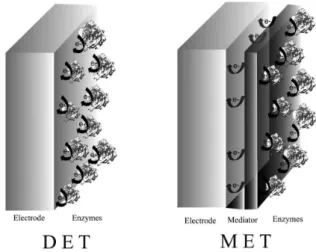
that acts as a mediator at the redox center. This species can diffuse to the electrode surface and carry the electrons from the enzymatic catalysis. The third group involves enzymes with a strongly bound redox center, normally located inside the protein shell. Classification of the electron transfer between enzymes and electrode surfaces depends on the way electrons move from the enzyme catalytic site to the electrode surface.51 Direct processes are known as direct
electron transfer (DET); processes requiring the assistance of a mediator molecule are designated mediated electron transfer (MET) (Figure 4).
2.3.1. Mediated electron transfer
Bioanodes performing MET
Considering that the majority of immobilized proteins cannot electrically communicate with the electrode surface by the DET mechanism,70 it is essential to use mediator
molecules in many bioelectronic devices. The electrical communication between the enzyme redox center at the electrode surface in an enzyme-based biofuel cell regulates bioelectrocatalysis efficiency. However, the redox center of most oxidoreductases enzymes is generally buried inside the protein matrix, so the electrical communication with the electrode surface is hindered.71, 72 In an enzymatic biofuel
cell, a mediator corresponds to a reversible redox species that facilitates electron transfer between the coenzyme and the electrode surface.5 Although MET-based bioelectrodes
require additional species during biofuel cell preparation, MET is generally preferred over DET, because it can generate higher output power with often large orders of magnitude than the direct mechanism. The possibility of using commercially available enzymes, such as many NAD+
-dependent alcohol dehydrogenases and FAD+-dependent
glucose oxidase and dehydrogenases, is another advantage of this methodology. The mediator molecules can be either anchored onto the electrode surface (e.g., in the form of a polymeric film), free in solution, or even linked to the structure of the enzyme; it withdraws the electrons generated during the enzymatic catalysis and transports them to the electrode surface.8,72,73 These mediator species must be able
to efficiently perform the enzyme/electrode connection, to rapidly react with the reduced form of the enzyme, and be soluble in both its reduced and oxidized forms, so that it can diffuse to the electrode/enzyme fast. Moreover, they should be non-toxic, stable, and biocompatible.
The efficiency of a mediator depends on its redox potential range, which should be as close to the redox pair of the enzymes as possible.19 When the electrode potential
is higher than the redox potential of the mediator species, mediator oxidation occurs at the electrode surface; if the opposite situation is true, mediator reduction takes place. In these circumstances, the electrode provides a continuous electron flow for both the oxidized and reduced mediator species. In a practical MET mechanism, the potential of the mediator couple controls the system; consequently, the potential window of both mediators determines the OCV of a fully mediated enzymatic device. Considering this premise, the thermodynamic driving force of an MET biofuel cell lies between the redox potentials of the mediator species and the enzyme redox center; therefore, it must be different from zero.19 In other words, the redox
potential of a mediator limits its application in enzymatic bioelectronics. The redox potential of this species must be as close as possible to the redox potential of the employed enzyme. Literature suggests that an enzymatic device would have optimal performance if the potential difference between the mediator and enzyme redox centers lay around 50 mV.16 Figure 5 illustrates the redox potential range of
some of the most often employed metal-based mediators and of the oxidoreductase enzymes glucose oxidase, and laccase. These potentials may vary according to the enzyme
structure, the organism from which is extracted, and the pH, among other factors.
The redox potential of some of the enzymes that are generally used in biofuel cells lies around −0.35 V vs Ag/AgCl
for glucose oxidase from A s p e rg i l l u s N i ge r,74
0.58 V vs Ag/AgCl for laccase from Trametes Versicollor,75
and 0.67 V vs Ag/AgCl for bilirubin oxidase from Myrothecium Verrucaria.76 Literature shows that ferrocene
(redox potential of 0.2 V vs Ag/AgCl)77 and quinone
derivatives possess the desired characteristics to function as good enzymatic mediators.73 Osmium and ruthenium
complexes, polypyrrole, phthalocyanine, organic dyes, and other molecules can also serve as mediators in enzymatic devices.78 Indeed, a variety of osmium and ruthenium
complexes find application in enzymatic biofuel cells. By changing the substituents on the ligands of the complex, it is possible to modify their redox potential, which normally ranges from −0.17 to 0.79 vs Ag/AgCl.19,51,79-82
Ohara et al.83 were one of the first to describe the
use of an osmium-based redox mediator in enzymatic biofuel cells. Besides displaying unique electron diffusion coefficients, these redox hydrogel films were also permeable to water-soluble species, such as substrates and products of enzymatic reactions.51 These mediators
provided efficient electrical connection between glucose oxidase and the electrode surface.83 Dónal Leech’s
research group extensively reported the use of osmium-based complexes.84-89 Zafar et al.87 described a wide-range
mediator containing five different osmium-based redox polymers that efficiently connected the oxidoreductase pyranose dehydrogenase with graphite electrodes. The prepared polymers covered a potential range from −0.270 to +0.160 mV vs Ag/AgCl.
Rengaraj et al.84 prepared a complete enzymatic biofuel
cell using glassy carbon and graphite electrodes modified with osmium redox polymers, crosslinked with poly (ethylene glycol) diglycidyl ether. By changing only the donor/receptor behavior of the substituting groups, the
authors achieved an enzymatic device with large potential window. Recently, Ó Conghaile et al.85 reported a versatile
approach to prepare bioanodes for mediated glucose/O2
biofuel cell. They immobilized glucose oxidase crosslinked in biofilms onto graphite electrodes containing different functionalized osmium complexes. In 5 mmol L-1 glucose,
the bioelectrodes prepared with dimethoxy or dimethyl-substituted bipyridines provided glucose oxidation currents around 30 and 70 µA cm-2 at 0.2 and 0.35 V under pseudo
physiological conditions, respectively. Nevertheless, the stability signals proved that the electrodes were inadequate for long-term operation.85
Ferrocene has also been effectively employed as a mediator in enzymatic fuel cells. For example, bioelectrodes in the form of cylindrical pellets, prepared by mechanical compression of a mixture of graphite, glucose oxidase, and ferrocene, effectively wired the enzymes onto the electrode surface.90 The resulting membraneless glucose/O
2 biofuel
cell generated an OCV of 0.45 and a power density of 80 µW cm-2. Kim et al.91 prepared a glucose/O
2 biofuel cell
based on polypyrrole nanowires along with glucose oxidase and 8-hydroxyquinoline-5-sulfonic acid hydrate. This nanowire-type enzymatic biofuel cell exhibited higher power density compared with film-type biofuel cells.
The NAD-dependent dehydrogenases are one of the most employed enzymes in MET biofuel cell studies. These enzymes transfer electrons and protons to the oxidized form of the cofactor, to produce its reduced form, NADH.5 A key point to build an efficient mediated system
employing NAD-dependent dehydrogenases is to regenerate the oxidized species (NAD+). Despite having a formal
redox potential of −0.52 V vs Ag/AgCl, NADH oxidation
overvoltage is around 1 V at glassy carbon electrodes and even higher at platinum surfaces.92-94 This energy barrier
hinders the application of NAD-dependent dehydrogenases when a electrocatalyst system is not available. The literature contains many examples of compounds that can lower the overpotential of the NADH oxidation reaction, to make the reaction energetically favorable. 95-97 Indeed, electrocatalysts
based on organic compounds such as quinones and phenazines reduce the NADH oxidation overpotential, enhancing the Ecell output.13,95 Among various phenothiazine
derivatives, organic compounds such as methylene green, methylene blue, and neutral red efficiently oxidize NADH at lower potentials. They can also form stable films, such as poly-methylene green, on the electrode surface upon electropolymerization, facilitating electrode fabrication and affording long-term stability during biofuel cell studies.62,93
We must emphasize that, in this type of bioelectrodes, the pair NAD+/NADH acts as the diffusional mediator system
and the azines function as the electrocatalysts, to lower the
NADH oxidation overpotential. On carbon paste electrodes, for example, methylene green (MG) has a formal redox potential toward NADH oxidation of −0.122 V vs Ag/AgCl,
pH 7.98 This data represents a reduction in the overpotential
of around 0.4 V, which enables their use in enzymatic fuel cells employing NAD-dependent enzymes. The Michaelis-Menten kinetics can describe the principle of the azine electrocatalytic activity toward NADH;5,99,100
i.e., the reaction mechanism indicates that NADH and methylene green form an intermediate compound followed by proton abstraction and subsequent NAD+ formation.
The use of MG as a freely diffusing electrocatalyst for NADH catalysis imposes restriction to the fabrication of a stable bioelectrode;101 therefore, researchers have seeked
immobilization techniques that provide stable layers of NADH catalyst. In the past decade, Minteer’s group successfully employed MG as an electrocatalyst to regenerate NADH in a wide range of dehydrogenase-based biofuel cells.13,25, 54,58,59,62,102 Using the NADH electrocatalyst in the
form of an electropolymerized film, Akers et al.13 obtained
a high-current-density bioanode containing poly(methylene green) coated with a layer of tetrabutylammonium bromide salt-treated Nafion® and dehydrogenase enzymes.
Klotzbach et al.65 employed the hydrophobically modified
chitosan and Nafion® membranes to obtain enzyme modified
electrodes for biofuel cell applications. Sokic-Lazic and Minteeralso described the use of poly(methylene green) to prepare bioelectrodes on carbon platforms that mimic one of the main metabolic pathways in living cells, the citric acid cycle.54 More recently, Meredith et al.62 presented a
methodology to co-immobilize dehydrogenase enzymes, different NADH electrocatalysts including MG, carbon nanotubes, and polymer hydrogels. The authors claimed that the so-called “one-pot” mixing and casting procedure effectively produced bioelectrodes that promote NADH oxidation at low overpotentials.Recently, our research group obtained good results employing MG as electrocatalyst for NADH oxidation in the form of a stable thin film layer in alcoholic biofuel cell using commercially available enzymes, NAD-dependent alcohol dehydrogenase, and aldehyde dehydrogenase.22,103 Forti et al.103 introduced the
use of PAMAM dendrimers in an ethanol/O2 biofuel cell, by immobilizing alcohol dehydrogenase and PAMAM dendrimers onto a carbon cloth platform. Similarly, Aquino Neto et al.22 used a poly(methylene green) film to prepare
bioelectrodes for ethanol/O2 biofuel cell the layer-by-layer assembly.
Biocathodes performing MET
often-employed redox species to electrically wire the enzymes (generally laccase and bilirubin oxidase) with the electrode surface. Barrière et al.86 thermodynamically
evaluated osmium and ruthenium-based mediators for laccase-catalyzed oxygen reduction. The targeted redox polymers displayed redox potentials around 0.40 and 0.63 V vs Ag/AgCl for the osmium and
ruthenium-based polymer, respectively. Using poly(vinylimidazole) as the stabilizing agent for the redox species, the authors prepared the biocathodes on a glassy carbon surface along with laccase and the cross-linking agent polyoxyethylene bis(glycidyl ether).86 Gallaway et al.104
obtained biocathodes containing a series of osmium-based redox polymer mediators. To determine the optimum redox potential toward laccase from Trametes versicolor and
maximize the power output of a hypothetical biofuel cell, these authors synthetized mediators covering a range of redox potentials from 0.11 to 0.85 V.104 Szamocki et al.37
presented another strategy to use osmium-based mediators: they immobilized the complexes at the bioelectrode surface along with the laccase enzyme from Trametes trogii using
the layer-by-layer self-assembled technique. The catalytic oxygen reduction current increased linearly with the number of bilayers in the self-assembled bioelectrode, reaching a maximum catalytic current of 150 µA cm-2.37
More recently, Shen et al.105 fabricated biocathodes based
on the laccase and electrodeposited thin films containing Os(4,4’-dicarboxylic acid-2,2’-bipyridine)2 on carbon electrodes. The authors claimed that laccase was readily incorporated in the electrodeposited redox polymer through coordination between the enzyme amine and histidine groups. This system efficiently catalyzed the four-electron oxygen reduction to water at 0.58 V vs Ag/AgCl.
One of the most often employed mediators in biocathode studies based on laccase immobilization is 2,2’-azino-bis (3-ethylbenzothiazoline)-6-sulfonic acid (ABTS). Several literature reports have pointed out that this compound efficiently mediates oxygen reduction to water. Palmore et al.34 presented one of the first reports
on the use of a biocatalyst for a H2/O2-based biofuel using a fungal laccase and ABTS as redox mediator, in the cathode side, to effectively reduce dioxygen to water. Tsujimura et al.106 also described the electrochemical
reduction of oxygen to water using ABTS and bilirubin oxidase as the biocatalyst at the cathode side; the authors achieved the targeted reaction at 0.4 V vs Ag/AgCl in
pH 7.0 and ambient temperature. Smolander et al.107
published an interesting paper focusing on the dioxygen four-electron reduction through concomitant oxidation of the phenolic aromatic compound, to prepare printable laccase-based biocathodes. The half-enzymatic fuel cell
tests, along with a Zn anode, furnished an OCV between 1.4 and 1.5 for the fresh samples and maintained an OCV in the range of 0.6 to 0.8 for three days. 107 More recently,
Cardoso et al.108 described how a mediated electron transfer
biocathode performed in a methanol/O2 biofuel cell. They
employed PAMAM dendrimers to immobilize laccase along with ABTS entrapped into polypyrrole films. The electrochemical characterization tests confirmed that the electropolymerized polypyrrole film entrapped the ABTS molecules. Additionally, laccase-mediator system enhanced catalytic oxidation current as compared with the control sample containing lacase-PAMAM dendrimer only. The use of ABTS as mediator entrapped into the biocathode layers generated a power density around 25 µW cm-2.108
Besides adding functional groups at conducting surfaces, covalent linkage leads to MET between the enzyme and the electrode surfaces. Covalently linked glucose oxidase and bilirubin oxidase as the anodic and cathodic catalyst, respectively, produced a biofuel cell with maximum power density of 13 µW cm-2 at 0.25 V.109
Table 1 summarizes some MET investigations on enzymatic biofuel cells.
2.3.2. Direct electron transfer
Bioanodes performing DET
Over 1300 oxidoreductases enzymes are known to date,111 and these enzymes are potentially applicable as
biocatalysts in enzymatic biofuel cells. However, less than 100 of these enzymes can directly connect with solid substrates and transfer electrons from the enzyme active site to the electrode surface.70 Indeed, DET only occurs in
enzymes that act as a molecular transducer; i.e., enzymes that can convert a chemical signal into an electric signal via charge transfer, in the presence of a stable redox species.112
In other words, in the DET mechanism, the enzymatic catalysis and the electrochemical reaction are not separate reactions, but a unique process where the electron functions as a second substrate.5 The tunneling mechanism of the
electrons in a DET enzymatic system will depend on the enzyme structure, the redox center location, the enzyme orientation on the electrode surface, and the distance of the electron transfer.113 Hence, a good electron transfer rate
between enzymes and electrodes will only be possible if all these conditions are met.114 One great advantage of this
miniaturization of the enzymatic devices.112 Although
researchers have increasingly targeted DET, the later process often leads to lower power values as compared with mediated systems. This happens because it is difficult to electrically connect a large amount of enzyme to obtain satisfactory power density values. Moreover, most of the enzymes that can accomplish this type of electron transfer (such as PQQ (pyrroloquinoline quinone)-dependent enzymes) are not commercially available, so laboratory extraction and purification steps are necessary to obtain these proteins.60
DET between the enzymes and different electrode materials, such as carbon and gold, can occur by using different immobilization techniques and nanostructured materials that appropriately orient the anchored enzymes. In an attempt to enhance DET, Yan et al.115 described
a glucose/O2 biofuel cell in which they designed the bioelectrodes architecture along with single-walled carbon nanotubes (SWCNTs), polyethylene blue, and glutaraldehyde as the cross-linking agent. The authors obtained high OCV (800 mV), catalytic reduction of O2 at 0.60 V, and oxidation of glucose at –0.15 V vs Ag/AgCl.
Coman et al.116 fabricated and characterized glucose/
oxygen DET bioelectrodes to operate in neutral buffer and
human serum. The authors prepared the electrodes using
Corynascus thermophilus cellobiose dehydrogenase and Myrothecium verrucaria bilirubin oxidase as anodic and
cathodic biocatalysts, respectively. Polydopamine can adsorb to a wide variety of surfaces and serve as an adhesion layer to immobilize biological molecules. Wang et al.117
prepared multifunctional carbon nanotubes composites via dopamine oxidation at room temperature; their results evidenced high sensitivity for glucose oxidation. Strategies to build bioelectrocatalytic interfaces by electrochemically functionalizing the MWCNTs surface exist, and this creates a conductive matrix to immobilize the enzyme.118 Such
approach provides an interface where glucose oxidase can perform direct electron transfer, affording a net current peak potential for the immobilized enzyme that lies close to the potential of the FAD/FADH2 pair (0.4 V vs Ag/AgCl).
Apart from using CNTs, introducing metallic nanoparticles is also a good strategy to enhance electronic conduction through the electrode surface. Holland et al.119
applied site-specific gold nanoparticle conjugation in a glucose/O2 biofuel cell. They attached a genetically modified glucose oxidase enzyme containing a free thiol group near its active site to a maleimide-modified gold nanoparticle, to obtain direct electrical communication Table 1. Summary of MET studies on enzymatic biofuel cells
Mediated System Enzyme Reference
Redox hydrogel - poly(1-vinylimidazole) / Os(bpy)2Cl+ cross-linked with poly(ethylene glycol) diglycidyl ether.
Glucose oxidase Ohara et al.83, 1993
ABTS Laccase Palmore et al.110, 1999
ABTS Bilirubin oxidase Tsujimura et al.106, 2001
[Os(bipyridine)2(poly{N-vinylimidazole})2]Cl2, and [Ru(bipyridine)2 (poly{N-vinylimidazole})10Cl]Cl
Laccase Barrière et al.86, 2004
Electropolymerized MG / NAD+ Alcohol Dehydrogenase Akers et al.13, 2005
Bis(4,4’-diamino-2,2’-bipyridine)Cl / poly(vinylimidazole) or polyacrylamide copolymer
Glucose oxidase Barrière et al.88, 2006
ABTS Laccase Smolander et al.107, 2008
Electropolymerized MG / NAD+ Dehydrogenase enzymes in cascade Sokic-Lazic and Minteer,54 2008
Serie of osmium-based redox polymer mediators Laccase Gallaway et al.104, 2008
Polypyrrole nanowires along with 8-hydroxyquinoline-5-sulfonic acid Glucose oxidase Kim et al.91, 2009 Osmium-based mediators self-assembled with poly(allylamine) Laccase Szamocki et al.37, 2009 Five different flexible osmium-based redox polymers Pyranose dehydrogenase Zafar et al.87, 2010 Osmium redox polymers, cross-linked with poly (ethylene glycol) diglycidyl
ether
Glucose oxidase Rengaraj et al.84, 2011 Six different enzyme/tetrabutylammonium bromide modified Nafion® Lactate dehydrogenase Sokic-Lazic et al.25, 2011
Mix of graphite particles and ferrocene Glucose oxidase Zebda et al.90, 2012
MG, MWCNTs, and polymer hydrogels Glucose dehydrogenase Meredith et al.62, 2012
Os-polymer wired on graphite electrodes Glucose dehydrogenase Zafar et al.72, 2012 Dimethoxy or dimethyl-substituted bipyridines osmium complexes Glucose oxidase Ó Conghaile et al.85, 2013
Os(4,4’-dicarboxylic acid-2,2’-bipyridine)2 Laccase Shen et al.105, 2013
between the conjugated enzyme and an electrode surface. Wang et al.40 inserted metallic gold nanoparticles
in the bioelectrode structure, to obtain a mediatorless sugar/oxygen biofuel cell operating in human physiological fluids, such as blood and plasma. The authors registered a maximum current density of 40 µA cm-2 and an OCV
of 680 mV in a sugar-containing neutral buffer. When the authors continuously operated the biofuel cell in physiological buffer for 12 h, they observed only a 20% drop in power density. The authors emphasized that the operational stability in the buffer was as good as the storage stability of the biocathode and the bioanode.40 Despite the
large number of papers claiming DET between glucose oxidase and different functionalized electrode materiais (some of which are mentioned above), this situation is controversial and is still a subject of debate in the literature. Such discussion stems from the fact that DET due to bioelectrocatalytic glucose oxidation can be mistaken for other processes that might suggest the same behavior. Naturally MET due to FAD species that are not bonded to the enzyme active site, hydrogen peroxide mediation, or even FAD species released from denatured enzymes are some of the situations that may take place at the electrode surface and lead to erroneous interpretation of DET.20
PQQ-dependent enzymes also provides direct electrical connection between proteins and solid surfaces. The cofactor of these enzymes consists of PQQ covalently linked to the protein structure, along with multiple heme-C complexes. The suggested action mechanism of these proteins indicates that substrate catalysis occurs at the PQQ active site; then, the electrons move on to the heme redox sites and finally to the electrode surface (Figure 6).120
This kind of electron transfer is feasible on different electrode surfaces employing PQQ-containing enzymes such as alcohol, lactate, and D-fructose dehydrogenase.121,122 The
main sources of these enzymes are the bacteria Acetobacter, Gluconobacter, Pseudomonas, and Commamonas. It is
generally preferable to extract and purify the enzyme
from Gluconobacter, because these bacteria thrive
in easily controlled conditions and in the presence of concentrated sugar solutions and low pH. These enzymes are not commercially available, so most papers describe their isolation from Gluconobacter sp. 33 and their further
purification in the laboratory.60,70,123,124 Flexer et al.125
showed that PQQ-dependent glucose dehydrogenase from
Acinetobacter calcoaceticus underwent DET at carbon
cryogel electrodes. Treu et al.56 developed a method to
first isolate and purify PQQ-dependent enzyme pyruvate dehydrogenase from Gluconobacter. They found that the
purified PQQ-dependent enzyme underwent DET at carbon electrode surfaces, thus being applicable in a pyruvate biofuel cell.56 Aquino Neto et al.124 compared the performance of
a DET bioanode containing both PQQ-dependent alcohol dehydrogenase and PQQ-dependent aldehyde dehydrogenase immobilized onto different modified electrode surfaces; these authors employed either a tetrabutylammonium-modified Nafion® membrane polymer or PAMAM dendrimers to
immobilize the enzyme. Electrochemical characterization showed that the prepared bioelectrodes underwent DET on glassy carbon surface in both the presence and absence of MWCNTs. A self-assembled bioelectrode prepared on gold surfaces modified with dendrimers afforded similar redox potential, indicating that both methodologies provided an environment that favored DET in the PQQ-dependent enzymes. The biofuel cell tests confirmed that the DET process was easy, and that the performance enhanced in the presence of carbon nanotubes. These electrode modifications represent effective methods to immobilize quinohemoproteins on electrode surfaces and obtain direct electrical connection. Literature papers also exist on glucose/ O2 biofuel cell using PQQ-dependent enzymes, where
the PQQ-dependent glucose dehydrogenase covalently binds to SWCNTs.126 Cyclic voltammetry of the enzymes
immobilized onto the modified carbon electrode evidenced two redox peaks related to the PQQ cofactor of the enzyme. The authors demonstrated not only direct electron transfer but also biocatalytic activity toward glucose. In other words, they obtained a molecular-size electronic nanowire between the active site of the enzyme and the carbon microelectrode surface.126
Biocathodes performing DET
Despite the difficulty in achieving electric connection between the active sites of the enzymes and electrode surfaces, many cathode-based materials are found on literature, in which the immobilized oxidoreductase enzymes are able to undergo DET. Gupta et al.42 presented
a gas-diffusion electrode based on bilirubin oxidase and hydrophobized carbon black. The authors claimed an oxygen Figure 6. Illustration of the electron transfer mechanism in a
reduction reaction onset potential around 0.55 V vs Ag/AgCl.
Besides, the prepared device maintained an OCV around 0.65 V, which was close to the redox potential of the enzyme. Vaz-Dominguez et al.127 covalently bound laccase
from Trametes hirsutabasidiomycete to graphite electrodes
previously modified with aminophenyl derivatives. In the absence of redox mediators, the authors achieved catalytic current toward oxygen reduction around 500 µA cm-2,
which suggested that the T1 Cu catalytic center of the enzyme was appropriately oriented. Furthermore, the prepared biomaterial displayed high operational stability and resisted inhibition by chloride.
Using carbon nanotubes to achieve better enzyme attachment/orientation and consequently higher DET efficiency is probably the most often employed strategy to prepare cathode materials. Many literature papers have dealt with this nanomaterial to study biofuel cells. The goal of functionalizing the carbon nanotubes surface with different active groups is to induce interactions with the catalytic site of the target enzymes via covalent bonds or hydrophobic interactions. Lau et al.128 prepared
Teflon®/MWCNTs composites modified with tethered
crosslinkers, which can covalently bind to the targeted biocatalysts, to give a gas-diffusion device. Nazaruk et al.129
applied a hybrid biofuel cell consisting of a Zn anode and laccase/SWCNTs to catalytically reduce oxygen.The
highly efficient anode material furnished a biofuel cell with a power density of almost 1 mW cm-2; the hybrid system
gave an OCV of 1.5 V. Martinez-Ortiz et al.130 described
4-(2-aminoethyl) benzoic acid-functionalized graphite electrodes in which the benzoic acid moiety interacted with the laccase T1 site and induced a DET environment between the T1 site and the graphite electrode surface. The authors also prepared a semi-enzymatic fuel cell using a zinc anode and the functionalized graphite electrodes with a substrate-like molecule, to obtain high electron transfer rate and a power density of 1.1 mW cm-2 at 0.41 V.130
Anthracene-modified CNTs also constitute scaffolds for DET in enzymatic oxygen reduction. Stolarczyk et al.131
compared the efficiency of SWCNT cathodes modified with phenyl, naphthyl, and terphenyl moieties. This set of electrodes reached the onset of oxygen reduction at ca. 0.60 V vs Ag/AgCl and generated a current density
of 200 µA cm-2 at 0.2 V. Meredith et al.61 prepared a
biocathode by mixing anthracene-modified nanotubes along with laccase immobilized with a modified-Nafion®
membrane. In the tested conditions, a compartmentless enzymatic device using a DET fructose dehydrogenase anode produced an OCV of 707 mV, a maximum power density of 34.4 µW cm-2, and a maximum current density
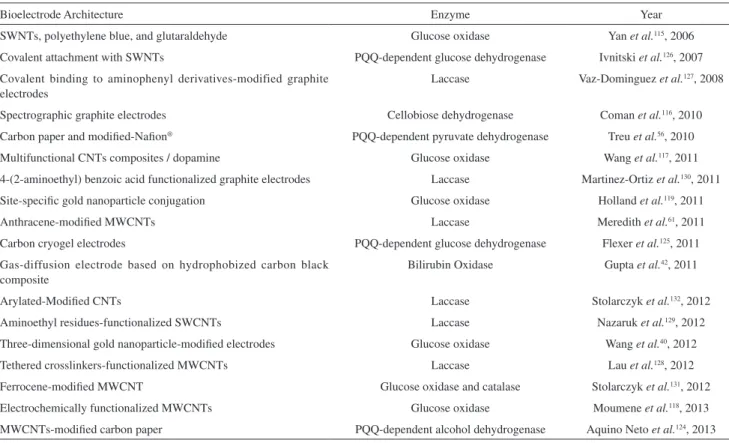
of 201.7 µA cm-2.61 Table 2 summarizes some DET studies
on enzymatic biofuel cells.
Table 2. Summary of DET studies on enzymatic biofuel cells
Bioelectrode Architecture Enzyme Year
SWNTs, polyethylene blue, and glutaraldehyde Glucose oxidase Yan et al.115, 2006 Covalent attachment with SWNTs PQQ-dependent glucose dehydrogenase Ivnitski et al.126, 2007 Covalent binding to aminophenyl derivatives-modified graphite
electrodes
Laccase Vaz-Dominguez et al.127, 2008
Spectrographic graphite electrodes Cellobiose dehydrogenase Coman et al.116, 2010
Carbon paper and modified-Nafion® PQQ-dependent pyruvate dehydrogenase Treu et al.56, 2010
Multifunctional CNTs composites / dopamine Glucose oxidase Wang et al.117, 2011
4-(2-aminoethyl) benzoic acid functionalized graphite electrodes Laccase Martinez-Ortiz et al.130, 2011 Site-specific gold nanoparticle conjugation Glucose oxidase Holland et al.119, 2011
Anthracene-modified MWCNTs Laccase Meredith et al.61, 2011
Carbon cryogel electrodes PQQ-dependent glucose dehydrogenase Flexer et al.125, 2011 Gas-diffusion electrode based on hydrophobized carbon black
composite
Bilirubin Oxidase Gupta et al.42, 2011
Arylated-Modified CNTs Laccase Stolarczyk et al.132, 2012
Aminoethyl residues-functionalized SWCNTs Laccase Nazaruk et al.129, 2012
Three-dimensional gold nanoparticle-modified electrodes Glucose oxidase Wang et al.40, 2012
Tethered crosslinkers-functionalized MWCNTs Laccase Lau et al.128, 2012
Ferrocene-modified MWCNT Glucose oxidase and catalase Stolarczyk et al.131, 2012
Electrochemically functionalized MWCNTs Glucose oxidase Moumene et al.118, 2013
2.4. Bioelectrode characterization
Electrochemical techniques
Electrochemistry focuses on the relationship between the chemical and electrical effects of a target process.133
Among the various available electrochemical techniques, enzymatic biofuel cell studies generally use cyclic voltammetry, polarization curves, and impedance measurements to gain better insight into the enzymatic system. Researchers employ these techniques to evaluate both semi-cell and complete biofuel cell and to asses mediator species by voltammetry and amperometry. Cyclic voltammetry is a simple and fast technique to initially characterize the reversibility of redox processes occurring on an enzymatic-based device. Normally, analysis of the voltammetric profile of a given system furnishes information about anodic and cathodic processes and gives the amount of electrons transferred in each case.133
Electrochemical characterization reveals how mediator species behave in enzymatic biofuel cells performing MET; (i.e., in cells where the enzymes do not establish direct contact with the electrode surface). As discussed earlier, the thermodynamic driving force of an MET biofuel cell lies on the difference between the redox potentials of the mediator species and the enzyme redox center. Hence, electrochemical characterization, which generally relies on the cyclic voltammograms of the targeted species, helps one to obtain better electronic shuttle between the enzymes and the electrode surface. Many literature papers on enzymatic biofuel cells employ this electrochemical tool to characterize different mediator species such as osmium and ruthenium-based complexes, ferrocene, and organic dyes with distinct voltammetric behavior.5, 16, 86 When the
enzymes are in direct electric contact with the electrode surface, the electrochemical profile refers to the catalytic redox process of a particular biomolecule. Several literature examples have used cyclic voltammetry to confirm the direct electrochemistry of redox proteins and different electrode materials, such as carbon and gold.124, 134-136 At
this point, it is worth highlighting the need to improve the electrochemical characterization of the active site of the enzyme. Indeed, this can promote better catalytic activity and electron transfer rate within the biodevice. Such feat constitutes a future goal in protein engineering, and shall help mimic active sites instead of regular biocatalysts on the electrode surface.137
The most often employed electrochemical tool in enzymatic biofuel cells is the power curve. Such curve displays the potential or the current profile as a function of the power density of a given system; it simplifies the most significant result expected from a fuel cell; i.e., the
generation of electrons. Osman et al.10 elegantly described
the whole process occurring in a power curve, from the OCV to zero. In general, this curve includes three steps: the first potential decrease corresponds to activation overpotential; the second decline refers to the ohmic drop; and the third process results from mass transport effects.10
Recently, electrochemical impedance spectroscopy has also received considerable attention in the field of bioelectrodes characterization, mainly because it is sensitive and non-destructive.138-140 This technique clarifies many of
the electrical properties of a biological device and the resistances involved in a biofuel cell, specifically in the case of the electron-transfer processes occurring on both the anode and the cathode sides. Such situations are critical during the fabrication of prototypes, because all the internal resistances of the operating device will directly affect the system power.141
Spectrophotometry, fluorescence and electronic microscopy The Michaellis-Menten model provides one of most relevant qualitative descriptions of the relationship between enzymes and substrates. This model is widely used in enzymatic kinetic characterization studies, and the function extracted from the curve of reaction rate vs substrate
amount is a rectangular hyperbola.142 Not all the enzymes
fit the Michaellis-Menten model, even though cannot be considered a standard mechanism for all enzymatic reactions, it is useful in most cases. Using statistical calculations, the Michaellis-Menten equation furnishes both the maximum susbtrate conversion rate and the well-known Michaellis-Menten constant, Km, which indicates
the enzyme specificity toward a given substrate. Another parameter of great importance in enzymatic kinetics is the turnover number (Kcat), which provides the maximum number of substrate molecules that is converted to product per active site of enzyme per unit of time. Considering that all these kinetic data are normally determined for the enzyme in solution, an intersting way to obtain more clues about how the immobilization procedure affects the enzyme is to determine the kinetic parameters using the immobilized enzyme itself. This kind of assay can be very helpful to compare the effectiveness of the different enzyme methodologies and to calculate the amount of enzyme that remains active after application of different protocols. Considering the immobilization effect, literature data have suggested that the kinetic behavior of an immobilized enzyme follows a particular pathway or retains the same substrate affinity after the anchoring procedure.143, 144 This
or oxidation or reduction of the cofators (such as the very often employed NAD+ and ABTS).143-145
In studies involving enzymatic biofuel cells, fluorescence measurements help assess how the enzyme and the support interact. These measurements also provide information about enzyme occupation, distribution, and stability.5 The interaction between dehydrogenase
enzymes and hydrophobically modified chitosan is a good example of how the fluorescence technique aids bioelectrode characterization. Lau et al.146 investigated
the microenvironment of the immobilized enzyme malate dehydrogenase. These authors bound the fluorophore
acrylodan to the enzyme structure and measured the
fluorescence emission in the immobilized state. The fluorescent emission of the probe shifted towards the red as a result of increased dipole moment, indicating that the local environment became more hydrophilic. The authors claimed that appropriate modification of the enzyme microenvironment could enhance both the enzymatic activity and power density.146 Konash et al.147 studied how
different fluorophore species interact with the enzyme alcohol dehydrogenase and immobilizing agents. These authors demonstrated that this fluorescence technique coupled with polarization and confocal microscopy was potentially applicable to visualize the polymer structure as well as the distribution of the incorporated species. Therefore, it is a very useful characterization tool to investigate how enzymes interact with polymeric matrixes.
The surface morphology of bioelectrodes has also been the target of much research. For this purpose, the main techniques employed in enzymatic biofuel cells are the physicochemical methodologies known as BET and Langmuir isotherms. X-ray diffraction analysis and scanning electron microscopy images (usually performed to evaluate film formation and thickness) are also described elsewhere. Isotherms normally help investigate bioelectrodes based on porous structures; they also provide the coverage profile.148 Reports on the composition and
morphology of bioelectrodes based on hydrogenase and functionalized MWCNTs,149 as well as papers on the
microstructure of the polypyrrole film containing entrapped ABTS molecules exist in the literature, too.108
2.5. Nanomaterials applied in bioanode structure and cell design
Advances in nanoscience and nanotechnology have enabled scientists to develop novel micro and nano electrodic materials. Moreover, immobilization methodologies can help improve both the biosensors and biofuel cells.150 To
solve one of the main limitations of enzymatic biofuel
cells; i.e., the low efficiency of the electron transfer between the active site of the enzyme and the electrode surface, new trends in biofuel cell catalysts design include incorporating materials at the nanoscale, such as carbon nanotubes, nanofibers, nanocomposites, as well as metallic nanoparticles, in the bioelectrode structure. The use of nanotechnology to develop bioelectrodes for enzymatic biofuel cells has recently received much attention.10
Nanostructured materials are an optimal environment to immobilize macromolecules: they provide larger surface area for enzyme immobilization, besides enhancing the efficiency of kinetic processes and allowing incorporation of higher enzyme load. Furthermore, the presence of these nanomaterials in the bioelectrode structure significantly enhances the bioelectrode electroactivity and provides efficient electrical contact between the enzyme active site and the electrode surface.10 Nanomaterials also improve
diffusional processes and reduce the redox potential of many mediator species used in MET enzymatic devices.137
The sum of these contributions tends to significantly raise the output power density values furnished by a biofuel cell, besides increasing the lifetime of the immobilized enzyme.20
Carbon nanotubes (CNT) have attracted considerable attention from the scientific community since their discovery in 1991. Their dimensions and extraordinary electronic, thermal, and mechanical properties have encouraged several studies, which showed that the presence of CNT significantly improves material properties.117, 151 The high
CNT electrical conductivity and its biocompatibility allows for their use as electrode constituent, so they are a promising material for enzymatic biofuel cells. CNT can favor both DET (by decreasing the electron transfer distance) and MET (by introducing redox molecules that assist the electron transfer process in CNT via functionalization or electropolymerization).20,117,150,151 To preserve the
conformational structure of immobilized enzymes, anchoring protocols employing CNT generally involve non-covalent interactions instead of chemical procedures. Hence, adsorption methods based on the hydrophobic interactions between the enzymes and CNT are usually employed.151 Furthermore, chemical modification of CNT
with carboxylic acid groups, to obtain better dispersion, increases their biocompatibility through coupling with the amine groups of the enzyme.152, 153 Enzymatic biofuel
have the ability to strongly interact with biomolecules, furnishing a highly conductive porous matrix. This feature favors diffusional processes and prevents enzyme loss, thus affording multifunctional materials.136, 154-157
Likewise, metallic nanoparticles have also drawn the attention of researchers in various fields, including bioelectrochemistry. The most important characteristics of this material include increased surface area per volume, excellent electron transport, and high catalytic power. In the case of enzymatic biofuel cells, the incorporated metallic nanoparticles act as electron “carriers” between the enzyme and the solid substrate, improving the bioelectrocatalytic process. This undoubtedly constitutes the major advantage of incorporating metallic nanoparticles along with biomolecules. Furthermore, enzymes and nanoparticles have similar sizes, so it is possible to reduce the electron transfer distance without affecting the enzyme activity.158
Therefore, combining nanoparticles that exhibit unique electronic and catalytic properties with biomaterials that display incomparable catalytic and specificity behavior can furnish high-performance hybrid nanobiomaterials.26
The literature brings different possibilities to incorporate metal nanoparticles in systems containing biomolecules. Most papers have focused on the preparation of hybrid bioelectrodes containing gold and platinum nanoparticles.26
Gold nanoparticles present high biocompatibility and excellent conductivity; metallic platinum has similar properties, as well as excellent electrocatalytic power.159
Amperometric glucose sensors and sugar/O2 enzymatic
biofuel cells are good examples of incorporation of platinum nanoparticles along with biomolecules.137,160
The literature brings good examples on the preparation of biosensors and mediatorless enzymatic biofuel cells based on glucose and fructose oxidation, along with gold nanoparticles.40,137,161,162
2.6. Implantable enzymatic biofuel cells
The possible applications of enzymatic biofuel cells cover low-power portable devices; their use as battery for implantable devices is the ultimate aim. Enzymes normally operate in physiological conditions, catalyzing complex reactions in many organisms, so applying them in implantable devices makes much sense.19 Since the
first description of electricity generation as the sole result of glucose oxidase catalysis,9 scientists have seeked
application of biofuel cells in cardiac pacemakers (used to regulate the cardiac rhythm by applying small electrical charges to the myocardial tissue) that employ glucose as fuel. Currently pacemakers operate with a lithium-iodine battery at a power output around 10 µW, which represents
an energy density of 1 W h mL-1. The lifetime of these
pacemakers is higher than 10 years.163-165 The advantage
of an implantable enzymatic biofuel cell is that it would continuously furnish electricity, because it could be possible to continuously replace the substrate.19 Despite
the lower power density generated by implantable biofuel cells, which normally lies in the range of some microwatts, these cells can satisfactorily provide the required energy inside many living organisms. At this point, the biological stability of the employed enzyme is the major drawback and is obviously the parameter that requires the most attention for practical purposes. Mass transfer issues also matter in an implantable enzymatic device. The output power depends on the amount of fuel, because substrate concentration in fluids is normally very low. The electrical connection and the surgical procedures involved in battery implantation also demand attention. Finally, the toxicity of some compounds employed in an enzymatic fuel cell, such as osmium-based mediators, must be overcome, so that viable implantable devices can be achieved.19 An excellent
review by Barton et al.19 has covered good examples of
implantable enzymatic devices, such as the preparation and characterization of a DET glucose/O2 biofuel cell
operating in human serum presented by Coman et al.116 The
complete biofuel cell supported on rods of spectrographic graphite electrodes reached a power density of 4 µW cm-2 and an OCV of 0.58 V. Implantable technology is
challenging, and obtaining electrical power from a small living organism is even more difficult. Cinquin et al.166
fabricated a functional implantable glucose/O2 biofuel cell working in the retroperitoneal space of freely moving rats. The innovation of this work lay on the simple mechanical confinement of various enzymes and redox mediators. Sales et al.167 also prepared an implantable enzymatic fuel
cell in a living rat. The authors conducted assays under physiological conditions using glucose from the rat blood as the anodic fuel and dissolved oxygen as the oxidizing agent in the cathode side.167 Rasmussen et al.168 implanted
an enzymatic biofuel cell based on trehalose oxidation and oxygen reduction in a living insect.The authors designed the bioelectrodes on the basis of a bienzymatic trehalase/ glucose oxidase in the anode side; the cathode material consisted of bilirubin oxidase grafted along with osmium complexes on thin carbon fibers. Halamkova et al.169