596 J. C. Xavier
A simple way to avoid metastable configurations in the density-matrix renormalization-group
algorithms
J. C. Xavier
Instituto de F´ısica, Universidade Federal de Uberlˆandia, Caixa Postal 593, 38400-902 Uberlˆandia, MG, Brazil
(Received on 3 June, 2009)
We use the spin-1 Heisenberg chain with periodic boundary conditions to ilustrate that the systems get stuck in metastable configurations only when the density-matrix renormalization-group algorithm start with small number of statesm. We also show that the convergence of the energies have a huge improvement if we start the algorithm with a large number of statesm.
Keywords: spin model, DMRG, spin-1
The density-matrix renormalization-group [1, 2] (DMRG) is one of the most appropriate techniques to study static prop-erties of the one-dimensional systems at zero temperature (for a review see, for example, Refs. 3 and 4). It is also possible to calculate dynamic properties [3–7] and work at finite-temperature through the DMRG [8–10]. The main ad-vantage of DMRG, compared with the Lanczos exact diag-onalization [11], is its capability to obtain the ground-state properties of very large systems in a well controlled way. Note that it is also possible to investigate large systems by Monte Carlo methods. However, the Monte Carlo technique is not appropriated to study frustrated/fermionic systems due to the “sign” problem.
Although the DMRG algorithm was developed for one-dimensional systems, it has been used to treat two-dimensional systems [12–17]. The procedure consists in mapping the low-dimensional model on an one-dimensional model with long range interactions. As first point out by Liang and Pang [12], the energies of two-dimensional tems, converge slower than the ones of one-dimensional sys-tems with short range interactions. The number of states needed to keep a fixed accuracy seems to increase exponen-tially with the width of the system.
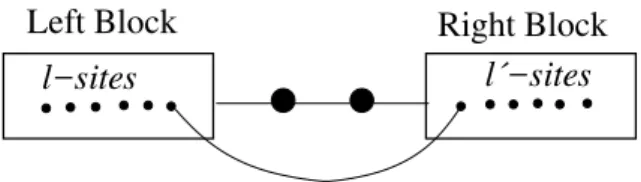
A similar effect also appears when we study one-dimensional systems with periodic boundary condition (PBC) [1, 2]. Since the DMRG was developed, it was ob-served that the ground state energy (as a function of the num-ber of statesmkept in the truncation process) converge faster for the system with open boundary condition (OBC) than the one with PBC. Although it is not completely understood, it seems that everytime that an operator that acts in theleft blockis directly connected with an operator that acts in the right block(see Fig. 1), the ground state energy convergence is slower. This has been observed for one-dimensional sys-tems as well for the two-dimensional syssys-tems.
Another difficulty also appears when the left and right blocks are directly connected. Some times, in the simula-tions, the system gets stuck in some local minimum of energy (see Fig. 3(a)), even working with large values ofm[18, 19]. This is a serious problem. If the energies do not change in-creasingm, we may think naively that the true ground state energy was reached. But in fact, the energy found is far from the true ground state.
Few years ago [19], White proposed a variation of the density-matrix renormalization-group algorithm with a sin-gle center site. This new algorithm has the advantage of (i)
Right Block
Left Block
l−sites
l´−sites
FIG. 1: A schematic representation of a system with sizeL=l+ l+2 sites for the standard DMRG method with two center sites. The left (right) block containl(l)sites. The solid lines represent the interactions.
decreasing the computation time as well as the memory used, and more important, (ii) to avoid that the system gets stuck in metastable configurations. As discussed by White [19], the main reason that the simulations get stuck in metastable configurations is due to the fact that some important fluctu-ations between the system and environment are absent. This happens because the environment blocks lost some relevant states in the truncation process [20]. In order to incorporate the missing states for those fluctuations, White suggests that we have to add in the density-matrixρsmall terms like [19]
∆ρ=a
∑
iA+i ρAi+h.c. (1)
for each operatorAithat is connected directly with the envi-ronment. The constantais a small free parameter, the mag-nitude ofais chosen to vary froma∼10−2
−10−4[19].
In fact, using the one-dimensional spin-1 Heisenberg model with PBC as a test, White found that single-site DMRG method with the correction to the density-matrix, gets lower energy than the standard two-sites DMRG method [19].
It is very important to note that, in the standard DMRG algorithms, White shown [1, 2] that the new blocks built in the renormalization process arebetter representedby the fol-lowing transformation:Hnew
sis =OHsisoldO†. Where the rows of Oare themeigenvectors of the density-matrixρthat are as-sociated with the largest eigenvalues. So, if we add in the density matrix the term∆ρ, the matrixOwill not have any-more all the optimal states. Actually, it is quite surprising that the DMRG with the correction in the density matrix gets a lower energy.
Brazilian Journal of Physics, vol. 39, no. 3, September, 2009 597
Environment System
L L=6 L=4
Part−1
Part−2
Part−3
(L/2−1)−sites (L/2−1)−sites
L/2−sites (L/2−2)−sites
(L/2+1)−sites (L/2−3)−sites
(L−4)−sites
(L−3)−sites
(L−4)−sites
(L/2−1)−sites (L/2−1)−sites
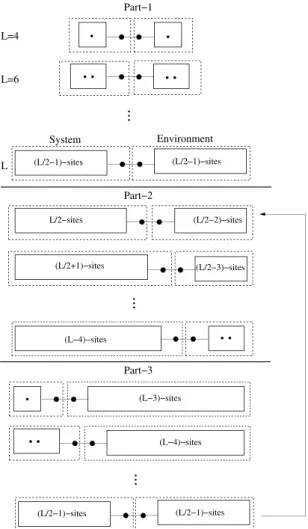
FIG. 2: A schematic representation of the DMRG algorithm with two center sites for a finite system with sizeL. The right and left blocks are represented by solid line rectangles, while the system and environment by the dotted line rectangles. In the first part of the algorithm, we add two new center sites at each interaction until reach the desized size.
the DMRG method with two center sites demand more CPU time and memory. But as we see, it has the advantage of ob-taining lower energy than the single-site DMRG method with correction in the density-matrix. Besides that, it is free of non-controlled parameters, and more important, the transfor-mation matrixOis built considering only the optimal states. As a benchmark test, in this work, we consider the one-dimensional spin-1 Heisenberg model
H=J
∑
iSi·Si+1,
where the couplingJwas set to unity to fix the energy scale. We investigated the model above with DMRG technique with OBC and PBC. We use the finite-size algorithm for sizes up toL=100 and keeping up tom=4000 states per block in the final sweep. The discarded weight, 1−Pm, was typically about 10−6
−10−13in the final sweep (see Fig. 4(b)).
Before presenting the results, let us first briefly describe the DMRG algorithm for finite-size systems, which is cru-cial in our discussion. We can divide the finite-size DMRG algorithm in three parts, as illustrated in Fig. 2. In the first
FIG. 3: The error in the energy∆Efor the one-dimensional spin-1 Heisenberg model with sizeL=100 and PBC. (a)∆Eas function of the sweeps. The arrows indicate the value ofmin that sweep. (b) ∆Evs.mfor some values ofm0(see text).
part, we use the standard infinite system density-matrix al-gorithm until reach the desired lattice size. This first part of the algorithm is used only once to obtain the environment blocks that will be used in the second part of the algorithm. As we see later, the fact that the system gets stuck in some metastable configurations is related with this part of the al-gorithm. Once we reach the desired size we start to sweep, as illustrated in Fig. 2. Note that in the third part of the al-gorithm the environment blocks are those blocks built in the second part of the algorithm. Usually, all the measurements are done in last iteration of the third part of the algorithm (the symmetric configuration).
In general, if we want the ground state energyE0(L,m)of a system with lattice sizeLandm=mf inalstates per block, we start the first part of the algorithm withm0<mf inal (typ-ically is usedm0∼50−100). We increase at each sweep the
states kept in the truncation process until we reach the final valuemf inal.
598 J. C. Xavier
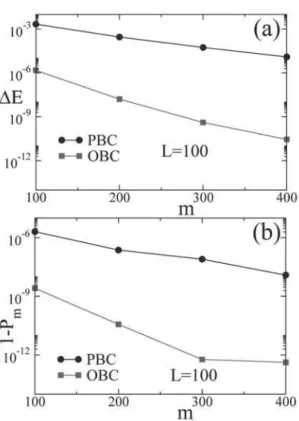
FIG. 4: (a)∆E vs. mfor the one-dimensional spin-1 Heisenberg model with lattice sizeL=100 under PBC (filled cicles) and OBC (filled squares). (b) The truncation error 1−Pmvs.m.
in fact, the energy is still far from the true ground state. In order to avoid this serious problem, as we mentioned before, White proposed to add in the density-matrix the small term ∆ρdefined in Eq. 1. By using this new approach, White was able to improve the convergence up to two orders of magni-tude [19].
In this article, we show another simple procedure to avoid that the system to get stuck in metastable configurations. Our main result is presented in Fig. 3(b). In this figure, we show the error in the energy as function ofmfor different values of m0. We clearly see that if we start the first part of the DMRG
algorithm with a small value of m0(filled triangles down),
the convergence is much worse than the one that started with m0=mf inal (filled circles). From this observation, we con-clude that a simple way to gain a huge improvement in the convergence is to start the algorithm with large values ofm0.
And more important, if we start withm0=mf inalthe system does not get stuckin metastable configurations. We empha-size that the system gets stuck in metastable configurations, as we observe in Fig. 3(b), due to the fact that some impor-tant states were missed in the truncation processin the first partof the algorithm.
It is also important to observe that the difference of the en-ergies obtained withm0=mf inalandm0=mf inal/2 is very
small. In particular form=mf inal=800 this difference is 2x10⁻⁷. So, we can save CPU time starting the DMRG
algo-rithm withm0=mf inal/2, and even so, we still obtain results with a very high accuracy.
In Table 1, we show some energies obtained using the standard DMRG algorithm with two center sites (standard two-sites) and m0=mf inal/2 for two values ofmf inal. We also present the energies (taken from Ref. 19) obtained with the single-site DMRG method with the correction to the density-matrix (corrected single site). Note that the energies obtained by the standard DMRG with two center sites are slightly lower than the ones acquired by White in Ref. 19.
mf inal 340 4000
standard two-sites -140.148 370 -140.148 403 904 64
corrected single-site -140.148 279 -140.148 403 903 92
TABLE I: The ground state energies of the spin-1 Heisenberg chain with lattice sizeL=100 and PBC for two values ofmf inal. The
energies for the single-site DMRG method with the correction was taken from Ref. 19. We usem0=mf inal/2 in the standard DMRG
with two center sites.
Finally, we point out that indeed the convergences of the energies have a significant improvement if we use m0=
mf inal(orm0=mf inal/2) instead ofm0=50 for the model
under PBC. However, the energies obtained with PBC still converge much slower than the ones with OBC, as we can observed in Fig. 4(a). As we can see in this figure, if we use OBC andm=400 we basically obtain the ground state energy with the precision of the computer. Similar behavior is also found in the truncation error 1−Pm, as presented in Fig. 4(b).
In conclusion, in this work we study the one-dimensional spin-1 Heisenberg model with periodic/free boundary con-ditions. We shown that the standard DMRG algorithm with two center sites gets stuck in metastable configurations only when few states are selected in the grow process (the first part of the algorithm, where is used the infinity size algo-rithm). A simple way to obtain a huge improvement in the convergence is to start the algorithm with the same numbers of states of the final sweep. Even using this procceding, we observe that the convergence of the ground state energy for the system under periodic boundary condition is slower than the one with open boundary condition. Finally, our results suggest that it may be possible also that a similar improve-ment can be reached with this approach if it is consider the single-site DMRG algorithm without the correction to the density-matrix.
Acknowledgments
This work was supported by Brazilian agencies FAPEMIG and CNPq.
Brazilian Journal of Physics, vol. 39, no. 3, September, 2009 599
[3] U. Schollw¨ock, Rev. Mod. Phys.77, 259 (2005). [4] K. Hallberg, Adv. Phys55, 477 (2006). [5] K. A. Hallberg, Phys. Rev. B52, R9827 (2006). [6] E. Jeckelmann, Phys. Rev. B66, 045114 (2002).
[7] T. K. K¨uhner and S. R. White, Phys. Rev. B60, 335 (1999). [8] R. J. Bursill, T. Xiang, and G. A. Gehring, J. Phys.: Condens.
Matter8, L583 (1996).
[9] X. Wang and T. Xiang, Phys. Rev. B56, 5064 (1997). [10] N. Shibata, J. Phys. A: Math. Gen.66, R381 (2003). [11] E. Dagotto, Rev. Mod. Phys,66, 763 (1994). [12] S. Liang and H. Pang, Phys. Rev. B49, 9214 (1994). [13] S. R. White, Phys. Rev. Lett.77, 3633 (1996). [14] D. J. J. Farnell, Phys. Rev. B68, 134419 (2003).
[15] T. Xiang, J. Lou, and Z. Su, Phys. Rev. B64, 104414 (2001). [16] J. C. Xavier and E. Dagotto, Phys. Rev. Lett.100, 146403
(2008).
[17] H. C. Jiang, Z. Y. Weng, and D. N. Sheng, Phys. Rev. Lett. 101, 117203 (2008).
[18] S. R. White and D. J. Scalapino, Phys. Rev. Lett. 80, 1275 (1998).
[19] S. R. White, Phys. Rev. B72, 180403(R) (2005).
[20] Note that some trials, such as adding extra random states, were tested. However did not work very well (see Ref. 19). [21] We usem0=2000, in the first part of the algorithm, to obtain
the energyE(L,4000).
[22] Form>2000 we did two sweeps.