The blackbody radiation in a
D
-dimensional universes
A radia¸c˜ao de corpo negro em um universosD-dimensional
Tatiana R. Cardoso and Antonio S. de Castro
1Departamento de F´ısica e Qu´ımica, Universidade Estudual Paulista ‘J´ulio de Mesquita Filho’, Campus de Guaratinguet´a, Guaratinguet´a, SP, Brasil
Recebido em 30/05/2005; Aceito em 26/09/2005
The blackbody radiation is analyzed in a universe withDspatial dimensions. Using the classical electrody-namics suited to the a D-dimensional universe and employing hyperspherical coordinates, the spectral energy density as well as the total energy density are calculated as function of the dimensionality of the universe. The Wien’s displacement law and the Stefan-Boltzmann law are properly generalized.
Keywords:blackbody,D-dimensions, extra dimensions, hyperspherical coordinates
A radia¸c˜ao de corpo negro ´e analisada em um universo comDdimens˜oes espaciais. Usando a eletrodinˆamica cl´assica consonante com a dimensionalidade do universo, e empregando o sistema de coordenadas hiperesf´ericas, tanto a densidade de energia espectral quanto a densidade de energia total s˜ao calculadas em fun¸c˜ao do n´umero de dimens˜oes espaciais. A lei do deslocamento de Wien e a lei de Stefan-Boltzmann s˜ao apropriadamente gene-ralizadas.
Palavras-chave: corpo negro,Ddimens˜oes, dimens˜oes extras, coordenadas hiperf´ericas
1.
Introduction
The space dimensionality can be specified by the num-berD, whereD+ 1 is the maximum number of points which are equidistant from each other. The dimension-ality of the space in which we live, the physical space, is not derived from any physical law but we perceive that we can move ourselves in three distinct directions: to the left and to the right, forward and backward, up-ward and downup-ward. Therefore, it is convenient for most of the purposes to take for granted that we live in a three-dimensional universe. Obviously this percep-tion of dimensionality is condipercep-tioned by the limitapercep-tions of our senses, and a possible world with more than three dimensions would be properly detected by means of ex-periments realized in laboratories.
A number of theories involving the unification of the fundamental physical interactions, such as Kaluza-Klein [1] and superstring theories [2]-[3], demand physi-cal universes encompassing extra spatial dimensions. It is argued that those extra dimensions do not manifest themselves neither to our sensory experiences nor to the laboratory experiments because such extra dimensions are curled up into dimensions of the order of 10−33
cm, an extremely small size to be perceived by our senses
or even to be detected by experiments. Physical the-ories in lower dimensions are also interesting not only as simpler models for the “realistic” three-dimensional world but also for exhibiting some peculiarities that make them different from the 3-dimensional physical theories [4]-[5].
The growing interest in the physics of multidimen-sional universes calls for a pedagogical approach of a few topics of physics that are usually explored only in the three-dimensional space. The classical electrodynam-ics in a universe with one and two spatial dimensions has already received a didactic treatment by Lapidus [6]. The author also speculated about the classical elec-trodynamics in a D-dimensional universe. Inspired by Lapidus’s work [6], the present paper analyzes the in-fluence of the space dimensionality in the blackbody radiation, one of the first topics the students face at their beginning studies on quantum theory.
The present analysis of the blackbody radiation in a D-dimensional universe follows the standard proce-dure for counting the number of standing wave modes in a cavity (see, e.g., [7]-[8]). Nevertheless, the classi-cal electrodynamics consonant with the dimensionality of the universe in question is used. As a sake of
com-1E-mail: [email protected].
pleteness, a few criticisms to the literature are also pre-sented. By employing the hyperspherical coordinates, it is shown that both the spectral energy density and the total energy density are dependent on the dimen-sionality of the universe. Wien’s displacement law as well as the Stefan-Boltzmann law are properly gener-alized. Finally, the readers are instigated to generalize the results for the specific heat of a crystalline solid and the mean particle energy of the ideal Bose gas in a
D-dimensional universe.
2.
Caveats
Lapidus [6] argues that the electric field in a one-dimensional universe obeys the wave equation. That statement induces unwary readers to guess about the propagation of electric waves in such a universe. Truly speaking, neither there are electric waves nor electro-magnetic waves. In such one-dimensional universe the magnetic field is absent and “Maxwell equations” are given by [6]
∂E ∂x =
ρ ε0
, ∂E
∂t =− J ε0
(1)
whereε0is the permittivity of free space. The charge
and current densities satisfy the equation of continu-ity: ∂ρ/∂t+∂J/∂x= 0. In the absence of sources the only possible configuration for the electric fieldE is to be homogeneous and static. A homogeneous and sta-tic electric field always satisfies the wave equation in a trivial way but it is obvious that there is no electromag-netic wave in a one-dimensional universe. The absence of magnetic fields in such one-dimensional universe re-inforces our argument. This remark naturally restricts the considerations of the cavity radiation for universes with D > 1. In order to calculate the electromag-netic modes confined in a cubic cavity, the authors of Refs. [7]-[8], for pedagogical purposes, consider first the modes in a one-dimensional cavity. We emphasize, how-ever, that the calculation refers to the one-dimensional cavity embedded in the three-dimensional world and not a cavity in the one-dimensional world. This argu-ment is strengthen by noting that the authors consider two possible directions for the polarization of the elec-tric field. This observation refuses the statement of the authors of Ref. [8], when they remark that the num-ber of modes in one-dimensional and three-dimensional cavities depend on different powers for frequencies just because the dimensionality of the corresponding uni-verses are different.
The above observations illustrate the subtle and cru-cial role of the dimensionality of the universe concerning the propagation of electromagnetic waves.
3.
Cavity radiation in a
D
-dimensional
universe
The blackbody radiation law is customarily formulated in terms of the electromagnetic energy density inside a cavity into the frequency range betweenν andν+dν. Thus, one must know the density of states in the inter-valdν and multiply it by the average energy.
Let us consider the electromagnetic radiation in thermal equilibrium in a metallic cavity with the shape of aD-dimensional cube (hypercube2) whose walls are
maintained at the absolute temperatureT. Choosing a system of orthogonal Cartesian coordinates with origin at one of the vertices of the cube and axes parallel to their edges, one can write the components of the elec-tric field corresponding to the standing waves in the cavity as
Ea(xa, t) =Ea(0)sin(|κa|xa) sin(2πνt) (2) whereEa(0) is the amplitude of thea-th component of the electric field oscillating with frequencyν,κa is the component of the wave number, and a = 1,2, . . . D. The electric field must vanish at the walls of the cavity so that the components of the wave number satisfy the conditions
|κa|=
π
Lna, na= 1,2,3, . . . (3)
whereLis the length of the edge of the cube. Therefore, the number of possible modes for the electric field in a given state of polarization, into the interval betweenκa andκa+dκa, is given by
NP(κa)dκa=
L
2πdκa. (4)
The presence of the factor 2 in the denominator of (4) allows us to consider that the components of the vector wave number have positive as well as negative values.
The total number of modes in the cavity is the prod-uct of the possible modes in each Cartesian axis:
NP(|κ|)d|κ|= D
a=1
NP(κa)dκa=V
dVκ
(2π)D (5)
whereV =LD is the volume of the cavity anddV κis the infinitesimal D-dimensional element of volume in theκ-space,viz.
dVκ= D
a=1
dκa (6)
This element of volume is, as a matter of fact, a volume which fills the space between the (D−1)-dimensional hyperspherical shells3 centered about the origin with
radii|κ|and|κ|+d|κ|.
2Square in the caseD= 2, cube in the caseD= 3.
In a D-dimensional world the electric field has D
components and the magnetic field has D(D−1)/2 components [6]. Since the electromagnetic waves are transverse, one can conclude that the electric field has
D−1 mutually perpendicular components standing at right angles to the direction of the wave propagation. In other words, there areD−1 possible directions of polar-izations for the electric field4. In this way, the number
of possible modes, including all possible polarizations of the electric field, is
N(|κ|)d|κ|= (D−1)V dVκ
(2π)D (7) To evaluatedVκit is convenient to consider to the hy-perspherical coordinates. The hyhy-perspherical coordi-nates in a space withDdimensions (D >1) are related to the cartesian coordinates by [9]:
x1 = rcosθ1sinθ2. . .sinθD−1
x2 = rsinθ1sinθ2. . .sinθD−1 (8) xa = rcosθa−1sinθa. . .sinθD−1,
for 3≤a≤D−1
xD = rcosθD−1,
in such a way that the distance of a point to the origin is expressed in terms of the Cartesian coordinates as
r=
a=D
a=1 x2a. In addition,
0≤θ1≤2π, and 0≤θa≤π
for 2≤a≤D−1. (9)
TheD-dimensional element of volume5and the (D−
1)-dimensional element of solid angle6are given by
D
a=1
dxa=rD
−1 dr dΩ,
dΩ = D−1
a=1
(sinθa)a
−1
dθa. (10)
For calculating the total solid angle, instead of proceed-ing with the calculation of the integrals by brute force, some special functions are used. The beta function,
B(z, w), can be defined as [10]
B(z, w) = 2 π/2
0
(sinθ)2z−1
(cosθ)2w−1 dθ
(11)
= Γ(z)Γ(w)
Γ(z+w), Re(z)>0, Re(w)>0,
where Γ(z) is the gamma function
Γ(z) =
∞
0
yz−1 e−y
dy. (12)
Then, knowing that Γ(1/2) =√π, one can write
π
0
(sinθa)a
−1
dθa=√π Γa
2
Γa+1 2
, (13)
in such a manner that the total solid angle is given by
Ω = 2πD/2×
1
a=D−1
a=2 Γ(a
2)
Γ(a+1 2 )
, forD= 2
, forD≥3 (14)
Writing Ω in the compact form
Ω = 2π D/2
Γ(D/2), (15)
one can finally express dVκas
dVκ= 2πD/2
Γ (D/2)|κ| D−1
d|κ|. (16)
Note that if the signs ofκawere restricted only to posi-tive values, the factors 2 and 2Din the denominators of (4) and (7), respectively, would be absent. In this cir-cumstance only the infinitesimal element of volume in the space κcorresponding toκa>0 should be consid-ered, implying that the result expressed by (16) should be divided by 2D for restrict itself to a 2D-ant7.
Since|κ|= 2πν/c, wherecis the speed of the elec-tromagnetic wave, the number of modes with frequen-cies betweenν andν+dν can be written as
N(ν)dν= (D−1)V 2 Γ (D/2)
√
π c
D
νD−1dν. (17)
Now, each mode has an average energy given by Planck’s radiation formula independently of the dimen-sionality of the universe [7]-[8],i.e.,
¯
E= hν
exp (hν/kBT)−1
, (18)
where h and kB are the Planck and Boltzmann con-stants, respectively, in such a way that the energy den-sity8within the interval betweenν andν+dνis given
by
ρT(ν)dν= 2
√
π c
D
D−1 Γ (D/2)×
hνD exp (hν/kBT)−1
dν. (19)
4If the remarks in Section 2 were not considered, one might conclude that there are no electromagnetic waves in an one-dimensional
universe but there might be longitudinal electric waves. This last possibility, however, only can be excluded by the analysis of Maxwell’s equations expressed by (1).
5Element of area in the caseD= 2. 6
Element of plane angle in the caseD= 2.
7A quadrant in the caseD= 2, an octant in the caseD= 3, and so on.
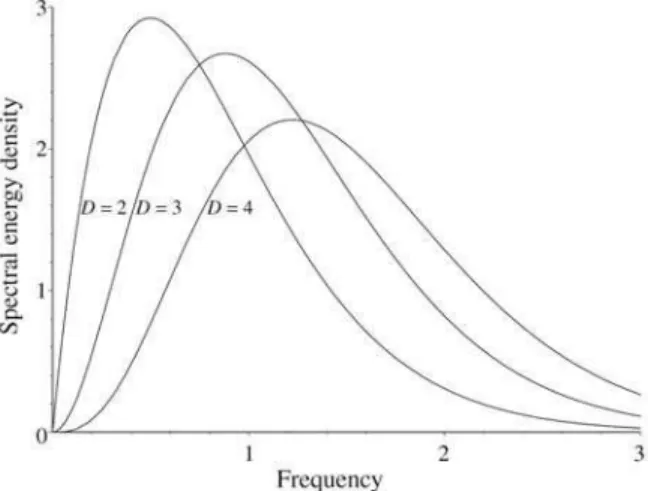
This is the mathematical expression for the Planck blackbody spectrum in a D-dimensional universe. It gives the spectral distribution for the energy in the cavity. Fig. 1 illustrates the spectral energy density (energy density per unit frequency) for the particular casesD= 2,3 and 4, forT = 1500 K9.
Figure 1 - Spectral energy density as a function of ν for T = 1500 K. Using the physical constants in SI, the frequency must be multiplied by 1014 in order to be expressed in Hz,
whereas the spectral energy density must be multiplied by 10−23,
10−17 and 10−11 in order to have the units W
·m−1·Hz−1,
W·m−2·Hz−1 and W·m−3·Hz−1, in the casesD= 2, 3 and 4, respectively.
The result known as Wien’s displacement law, re-lating the frequency, where the the spectrum reaches a maximum, with the temperature, i.e. νmax/T =
α = const, is valid independently of the universe di-mensionality. Nevertheless, the constantαincreases as the number of the dimensions of the universe increases. Indeed, substitutingx=hνmax/kBT in (19) and mak-ingdρT(x)/dx= 0, one finds
e−x
= 1− x
D. (20)
Eq. (20) has as positive solution10
x=D+W
−De−D
, (21)
whereW is the Lambert function defined as [11]
W(z) +eW(z)=z. (22) Note that ifxis a function of the space dimensionality forD >1, it is a monotonic increasing function. This happens because the second term at the right hand side of (21) is a monotonic increasing function forD >1 and tends asymptotically to zero asD→ ∞. Of course, the very same conclusion concerning the behavior ofαas a function ofDcould be obtained in a simpler manner by
plotting Eq. (20). It should be mentioned, though, that the numerical solution of (20) becomes extremely easy by using computer algebra softwares which contains the LambertW function.
The total energy density in the cavity is obtained by integrating the spectral energy density over all fre-quencies,ρT =
∞
0 ρT(ν)dν, resulting in
ρT=aDTD+1. (23)
Using the identities [10]
Γ(z+ 1) =zΓ(z) and
Γ (2z) = 2
2z−1/2
√
2π Γ (z) Γ
z+1 2
, (24)
the constant of proportionalityaD can be written as
aD =
2
hc
D √
πD−1
kBD+1D(D−1)×
Γ
D+ 1 2
ζ(D+ 1), (25)
whereζ(z) is the Riemann zeta function [10]:
ζ(z) =
∞
n=1
n−z
, Re(z)>1, (26)
which can also be written in the form
ζ(z) = 1 Γ(z)
∞
0
yz−1
ey−1 dy. (27)
The radiation energy rate per unit area, known as the radiancy, is defined by the total energy emitted per unit time and per unit area of the cavity surface. The radiancy and the energy density in the cavity are re-lated by purely geometric factors. It results that such quantities are proportional to each other, as one will see.
The energy emitted by an infinitesimal element of areadA of the surface of the cavity in the interval of timedtoccupies a hemisphere (D−1)-dimensional with radiuscdtcentered aboutdA. The energy contained in a cylinder11 of length cdt, with inclination θ
D−1 with
respect to the Cartesian axisxD perpendicular to the element of area, is
dUT=ρTcdt dAcosθD−1. (28)
Nevertheless, only the fractiondΩ/Ω of the energy con-tained in the cylinder propagates in the direction spec-ified by the angleθD−1. Therefore, the energy emitted
in the direction specified by the angleθD−1is RT(θD−1) =ρTc
dΩ
Ω cosθD−1. (29) 9Due to errors on the scales of the abscissa and ordinate axes in the figures 1-1 and 1-8 in the Ref. [8], the comparison with the Fig.
1 can not be done.
10x= 0 is another possible solution.
In order to obtain the energy emitted all over possible directions one must integrate the previous expression over all angles that sweep the hemisphere. The results
RT =
ρTc Ω ×
2
π
θ
for D= 2
for D= 3
for D≥4,
(30)
where
θ= 2(
√
π)D−1 D−1
a=D−2
a=2
Γa 2
Γa+1 2
,
can even be written as
RT=
(√π)D−1
ΓD+1 2
ρTc Ω =
ΓD 2
ΓD+1 2
c
2√πρT. (31)
Now we are ready to establish the law which re-lates the radiancy with the temperature, the general-ized Stefan-Boltzmann law:
RT=σDTD+1, (32)
where the factor σD is the generalized Stefan-Boltzmann constant, given by
σD =
2
c
D−1
√
πD−2 kD+1
B
hD D(D−1)×
Γ
D
2
ζ(D+ 1). (33)
We conclude that the generalized Stefan-Boltzmann constant is a monotonic increasing function of the num-ber of space dimensions.
4.
Conclusions
We showed that the use of hyperspherical coordinates allows us to treat analytically the blackbody radia-tion in a D-dimensional universe. The case of one-dimensional cavities was excluded from the analysis by taking the possible independent directions for the po-larization of an electromagnetic wave into account.
Experimental results are consistent with the black-body radiation in a three-dimensional world. Since higher dimensional universes with such extra dimen-sions properly made compact were not considered, the possibility of higher dimensional universes can not be discarded by contrasting the experimental data with the analysis done in this work.
It is worthwhile to observe that the results of this paper would be the same if one had considered the pho-ton gas obeying the usual Bose-Einstein distribution. This is the case because one would had to consider that each photon with energy hν can haveD−1 possible states of polarization.
The formalism developed in this work can be used to generalize other quantities of the quantum theory in an easy way. For instance, the calculation of the vibration modes of atoms in an elastic solid, or the
number of states of a phonon gas, for the generaliza-tion of the Debye theory of the specific heat of a solid. In this scenario, diversely from the case of electromag-netic waves, longitudinal acoustic waves are feasible in a one-dimensional universe. It is anticipated that the specific heat at high temperatures behaves asCV =DR (the generalized Dulong e Petit law), where R is the universal gas constant, and that at low temperatures it behaves likeCV ∼TD. Another interesting subject is related to the Bose condensation. In this case the number of quantum states of the ideal gas with energy within the interval E and E +dE is proportional to
ED/2−1
dE, a result divergent atE= 0 forD= 1 and independent of E for D = 2. The calculations which lead to these results, as well as the calculation of the average particle energy of the ideal Bose gas (with a puzzle in the calculation of the number of particles for
D <3), are left to the readers.
Note added in proof
After the paper was submitted, we become aware of the more technical and quasi-homonymous “Black-body radiation in extra dimensions” by H. Alnes, F. Ravndal and K. Wehus (arXiv: quant-ph/0506131), up-loaded to the archives seventeen days later.
Acknowledgments
This work was supported in part funding agencies CNPq and FAPESP.
References
[1] R. Coquereaux and A. Jadezyk, Riemannian Geom-etry, Fiber Bundles, Kaluza-Klein Theories and All That...(World Scientific, Singapore, 1988).
[2] M. Green, J. Schwarz and E. Witten,Superstring The-ory (Cambridge University Press, Cambridge, 1987). [3] V.O. Rivelles, Ciˆencia Hoje23, 46 (1998).
[4] E. Abdalla, M.C.B. Abdalla and K.D. Rothe, Non-Perturbative Methods in 2-Dimensional Quantum Field Theory(World Scientific, Singapore, 1991).
[5] C.J. Efthimiou and D.A. Spector,A Collection of Exer-cises in Two-Dimensional Physics, Part. I, arXiv: hep-th/0003190.
[6] I.R. Lapidus, Am. J. Phys.50, 155 (1982).
[7] R.P. Feynman, R.H. Leighton and M. Sands,The Feyn-man Lectures on Physics (Addison-Wesley, Reading MA, 1964), v. I and III.
[8] R. Eisberg and R. Resnick,Quantum Physics of Atoms, Molecules, Solids, Nuclei, and Particles (Wiley, New York, 1974).
[9] A. Erdelyi, Higher Transcendental Functions
(McGraw-Hill, New York, 1953), v. 2.
[10] M. Abramowitz and I. A. Stegun,Handbook of Mathe-matical Functions(Dover, Toronto, 1965).