TEMAS LIVRES FREE THEMES
1 Centro de Ciências da Saúde, Universidade Federal do Acre. BR 364 km 04. 69917-769 Rio Branco AC Brazil. msnunes1@ yahoo.com.br
2 Programa de Computação Científica, Fundação Oswaldo Cruz. Rio de Janeiro RJ Brazil.
Stunting in children under five years old is still a health problem
in the Western Brazilian Amazon: a population-based study
in Assis Brasil, Acre, Brazil
Nanismo em crianças menores de cinco anos de idade ainda é um
problema de saúde na Amazônia Ocidental Brasileira: um estudo
de base populacional em Assis Brasil, Acre, Brasil
Resumo Apesar do processo de transição nutri-cional no Brasil, em alguns lugares, como a região amazônica, o nanismo ainda é um importante problema de saúde pública. Identificou-se a pre-valência e fatores associados ao déficit de cresci-mento em crianças menores de cinco anos de ida-de resiida-dentes na área urbana ida-de Assis Brasil. Um inquérito foi realizado utilizando instrumento semiestruturado sobre características socioeconô-micas, maternas e das crianças, e foram aferidas medidas antropométricas. As crianças com índice de estatura para idade inferior a -2 escores-Z fo-ram consideradas com déficit de crescimento, de acordo com os critérios da Organização Mundial da Saúde. Quatrocentos e vinte e oito crianças foram avaliadas. Destas, 62 apresentaram déficit de crescimento. Os fatores associados à baixa es-tatura, de acordo com modelos ajustados, foram: presença de esgoto a céu aberto, índice de riqueza para as famílias, recebimento de ajuda financei-ra governamental, altufinancei-ra materna, idade e esco-laridade maternas. Portanto, observou-se que as características familiares e da mãe, bem como fatores ambientais e socioeconômicos estavam in-timamente relacionados com a ocorrência de dé-ficit de crescimento na população estudada, e que a desnutrição ainda é um problema de saúde na
Amazônia brasileira.
Palavras-chave Estado nutricional, Deficiência
nutricional, Saúde da criança, Stunting
Abstract Despite the process of nutritional tran-sition in Brazil, in some places, such as the Am-azon region, stunting is still an important pub-lic health problem. We identified the prevalence and factors associated with stunting in children under five years old residing in the urban area of Assis Brasil. A survey was conducted in which a questionnaire on socioeconomic, maternal and children’s conditions was applied, and height or length was measured. The children with height for age index below -2 Z-scores were considered stunted, according to the criteria by the World Health Organization. Four hundred and twen-ty-eight children were evaluated. Of these, 62 were stunted. Factors associated with stunting, according to adjusted models, were: the presence of open sewer, the wealth index for households, the receipt of governmental financial aid and the mother’s height, age and education. There-fore, it was observed that family and the moth-er’s characteristics as well as environmental and socioeconomic factors were closely related to the occurrence of stunting in the population studied, and such nutritional disturbance is still a health
problem in the Brazilian Amazon.
Key words Nutritional status, Nutritional defi-ciency, Child health, Stunting
Saulo Augusto Silva Mantovani 1
Alanderson Alves Ramalho 1
Thasciany Moraes Pereira 1
Fernando Luiz Cunha Castelo Branco 1
Humberto Oliart-Guzmán 1
Breno Matos Delfino 1
Athos Muniz Braña 1
Antonio Camargo Martins 1
José Alcântara Filgueira-Júnior 1
Ana Paula Santos 1
Rhanderson Gardinali Campos 1
Andréia Silva Guimarães 1
Thiago Santos de Araújo 1
Cristieli Sérgio de Menezes Oliveira 1
Cláudia Torres Codeço 2
M
ant
o
vani SAS
Introduction
The height-for-age index measures linear growth and its deficit indicates that height increase has been compromised by the cumulative effect of inadequate living, health and nutritional con-ditions. Because it is associated with long-term processes, it reflects chronic forms of undernu-trition, and it is, therefore, a good indicator of chronic undernutrition, having been used in several surveys on child nutrition1-3. Individuals
with height-for-age Z-score <-2 in relation to the World Health Organization growth curves are considered stunted4.
Chronic child undernutrition remains a ma-jor morbidity in children under five years old, with approximately 165 million children in this age group being affected by stunting worldwide in 20115.
In Brazil, the prevalence of child undernu-trition (stunting) in 1996 was 13.5%, decreasing to 6.8% in 2006/76. Concomitantly, there was an
increase in excess weight in children, suggesting that Brazil is undergoing the nutrition transition. However, this process occurs unevenly in the country7. In 2006, the prevalence of stunting in
children under five years old was 7.0% for Brazil and 14.9% in the Northern Region8, showing the
great disparity between the Amazon region and the rest of the country, even in the 21st century.
Acre, located in the Brazilian Amazon, is one of the Brazilian states where the effects of so-cioeconomic conditions on health are still quite evident. Studies conducted in the early 2000s in Acre state1,2 showed a child undernutritional
prevalence rate that was higher than the national average7,8. In 2005, the prevalence of stunting in
children under five years old in inner Acre was 35.8%2.
In this study, we evaluated the prevalence of stunting in Assis Brasil, located on the bor-der between Acre and Peru and Bolivia, and its associated factors, providing data for planning preventive public health actions targeted at the Amazonian reality.
Material and methods
Study area
Assis Brasil is located on the Acre River Valley, 550.4 km southwest of Rio Branco, the capital of Acre state. It occupies an area of 4,974 km2, and
borders the city of Brasileia to the east, the cities
of Iñapari (Peru) and Bolpebra (Bolivia) to the south, and the municipality of Sena Madureira to the north. In 2010, Assis Brasil had a total popu-lation (urban and rural) of 6,017 (3,057 men and 2,960 women), of whom 12.7% were aged with less than 5 years9.
Study population and design
We conducted a population-based study with all children living in the urban area of Assis Bra-sil in 2011. These children were located by using the census records of the only Public Health Unit, which included all children at this age living in the urban area. There were 454 children identi-fied by the Health system, and we were able to interview all 454 children. However, 26 children were excluded from the study because they were not submitted to the nutritional exam, resulting in a minimal loss of 5.72%.
The study was conducted with a cross-sec-tional epidemiological design. Data collection occurred between January and February 2011 by applying a questionnaire to investigate maternal, children and socioeconomic characteristics, as well as household and environmental charac-teristics. Maternal characteristics were collected from the children’s female caregiver (biological mother, grandmother, stepmother or other), ex-cept for weight and height, which were collected only from the biological mother.
The length of children under two years old was obtained by using a portable infantometer with 0.1-cm accuracy placed on a smooth sur-face. The height of children over two years old was measured using a wooden stadiometer with 0.1-cm accuracy and mounted on a wall without footer at a 90° angle in relation to the floor. All anthropometric measurements were performed in duplicate. When the two measurements were discrepant, a third measurement was performed, and the two closest ones were selected. For the analysis, the mean of the duplicate measure-ments generated the height-for-age index. Val-ues from the World Health Organization4 were
used as reference and calculated by using the An-thro software v.3.2.2 (Department of Nutrition, WHO, Geneva). The cutoff point used for stunt-ing was ≤ -2 Z scores10. The same routine used
aúd
e C
ole
tiv
a,
21(7):2257-2266,
2016
the World Health Organization as reference11.
The anthropometric measurements of 26 chil-dren were not performed, and they were exclud-ed from the analysis. These excludexclud-ed children differed from the others for being predominantly of indigenous origin (p = 0.001), for being most-ly from the lower stratum of the socioeconomic index (p = 0.001), for receiving governmental financial assistance (p = 0.017) and for having mothers who did not attend school (p < 0.001).
Statistical analysis
Wealth index: a wealth index was established
for each household, as described by Filmer and Pritchett12, using principal component analysis
by the XLSTAT software, version 7.5.2 (Addin-soft, New York, NY). The creation of the wealth index was based on the presence of 21 consumer goods (TV, radio, DVD player, gas cooker, fridge, washing machine, landline telephone, bicycle, blender, electric iron, car, sofa, satellite dish , mo-bile telephone, motorcycle, computer, boat, boat motor, water well, power generator and micro-wave oven) as described in previous studies10,11.
The first principal component explained 51.77% of the total variance. The scores of each vari-able were summed to estimate the wealth index, which was stratified into quartiles and later in two groups (the poorer half and the richer half).
Exploratory analysis. The database was
cre-ated by using the SPSS 13.0 software (SPSS Inc., Chicago, IL). Crude analysis utilizing the Stata software, version 10 (StataCorp, College Station, TX) was performed by examining potential asso-ciated factors and confusion. Factors assoasso-ciated with stunting were identified by adjusted mod-els using the conceptual model (Chart 1) adapt-ed from previous studies13,14. Poisson regression
models with robust error were adjusted for in-dividual, maternal and household variables by applying the stepwise forward method.
The quality of fit of the model was evaluated by the value of variance. No significant interac-tions, influential or extreme points were found. Variables open sewer, wealth index, receipt of fi-nancial aid and maternal height, age and educa-tion were maintained in the final model.
Since the maternal height of biological moth-ers is associated with undernutrition and can express both genetic effects and the results of socioeconomic conditions, we performed all the analysis in two separate models. The first model included all 428 children, and the second model included only 398 children who were cared for
and lived with their biological mother. Among the 30 children excluded in the second model there were five children with stunting. The re-sults were similar between the two models, ex-cept for the sewer variable, which showed p value of 0.052, and therefore only the results from the analysis on all the children are shown, regardless of type of caregiver. There were some missing values in some variables, and the final multivari-ate model contained 407 children.
Results
Socioeconomic and environmental characteristics of the study population
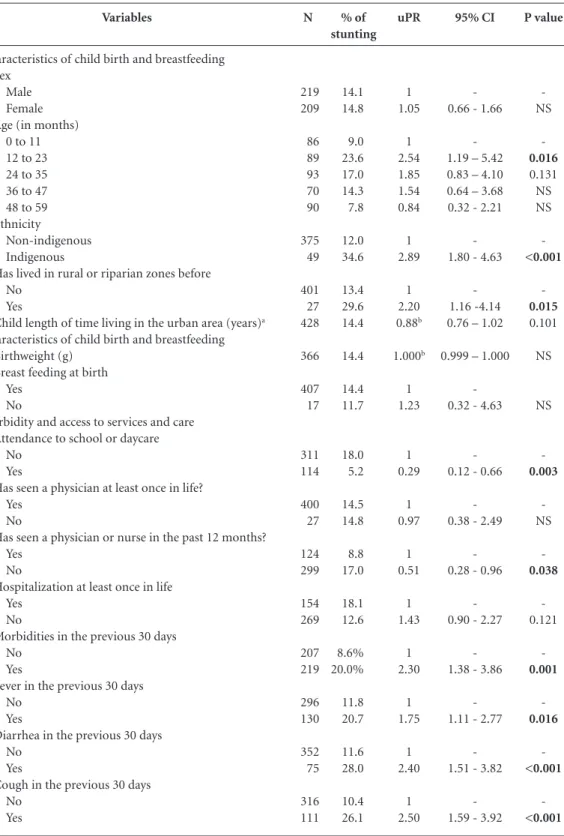
The sociodemographic and economic char-acteristics of the study population are shown in Table 1. Although 97.4% of children resided in households with electric power supply and 92.9% had garbage collection at their residenc-es, the other socioeconomic conditions observed were very unfavorable, such as their house con-struction material, presence of open sewer, lack of shower with running water at the household, use of pit toilets or lack of latrines. About one third of the children interviewed (31.7%) re-ceived some type of individual or family govern-mental financial aid.
Characteristics of caregiver and gestational conditions
The mean age of the caregivers (biological mothers and others) was 27.47 years (median = 26, range = 15 - 78 years). The average height of 407 biological mothers was 156.98 cm, and 50.7% of them were overweight. Only 9.1% of the caregivers were illiterate, while 45.3% had more than eight years of schooling. Only 15 mothers (3.71%) did not attend prenatal care (Table 2).
Children’s characteristics
M
ant
o
vani SAS
2.97 years (median = 3 years), and the average length of time residing in the urban area was 2.34 years (median = 2.19 years). About 94.7% were cared for by their own biological mother. The median birth weight of 366 children with known information was 3,350 g (mean 3,320 g, range = 1,000 g - 5,000 g). The majority of chil-dren (93.7%) had seen a physician at least once in their lives, but 36.4% had been hospitalized at least once. Only 29.3% had had a health care appointment in the Health Care Unit in the pre-vious 12 months.
Prevalence of stunting and associated factors
The prevalence of stunting found in the urban area of the municipality of Assis Brasil among children under five years old was 14.4% in 2011.
In crude analysis (Table 2), children of indig-enous origin were more likely to show stunting (PR = 2.89, CI = 1.80 to 4.65, p < 0.001), but this variable did not remain as a factor independently associated with undenutrition when adjusted for socioeconomic factors. Living in the countryside was also a associated factor for stunting (PR = 2.20, p = 0.015) in crude analysis, but after
ad-a Adapted from Souza et al.1 and United Nations Children’s Fund14.
Chart 1. Conceptual model of factors associated with undernutritiona.
1. Distal
2. Intermediate
3. Proximal
Socioeconomic and environmental conditions
Characteristics of caregiver and gestational conditions
Child characteristics
Environmental and socio-economic variables Socio-economic variables
Wealth index
Family income (in BMS) Household construction material Receipt of benefits
Household environmental variables
Garbage collection Presence of open sewer
Presence of electric power supply Type of sanitary installation
Presence of shower with running water
Caregiver characteristics
Type of caregiver Age of caregiver Schooling of caregiver Height of biological mother
Body mass index of biological mother
Gestational characteristics
Attendance of pre-natal care by biological mother
Child characteristics
Age Sex Ethnicity
Lived outside urban area before Time of residence in urban area
Characteristics of child birth and breastfeeding
Birth weight
Ocurrence of breastfeeding
Morbidity and access to services and care
Attending daycare or school
Monitoring through health care service Self-reportedmorbidities
aúd e C ole tiv a, 21(7):2257-2266, 2016 P value -< 0.001 -0.053 -0.059 -< 0.001 -NS -0.002 0.093 -0.014 -NS -< 0.001 -NS NS 0.073 -0.005 0.019 <0.001 <0.001 -0.002 -<0.001 Variables Socioeconomic variables Wealth índex Richerhalf Poorerhalf
Family monthly income
> one Brazilian minimum salarya
<= one Brazilian minimum salarya
Type of house construction material Brick
Wood or other materials
Receipt of governmental financial aid No
Yes
Household environmental variables Eletric power supply at home
No Yes
Type of sanitary installation Toilet with running water Pit toilet
Lacking sanitary installations Shower with running water in the house
No Yes
Street garbage collection by council No
Yes
Open sewer in the house No
Yes
Characteristics of caregiver and gestational conditions Type of caregiver
Biological mother Grandmother Other
Age of caregiver (in years) Schooling of caregiver
Did not attend school 1 to 4 years inclusive 5 to 8 years inclusive More than 8 years
Height of biological mother (cm) Body Mass Index of biological mother
Below 25 kg/m2
Equal or above 25 kg/m2
Attendance of pre-natal care by biological mother Yes
No
Table 1. Prevalence (%) and Prevalence Rate (PR) of stunted children under 5 years old according to
socioeconomic and characteristics of caregiver. Assis Brasil, 2011.
% of stunting 6.1 22.6 10.0 20.9 5.3 15.8 9.0 26.4 27.2 14.1 9.9 21.6 18.6 19.7 11.1 20.0 14.0 7.9 22.4 14.3 16.7 16.7 14.4 35.9 14.7 17.2 8.8 14.4 20.0 8.73 13.8 53.3 N 212 216 210 181 56 372 289 136 11 417 251 134 43 167 261 30 398 265 183 398 18 12 428 39 102 93 194 407 200 206 389 15 uPR 1 3.69 1 1.58 1 2.96 1 2.87 1 0.51 1 2.17 1.86 1 0.56 1 0.70 1 2.61 1 1.16 1.16 0.97b 1 0.41 0.48 0.24 0.89c 1 0.44 1 4.15 95% CI -2.06 – 6.63
-0.99 – 2.50
-0.95 – 9.13
-1.81 – 4.57
-0.19 - 1.4
-1.32 – 3.55 0.90 – 3.86
-0.35 - 0.89
-0.33 - 1.49
-1.60 - 4.26
-0.40 - 3.36 0.32 – 4.22 0.94 - 1.00
-0.22 - 0.77 0.26 - 0.88 0.13 - 0.45 0.86 - 0.94
-0.26 - 0.74
-2.42-7.12
M ant o vani SAS P value -NS -0.016 0.131 NS NS -<0.001 -0.015 0.101 NS NS -0.003 -NS -0.038 -0.121 -0.001 -0.016 -<0.001 -<0.001 Variables
Characteristics of child birth and breastfeeding Sex
Male Female Age (in months)
0 to 11 12 to 23 24 to 35 36 to 47 48 to 59 Ethnicity
Non-indigenous Indigenous
Has lived in rural or riparian zones before No
Yes
Child length of time living in the urban area (years)a
Characteristics of child birth and breastfeeding Birthweight (g)
Breast feeding at birth Yes
No
Morbidity and access to services and care Attendance to school or daycare
No Yes
Has seen a physician at least once in life? Yes
No
Has seen a physician or nurse in the past 12 months? Yes
No
Hospitalization at least once in life Yes
No
Morbidities in the previous 30 days No
Yes
Fever in the previous 30 days No
Yes
Diarrhea in the previous 30 days No
Yes
Cough in the previous 30 days No
Yes
Table 2. Prevalence (%) and Prevalence Rate (PR) of stunted children under 5 years old according to individual
child characteristics. Assis Brasil, 2011.
% of stunting 14.1 14.8 9.0 23.6 17.0 14.3 7.8 12.0 34.6 13.4 29.6 14.4 14.4 14.4 11.7 18.0 5.2 14.5 14.8 8.8 17.0 18.1 12.6 8.6% 20.0% 11.8 20.7 11.6 28.0 10.4 26.1 N 219 209 86 89 93 70 90 375 49 401 27 428 366 407 17 311 114 400 27 124 299 154 269 207 219 296 130 352 75 316 111 uPR 1 1.05 1 2.54 1.85 1.54 0.84 1 2.89 1 2.20 0.88b 1.000b 1 1.23 1 0.29 1 0.97 1 0.51 1 1.43 1 2.30 1 1.75 1 2.40 1 2.50 95% CI -0.66 - 1.66
-1.19 – 5.42 0.83 – 4.10 0.64 – 3.68 0.32 - 2.21
-1.80 - 4.63
-1.16 -4.14 0.76 – 1.02
0.999 – 1.000
-0.32 - 4.63
-0.12 - 0.66
-0.38 - 2.49
-0.28 - 0.96
-0.90 - 2.27
-1.38 - 3.86
-1.11 - 2.77
-1.51 - 3.82
-1.59 - 3.92
aúd
e C
ole
tiv
a,
21(7):2257-2266,
2016
justment for socioeconomic factors, it failed to show an association with that outcome.
Some acute morbidities were also associated with chronic undernutrition in the unadjusted analysis (Table 2). Children with height-for-age deficit were more likely to have fever (PR = 1.75, p = 0.015), diarrhea (PR = 2.40, p < 0.001) and cough (PR = 2.50, p < 0.001) in the 30 days pre-ceding the interview. None of these variables, however, remained significantly associated in the adjusted analysis. The other socioeconomic vari-ables (characteristics of household and children - gender, access to daycare or school, pregnancy and breastfeeding conditions, access to health care services and previous hospitalization, Table 3) showed no statistically significant association in the adjusted analysis. The biological mothers’ body mass indexes were also not associated with stunting in children in adjusted analysis. Other so-cioeconomic and environmental variables did not show association in the adjusted analysis either.
Adjusted models (Table 3) showed that, for the population studied, the family’s socioeco-nomic conditions, the caregiver’s age and edu-cation and the biological mother’s height were independently associated variables in relation to stunting.
The presence of open sewer in the house-hold (aPR = 1.67, p = 0.045) and economically disadvantaged situation (aPR = 2.05, p = 0.015) significantly increased the probability of a child showing stunting (Table 3). Chronic undernutri-tion was also more common in children whose
families received governmental financial aid (aPR = 1.88, p = 0.014). (Table 3).
Children whose biological mothers were tall-er wtall-ere less likely to show stunting (aPR = 0.92, p 0.001). Children cared for by caregivers who did not attend school were more likely to show un-dernutrition (aPR = 2.11, p = 0.014). Children cared for by older caregivers were less likely to be stunted, a decrease of 7 % with each additional year of the caregiver’ age (p = 0.001) (Table 3).
Discussion
The prevalence of stunting found in this study is similar to the 14.8% prevalence rate found in the Northern Region, as identified by the 2006 National Demographic and Health Survey, and much higher than the national average of 7%8.
Possible causes for this discrepancy in relation to the national average is that the Northern Region still faces many unfavorable socioeconomic con-ditions as compared to other Brazilian regions6,8
which have managed to reduce child undernutri-tion in recent years, such as the Northeastern and the Southeastern Regions in Brazil7,15.
In Assis Brasil, the factors associated with stunting are especially related to unfavorable so-cioeconomic conditions.
Close to 21.7% of the reduction in the prev-alence of child undernutrion between 1996 and 2006-07 in Brazil can be attributed to the in-creased purchasing power of Brazilian families6,
Variable (n = 407)
Wealth index Richerhalf Poorerhalf
Receipt of governmental financial aid No
Yes Open sewer No Yes
Age of caregiver (in years) Schooling of caregiver Did not attend school Attended school
Height of biological mother (in cm)
Table 3. Factors associated with stunting in children under 5 years obtained by multivariate modeling. Assis
Brasil, AC, 2011.
aPR
1 2.05
1 1.88
1 1.67
0.93a
1 2.11
0.92b
95% CI
1.14-3.66
1.13-3.13
1.01-2.76 0.90-0.97
1.16-3.83 0.88-0.97
P value
0.015
0.014
0.045 0.001
0.014 0.001
M
ant
o
vani SAS
both in developed16 regions and in those still
un-der development15. The Brazilian government is
partly responsible for this increase by granting benefits to mothers or guardians in the poorest families in the last two decades, such as the Fome Zero and Bolsa Família programs, which have managed to have impact on linear growth in chil-dren and adolescents assisted by the programs17.
In this study, it was observed that many fam-ilies do not have adequate sanitation facilities, which has been associated with stunting in other studies performed in Acre1. Exposure to an open
sewer, besides indicating a poorer socioeconomic status, may lead to the acquisition of infectious diseases more frequently and result in stunting. In fact, cohort studies have shown that repeated episodes of diarrhea are associated with a small reduction in linear growth18. In our analysis
chil-dren with stunting were more likely to present a recent episode of diarrhea in the unadjusted anal-ysis, as well as fever and cough. Although it was not possible to confirm this association because of the limited number of events, it is worth em-phasizing the clinical importance of this finding. Care to a child with fever and especially non-ep-idemic diarrhea in socially disadvantaged areas, should raise clinical suspicion of some kind of undernutrition, which should be investigated by the health service.
Maternal education has been shown in some studies to be inversely associated with growth retardation in children under five years old19,20,
probably due to lower access to information about the importance of household and personal hygiene habits and proper nutrition for children’s growth and development. Drachler et al.21, when
studying non-indigenous children, claimed that the mother figure represents the bond between children and the environment, besides the fact that it is usually the mother who decides about the family’s eating habits as well as about hygiene care and immunization. In our study, even after adjustment for income and housing conditions, the effect of the lack of maternal education re-mained associated with undernutrition.
As occurred in Assis Brasil, other studies sug-gest an association between maternal age and children undernutrition, and the risk of stunting is higher in children of adolescent mothers22. The
most likely explanation is that young women are generally not prepared to take care of such a de-pendent being23, which can result in nutritional
deficit.
Several studies found an association between the biological mother’s height and stunting in
children24,25. Maternal height is also associated
with weight at birth: children born to mothers with short stature are born with low weight26,27.
Maternal height may be a marker of such wom-an’s nutritional history and previous socioeco-nomic conditions26,27, or even suggest a genetic
predisposition to short stature, which ends up being “inherited” by the child28, first reflected in
low weight at birth and later in stunted growth. Separating such genetic effect of short maternal stature from families’ socioeconomic and envi-ronmental effects that are perpetuated through generations (both the mother’s and child’) and lead to stunting in children5 is not an easy task.
To that end, a long-term specific epidemiologi-cal cohort design is necessary, since low mater-nal height is significantly associated with poverty and adverse conditions of the socioenvironmen-tal milieu in several publications19,24. As our study
has a cross-sectional nature and it is not possi-ble to establish a temporal relationship between the independent variables and the outcome, it is likely that not all the socioeconomic factors that influence maternal height were controlled in the analysis. Therefore, the association between ma-ternal height and stunted children can be con-founded by unadjusted socioeconomic factors, such as maternal socioeconomic status at the time of the biological mother’s growth.
This study has limitations. It is not possible to determine, for example, if the higher frequency of acute diarrhea in stunted children is a cause or a consequence of undernutrition, but only to emphasize that children with diarrhea should be investigated for the presence of undernutrition. Another limitation is a possible selection bias, since there was a selective loss of children who were not assessed anthropometrically and who were characterized by predominantly belonging to indigenous ethnic groups, to the lowest socio-economic group, with uneducated mothers and a history of having resided in rural areas previous-ly. Therefore, there may have been an underesti-mation of stunting prevalence and of the mag-nitude of the association of significant variables with the outcome, but which, however, does not invalidate the findings in the study regarding fac-tors associated with chronic undernutrition.
aúd
e C
ole
tiv
a,
21(7):2257-2266,
2016
was also not possible to collect data on the dura-tion of breastfeeding and, therefore, the effect of pregnancy, childbirth and peripartum variables was not adequately tested. Since the majority of children were cared for by their biological moth-ers, the ability of this study to evaluate the effect of caregivers on undernutrition occurrence was also limited. Finally, the relationship between at-tending a daycare center or a school and stunting also introduced a selection bias, since children can only attend such services after they are two years old.
Finally, it is concluded that, although Brazil is going through a process of nutritional transition with consequent reduction in undernutrition, the prevalence of stunting in Assis Brasil can be
regarded as an important public health problem. Socioeconomic conditions and maternal charac-teristics were shown to be closely related to the occurrence of stunting in this population, and some intervention is possible in the short term, while others depend on greater social and eco-nomic transformation in the Amazon region. A few interventions are already being executed by the Brazilian government, such as the inclusion of all children in school and kindergarten, where balanced food is offered everyday, and the social program of monthly wealth distribution for the poor, which is targeting those children at major risk for stunting, as seen in this study. Hopeful-ly, these interventions will be able to eliminate stunting in the Amazon in near future.
Collaborations
SAS Mantovani, AA Ramalho, TM Pereira, FLCC Branco, H Oliart-Guzmán, BM Delfino, AM Braña, AC Martins, JA Filgueira-Júnior, AP San-tos, RG Campos, AS Guimarães, TS Araújo, CSM Oliveira, CT Codeço and M da Silva-Nunes par-ticipated in the conception, design and analysis of data and read the final version of the manu-script.
Ethical approval
The study was approved by the Ethics Committee for Human Research of our Institution (Process n. 23107.09782/2009-04). We obtained informed consent from the parents or legal guardian of each participant after the nature and possible consequences of the studies had been fully ex-plained.
References
Souza OF, Benício MHD, Castro TG, Muniz PT, Cardo-so MA. Desnutrição em crianças menores de 60 meses em dois municípios do Estado do Acre: prevalência e fatores associados. Rev Bras Epidemiol 2012; 15(1):211-221.
Araújo TS. Desnutrição infantil em Jordão, Estado do Acre, Amazônia Ocidental Brasileira [thesis]. São Paulo: Faculdade de Saúde Pública da USP; 2010.
Cobayashi F, Augusto RA, Lourenço BH, Muniz PT, Cardoso MA. Factors associated with stunting and overweight in Amazonian children: a popula-tion-based, cross-sectional study. Public Health Nutr 2013; 17(3):551-560.
World Health Organization (WHO). WHO child growth standards based on length/height, weight and age. Acta Paediatr Suppl 2006; 450:76-85.
Black RE, Victora CG, Walker SP, Bhutta ZQA, Chris-tian P, Onis M, Ezzati M, Grantham-McGregor S, Katz J, Martorell R, Uauy R; Maternal and Child Nutrition Study Group. Maternal and child undernutrition and overweight in low-income and middle-income coun-tries. Lancet 2013; 382(9890):427-451.
Monteiro CA, Benicio MHD, Conde WL, Konno S, Lovadino AL, Barros AJD, Victora CG. Narrowing so-cioeconomic inequality in child stunting: the Brazilian experience, 1974-2007. Bull World Health Organ 2010; 88:305-311.
Victora CG, Aquino EML, Leal MC, Monteiro CA, Barros FC, Szwarcwald CL. Maternal and child health in Brazil: progress and challenges. Lancet 2011; 377(9780):1863-1876.
1.
2.
3.
4.
5.
6.
M
ant
o
vani SAS
Ministério da Saúde (MS). PNDS 2006: Pesquisa Na-cional de Demografia e Saúde da Criança e da Mulher. Brasília: Ministério da Saúde, 2008. [cited 2013 Dec 1]. Available in: http://bvsms.saude.gov.br/bvs/pnds/img/ relatorio_final_PNDS2006_04julho2008.pdf Instituto Brasileiro de Geografia e Estatística. Resul-tados parciais do Estado do Acre no Censo 2010. Ins-tituto Brasileiro de Geografia e Estatística; 2010. [cit-ed 2011 Jan 1]. Available in: http://www.ibge.gov.br/ home/estatistica/populacao/censo2010/tabelas_pdf/ total_populacao_acre.pdf
World Health Organization Expert Committee on Physical Status. Physical status: the use and interpre-tation of anthropometry: report of a WHO Expert Committee. Geneva: World Health Organization; 1995. [cited 2013 Dec 1]. Available in: http://www.who.int/ childgrowth/publications/physical_status/en/ World Health Organization. Obesity: Preventing and Managing the Global Epidemic. Geneva: World Health Organization; 1998. [cited 2013 Dec 1]. Available in: http://www.who.int/nutrition/publications/obesity/ WHO_TRS_894/en/
Filmer D, Pritchett LH. Estimating wealth effects with-out expenditure data - or tears: an application to ed-ucational enrollments in states of India. Demography 2001; 38(1):115-132.
Muniz PT, Castro TG, Araújo TS, Nunes NB, Silva-Nu-nes M, Hoffmann EHE, Ferreira MU, Cardoso MA. Child health and nutrition in the Western Brazilian Amazon: population-based surveys in two counties in Acre State. Cad Saude Publica 2007; 23(6):1283-1293. United Nations Children’s Fund. The State of the World’s Children. Geneva: United Nations Children’s Fund; 1998. [cited 2013 Dec 1]. Available in: http:// www.unicef.org/sowc98/sowc98.pdf
Lima ALL, Silva ACF, Konno SC, Conde WL, Benicio MHD, Monteiro CA. Causas do declínio acelerado da desnutrição infantil no Nordeste do Brasil (1986-1996-2006). Rev Saude Publica 2010; 44(1):17-27.
Matijasevich A, Santos IS, Menezes AMB, Barros AJD, Gigante DP, Horta BL, Barros FC, Victora CG. Trends in socioeconomic inequalities in anthropometric status in a population undergoing the nutritional transition: data from 1982, 1993 and 2004 Pelotas birth cohort studies. BMD Public Health 2012; 12:511-520. Piperata BA, Spence JE, DA-Gloria P, Hubbe M. The Nutrition transition in Amazonia: rapid economic change and its impact on growth and development in Ribeirinhos. Am J Phys Anthropol 2011; 146(1):1-13. Richard AS, Black RE, Gilman RH, Guerrant RL, Kang G, Lanata CF et al. Diarrhea in Early Childhood: short-term association with weight and long-short-term association with length. Am J Epidemiol 2013; 178(7):1129-1138. 8.
9.
10.
11.
12.
13.
14.
15.
16.
17.
18.
Silveira KBR, Alves JFR, Ferreira HS, Sawaya AL, Florêncio TMMT. Association between malnutrition in children living in favelas, maternal nutritional status, and environmental factors. J Pediatr 2010; 86(3):215-220.
Florêncio TMMT, Ferreira HS, França APT, Cavalcante JC, Sawaya AL. Obesity and undernutrition in a very-low-income population in the city of Maceió, North-eastern Brazil. BrJ Nutrition 2001; 86(2):277-283. Drachler ML, Macluf SPZ, Leite JCC, Aertz DRGC, Gi-ugliani ERJ, Horta BL. Fatores de risco para sobrepeso em crianças no sul do Brasil. Cad Saude Publica 2003; 19(4):1073-1081.
Olusanyaa BO, Wirzc SL, Rennerb JK. Prevalence, pat-tern and risk factors for undernutrition in early infancy using the WHO Multicentre Growth Reference: a com-munity-based study. Paediatr Perinat Epidemiol 2010; 24(6):572-583.
Carvalhaes MABL, Benício MHA. Capacidade mater-na de cuidar e desnutrição infantil. Rev Saude Publica 2002; 36(2):188-197.
Ashworth A, Morris SS, Lira PIC. Postnatal growth pat-terns of full-term low birth weight infants in Northeast Brazil are related to socioeconomic status. J Nutr 1997; 127(10):1950-1956.
Engstrom EM, Anjos LA. Desnutrição por déficit esta-tural nas crianças brasileiras: Relação com condições sócio-ambientais e estado nutricional materno. Cad Saude Publica 1999; 15(3):559-567.
Barros FC, Victora CG, Matijasevich A, Santos IS, Hor-ta BL, Silveira MF, Barros AJD. Preterm births, low birth weight, and intrauterine growth restriction in three birth cohorts in Southern Brazil: 1982, 1993 and 2004. Cad Saude Publica 2008; 24(Supl. 3):S390-S398. Victora CG, Adair L, Fall C, Hallal PC, Martorell R, Richter L, Sachdev HS; Maternal and Child Undernu-trition Study Group. Maternal and child undernutri-tion: consequences for adult health and human capital. Lancet 2008; 371(9609):340-357.
Ramakrishnan U, Martorell R, Schroeder DG, Flores R. Role of intergenerational effects on linear growth. J Nutr 1999; 129(Supl. 2S):S544-S549.
Artigo apresentado em 25/03/2014 Aprovado em 24/08/2015
Versão final apresentada em 26/08/2015 19.
20.
21.
22.
23.
24.
25.
26.
27.