REVIEW
Pharmacokinetics of cephalosporins in the neonate: a
review
Gian Maria Pacifici
University of Pisa, Department of Neurosciences, Section of Pharmacology, Medical School, Pisa, Italy.
The aim of this work was to review the published data on the pharmacokinetics of cephalosporins in neonates to provide a critical analysis of the literature as a useful tool for physicians. The bibliographic search was performed for articles published up to December 3, 2010, using PubMed. In addition, the bookNeofax: A Manual of Drugs Used in Neonatal Careby Young and Mangum was consulted. The cephalosporins are mainly eliminated by the kidneys, and their elimination rates are reduced at birth. As a consequence, clearance is reduced and t1/2is more prolonged in the neonate than in more mature infants. The neonate’s substantial body water content creates a large volume of distribution (Vd) of cephalosporins, as these drugs are fairly water soluble. Postnatal development is an important factor in the maturation of the neonate, and as postnatal age proceeds, the clearance of cephalosporins increases. The maturation of the kidney governs the pharmacokinetics of cephalosporins in the infant. Clearance and t1/2are influenced by development, and this must be taken into consideration when planning a cephalosporin dosage regimen for the neonate.
KEYWORDS: Cephalosporins; Pharmacokinetics; Neonate.
Pacifici GM. Pharmacokinetics of cephalosporins in the neonate: a review. Clinics. 2011;66(7):1267-1274.
Received for publication onDecember 14, 2010;First review completed onJanuary 21, 2011;Accepted for publication onMarch 2, 2011
E-mail: [email protected]
Tel.: 39 050-2218721
INTRODUCTION
Cephalosporins are the most common class of antibiotics used to treat bacterial infection. These drugs have proven to be safe, clinically effective, and easy to use.1,2 The expanded-spectrum cephalosporins (e.g., cefotaxime, cef-triaxone, and ceftazidime), either alone or in combination with other antibiotics, are the most common antibiotics used as initial empiric therapy for treating serious infections.3
The first generation of cephalosporins has good activity against Gram-positive bacteria and relatively modest activity against Gram-negative bacteria. The second genera-tion of cephalosporins has increased activity against Gram-negative microorganisms but tends to be much less active than the third-generation agents. The fourth generation of cephalosporins is particularly useful for the empirical treatment of serious infections in hospitalized patients when Enterobacteriaceae and pseudomonas are potential etiologies.4 Cephalosporins are minimally toxic, with the exception of ceftriaxone, which displaces bilirubin from albumin5,6 and precipitates calcium, resulting in serious adverse effects.7,8The aim of this paper was to review the literature on the kinetics of cephalosporins in the neonate and provide a critical analysis of the literature as a useful tool for physicians.
Bibliographic search
The bibliographic search was performed electronically, using PubMed to find articles published up to December 3, 2010. First, a Medline search was performed with the key words ‘‘pharmacokinetics of cephalosporins in neonates," with the limit of ‘‘human’’. Other Medline searches were performed with the key words ‘‘pharmacokinetics of ……… in neonates,’’ followed by the names of single cephalospor-ins. In addition, the bookNeofax: A Manual of Drugs Used in Neonatal Careby Young and Mangum9was consulted. The bibliographic search produced 37 original articles, four review articles and two book chapters. The publication years of this material ranged from 1977 to 2010.
RESULTS
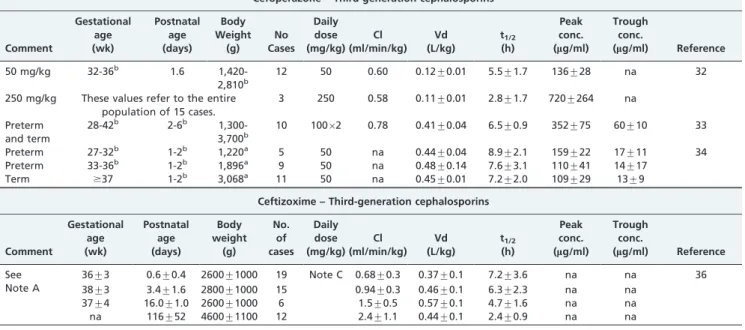
The demographic data for the neonates and the pharmacokinetic parameters of different cephalosporins are presented in four tables. Information relative to the first-generation cephalosporin, cefazolin, and the second-generation cephalosporins, cefoxitin, and cefuroxime, is provided in Table 1. Table 2 summarizes the results relative to the third-generation cephalosporins. Table 3 shows the results relative to cefepime, a fourth-generation cephalosporin, and Table 4 shows the concentrations of various cephalosporins in the cerebrospinal fluid (CSF) and serum.
Clearance (Cl) is expressed in different units by different authors. This makes comparisons between studies difficult. To overcome this difficulty, Cl was converted into ml/min/ kg. SD cannot be converted; therefore, Cl values are reported without SDs.
Copyrightß2011CLINICS– This is an Open Access article distributed under
First generation cephalosporin
Cefazolin. The pharmacokinetics of cefazolin (Table 1) in 11 neonates were studied by Deguchi et al.10 There was
marked interindividual variability in the distribution volume (Vd). This parameter ranged from 0.21 to 0.37 L/ kg. The unbound fraction of cefazolin in neonatal plasma ranged from 0.22 to 0.83. The Vd of cefazolin highly correlated (r = 0.936; p,0.001) with the unbound fraction of this drug.
Young and Mangum9suggested administering 25 mg/kg
cefazolin every 8 to 12 h according to the neonate’s postmenstrual age and postnatal age. When the postmenstr-ual age is.45 weeks, the interval between doses should be six hours.
Second-generation cephalosporins
Cefoxitin. Regazzi et al11 studied the pharmacokinetics of cefoxitin in 15 neonates. Their reported kinetic parameters are summarized in Table 1. The half-life (t1/2)
negatively correlated with postnatal age (r = -0.58;p,0.05). Young and Mangum9suggested administering 25 to 33 mg/
kg cefoxitin every 8 to 12 h according to the neonate’s postmenstrual age and postnatal age. When the post-menstrual age is .45 weeks, the interval between doses should be six hours.
Cefuroxime. Renlund and Pettay12 studied the
pharmacokinetics of cefuroxime in 104 neonates, and their reported kinetic parameters are summarized in Table 1. The serum concentration of cefuroxime decreased with body weight from 25.6¡9.9mg/ml (,1 kg body weight) to 19.5¡6.8mg/ml (.4 kg body weight) because of the increase in GFR with neonatal maturation. t1/2 showed
similar behavior, decreasing from 5.6 h (2.83 kg body weight) to 4.0 h (3.83 kg body weight). Cefuroxime did not accumulate over a period of 8 days and was excreted in the urine by more than 70%.
Third-generation cephalosporins
Cefotaxime. The kinetic parameters of cefotaxime are summarized in Table 2. Kafetzis et al13 described treating infections with cefotaxime in 32 neonates. The pathogens that sustained the infection were Escherichia coli, Klebsiella species, Pseudomonas aeruginosa, Serratia marcescens Staphylococcus aureus, Staphylococcus epidermidis, and
b-hemolytic streptococcus. All of the isolated pathogens were susceptible to cefotaxime. These authors clustered the pharmacokinetic parameters of cefotaxime into four groups according to the neonates’ gestational age and postnatal age. With neonatal maturation, t1/2decreased and Cl increased.
For brevity, Table 2 shows the two extremes of the cohort. In five patients with meningitis who received 50 mg/kg cefotaxime twice daily, the concentration of the drug was simultaneously measured in the CSF and serum 1 to 2 h after cefotaxime administration. The CSF and serum concentrations (mean¡SD) were 18.2¡7.4 and 38.6¡10.3
mg/ml, respectively. The CSF-to-serum ratio was 45¡0.12%. McCracken et al14 compared the kinetic parameters of
cefotaxime in two groups of neonates; the first had an average body weight of 1,103 g, and the second had an average body weight of 2,561 g (p,0.0001). Vd and t1/2were
greater in the former than the latter group, whereas Cl was greater in the latter group and AUC was not different in the two groups.
Cefotaxime is converted into desacetyl cefotaxime in the neonate, and the peak concentration of desacetyl cefotaxime is about one-tenth of that of cefotaxime.15-17 The t
1/2 of
desacetyl cefotaxime is 9.4 h in very low-body-weight neonates.18 After 50 mg/kg cefotaxime, 50 to 60% of the dose is excreted unchanged in the urine, and approximately 20% is excreted as desacetyl cefotaxime.18 The renal Cl of
cefotaxime is quantitatively more important than its meta-bolic Cl. Gouyon et al15observed that the t1/2of cefotaxime
was negatively correlated with gestational age (r = -0.8954; p,0.01) and body weight (r = -0.8500; p,0.01). In contrast, Cl was positively correlated with gestational age (r = 0.7280; p,0.02) and body weight (r = 0.8667; p,0.02). The AUC of cefotaxime was negatively correlated with gestational age (r = -0.7950; p,0.01), but it did not correlate with body weight.
One recent study examined cefotaxime in neonates under-going extracorporeal membrane oxygenation (ECMO).19 Doses of 50 mg/kg of body weight twice a day (postnatal age,1 week), 50 mg/kg three times a day (postnatal age 1 to 4 weeks) or 37.5 mg/kg four times a day (postnatal age.4 weeks) were found to provide sufficient periods of supra-MIC concentrations to give adequate treatment of infants on ECMO.
Young and Mangum9 suggested intravenously
adminis-tering 25 to 33 mg/kg of cefotaxime every 8 or 12 h
Table 1 -Demographic data of the studied neonates and pharmacokinetic parameters of first- and second-generation cephalosporins. Figures are the mean¡SD.
Cefazolin – First-generation cephalosporins
Gestational age (wk)
Postnatal age (days)
Body weight (g)
No. of cases
Daily dose (mg/kg)
Cl (ml/min/kg)
Vd (L/kg)
t1/2
(h)
Peak conc. (mg/ml)
Trough conc.
(mg/ml) Reference
35¡3 9.4¡7.4 2,326¡943 11 30 0.80 0.28¡0.05 na na na 10
Cefoxitin and cefuroxime – Second-generation cephalosporins
Drug
Gesta-tional age (wk)
Postnatal age (days)
Body weight
(g)
No. of cases
Daily dose (mg/kg)
Cl (ml/min/
kg)
Vd (L/kg)
t1/2
(h)
Peak conc. (mg/ml)
Trough conc.
(mg/ml) Reference
Cefoxitin 36¡4 ,2 months 2,404¡599 15 3063 4.5 0.50¡0.21 1.43¡0.53 69.8¡31.9 na 11
Cefuroxime na ,3 weeks ,1,000.4,000 104 1063 na na 4.6¡0.7a 24.2¡8.2b 6.4¡5.6b 12
na = not available.
Table 2 -Demographic data of the studied neonates and pharmacokinetic parameters of the third-generation cephalosporins. Figures are the mean¡SD unless otherwise stated.
Cefotaxime – Third-generation cephalosporins
Comment
Gestational age (wk)
Postnatal age (days)
Body weight
(g)
No. of cases
Daily dose (mg/kg)
AUC (mg.h/ml)
Cl (ml/min/kg)
Vd (L/kg)
t1/2
(h)
Peak conc. (mg/ml)
Trough conc.
(mg/ml) Reference
Preterm Preterm ,7 na 18 Note A na 1.37
(ml/min)
0.61¡0.05 5.7¡0.8 na na 13
Term Term 7-28b na 14 na 4.45 (ml/min) 0.69¡0.08 2.0¡0.5 na na
p ___ ___ ___ ___ ___ ___ ,0.05 NS ,0.05 ___ ___
1.1¡0.22 kg body weight
na 4.0¡1.6 1,103¡216 14 50 400¡56 23.0 (ml/min/ 1.73 m2)
0.51¡0.06 4.6¡1.1 115.9¡38.1 34.4¡12.1 24
2.6¡0.6 kg body weight
na 3.5¡1.7 2,561¡607 15 50 392¡77 43.9 (ml/min/ 1.73 m2)
0.44¡0.07 3.4¡0.9 132.7¡37.7 38.1¡6.9
p ___ NS ,0.0001 ___ ___ NS ,0.001 ,0.01 ,0.01 na na
Term 37¡3 4.1¡1.7 1,836¡723 10 25x2 373¡206 1.57 0.43¡0.15 3.7¡1.5 171a 5a 15
Preterm 28¡2 4.0¡1.6 1,016¡350 18 50 na 1.23 0.46¡0.03 4.4a 159.0¡11.6 na 18
Preterm ,32 ,7 na 3 25 262¡46 1.08 0.34¡0.07 3.5¡0.4 73.8¡9.6 11.1a 17
Term .37 $7 na 5 25 177¡25 2.33 0.36¡0.08 2.0¡0.5 68.2¡9.6 22¡1.3
p ___ ___ ___ ___ ___ ,0.001 ,0.005 NS ,0.001 NS ,0.05
Ceftazidime – Third-generation cephalosporins
Comment
Gestational age (wk)
Postnatal age (days)
Body weight
(g)
No. of Cases
Daily dose (mg/kg)
AUC (mg.h/ml)
Cl (ml/min/
kg)
Vd (L/kg)
t1/2
(h)
Peak conc. (mg/ml)
Trough conc.
(mg/ml) Reference
Intravenous 35a 6a 2,470a 7 50 na na na 4.7¡1.5 109¡19.9 11.8¡4.1 20
Intramuscular 37a 8a 2,860a 9 50 IM na na na 3.8¡1.1 53.0¡22.4 8.9¡5.6
p ___ ___ ___ ___ ___ ___ ___ ___ ,0.05 ,0.001 ,0.05
Preterm #32 1-22b 805-4170b 7 Note B 912¡203 0.98 0.53¡0.12 6.7¡2.6 111¡15 41¡8 21
Preterm 33-37 14 691¡156 1.25 0.51¡0.12 4.9¡1.6 118¡28 31¡9
Controls 31¡3 3 1,579¡597 84 5062 0.68 0.36¡0.09 6.3¡1.7 115¡39 34¡18 23
Term $38 8 619¡151 1.42 0.48¡0.09 4.2¡1.2 102¡18 29¡8
Indomethacin 29¡2 3 1,133¡334 23 5062 0.46 0.36¡0.2 9.4¡3.1 na na
3 days old 29¡1 3 1,154¡201 Weight at
birth
23 2562 0.51 0.36¡0.06 8.7¡2.8 na na 24
10 days old 29¡1 10 0.69 0.29¡0.04 5.0¡0.9 na na
p ___ ___ ___ ___ ___ ,0.05 ,0.005 ,0.005 ___ ___
Once daily 29¡2 3 1,168¡309 13 25 0.46 0.32¡0.06 8.15¡1.2 na 13.1¡4.7 25
Twice daily 29¡2 3 1,141¡400 15 2562 0.41 0.30¡0.06 7.09¡1.7 na 42.0¡13.4
p ___ ___ NS ___ ___ NS NS NS ___ p,0.001
Ceftriaxone – Third-generation cephalosporins
Comment
Gestational age (wk)
Postnatal age (days)
Body weight
(g)
No. of cases
Daily dose (mg/kg)
Cl (ml/min/kg)
Vd (L/kg)
t1/2
(h)
Peak conc. (mg/ml)
Trough conc.
(mg/ml) Reference
50 mg/kg 5 term neonates and
25 infants 6 weeks to 2
years old
na na 15 50 0.85 0.38¡0.13 5.8¡2.6 230¡64 na 29
75 mg/kg na na 15 75 0.93 0.39¡0.06 5.4¡2.1 295¡75 na
Intravenous 32¡4 1-60b 1880¡860 12 50 0.28 0.33¡0.07 15.4¡5.6 153¡39 54¡22 30 Intramuscular These values refer to the entire population
of 18 cases.
6 50 IM 0.28 0.32¡0.04 15.8¡5.8 120¡37 54¡19
Preterm na 3.2a 1164a 10 50 1.0
(ml/min)
0.61¡0.02 7.7¡0.6 145¡18 66¡3.3 31
Preterm na 6.7a 1176a 3 50 0.73
(ml/min)
0.53¡0.03 8.4¡1.6 136¡8.9 71¡4.4
Term na 2.8a 2670a 9 50 1.8
(mL/min)
0.52¡0.04 7.4¡0.5 159¡9.1 74¡5.4
Preterm na 22.5a 2112a 4 50 1.6
(ml/min)
according to the postmenstrual age. When the postmenstr-ual age is.45 weeks, the interval between doses should be six hours.
Ceftazidime. The pharmacokinetic parameters of cefta-zidime are summarized in Table 2. The ceftacefta-zidime concen-tration was measured after intravenous adminisconcen-tration to seven neonates and after intramuscular administration to 9 infants.20
Ceftazidime concentrations after intravenous injection declined biexponentially, and the postdistributive phase occurred 30 to 60 min after administration. The peak ceftazidime concen-tration was 109¡19.9 (intravenously) and 53.0¡22.4 (intra-muscularly; p,0.05). The t1/2 of ceftazidime was 4.7¡1.5
(intravenously) and 3.8¡1.1 (intramuscularly; NS).
McCracken et al21 described the pharmacokinetics of ceftazidime in three groups of neonates with gestational ages of #32, 33-37, and $38 weeks. Cl increased with gestational age, whereas t1/2, AUC and the trough
concen-trations decreased with gestational age.
Blumer et al22 described ceftazidime’s pharmacokinetics
and penetration into CSF in ten children aged 12 to 540 days. Ceftazidime at 50 mg/kg was intravenously administered once per day. The t1/2of ceftazidime was 1.8¡0.8 h, which
was 2- to 4-fold lower than that reported in neonates during the first week of life (see Table 2). The two youngest children, aged 12 and 23 days, had a t1/2of 3.6 and 2.18 h, respectively.
The Cl of ceftazidime varied by more than 300%; such a large variation makes it inappropriate to report the average Cl, so the data from Blumer et al22are not shown in Table 2. In
contrast, Vd showed little variation and ranged from 0.27 to 0.38 L/kg, with a mean¡SD of 0.34¡0.07 L/kg. The ceftazidime concentrations in the CSF and serum were 4.7¡2.5 and 145¡30.4mg/ml, respectively. The CSF-to-serum concentration of ceftazidime was 3.5¡1.8%. The ratio
of CSF to serum ceftazidime concentration showed a time-dependent increase, suggesting that ceftazidime was elimi-nated more slowly from the CSF than from the vascular compartment. The MIC of the isolated pathogens ranged from 0.0156mg/ml (Neisseria meningitidis) to 0.125mg/ml (Haemophilus influenzae, Type B).
Prenatal exposure to indomethacin resulted in signifi-cantly lower GFR and ceftazidime Cl values.23 The Cl of
ceftazidime was 0.46 ml/min/kg (n = 23) in neonates who were prenatally exposed to indomethacin and 0.68 ml/ min/mg (No = 84) in infants who were not exposed to indomethacin (p,0.05). The Cl of ceftazidime increased with gestational age (r = 0.83;p,0.001), whereas t1/2showed
an opposite trend (r = -0.54; p,0.001).23 The positive relationship between the Cl of ceftazidime and the Cl of inulin (r = 0.73;p,0.001) indicated that glomular filtration had an important effect on the Cl of ceftazidime. The Cl of ceftazidime correlated with the reciprocal of the serum concentration of creatinine (r = 0.72; p,0.001), suggesting that this compound may interfere with the renal Cl of ceftazidime.
The ceftazidime Cl increased from days 3 to 10 of life24 (Table 2). Such increases are due to an increase in GFR. The inulin Cl was 0.72 (day 3) and 0.91 ml/min (day 10;p,0.05). The Cl of ceftazidime correlated with GFR (r = 0.81; p,0.001). This correlation indicates the important role of GFR in the clearance of ceftazidime. The Vd of ceftazidime decreased between days 3 and 10 of life. During the first week of life, there was a significant decrease in extracellular water. Ceftazidime is mainly distributed in the extracellular water component, and a decrease of extracellular water may cause a decrease in the Vd during this period. Postnatal exposure to indomethacin prevented the pharmacokinetic
Cefoperazone – Third-generation cephalosporins
Comment
Gestational age (wk)
Postnatal age (days)
Body Weight
(g) No Cases
Daily dose (mg/kg)
Cl (ml/min/kg)
Vd (L/kg)
t1/2
(h)
Peak conc. (mg/ml)
Trough conc.
(mg/ml) Reference
50 mg/kg 32-36b 1.6
1,420-2,810b
12 50 0.60 0.12¡0.01 5.5¡1.7 136¡28 na 32
250 mg/kg These values refer to the entire population of 15 cases.
3 250 0.58 0.11¡0.01 2.8¡1.7 720¡264 na
Preterm and term
28-42b 2-6b
1,300-3,700b
10 10062 0.78 0.41¡0.04 6.5¡0.9 352¡75 60¡10 33
Preterm 27-32b 1-2b 1,220a 5 50 na 0.44¡0.04 8.9¡2.1 159¡22 17¡11 34
Preterm 33-36b 1-2b 1,896a 9 50 na 0.48¡0.14 7.6¡3.1 110¡41 14¡17
Term $37 1-2b 3,068a 11 50 na 0.45¡0.01 7.2¡2.0 109¡29 13¡9
Ceftizoxime – Third-generation cephalosporins
Comment
Gestational age (wk)
Postnatal age (days)
Body weight
(g)
No. of cases
Daily dose (mg/kg)
Cl (ml/min/kg)
Vd (L/kg)
t1/2
(h)
Peak conc. (mg/ml)
Trough conc.
(mg/ml) Reference
See Note A
36¡3 0.6¡0.4 2600¡1000 19 Note C 0.68¡0.3 0.37¡0.1 7.2¡3.6 na na 36 38¡3 3.4¡1.6 2800¡1000 15 0.94¡0.3 0.46¡0.1 6.3¡2.3 na na
37¡4 16.0¡1.0 2600¡1000 6 1.5¡0.5 0.57¡0.1 4.7¡1.6 na na
na 116¡52 4600¡1100 12 2.4¡1.1 0.44¡0.1 2.4¡0.9 na na
na = not available. NS = not significant. IM = intramuscular.
aMean; the SD was not available;
brange. Note A: The cefotaxime dose was 25 mg/kg and 50 mg/kg in patients with meningitis. Doses were administered every 12 h in neonates younger
than one week of age and every 8 h in patients 1 to 4 weeks of postnatal age. Note B: The ceftazidime dose was 50 mg/kg every 12 h for neonates in the first week of life and every 8 h for older infants. Note C: Twenty-five patients received 25 mg/kg, and 27 patients received 50 mg/kg.
modification seen from days three to ten of life. This may be explained by renal function’s dependence on postnatal changes in extracellular water24 and the GFR impairment associated with indomethacin use.
Once-daily versus twice-daily administration of ceftazi-dime was studied by van den Anker et al.25After 25 mg/kg twice daily, the trough concentration of ceftazidime was 42.0¡13.4mg/ml, which was higher than the target value of 10mg/ml. After once-daily dosing, the trough concentration was 13.1¡4.7mg/ml, higher than the target value of 10mg/ ml and higher than major neonatal pathogen MIC99values
such as those for Streptococcus agalactiae and Escherichia coli26,27 (MIC99 ,0.25mg/ml). Therefore, these authors
suggested that once-daily 25 mg/kg ceftazidime is the appropriate therapeutic schedule for ceftazidime in the neonate. This administration schedule conflicts with the one suggested by Young and Mangum.9 They suggested administering 30 mg/kg of ceftazidime every 8 or 12 h according to the postmenstrual and postnatal age. When the postmenstrual age is $45 weeks, ceftazidime should be administered every eight hours.
Ceftriaxone. Ceftriaxone is contraindicated in neonates because it displaces bilirubin from albumin binding sites, resulting in a higher free bilirubin serum concentration with subsequent accumulation of bilirubin in the tissues.5,6Even more dangerous is ceftriaxone’s interaction with calcium. This interaction precipitates calcium, which results in serious adverse effects.7,8
Nonetheless, the literature on ceftriaxone was reviewed to provide a comprehensive study of cephalosporin use. The kinetic parameters of ceftriaxone are summarized in Table 2. The MIC90of ceftriaxone ranged between 0.06 and 2mg/ml
for Escherichia coli, Klebsiella species, Proteus species, Enterobacter species, and Staphylococcus aureus, whereas Enterococci and Listeria monocytogenes are resistant.28 Ceftriaxone reached CSF concentrations of 5.4 and 6.4mg/ ml after intravenous doses of 50 and 75 mg/kg, respec-tively, and the CSF-to-peak serum concentration was 2.2-2.3%.29 Sixty percent of ceftriaxone is eliminated by the kidneys, and Mulhall et al30have described the pharmaco-kinetics of this drug in the neonate (Table 2).
McCracken et al31 stratified the kinetic parameters of ceftriaxone based on neonatal body weight. The longest t1/2,
7.7 to 8.4 h, was found in neonates weighing #1,500 g, compared with 5.2 to 7.4 h in those weighing.1,500 g. The shortest t1/2(3.5 and 4.8 h) was found in two neonates aged
45 to 33 days, respectively. Vd ranged between 0.50 and 0.61 l/kg; the smaller value was found in larger and older infants. Of nine neonates who received multiple ceftriaxone doses of 50 mg/kg every 12 h, five showed evidence of drug accumulation in the plasma. The concentrations of ceftriazone increased from 20 to 208% (mean 82%) at 0.5 h and from 15 to 165% (mean 53%) at 6 h after dosing. The
ceftriaxone concentration in randomly collected urine ranged from 113 to 3,350mg/ml (median 618mg/ml).
Young and Mangum9suggested administering 50 mg/kg
every 24 h. To treat meningitis, they suggested a 100-mg/kg loading dose and then 80 mg/kg once daily.
Cefoperazone. The kinetic parameters of cefoperazone are summarized in Table 2. Gestational age correlated with Cl (r = 0.67;p= 0.01) and with a constant rate of elimination32
(Ke; r = 0.57;p= 0.05), while t1/2decreased with advancing
gestational age33 (r = -0.81; p,0.001). Rosenfeld et al34 studied the pharmacokinetics of cefoperazone (50 mg/kg) in 25 infants with a postnatal age of 1 to 2 days. The neonates were divided into three groups according to their gestational age. These authors repeated the cefoperazone treatment in 14 neonates aged 5 to 7 days, and the kinetic parameters were similar to those obtained at a postnatal age of 1 to 2 days. The percentage of the cefoperazone dose excreted in the urine on days 1 and 2 after birth was highest in the most premature patients (55%) but was not statistically different from that of full-term infants (37%). In infants 5 to 7 days old, cefoperazone excretion decreased in the full-term neonates (27%) and was 55% in the most premature infants (p,0.03). These data suggest that cefoperazone is partially metabolized and that its rate of metabolism depends on neonatal maturation. In adults, 69% of cefoperazone administered orally is eliminated by hepatic routes.35
A study based on seven neonates with body weights ranging from 1,540 to 3,600 g determined that cefoperazone penetrates the CSF.34The cefoperazone concentration (mg/
ml) in the CSF and serum was 5.3¡3.6 and 89¡58, respectively. The CSF-to-serum ratio was 10.9¡9.6% and ranged from 1.4 to 31.7%.
Ceftizoxime. The kinetic parameters of ceftizoxime are summarized in Table 2. The pharmacokinetics of ceftizoxime were studied in 52 infants whose postnatal age ranged from 0.1 to 189 days.36t1/2diminished steadily
as the postnatal aged increased, whereas Cl showed the opposite trend. In this study, Vd remained relatively constant37, and ceftizoxime was excreted essentially
unchanged via the kidney.36
Fourth-generation cephalosporins
Cefepime. The kinetic parameters of cefepime are summarized in Table 3. The serum creatinine concentration was negatively correlated (r = -0.79) with cefepime Cl in neonates.38 The serum concentration of creatinine was a strong predictor of cefepim Cl.38 The relationship between
cefepime Cl and gestational age was not significant. The maturation of the renal excretory function is an important dosing determinant for cephalosporins, including cefepime. In premature infants, renal function is impaired. Because cefepime is mainly excreted unchanged, the premature and
Table 3 -Demographic data of the neonates and pharmacokinetic parameters of the fourth-generation cephalosporin cefepime. Figures are the mean¡SD unless otherwise stated.
Gestational age (wk)
Postnatal age (days)
Body Weight (g)
No. of cases
Daily dose (mg/kg)
Cl (ml/min/kg)
Vd (L/kg)
t1/2
(h)
Peak conc. (mg/ml)
Trough conc.
(mg/ml) Reference
30¡5.3 14.7¡14.5 1,910¡1,040 54 5062 1.1 0.43¡0.13 4.9¡2.1 89¡27 18¡10 38
na 2 to 6 months na 8 5063 2.7 0.43¡0.1 1.9¡0.5 184¡38 6¡7 39
31¡3 21.8¡14 1,400¡400 31 5062 1.2 0.41¡0.12 4.3¡1.8 120¡38 18¡13 40
term neonates clear cefepime more slowly than more mature infants. In neonates, the cefepime Cl value was approximately 40% of that of more mature infants, which results in a longer t1/2 and a higher trough concentration. Vd was greater in
infants with less than 30 weeks of postconceptional life.38This is consistent with the greater total body water content in the extremely premature neonate.
Reed et al39 described the pharmacokinetics of cefepime in 37 infants and children aged between 2 months and 16 years. The data were grouped by age; the youngest patients ranged between two and six months of age, and the pharmacokinetic parameters of cefepime in these patients are reported in Table 3. Ninety percent of cefepime was recovered in the urine during 24-h urine collection; thus, the elimination of cefepime is in large part via the kidneys. The data for cefepime reveal disposition parameters similar to those of third-generation cephalosporins, including linearity over a broad dose range (250-2,000 mg), limited disposition and Cl mainly by the kidneys.
Lima-Rogel et al40 compared their own results on the pharmacokinetics of cefepime in neonates with those of Capparelli et al38and Reed et al.39The kinetic parameters of cefepime measured by Lima-Rogel et al40 and those of Capparelli et al38 were obtained in infants with similar
demographic data, and t1/2 and Cl were comparable in
these two studies. Reed et al39described the pharmacoki-netics of cefepime in older infants and children. In this last study, t1/2was one-half and Cl was double the values in
the neonates.
Information on the penetration of cephalosporins in the CSF is limited. Table 4 summarizes the concentrations of cefotaxime, ceftazidime, ceftriaxone, cefoperazone, and cefepime in the CSF and serum and the CSF-to-serum ratio. Information on the penetration in the CSF is available only for these cephalosporins. A relevant CSF-to-serum ratio was observed for cefotaxime13 and it was 45¡12%. Another relevant penetration rate in the CSF was observed for cefoperazone,34which was 10.9¡9.6%. This figure seems to be overestimated, as it ranged from 1.4% to 37.1%. The rate of penetration of cefepime in the CSF was variable. In two preterm infants, the CSF-to-serum ratio was 30% and 87%, whereas in 7 term infants, it ranged from 3.6% to 59%, with a mean¡SD of 16.7¡21.4%. Table 4 shows the data for all nine neonates.
DISCUSSION
A common feature in the reviewed literature is the remarkable interindividual variability of the kinetic parameters
of cephalosporins in the neonate. Such variability is due to renal maturation, as cephalosporins are fairly water soluble and are mainly eliminated with the urine.
The pharmacokinetic parameters of cephalosporins are development dependent; the t1/2of cefotaxime,13,14
ceftazi-dime24-26and ceftizoxime37decrease with increasing gesta-tional and postnatal age, whereas Cl shows an opposite trend. With prenatal and postnatal maturation, GFR increases, and consequently, the Cl of drugs that are mainly eliminated by kidneys increases.41,42 Vd is only slightly influenced by neonatal maturation, although it tends to decrease with the maturation of the neonate. This has been observed for cefotaxime.20,24Preterm infants have a higher water content than term infants,40 and because cephalos-porins are fairly water soluble, they are distributed at a larger volume in preterm infants than in term infants.
The hypersensitivity, resistance and toxicology of cepha-losporins have been studied in adults, but little is known about these characteristics in the neonate. Cephalosporin resistance may be related to the drug’s inability to reach its sites of action, alterations in the penicillin-binding proteins that are the targets of cephalosporins or hydrolysis of theb -lactam ring byb-lactamase.4The most common side effects of cephalosporins are hypersensitivity reactions. The reac-tions appear to be identical to those caused by penicillins and may be related to the sharedb-lactam structure of both groups of antibiotics. Immediate reactions, such as anaphy-laxis, bronchospasm, and urticaria, are typically observed.4 The cephalosporins have been implicated as potentially nephrotoxic agents, although they are not nearly as toxic to the kidneys as the aminoglycosides or polymyxins. In adults, renal tubular necrosis has followed the administra-tion of cephaloridine in doses greater than 4 g/day.4
With the exception of cefotaxime15,16and cefoperazone,34 which are partially metabolized, cephalosporins are mostly eliminated by the renal route, and maturation of the excretory renal function increases with development. Cl correlates with gestational age for cefotaxime,15 cefoper-azone,32and ceftazidime.23The Cl of cefotaxime is 2- to 3-fold higher in term than preterm infants.13,14 With increasing Cl, t1/2clearly decreases. The Cl of ceftazidime
negatively correlates with the reciprocal of serum concen-tration of creatinine; thus, the serum creatinine concentra-tion negatively influences the Cl of ceftazidime.23
Little is known about the AUC, although this parameter for cefotaxime is similar in preterm and term infants.14 In contrast, the AUC for ceftazidime is greater in neonates with a gestational age #32 weeks than in term infants.21 This
Table 4 -Cephalosporin concentration in the cerebrospinal fluid (CSF) and serum in neonates. Figures are the mean¡SD, unless otherwise stated.
Drug
Daily dose (mg/kg)
Drug concentration in CSF (mg/ml)
Drug concentration in serum (mg/ml)
% CSF-to-serum
ratio Reference
Cefotaxime* 5062 18.2¡7.4 38.6¡10.3 45¡12 13
Ceftazidime *a 50 4.7¡2.5 145¡30.4 3.5¡1.8 22
Ceftriaxone* 75 6.5b 295¡64 2.2b 29
Ceftriaxone* 50 5.4b 230¡64 2.3b
Cefoperazone * 50 5.3¡3.6 89¡58 10.9¡9.6c 34
Cefepime * 5062 4.7¡5.3 32.7¡23.1 25.8¡29.8 43
*Infants with meningitis.
aThe infants’ ages ranged from 12 to 540 days. bMean; SD was not available. Plasma.
finding is due to the reduced renal excretory function in preterm infants compared with term infants. In premature subjects, the Cl of ceftazidime is reduced; therefore, the ceftazidime serum concentration slowly decreases, and AUC tends to increase.
Most of the available information about the kinetics of cephalosporins deals with the third generation of these antibiotics. A considerable body of information is available on cefotaxime, ceftazidime, and ceftriaxone.
The Cl of ceftazidime increases between days 3 and 10 of life.24This increase is due to the increase in GFR. The Cl of ceftazidime is also correlated with GFR (r = 0.81;p,0.001). This correlation indicates the important effect of GFR on ceftazidime Cl. Intravenous administration of ceftazidime yields double the peak concentration of intramuscular administration.20
Ceftriaxone is active against Escherichia coli, Klebsiella species, Proteus species, Enterobacter species, and Staphylococcus aureus.28 Cefepime is a fourth-generation cephalosporin and little is known about this drug, as it is the latest cephalosporin to enter clinical use. Creatinine nega-tively influences the Cl of cefepime.39Cefepime is primarily
excreted unchanged. Preterm infants clear cefepime more slowly than full-term infants, as the renal excretory function rate is reduced in preterm subjects. Consequently, cefepime has a longer t1/2 and a higher trough concentration in the
preterm infant than the term infant.38
Meningitis can be treated with cephalosporins, so the penetration of these drugs in the CSF is important. Information on the concentration of cephalosporins in CSF is available for cefotaxime, ceftazidime, ceftriaxone, cefo-perazone, and cefepime. Cefotaxime reaches a considerable CSF concentration, and the CSF-to-serum concentration ratio is relevant.13 Only one study is available on the penetration of cefepime in CSF.43The concentration of this drug varies considerably in serum and CSF, and conse-quently, the CSF-to-serum ratio ranges widely.
The penetration of other cephalosporins into the CSF should be studied, and we feel that further research is required to ensure that the doses recommended for treating sepsis in neonates are entirely evidence-based.
ACKNOWLEDGEMENTS
This work was supported by the Ministry of University and Scientific and Technological Research (Rome, Italy).
REFERENCES
1. Neu HC.In vitroactivity of ceftazidime, ab-lactamase stable cephalos-porin. J Antimicrob Chemother. 1981;8(Suppl B):131-4.
2. Williams JD. Classification of cephalosporins. Drugs. 1987;34(Suppl.2):15-22, doi: 10.2165/00003495-198700342-00004
3. Klein NC, Cunha BA. Third-generation cephalosporins. Med Clin North Am. 1995;79:705-19.
4. Petri WA Jr. Penicillins, cephalosporins, and otherb-lactam antibiotics. In ‘‘The pharmacological basis of therapeutics’’. Brunton LL, Lazo JS, Parker KL editors. 11thedition, 2006 pp 1127-1154. New York USA. 5. Martin E, Fanconi S, Ka¨lin P, Zwingelstein C, Crevoisier C, Ruch W, et al.
Ceftriaxone—bilirubin-albumin interactions in the neonate: an in vivo study. Eur J Pediatr. 1993;152:530-4, doi: 10.1007/BF01955067. 6. Gulian JM, Gonard V, Dalmasso C, Palix C. Bilirubin displacement by
ceftriaxone in neonates: evaluation by determination of ‘free’ bilirubin and erythrocyte-bound bilirubin. J Antimicrob. Chemother. 1987;19:823-9, doi: 10.1093/jac/19.6.823.
7. Steadman E, Raisch DW, Bennett CL, Esterly JS, Becker T, Postelnick M, et al. Evaluation of a potential clinical interaction between ceftriaxone and calcium. Antimicrob. Agents. Chemother. 2010;54:1534-40, doi: 10. 1128/AAC.01111-09.
8. Park HZ, Lee SP, Schy AL. Ceftriaxone-associated gallbladder sludge. Identification of calcium-ceftriaxone salt as a major component of gallbladder precipitate. Gastroenterology. 1991;100:1665-70.
9. Young TE, Mangum B. Antimicrobials pp 1-99. Neofax: A Manual of Drugs used in neonatal care. Edition 23rd. Thomson Reuters, Montvale 07645, New Jersey, USA 2010.
10. Deguchi Y, Koshida R, Nakashima E, Watanabe R, Taniguchi N, Ichimura F, et al. Interindividual changes in volume of distribution of cefazolin in ewborn infants and its prediction based on physiological pharmacokinetic concepts. J Pharm Sci. 1988;77:674-8, doi: 10.1002/jps. 2600770807.
11. Regazzi MB, Chirico G, Cristiani D, Rondini G, Rondanelli R. Cefoxitin in newborns. A clinical and pharmacokinetics study. Eur J Clin Pharmacol. 1983; 25:507-9.
12. Relund M, Pettay O. Pharmacokinetics and clinical efficacy of cefurox-ime in the newborn period. Proc roy Soc Med. 1977;70:179-82. 13. Kafetzis DA, Brater DC, Kapiki AN, Papas CV, Dellagrammatics H,
Papadotos CJ. Treatment of severe neonatal infections with cefotaxime. Efficacy and pharmacokinetics. J Pediatr. 1982;100:483-9.
14. McCracken GH, Threlkeld NA, Thomas ML. Pharmacokinetics of cefotaxime in newborn infants. Antimicrob Agents Chemother. 1982;21:683-4.
15. Gouyon JB, Pechinot A, Safran C, Chretien P, Sandre D, Kazmierczak A. Pharmacokinetics of cefotaxime in preterm infants. Dev Pharmacol Ther. 1990;14:29-34.
16. Crooks J, White LO, Burville LJ, Speidel BD, Reeves DS. Pharmacokinetics of cefotaxime and desacetyl-cefotaxime in neonates. J Antimicrob Chemother. 1984;14(Suppl. B):97-101.
17. Aujard Y, Brion F, Jacqz-Aigrain E, Kasse MC, Chretien P, Criqui C, et al. Pharmacokinetics of cefotaxime and desacetylcefotaxime in the newborn. Diagn Microbiol Infect Dis. 1989;12:87-91, doi: 10.1016/0732-8893(89) 90051-5.
18. Kearns GL, Jacobs RF, Thomas BR, Darville TL, Trang JM. Cefotaxime and desacetylcefotaxime pharmacokinetics in very low birth weight neonates. J Pediatrics. 1989;114:461-7, doi: 10.1016/S0022-3476(89)80573-6.
19. Ahsman MJ, Wildschut ED, Tibboel D, Mathot RA. Pharmacokinetics of cefotaxime and desacetylcefotaxime in infants during extracorporeal membrane oxygenation. Antimicrob Agents Chemother. 2010;54:1734-41, doi: 10.1128/AAC.01696-09.
20. Boccazzi A, Rizzo M, Caccamo ML, Assale BM. Comparison of the concentrations of ceftazidime in the serum of newborns infants after intravenous and intramuscular administration. Antimicrob Agents Chemother. 1983;24:955-6.
21. McCracken GH Jr, Threlkeld N, Thomas ML. Pharmacokinetics of ceftazidime in newborn infants. Antimicrob Agents Chemother. 1984;26:583-4.
22. Blumer JI, Aronoff SC, Myers CM, O’Brien CA, Klinger JD, Reed MD. Pharmacokinetics and cerebrospinal fluid penetration of ceftazidime in children with meningitis. Dev Pharmacol Ther. 1985;8:219-31. 23. van den Anker JN, Schoemaker RC, Hop WC, van der Heijden BJ, Weber A,
Sauer PJ, et al. Ceftazidime pharmacokinetics in preterm infants: effects of renal function and gestational age. Clin Pharmacol Ther. 1995;58:650-9, doi: 10.1016/0009-9236(95)90021-7.
24. van den Anker JN, Hop WC, Schoemaker RC, van der Heijden BJ, Neijens HJ, de Groot R. Ceftazidime pharmacokinetics in preterm infants: effect of postnatal age and postnatal exposure to indomethacin. Br J Clin Pharmacol. 1995;40:439-43.
25. van den Anker JN, Schoemaker RC, van der Heijden BJ, Broerse HM, Neijens HJ, de Groot R. Once-daily versus twice-daily administration of ceftazidime in the preterm infant. Antimicrob Agents Chemother. 1995; 39:2048-50.
26. Gentry LO. Antimicrobial activity, pharmacokinetics, therapeutic indica-tions and adverse reacindica-tions of ceftazidime. Pharmacotherapy. 1985;5:254-67.
27. Neu HC. Pathophysiologic basis for the use of third-generation cephalosporins. Am J Med. 1990;88(Suppl. 4A):3S-11S, doi: 10.1016/ 0002-9343(90)90321-4.
28. Bint AJ, Yeoman P, Kilburn P, Anderson E, Stansfield E. The in vitro activity of ceftazidime compared with that of the other cephalosporins. J Antimicrob Chemother. 1981;8(Supple B):47-51.
29. Steele RW, Eyre LB, Bradsher RW, Weinfeld RE, Patel IH, Spicehandler J. Pharmacokinetics of ceftriaxone in pediatric patients with meningitis. Antimicrob Agents Chemother. 1983;23:191-4.
30. Mulhall A, de Louvois J, James J. Pharmacokinetics and safety of ceftriaxone in the neonate. Eur J Pediatr. 1985;144:379-82, doi: 10.1007/ BF00441782.
31. McCracken GH Jr, Siegel JD, Threlkeld N, Thomas M. Ceftriaxone pharmacokinetics in newborn infants. Antimicrob Agents Chemother, 1983;23:341-3.
32. Bosso JA, Chan GM, Matsen JM. Cefoperazone pharmacokinetics in preterm infants. Antimicrob Agents Chemother. 1983;23:413-5. 33. Philips JB 3rd, Braune K, Ravis W, Cassady G, Dillon H. Pharmacokinetics
34. Rosenfeld WN, Evans HE, Batheja R, Jhaveri RC, Vohra K, Khan AJ. Pharmacokinetics of cefoperazone in full-term and premature neonates. Antimicrob Agents Chemother. 1983;23:866-9.
35. Brogden RN, Carmine A, Heel RC, Morley PA, Speight TM, Avery GS. Cefoperazone: A review of its in vitro antimicrobial activity, pharmaco-logical properties and therapeutic efficacy. Drugs. 1981;22:423-60, doi: 10. 2165/00003495-198122060-00002.
36. Reed MD, Gooch WM 3rd, Minton SD, Tanaka-Kido J, Santos JI, Yamashita TS, et al. Ceftizoxime disposition in neonates and infants during the first six months of life. DICP. 1991;25:344-7.
37. Cutler RE, Blair AD, Burgess ED, Parks D. Pharmacokinetics of ceftizoxime. J Antimicrob Chemother. 1982;10(Suppl C):91-7.
38. Capparelli E, Hochwald C, Rasmussen M, Parham A, Bradley J, Moya F. Population pharmacokinetics of cefepime in the neonate. Antimicrob Agents Chemother. 2005;49:2760-6, doi: 10.1128/AAC.49.7.2760-2766. 2005.
39. Reed MD, Yamashita TS, Knupp CK, Veazey JM Jr, Blumer JL. Pharmacokinetics of intravenously and intramuscularly administered cefe-pime in infants and children. Antimicrob Agents Chemother. 1997;41:1783-7. 40. Lima-Rogel V, Medina-Rojas EL, Del Carmen Mila´n-Segovia R, Noyola DE, Nieto-Aguirre K, et al. Population pharmacokinetics of cefepime in neonates with severe nosocomial infection. J Clin Pharmacol Ther. 2008;33:295-306, doi: 10.1111/j.1365-2710.2008.00913.x.
41. Paap CM, Nahata MC. Clinical pharmacokinetics of antibacterial drugs in neonates. Clin. Pharmacokinet. 1990;19:280-318, doi: 10.2165/ 00003088-199019040-00003.
42. de Hoog, Mounton JW, can den Anker JN. Vancomycin. Pharmacokinetics and administration regimen in neonates. Clin Pharmacokinet. 2004;43:417-40, doi: 10.2165/00003088-200443070-00001.