Chilean version of the INECO
Frontal Screening (IFS-Ch)
Psychometric properties and diagnostic accuracy
Josefina Ihnen1, Andrés Antivilo2, Carlos Muñoz-Neira1, Andrea Slachevsky3
ABSTRACT. Objective: This study sought to analyze the psychometric properties and diagnostic accuracy of the Chilean version of the INECO Frontal Screening (IFS-Ch) in a sample of dementia patients and control subjects. Methods: After adapting the instrument to the Chilean context and obtaining content validity evidence through expert consultation, the IFS-Ch was administered to 31 dementia patients and 30 control subjects together with other executive assessments (Frontal Assessment Battery [FAB], Modified version of the Wisconsin Card Sorting Test [MCST], phonemic verbal fluencies [letters A and P] and semantic verbal fluency [animals]) and global cognitive efficiency tests (Mini mental State Examination [MMSE] and Addenbrooke’s Cognitive Examination-Revised [ACE-R]). Caregivers of dementia patients and proxies of control subjects were interviewed with instruments measuring dysexecutive symptoms (Dysexecutive Questionnaire [DEX]), dementia severity (Clinical Dementia Rating Scale [CDR]) and functional status in activities of daily living (Activities of Daily Living Scale [IADL] and Technology-Activities of Daily Living Questionnaire [T-ADLQ]). Convergent and discriminant validity, internal consistency reliability, cut-off points, sensitivity and specificity for the IFS-Ch were estimated. Results: Evidence of content validity was obtained. Evidence of convergent validity was also found showing significant correlations (p<0.05) between the IFS-Ch and the other instruments measuring: executive functions (FAB, r=0.935; categories achieved in the MCST, r=0.791; perseverative errors in the MCST, r= –0.617; animal verbal fluency, r=0.728; A verbal fluency, r=0.681; and P verbal fluency, r=0.783), dysexecutive symptoms in daily living (DEX, r= –0.494), dementia severity (CDR, r= –0.75) and functional status in activities of daily living (T-ADLQ, r= –0.745; IADL, r=0.717). Regarding reliability, a Cronbach’s alpha coefficient of 0.905 was obtained. For diagnostic accuracy, a cut-off point of 18 points (sensitivity=0.903; specificity=0.867) and an area under curve of 0.951 were estimated to distinguish between patients with dementia and control subjects. Discussion: The IFS-Ch showed acceptable psychometric properties, supported by evidence of validity and reliability for its use in the measurement of executive functions in patients with dementia. The diagnostic accuracy of the IFS-Ch for detecting dementia patients was also considered acceptable.
Key words: INECO Frontal Screening, executive functions, neuropsychological tests, dementia
VERSÃO CHILENA DO RASTREIO FRONTAL INECO: PROPRIEDADES PSICOMÉTRICAS E UTILIDADE DIAGNÓSTICA
RESUMO. Objetivo: Analisar as propriedades psicométricas e utilitário de diagnóstico da versão chilena do rastreio frontal INECO (IFS-Ch) em uma amostra de pacientes com demência e controles. Métodos: Após a adaptação do instrumento para o contexto chileno e obtenção de evidências de validade de conteúdo, o IFS-Ch foi administrado a 31 pacientes com demência e 30 indivíduos do grupo controle, além de outros testes de eficiência cognitiva global e executiva. Cuidadores de pacientes com demência e informantes de indivíduos controles foram entrevistados com instrumentos de medidas de sintomas disexecutivos, gravidade da demência e estado funcional nas atividades da vida diária. Validade convergente e discriminante, consistência interna, pontos de corte, sensibilidade e especificidade para o IFS-Ch foram estimados. Resultados: A evidência de validade de conteúdo foi obtida através de consulta a um especialista. Evidências de validade convergente foram encontrados, bem como, descritas correlações significativas entre o IFS-Ch e outros instrumentos de
1Unidad de Neurología Cognitiva y Demencias, Servicio de Neurología, Hospital del Salvador. Santiago, Región Metropolitana, Chile. Universidad de Chile. 2
De-partamento de Psicología, Facultad de Ciencias Sociales, Universidad de Chile. DeDe-partamento de Psicología, Facultad de Ciencias Sociales, Universidad de Chile.
3Unidad de Neurología Cognitiva y Demencias, Servicio de Neurología, Hospital del Salvador. Santiago, Región Metropolitana, Chile. Universidad de Chile.
Departa-mento de Psicología, Facultad de Ciencias Sociales, Universidad de Chile. Centro de Investigación Avanzada en Educación, Universidad de Chile. DepartaDeparta-mento de Farmacología Molecular y Clínica, ICBM y Departamento de Ciencias Neurológicas Oriente, Facultad de Medicina, Universidad de Chile, Santiago, Chile. Servicio de Neurología, Clínica Alemana de Santiago, Región Metropolitana, Chile.
Andrea Slachevsky. Unidad de Neurología Cognitiva y Demencias, Servicio de Neurología, Hospital del Salvador – Avenida Salvador 364 – Santiago – Región Metropolitana – Chile. E-mail: [email protected]
Disclosure: The authors report no conflicts of interest.
medidas: de funções executivas (FAB, r=0,935; categorias alcançadas no MCST, r=0,791; erros perseverativos na MCST, r= –0,617; fluência verbal animais, r=0,728; “A” de fluência verbal, r=0,681; gravidade de demência e fluência verbal de “P”, r=0,783), sintomas disexecutivos na vida diária (DEX, r= –0,494), (CDR, r= –0,75) e estado funcional nas atividades da vida diária (T-ADLQ, r= –0,745; AIVD, r=0,717). Quanto à confiabilidade, coeficiente alfa de Cronbach de 0,905 foi obtido. Quanto a utilidade de diagnóstico, um ponto de corte de 18 pontos (sensibilidade=0,903, especificidade=0,867) e uma área sob a curva de 0,951 foi estimada para distinguir entre pacientes com demência e sujeitos controles. Discussão: O IFS-Ch mostra propriedades psicométricas aceitáveis, apoiadas por evidências de validade e confiabilidade para sua utilização como medida de funções executivas em pacientes com demência. Sua utilidade diagnóstica para detectar pacientes com demência também é considerada aceitável.
Palavras-chave: INECO triagem frontal, funções executivas, testes neuropsicológicos, demência.
INTRODUCTION
E
xecutive functions constitute a group of higher or-der abilities that coordinate basic cognitive process-es in order to regulate, control and execute goal-orient-ed behaviors that require new and creative solutions.1-3hese include a wide range of cognitive processes such as inhibition, working memory, shifting, verbal reason-ing, multitasking and plannreason-ing,4,5 all of which involve
signiicant activity of the frontal lobes and “frontal lobe systems”, i. e. those areas with direct connections with the frontal lobes.6
his cognitive domain is impaired in numerous neu-rological and neuropsychiatric pathologies, such as focal lesions involving the frontal lobes (abscesses, strokes or tumors), inlammatory diseases, neurodegenerative dis-orders, schizophrenia, obsessive compulsive disorder, etc.7 Executive dysfunction has also been observed early
in most types of dementia, to the point where some au-thors have deined it as its core symptom.8 Accordingly,
the assessment of executive functions contributes to an early diagnosis of dementia. Moreover, executive dei-cits are prominent symptoms of some dementia syn-dromes, such as frontotemporal dementia (behavioral variant)9 and vascular dementia10,11 Hence, the
assess-ment of this cognitive domain also contributes to the diferential diagnosis of the speciic type of dementia.
he above-mentioned facts, together with the high and increasing prevalence of dementia,12 have prompted
the development of executive screening tests to be ap-plied in neurological and general medical practice with elderly patients that can provide brief and quick as-sessment of this cognitive domain. he INECO Frontal Screening (IFS) is an executive screening test that as-sesses several executive processes using a few tasks.13 It
comprises three of the subtests included in the Frontal Assessment Battery (FAB) - another executive screening test that has shown good characteristics for assessing executive dysfunctions:14,15 those which have shown the
highest sensitivity according to the test author’s every-day clinical experience13 as well as empirical evidence16
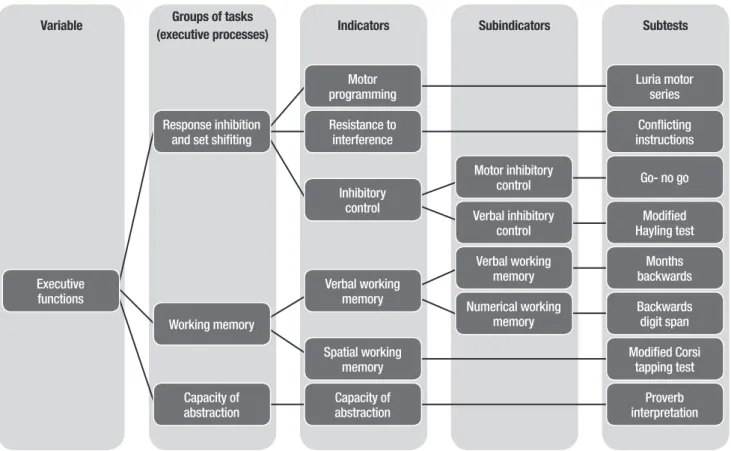
(Luria Motor Series, Conlicting Instructions and Go-no go). In addition, the IFS includes new subtests, most of them assessing various dimensions of working memo-ry. Figure 1 shows the detailed structure of the IFS, de-scribes the variables assessed by the test, its indicators and sub-indicators, and the subtests that measure each indicator or subindicator.
Since the IFS has only been validated in Argentina and to the best of our knowledge neither content valid-ity nor correlation of the IFS with functionalvalid-ity and dys-executive behaviors in daily living have been examined, it would be valuable to consider these aspects in order to complement the study of the instrument. herefore, the aim of the present study was to adapt the IFS to the Chilean cultural context and evaluate its psychometric properties and diagnostic accuracy in a sample of con-trol subjects and dementia patients.
METHODS
Subjects. he study was carried out in a convenience sam-ple, which included participants of both sexes, Spanish speakers, aged 52 or older, with at least three years of formal education. All subjects had a proxy that gave rel-evant information about their everyday activities and behavior. Subjects were divided into two groups:
A clinical sample, including 31 patients recruited from the Cognitive Neurology and Dementias Unit (Unidad de Neurología Cognitiva y Demencias) of the Neurology Service at the Hospital del Salvador in San-tiago, Chile. he diagnosis of dementia was provided by a Neurologist based on detailed neurological, neu-ropsychological, laboratory, and neuroimaging data from each participant. he irst step in the diagnostic process was to determine the presence of dementia using the DSM-IV-TR criteria.17 When these criteria
frontotem-poral dementia (i.e. Consensus for FTD diagnosis).18-21
All patients had a Clinical Dementia Rating Scale (CDR) ≥1. More speciically, 10 patients with AD, 3 with VD, 2 with mixed dementia, 5 with LBD, 5 with bvFTD, 2 with SD and 4 dementia patients with non-speciied etiol-ogy, were included in the sample.
he control sample comprised 30 subjects with simi-lar socio-demographic characteristics (age, sex and years of education) to those of the clinical sample. All partici-pants included in this group had CDR=0 and presented no symptoms or history of neurological or psychiatric diseases.
Finally, exclusion criteria for both groups were: [1] presence of depression as measured by the Geriat-ric Depression Scale (score ≥5 points); [2] presence of Anxiety Disorder as measured by the Zung Scale (score ≥51 points); and [3] presence of severe sensory deicits (loss of vision and/or hearing) that could impede test administration.
IFS and other neuropsychological tests. As outlined above, the IFS is a screening test for executive dysfunctions. he tasks included in the IFS are: Luria motor series (3 points), Conlicting instructions (3 points), Go-no go (3
points), Months backwards (2 points), Backwards digit span (6 points), Modiied Corsi tapping test (4 points), Proverb interpretation (3 points) and Modiied Hayling Test (6 points). hus, the IFS has a maximum possible score of 30 points. High scores indicate preservation of the executive functions. In this study, the IFS was adapted to the Chilean cultural context (IFS-Ch) and then administered to all subjects.
All subjects were assessed with the following ex-ecutive tests to estimate convergent validity. [1] he Modiied version of the Wisconsin Card Sorting Test (MCST),22 a brief version of the widely known
Wiscon-sin Card Sorting Test23,24 designed originally to study
“abstract behavior” and “set-shifting ability” and later proposed as being sensitive for assessing frontal dam-age.24 he MCST is a classiication task in which the
sub-ject must ind the sorting criteria and maintain it for a number of trials.14 his particular version was used as
it simpliies and reduces ambiguity in administration, making it more suitable for elderly patients.25 [2]
Ver-bal luency tasks, or controlled oral word-association, in which subjects have to generate words following a given criteria. his test is sensitive for assessing executive dysfunction24,26 and semantic memory impairment.24
Variable Groups of tasks
(executive processes) Indicators Subindicators Subtests
Executive functions
Response inhibition and set shifiting
Luria motor series
Conflicting instructions Motor
programming
Resistance to interference
Inhibitory control
Go- no go
Modified Hayling test Motor inhibitory
control
Verbal inhibitory control
Months backwards
Backwards digit span Verbal working
memory
Numerical working memory
Modified Corsi tapping test
Proverb interpretation Capacity of
abstraction Working memory
Verbal working memory
Spatial working memory
Capacity of abstraction
Semantic verbal luency (animals) and phonemic ver-bal luencies (letters A and P)27 were speciically used.
[3] he FAB, a screening test for executive dysfunction that assesses conceptualization, mental lexibility, mo-tor programming, resistance to interference, inhibimo-tory control and environmental autonomy.14
All participants were also tested with global cog-nitive eiciency measures: [1] the Mini Mental State Examination (MMSE),28 the most commonly used
cog-nitive screening test internationally;29 and [2] the
Ad-denbrooke’s Cognitive Examination Revised-Chilean Version (ACE-R-Ch),30 a test that assesses ive cognitive
domains: orientation and attention, memory, verbal lu-ency, language and visuospatial abilities.
Proxies were interviewed with instruments to assess dysexecutive symptoms in daily life (Dysexecutive Ques-tionnaire [DEX]),31 dementia severity (CDR)32 and
func-tional capacity in activities of daily living (Instrumental Activities of Daily Living Scale [IADL]33 and
Technology-Activities of Daily Living Questionnaire [T-ADLQ]).34
Procedure. he IFS was irst adapted to the Chilean cul-tural context and its content validity was assessed by consultation with experts through a content validity questionnaire. All subjects were assessed by the modi-ied IFS (IFS-Ch) and the other instruments previously described.
Statistical analysis. All statistical analyses were performed with signiicance level set at 0.05. Data analysis was per-formed with PASW Statistics 18 software. Diferences in sex were analyzed using the χ² test. Diferences in age, years of education and test scores between groups were analyzed using the t test for independent samples. A one-way MANOVA analysis was conducted to com-pare results across subtests of the IFS-Ch by diagnostic category. he correlations between scores of two tests were evaluated using the Pearson coeicient, with the exception of the association between CDR and IFS-Ch
scores, for which the Spearman rank correlation test was employed. Reliability was assessed using the Cron-bach’s alpha coeicient. he sensitivity and speciicity of the IFS-Ch for detecting the presence of dementia were evaluated using the receiver operating characteristic (ROC) analysis.
Ethical concerns. he study was approved by the Eth-ics Committee at the Servicio de Salud Metropolitano Oriente. Informed consent was obtained from control subjects, dementia patients and their closest relatives.
RESULTS
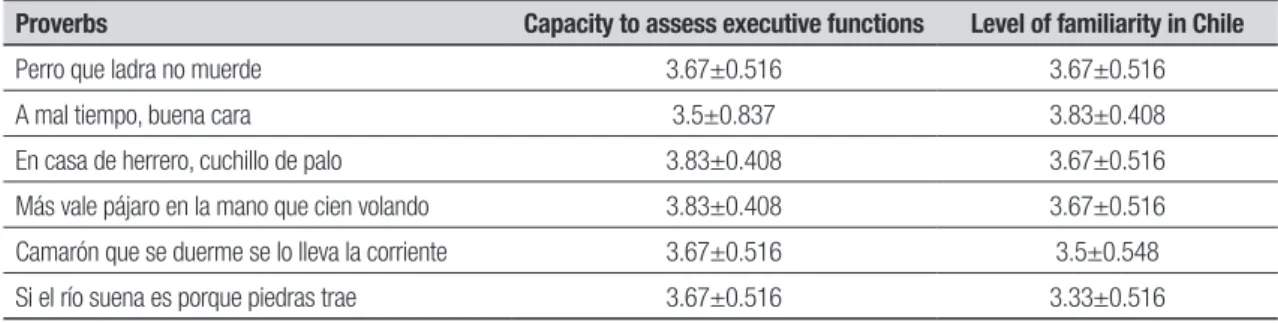
Adaptation. Given its sociocultural nature, the proverb in-terpretation subtest of the IFS was adapted to the Chil-ean cultural context. Using a four-point Likert scale, six experts in the neuropsychological ield were consulted about the capacity of the three proverbs included in the original test and three proverbs proposed as relatively common in Chile to assess executive function and their level of familiarity in the Chilean cultural context. he three proverbs that presented the highest means and the lowest standard deviations were selected. Table 1 summarizes the statistical parameters for the experts’ responses. Only minor modiications were made to the rest of the test administration procedure and scoring in-structions in order to standardize the assessment proce-dure as much as possible.
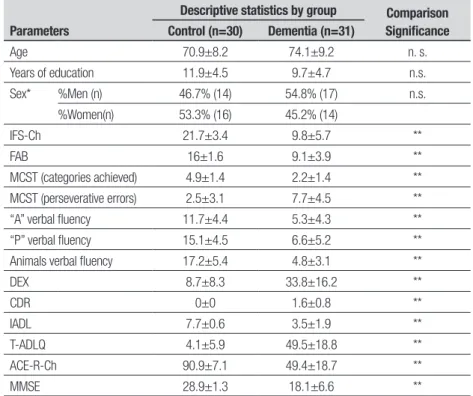
Demographic and neuropsychological data. Table 2 shows de-mographic and neuropsychological data for the clinical and control samples. No signiicant diferences in sex, age or years of education were found among the groups (p>0.05). In contrast, the scores of all the instruments administered to subjects and their informants difered signiicantly between the studied groups (p<0.05).
Influence of socio-demographic variables on IFS-Ch perfor-mance. In order to determine the inluence of
demo-Table 1. Mean and standard deviation of the proverbs’ capacity to assess executive functions and level of familiarity in Chilean population.
Proverbs Capacity to assess executive functions Level of familiarity in Chile
Perro que ladra no muerde 3.67±0.516 3.67±0.516
A mal tiempo, buena cara 3.5±0.837 3.83±0.408
En casa de herrero, cuchillo de palo 3.83±0.408 3.67±0.516
Más vale pájaro en la mano que cien volando 3.83±0.408 3.67±0.516
Camarón que se duerme se lo lleva la corriente 3.67±0.516 3.5±0.548
Si el río suena es porque piedras trae 3.67±0.516 3.33±0.516
graphic variables on IFS-Ch performance, the correla-tion between demographic characteristics and IFS-Ch total scores was estimated. No signiicant association was found between IFS-Ch total scores and age (r= –0.197; p>0.05), whereas a signiicant correlation was found between IFS total scores and years of education (r=0.48; p<0.001). Regarding sex, no signiicant gender diferences were found on IFS performance (t= –0.25; p>0.05). In summary, only years of education showed an inluence on IFS performance.
Evidence of validity. Content validity. Five experts with at least two years of experience in the ield of neuropsy-chology answered a content validity questionnaire de-signed for the IFS-Ch. In this questionnaire, the concep-tual and operational deinitions of executive functions and its indicators were presented. he deinition of each indicator was followed by the administration and scor-ing instructions for the correspondscor-ing subtest. Subse-quently, the experts were asked about the capacity of each subtest to assess executive function, its capacity to measure the corresponding indicator, and the clarity of the administration and scoring instructions, leaving a space for any other observations. All the experts agreed that each of the subtests measured executive functions and that each subtest assessed its respective indicator.
For 5 of the 8 subtests, all the experts considered that the instructions were formulated clearly, while for the 3 remaining subtests, one expert considered that the instructions were formulated poorly. he latter expert suggested changes to clarify the instructions, which were later incorporated into the test. A new version of the IFS-Ch was then devised according to these observa-tions. his new version had only minor diferences com-pared with the original test.
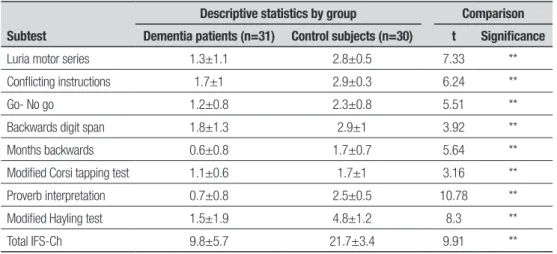
Discriminant validity. he performance of the two groups
difered signiicantly (p<0.05). Average total scores on the IFS-Ch and each of its subtests were signii-cantly lower in the clinical sample (Table 3). A one-way MANOVA revealed a signiicant multivariate main ef-fect for diagnosis, Wilks’ Lambda=0.225, F(8, 52)=22.398,
p<0.001, partial eta squared=0.775. he power to detect the efect was 1.00.
he standardized mean diferences between the de-mentia and control groups showed a Cohen’s d value (ef-fect size r) of 2.54 (0.79) for the IFS-Ch.
Convergent and divergent validity. he total IFS-Ch scores
signiicantly correlated (p<0.05) with other measures of executive functions (categories achieved in the MCST, perseverative errors on the MCST, phonemic verbal
lu-Table 2. Demographic and neuropsychological data.
Parameters
Descriptive statistics by group Comparison Significance Control (n=30) Dementia (n=31)
Age 70.9±8.2 74.1±9.2 n. s.
Years of education 11.9±4.5 9.7±4.7 n.s.
Sex* %Men (n) 46.7% (14) 54.8% (17) n.s.
%Women(n) 53.3% (16) 45.2% (14)
IFS-Ch 21.7±3.4 9.8±5.7 **
FAB 16±1.6 9.1±3.9 **
MCST (categories achieved) 4.9±1.4 2.2±1.4 **
MCST (perseverative errors) 2.5±3.1 7.7±4.5 **
“A” verbal fluency 11.7±4.4 5.3±4.3 **
“P” verbal fluency 15.1±4.5 6.6±5.2 **
Animals verbal fluency 17.2±5.4 4.8±3.1 **
DEX 8.7±8.3 33.8±16.2 **
CDR 0±0 1.6±0.8 **
IADL 7.7±0.6 3.5±1.9 **
T-ADLQ 4.1±5.9 49.5±18.8 **
ACE-R-Ch 90.9±7.1 49.4±18.7 **
MMSE 28.9±1.3 18.1±6.6 **
ency with letters A and P, semantic verbal luency of animals and the FAB); global cognitive eiciency (ACE-R-Ch and MMSE); dysexecutive symptoms (DEX); de-mentia severity (CDR); and functionality (IADL and T-ADLQ). he coeicients estimated for each association are given in Table 4. he association between IFS-Ch and measures of global cognitive eiciency indicates no evidence of divergent validity.
Evidence of reliability. he Cronbach’s alpha coeicient cal-culated for the total test was 0.901. Regarding the sub-tests that included more than one item, the Cronbach’s alpha coeicient was 0.577 for the Modiied Corsi tap-ping test, 0.781 for the Proverb interpretation task, and 0.836 for the Modiied Hayling test.
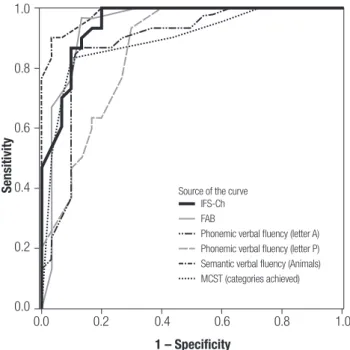
Diagnostic accuracy. A ROC curve analysis on the IFS-Ch total score between control subjects and dementia pa-tients generated several cut-of points, with 18 points being the best balance between sensitivity and speciic-ity (sensitivspeciic-ity=0.903; speciicspeciic-ity=0.867). he area un-der the curve (AUC) was 0.951 (Figure 2). here were no signiicant diferences among the areas under the curve of the IFS-Ch, FAB, categories completed on the MCST, Animals verbal luency, A verbal luency, and P verbal luency (p>0.05).35
DISCUSSION
In this paper, the IFS-Ch has shown good psychometric properties and diagnostic accuracy. First, it has shown validity evidence from multiple sources: content validity
Table 3. Performance of dementia patients and control subjects in the IFS-Ch and its subtests.
Subtest
Descriptive statistics by group Comparison Dementia patients (n=31) Control subjects (n=30) t Significance
Luria motor series 1.3±1.1 2.8±0.5 7.33 **
Conflicting instructions 1.7±1 2.9±0.3 6.24 **
Go- No go 1.2±0.8 2.3±0.8 5.51 **
Backwards digit span 1.8±1.3 2.9±1 3.92 **
Months backwards 0.6±0.8 1.7±0.7 5.64 **
Modified Corsi tapping test 1.1±0.6 1.7±1 3.16 **
Proverb interpretation 0.7±0.8 2.5±0.5 10.78 **
Modified Hayling test 1.5±1.9 4.8±1.2 8.3 **
Total IFS-Ch 9.8±5.7 21.7±3.4 9.91 **
Results expressed in Mean±Standard Deviation. **Significant difference, p<0.05. All comparisons were carried out with a t test for independent samples.
Table 4. Association coefficients between the IFS-Ch and the rest of the administered measures.
Instrument
IFS-Ch
rxy Significance
Executive functions FAB 0.935 **
MCST (categories achieved) 0.791 **
MCST (perseverative errors) –0.617 **
A verbal fluency 0.681 **
P verbal fluency 0.783 **
Animals verbal fluency 0.728 **
Global cognitive efficiency ACE-R-Ch 0.9 **
MMSE 0.874 **
Dysexecutive symptoms DEX –0.494 **
Dementia severity CDR –0.75 **
Functional capacity T-ADLQ –0.745 **
IADL 0.717 **
through expert consultation, discriminant validity by comparing the means of IFS-Ch scores between groups, and convergent validity through associations between IFS-Ch scores and other executive and related measures. Second, the IFS-Ch demonstrated evidence of reliabil-ity, exhibiting a good internal consistency coeicient. his is relevant given that reliability is a common weak-ness of executive tests.36,37 With regard to diagnostic
ac-curacy, the selected cut-of point produced an excellent AUC as well as a very good balance between sensitivity and speciicity for detecting dementia.
Although the test and two subtests (Modiied Hay-ling test and Proverb interpretation) showed evidence of very good reliability, the Modiied Corsi tapping subtest had a poor internal consistency coeicient. Further stud-ies are needed to determine whether this subtest pro-vides an accurate measure of spatial working memory. It is noteworthy that the cut-of point found in this study (18) was much lower than that found in the original publication (25). his fact is probably due to the socio-demographic diferences between both samples, particularly in relation to years of education. In our study, the mean of this parameter was 11.93 and 9.65 years for the control and clinical groups, respectively, whereas in the Argentinian investigation the mean for bvFTD, AD and control subjects was 16.3 years, 14.5
years and 14.5 years, respectively. hese diferences are coherent with our inding that years of education exhib-ited a signiicant association with IFS-Ch total scores and with results of studies showing that education is an important variable in executive test performance in general.38-40 Overall, these data suggest that it is
impor-tant to formulate local norms in order to interpret IFS-Ch scores accurately.
One of the main indings of this study was that the IFS-Ch showed a good association with functionality measures such as the IADL and T-ADLQ. his is coher-ent with the indings of previous studies which sug-gest that executive tests predict functional impairment more accurately than tests that assess other cognitive domains,41-43 which is expected given that daily life
ac-tivities are mainly goal-oriented behaviors. hus, the described association contributes with evidence of con-vergent validity for the IFS-Ch.
Similarly, a good association was found between IFS-Ch total scores and the DEX, a questionnaire that assesses dysexecutive symptoms. In other words, the IFS-Ch, despite the fact that it is a non-ecological mea-sure - i. e. it is a standardized test administered in a laboratory type setting - correlates signiicantly with the presence of dysexecutive behaviors in everyday life. he latter constitutes not only evidence of convergent validity for the test, but also suggests that it presents good ecological validity, a relevant and highly desirable feature for an executive assessment instrument.4,44
One limitation of our study is the small number of subjects by category of dementia, a situation preclud-ing proper assessment of the capacity of the IFS-Ch to discriminate between diferent types within the pa-thology. Moreover, the greater number of patients with AD compared with patients with bvFTD or VD, meant that most of our clinical group presented a multideicit clinical proile, a situation that could explain the sig-niicant correlation found between IFS-Ch total scores and measures of global cognitive eiciency (ACE-R-Ch and MMSE). Evidence of divergent validity for the IFS-Ch should be studied with patients presenting deicits mainly in the executive domain. Further research is needed to determine whether the IFS-Ch can diferenti-ate between diferent forms of dementia and to obtain further evidence of divergent validity.
Acknowledgements. his study was supported by grants: Project FONDECYT No. 1100975 CONICYT and PIA-CONICYT Project CIE-05. We thank Constanza Ihnen for her English review of the manuscript.
Figure 2. ROC curve for controls vs. patient groups (bvFTD and depression). The superior discriminatory accuracy of the IFS over the MMSE and ACE-R is revealed by its larger area under the curve.
1.0
0.8
0.6
0.4
0.2
0.0
Sensitivity
0.0 0.2 0.4 0.6 0.8 1.0
IFS-Ch FAB
Phonemic verbal fluency (letter A) Phonemic verbal fluency (letter P) Semantic verbal fluency (Animals) MCST (categories achieved)
1 – Specificity
Source of the curve
REFERENCES
1. Elliott R, Executive functions and their disorders. Br Med Bull 2003; 65:49-59.
2. Stuss DT, Levine B, Adult clinical neuropsychology: lessons from stud-ies of the frontal lobes. Annu Rev Psychol 2002;53:401-433. 3. Verdejo A, Bechara A. Neuropsicología de las funciones ejecutivas.
Psi-cothema 2010;22:227-235.
4. Chan RC, Shum D, Toulopoulou T, Chen EY. Assessment of executive functions: review of instruments and identification of critical issues. Arch Clin Neuropsychol 2008;23:201-216.
5. Miyake A, Emerson MJ, Friedman NP. Assessment of executive func-tions in clinical settings: problems and recommendafunc-tions. Semin Speech Lang 2000;21:169-183.
6. Stuss DT, Alexander MP. Executive functions and the frontal lobes: a conceptual view. Psychol Res 2000;63:289-298.
7. Godefroy O. Frontal syndrome and disorders of executive functions. J Neurol 2003; 250: 1-6.
8. Voss SE, Bullock RA. Executive function: the core feature of dementia? Dement Geriatr Cogn Disord 2004;18:207-216.
9. Torralva T, Martínez M, Manes F. Demencia frontotemporal. In: Labos E, Slachevsky A, Fuentes P, Manes F (editors). Tratado de Neuropsicología Clínica. Buenos Aires, Argentiana: Librería Akadia; 2008:501-509. 10. Merino J, Hachinski V. Demencia Vascular. In: Labos E, Slachevsky A,
Fuentes P, Manes F (editors). Tratado de Neuropsicología Clínica. Bue-nos Aires, Argentiana:Librería Akadia; 2008:511-519.
11. Graham NL, Emery T, Hodges JR. Distinctive cognitive profiles in Al-zheimer’s disease and subcortical vascular dementia. J Neurol Neuro-surg Psychiatry 2004;75:61-71.
12. Cleusa P Ferri, Martin Prince, Carol Brayne, et al. Global prevalence of dementia: a Delphi consensus study. Lancet 2005;366:2112-2117. 13. Torralva T, Roca M, Gleichgerrcht E, López P, Manes F. INECO Frontal
Screening (IFS): a brief, sensitive, and specific tool to assess executive functions in dementia. J Int Neuropsychol Soc 2009;15:777-786. 14. Dubois B, Slachevsky A, Litvan I, Pillon B. The FAB: a Frontal
Assess-ment Battery at bedside. Neurology 2000;55:1621-1626.
15. Sarazin M, Pillon B, Giannakopoulos P, Rancurel G, Samson Y, Dubois B. Clinicometabolic dissociation of cognitive functions and social be-havior in frontal lobe lesions. Neurology 1998;51:142-148.
16. Lipton AM, Ohman KA, Womack KB, Hynan LS, Ninman ET, Lacritz LH. Subscores of the FAB differentiate frontotemporal lobar degeneration from AD. Neurology 2005;65:726-731.
17. American Psychiatric Association. and American Psychiatric Associa-tion. Task Force on DSM-IV., Diagnostic and statistical manual of mental disorders : DSM-IV. 4th ed, Washington, DC: American pyschiatric as-sociation. 1994: xxvii, 886.
18. McKhann G, Drachman D, Folstein M, Katzman R, Price D, Stadlan EM. Clinical diagnosis of Alzheimer’s disease: report of the NINCDS-ADRDA Work Group under the auspices of Department of Health and Human Ser-vices Task Force on Alzheimer’s Disease. Neurology 1984;34:939-944. 19. Neary D, Snowden JS, Gustafson L, et al. Frontotemporal lobar de-generation: a consensus on clinical diagnostic criteria. Neurology 1998; 51:1546-1554.
20. McKeith IG, Galasko D, Kosaka K, et al. Consensus guidelines for the clinical and pathologic diagnosis of dementia with Lewy bodies (DLB): report of the consortium on DLB international workshop. Neurology 1996;47:1113-1124.
21. Román GC, Tatemichi TK, Erkinjuntti T, et al., Vascular dementia: diag-nostic criteria for research studies. Report of the NINDS-AIREN Interna-tional Workshop. Neurology 1993;43:250-260.
22. Grant DA, Berg EA, A behavioural analysis of degree or reinforcement and ease of shifting to new responses in a Weigl-type card sorting prob-lem. J Exp Psychology 1948; 38:404-411.
23. Berg EA. A simple objective technique for measuring flexibility in think-ing. J Gen Psychol 1948;39:15-22.
24. Hodges JR. Cognitive assessment for clinicians. 2nd ed, Oxford ; New York: Oxford University Press. 2007:266, xviii
25. Nelson HE. A modified card sorting test sensitive to frontal lobe defects. Cortex 1976;12:313-324.
26. Henry JD, Crawford JR, A meta-analytic review of verbal fluency perfor-mance in patients with traumatic brain injury. Neuropsychology 2004; 18:621-628.
27. Benton A, Hamsher K. Multilingual aphasia examination manual, Iowa: Universidad de Iowa; 1976.
28. Folstein MF, Folstein SE, McHugh PR. “Mini-mental state”. A practical method for grading the cognitive state of patients for the clinician. J Psychiatr Res 1975;12:189-198.
29. Mangone C, Bauman D, Gigena V. Evaluación neuropsicológica de las demencias. In: Labos E, Slachevsky A, Fuentes P, Manes F (editors). Tratado de Neuropsicología Clínica. Buenos Aires, Argentiana: Librería Akadia; 2008:483-491.
30. Muñoz-Neira C, Henríquez Ch F, Ihnen J J, Sánchez C M, Flores M P, Slachevsky Ch A. Psychometric properties and diagnostic usefulness of the Addenbrooke’s Cognitive Examination-revised in a Chilean elderly sample. Rev Med Chil 2012;140:1006-1013.
31. Wilson BA, Emslie H, Evans JJ, Alderman N, Burgess PW. Behavioural Assessment of the Dysexecutive Syndrome (BADS) Bury St. Edmunds: Thames Valley Test Company; 1996.
32. Hughes CP, Berg L, Danziger WL, Coben LA, Martin RL. A new clinical scale for the staging of dementia. Br J Psychiatry 1982;140:566-572. 33. Lawton MP, Brody EM. Assessment of older people:
self-maintain-ing and instrumental activities of daily livself-maintain-ing. Gerontologist 1969;9: 179-186.
34. Muñoz-Neira C, López OL, Riveros R, Núñez-Huasaf J, Flores P, Slachevsky A. The technology - activities of daily living questionnaire: a version with a technology-related subscale. Dement Geriatr Cogn Disord 2012;33:361-371.
35. Hanley JA, McNeil BJ. A method of comparing the areas under receiver operating characteristic curves derived from the same cases. Radiology 1983;148:839-843.
36. Burgess PW, Alderman N, Evans J, Emslie H, Wilson B. The ecologi-cal validity of tests of executive function. J Int Neuropsychol Society 1998;4:547-558.
37. Miyake A, Friedman NP, Emerson MJ, Witzki AH, Howerter A, Wager TD. The unity and diversity of executive functions and their contribu-tions to complex “Frontal Lobe” tasks: a latent variable analysis. Cogn Psychol 2000;41:49-100.
38. Heaton RK, Grant I, Mathews C. Differences in neuropsychological test performances associated with age, education and sex. In: Grant I, Ad-ams KM (Editors). Neuropsychological assessment in neuropsychiatric disorders. Oxford University Press: Nueva York; 1986:108-120. 39. Ivnik RJ, Malec JF, Smith GE, et al. Neuropsychological tests’ norms
above age 55: COWAT, BNT, MAE Token, WRAT-R Reading, AMNART, Stroop, TMT, and JLO. Clin Neuropsychologist 1996;10:262-278. 40. Mortiner JA, Graves AB, Education and other socioeconomic
determi-nants of dementia and Alzheimer’s Disease. Neurology 1993;43:39-44. 41. Royall DR, Lauterbach EC, Cummings JL, et al., Executive control func-tion: a review of its promise and challenges for clinical research. A report from the Committee on Research of the American Neuropsychiatric As-sociation. J Neuropsychiatry Clin Neurosci 2002;14:377-405. 42. Royall DR, Lauterbach EC, Kaufer D, Malloy P, Coburn KL, Black KJ,
Committee on Research of the American Neuropsychiatric Association. The cognitive correlates of functional status: a review from the Com-mittee on Research of the American Neuropsychiatric Association. J Neuropsychiatry Clin Neurosci 2007;19:249-265.
43. Godefroy O, Azouvi P, Robert P, Roussel M, LeGall D, Meulemans T; Groupe de Réflexion sur l’Evaluation des Fonctions Exécutives Study Group. Dysexecutive syndrome: diagnostic criteria and validation study. Ann Neurol 2010;68:855-864.