Prediction Formulas for Individual Opioid
Analgesic Requirements Based on Genetic
Polymorphism Analyses
Kaori Yoshida1,2‡, Daisuke Nishizawa1‡, Takashi Ichinomiya3, Tatsuya Ichinohe2, Masakazu Hayashida4, Ken-ichi Fukuda2, Kazutaka Ikeda1*
1Addictive Substance Project, Tokyo Metropolitan Institute of Medical Science, Tokyo, Japan,2Department of Dental Anesthesiology, Tokyo Dental College, Tokyo, Japan,3Department of Biomedical Informatics, Gifu University Graduate School of Medicine, Gifu, Japan,4Department of Anesthesiology and Pain Medicine, Juntendo University School of Medicine, Tokyo, Japan
‡These authors contributed equally to this work. *[email protected]
Abstract
Background
The analgesic efficacy of opioids is well known to vary widely among individuals, and vari-ous factors related to individual differences in opioid sensitivity have been identified. How-ever, a prediction model to calculate appropriate opioid analgesic requirements has not yet been established. The present study sought to construct prediction formulas for individual opioid analgesic requirements based on genetic polymorphisms and clinical data from pa-tients who underwent cosmetic orthognathic surgery and validate the utility of the prediction formulas in patients who underwent major open abdominal surgery.
Methods
To construct the prediction formulas, we performed multiple linear regression analyses using data from subjects who underwent cosmetic orthognathic surgery. The dependent variable was 24-h postoperative or perioperative fentanyl use, and the independent vari-ables were age, gender, height, weight, pain perception latencies (PPL), and genotype data of five single-nucleotide polymorphisms (SNPs). To examine the utility of the prediction for-mulas, we performed simple linear regression analyses using subjects who underwent major open abdominal surgery. Actual 24-h postoperative or perioperative analgesic use and the predicted values that were calculated using the multiple regression equations were incorporated as dependent and independent variables, respectively.
Results
Multiple linear regression analyses showed that the four SNPs, PPL, and weight were re-tained as independent predictors of 24-h postoperative fentanyl use (R2= 0.145,P= 5.66 × 10⁻¹⁰) and the two SNPs and weight were retained as independent predictors of
periopera-tive fentanyl use (R2= 0.185,P= 1.99 × 10⁻¹⁵). Simple linear regression analyses showed OPEN ACCESS
Citation:Yoshida K, Nishizawa D, Ichinomiya T, Ichinohe T, Hayashida M, Fukuda K-i, et al. (2015) Prediction Formulas for Individual Opioid Analgesic Requirements Based on Genetic Polymorphism Analyses. PLoS ONE 10(1): e0116885. doi:10.1371/ journal.pone.0116885
Academic Editor:Brion Maher, Johns Hopkins Bloomberg School of Public Health, UNITED STATES
Received:August 7, 2014
Accepted:December 16, 2014
Published:January 23, 2015
Copyright:© 2015 Yoshida et al. This is an open access article distributed under the terms of the
Creative Commons Attribution License, which permits unrestricted use, distribution, and reproduction in any medium, provided the original author and source are credited.
Data Availability Statement:All relevant data are within the paper and its Supporting Information files.
that the predicted values were retained as an independent predictor of actual 24-h postoper-ative analgesic use (R2= 0.033,P= 0.030) and perioperative analgesic use (R2= 0.100,
P= 1.09 × 10⁻⁴), respectively.
Conclusions
We constructed prediction formulas, and the possible utility of these prediction formulas was found in another type of surgery.
Introduction
Opioid analgesics are widely used for the treatment of moderate to severe pain during the peri-operative period. However, the analgesic efficacy of opioids is well known to vary widely among individuals [1]. For example, the minimal effective analgesic concentration of fentanyl that is required for satisfactory analgesia varies from 0.2 to 2.0 ng/ml among patients [2]. Thus, effective pain treatment is often hampered by significant differences in opioid sensitivity (S1 Fig.). Inadequate pain relief because of insufficient doses of opioids and adverse side-effects caused by unnecessarily high doses of opioids (e.g., nausea, vomiting, and constipation) are often observed in clinical settings [3]. The proper administration of opioids that meets the needs of individual patients is crucial.
Individual differences can be attributed to both environmental and genetic factors, although the relative influence of each of these factors can be variable [4]. For example, this variation in postoperative pain and analgesic consumption is reportedly affected by environmental factors including hepatic or renal function, type of surgery, and anesthesia method, demographic fac-tors including gender, age, and ethnic origin, and preexisting psychophysical facfac-tors including anxiety and preoperative pain [4–6]. Additionally, a recent study that included identical and fraternal twins revealed that an estimated 60% of the variance in cold-pressor pain and 26% of the variance in heat pain were genetically mediated. Thus, some individual differences are like-ly to be attributable to genetic factors [7]. To date, various candidate genetic polymorphisms related to individual opioid sensitivity have been revealed and in particular several genetic polymorphisms within or close to regions of theOPRM1gene that encodes opioid receptor, mu 1,CACNA1Egene that encodes calcium channel, voltage-dependent, R type, alpha 1E sub-unit,ADRB2gene that encodes adrenoceptor beta 2, surface,GIRK2(KCNJ6) gene that en-codes potassium inwardly-rectifying channel, subfamily J, member 6, andCREB1gene that encodes cyclic adenosine 3’,5’-monophosphate responsive element binding protein 1, have been reported to be strongly associated with opioid requirements in patients who underwent cosmetic orthognathic surgery with postoperative pain [8–10].
Although various factors related to individual differences in opioid sensitivity have been identified, a prediction model that calculates appropriate opioid analgesic requirements has not yet been developed. Therefore, the present study sought to construct prediction formulas for individual opioid analgesic requirements based on five genetic polymorphisms described above and clinical data using patients who underwent cosmetic orthognathic surgery. We in-vestigated patients who underwent mandibular sagittal split ramus osteotomy, which is highly standardized at our institute regarding surgical procedures, duration of surgery, and the skill of the surgeons. Because these patients are usually young and healthy and expected to have simi-lar pain after surgery, they may be ideal for evaluating the analgesic effects of opioids [1,8]. We for Research on Metabolic Disorders (Tokyo, Japan).
The funders had no role in study design, data collection and analysis, decision to publish, or preparation of the manuscript.
also validated the utility of the prediction formulas in another type of surgery, major open abdominal surgery.
Materials and Methods
Ethics statement
The study protocol was approved by the Institutional Review Boards at Tokyo Dental College (Tokyo, Japan), the Institute of Medical Science, The University of Tokyo (Tokyo, Japan), Toho University Sakura Medical Center (Sakura, Japan), and the Tokyo Institute of Psychiatry (currently Tokyo Metropolitan Institute of Medical Science, Tokyo, Japan). All of the subjects and the parents when the subjects were minors provided informed, written consent for the genetics studies.
Subjects
Enrolled in the initial study to construct the prediction formulas for individual opioid analgesic requirements were 354 healthy patients (American Society of Anesthesiologists Physical Status I, age 15–52 years, 126 males and 228 females) who were scheduled to undergo cosmetic orthognathic surgery (mandibular sagittal split ramus osteotomy) for mandibular prognathism under general anesthesia at Tokyo Dental College Suidoubashi Hospital. Patients with chronic pain, those taking pain medication, and those who experienced Raynaud’s phenomenon were excluded. Peripheral blood samples were collected from these subjects for the gene analysis. The detailed demographic and clinical data of the subjects are provided inTable 1andS1 Table.
The subjects who were included in the second analysis to examine the utility of the predic-tion formulas that were constructed based on multiple regression analysis were different 145 patients (American Society of Anesthesiologists Physical Status I or II, age 28–80 years, 83 males and 62 females) who underwent major open abdominal surgery, mostly gastrectomy for gastric cancer and colectomy for colorectal cancer under combined general and epidural anesthesia at the Institute of Medical Science (The University of Tokyo) or Toho University Sakura Medical Center. Peripheral blood or oral mucosa samples were collected from these subjects for the gene analysis. The detailed demographic and clinical data of the subjects are provided inTable 2andS2 Table.
Table 1. Demographic and clinical data of the subjects who underwent cosmetic orthognathic surgery.
Age (years) 25.9±7.6 (15–52)
Male/Female 126/228
Height (cm) 164.6±8.8 (143–190)
Body weight (kg) 57.7±10.9 (38–128)
PPL (s) 14 [9,23] (2–150)
OPRM1(rs9384179) AA/AG, GG 283/71
CACNA1E(rs3845446) AA/AG, GG 167/187
ADRB2(rs11959113) AA, AG/GG 153/201
GIRK2(rs2835859) TT/TC, CC 305/49
CREB1(rs2952768) CC/TC, TT 35/319
The data are expressed as numbers, mean±SD (range), or median [interquartile range]. PPL, pain perception latency.
General anesthesia and postoperative pain management
For the subjects who underwent cosmetic orthognathic surgery, the surgical protocol and sub-sequent postoperative pain management were fundamentally the same as in previous studies [8,9]. The cold pressor-induced pain test was performed before the induction of anesthesia as previously described [11,12]. Briefly, crushed ice cubes and cold water were blended 15 min before testing in a 1 L isolated tank, and the mixture was stirred immediately before each test to ensure a uniform distribution of temperature (0°C) within the tank. The dominant hand was immersed up to the wrist. The subjects were instructed to keep their hand calm in the ice-cold water and withdraw it as soon as they perceived any pain. The same investigator conducted the test for all of the patients. The baseline latency to pain perception, defined as the time of im-mersion of the hand in the ice water (pain perception latency [PPL]), was recorded. A cut-off point of 150 s was set to avoid tissue damage. After the induction of anesthesia, peripheral blood samples were collected from these subjects for the gene analysis. After emergence from anesthesia and tracheal extubation, 1.25 mg droperidol was administered intravenously to pre-vent nausea/vomiting, and intravenous patient-controlled analgesia (PCA) with fentanyl (1 mg fentanyl and 5 mg droperidol diluted in normal saline in a total volume of 50 ml) com-menced using a CADD-Legacy PCA pump (Smiths Medical Japan, Tokyo, Japan). The PCA settings included a bolus dose of 20μg fentanyl on demand and a lockout time of 10 min. Con-tinuous background infusion was not used. Droperidol was coadministered with fentanyl to prevent nausea/vomiting because our preliminary study found a high incidence (up to 30%) of nausea/vomiting with PCA fentanyl in young females. Patient-controlled analgesia was contin-ued for 24 h postoperatively. Intraoperative fentanyl use and postoperative PCA fentanyl use during the first 24-h postoperative period were recorded. The doses of fentanyl administered intraoperatively and postoperatively were normalized to body weight.
For the subjects who underwent major open abdominal surgery, the surgical protocol and subsequent postoperative pain management were fundamentally the same as in previous stud-ies [13,14]. Postoperative pain was managed primarily with continuous epidural analgesia with fentanyl or morphine. Fentanyl or morphine was diluted with 0.25% bupivacaine in a total volume of 100 ml and infused at a constant rate of 2 ml/h through a catheter placed in the lower thoracic or upper lumbar epidural space. Whenever the patient complained of significant postoperative pain despite continuous epidural analgesic, appropriate doses of opioids, includ-ing morphine, buprenorphine, pentazocine, and pethidine, and/or nonsteroidal antiinflamma-tory drugs (NSAIDs), including diclofenac and flurbiprofen, were administered as rescue analgesics at the discretion of the surgeons based on the patient’s request. The doses of rescue
Table 2. Demographic and clinical data of the subjects who underwent major open abdominal surgery.
Age (years) 63.8±9.9 (28–80)
Male/Female 83/62
Height (cm) 158.3±8.5 (133–175)
Body weight (kg) 56.3±10.5 (30–80)
OPRM1(rs9384179) AA/AG, GG 117/28
CACNA1E(rs3845446) AA/AG, GG 68/77
ADRB2(rs11959113) AA, AG/GG 63/82
GIRK2(rs2835859) TT/TC, CC 132/13
CREB1(rs2952768) CC/TC, TT 17/128
The data are expressed as numbers and mean±SD (range).
analgesics (opioids and/or NSAIDs) administered during the first 24-h postoperative period and dose of analgesics administered during the intraoperative period were recorded. To allow intersubject comparisons of the analgesic doses required during the intraoperative period and first 24 h postoperative period, the doses of opioids and NSAIDs administered as rescue analge-sics during these periods were converted to the equivalent dose of systemic fentanyl according to previous reports [13–24]. The total dose of analgesics administered was calculated as the sum of the systemic fentanyl-equivalent doses of all of the opioids and NSAIDs administered to patients as analgesics during the intraoperative period and first 24-h postoperative period.
Peripheral blood or oral mucosa samples were collected from these subjects after surgery for the gene analysis.
Genotyping
Genomic DNA was extracted from the oral mucosa or whole-blood samples using the Wizard Genomic DNA Purification Kit (Promega, Tokyo, Japan) or the QIAamp DNA Mini Kit (Qiagen, Tokyo, Japan) according to the manufacturer’s instructions [25].
For genotyping the five selected single-nucleotide polymorphisms (SNPs; rs9384179 in the humanOPRM1gene, rs3845446 in the humanCACNA1Egene, rs11959113 in the human ADRB2gene, rs2835859 in the humanGIRK2[KCNJ6] gene, and rs2952768 around the humanCREB1gene), direct sequencing, the TaqMan allelic discrimination assay, and Infinium assay II were used. Genotype data from whole-genome genotyping, which was performed using Infinium assay II and an iScan system (Illumina, San Diego, CA, USA), were used for the rs3845446, rs11959113, rs2835859, and rs2952768 SNPs. Direct sequencing was conducted to genotype the rs9384179 SNP as described in a previous report [8]. The TaqMan allelic discrim-ination assay was conducted to genotype the rs3845446, rs2835859, and rs2952768 SNPs as de-scribed in previous reports [9,10] and the rs11959113 SNP. To perform the TaqMan assay with a LightCycler 480 (Roche Diagnostics, Basel, Switzerland), we used TaqMan SNP Geno-typing Assays (Life Technologies, Carlsbad, CA, USA) that contained sequence-specific for-ward and reverse primers to amplify the polymorphic sequence and two probes labeled with VIC and FAM dye to detect both alleles of the rs3845446, rs11959113, rs2835859, and rs2952768 SNPs (Assay ID: C___7539287_30, C__27108051_10, C__16076710_10, and C__11510543_20, respectively). Real-time polymerase chain reaction was performed in a final volume of 10μl that contained 2× LightCycler 480 Probes Master (Roche Diagnostics), 40× TaqMan SNP Genotyping Assays, 5–50 ng genomic DNA as the template, and H2O (Roche Di-agnostics). The thermal conditions were the following: 95°C for 10 min, followed by 45 cycles of 95°C for 10 s and 60°C for 60 s, with final cooling at 50°C for 30 s. Afterward, endpoint fluo-rescence was measured for each sample well, and each genotype was determined based on the presence or absence of each type of fluorescence. The details of Infinium assay II for whole-genome genotyping were provided in a previous report [9].
Statistical analysis
postoperative fentanyl requirements from the clinical or genomic parameters that may affect the analgesic efficacy of fentanyl (i.e., age, gender, height, weight, PPL, and genotype of the five SNPs), multiple linear regression analysis using the stepwise method of bidirectional selection was performed. The cut offPvalue for inclusion was set at 0.05. Moreover, to confirm the utili-ty of including the five SNPs in the predictive models of 24-h postoperative and perioperative fentanyl use, we examined whether adding the five SNPs to other patient characteristics in the models improves its predictive ability using forced entry method. The dependent variable was 24-h postoperative fentanyl use, and the independent variables were age, gender, height, weight, pain perception latencies, and genotype data of five single-nucleotide polymorphisms (SNPs). For the analysis, the gender and genotype data for each SNP were used as dummy vari-ables based on the previous analyses (S3andS4Tables) by replacing females and the genotypes associated with greater fentanyl use with 1, and males and the genotypes associated with lesser fentanyl use with 0. Therefore, we replaced homozygous carriers of the A allele of the
rs9384179 SNP with 1 and non-carriers with 0, homozygous carriers of the A allele of the rs3845446 SNP with 1 and non-carriers with 0, carriers of the A allele of the rs11959113 SNP with 1 and homozygous carriers of the G allele with 0, homozygous carriers of the T allele of the rs2835859 SNP with 1 and non-carriers with 0, and homozygous carriers of the C allele of the rs2952768 SNP with 1 and non-carriers with 0, respectively. Similar analysis using subjects who underwent cosmetic orthognathic surgery was also conducted for analgesic requirements during the perioperative period instead of during the postoperative period because the analge-sic effect of the intermediate-acting analgeanalge-sics, administered pre- and intraoperatively, could outlast the duration of surgery and thus affect postoperative analgesic use, especially in patients who received large doses of analgesics intraoperatively. Perioperative fentanyl use was calculat-ed as the sum of the intraoperative and postoperative doses of fentanyl or fentanyl-equivalent doses of analgesics.
Second analyses were conducted using the different 145 subjects who underwent major ab-dominal surgery. The total dose of rescue analgesics administered during the first 24-h postop-erative period was used as an index of opioid sensitivity. Prior to the analyses, the quantitative values of postoperative analgesic requirements (μg/kg) were natural-log-transformed for ap-proximation to the normal distribution according to the following formula:Value for analyses = Ln (1 + postoperative analgesic requirement [μg/kg]). To explore the regression of the actual
value of 24-h postoperative analgesic requirements after major abdominal surgery to the pre-dicted value that was calculated using the multiple regression equation constructed in the ini-tial analysis, simple linear regression analysis was performed. Actual 24-h postoperative analgesic use (μg/kg; log-transformed) and the predicted value that was calculated were incor-porated as dependent and independent variables, respectively. Similar analysis using subjects who underwent major abdominal surgery was also conducted for analgesic requirements dur-ing the perioperative period instead of durdur-ing the postoperative period. Perioperative fentanyl use was calculated as the sum of the intraoperative and postoperative doses of fentanyl or fenta-nyl-equivalent doses of analgesics.
For all of the statistical analyses described above, IBM SPSS v.20.0 for Windows software (IBM Japan, Tokyo, Japan) was used.
Results
(P= 1.3 × 10⁻⁶), rs2835859 (P= 0.003), rs9384179 (P= 0.042), and rs11959113 (P= 0.018), PPL (P= 0.016), and weight (P= 0.044) were retained as independent predictors of 24-h post-operative fentanyl use for cosmetic orthognathic surgery (R2= 0.145,P= 5.66 × 10⁻¹⁰;Fig. 1). The detailed multiple regression equation is shown inFig. 2. Similar multiple linear regression analysis of the perioperative period considering the analgesic effect of intermediate-acting
Fig 1. Regression analysis of 24-h postoperative fentanyl use after cosmetic orthognathic surgery. The figure shows a scatterplot for the actual value of 24-h postoperative fentanyl use (μg/kg; log-transformed)
in patients who underwent cosmetic orthognathic surgery and the predicted value that was calculated. Each point represents an individual patient. The solid line in the scatterplot represents the regression line, and the mathematical formula represents the regression equation.
doi:10.1371/journal.pone.0116885.g001
Fig 2. Construction of prediction formula.Multiple linear regression analysis during the postoperative period using the stepwise method was performed to construct a prediction formula for individual opioid sensitivity.“y”represents the predicted value of 24-h postoperative fentanyl requirements (μg/kg;
log-transformed) that was calculated using the multiple regression equation.
analgesics administered pre- and intraoperatively showed that the genotype of the two SNPs, rs2952768 (P= 9.1 × 10⁻⁵) and rs3845446 (P= 0.001), and weight (P= 2.8 × 10⁻¹²) were re-tained as independent predictors of perioperative fentanyl use for cosmetic orthognathic surgery (R2= 0.185,P= 1.99 × 10⁻¹⁵;Fig. 3). The multiple-regression equation was the follow-ing:predicted value of perioperative fentanyl requirements (μg/kg; log-transformed) = 2.749 +
0.221 × [CREB1] + 0.109 × [CACNA1E] + (-0.011) × [weight (kg)].
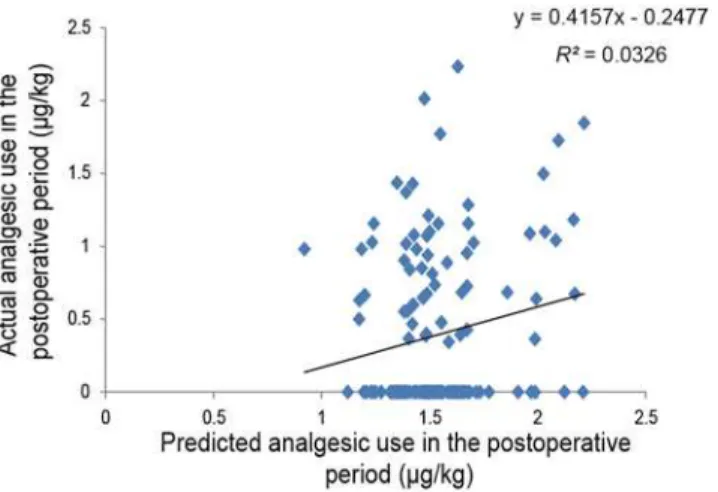
Second simple linear regression analysis of the postoperative period using subjects who un-derwent major abdominal surgery showed that the predicted value that was calculated was re-tained as an independent predictor of actual 24-h postoperative analgesic use for major abdominal surgery (R2= 0.033,P= 0.030;Fig. 4). Similar simple linear regression analysis of the perioperative period showed that the predicted value that was calculated was retained as an independent predictor of actual perioperative analgesic use for major abdominal surgery (R2= 0.100,P= 1.09 × 10⁻⁴;Fig. 5).
Discussion
A prediction formula for individual opioid analgesic requirements during the first 24-h postop-erative period (Fig. 2) was constructed using multiple linear regression analysis in healthy sub-jects who underwent painful cosmetic orthognathic surgery. By conducting similar analysis, we also constructed a prediction formula for the perioperative period, although the variables that were retained as independent predictors after the analysis of the perioperative period were not the same as those of the postoperative period (Fig. 3). TheR2index in the prediction formula for perioperative analgesic requirements was higher than theR2index for the first 24-h postop-erative analgesic requirements. Furthermore, by conducting simple linear regression analyses in subjects who underwent major open abdominal surgery, we demonstrated the possibility that the prediction formulas may be useful in another type of surgery (Figs.4and5), although the predictability of the formula remains to be verified in future studies. Using the prediction formulas and the patients’genetic polymorphisms and clinical data, better analgesia could be provided to individual patients. Based on the predicted values, less fentanyl could be
Fig 3. Regression analysis of perioperative fentanyl use after cosmetic orthognathic surgery.The figure shows a scatterplot for the actual value of perioperative fentanyl use (μg/kg; log-transformed) in
patients who underwent cosmetic orthognathic surgery and the predicted value that was calculated. Each point represents an individual patient. The solid line in the scatterplot represents the regression line, and the mathematical formula represents the regression equation.
administered to patients with higher opioid sensitivity, and more fentanyl could be adminis-tered to patients with lower opioid sensitivity. For example, setting the appropriate dose of an-algesics for individual patients by setting an upper level has great potential for safe,
personalized pain control while minimizing potential side effects.
Empirical approaches to the effective treatment of pain are currently limited because the ini-tial drug selection and subsequent dosage titrations, drug additions, and switches in therapy are driven by only a few patient-specific clinical features [26]. Thus, pharmacogenetic studies are being developed to advance personalized medicine. Pharmacogenetics is defined as the use of pharmacogenomic or pharmacogenetic tests in conjunction with drug therapy and has the potential to change the way in which healthcare is provided by stratifying patients into likely
Fig 4. Regression analysis of 24-h postoperative analgesic use after major abdominal surgery.The figure shows a scatterplot for the actual value of 24-h postoperative analgesic use (μg/kg; log-transformed) in
patients who underwent major abdominal surgery and the predicted value that was calculated. Each point represents an individual patient. The solid line in the scatterplot represents the regression line, and the mathematical formula represents the regression equation.
doi:10.1371/journal.pone.0116885.g004
Fig 5. Regression analysis of perioperative analgesic use after major abdominal surgery.The figure shows a scatterplot for the actual value of perioperative analgesic use (μg/kg; log-transformed) in patients
who underwent major abdominal surgery and the predicted value that was calculated. Each point represents an individual patient. The solid line in the scatterplot represents the regression line, and the mathematical formula represents the regression equation.
responders, likely non-responders, and likely to experience adverse drug reactions [27]. The use of pharmacogenomic principles represents an opportunity to enhance public health and patient care. Therefore, prediction formulas can be constructed for individual analgesic re-quirements based on genetic polymorphisms.
Recently, methods of predicting drug requirements using genetic tests may be adopted for drugs for which dose adjustments are difficult because of large individual differences in sensi-tivity. For example, a dosing algorithm has been constructed for warfarin, consisting of the pa-tient’s age, body surface area, state of amiodarone co-administration, and genotype of three SNPs (R2= 0.434) [28]. A prospective study reported that an algorithm guided by pharmacoge-netic and clinical factors improved the accuracy and efficiency of warfarin dose initiation, al-though a reduction of out-of-range prothrombin time international normalized ratios (INRs) was not achieved [29]. Thus, prediction formulas have also been constructed and verified for medications other than opioid analgesics. Although the precision of our prediction formula for individual opioid analgesic requirements appears to be relatively low in terms of theR2index compared with the warfarin dosing algorithm, such algorithms are expected to be improved in future studies and contribute to personalized medicine.
Gene and opioid-effect relationships are difficult to determine from data that are sampled from patients with cancer pain because the mechanism, severity, and nature of cancer pain can differ substantially between patients [30]. Thus, patients with acute postoperative pain after stan-dardized surgical procedures in the present study may be optimal subjects for investigating such relationships [1]. The precision of our prediction formulas for individual opioid analgesic re-quirements was relatively low in terms of theR2index for major open abdominal surgery com-pared with cosmetic orthognathic surgery, and several factors may have contributed to this imprecision. The first consideration is differences in the surgical procedures and the degree of in-vasiveness. The present study included patients with various diseases and pathologies that re-quired major abdominal surgery. Another consideration is the analgesics employed and their routes of administration. Various analgesics and routes of administration are used in major ab-dominal surgery, and analgesic action, absorption, metabolism, and excretion can vary consider-ably among analgesics and routes of administration. For example, buprenorphine is long-acting and antagonizes other opioids, which may prevent the effects of continuous epidural opioids and other rescue opioids. A third consideration is the pathways of pain. Major abdominal surgery in-volves visceral pain, and some pain pathways may not be exactly the same as those associated with cosmetic orthognathic surgery. Therefore, to apply our formulas to other types of surgery, further investigation is necessary. Future studies should verify the utility of the prediction formu-las in surgeries that have fewer variations with regard to patients and surgical procedures.
Moreover, gene-gene interactions and gene-environment interactions can also affect opioid sensitivity, although the present study assumed that each factor was independent. Thus, other prediction formulas should be constructed by taking these factors into account. Such consider-ations should aid in the development of more effective personalized pain treatment for patients who suffer from cancer pain or postoperative pain after various surgeries by predicting opioid sensitivity based on simple genetic tests.
In conclusion, by conducting multiple linear regression analyses of healthy subjects who un-derwent painful cosmetic orthognathic surgery, we constructed prediction formulas for indi-vidual opioid analgesic requirements during the first 24-h postoperative period and
perioperative period. Furthermore, by conducting simple linear regression analyses in subjects who underwent major open abdominal surgery, we found that these prediction formulas may be useful for other types of surgery. Although further validation is needed, our data provide valuable information for the individualization of appropriate fentanyl doses to achieve ade-quate pain control and open new avenues for personalized pain treatment.
Supporting Information
S1 Fig. Illustration of personalized medicine in patients with high and low opioid sensitivi-ty.The minimal effective analgesic concentration (MEAC) is 5- to 10-fold different among in-dividuals, and this is a purported cause of wide variations in the clinical response to opioids among individuals. The difference between the MEAC and maximum concentration with pain (MCP) is low among individuals. Purple, pink, blue, and brown zones indicate ranges of the blood opioid concentration associated with severe pain (no analgesia), pain (insufficient anal-gesia), satisfactory analgesia, and side-effects, respectively. Conventional pain control (dashed line) can result in an overdose (associated with side-effects) in patients with high opioid sensi-tivity or under-dose (associated with persistent pain) in patients with low opioid sensisensi-tivity. Personalized pain control (solid line) provides satisfactory pain relief in both patients. (TIF)
S1 Table. Detailed data of the subjects who underwent cosmetic orthognathic surgery. (XLSX)
S2 Table. Detailed data of the subjects who underwent major open abdominal surgery. (XLSX)
S3 Table. Actual fentanyl use after cosmetic orthognathic surgery stratified by genotype of the five SNPs.
(DOCX)
S4 Table. Actual analgesic use equivalent to systemic fentanyl after major open abdominal surgery stratified by genotype of the five SNPs.
(DOCX)
Acknowledgments
Author Contributions
Conceived and designed the experiments: KY DN KI. Performed the experiments: KY DN. An-alyzed the data: KY DN T. Ichinomiya. Contributed reagents/materials/analysis tools:
T. Ichinohe MH KF. Wrote the paper: KY DN KI.
References
1. Ikeda K, Ide S, Han W, Hayashida M, Uhl GR, et al. (2005) How individual sensitivity to opiates can be predicted by gene analyses. Trends Pharmacol Sci 26: 311–317. doi:10.1016/j.tips.2005.04.001 PMID:15925706
2. Kasai S, Hayashida M, Sora I, Ikeda K (2008) Candidate gene polymorphisms predicting individual sen-sitivity to opioids. Naunyn Schmiedebergs Arch Pharmacol 377: 269–281. doi: 10.1007/s00210-007-0205-3PMID:17999051
3. Goldstein FJ (2002) Adjuncts to opioid therapy. J Am Osteopath Assoc 102: S15–21. PMID:12356036 4. Coulbault L, Beaussier M, Verstuyft C, Weickmans H, Dubert L, et al. (2006) Environmental and genetic
factors associated with morphine response in the postoperative period. Clin Pharmacol Ther 79: 316–324. doi:10.1016/j.clpt.2006.01.007PMID:16580900
5. Ip HYV, Abrishami A, Peng PWH, Wong J, Chung F (2009) Predictors of postoperative pain and anal-gesic consumption: a qualitative systematic review. Anesthesiology 111: 657–677. doi:10.1097/ALN. 0b013e3181aae87aPMID:19672167
6. Aoki Y, Yoshida K, Nishizawa D, Kasai S, Ichinohe T, et al. (2014) Factors that Affect Intravenous Pa-tient-Controlled Analgesia for Postoperative Pain Following Orthognathic Surgery for Mandibular Prog-nathism. PLoS One 9: e98548. doi:10.1371/journal.pone.0098548PMID:24893040
7. Nielsen CS, Stubhaug A, Price DD, Vassend O, Czajkowski N, et al. (2008) Individual differences in pain sensitivity: genetic and environmental contributions. Pain 136: 21–29. doi:10.1016/j.pain.2007. 06.008PMID:17692462
8. Fukuda K, Hayashida M, Ide S, Saita N, Kokita Y, et al. (2009) Association betweenOPRM1gene
poly-morphisms and fentanyl sensitivity in patients undergoing painful cosmetic surgery. Pain 147: 194–201. doi:10.1016/j.pain.2009.09.004PMID:19783098
9. Nishizawa D, Fukuda K, Kasai S, Hasegawa J, Aoki Y, et al. (2014) Genome-wide association study identifies a potent locus associated with human opioid sensitivity. Mol Psychiatry 19: 55–62. doi: 10.1038/mp.2012.164PMID:23183491
10. Ide S, Nishizawa D, Fukuda K, Kasai S, Hasegawa J, et al. (2013) Association between genetic poly-morphisms in Ca(v)2.3 (R-type) Ca2+channels and fentanyl sensitivity in patients undergoing painful cosmetic surgery. PLoS One 8: e70694. doi:10.1371/journal.pone.0070694PMID:23940630 11. Bisgaard T, Klarskov B, Rosenberg J, Kehlet H (2001) Characteristics and prediction of early pain after
laparoscopic cholecystectomy. Pain 90: 261–269. doi:10.1016/S0304-3959(00)00406-1PMID: 11207398
12. Martikainen IK, Närhi MV, Pertovaara A (2004) Spatial integration of cold pressor pain sensation in hu-mans. Neurosci Lett 361: 140–143. doi:10.1016/j.neulet.2003.12.060PMID:15135913
13. Nishizawa D, Nagashima M, Katoh R, Satoh Y, Tagami M, et al. (2009) Association betweenKCNJ6
(GIRK2) gene polymorphisms and postoperative analgesic requirements after major abdominal
sur-gery. PLoS One 4: e7060. doi:10.1371/journal.pone.0007060PMID:19756153
14. Hayashida M, Nagashima M, Satoh Y, Katoh R, Tagami M, et al. (2008) Analgesic requirements after major abdominal surgery are associated withOPRM1gene polymorphism genotype and haplotype.
Pharmacogenomics 9: 1605–1616. doi:10.2217/14622416.9.11.1605PMID:19018716
15. Loper KA, Ready LB, Downey M, Sandler AN, Nessly M, et al. (1990) Epidural and intravenous fentanyl infusions are clinically equivalent after knee surgery. Anesth Analg 70: 72–75. doi: 10.1213/00000539-199001000-00012PMID:2297107
16. Guinard JP, Carpenter RL, Chassot PG (1995) Epidural and intravenous fentanyl produce equivalent effects during major surgery. Anesthesiology 82: 377–382. doi:10.1097/00000542-199502000-00008 PMID:7856896
17. Pathak KS, Brown RH, Nash CL, Cascorbi HF (1983) Continuous opioid infusion for scoliosis fusion surgery. Anesth Analg 62: 841–845. doi:10.1213/00000539-198309000-00012PMID:6881571 18. Klinck JR, Lindop MJ (1982) Epidural morphine in the elderly. A controlled trial after upper abdominal
surgery. Anaesthesia 37: 907–912.
20. Bahar M, Rosen M, Vickers MD (1985) Self-administered nalbuphine, morphine and pethidine. Com-parison, by intravenous route, following cholecystectomy. Anaesthesia 40: 529–532.
21. Buchanan WW, Kassam YB (1986) European experience with flurbiprofen. A new analgesic/anti-inflammatory agent. Am J Med 80: 145–152.
22. Sunshine S, Olson NZ (1994) Nonnarcotic analgesics. In: Wall PD, Melzack R, editors. Textbook of Pain. Edinburgh: Churchill Livingstone. pp.923–942.
23. Basar H, Yilmaz E, Ozcan S, Buyukkocak U, Sari F, et al. (2003) Four analgesic techniques for shock-wave lithotripsy: eutectic mixture local anesthetic is a good alternative. J Endourol Endourol Soc 17: 3–6. doi:10.1089/089277903321196706
24. Ozcan S, Yilmaz E, Buyukkocak U, Basar H, Apan A (2002) Comparison of three analgesics for extra-corporeal shock wave lithotripsy. Scand J Urol Nephrol 36: 281–285. doi:10.1080/
003655902320248254PMID:12201921
25. Nishizawa D, Hayashida M, Nagashima M, Koga H, Ikeda K (2010) Genetic polymorphisms and human sensitivity to opioid analgesics. Methods Mol Biol 617:395–420. doi: 10.1007/978-1-60327-323-7_29PMID:20336437
26. Zineh I, Pacanowski MA (2011) Pharmacogenomics in the assessment of therapeutic risks versus ben-efits: inside the United States Food and Drug Administration. Pharmacotherapy 31: 729–735. doi: 10.1592/phco.31.8.729PMID:21923598
27. Maliepaard M, Nofziger C, Papaluca M, Zineh I, Uyama Y, et al. (2013) Pharmacogenetics in the evalu-ation of new drugs: a multiregional regulatory perspective. Nat Rev Drug Discov 12: 103–115. doi: 10.1038/nrd3931PMID:23370249
28. Cha P-C, Mushiroda T, Takahashi A, Kubo M, Minami S, et al. (2010) Genome-wide association study identifies genetic determinants of warfarin responsiveness for Japanese. Hum Mol Genet 19: 4735–4744. doi:10.1093/hmg/ddq389PMID:20833655
29. Anderson JL, Horne BD, Stevens SM, Grove AS, Barton S, et al. (2007) Randomized trial of genotype-guided versus standard warfarin dosing in patients initiating oral anticoagulation. Circulation 116: 2563–2570. doi:10.1161/CIRCULATIONAHA.107.737312PMID:17989110
30. Klepstad P, Rakvåg TT, Kaasa S, Holthe M, Dale O, et al. (2004) The 118 A>G polymorphism in the
human mu-opioid receptor gene may increase morphine requirements in patients with pain caused by malignant disease. Acta Anaesthesiol Scand 48: 1232–1239. doi:10.1111/j.1399-6576.2004.00517.x PMID:15504181
31. Rogers JF, Nafziger AN, Bertino JS Jr (2002) Pharmacogenetics affects dosing, efficacy, and toxicity of cytochrome P450-metabolized drugs. Am J Med 113: 746–750. doi:10.1016/S0002-9343(02)01363-3 PMID:12517365
32. Kobayashi D, Nishizawa D, Kasai S, Hasegawa J, Nagashima M, et al. (2009) Association between an-algesic requirements after major abdominal surgery and polymorphisms of the opioid metabolism-relat-ed geneABCB1. In: D’Alonso S, Grasso KL, editors. Acute Pain: Causes, Effects, and Treatment.