Abstract
The emergence of English as the international language of scientific communication has been so amply documented (e.g. see Sano, 2002; Ammon, 2003) that its dominance is hardly disputed empirically even by those most critical of this state of affairs. More contested, however, are the effects of this dominance: with two sets of concerns particularly salient: (i) the potential detrimental impact on other languages –even standardised national languages, which are at risk, so it is argued, of being relegated to a lesser role in an incipient global diglossia and of losing domains; and (ii) the communicative inequality produced by the dominance of English between, in particular, native-speaking scientists/academics and non-native scientists, the latter experiencing relative disadvantage, it is sometimes claimed, when it comes to placing their work in high prestige international journals.
This paper investigates both these concerns drawing on a combination of bibliometric data, literature survey and conceptual analysis, the purpose being to determine the extent which criticisms relating to domain loss and inequity can be sustained. The paper argues that the risk of domain loss is very real, but that recent language planning interventions may help avert the danger. As regards inequality, we argue that while language is still a barrier for some scholars, it seems to be diminishing in importance, with non-language factors surpassing them as sources of disadvantage. At the end of the paper some tentative suggestions are made for the amelioration of language-based disadvantage in academic publication.
Key words: global English, scientific communication, publication, inequality, ESP.
communication and ESP: questions of
equity, access and domain loss
Gibson Ferguson
Resumen
La diseminacin global del ingls, comunicacin cientfica e IFE: cuestiones de equidad, acceso y prdida de influencia
La aparición del inglés como lengua internacional de comunicación científica posee una bibliografía tan extensa (véase, por ejemplo, Sano, 2002; Ammon, 2003) que su predominio no se presta a disputas empíricas, ni tan siquiera por parte de aquellas voces que se han mostrado más críticas con esta situación. No obstante, lo que sí pueden rebatirse son las consecuencias de esta preponderancia, entre las que destacan dos preocupaciones especialmente sobresalientes: (1) el efecto potencialmente perjudicial sobre otras lenguas (lenguas oficiales, incluso, que corren el riesgo, o al menos así se entiende, de ser relegadas a un segundo plano en lo que podría denominarse los inicios de una diglosia global y de pérdida de influencia); y (2) la desigualdad comunicativa que se produce como consecuencia del predominio del inglés, especialmente, en el seno de la sociedad científica/académica nativa y no nativa, que favorece a la primera en la divulgación de su investigación a través de las publicaciones en revistas internacionales de gran prestigio.
En el presente trabajo se estudian estas dos preocupaciones mediante el examen de datos sobre producción científica, la evaluación de bibliografía y el análisis de conceptos; todo ello con el fin de determinar hasta qué punto pueden sostenerse las críticas relativas a la pérdida de influencia y a la desigualdad comunicativa. A lo largo de estas páginas se defiende que el riesgo de pérdida de influencia de la tradición lingüística de una cultura es verdaderamente real pero que este peligro todavía puede evitarse gracias a las distintas intervenciones sobre planificación lingüística que recientemente se han producido. Por lo que respecta a la desigualdad, entendemos que, si bien la lengua puede seguir siendo un obstáculo para algunos autores, parece que esta cuestión va perdiendo importancia y que son otros factores no-lingüísticos los que realmente los sitúan en una posición desfavorable. A modo de conclusión, al final del trabajo se aporta una serie de consejos encaminados a mejorar las desventajas de origen lingüístico identificadas y en lo que se refiere a la publicación de trabajos académicos.
Palabras clave: inglés global, comunicación científica, publicaciones, desigualdad, IFE.
Introduction
emergence as the dominant international language of academic publication; and second, recognition of language variation, by use as well as user, as a fundamental property of language use. Without the first there would, for reason of lack of demand, be no ESP –at least on the scale we presently witness. Without the second, ESP would lack vitality as a distinct enterprise since it is specificity of language learning purpose alongside variation in the production and interpretation of language across and within discourse
communities that provide the principal raison d’être for practice and for
research. Indeed, a key motif in ESP/EAP research has been “difference”: difference between academic disciplines, between professions, between genres and registers, between discursive practices; differences that, quite justifiably, have been explored in ever finer detail drawing on ethnography, corpora and well as more traditional techniques of discourse analysis.
In this paper, however, we move out from these very focused concerns with variation to consider a set of socio-political, equity and planning questions that the current dominance of English as an international language of science poses. Central to our discussion are two particular issues: the alleged threat to other languages posed by English and how, if at all, this can be managed; and second, questions of access, equity and inequality in academic publication in a world dominated by English.
English as the international language of science
The current dominance of English as an international language of academic publication, particularly in the natural and social sciences, has been so amply documented (see, for example, Crystal, 1997; Graddol, 1997; Ammon, 2001a & 2003; Swales, 2004) that only a brief descriptive account is needed here. One useful statistical source is Ammon (2003), who, drawing on Anglo-Saxon bibliographic databases, reports that by 1995 English accounted for 87.2% of journal publications in the natural sciences (e.g. biology, chemistry, physics, medicine and mathematics) and 82.5% of publications in the social
sciences (e.g. sociology, economics, etc). There is, moreover, plentiful
diachronic evidence of the increasing hegemony of English. Benfield & Howard (2000) show, for example, that the proportion of Medline journal articles in English has increased from 72.2% in 1980 to 88.6% of the overall total in 1996. A similar picture for the field of chemistry is sketched by Sano
(2002), who, drawing on the abstracting journal Chemistry Abstracts (CA),
reports that over the period 1970-2000 the share of chemistry journal articles published in English rose from 54.2% to 82.1% overall.
Significant also, though less widely publicised, is the increased presence of English more generally in higher education in Europe, this being most pronounced in northern Europe, and within that Scandinavia, and least marked in southern Europe. Among the more widely employed indices used to chart the penetration of English here is the proportion of PhD theses written in English and the number of English-medium content courses in operation in European universities (see Ammon & McConnell, 2002).
example, states that the most recent academic publication of 70% of staff was in English and that 100% of PhD candidates in the Faculty of Medicine are writing their theses in English. Meanwhile, from Switzerland, Grin & Korth (2005) report that there is increasing pressure for research funding applications to the National Science Foundation to be presented in English.
It might be argued at this point, with some degree of justification, that because these various surveys primarily target smaller national communities with a long tradition of using foreign languages (e.g. German in the 19th century) for scientific communication, they may be unrepresentative of wider European trends, especially in the larger countries, and may consequently overstate the degree of Anglification of higher education and science. It is useful, therefore, to turn to our second set of indices: the use of English as a medium of university level content courses, most comprehensively and recently surveyed by Ammon & McConnell (2002). Their survey shows that even in the larger European countries with sizeable research communities, English has a significant presence as a teaching medium. In Germany, for example, there were at the time of the survey 43 higher education institutions offering English-medium courses, mainly at postgraduate level, across a wide range of subjects from Automotive Engineering to Systems Design, these courses enrolling both German and foreign students. In France, too, somewhat surprisingly given the general disposition to resist the spread of English as a lingua franca, there are a fair number of mostly graduate courses taught in English: 51, to be precise, across such disciplines as Management, Engineering and Economics (Ammon & McConnell, 2002).
Smaller scale studies of particular institutions seem, moreover, to corroborate the findings of the Ammon & McConnell’s (2002) macro survey. Erling (2002), for example, reports that at the Free University Berlin alone there were 12 courses taught in English, including a Masters programme in Agricultural and Rural Development. Thus, there seems no reason to dissent from Ammon & McConnell’s (2002: 171) broad conclusion that:
To be sure, the portrait painted in this quotation needs to be qualified. There are countries, for example, where there are few English-medium university courses reported (Spain, for example) and there are “niche subjects”, as Ammon & McConnell (2002: 21) put it, where publications in English account for only a small proportion of research outputs. That said, the cumulative evidence from academic publication statistics, covering both journal articles and doctoral dissertations, and from figures on English-medium content courses at European universities, when combined with evidence of the ever earlier introduction of English as a school subject (see Eurydice, 2005), points unambiguously to language spread of a degree sufficient to provoke justifiable concerns around issues of diversity, equity and identity.
The main aim of this paper, however, is not to document the extent of the dominance of English as an international language of science but to examine the consequences, particularly for language diversity and for equity in scientific communication, and to discuss how, if at all, this might be addressed from a policy perspective. A useful preliminary, however, is a brief consideration of the causal factors underpinning the present dominance of English in the scientific domain, for aetiology, to use a medical metaphor, has significance for treatment.
Cause and agency in the rise of English as an
international language of science
Up to 1914 German was the predominant international language of science (Gizycki, 1973). Post 1914, however, the language’s status fell into decline, an immediate trigger for which was its banishment post-war from international scientific conferences (Ammon, 2001b). A more profound long term cause, however, can be found in the expanding scientific research base of the United States, a resource left untouched by the destruction that the Second World War inflicted on the scientific communities of Germany and France, and enhanced by the immigration of scientists seeking refuge from the National Socialist regime.
to English as the principal medium of scientific communication in some of the smaller European countries. Haarman & Holman (2001), for example, date the reorientation of Finnish academic life to English to the 1950’s, highlighting the significance of academic exchange programmes initiated in 1953 that gave Finnish academics the opportunity to spend substantial periods of time researching and teaching at US universities.
It would be wrong, however, to read into this account any endorsement of the argument that the rise of English as the dominant, international language was, orchestrated, as the linguistic imperialism thesis claims, by the United States and Britain, whose commercial and political interests it undoubtedly serves. The principal flaw in the orchestration argument lies in its exaggeration of the potency of top-down promotional efforts, and its neglect, denial even, of the agency of many organisations and individuals in Europe, East Asia and beyond, who have elected to adopt English as a lingua franca not because they have been told to do so but because they perceive
acquisition to be economically and educationally advantageous1.
Relevant here to understanding the motives of these actors is De Swaan’s (2001a) account of the impact of “external network” effects in language spread. Very briefly, languages, like some other collective goods, do not diminish in utility with use: on the contrary, the more speakers a language gains, the greater the potential number of interlocutors, the greater the production of texts, and the greater the utility of the language to all those already proficient in it. The operation of these “external network” effects is as well exemplified in the domain of scientific communication as any other: the more switches to English publication occurred, as was the case, for
example, with the German Angewandte Chemiejournal re-titling itself Applied
Chemistry, the more the incentives grew for additional researchers to publish
in English. And so, it is not difficult to see the expansion of English for scientific/academic communication as assuming a self-perpetuating dynamic of its own, and how, once established, a popular lingua franca like English attracts still further users.
are, they are, of course, not freely undertaken but conditioned rather by wider structural factors: the globalisation and commodification of higher education in a competitive, market-driven world characterised by the increased mobility of academics and students, and by the increased ease of international communication.
From this analysis of the spread of English as substantially uncoordinated and as primarily market-driven, a number of policy implications emerge. Foremost is that calls by Phillipson (2000 & 2003) and others for the enactment of policies to restrain the spread of English, while well-intentioned, may be unduly optimistic about their potency (see also Wright, 2004). This is not to say that the nation state is so diminished in sovereignty that it cannot act in defence of the national language, as we shall see shortly; nor is it to say that the unbridled spread of English is to be lauded. Far from it, as we shall see as we now turn to examine two major effects of the global spread of English in the scientific/academic domain, starting first with the threat of domain loss.
The global spread of English and the threat of
domain loss
In discourses on language spread and language endangerment English has sometimes been described as a “killer language” (Skuttnab-Kangas, 2003: 33). But such metaphors are inappropriate, for languages cannot themselves act agentively, only their speakers. As Mufwene (2001: 12) points out:
Language do not kill languages; their speakers do, in giving them up, although they themselves are victims of changes in the socio-economic ecologies in which they evolve.
indigenous lingua francas (e.g. Swahili in East Africa, Malay in Indonesia/Malaysia).
A more nuanced account is needed therefore; one that explains why contact in some sociolinguistic situations (e.g. in the British Isles, Australasia) has had more detrimental consequences than in others. Plausible here is the generalisation that English tends to undermine indigenous local languages when it becomes a vernacular for a substantial segment of the population. Where, on the other hand, it is not a vernacular but a lingua franca, and a lingua franca for a minority at that, as appears to be the case in most former exploitation colonies, there is much less threat to indigenous languages. “Languages or dialects can be threat to each other when they compete for the same functions”, as Mufwene (2002: 24) reminds us.
Turning now from the global picture to our specific area of interest, Europe, rather similar points can be made. There is little evidence that English poses an existential threat to the standardised national languages of European states, even the smaller ones (e.g. Norwegian), for, despite globalisation, these still retain sufficient autonomy to implement protectionist policies, reserving a privileged place for national languages in such public domains as education and administration. Additionally, these national languages index valued identities to an extent that English, an instrumental lingua franca cannot (Oakes, 2005), this considerably reducing the likelihood of any wholesale language shift.
Swedish discourse patterns will be replaced by Anglo-American ones, that researchers may lose their ability to discuss science in Swedish, and that eventually the quality of Swedish research will suffer.
Gunnarsson, it should be said immediately, is not a lone academic voice. Similar views have been expressed by a number of scholars across a range of Scandinavian countries (e.g. Berg, Hult & King (2001) on Swedish; Jarvad on Danish cited in Preisler (2005)). Indeed, the possibility of English taking over the domain of scientific/academic communication has been a staple of intellectual debate for the last two decades in Sweden (Hult, 2005; Oakes, 2005) and beyond. In Denmark, for example, the state of the Danish language has been debated in Parliament (the Folketing) and a working group
established to consider proposals to strengthen the Danish language viz á viz
English (Davidsen-Nielsen, 2004). This followed the convening of a
national conference in 1998 to debate the growing influence of English (Preisler, 2005).
In Sweden, similarly. Growing concern about the displacement of Swedish from academic and research domains led to the Swedish Language Council’s publication of a draft action plan for the promotion and protection of Swedish. Subsequently, in 2002 a parliamentary committee, charged with reviewing the draft proposals of the Swedish Language Council, published
its conclusions in a report titled Mål i mun: Förslag till handlingsprogram för
svenska språket, many, but not all, of whose policy recommendations were
later incorporated in a Social Democratic government bill titled Best language
–a concerted language policy for Sweden presented to parliament in September
2005 (Hult, 2004; Regeringkansliet, 2005; Linn & Oakes, 2007 forthcoming). In Norway, meanwhile, the newly reorganised Norwegian Language Council
published a report in 2005 titled Norsk i hundre setting out proposals for
strengthening the status of Norwegian, and almost simultaneously, in March 2006, the University of Oslo brought forward recommendations for a university language policy to address the increasing encroachment of English into the domains of research and higher education (University of Oslo, 2006).
The measures recommended in these various reports and bills do, of course, vary from country to country but the underlying thrust is broadly the same: to maintain Swedish, Norwegian, Danish as “complete” languages, capable of discharging functions across all domains, including research and higher education. In pursuit of this goal the Swedish “Best Language” bill, like the
dual use of Swedish (or Norwegian) alongside English in research and higher education. An example would be full, extensive national language summaries of doctoral dissertations written in English.
Most detailed in its policy proposals for higher education is the University of Oslo’s (2006) language policy report, which distinguishes four areas of language use within the broad domain of higher education: research, teaching, dissemination of research and administration, for each of which specific recommendations are made. Thus, for the latter two the report stipulates that the language used should be Norwegian. For teaching, a distinction is drawn between lower levels, where the primary language should be Norwegian, and upper levels, where use of a foreign language medium is permissible; for research, meanwhile, the principle of parallel-lingualism is commended (see above). Funding systems should not favour any particular language of publication. Finally, and significantly for ESP practitioners, the report recommends the establishment of a University Centre for Language Assistance, one of whose responsibilities would be the provision of such services as editing, revising and proof-reading.
Turning now from a descriptive account of policy measures to an assessment of the risk of domain loss, we can immediately acknowledge that the statistics cited above do indicate a very real threat. That said, there are reasons to regard the risk as less dire than portrayed in the 2004 remarks of
the incoming Director of the Norwegian Language Council2, Sylfest
Lomheim (cited in Linn & Oakes 2007 forthcoming):
… the future of our mother tongue is not safe. Those who don’t know it are not keeping up. There is no law of nature which states that written Norwegian will be going strong in 100 years (…). The Swedes have of course long since seen the writing on the wall and got to work.3
One of the more refined portraits of such academic bilingualism is Petersen & Shaw’s (2002) study of publication practices in the Faculty of Business Administration at Aarhus School of Business in Denmark. They show that in a range of disciplines (e.g. Economics, Finance, Information Science) between a half and a third of published outputs between 1996 and 1998 appeared in Danish, the choice of language of publication being influenced by such factors as author’s attitude, degree of localisation of the topic discussed, genre, departmental publication culture, and discourse community addressed. Preisler (2005), similarly, reporting on his own academic field, English Studies, comments that some research continues to be published in Danish and that at national-level academic conferences plenary sessions are delivered in Danish. Informal discussion fluctuates between Danish and English depending on the participants. Again, then, the picture is not one of diglossia but of a rather complex academic bilingualism.
Caveats are in order, however, for the disciplines studied by Petersen & Shaw (2002) are applied ones, seeking to communicate research findings to local practitioners, and it is understandable therefore that they continue to publish a significant proportion of their outputs in Danish. In the “hard” science disciplines, by contrast, the subject matter is universal rather than local, and the primary audience the international scientific community not local practitioners, and so one would expect a much greater proportion of publication to be in English, as indeed appears to be the case.
Even so, it is debateable whether the trend to English as the exclusive language of publication in the “hard” sciences should necessarily be depicted as a process of domain loss, for, as Preisler (2005) plausibly argues, given the size of the Danish national community and its scientific community, publication in an international lingua franca is, and may well always have been, necessary to maintain a wide readership for Danish-originated scientific research, not to mention its quality and relevance. If publication did not take place in English, it would need to be in some other language of wider communication, and so, just as one cannot lose something one never had, it is problematic to present scientific publication in English as a domain loss for Danish. Indeed, some commentators such as Haarman & Holman (2001), rather than stressing the loss to Finnish of using English as the primary language of scientific publication, choose to highlight the gains:
role, both active and passive, in the process of globalisation. (Haarman & Holman, 2001: 256)
Also relevant here is Preisler’s (2005) observation that the “scientific domain” actually comprises at least two areas of use, these being research publication and university teaching, not forgetting the research process and the dissemination of findings. The status of Danish as a language of scholarship would only truly suffer, he goes on to argue, if, in addition to research publication, university teaching and locally-relevant applied research were to go over to a language other than Danish, a switch that has as yet not taken place.
Another reason for taking a more measured view of the risk of domain loss is that, as we have seen, measures are now being taken to promote the use of Scandinavian national languages in such areas as university teaching,
research dissemination, and summaries of theses4. Of course, it is entirely
possible that these may turn out to be ineffective in curbing the further
incursion of English. Indeed, the policy of parallel-lingualism invites
scepticism not just because the details of implementation are clouded but because it seems to run counter to the widely accepted sociolinguistic principle that languages are best maintained when used in separate, distinct domains rather than for similar functions in one domain.
That said, the measures proposed, if not yet fully implemented, do signal that a significant sector of influential opinion has now mobilised in defence of the national language and the identity values it embodies. And this is important, for, as Oakes (2005) observes, identity considerations tend to be an underrated force pushing against trends to uniformity and homogenisation. Besides, the defensive measures outlined previously can be expected to stiffen resistance to the use of English at least in some areas of use (science teaching, for example). The most sensible stance to adopt, then, may be one of qualified, watchful optimism. Certainly, if one takes academic publication in the hard sciences to be the crucial domain of interest, then the threat of an English take-over is very real and present. If, however, the relevant domain under threat is defined more broadly as one of academic/scientific communication in higher education, then domain loss is far from assured, and the very fact that it has become a topic of public debate is a positive indicator.
Issues of access and equity in scientific/academic
publication in English
Several commentators (e.g. De Swaan, 2001b; Wright, 2004) have remarked on the undeserved and substantial advantages accruing to native speakers from the global dominance of English, not least in the field of academic publication. They are undeserved in that whereas native speakers acquire the language naturalistically in childhood, second language users (and the societies they come from) incur the considerable costs of formal study, books, teachers and so on, not to mention the time and effort expended. Moreover, through the operation of external network effects these second language users add to the utility of the language for all other users, including native speakers, who, in economic parlance, enjoy “location rent” in as much as they benefit from a resource towards the cost of whose production they make comparatively little contribution.
The bulk of critical comment, however, is not so much focused on these advantages as on the disadvantage of non-native speakers, and more generally on inequalities in the domain of scientific/academic publication. There are claims, for instance, that scholars from non-English speaking or “periphery” backgrounds are disadvantaged when it comes to placing their work in high prestige international journals (Canagarajah, 1996 & 2002; Tardy, 2004); that work not published in English tends to be undervalued or even ignored, thereby falling into the domain of “lost science” (Gibbs, 1995; Phillipson, 2001; Tardy, 2004); and that the gatekeeping practices of US or British editors may bolster the dominance of Anglo-American discursive norms (De Swaan, 2001b; Tardy, 2004). There have also been calls for greater tolerance on the part of Anglo-American journal editors and reviewers toward deviance from native linguistic norms and for non-native writer’s right to “linguistics peculiarities” (Ammon, 2000: 112).
Clearly, then, there is a fairly widespread sense of disquiet, with the charges made of sufficient gravity to merit systematic investigation. The key issues can be summarised as follows:
(i) to what extent are there country-based variations, and inequalities, in academic knowledge production, and do these indicate inequalities?
(ii) if there are inequalities, to what extent do linguistic factors, specifically non-native speaker status in a world dominated by
English, contribute to these –independent of other
(iii) to what extent are inequalities, where they exist, exacerbated by discriminatory practices on the part of journal editors and reviewers?
Our main interest, of course, is in the second of these broad questions –i.e., in the role linguistic factors play in international journal publication, but we will unavoidably also need to consider non-linguistic/non-discursive factors, if only to attempt to isolate the former from the latter. First, however, we turn to first question above: the extent of inequality in scientific/academic research publication.
Inequality in scientific/academic publication:
the bibliometric evidence
The production of high quality scientific research is quite evidently an expensive business, requiring not just an established research infrastructure (well-stocked libraries, laboratories and specialised equipment, well-educated scientists, complex logistical support) but also the commitment of substantial financial resources on a stable and sustained basis to research, the productivity of whose outcomes may not easily be foreseen. It is to be expected, then, that differences in research output may well mirror national differences in wealth distribution across the world, and this in fact seems to be borne out by most macro bibliometric statistics. Table 1, for example, drawing on figures published by the European Commission (2003), shows that in 2001 the United States, the European Union and Japan, some of the world’s wealthiest societies, collectively accounted for 78.3% of the world’s published scientific research.
1995 1998 2001
King (2004) notes meanwhile that 32 countries, inclusive of the G8 and the
former EU-15, account for 98% of all highly cited papers5, with the world’s
remaining 162 countries accounting for 2%.
World Regions % of Publications
1995 1998 2001
USA 33.9% 31.6% 31.0%
EU-15 35.8% 37.5% 37.2%
Japan 9.2% 9.9% 10.1%
Total (%) 78.9% 79.0% 78.3 %
Homing in on specific disciplines and publication rates by country, a not dissimilar picture emerges. Table 2 provides a breakdown by world regions of the number of publications and publication growth rates in the field of the material sciences over the period 1995-1999. Again, we see that the three regions of the EU, North America and developed Pacific Rim countries together account for a very large proportion of total published output with less wealthy regions (e.g. South America, South Asia) accounting for a relatively small share. Significantly, though, the highest publication growth rates over the last decade or so have been in what May (1997: 795) refers to as “scientifically emerging countries” such as China and Hong Kong.
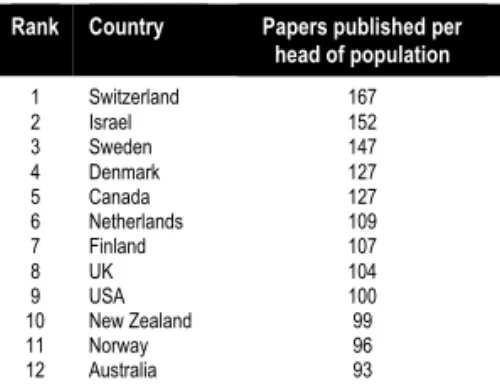
A further interesting point is that the three very wealthy EFTA countries of Norway, Iceland and Switzerland have a larger share of outputs than the much more populous but poorer ASEAN countries and nearly as large share as the whole of South America, suggesting that we also need take account of publications in relation to population size. This is done in Table 3, which, drawing on the entire Science Citation Index (SCI) over a 14 year period 1981-1994 (see May, 1997: 794), displays the top twelve countries ranked by publications per head of population.
Once again, there is evidence of a strong association between national wealth and research output with 5 of the 12 countries above ranking as among the world’s ten richest states as determined by GNP per capita (World Bank, 2006) and all the others falling in the high income category. Conversely, there is no representation in this list for any middle or low income country. Interestingly, the four highest ranking countries above are non-Anglophone, though this is balanced by the fact that five others are
World Regions % of
Publications (1995-1999)
% Publication Growth Rate
(1995-1999)
EU-15 29.4% (40,108) 6.5%
NAFTA (USA, Canada, Mexico) 23.2% (31,620) -0.7%
Developed Asian Countries (Japan, Korea, Taiwan, Singapore) 18.3% (25,047) 10.9% Other European Countries (Russia, Ukraine) 8.6% (11,705) 5.4% Asian Countries (China and Hong Kong) 6.3% (8,554) 26.2% EU candidate (transitional) countries 4.8% (6,535) 8.5% Other Asian Countries(India and Pakistan) 3.9% (5,293) 4.6%
Oceania (Australia and NZ) 1.7% (2,356) 3.1%
South American Countries 1.4% (1,898) 21.1%
EFTA countries (Iceland, Norway , Switzerland) 1.3% ( 1,776) 8.9% Other countries (Israel, South Africa) 1.0% (1,399) 7.6% Asean -4 (Indonesia, Malaysia, Philippines, Thailand) 0.1% (205) 20.9%
TOTALS 100% 136,496
English-speaking, suggesting though not confirming, that Anglophone status could have some influence on quantity of published research output. Scandinavian countries, one may note, feature prominently in the list, these having both a high GNP per capita and, by repute, populations with high level skills in English.
There remains, however, substantial variation among the rich countries in publication outputs, which suggests that factors beyond wealth play a role, commonly mentioned among which are research culture (the propensity to reward academics according to their publications), a well-established research tradition, and less rather than more hierarchical university structures. There is no decisive evidence for any one of these, however.
We can conclude, then, that while the bibliometric statistics cited above are certainly coarse, not taking account, for instance, of the growing trend toward collaborative co-publication, they do broadly confirm that there are, as expected, marked regional and country-based variations in published research outputs across the globe, and that in that sense there are inequalities mirroring more general socio-economic inequalities. This being so, we can now turn to the far complex question of the role of linguistic factors in scientific publication rates.
Linguistic factors and scientific/academic publication
rates
In assessing the claim that scholars from non-Anglophone backgrounds are disadvantaged relative to native speakers in placing their research outputs in high prestige international journals there are three main kinds of evidence
Rank Country Papers published per head of population 1 Switzerland 167
2 Israel 152
3 Sweden 147
4 Denmark 127
5 Canada 127
6 Netherlands 109
7 Finland 107
8 UK 104
9 USA 100
10 New Zealand 99
11 Norway 96
12 Australia 93
that we can appeal to, each of which is problematic in its own way: bibliometric statistics, attitude surveys of academics/scientists, and ethnographically-oriented case studies. Let us consider each in turn.
The bibliometric evidence
In addition to the macro bibliometric surveys cited above, which point to an increasing globalization of scientific research with a greater proportion of the total volume of published research originating in non-Anglophone countries (e.g. China, Japan), there are a number of smaller scale studies that examine the proportions of papers contributed by non-native speaking scholars (NNSs) or countries in specific disciplines or journals.
An example would be Wood (2001), who concludes on the basis of one
year’s issues (1997-98) of the journals Natureand Science that while there may
be financial or material resource impediments to “periphery” scholars publishing their work, the barriers of language are not in themselves that formidable:
… 49.5% of papers in Scienceand 40.6% of papers in Nature, or an average of 45.6% of RAs (research articles) in these two journals are written by NNSs. (…) From the data here, the linguistic barriers for NNSs to be published in even the most prestigious journal do not seem to be that high. (Wood, 2001: 79-80)
Sano (2002), meanwhile, reports that the share of chemistry papers originating from non-English-speaking countries rose from 31% in 1970 to
58% in 2000.6 Similar trends are noted by Swales (2004), who reports that
the percentage of TESOL Quarterly articles of US provenance has fallen from above 90% in 1984 to a still high 50% in 2000; by Master (1999), whose 1999 editorial for the ESP journal remarks on the growing number of contributions from non-native authors (up to 8.7 per issue from 1996); and by Benfield & Feak (2006), who comment that over the period 2003-05
around 60% of submissions to the Journal of Thoracic and Cardiovascular Surgery
developed Pacific Rim Asian countries (e.g. Japan, Korea) –in short, a growing globalisation of scientific research published in English.
The evidence suggests, then, that there is no fundamental, insuperable English language barrier to publication in international journals. However, because the bibliometric data highlight outputs rather than research or writing-up processes, it does not allow us to conclude that there is no linguistically-based disadvantage suffered by non-Anglophone researchers, who, in all probability, do exert themselves considerably more to secure publication of their research. To gain a better understanding of this putative disadvantage, it is necessary, therefore, to turn to other kinds of data, starting with attitude surveys.
Attitude surveys
On the matter of perceptions of disadvantage, the survey evidence is, as one might anticipate, mixed and rather inconclusive. Tardy (2004), for example, cites a number of authors who feel that non-native scholars are indeed disadvantaged relative to native English-speaker academics, yet the findings of her own survey of international graduate students in the United States present a more qualified picture. All questionnaire respondents (n=45) believed that there were beneficial aspects to the use of English as an international language of science, but at the same time thirty-six of these same respondents identified disadvantages –the time needed to learn English to a high level, for example.
A similar picture emerges from a survey of Swiss researchers’ attitudes to English as an international language of science carried out by Murray & Dingwall (2001). In this instance 41% of respondents (n=250) thought the dominance of English was a slight disadvantage in their careers and 8% a major handicap, but 27% believed it was actually an advantage with a further
24% seeing it as having no effect either way. These findings are not
Drawing any definitive conclusion from these various surveys is very difficult. The questions and samples are very different, and the responses are influenced by who the respondents believe themselves to be in competition with and by how good they believe their English is. Then there is the influence of personal and national background: Swiss researchers from a relatively small, officially multilingual country may be more easily reconciled to the use of English to transcend the limits of the national science community than, say, French scientists, whose language, once a lingua franca competitor of English, has now been displaced from that function.
What one can say, however, is that attitudes to the dominance of English as
the dominant international language of science are ambivalent. Some
acknowledge the advantage of an international language of scientific communication, but there is, too, a widespread, if not universal, sense that non-Anglophone researchers are disadvantaged relative to native English-speaking researchers when it comes to publication in English. Surveys, however, are not the best instrument for gauging the scale or nature of this possible disadvantage; for that, closer, more detailed studies of writing and publication processes are more suitable.
Case studies
There is now a growing body of literature on the academic writing of multilingual non-Anglophone scholars, some of which focuses on the textual features of such writing, some on writing practices and processes, and some on the challenges of securing journal publication. It is on this last area that we now concentrate, though we recognize the potential relevance of the other two areas as well as the complementary literature on peer reviews (e.g. Gosden, 2003; Hewings, 2004). Especially significant here is work by Flowerdew (1999b, 2000 & 2001) on Hong Kong academics, by Curry & Lillis (2004) on Hungarian, Slovak and Spanish psychologists, by Burrough-Boenisch (2003) on Dutch scientists, and by Kourilova (1998) on Slovak medical researchers’ English language submissions to bio-medical
journals. Also of importance, and a topic for later discussion, is
Canagarajah’s (1996, 2002 & 2003) work on the particular difficulties “periphery” scholars face in writing for international publication.
entirely easy matter, for the contexts and disciplines studied are diverse and many studies, being ethnographically inclined, comprise relatively small
numbers of subjects. Nonetheless, a number of general trends and
conclusions can be elicited, if tentatively.
The first is that the literature tends to confirm what one might suspect a
priori: writing in English does present an additional burden for some
non-Anglophone researchers. The three scholars in Curry & Lillis’s (2004) case study, for example, all refer, with great plausibility, to the extended time and effort needed to write for publication in English, not to mention the time and opportunity cost of learning and maintaining English skills to a high level. The case studies by Flowerdew (2000) and Li (2006) also attest to the often prolonged processes of revision and resubmission undergone by non-Anglophone scholars, often in response to language and style-based criticisms; and Burrough-Boenisch (2003) amplifies the picture through her discussion of the degree to which non-Anglophone manuscripts are subjected to revisions at the hands of copy-writers, reviewers, and professional “language correctors”.
At a finer level of linguistic detail, meanwhile, Flowerdew (1999b: 254) reports that his sample of Hong Kong academics (n=26) feel handicapped by a “less rich vocabulary” and “less facility of expression” generally. Burrough-Boenisch (2003) highlights multilingual authors’ problems with word order, word choice and register, while Kourilova (1998) hypotheses that shortcomings in Slovak writers’ understanding of the pragmatics of the English modality system may cause them to modulate their claims inappropriately. From studies of peer reviews, finally, come some evidence (see Benfield & Howard, 2000) that critical comments on language and writing quality may be significantly more frequent for second language users than Anglophone writers.
targeted, academic seniority, and, very probably, the level of English proficiency of the scholar, though this rarely features explicitly as a variable of enquiry. This leads us fairly directly to our second major point, on the concept of the non-native speaker in academic knowledge production.
Many of the studies cited above (e.g. Kourilova, 1998; Flowerdew, 1999b) invoke the concept of the non-native speaker in discussions of the
challenges facing multilingual scholars. This is understandable, for the
native/non-native dichotomy is well-established and has a certain convenience for distinguishing two populations of writers. However, there are a number of reasons for questioning its utility, coherence and relevance. First, the boundaries of native-speakerhood are now under serious scrutiny (see Davies, 2003), and second, if the notion of native-speakerhood has meaning, it would seem to refer most accurately to the acquisition of syntactic and phonological knowledge from early childhood socialisation and not to the acquisition of writing, let alone academic writing, which requires prolonged formal education, socialisation into academic literacy practices and a gradual accretion of competence in specialised disciplinary discourses (see Hyland, 2000 & 2006).
With regard to the acquisition of this specialised competence, the native-speaker and the non-native native-speaker both start out as novices, a position of parity that the native/non-native dichotomy obscures, but that is noted by some of the editors from Flowerdew’s (2001) study, who remark that many of the problems of Hong Kong/Chinese authors are shared by their native speaker counterparts (see also Swales, 2004). This is not to say that native-speakerhood confers no advantage at all. It may do so with particular regard to intuitions of grammaticality, and it may do so if one construes “native speaker” as a proxy term for long-term residence in the United States or the UK, this being conducive to higher levels of English language proficiency and, thence, to greater control over the formal resources of vocabulary and
grammar as drawn on in academic writing7. The key dimensions of
difference, then, are not so much native or non-native speaker status as expertise (novice or expert) and proficiency, the significance of the latter being underscored if one bears in mind the frequency with which so-called non-natives display greater facility in academic writing than natives, whose performance levels are in fact very variable.
probably have to include authors from such places as Singapore, India, Wales, South Africa, Ghana and Kenya, where English is all too commonly the first language of literacy, if not the mother tongue. Researchers from some of these countries can readily be identified as advantaged, not so much because they are native-speakers but because they work in prosperous, well-funded, amply networked research settings. Others, on the other hand, particularly those from Africa, are, judging by academic publication statistics, significantly disadvantaged, indeed more disadvantaged than bilingual EIL
scholars8from, say, Hong Kong/China, Japan or Hungary, who despite their
non-native status seem to be managing to increase their share of global academic outputs (see Table 2).
Patterns of disadvantage would seem, then, to cut across the native/non-native distinction, the prime reason being that there are many non-language and non-discursive impediments to academic publication, many of which have been ably explored by Canagarajah (1996, 2002 & 2003). It is to these that we now turn briefly.
The role of non-language constraints on academic
publication
The very evident disparity in academic knowledge production between rich and poor regions (e.g. Africa, South America), illustrated in Table 2, provides strong support for Cangarajah’s (1996 & 2002) claims that “periphery” scholars are very significantly impeded by scarce financial and material resources: for example, poorly equipped laboratories and libraries, limited access to specialist journals, scant funding for empirical research, and, at the extreme end of the spectrum, no photocopying facilities, limited supplies of
paper, outdated information technology facilities. The effects of such
scarcity are, Canagarajah (2002) suggests, pervasive and far-reaching, leading, for example, to an inability to keep in touch with fast-moving developments in scientific disciplines and, therefore, to difficulties in composing suitable literature reviews and in moving beyond what some of the editors in Flowerdew’s (2001: 135) survey refer to as a “parochial” outlook.
the absence of a critical mass of local scholars engaged in specialised research fields. This isolation (off-networked status) makes it more difficult to acquire knowledge of the publishing conventions of metropolitan journals and of the discourses expected in particular disciplinary communities through “legitimate peripheral participation” (Lave & Wenger,
1991)9. Canagarajah (2003: 198) is eloquent on this point:
… the problem for me –when I tried to publish from Sri Lanka– was that I was so off-networked from scholars in the center that my peripherality was too excessive: the publishing practices of the insiders in the West became insufficiently transparent, the legitimacy of the practices I was adopting was questionable; surrounded by local academics who did not see the value of publishing and were distanced from scholars who were actively publishing, my ability to practice was severely curtailed.
Also unhelpful here, of course, is that some of the genres surrounding academic publication (e.g. peer reviews, editors’ letters, covering submission letters) are partially occluded and therefore opaque to off-networked scholars, the same being true of uncodified and variable publishing conventions ranging from the formatting of manuscripts to the epistemological preferences of particular journals. And beyond material and networking disadvantage, differences in academic culture may also constrain
publication. For example, there are settings, not exclusively in the
“periphery”, where there is little urgency for publication –not just because teaching loads are heavy and second teaching jobs common but because rewards are allocated on the basis of one’s position in hierarchies delineated by patronage and seniority rather than by publishing output.
such discrimination is not so widespread or systematic that it in itself constitutes a major barrier to publication. Central to this tentative claim are the bibliometric statistics showing a steady growth in the number of publications from authors and regions outside the traditional centre. But it is also true that an increasing number of reviewers are themselves bilingual users of English as a lingua franca and that an increased number of journals are opting for a double-blind peer review process, both these trends reducing the likelihood of discrimination. One might also mention here Flowerdew’s (2001) study of editors’ attitudes in the field of applied linguistics, which provide no evidence of discrimination: on the contrary, most editors reported themselves as being positively sympathetic to non-native submissions. The limitation here, of course, is that this is a small-scale study confined to a single discipline and drawing on self-report data. Clearly, then, further studies are needed but for the moment we cannot conclude that discrimination per se is a major factor in disadvantage.
Conclusion
In this overview paper we have focused on two major and adverse consequences of the rise of English as the dominant language of scientific/academic publication: the threat of domain loss, perceived as particularly acute in some of the smaller European countries most exposed to English (e.g. in Scandinavia), and the alleged disadvantage of non-Anglophone scholars, relative to native speakers, in the field of academic publication. The aim has been to assess the extent and severity of both these problems, and now in the conclusion we summarize some of the principal findings, starting with the issue of domain loss.
Concluding remarks on the threat of domain loss
Anxiety about domain loss seems amply justified when one considers the dominance of English in natural/social science publication and the growing use of English as a University teaching medium. Clearly, if such trends continue, or intensify, Swedish, Norwegian and other national languages may no longer find a use in scientific communication, and registers and lexical resources may eventually be lost.
reasons to believe it may be averted. First, the current situation cannot be adequately represented as one of diglossia. It is rather one where a complex academic bilingualism obtains in that some disciplines still publish in national languages, while in others informal scientific communication (beyond the pages of academic journals) continues to be transacted in national languages. A second factor is that universities, language agencies and national governments are alert to the threat and have begun to take measures to maintain Norwegian, Swedish, etc. as “complete” languages, including, for example, the introduction of a policy of parallel-lingualism and the imposition of limits on the use of English for university level teaching. Finally, the important role of language in constructing national identities may help hold the encroachment of English in check.
Clearly, however, the situation remains precarious. The measures outlined above turn out to be ineffective, and the language planning interventions necessary will be complex, for a delicate balance has to be struck between the maintenance of national languages across all domains and the on-going need for English in a world of increasing academic mobility in ever more market-oriented higher education systems and in a globalising research environment. In short, this is a test case for language planning, whose final outcomes are as yet unknown.
Concluding remarks on inequalities in academic
knowledge production
Statistics show that there are indeed significant imbalances in published research outputs between world regions, and in the preceding sections we have focused on both linguistic and non-linguistic contributory factors with a view to estimating the relative weight of the former compared to the latter. The conclusion emerging is that while English remains a barrier to publication for some scholars, it is non-language factors that constitute the greater impediment.
2002; Swales, 2004; Benfield & Feak, 2006) that in particular disciplines the proportion of submissions from non-native authors is on the increase. Third, small scale studies of the problems experienced by non-Anglophone scholars writing for publication (e.g. Flowerdew, 1999b & 2001), and of peer review studies (e.g. Gosden, 2003), suggest that many of these problems are in fact shared by so-called “native” writers, casting further doubt on the relevance of the already much criticised native/non-native distinction. Of more import, it would seem, are degree of experience/expertise in academic publication and proficiency in certain kinds of academic written discourse in English, this varying in both native and non-native populations.
A possible reason for the waning of the linguistic factor in disadvantage, one might add, is that knowledge of English is increasingly regarded in many countries as a necessary, basic skill (see Graddol, 2006) and not as an optional foreign language with the result that English skills are now more commonplace and more widely distributed than was once the case. That said, diminished importance does not mean of no account, and there is evidence (see Curry & Lillis, 2004) that many scholars (particularly, perhaps, of an older generation) find that writing in English requires extra time and effort for the production of less than optimal written texts. Ameliorative actions are, therefore, required, and it is to these that we turn finally, albeit briefly.
Recourse to a neutral lingua such as Esperanto is sometimes mooted, but, on anything other than a minor scale, is impractical (see Li, 2003) because, as we have argued, the spread of English as an international lingua franca is substantially a market-driven bottom-up process not amenable to control by any one country or organisation. It is likely, therefore, that any amelioration of linguistic disadvantage will flow from more modest interventions, possibly including:
• the long term de-anglicisation of English, allowing bilingual EIL authors to identify themselves, and be identified, as authoritative users of their own lingua franca variety (with its own peculiarities –see Ammon, 2000) as opposed to imperfect writers of a standard British or American standard English;
• the establishment of journal-based editing and language services for bilingual EIL authors;
their services beyond students to academic staff. Far from strengthening the hegemony of English, this work should be regarded as an important contribution to the amelioration of language-based disadvantage;
• the cultivation of a greater sense of responsibility on the part of relatively privileged Anglophone researchers for assisting their non-Anglophone disciplinary peers with their English, perhaps through co-publication or editing advice (see Benfield & Feak, 2006).
Any reduction of language-based disadvantage flowing from such measures is unlikely, of course, to have much impact on the larger problem of non-language-based inequalities in academic publication, which, because they are related to wider disorders of development and wealth distribution, are even more intractable. That said, there are measures (e.g. preferential journal subscription rates for low income countries, more open access publishing, more supportive institutional links) that can help mitigate some of the
inequalities,10but space limitations regrettably preclude further discussion of
these here.
A final comment, of some possible consolation perhaps, is that the contemporary dominance of English is, in all probability, a temporary, time-bound phenomenon. In the future other lingua francas are likely to challenge its pre-eminence, just as they did in the past, as Lankester’s 1883 presidential address to the British Association for the Advancement of Science reminds us:
You will find in every department of biological knowledge, the hard work of investigation is being carried on by the well-trained army of German observers. Whether you ask the zoologist, the botanist, the physiologist or the anthropologist, you will get the same answer: it is to German sources that he looks for new information, it is in German workshops that discoveries are daily being made. (Cited in Gizycki, 1973: 48111)
(Revised paper received January 2007)
REFERENCES
Ammon, U. (1990). “German or English? The problems of choice experienced by German-speak-ing scientists” in P. Nelde (ed.)
Language Conflict and Minori-ties, 33-51. Bonn: Dümmler.
Ammon, U. (2000). “Towards more fairness in international English: linguistic rights of non-native speakers?” in R. Phillip-son (ed.), Rights to Language, Equity and Power in Education, 111-116. Mahwah, New Jersey:
Lawrence Erlbaum.
Ammon, U. (2001b). “English as a future language of science at German universities? A question of difficult consequences, posed by the decline of German as a language of science” in U. Am-mon (ed.), 343-361.
Ammon, U. (2003). “The interna-tional standing of the German language” in J. Maurais & M. Morris (eds.), Languages in a Globalising World, 231-249. Cambridge: Cambridge Univer-sity Press.
Ammon, U. & G. McConnell (2002). “English as an academic language in Europe: a survey of its use in teaching”. Frankfurt: Peter Lang, Duisburg papers on Research in Language and Cul-ture 48.
Benesch, S. (1996). “Needs analysis and curriculum devel-opment in EAP. An example of a critical approach”. TESOL Quar-terly30: 723-738.
Benesch, S. (2001). Critical English for Academic Purposes.
Mahwah, New Jersey: Erlbaum.
Benfield, J. & C. Feak (2006). “How authors can cope with the burden of English as an interna-tional language”. Chest 129: 1728-1730.
Benfield, J. & K. Howard (2000). “The language of science”. Eu-ropean Journal of Cardio-Tho-racic Surgery18: 642-648. Berg, E., F. Hult & K. King (2001). “Shaping the climate for language shift? English in Swe-den’s elite domains”. World Eng-lishes20: 305-319.
Blommaert, J. (2005). Dis-course. Cambridge: Cambridge University Press.
Burrough-Boenisch, J. (2003). “Shapers of published NNS re-search articles”. Journal of Sec-ond Language Writing12: 223-243.
Canagarajah, S. (1996). “Non-discursive requirements in aca-demic publishing, material
re-sources of periphery scholars, and the politics of knowledge production”. Written Communi-cation13: 435-472.
Canagarajah, S. (2002). A Geopolitics of Academic Writing.
Pittsburgh: University of Pitts-burgh Press.
Canagarajah, S. (2003). “A somewhat legitimate and very peripheral participation” in C. Casanave & S. Vandrick (eds.),
Writing for Scholarly Publication: Behind the Scenes in Language Education, 197-210. Mahwah, New Jersey: Erlbaum.
Crystal, D. (1997). English as a Global Language. Cambridge: Cambridge University Press.
Curry, M. & T. Lillis (2004). “Mul-tilingual scholars and the imper-ative to publish in English: nego-tiating interests, demands and rewards”. TESOL Quarterly38: 663-688.
Davidsen-Nielsen, N. (2004).
Language Policy in Denmark –with special reference to func-tional domains. URL: http://www.eurfedling.org/conf/fil es/DavidsenNielsen-English.pdf [23/11/06].
Davies, A. (2003). The Native Speaker: Myth and Reality. Clevedon: Multilingual Matters.
De Swaan, A. (2001a). Words of the World.London: Polity Press. De Swaan, A. (2001b). “English in the social sciences” in U. Am-mon (ed.), 71-83.
Erling, E. (2002). English as the Language of the European Aca-demic Community: Questions from the Freie Universität Berlin. Unpublished conference paper, September 2002, Freie Univer-sität, Berlin.
European Commission (2003).
Third European Report on Sci-ence and Technology Indicators. Brussels: European Commis-sion Directorate-General for Re-search.
Eurydice (2005). Key Data on Teaching Languages at School in Europe. Office for Publica-tions of the European Communi-ties. URL: http://www.eurydice.org/portal/p age/ portal/Eurydice/PubCon-tents?pub=049EN [26/11/06].
Flowerdew, J. (1999a). “Writing for scholarly publication in Eng-lish: the case of Hong Kong”.
Journal of Second Language Writing8: 123-145.
Flowerdew, J. (1999b). “Prob-lems in writing for scholarly pub-lication in English: the case of Hong Kong”. Journal of Second Language Writing8: 243-264. Flowerdew, J. (2000). “Dis-course community, legitimate peripheral participation, and the nonnative-English-speaking scholar”. TESOL Quarterly 34: 127- 150.
Flowerdew, J. (2001). “Attitudes of journal editors to nonnative speaker contributions”. TESOL Quarterly35: 121- 150. Gibbs, W. (1995). “Information have-nots”. Scientific American
May 1995: 12B-14B.
Gizycki, R. (1973). “Centre and periphery in the international sci-entific community: Germany, France and Great Britain in the 19th century”. Minerva 11: 474-494.
Gosden, H. (2003). “‘Why not give us the full story?’: functions of referees’ comments in peer reviews of scientific research pa-pers”. Journal of English for Academic Purposes 2: 87-101. Graddol, D. (1997). The Future of English? London: The British Council.
Graddol, D. (2006). English Next.
London: The British Council.
Grin, F. & B. Korth (2005). “On the reciprocal influence of lan-guage politics and lanlan-guage ed-ucation: The case of English in Switzerland”. Language Policy
Gunnarsson, B.L. (2000). “Swedish tomorrow –a product of the linguistic dominance of English?”. Current Issues in Language and Society7: 51- 69. Gunnarsson, B.L. (2001). “Swedish, English, French or German –the language situation at Swedish universities” in U. Ammon (ed.), 267–315.
Haarman, H. & E. Holman (2001). “The impact of English as a language of science in Fin-land and its role for the transition to network society” in U. Ammon (ed.), 229–260.
Hewings, M. (2004). “An ‘impor-tant contribution’ or ‘tiresome reading’? A study of evaluation in peer reviews of journal article submissions”. Journal of Applied Linguistics 1: 249-274. Hult, F. (2004). “Planning for multilingualism and minority lan-guage rights in Sweden”. Lan-guage Policy3: 181-201. Hult, F. (2005). “A case of pres-tige and status planning: Swedish and English in Swe-den”. Current Issues in Lan-guage Planning6: 73-79. Hyland, K. (2000). Disciplinary Discourses: Social Interactions in Academic Writing. London: Longman.
Hyland, K. (2006). “The ‘other’ English: thoughts on EAP and academic writing”. The Euro-pean English Messenger15: 34-38.
King, D. (2004). “The scientific impact of nations”. Nature430: 311-316.
Kourilova, M. (1998). “Commu-nicative characteristics of re-views of scientific papers written by non-native users of English”.
Endocrine Regulations32: 107-114.
Lave, J. & E. Wenger (1991).
Situated Learning: Legitimate Peripheral Participation. Cam-bridge: Cambridge University Press.
Li, D. (2003). “Between English and Esperanto what does it take to be a world language?”. Inter-national Journal of the Sociology of Language164: 33-63. Li, Y. (2006). “A doctoral student of Physics writing for publication; a socio-politically-oriented case study”. English for Specific Pur-poses25: 456-478.
Linn, A. & L. Oakes (2007 forth-coming). “Language policies for a global era: the changing face of language politics in Scandi-navia” in C. Fandrych & R. Salverda (eds.), Standard, Vari-ation and Language Change in the Germanic Languages. Tübingen: Narr.
Master, P. (1998). “Positive and negative aspects of the domi-nance of English”. TESOL Quar-terly32: 716-725.
Master, P. (1999). “Editorial”.
English for Specific Purposes
18: 102-104.
May, R. (1997). “The scientific wealth of nations”. Science275: 793-796.
Mufwene, S. (2001). The Ecolo-gy of Language Evolution. Cam-bridge: Cambridge University Press.
Mufwene, S. (2002). “Colonisa-tion, globalisa“Colonisa-tion, and the future of languages in the twenty-first century”. International Journal on Multicultural Societies 4. URL:
http://www.unesco.org/most/vl4 n2mufwene.pdf [21/04/04]
Murray, H. & S. Dingwall (2001). “The dominance of English at European universities: Switzer-land and Sweden compared” in U. Ammon (ed.), 85-112.
Oakes, L. (2005). “From interna-tionalisation to globalisation”.
Language Problems and Lan-guage Planning29: 151-176. Pennycook, A. (1997). “Vulgar pragmatism, critical pragmatism, and EAP”. English for Specific Purposes16: 253-269.
Pennycook, A. (2000). “English, politics, ideology: from colonial celebration to postcolonial pefor-mativity” in T. Ricento (ed.), 107–119.
Pennycook, A. (2001). Critical Applied Linguistics: A Critical In-troduction. Mahwah, New Jer-sey: Lawrence Erlbaum.
Petersen, M. & P. Shaw (2002). “Language and disciplinary dif-ferences in a biliterate context”.
World Englishes11: 357-374. Phillipson, R. (1992). Linguistic Imperialism. Oxford: Oxford Uni-versity Press.
Phillipson, R. (2000). “English in the new world order: variations on a theme of linguistic imperial-ism and ‘world’ English” in T. Ri-cento (ed.), 87–106.
Phillipson, R. (2001). “English or ‘no’ to English in Scandinavia”.
English Today17: 22-28. Phillipson, R. (2003). English-Only Europe? Challenging Lan-guage Policy. London: Rout-ledge.
Preisler, B. (2005). “Decon-structing ‘the domain of science’ as a sociolinguistic entity in EFL societies: The relationship be-tween English and Danish in higher education and research” in B. Preisler, A. Fabricius, H. Haberland, S. Kjaerbeck, K. Ris-ager (eds.) The Consequences of Mobility, 238-248. Roskilde: Roskilde University.
Regeringkansliet (2005). Sum-mary of Government Bill 2004/05:2 Best Language –a concerted policy for Sweden. URL:
http://miljo.regeringen.se/sb/d/5 74/a/53400/ dictionary/true;jses-sionid=an_3uS2KnfJd [25/09/06]
Ricento, T. (ed.) (2000). Ideolo-gy, Politics and Language Poli-cies: Focus on English. Amster-dam: John Benjamins.
Dr. Gibson Ferguson currently lectures at the University of Sheffield, where he is the Program Director of the MA in Applied Linguistics. His
recent publications include Language Planning and Education (2006) with
Edinburgh University Press and Language in Language Teacher Education(2002)
with John Benjamins. His principal research interests are in language
planning and sociolinguistics, ESP and teacher education.
NOTES
1 It is true, of course, that the United States and Britain promote English through agencies such as the British Council and the United States Information Agency (USIA), but so do almost all the major OECD countries: Spain, Japan, Germany, or France –Spain through the Instituto Cervantes, Japan through the Japan Language Foundation, Germany through such agencies as the Goethe Institut and Carl Duisberg Gesellschaft, and so on. And one should not really be surprised at these promotional activities, for foreign policy, including the export of the national language, has long been recognised as animated principally by national self-interest.
2 Presumably, the remarks were designed to mobilise public opinion rather than present a dispassionate considered view.
3 The remarks are from the National Daily Dagbladetof March 2004, as translated by Linn & Oakes. 4 Also under consideration is the provision of financial support for the production of national language textbooks (see University of Oslo, 2006).
Hachinski, R. Gibbons, T. Gard-ner & H. Krumholz (2006). “Ef-fect of blinded peer review on abstract acceptance”. The Jour-nal of the American Medical As-sociation (JAMA) 295: 1675-1680.
Sano, H. (2002). “The world’s lingua franca of science”. Eng-lish Today18: 45-49. Skuttnab-Kangas, T. (2003). “Linguistic diversity and biodi-versity: the threat from killer lan-guages” in C. Mair (ed.), The Politics of English as a World Language, 31-52. Amsterdam: Rodopi, ASNEL papers 7.
Swales, J. (1997). “English as tyrannosaurus rex”. World Eng-lishes16: 373-382.
Swales, J. (2004). Research Genres. Cambridge: Cambridge University Press.
Taavitsvainen, I. & P. Pahta
(2003). “English in Finland: glob-alisation language awareness and questions of identity”. Eng-lish Today19: 3-15.
Tardy, C. (2004). “The role of English in scientific communica-tion: lingua franca or tyran-nosaurus rex?”. Journal of Eng-lish for Academic Purposes 3: 247–269.
Tollefson, J. (1991). Planning Language, Planning Inequality. London: Longman.
Tollefson, J. (ed.) (1995). Power and Inequality in Language Edu-cation. Cambridge: Cambridge University Press.
Truchot, C. (2001). “The lan-guage of science in France: public debate and language poli-cies” in U. Ammon (ed.), 319–328.
University of Oslo (2006). In the next hundred years: the
Univer-sity of Oslo and language in that age of internationalization. Rec-ommendation of the Committee on Language Policy at the Uni-versity of Oslo. URL: http://www.uio.no/om_uio/innstill inger/ 06/sprakpolitikk/report.pdf [19/11/06]
Wood, A. (2001). “International scientific English: the language of research scientists” in Flow-erdew, J. & M. Peacock (eds.)
Research Perspectives on Eng-lish for Academic Purposes, 71-83. Cambridge: Cambridge Uni-versity Press.
World Bank (2006). World Bank Development Indicators 2006. Washington DFC: World Bank Publications.