Rev Bras Ter Intensiva. 2015;27(4):312-314
Improving outcomes for the critically ill in
developing countries: what is next?
COMMENTARY
Critical care in developing countries
Critical care is a complicated, high risk, resource-dependent environment. Developing countries face common barriers to delivering quality emergent care due to the lack of supplies, coordination, infrastructure, technology, and human resources (e.g., competency-based education, multi-disciplinary staf and access to the most recent literature).(1) More importantly, the capacity
to provide care for critically ill patients in intensive care units (ICUs) of low-income countries is unknown. Most developing countries lack published data on ICU capacity.(2) Importantly, a previous observational study aimed to
assess the worldwide burden of critical illness, but only an insigniicant sample (2 of 730 centers) of ICUs in low-income countries was taken into account.(3)
Poor access to material resources and skilled personal pose a signiicant barrier to care improvement. Indeed, severity-of-illness-adjusted mortality is inversely related to gross national income.(3) Nevertheless, a recent survey
performed by the CERTAIN (Checklist for Early Recognition and Treatment of Acute Illness and INjury; www.icertain.org) Investigators network in 15 ICUs from 11 low- and middle-income countries showed that 77% of ICUs singled out lack of protocols and trained staf, which are the most important barriers to improving the care and outcomes of critically ill patients as opposed to cost-dependent variables, such as equipment or supplies.(1) Basic resources,
such as standardized supportive care and trained personnel have been cited as instrumental in changing the outcomes for catastrophic/challenging diseases, such as the Ebola virus disease in resource-limited settings.(4)
Outcome research
he irst step in solving the problem is to measure the problem, i.e., collect data for processes of care and patient outcome measures. Out of the various critical care syndromes, sepsis heavily alicts morbidity and mortality in ICUs(1,3) regardless of the resources at hand. hus, focused eforts to understand
sepsis outcomes and interventional studies are essential in unlocking the keys to the success of critical care in developing countries. Developing countries in Asia and Africa report mortalities as high as 45% for sepsis.(5,6) he common
denominators for such high mortality rates are low adherence to protocols(6)
Rahul Kashyap1,2,3, Manuel Hache-Marliere1,4,
Srdjan Gavrilovic1,5,6, Ognjen Gajic1,3,7
1. Checklist for Early Recognition and Treatment of Acute Illness and Injury (CERTAIN) team. 2. Anesthesia and Critical Care Medicine, Mayo Clinic - Rochester, Minnesota, United States. 3. United States Critical Injury and Injury Trial (USCIIT) Group.
4. CEDIMAT - Santo Domingo, Dominican Republic.
5. The Institute for Pulmonary Diseases of Vojvodina, Sremska Kamenica, Serbia. 6. Faculty of Medicine, University of Novi Sad - Novi Sad, Serbia.
7. Pulmonary and Critical Care Medicine, Mayo Clinic - Rochester, Minnesota, United States.
Conflicts of interest: None. Submitted on August 25, 2015 Accepted on September 12, 2015
Corresponding author:
Rahul Kashyap
Anesthesia and Critical Care Medicine, Mayo Clinic
200, First Street, SW Rochester Minnesota 55905
United States
E-mail: [email protected]
Responsible editor: Jorge Ibrain de Figueira Salluh
Melhora dos desfechos em pacientes graves nos países em
desenvolvimento: qual o próximo passo?
Improving outcomes for the critically ill in developing countries 313
Rev Bras Ter Intensiva. 2015;27(4):312-314
and the lack of adaptive-innovative quality improvement strategies.(7)
Nevertheless, low- to non-cost interventions, such as early sepsis management provided by a dedicated study medical oicer was shown to substantially reduce the 30-day mortality rate for sepsis patients.(5) Additionally, in a
national study in Brazil, implementation of a multifaceted sepsis education program increased compliance with the entire sepsis bundle by four-fold (from 13% to 62%), resulting in patients being identiied progressively earlier and at a lower illness severity, and a decrease in hospital mortality and costs.(8)
Checklists in critical care
Intensive care units heavily rely on continuous electronic monitoring, frequent blood tests and imaging modalities. his surplus of complex information may overwhelm clinicians and impair decision-making. As previously described, establishing a systematic approach improves outcomes without consuming means. A structured approach to the management of sepsis or ventilatory failure (i.e., care bundles) has become nearly universal in the ICUs of high-income countries.
he use of checklists is an efective strategy that ensures timely error-free compliance with care bundles. Checklists have emerged from the nuclear and aviation industry into high-risk hospital settings, such as trauma resuscitation and surgical suits. In the ICU, checklists have improved
the processes of care, patient safety and morbidity.(9)
However, despite clear beneits and wide appeal, only 38% of ICUs in low-middle income countries report the use of some checklists during daily rounds upon admission. Only 15% of ICUs have reported the use of any type of checklists for acute resuscitation.(1) When used in trauma
resuscitation in a randomized, controlled interventional study, the computer-assisted decision support (checklist) decreased the number of errors and improved protocol compliance.(10)
he CERTAIN initiative is a multidisciplinary international quality improvement efort, which uses cloud-based electronic checklist and decision support tools to facilitate the best practices during admission/ resuscitation and daily rounds of critically ill patients. CERTAIN methodologies and algorithms are applicable
to a wide variety of pre-hospital, austere setting, and transport scenarios. Current and future development of CERTAIN methodologies and algorithms are important in the care of patients with life-threatening physiological conditions who manifest ongoing surveillance and resuscitation requirements.
Remote education
Importantly, mere physical space does not make an ICU education and retaining skills are crucial to efectively care for critically ill patients. Nearly one-third of low-middle income countries are not stafed by specialists in critical care, and only approximately half of these countries had access to medical journals (54%) and continuing health
education (61%).(1) his number is even lower, in some
parts of the world. More importantly, access to ICU care is limited. Most critically ill patients are treated outside of the ICU during the early, golden hours of critical illness when error-free care is the most important but is the least likely to occur. To overcome this barrier, there is a need for low cost and easily available training resources.
In 2011, over 135 web-based education resources for critical care were identiied, including tutorials, self-directed learning modules, interactive case studies,
webcasts, podcasts, and video-enhanced programs.(11)
Even practice-based skills, such as procedural ultrasound
can be acquired efectively via remote education.(12,13)
Web-based education can convey the same results as classroom instruction with greater time lexibility,(13) and,
in some cases, may even lead to greater proiciency.(12)
Although there are a wide variety of resources, critical care remote education is still in its infancy. Education and research needs to be built around the needs of developing countries. hese countries have limited access to resources, and thus, there is a need to design innovative approaches to bypass their constricted states and reach a wider audience. Currently, the CERTAIN group investigators are testing the delivery best-care practice on critical care patients via a novel, web-based, simple, electronic decision support tool with remote education, use of checklists and two-way video remote simulation assessment.(14) Advances
314 Kashyap R, Hache-Marlieri M, Gavrilovic S, Gajic O
Rev Bras Ter Intensiva. 2015;27(4):312-314
Conclusion
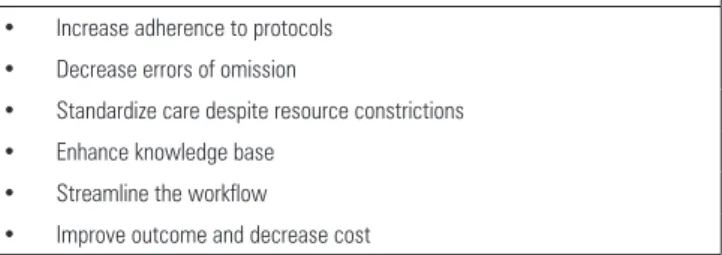
Critical care clinicians face a myriad of challenges while delivering quality care. Research endeavors in developing countries require strategic, low-cost solutions. he use of checklists, bundles and structured processes have been instrumental in decreasing the number of errors of omission and complications in critically ill patients (Table 1).
Multi-national quality improvement projects should focus on high-risk conditions for which simple, timely, error-free interventions can make the most diference (e.g., early recognition of sepsis, shock and respiratory failure; adequate resuscitation; appropriate sedation and ventilation policies, and, when appropriate, palliative care). Furthermore, there is a need for translating research outcomes into
REFERENCES
1. Vukoja M, Riviello E, Gavrilovic S, Adhikari NK, Kashyap R, Bhagwanjee S, Gajic O, Kilickaya O; CERTAIN Investigators. A survey on critical care resources and practices in low- and middle-income countries. Glob Heart. 2014;9(3):337-42.e1-5.
2. Murthy S, Leligdowicz A, Adhikari NK. Intensive care unit capacity in low-income countries: a systematic review. PloS One. 2015;10(1):e0116949. 3. Vincent JL, Marshall JC, Namendys-Silva SA, François B, Martin-Loeches
I, Lipman J, Reinhart K, Antonelli M, Pickkers P, Njimi H, Jimenez E, Sakr Y; ICON investigators. Assessment of the worldwide burden of critical illness: the intensive care over nations (ICON) audit. Lancet Respir Med. 2014;2(5):380-6.
4. Fowler RA, Fletcher T, Fischer WA 2nd, Lamontagne F, Jacob S, Brett-Major D, et al. Caring for critically ill patients with ebola virus disease. Perspectives from West Africa. Am J Respir Crit Care Med. 2014;190(7):733-7. 5. Jacob ST, Banura P, Baeten JM, Moore CC, Meya D, Nakiyingi L, Burke
R, Horton CL, Iga B, Wald A, Reynolds SJ, Mayanja-Kizza H, Scheld WM; Promoting Resource-Limited Interventions for Sepsis Management in Uganda Study Group. The impact of early monitored management on survival in hospitalized adult Ugandan patients with severe sepsis: a prospective intervention study. Crit Care Med. 2012;40(7):2050-8. 6. Phua J, Koh Y, Du B, Tang YQ, Divatia JV, Tan CC, Gomersall CD, Faruq MO,
Shrestha BR, Gia Binh N, Arabi YM, Salahuddin N, Wahyuprajitno B, Tu ML, Wahab AY, Hameed AA, Nishimura M, Procyshyn M, Chan YH; MOSAICS Study Group. Management of severe sepsis in patients admitted to Asian intensive care units: prospective cohort study. BMJ. 2011;342:d3245.
7. Mahavanakul W, Nickerson EK, Srisomang P, Teparrukkul P, Lorvinitnun P, Wongyingsinn M, et al. Feasibility of modified surviving sepsis campaign guidelines in a resource-restricted setting based on a cohort study of severe S. aureus sepsis [corrected]. PloS One. 2012;7(2):e29858. Erratum in PLoS One. 2012;7(5): doi/10.1371/annotation/7f498e31-2709-44f6-877a-d0ee89bebe03.
8. Noritomi DT, Ranzani OT, Monteiro MB, Ferreira EM, Santos SR, Leibel F, et al. Implementation of a multifaceted sepsis education program in an emerging country setting: clinical outcomes and cost-effectiveness in a long-term follow-up study. Intensive Care Med. 2014;40(2):182-91. 9. Weiss CH, Moazed F, McEvoy CA, Singer BD, Szleifer I, Amaral LA, et al.
Prompting physicians to address a daily checklist and process of care and clinical outcomes: a single-site study. Am J Respir Crit Care Med. 2011;184(6):680-6.
10. Fitzgerald M, Cameron P, Mackenzie C, Farrow N, Scicluna P, Gocentas R, et al. Trauma resuscitation errors and computer-assisted decision support. Arch Surg. 2011;146(2):218-25.
11. Kleinpell R, Ely EW, Williams G, Liolios A, Ward N, Tisherman SA. Web-based resources for critical care education. Crit Care Med. 2011;39(3):541-53. 12. Beaulieu Y, Laprise R, Drolet P, Thivierge RL, Serri K, Albert M, et al.
Bedside ultrasound training using web-based e-learning and simulation early in the curriculum of residents. Crit Ultrasound J. 2015;7:1.
13. Platz E, Goldflam K, Mennicke M, Parisini E, Christ M, Hohenstein C. Comparison of Web-versus classroom-based basic ultrasonographic and EFAST training in 2 European hospitals. Ann Emerg Med. 2010;56(6):660-7. 14. Vukoja M, Kashyap R, Gavrilovic S, Dong Y, Kilickaya O, Gajic O. Checklist for early recognition and treatment of acute illness: International collaboration to improve critical care practice. World J Crit Care Med. 2015;4(1):55-61. 15. Wootton R, Bonnardot L. Telemedicine in low-resource settings. Front
Public Health. 2015;3:3.
Table 1 - Checklist and remote education for outcome improvement
How checklists and remote education improve outcomes for critically ill patients in developing countries
• Increase adherence to protocols
• Decrease errors of omission
• Standardize care despite resource constrictions
• Enhance knowledge base
• Streamline the workflow
• Improve outcome and decrease cost