(1) Universidade Federal de Santa Maria, Santa Maria, RS, Brasil.
Conlict of interest: non-existent
Family and therapist perception of child evolution
in an interdisciplinary approach on early intervention
Percepção da família e do terapeuta sobre a evolução de crianças
em uma abordagem interdisciplinar de intervenção precoce
Fernanda dos Santos Pichini
(1)Nathana da Graça Sartori Rodrigues
(1)Tatiane Medianeira Baccin Ambrós
(1)Ana Paula Ramos de Souza
(1)Received on: January 22, 2015 Accepted on: October 16, 2015
Mailing address:
Ana Paula Ramos de Souza
Rua Raposo Tavares 134 apartamento 401 – Medianeira
Santa Maria – RS – Brasil CEP: 97015-560
E-mail: [email protected]
doi: 10.1590/1982-021620161810915
ABSTRACT
Purpose: to analyze and to compare parents and therapists perceptions regarding of early intervention effects in developing of their children, as well as child’s development and future outlook.
Methods: this research studied nine individuals from Early Intervention Clinic. Parents and responsible were interviewed. They were recorded and literately transcribed. The information was analyzed qualita-tively and confronted considering the following child development aspects: linguistic, motor, social and psychic.
Results: seven out of nine individuals analyzed showed similar parental and therapeutic perception concerning the development characteristics analyzed. In two cases, there was disagreement between family members and therapists regarding children development, when family members expressed diffe-rent expectations from the therapists about the future of their child. Regarding communication advances, all parents and therapist realized improvements. Conclusions: the perception of therapists and parents demonstrated positive effects of interdisciplinary early intervention as manifested in the concordance between therapists and parents views in seven out of nine individuals analyzed. This study also reinforced the importance of conducting a qualiied monitoring of family dificulties regarding to limitation of their children and guide them appropriately depending on the disease or disorder presented.
Keywords: Child Development; Early Intervention (Education); Child Language
RESUMO
Objetivo: analisar e comparar a percepção dos pais e dos terapeutas referente aos efeitos da intervenção precoce no desenvolvimento de seus ilhos, bem como acerca da evolução da criança e perspectivas futuras.
Métodos: participaram deste estudo nove sujeitos, incluídos na clínica de Intervenção Precoce. Para a coleta dos dados realizaram-se entrevistas com os pais e/ou responsáveis pelas crianças e com os tera-peutas de referência, as quais foram gravadas em áudio e transcritas literalmente. As informações foram analisadas qualitativamente e confrontadas, considerando os aspectos do desenvolvimento linguístico, motor, social e psíquico das crianças.
Resultados: dos nove sujeitos analisados, sete apresentaram percepção parental e terapêutica seme-lhante para as questões do desenvolvimento abordadas e em dois casos houve divergência entre a visão dos familiares e dos terapeutas acerca do desenvolvimento das crianças, em que os familiares demons-tram expectativas muito distintas das dos terapeutas quanto ao futuro dos ilhos.Em relação à comunica-ção, todos os pais percebem avanços como as terapeutas.
Conclusão: a percepção das terapeutas e pais demonstrou efeitos positivos da intervenção precoce interdisciplinar, manifestada na concordância de pontos de vista em relação aos sete dos nove sujeitos
analisados.O estudoreforçou, ainda, a importância de se realizar a escuta qualiicada das diiculdades
da família quanto à limitação de seus ilhos e orientá-las adequadamente a depender da patologia e/ou distúrbio apresentado.
Descritores: Desenvolvimento Infantil; Intervenção Precoce (Educação); Linguagem Infantil
Original articles
INTRODUCTION
For many years, the hypotheses of language
acqui-sition, motor and cognitive development, and psychic
constitution of babies were the main focus on the
theoretical discussion involved with early development
and had as a central unit of analysis the behaviors of
babies. Currently, there is clarity about the
impor-tance of baby’s relationship with those who exercise
the parental function, considering that development is
a process of constitution in which the biological and
the psychic are dependent in a complex relationship
between baby and their environment
1,2.
Therefore, one can imagine that a desired baby and
a mother with mental health are constituted in a dyad
very early, offering ield for their development. However,
when the baby is born with any evident biological limit
such as syndromes or neurological damage, or present
evident language disorders without an evident lesion,
as the Speciic Language Impairment (SLI),
charac-terized by several studies
3,4, the imagery that the family
has on child while good speaker may rupture and
endanger also the parental bond with baby. Some
studies show that this rupture in the parental bond with
baby may have effects on the mother-child dialogue
that turn out hamper the child insertion into routines in
which dialogue allows exposure to language
5.
It is known that babies with syndromes or evident
neurological lesions are diagnosed early, but individuals
with language speciic disorders may have access to
speech therapy only at the end of the second year of
life when they are not talking
3.
Therefore, the
parent-baby relationship may be compromised and
psycho-social dificulties may be added to the biological limits
of the baby during their development. Furthermore,
some research on development risk factors
6-9show that
psychosocial and socio-demographic may predispose
to the onset of developmental disorders
6,7,9, among
which, the language is frequent factor, since babies
with psychic and /or developing risk have lower initial
speech production than babies without this risk
9,
besides important qualitative language dificulties
in the irst two years of life
3,10. Therefore, it is
funda-mental detect any risk or abnormal development and
be offered family support as well as early intervention,
considering both the brain plasticity as minimize the
effects of the condition that the baby presented at
parent-infant relationship
10-13.
In this context, early intervention is an important
provision of health care, as it can both prevent the
effects as the psychopathology establishment in
cases of syndromes or organic damage such as Down
Syndrome or Encephalopathy Not Progressive Motor,
by type of support that is provided to parents to exercise
their functions with this son who is different from the
imagined
14. However, is necessary be especially careful
regarding to the modality of attendance these babies
and their families, once that it works with the psychic
constitution during the irst years of life
13. Such
atten-dance should not be disciplinary and multiple, it may
endanger the performance of parenting functions when
the family is without a professional reference.
It is known that simultaneous introduction of different
professionals may generate a dissociative effect on
the parental function exercise, damaging the baby
development. For that reason, the arrangements for
Interdisciplinary and Single Therapist were inserted in
the clinical practice for care infants and children
13. The
Interdiscipline is conigured as creation of a common
space in which knowledge is not limited to professional
identity of the therapist who serves, it is necessary that
the therapist has a broader knowledge of predicted in
their discipline to children’s development, in another
words, a speech pathologist need to have in addition to
the knowledge of the language, swallow and hearing
commonly respondents in early intervention cases, a
minimum knowledge of cognitive and psycho-affective
development, in general studied by psychologists,
and psychomotor aspects, these deeper by
physio-therapists and occupational physio-therapists. This knowledge
shared on an interdisciplinary view allow to happen in
many cases, a single therapist approach that
corre-sponds to the action of an expert on early intervention,
with speciic training in child development and not with
partial knowledge of a discipline on it. Also, should
prioritize the presence of parents, which is signiied by
the therapist, so that they can perform their parental
functions so crucial for babies
10,13. On the program
in which it operates this research, the family inclusion
strategies are created in the therapeutic process, such
as parents-baby set sessions and the possibility of
psychological support to parents. In the set session
articulate scenes that range during the session,
namely: parent-therapist; baby-parent; baby-therapist
and baby-parent-therapist
13. In the moments when
the scene is parent-therapist, there are many aspects
of parents’ perceptions of the development of their
children, or even doubts about the therapeutic process
in individual session and continued interviews with
parents can be the most appropriate intervention
15,16.
However, this space is not always enough to access
the parents’ perception; covered more thoroughly,
for this reason the operating group of parents and
continued interview are involved strategies. The
evolu-tionary perception that the therapist has to each baby,
in addition to being comparative to own baby, is related
to their sample, in another words, the therapist tends to
compare to the performance of similar cases treated,
even if it adopts a singular perspective intervention
10,13,
which may require new intervention devices to work
with parents and supervision of therapists.
Thus, the goals of this study are to analyze and
compare the parents and therapists perceptions about
the early intervention effects in developing of their
children, as well as, their perceptions regarding the
children evolution and future perspectives.
METHODS
This study was approved by the Research
Ethics Committee of the Federal University of Santa
Maria (CEP / UFSM) under the protocol number
0284.0.243.000-09 and used the mandatory ethical
standards for research involving human (Resolution 196
/ 96 of the National Health Council - CNS). All subjects
in the study were informed about the goals and
proce-dures and, after reading the Informed Consent and
Informed (IC), have signed even though according to
this research and the dissemination of its results while
maintaining anonymity of the participants. The research
was developed at Speech Therapy Service (SAF), from
the home institution. This study is part of the research
project entitled “Parental Roles and Risk Factors for
Language Acquisition: speech therapy interventions.”
The study was consisted of nine children aged 2
years and 1 month and 4 years and 7 months, three
girls and six boys, with language disorders associated
or not with developmental disorders, and who were
in therapy for a minimum of six months in the early
intervention program or in the language therapy at
internship clinical. The therapy may or not be unique
to the program. Some cases presented therapy in
single therapist modality and others cases presented
concomitant therapies at other institutions, particularly
the cases of non-progressive chronic encephalopathy
(NPCE), commonly identiied as cerebral palsy, with
physiotherapy intervention. In the case of single
therapist, there was a support of the interdisciplinary
team in order to sustain the necessary knowledge in
each case. The single therapists in language disorder
cases were speech language pathologist,
physiothera-pists for cases of NPCE and occupational theraphysiothera-pists for
Down Syndrome (DS) cases. The frequency of sessions
within the program was twice a week, as well as, the
sessions provided outside the institution, in
physio-therapy, with this the possibility of a higher frequency
in some cases. The group meetings to anchor the
inter-consultation occurred every two weeks. Also, there was
weekly supervision of the case by Professional speech
language pathologist and occupational therapy.
To collect the data, semi-structured (with attached
script) interviews were conducted, with those
respon-sible for children, as well as with reference therapists
in order to identify the perception of the case and
their evolution, and compare with the initial parental
perceptions. Also, diagnosis issues and future
perspec-tives envisioned by parents or their substitutes were
discussed. Therefore, the aspects that guide the
questions were if the parents has clarity about the
biological son limits and / or psychic, the acceptance
level of dificulty and the relationship between the
imagined and the real son, as well as how the therapy
mode there was or there was not given support to
dealing with challenges that were emerging in the
relationship with child.
The interviews were conducted and recorded on
audio for later analysis. Posteriorly, the recordings were
literally transcribed. The data were analyzed
qualita-tively through analysis content
17in order to confront the
parents and / or guardians and therapists perceptions,
considering the evolutionary aspects of language
devel-opment, motor, social and psychic of the child. For this
purpose, the interviews were read and reread countless
times, trying to identify the themes that emerged from
the parental discourse.
RESULTS
Figure 1 presents general aspects of identiication,
clinical and therapeutic history of the nine subjects in
the study.
All subjects present language impairment, S8
and S9 presented maternal deprivation. Regarding
to S8, the mother died when he was three years old,
generating such deprivation. Also, prior this trauma,
the family report suggests dificulties for the mother to
waive emotional care to the child. About S9, the mother
cannot perform her function, which leads to important
psychic risk. Another fact to be noted in Figure 1 is
that despite the indication for initial therapy program
with single therapist, the family resorted occasionally
to other therapies by medical indication. This is a city
reality which the program has to deal with, because
many times ethical confront emerge by the therapeutic
approach which indicates the family needs choice as in
the S4 case.
Figure 2 are analyzed the history of pregnancy and
delivery, as well as the clinical status and family feelings
by receiving the diagnosis.
Subject Age Gender Clinical Status Therapeutic History
S1 2:1 F
Encephalopathy Not Progressive Motor tetraplegia type and dysphagia
The demand was for speech-language, but in the program indicated initially physiotherapy and assessment of dysphagia for subsequent insertion of the weekly speech therapy.
Do not have therapies outside the program.
S2 2:10 F Down Syndrome In compliance with single therapist – speech therapist- for eight months. Does occupational therapy for 12 months and physical therapy for 14 months in aother
institutions.
S3 2:8 M Cofin-Síris Syndrome In speech therapy in the program for 12 months. Receive respiratory
physiotherapy for 17 months in another institution.
S4 2:8 F
Hydrocephaly, Cleft Palate, hearing impairment and autism spectrum
In speech therapy in the program for 18 months. Does physical therapy 12 months ago in another service in town. Did attempt to behaviorist approach by medical indication, but not adapted.
S5 4:7 M Verbal Dispraxia In speech therapy in the program for 12 months.
S6 3:2 M Blindness and autism
spectrum.
In compliance with the occupational therapy program three years ago. A year ago it holds combined sessions of speech therapy to occupational therapy. He did physical therapy in other institution for three months.
S7 3:9 M Verbal Dispraxia l
The speech therapy began in Community Speech Therapy internship 12 months ago. The mother’s complaint was that her son did not speak and that the
vocalizations produced were not easy to understand. Moreover, he had a hard time interacting with other children.
S8 4:3 M
Verbal Dispraxia and
maternal deprivation Conducted service with a speech therapist Specialties Clinic, which referred him to therapy in the EI program, for having knowledge of it. Does psychological therapy for 12 months in another institution.
S9 3:0 M Maternal deprivation Began speech therapy in a group setting and not to present evolution was
Subject Pregnancy history, childbirth and baby evolution Feelings by receiving a diagnosis
S1 Pregnancy was quiet and uneventful, plus delivery was troubled
because I was already passing of time to be born, taking place then cesarean section. Born 42 weeks. With about a month the mother noticed difference in the development of the girl when compared to other children. He presented of seizures around ive months when conducted Cranial ultrasound and consisted to brain injury.
At irst he could not elaborate the news because it was involved with doctors and referrals. When she began physical therapy and had contact with the EI professional, she acknowledged the daughter dificulties and reported initial shock.
S2 The mother believes a healthy pregnancy, but that was not quiet. In the 14th week of gestation I knew the baby had a disability, which was only discovered after birth. Cesarean section was performed without clinical complications. Denies neonatal jaundice and other complications.
Knowing that her daughter had a disability was worse than ind out later that it was Down syndrome. The mother reports that when she saw daughter for the irst time, was happy to know that it was SD, because it is a known syndrome and who would know how to handle the dificulty.
S3 The mother has high blood pressure from the 12th week of pregnancy, requiring rest and medical attention. One day before the child’s birth, was hospitalized presenting contractions. Cesarean section was performed. The baby showed no sucking relex, being suckled with the cup method. At 3 months was admitted with bronchiolitis for 28 days, was referred to another hospital genetic reference region. Up to 1 year and 3 months had a diagnosis of cystic ibrosis, passing the clinical genetic diagnosis for Cofin-Siris syndrome.
From the irst moment she does not know how to react because it does not know the syndrome, so did not know what to expect from the child’s development. After a few days felt great anguish because, as it was not informed by medical staff details on the syndromic son. Anxiety grew as did internet searches about the syndrome and found material where the description was rather negative and limiting. She reported initial shock, but found support in speech therapy, overcoming gradually the anxiety facing the diagnosis of the child.
S4 Pregnancy risk. Presented gestational diabetes and high blood
pressure, required hospitalization for one month before child birth. The mother says that during pregnancy was not diagnosed any abnormal development of the child, making it dificult to accept the diagnosis of hydrocephaly after birth and preferring not remember this lived phase.
S5 Healthy pregnancy, and the term birth and cesarean delivery. In kindergarten, about three years old, her mother noticed that the other children spoke more than his son and he had trouble interacting with colleagues.
The mother says she was sad and distressed because they will realize much more the dificulty of the child and compare it with children of the same age.
S6 High-risk premature birth and 29 weeks gestation. He remained in hospital for 45 days in the ICU NEO and held two blood transfusions, besides presenting meningitis during that period. At ive months was diagnosed visual impairment.
His mother afirms that it was very painful know of visual impairment and that parents had extreme dificulty accepting the diagnosis. The maternal grandmother, however, provided support at this time.
S7 No peculiarities pregnancy, healthy and full term birth, but requiring 36 hours of induction to natural delivery. The baby took a while to cry, but did not need any follow-up after birth. Associated with communication dificulties to a burn event that the child had around 18 months, followed by hospitalization.
The mother says she feels anguished for wanting the child to develop expressive language as soon as possible.
S8 The pregnancy was troubled and agitated. The mother was nervous and had systemic hypertension, treated with medication. Born 39 weeks and delivered vaginally, one day prior to elective caesarean section. The paternal grandmother always believed that by not speak and present autism spectrum traits, the grandson needed help but could not interfere with function of denial and parental resistance. After the death of daughter in law, with acceptance of the child, sought specialized service and follow up with a neurologist.
The paternal grandmother said that for always believing in dificulty grandchild and in need of treatment, being diagnosed reacted naturally, although it is confronting signiicant changes with the passing away of the daughter in law. Held no knowledge of the change, since professionals be suspected autism. The psycho-diagnosis and speech therapy psycho-diagnosis showed other pathologies.
S9 The pregnancy was uneventful without clinical complications, and the mother had high blood pressure, without using medication. The delivery was normal and no special requirements, was born 38 weeks and immediately cried. The mother did not specify the change in the child, showing little knowledge about it.
The mother says that due to the fact that her eldest son, also have speech development delayed, usually reacted without surprise, and claim that it is normal for children submit such amendment and dificulty.
Figure 2.
History pregnancy, childbirth and family feelings by receiving a diagnosis
In previous reports is interesting to note that, except
for S9 case, all mothers felt distressed by the diagnosis
and, in some cases as S1, even denied it. Only S8
grandmother was relieved with language impairment
diagnosed and psychic risk, because doctors had
all its extension as S7. It is noticed that the reaction
of these two mothers differs from the S2’s mother,
whose knowledge of the Down Syndrom, presented
by her daughter, brought relief because it is a known
pathology.
anxiety presented in S3 is related with syndrome rarity,
and cannot assimilate as would be the son`s
devel-opment from such genetic conirmation. The diagnostic
effect in the S5 case was worse than S7, because
the irst one does not realize the son’s dificulty in
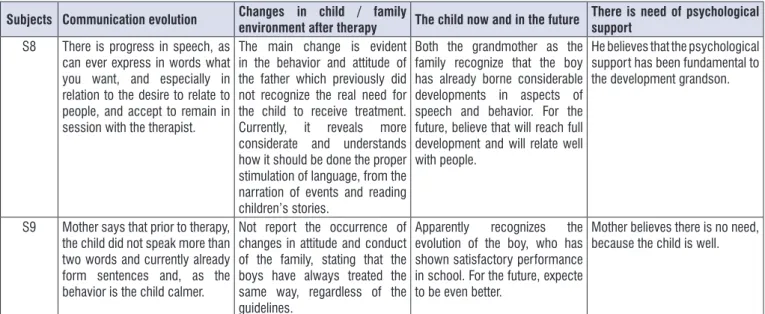
Subjects Communication evolution Changes in child / family
environment after therapy The child now and in the future
There is need of psychological support
S1 The mother realizes that child is
able to express feelings through the eyes, she came to understand the speech of the mother and the everyday situations and produces some vocalizations.
Before her daughter spent most of the day lying in her stroller, without participating in the family routine. Today, she rejects lie and is always involved in the family’s daily activities. There was a change of the child’s desire and the mother’s attitude to daughter.
Feels very happy to see her daughter in the evolving aspects of motor and language development. For the future, want to see the child running and playing with other children, but that is mainly independent stand, where he stayed most of the day.
Has conducted psychological support before, but points out that it was not the daughter, but the loss a loved family member one. He believes it is a good support to endure hardship.
S2 When the neurologist asked if she had 50 words realized she had a big own vocabulary
There was change of routine with greater involvement time for treatments, but do not claim change in the relationship, because I joked and took care of it before early intervention. After intervention with speech therapy invests more in song and story.
Family recognizes who is now better development than children with higher SD and assigns the IP. Believes she can do many things, not necessarily academic, but do not know exactly what.
The mother says that swings in their emotional stability and is sometimes good and sometimes not so. Takes anxiolytic and thinks that perhaps it could be good support.
S3 Realize signiicant improvement in understanding language and communicative intentions. Although oral expression is impaired, reports that the child is able to communicate with gestures, vocalizations and other expressions.
Reports clear behavioral perception of the child, and the family routine, believes that father’s playing changed because the reviews developed in the IP session were extended to the family routine. They began to report daily activities and play more with her son.
Recognizes the child various skills, however, expect further development of expressive language. For the future, presents science possible limitations, among them the regular school. The greatest wish is to see him speak.
Believes that the worst phase, when the diagnosis was given, has passed. However, think might eventually need this support over the years and the development of the child..
S4 Daily realize the occurrence of changes in the child for the better because it draws mother and cries when she wants something.
The mother walked away completely from work for believing that his life is to take care of her daughter. Feels surprese by the girl’s developments.
Currently, see well, despite the limitations, but always shows evolution. For the future is dificult to predict, since the doctors say you cannot go to school like other children
The mother thinks that does not need such monitoring because the worst is over and reacts to all the bad news we receive in relation to the child.
S5 Realize improvement in oral expression in her son and said that families have come to understand it better after therapy.
At home it is just mother and son,
does not notice much change. Recognizes that the child is well, but needs to improve in some aspects. For the future, imagine very talkative and would like to see him sing.
Believes that it is not necessary.
S6 She believes that every day the grandson learn something new and try to show the family what you learn in session.
There was a time that was very dificult to understand what the grandson wanted, which made him cry a lot. Today is calmer and better understand the situations of day-to-day, in addition to better express their desires, relecting the coexistence of all at home.
See as a normal boy who just does not see. Believes so will have a development as normal children and not have dificulties.
Consider monitoring both for the family and for the child considers necessary.
S7 Realize improvement in the child expressiveness primarily because the boy effort to demonstrate that others understand.
Today is a quieter boy and a better understanding of family orders, making living together in family easier and more enjoyable.
Realizes that the child needs to evolve further and believes that this will happen over time. To future, wants the child be a good speaker.
Subjects Communication evolution Changes in child / family
environment after therapy The child now and in the future
There is need of psychological support
S8 There is progress in speech, as can ever express in words what you want, and especially in relation to the desire to relate to people, and accept to remain in session with the therapist.
The main change is evident in the behavior and attitude of the father which previously did not recognize the real need for the child to receive treatment. Currently, it reveals more considerate and understands how it should be done the proper stimulation of language, from the narration of events and reading children’s stories.
Both the grandmother as the family recognize that the boy has already borne considerable developments in aspects of speech and behavior. For the future, believe that will reach full development and will relate well with people.
He believes that the psychological support has been fundamental to the development grandson.
S9 Mother says that prior to therapy, the child did not speak more than two words and currently already form sentences and, as the behavior is the child calmer.
Not report the occurrence of changes in attitude and conduct of the family, stating that the boys have always treated the same way, regardless of the guidelines.
Apparently recognizes the evolution of the boy, who has shown satisfactory performance in school. For the future, expecte to be even better.
Mother believes there is no need, because the child is well.
Figure 3.
Family perception of the development
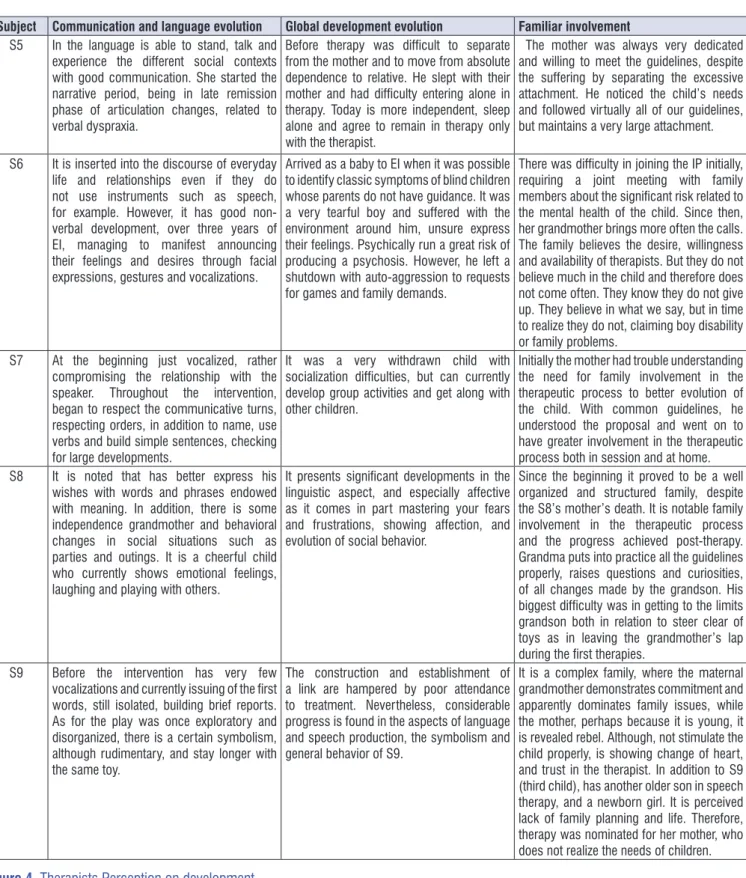
Subject Communication and language evolution Global development evolution Familiar involvement
S1 In communication, presented great verbal
evolution (vocals) and nonverbal (gaze and gestures), she began to perceive the world around them and call the party’s attention to themselves.
Great evolution psychomotor and head control, providing progress in the representation of the world.
With the cognitive development is now possible to insert an alternative form of communication.
The family is present and participatory. The mother raises questions and reports her daughter’s achievements. During dysphagia on guidelines resisted the withdrawal of water, at which point we realized the rejection / daughter disability denial. It has dificulty in understanding the evolution of the child and accept that will have serious limitations in development.
S2 The patient presents good development of comprehensive language and expressive language, demonstrating increasing the phonetic inventory and increased vocabulary.
It presents considerably positive developments in aspects of the play, passing the sensorimotor stage for symbolism.
It is notable family involvement, particularly the involvement of the mother. She is able to move to the daily life of the family that is experienced in session, thus promoting the child development.
S3 Came to understand the communicative situations, showing interest for the proposed activities, respects the communicative turn, has articulated and differentiated vocalizations to certain situations. Demonstrating good verbal and nonverbal development.
There was a positive trend and contrary to what reported in literature about syndrome, he presented psychomotor development, behavioral, cognitive, and communication important for the proposed design.
The mother is dedicated and participative in the therapeutic process by putting in place the necessary guidelines for the overall child development.
S4 This is a case with signiicant limitations, either the neurological level, sensory (hearing impairment) and also some signiicant contact with each other, requiring dedication of the therapist, but also caution in interpreting the gestures and scenes. It can be considered an evolutionary gain in communicating the entry of speech in EI, along with occupational therapy, since in addition to the look and body touch, if leveraged-other communication skills, listening.
The child did not move clarity. For anyone who meets you can see that is connected to the other longer (but still very little time). But the family is changing some attitudes with the girl on a daily basis, which is causing satisfaction for everyone.
Subject Communication and language evolution Global development evolution Familiar involvement S5 In the language is able to stand, talk and
experience the different social contexts with good communication. She started the narrative period, being in late remission phase of articulation changes, related to verbal dyspraxia.
Before therapy was dificult to separate from the mother and to move from absolute dependence to relative. He slept with their mother and had dificulty entering alone in therapy. Today is more independent, sleep alone and agree to remain in therapy only with the therapist.
The mother was always very dedicated and willing to meet the guidelines, despite the suffering by separating the excessive attachment. He noticed the child’s needs and followed virtually all of our guidelines, but maintains a very large attachment.
S6 It is inserted into the discourse of everyday life and relationships even if they do not use instruments such as speech, for example. However, it has good non-verbal development, over three years of EI, managing to manifest announcing their feelings and desires through facial expressions, gestures and vocalizations.
Arrived as a baby to EI when it was possible to identify classic symptoms of blind children whose parents do not have guidance. It was a very tearful boy and suffered with the environment around him, unsure express their feelings. Psychically run a great risk of producing a psychosis. However, he left a shutdown with auto-aggression to requests for games and family demands.
There was dificulty in joining the IP initially, requiring a joint meeting with family members about the signiicant risk related to the mental health of the child. Since then, her grandmother brings more often the calls. The family believes the desire, willingness and availability of therapists. But they do not believe much in the child and therefore does not come often. They know they do not give up. They believe in what we say, but in time to realize they do not, claiming boy disability or family problems.
S7 At the beginning just vocalized, rather compromising the relationship with the speaker. Throughout the intervention, began to respect the communicative turns, respecting orders, in addition to name, use verbs and build simple sentences, checking for large developments.
It was a very withdrawn child with socialization dificulties, but can currently develop group activities and get along with other children.
Initially the mother had trouble understanding the need for family involvement in the therapeutic process to better evolution of the child. With common guidelines, he understood the proposal and went on to have greater involvement in the therapeutic process both in session and at home. S8 It is noted that has better express his
wishes with words and phrases endowed with meaning. In addition, there is some independence grandmother and behavioral changes in social situations such as parties and outings. It is a cheerful child who currently shows emotional feelings, laughing and playing with others.
It presents signiicant developments in the linguistic aspect, and especially affective as it comes in part mastering your fears and frustrations, showing affection, and evolution of social behavior.
Since the beginning it proved to be a well organized and structured family, despite the S8’s mother’s death. It is notable family involvement in the therapeutic process and the progress achieved post-therapy. Grandma puts into practice all the guidelines properly, raises questions and curiosities, of all changes made by the grandson. His biggest dificulty was in getting to the limits grandson both in relation to steer clear of toys as in leaving the grandmother’s lap during the irst therapies.
S9 Before the intervention has very few vocalizations and currently issuing of the irst words, still isolated, building brief reports. As for the play was once exploratory and disorganized, there is a certain symbolism, although rudimentary, and stay longer with the same toy.
The construction and establishment of a link are hampered by poor attendance to treatment. Nevertheless, considerable progress is found in the aspects of language and speech production, the symbolism and general behavior of S9.
The S4’s mother presented questions about the
effects of EI with ludic focus, such as the program,
according on the neurologist indication by
behav-ioral therapy, which could not be in the session with
her daughter. Gave up this because the child cried a
lot during that intervention and she realized that the
program approach include her in the process, unlike
behavioral approach. Although the EI was not directly
cited, she afirms perceive constant evolution in her
daughter. The same is noticeable in S5 and S9.
DISCUSSION
In the present study was observed concordance
between parental and therapist perceptions about the
children evolution aspects in the language, motor,
social and psychic development in all cases, but not in
completely mode in S1, where there is maternal denial
about the daughter disability, which also emerges in
M6’s discourse on S6 where the psychic dificulty is
not realized by the family. According to some studies,
the main reactions expressed by parents against the
child’s disability diagnostic pass with shock at the
news, followed by denial and feelings of guilt, sadness,
anger and anxiety about the baby until it reaches the
equilibrium stage and acceptance
18.19. It was observed
that in S5 and S7 anxiety is the most evident symptom.
Mothers of S5 and S9 do not realize their dificulties in
interacting with their children, for opposite behaviors.
While the excessive attachment S5, S9 for lack thereof.
In the S5 case, there was a common situation in the
language clinic disorders, the absence of the paternal
function, common element in reports cases in the
liter-ature
20,21.
Some authors afirm that pregnancy is conigured as
an important step on the woman’s identity structuring
process and the representations that this builds on their
child. Throughout this process, the suspicion or
conir-mation of the physical and mental integrity of the future
child can become an obstacle to the establishment of
the dynamic mother-baby
22,23, once the family
experi-ences feeling the loss of their desired and idealized
son, leading to an existential and emotional conlict that
requires them to review all the dreams and
expecta-tions for the child. This initial dificulty, however small,
increases over time and can be cured or permanently
installed depending on the family conduct adopted
before this reality and the signiicance that this event
will have for each
24,25.
Therefore, it becomes paramount importance, the
way in which parents explain the dificulty / limitation
When confronting the families responses (Figure
3) with the therapists (Figure 4) about the children
evolution in aspects of language development, motor,
social and psychological, it is clear that in regard to
communication and general aspects of behavior, all
mothers recognize the children evolutions, especially
in terms of comprehension and oral expression, and
refer desire and possibilities for the child participation
in the family daily activities. This perception
corre-sponds with therapists’ perception, except in S1,
when the dysphagia discussion presented dificulties
in acceptance daughter`s deiciency and said that
not realize evolution in her daughter, because, at the
time, their expectation was that she walked and speak.
Such aspect becomes evident in the daughter future
perception, exposed in Figure 3, in which the goal
for the child is too dificult to perform, once running
is an unrealistic expectation for a tetraplegia child.
In this sense, it is also interesting to note that the S5
expectation is that his son sings and S7 that be a
good speaker, just focusing on aspects whose base
is currently deicient: speech. Also the S6 case draws
attention, which the family believes that this is only
the blindness and in the other aspects will be a child
with normal development. Still on the future
expecta-tions, S2 realizes her daughter from the comparison
with other children with Down Syndrome, older than
S2 and have a worse development than her. Realizes
that she has potential and accepts that will not
neces-sarily academic. The same is seen in S3 and S4, which
relate know the academic impossibility of their children,
but believe they can always progress. Already the S8’s
grandmother seems to realize that the boy’s dificulty
lies in the subjective and inter-subjective areas, which
creates a greater expectation to child engage well in
different social environments.
to the legality of child acquisitions. . In this sense, it is
worth noting the Cunha
28and Cauduro
29work about
the importance of parental care in the neuroscience
context. While the irst author explains the basic
principles of brain growth in development in connection
with the care, the second afirms the importance of care
from a rapprochement between Winnicott and
neuro-science. Both studies allow supposing that the
inter-vention that considers the infant-caregiver interaction
is much more effective in terms of brain registration,
once that focuses on the fundamental limbic system
memory, and maturing in the irst year of life. This
system, together with the subcortical and cerebellar
structures, will form the basis for the cortical maturation
in the second year of life in children with normal
devel-opment, in another words, a consolidated affective
relationship is necessary for purely instrumental
inter-ventions can make sense in children’s lives and their
families. For this research`s children, although the
chronological age is greater than the second year of
life in all cases, including those with signiicant
neuro-logical limitations (S1, S3, S4, and S6) it is evident that
early intervention also focuses on the relationship that
underlies the cortical acquisitions in progress, or even
about the possible limits to both. It should be noted,
among limits, access a luent verbal expression, which
may be impossible in some cases (S1, S3, S4), which
may depend on alternative forms of communication.
CONCLUSION
Considering the proposed initial analysis regarding
the comparison of parental and therapists perceptions
on the effects of early intervention in the development
of their children and care to them, the study showed
correlation between parental and therapeutic insights
about the evolution aspects of development language
and motor in all cases. In social terms and psychic of
children, in two cases there was no agreement because
the family shows poor perception of the present and
dificult expectations to perform in the future of children.
REFERENCES
1.
Laznik MC. A hora e a vez do bebê. 1. ed. São
Paulo, SP: Instituto Langage; 2013.
2.
Coriat E. Psicanálise e clínica de bebês. Porto
Alegre, RS: Artes e Ofícios; 1997.
3.
Crestani AH, Oliveira LD, Vendruscolo JF,
Ramos-of their children, in another words, the way they
understand the signiicance of the problem once that
according to overcome the deiciency, create
expec-tations, both positive and negative, ranging from the
full development of the child to complete incredulity
regarding the child’s situation. From this perspective, is
interesting the S7 case, in which the mother associates
the son’s communication dificulties, verbal dyspraxia,
with one episode of burn. It is known that this kind of
explanation attributed by the mother, who has no basis
in scientiic knowledge, presents her hypothesis based
on concepts of popular culture, since they need a
concrete explanation that satisies speciic association
26