THERAPEUTIC PROGRESS ON SUBJECTS SUBMITTED
TO PHONOLOGICAL THERAPY USING THE MULTIPLE
OPPOSITIONS APPROACH
Progresso terapêutico de sujeitos submetidos a terapia
fonológica pelo modelo de oposições múltiplas:
comparação do progresso terapêutico
Marizete Ilha Ceron (1), Joviane Bagolin Bonini (1), Márcia Keske-Soares (1)
(1) Universidade Federal de Santa Maria (UFSM), Santa
Maria, RS, Brasil.
Conlict of interest: non-existent
The phonological disorder is one of the speech sound disorders with a higher incidence in children1,4-9 and can negatively impact the health and quality of life of children. Because of it early diagnosis and intervention become essential to prevent further improvement of the disorder and the appearance of
other alterations1.
Children with phonological disorder during the speech sounds acquisition have several repair strat
-egies, which are named phonological processes. The phonological process are used because children need get along with the complexity of the segment and/or syllable structure which they do not know or control yet in the production2.
These children need phonological intervention, which aims to the sounds system reorganization as early as possible. The intervention improvement in speech intelligibility10-12 and communication with
INTRODUCTION
The development of speech occurs with the integration of the motor, sensory and auditory systems1. The phonology acquisition is a complex function subject to changes throughout its process2. The greatest expansion of the phonological system occurs between 1 year and 6 months and 4 years1. Children who show substitutions and/or omissions of phonemes during spontaneous speech have what is called a “phonological disorder” and its complicate the speech intelligibility to the listener3.
ABSTRACT
This work aims to analyze and compare the therapeutic progress shown in children submitted to the Multiple Oppositions Approach, stimulated in therapy with the same target sounds. Two children with phonological disorder participated in this case report, being a boy (S1) and a girl (S2), aged 4:2 and 4:11, respectively. The speech data were collected through phonological evaluation. As treatment, we used the Multiple Oppositions Approach during 25 sessions with the same target sounds, all belonging to fricatives classes. The substitutions and omissions of each child’s phonological inventory were analyzed, as well as the occurrence of pre and post-therapy phonological processes. It was observed that the subject with more substitutions (S1) was the one with phonemes major acquisitions in the phonological inventory. S1 showed the highest occurrence of cases in his speech, both pre and post-therapy, which made the speech intelligible to the listener. The processes involving the class of liquids showed a higher percentage of occurrences, even after therapy. The Multiple Oppositions Approach showed an adequate progress of the treatment of these children with phonological disorder, providing a phonological inventory expansion and a reduction of phonological processes occurrence, although with differences regarding the evolution presented by each one.
carried out: inspection of the external acoustic meatus, audiological and neurological evaluations. These evaluations were performed to conirm the diagnosis of phonological disorder and exclude other alterations that may interfere with the speech acquisition.
The Phonological Assessment of Child26 was performed through the spontaneous nomination of igures (“vehicles”, “room”, “kitchen”, “bathroom” and “zoo”), which allowed the collection of a signif
-icant linguistic sample (all phonemes in all possible positions of the word and in different words). The speech data were recorded, phonetically transcribed and checked by two more specialists students in the last grade of under graduation course in Speech-Language and Hearing Pathology. Afterwards a contrastive analysis was applied. From this analysis it was determined the phonological inventory pre and post-therapy of each child, considering its acquisition level, which means: the phoneme was acquired when produced correctly in 80% of the times or more; partially acquired when the phoneme was produced correctly between 40% and 79%; and not acquired when the phoneme was produced correctly from 0% to 39% of the possibilities30.
After, the Percentage of Consonants Correct
– Revised (PCC-R)31 was calculated from the contrastive analysis, considering like errors substi
-tutions and omissions presented by children in the phonological system (Table 1). The percentage of occurrence of each phonological process pre and post-therapy was calculated too.
After these evaluations, both subjects were submitted to the Multiple Oppositions Approach, twice a week sessions, during 45 minutes each. In this research were analyzed the irst 25 sessions of each children. The treatment applied is based on the contrast of several sounds simultaneously, contrasting the replaced sounds with the substitute. The target sounds were chosen according to the author’s proposal14 and with the phonological inventory presented by each subject.
Some modiications were made in order to adapt the Multiple Oppositions Approach to Brazilian Portuguese (BP) speakers. These changes were caused by the facts that in BP rarely ind sounds replaced by a single one in different classes of sounds and with different syllable structure (e.g. in BP there is not onset replacement by conso
-nantal cluster) and the dificulty in forming sets of contrastive words to be used in the treatment in other children and/or adults1,11, as well as reduce
eventual dificulties in learning reading and writing of school-age children11,13.
There are different treatment approaches (traditional and phonological) for the phonological disorder. The traditional approach makes the therapy longer, since all the sounds need to be taught separately in all positions in the syllable and the word. The phonological approaches are faster because they use one or few target sounds induces to the acquisition of many other sounds substitution in the child system which were not directly treated14-23. Sometimes the progress in the acquisition of a segment results in the regression of others, until the acquisition process is stabilized with the acquisition of this sounds20.
The Multiple Oppositions Approach was developed to treat children with more severe
disorders14,24. This treatment uses multiple sounds simultaneously considering the ability of children to generalize. The generalization refers to children ability to apply phonological knowledge on non-treated targets in therapy 11,14,17-23.
The irst evaluation is used both to therapeutic planning and evolution monitoring. Periodic monitoring of each case adds important new infor
-mation to the diagnosis and enables to strengthen the irst evaluation regarding to the underlying dificulties25.
Therefore, the objective of this case report was to analyze and compare the therapeutic progress presented by two children submitted to the multiple oppositions approach, stimulated in the therapy with the same target sounds.
CASE REPORT PRESENTATION
This case report was composed of two (2) children with phonological disorder, a boy (S1) and a girl (S2), aged 4:2 and 4:11, respectively, at the beginning of the evaluation process. The parents and/or responsible persons received information about the survey and authorized the participation of their children by the signature of Informed Consent which will explain about research study. The project was approved by the Research Ethics Committee Number 108/05 of a Universidade Federal de Santa
Maria (UFSM).
correct model of the SLP. The spontaneous speech production phase (words and sentences) began when children obtained a percentage of correct production of target sounds of 80% or more.
At the end of the 25 sessions (excluding the evaluation sessions), the subjects were re-evaluated with the use of Phonological Assessment of
Child26, in order to correlate with the initial evalu -ation. Therefore, were examined the pre and post-therapy phonological inventory, the acquisition level of phonemes in the phonological inventory, the occurrence of pre and post-therapy phonological processes, and the generalization types (compared to lexical items non used during treatment, to another position of the word, inside a sounds class and to other sounds class).
RESULTS
The subjects of this study differed per gender, age and severity level of the phonological disorder (Figure 1), nevertheless the differences of age and gravity were not extreme, which means, the results were next. Regarding to the severity level of the phonological disorder, S1 was classiied as a severe phonological disorder and S2 as a moderate-severe phonological disorder.
The phonemes acquired and partially acquired in the pre and post-therapy phonological inventories for both subjects are presented in Table 1.
target sounds belonging to the same class sounds and preferably in words with meanings.
After the analysis of phonological inventories for both S1 and S2, it was chosen the same target sounds for the therapy (/s/, /z/ and /Z/ and its substitute /S/). All target sounds belonging to the fricatives class because these were the only sounds that could be selected according to the proposed Multiple Oppositions Approach. The selected words target (minimal pairs) for therapy for both subjects were [‘kaSa], [‘kasa], [‘kaza] and [‘kaZa]. For the target word [‘kaZa] a “meaning/”nickname” was created with children to the image “staff” (in BP “[ka’Zado].
In the irst session was applied the baseline, and calculated the percentage of the correct productions for the phonemes partially acquired and non-acquired in the phonological inventory of each child. Afterwards, the treatment with target sounds was made in ive therapy sessions. In the sixth session the targets sounds was evaluated at the same way as the baseline. After 25 therapy sessions the totally results of the treatment were analyzed. These therapeutic procedures have also been used in another study18.
The targets sounds were treated in the production practice across playful activities in the phonological therapy. Initially, the minimal pairs were treated by imitation of the production of the Speech-Language Pathologist (SLP). Children had to imitate the
Subject Gender Age Severity
S1 B 4:2 PCC-R= 39,78% - Severe
S2 G 4:11 PCC-R= 54,24% - Moderate-Severe
Legend: PCC-R: Percentage of Consonants Correct – Revised; B: boy; G: girl; S1: subject 1; S2: subject 2.
Figure 1 - Subjects description regarding gender, age and severity of the phonological disorder.
It was observed in the pre-therapy evalu
-ation S1 had eight non-acquired phonemes in the phonological inventory: /g/, /s/, /z/, /Z/, /´/, /l/, /r/ and /R/. Nine phonemes were partially acquired and only three acquired (/p/, /t/ e /v/). While in the post-therapy evaluation only four phonemes were non-acquired: /s/, /z/, /´/ and /r/. S2 had more
completely phonological inventory which presented only ive non-acquired phonemes in the pre-therapy evaluation (/g/, /z/, /Z/, /´/ and /r/) and the others phonemes were all acquired. After the treatment, only three phonemes remained at this level of acqui
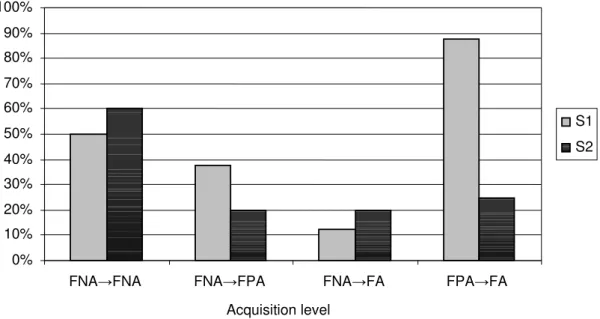
highest percentage was partly acquired, while for S2 acquired. As for the phonemes partially acquired that were acquired, S1 presented a great evolution, when compared to S2.
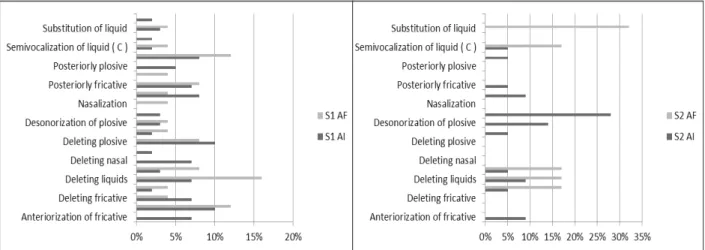
The phonological processes carried out by the subjects pre and post-therapy are presented in
Figure 3.
The Figure 2 shows the development percentages in the phonological inventories as per the acqui
-sition level, i.e. non-acquired phonemes, phonemes partially acquired and acquired phonemes.
It was observed to both subjects that more than 50% of the non-acquired phonemes remained at this level. However, in relation to the non-acquired phonemes that evolved with the therapy, for S1 the
Table 1 - Phonemes acquired and partially acquired in the subjects phonological system.
Subjects Phonological System Nr. of FA
p, b, t, d, k, g, f, v, s, z, S, Z, m, n, , l, r, , R
S1 Pre p, (b)*, t, (d)*, (k)*, (f)*, v, (S)*, (m)*, (n)*, ()* 3 Post p, b, t, d, (k)*, (g)*, f, v, S, Z, m, n, , (l)*, ({)* 11
S2 Pre p, (b)*, t, (d)*, k, f, (v)*, s, S, m, n, , (l)*, { 10 Post p, (b)*, t, d, k, f, (v)*, s, (z)*, S, Z, m, n, , (l)*, { 12
Legend: *: Phoneme partially acquired; Bold: phonemes acquired through therapy; FA: phonemes acquired; S1: subject 1; S2: subject
2.
Legend: FNA → FNA: phoneme non acquired pre and post-therapy; FNA → FPA: phoneme non acquired pre-therapy and partially acquired post-therapy; FNA → FA: phoneme non acquired pre-therapy and acquired post-therapy; FPA → FA: phoneme partially acqui
-red pre-therapy and acqui-red post-therapy; S1: subject 1; S2: subject 2.
Figure 2 - Evolution percentages in the phonological inventory of each subject according to the acquisition level.
0% 10% 20% 30% 40% 50% 60% 70% 80% 90% 100%
FNA→FNA FNA→FPA FNA→FA FPA→FA
Acquisition level
S1
In Table 2 is presented the generalization types. It was observed that both subjects showed favorable evolution, i.e. the percentage increased in all types examined, except for S2 towards the generalization inside a sounds class, which showed a greater occurrence in pre-therapy evaluation than in post-therapy evaluation.
It was observed that the processes involving the class of liquids were those who persisted and even evolved, showing a higher percentage of occur
-rence, even after the therapy. Among these, the liquid deletion in onset and coda had an increase in its occurrence percentage for both subjects, as well as the semivocalization process in onset position for S1 and in coda position for S2, as well as the substitution process.
Legend: AI: Initial evaluation; AF: Final evaluation; C: Coda; S1: subject 1; S2: subject 2.
Figure 3 - Phonological processes occurrence performed by S1 and S2 pre and post-therapy.
Table 2 - Generalization Types obtained through multiple oppositions approach
S1 S2
AI (%) AF (%) AI (%) AF (%)
Lexical items non used in the treatment 40,08 57,78 15 33,07
Another positions of the word 30,21 60,71 33,76 50
Inside a sounds class 50 81,82 76,19 52,94
Other sounds classes 42,39 67,77 33,35 40,80
Legend: AI: Initial evaluation; AF: Final evaluation; S1: subject 1; S2: subject 2.
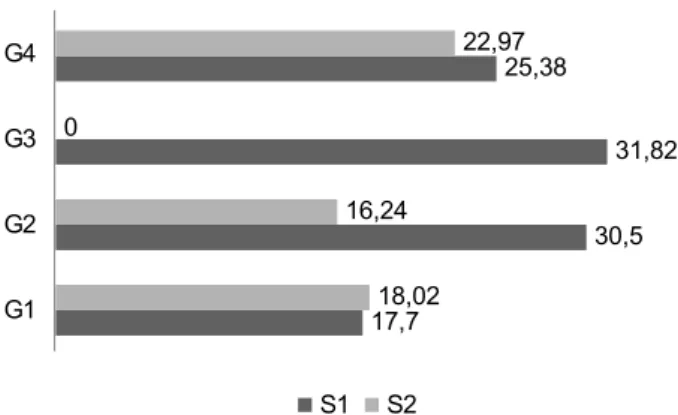
In the comparison of the percentages obtained regarding to the generalization types (Figure 4) it was observed S1 obtained the largest percentage of evolution in the generalization to another position
in trained phonemes in trained positions, but also in non-target phonemes in untrained positions. Other
studies12,15,18,23 using this treatment reported the
acquisition of non treated phonemes during therapy in subject’s phonological inventories. Therefore, the used therapeutic treatment seems to favor the generalizations on the treated subjects.
According to the acquisition levels it was observed that more than 50% of non-acquired phonemes remained at this level, which highlights the absence of phonemes and their distinctive features in the phonetic inventories of the subjects. In the non-acquired phonemes pre-therapy, the highest percentage was to partially acquired for S1 and was to acquire for S2. Regarding the phonemes partially acquired which were acquired post-therapy, S1 presented a great evolution when compared to S2. S1 showed in his phonological system fewer number of phonemes correctly produced than S2. S1 acquired more number of phonemes, from the non-acquired level to partially acquired and of the partially acquired to acquired. It shows S1 is in the acquisition phase of phonological characteristics and articulatory that compose the phonemes. On the other hand, S2 showed a faster evolution because her phonological system was closer to normality. It means S2 already had on her phonological system several distinctive features which compound the phonemes.
In relation to phonological processes, S1 with
severe disorder was the one who showed the
highest cases occurrence in his speech pre and post-therapy. It dificult the speech intelligibility to the listener. A similar result was described in a study32 which observed that the greater the severity level of the phonological disorder was the largest the number of altered phonological process was used.
It is possible to observe the occurrence of various phonological processes, especially in S1. The phonological processes involving the class of liquids showing the higher occurrence percentage even after therapy. A study33 reported that among the phonological processes most widely used in children with phonological disorder are the Reduction of Consonant Cluster (60.67%) and the Liquids Simpliication and Omission (47.19%).
Other studies1,34,35 showed the dificulty of children in the liquids production and in more complex syllable structures.
Alterations in the liquid class occur due to
DISCUSSION
The Multiple Oppositions Approach is a recent form of intervention, which began to be applied in the last years in studies with children who presented phonological disorder in Brazil12,18,23. This treatment
is described in the international literature12,24 as a treatment to be used on more severe phonological disorder due to a peculiarity in its application. It means that children has several phonemes absent from the phonological inventory which be replaced by a single sound. This feature takes place in the children inventories with severe disorders, as the example of these two subjects. Although S2 has moderate-severe disorder, the percentage was very close to severe disorder, reason why it has been possible to apply the Multiple Oppositions Approach in the treatment.
In relation to the phonological inventories, S1 presented it so restricted, showing only three phonemes acquired in pre-therapy. This subject acquired eight phonemes, which were mostly partially acquired. On the other hand, S2 showed a pre-therapy inventory with a larger number of phonemes, showing consequently less acquisitions. Therefore, it appears that the subject who showed
17,7
30,5
31,82 25,38
18,02
16,24 0
22,97
G1 G2 G3 G4
Percentual de aquisições (%)
S1 S2
Legend: G1: Generalization to lexical items non used in the tre
-atment; G2: Generalization to another position in the word; G3: Generalization to inside a sounds class; G4 Generalization to other sounds class; S1: subject 1; S2: subject 2.
Figure 4 - Evolution percentages by comparing subjects regarding the generalization types obtained at post-therapy
systems and age being similar, there are other factors that inluence on therapy, among them the family’s participation in the therapeutic process. This differed among the children, one family was always present, questioned the therapy, performed activities at home, while the other children was absent in several sessions and did not performe tasks at home. This was an important factor on the different evolution in the therapy. The level of family support and the involvement may also make an important role in the treatment progress. In fact, the father being present in the therapy room may simply affect the treatment outcome37. The motivation, the involvement and the interest of family in the therapy may inluence the evolution of the clinical situation of children with phonological disorder, since their speech may not be understood by an adult hindering the interaction between them11.
CONCLUSION
The Multiple Oppositions Approach was eficient for these children’s treatment because they presented several phonemes acquisitions in the phonological inventory and various types of general
-izations and decreased occurrence of post-therapy phonological processes.
The children had the same approach of therapy and the same target phonemes, but there were different evolution among them, demonstrating that the family’s participation, involvement and interest is an aspect to be considered for the fastest therapy
progress.
ACKNOWLEDGMENT
We thank CAPES for the scholarship granted to study during this study.
therefore may be involved in phonological processes showed by older children34.
The generalization obtained by the children was favorable to both subjects (S1 e S2) because the percentage increase. However, S1 obtained evolu
-tion’s greatest percentage in the generalization to another position of the word, inside a sounds class and to other sound class than the S2. Similar percentages were obtained in the generalization to lexical items none used during treatment to both subjects. A study23 refers to the occurrence of greater generalization (another position of the word) in subjects with more restricted phonological inventories (less phonemes present), and the same can be observed in this study comparing the two children. Other studies14-23 also reported the gener-alization occurrence after phonological therapy.
Fricatives phonemes were used in the treatment of both subjects, but S2 did not obtain generalization inside a sounds class (fricatives), showing a decrease in the percentage of correct productions post-therapy. It happens due to the phonological reorganization that occurs during the treatment which does not happen in a linear way. Therefore regression periods are observed during the treatment. This non-linearity in the acquisition process has also been observed in study36 which showed the discontinuity mainly in class of liquids and coronal fricatives. The emergence of new segments or structures sometimes results in regression of other segments or structures learned20.
The generalization occurrence in the treatment is expected by the clinician for it may reduce the time of therapy14 making it quicker and more eficient which are the treatment goals.
8. Rabelo ATVR, Alves CRL, Goulart LMHF, Frische AAL, Lemos SMA et al. Alterações de fala em escolares na cidade de Belo Horizonte. J Soc Bras
Fonoaud. 2011;23(4):344-50.
9. Müürsepp I, Aibast HA, Gapeyeva H, Pääsuke M. Motor skills, haptic perception and social abilities in children with mild speech disorders. Brain & Development. 2012;34(2):128-32.
10. Gierut JA, Morrisette ML, Ziemer SM. Nonwords and generalization in children with phonological disorders. Am J Speech-Lang Path. 2010;19:167-77. 11. Nunes DA, Payão LMC, Costa RCC. Desvios fonológicos na educação infantil. Rev CEFAC. 2010
Mar-Abr; 12(2):331-6.
12. Ceron MI, Keske-Soares M. Análise do progresso terapêutico de crianças com desvio fonológico após a aplicação do Modelo de Oposições Múltiplas. J Soc Bras Fonoaudiol. 2012;24(1):91-5.
13. Mota HB, Melo Filha MGC. Habilidades em consciência fonológica de sujeitos após realização de terapia fonológica. Pró-Fono R Atual Cient.
2009;21(2):119-24.
14. Williams AL. Multiple oppositions: theoretical foundations for an alternative contrastive intervention approach. Am J Speech Lang Pathol. 2000a;9(4):282-8.
15. Williams AL. Assessment, target selection, and
REFERENCES
1. Rabelo ATV, Alves CRL, Goulart LMF, Friche ALL, Lemos SMA, Campos FR et al. Alterações de fala em escolares na cidade de Belo Horizonte. J Soc
Bras Fonoaudiol. 2011;23(4):344-50.
2. Costa VP, Backes FT, Pegoraro SP, Wiethan FM, Melo RM, Mota HB. Emprego da estratégia de reparo de plosivização: relação com a gravidade do desvio fonológico e fonemas acometidos. J Soc
Bras Fonoaudiol. 2012;24(1):76-9.
3. Wertzner HF, Claudino GL, Galea DES, Patah LK, Castro MM. Medidas fonológicas em crianças com transtorno fonológico. Rev Soc Bras Fonoaudiol. 2012;17(2):189-95.
4. Newmeyer AJ, Grether S, Grasha C, White J, Akers R, Aylward C et al. Fine motor function and oral-motor imitation skills in preschool-age children with speech-sound disorders. Clin Pediatr (Phila).
2007;46(7):604-11.
5. Skahan SM, Watson M, Lof GL. Speech-language pathologists’ assessment practices for children with suspected speech sound disorders: Results of a national survey. Am J Speech-Lang Path.
2007;16(3):246-59.
6. Pagan-Neves LDO, Wertzner HF. Parâmetros acústicos das líquidas do Português Brasileiro
RESUMO
Este trabalho tem como objetivo analisar e comparar o progresso terapêutico apresentado por crian
-ças submetidas ao Modelo de Oposições Múltiplas estimuladas na terapia com os mesmos sons-alvo. Participaram deste relato de caso duas crianças com desvio fonológico, sendo um menino (S1) e uma menina (S2), com idades de 4:2 e 4:11, respectivamente. Os dados da fala foram coletados por meio da avaliação fonológica. Para o tratamento, foi utilizado o Modelo de Oposições Múltiplas durante 25 sessões com os mesmos sons-alvo, todos pertencentes a classe das fricativas. As substituições e omissões no inventário fonológico de cada criança foram analisadas, assim como a ocorrência de processos fonológicos pré e pós-terapia. Observou-se que o sujeito que apresentava mais substi
-tuições (S1) foi o que apresentou maiores aquisições de fonemas no inventário fonológico. O S1 foi o que apresentou maior ocorrência de processos em sua fala, tanto pré quanto pós-terapia, o que diicultava a inteligibilidade de fala para o ouvinte. Os processos que envolveram a classe das líquidas foram os que apresentaram um maior percentual de ocorrência, mesmo após a terapia. O Modelo de Oposições Múltiplas possibilitou um adequado progresso no tratamento dessas crianças com desvio fonológico, proporcionando uma expansão no inventário fonológico e uma diminuição de ocorrência de processos fonológicos apesar de haver diferenças quanto a evolução apresentada por cada uma.
28. Rodrigues EJB. Discriminação auditiva: Normas para Avaliação de crianças de 5 a 9 anos. São Paulo: Cortez, 1981.
29. Cielo CA. Habilidades em consciência fonológica em crianças de 4 a 8 anos de idades. [Tese]. Porto Alegre (RS): Pontifícia Universidade Católica do Rio Grande do Sul, Letras, Área de Concentração Linguística Aplicada; 2001.
30. Bernhardt B. Developmental implications of nonlinear phonological theory. Clin Linguist Phon. 1992;6(4):259-81.
31. Shriberg ID, Austin D, Lewis BA, McSweeny JL, Wilson DL. The percentage of consonants correct (PCC) metric: extensions and reliability data. J Speech Lang Hear Res. 1997;40(4):708-22.
32. Ghisleni MRL, Keske-Soares M, Mezzomo CL. O uso das estratégias de reparo, considerando a gravidade do desvio fonológico evolutivo. Rev
CEFAC. 2010;12(5):766-71.
33. Patah LK, Takiuchi N. Prevalência das alterações fonológicas e uso dos processos fonológicos em escolares aos 7 anos. Rev CEFAC. 2008;10(2):158-67.
34. Ferrante C, Van Borsel J, Pereira MMB. Análise dos processos fonológicos em crianças com desenvolvimento fonológico normal. Rev Soc Bras
Fonoaudiol. 2009;14(1):36-40.
35. Stoel-Gammon C. The Word Complexity Measure: Description and application to developmental phonology and disorders. Clin Linguist Phon. 2010;24(4-5):271-82.
36. Keske-Soares M, Pagliarin KC, Ghisleni MRL, Lamprecht RR. Aquisição não-linear durante o processo terapêutico. Letras de Hoje. 2008;43(3):22-6.
37. Kamhi AG. Treatment decisions for children with speech-sound disorders. Lang, speech Hear Serv Schools. 2006;37:271-9.
17. Gierut JA, Dale RA. Comparability of Lexical Corpora: Word frequency in phonological generalization. Clin Ling Phon. 2007;21(6):423-33. 18. Pagliarin KC, Ceron MI, Keske-Soares M. Modelo de Oposições Múltiplas Modiicado: abordagem baseada em traços distintivos. Rev Soc
Bras Fonoaudiol. 2009;14(3):411-5.
19. Topbas S, Ünal Ö. An alternating treatment comparison of minimal and maximal opposition sound selection in Turkish phonological disorders. Clinical Linguistics & Phonetics. 2010;24(8):646-68. 20. Rvachew S, Bernhardt BM. Clinical Implications of Dynamic Systems Theory for Phonological Development. Am J Speech-Lang Path.
2010;2:34-50.
21. Gierut GA, Morrisette ML, Ziemer SM. Nonwords and generalization in children with phonological disorders. Am J Speech-Lang Path. 2010;19:167-77. 22. Gierut JA, Morissete ML. Age of word acquisition effects in treatment of children with phonological delas. Applied Psycholinguistic. 2012;33:121-44. 23. Ceron M e Keske-Soares M. Mudanças fonológicas obtidas no tratamento pelo Modelo de Oposições Múltiplas. Rev CEFAC.
2013;15(2):314-23.
24. Williams AL. Multiple oppositions: case studies of variables in phonological intervention. Am J Speech Lang Pathol. 2000b;9(4):289-99.
25. Wertzner HF, Pagan-Neves LO. A efetividade dos testes complementares no acompanhamento da intervenção terapêutica no transtorno fonológico. Rev Soc Bras. Fonoaudiol.
2012;17(4):469-75.
26. Yavas M, Hernandorena CLM, Lamprecht RR. Avaliação Fonológica da Criança. Porto Alegre: Artes Médicas, 2002.
27. Marchesan I. Motricidade oral: visão clínica do trabalho fonoaudiológico integrado com outras especialidades. São Paulo: Pancast, 1999.
Received on: August 05, 2013 Accepted on: October 22, 2014
Mailing address:
Marizete Ilha Ceron R. Bentevi, 215, Bairro JK
Santa Maria - RS – Brasil CEP: 97035-130