PHONOLOGICAL CHANGES OBTAINED BY TREATMENT
BASED ON ABAB-WITHDRAWAL AND MULTIPLE-PROBES
APPROACH IN DIFFERENT SEVERITY LEVELS
OF PHONOLOGICAL DISORDERS
As mudanças fonológicas obtidas pelo tratamento
com o modelo ABAB-Retirada e Provas Múltiplas
em diferentes gravidades do desvio fonológico
Luciana da Silva Barberena(1), Helena Bolli Mota(2), Márcia Keske-Soares(3)
(1) Universidade Federal de Santa Maria – UFSM, Santa Maria, RS, Brasil.
(2) Programa de Pós-graduação em Distúrbios da Comunica-ção Humana da Universidade Federal de Santa Maria – UFSM, Santa Maria, RS, Brasil.
Conlict of interest: non-existent
about the phonological system pre- and post--treatment in different phonological disorder levels.
This model is based on the distinctive features implicational hierarchy to choose the target sounds used in the treatment.
The principles of the treatment based on the
distinctive features implicational hierarchy conirm
the hypothesis that the treatment of sounds which
are considered more dificult, which represent the most complex distinctive features of the hierarchy,
would be positive to wide changes in the children phonological systems.
Recent studies 1-3,8,9,11,12 which applied the ABAB-Withdrawal and Multiple Probes Approach
veriied their validity with children who present phonological disorders, because it promoted
speech intelligibility improvements and it enabled the occurrence of generalizations in all phonological disorders degrees of severity.
Other therapy models with phonological basement such as Maximum Oppositions 4, Minimal Oppositions, Multiple Oppositions 5 and Modiied
INTRODUCTION
In Brazil, clinical research presented some appro -aches to treat phonological disorders 1-12, contributing to establish analysis patterns and speech-language
intervention. It determines higher speed and eficacy
of therapy with children with phonological disorders through phonological models.
These models are widely used, producing
important and varied generalizations. The generali-zation is the most important criteria to measure the success obtained with the treatment.
The ABAB-Withdrawal and Multiple Probes Approach 13, applied in Brazilian Portuguese and
used in this study help the development of research ABSTRACT
Purpose: to analyze the phonological changes obtained (phonological system, phonetic inventory and distinctive features alterations) pre and post-treatment by ABAB-Withdrawal and Multiple Probes Approach in different severity levels of phonological disorders. Method: the diagnosis was determined by the phonoaudiological evaluation in eight children with different severity level of phonological disorders, whose average age was 5:5 in the beginning of the treatment. All of them were treated by ABAB-Withdrawal and Multiple Probes Approach. It was analyzed the phonetic inventory, phonological system and distinctive features alterations. Results: all severity levels of phonological disorders demonstrated some improvement in the phonological system. Conclusions: the severe phonological disorders presented the highest improvement among the different levels.
Cycles 6,14 veriied the eficacy of the treatment comparing different phonological disorders degrees
of severity. However, there are no studies which present the eficacy of the treatment through the
ABAB-Withdrawal and Multiple Probes Approach comparing the development in different phonolo-gical disorders degrees of severity.
The analysis of children development using therapy models with phonological basement in different phonological disorders severity degrees may help clinical practice and contribute to the creation of therapy models which are proper for each case.
The purpose of this study is to analyze the phonological changes obtained (phonological
system, phonetic inventory and distinctive features
alterations) pre and post-treatment using the ABAB-Withdrawal and Multiple Probes Approach in different phonological disorders degrees of severity.
METHOD
This research is cross-sectional, prospective
in which the phonological disorder is dependent
variable and the results of the phonetic inventory,
phonological system and distinctive features altera-tions are the independent variables.
The sample of the study consists of speech data of
eight subjects with phonological disorders, four male
and four female. The average age in the beginning of the treatment was 5:5. All subjects presented altered phonological systems when compared with the adult pattern of Brazilian Portuguese in children. The phonetic representations of adults occur in the Brazilian Portuguese which is spoken in Rio Grande
do Sul state, in a city called Santa Maria. All subjects were received in a school clinic of a university, for
four months.
The subjects were submitted to phonological
evaluation, including anamnesis, evaluations of receptive and expressive language, oral sensory
--motor oral system, psychomotricity, hearing discrimination and phonology were carried out, in addition to audiological, otorhinolaryngological and
neurological evaluations.
In the choice of subjects, it was used as funda -mental criteria that the individuals did not present
signiicant alterations in the performed evaluations,
except in the phonological evaluation. This last evaluation revealed disorders in the phonological level and reduced phonetic inventory
For the data analysis, it was performed the
contrastive analysis and the analysis through
distinctive features. The contrastive analysis, in this case, is the comparison between the child’s
phonological system and the pattern adult system.
The subjects’ phonetic inventory or their articulatory
skills was delimited. To determine the presence of
the sound in the phonetic inventory, it was consi -dered at least two occurrences of it.
The contrastive analysis has the register of occurrences and possibilities of substitutions and
omissions of the sounds produced by the child, calculating the percentages. With this register, it was determined the children phonological system,
considering the following criteria 15: 80% or more of
the sound occurrences produced correctly by the child – the segment is considered as established;
between 40% – 79% of the sound occurrences
produced correctly – the segment is considered as
partially established; between 0% – 39% of sound
occurrences produced correctly by the child – the sound is considered as non-established.
The substitutions of sounds allowed the
identi-ication of distinctive features whose alterations would imply the difference between the subjects’
system and the adult pattern system. The present study is based on the Feature Geometry proposed
by Clements & Hume (1995).
So, the occurrence of altered distinctive features higher than 15% was registered. The percentage of 85% of sound correct production was considered
as feature acquisition criteria. According to these
criteria, it was determined which features and
segments were present and absent in the children inventories.
The severity of the phonological disorder was determined after the data obtained through
the contrastive analysis, identiied through the
Percentage of Consonants Correct (PCC) 16. The
sample was divided in four groups with different
degrees of phonological disorder severity, according
to the PCC. Each group consisted of two subjects with the same severity degree. The groups were:
severe disorder (SD), moderate severe disorder (MS), mild-moderate disorder (MM) and mild disorder (MD), organized regarding sex and age.
The ABAB-Withdrawal and Multiple Probes Approach 13, used in this research, consisted of speech data collection (A1), performed through
spontaneous speech recording and spontaneous
naming. For these procedures, the instrument
Phonological Assessment of Child was used 17.
Then, the altered distinctive features were identiied and, after that, the therapy target sound was
delimited.
The therapeutic intervention started in the irst cycle of the treatment (B1). It lasted about ive weeks (nine sessions), with two speech-language therapy sessions a week (45 minutes each). Next, there was the Period of Withdrawal (A2) – a period without any
has the purpose of observing the obtained
genera-lizations. During this period, the Generalization
Tests (G.T.) were applied and the samples of the
subjects’ spontaneous speech were collected. So, successively, the treatment continued with the new cycle (B2), which lasted ive weeks, as previously explained, followed by another Period of Withdrawal (A3), which had two weeks of duration.
The performance of the subjects was evaluated during the Period of Withdrawal through the G.T. The test was managed before the beginning of the therapy. It corresponded to the initial speech data collection. It was applied again after the end of each
therapy cycle and in the end of this period, that is
before the beginning of the next cycle of therapy. All subjects agreed in participating in this research and in showing their results according to
the resolution 196/96 (BRASIL. Resolution MS/CNS/
CNEP n. 196/96 on October, 10, 1996). The Project
was approved by the institutional Ethics Committee
of the Health Sciences Center, n. 059/2002.
Comparing the indings pre- and post-therapy among the different disorder severity levels, the Fischer’s Exact Test was used. In the analysis of the indings pre- and post-treatment for all subjects, regardless their disorder severity level, the Wilcoxon Test was used. It was considered p<0.05.
RESULTS
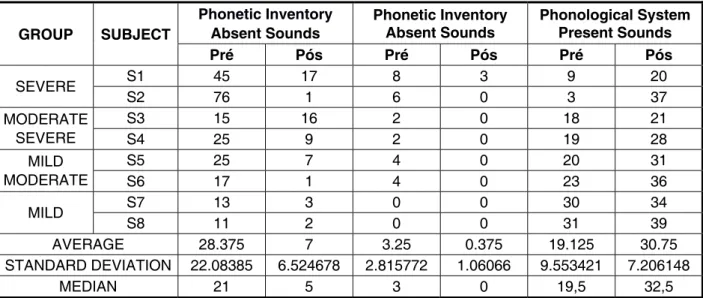
Figure 1 presents the sound substitutions which characterize the number of distinctive features
altera-tions, the sounds which are absent in the phonetic inventory of the studied subjects, regardless the
level of severity of the phonological disorder.
GROUP SUBJECT
Phonetic Inventory
Absent Sounds
Phonetic Inventory Absent Sounds
Phonological System Present Sounds
Pré Pós Pré Pós Pré Pós
SEVERE S1 45 17 8 3 9 20
S2 76 1 6 0 3 37
MODERATE SEVERE
S3 15 16 2 0 18 21
S4 25 9 2 0 19 28
MILD MODERATE
S5 25 7 4 0 20 31
S6 17 1 4 0 23 36
MILD S7 13 3 0 0 30 34
S8 11 2 0 0 31 39
AVERAGE 28.375 7 3.25 0.375 19.125 30.75
STANDARD DEVIATION 22.08385 6.524678 2.815772 1.06066 9.553421 7.206148
MEDIAN 21 5 3 0 19,5 32,5
Subject 1 (S1) presented alterations in the following distinctive features pre-treatment: [- sonant]
→ [+sonant] (1), [+approximant]→[-approximant] (4), [- vocoid] → [+vocoid] (6), [+voiced] → [-voiced] (1), [+ continuous] → [- continuous] (4), [- continuous] → [+ continuous] (6), point of consonant (PC) labial → coronal + anterior (3), PC labial → dorsal (4), PC coronal [-anterior] → [+anterior] (4), PC coronal → dorsal (6), PC coronal [+ anterior] → vowel point (VP) coronal [- anterior] (4), PC dorsal → VP coronal [+ anterior] (1), complex segment (CS) → O PC
coronal [+anterior] → VP coronal [- anterior] (1).
The substitutions which characterize these features alterations were preferably: /r/→[j], /l/→[j],
/d/→[j], /n/→[j], /S/→[k].
Subject 2 (S2) presented alterations in the
following distinctive features pre-treatment: [- sonant]
→ [+ sonant] (6), [+ approximant] → [- approx
-imant] (4); [- approx-imant]→ [+ approx-imant] (3), [- vocoid] → [+ vocoid] (9), [+voiced] → [-voiced] (5), [+ continuous] → [- continuous] (5), [- continuous] → [+ continuous] (8), PC coronal [-anterior] → [+anterior] (2), PC dorsal → coronal (1), PC labial → VP coronal [-anterior] (1), PC coronal [+ anterior] → VP coronal [- anterior] (5), PC dorsal → VP coronal [-anterior]
(1) , O PC labial (4), O PC coronal + anterior (3), O PC coronal – anterior (3), O PC dorsal (2), SC → O PC coronal [+anterior] → VP coronal [- anterior] (2), – glottis constriction→ + glottis constriction (12).
The substitutions which characterized these features alterations were preferably: /b/→[j], /l/→[j], /d/→[j], /g/→[j], /n/→[j], /l/→[j], /r/→[j], /p/→ [?], /b/→[?], /t/→[?], /d/→[?], /k/→[?], /g/→[?], /f/→[?], /v/→[?], /s/→[?], /S/→ [?], /Z/→[?].
Subject 3 (S3) presented alterations in the
following features pre-treatment: [+voiced] → [-voiced] (9), [+ continuous] → [- continuous] (1), PC coronal [+ anterior] → [-anterior] (3), [- glottis constriction] → [+ glottis constriction] (2).
The substitutions which characterized these alterations were preferably: /b/→[p], /d/→[t], /v/→[f],
/z/→[S], /z/→[s], /Z/→[S], [dZ]→[tS], /k/→[?], /g/→[?],
/s/→[S], /s/→[S], /z/→[S].
Subject 4 (S4) presented alterations in the following distinctive features pre-treatment:
[+ approximant ]→ [- approximant] (5), [- vocoid] → [+ vocoid] (5), [+voiced] → [-voiced] (4), [- continuous] → [+ continuous] (2) PC [coronal + anterior] → [-anterior] (2), PC [dorsal] → [labial] (1), PC [dorsal] → [coronal] (1), PC [coronal + anterior] → VP [coronal – anterior] (3), PC [dorsal] → VP [coronal –anterior] (1), SC → O PC [coronal +anterior] → VP
[coronal – anterior] (1).
The substitutions which characterized these alter-ations were preferably: /{/→[j], /l/→[j], //→[j], /r/→[j], /r/→[j], /z/→[S], /Z/→[S], [dZ]→[tS].
Subject 5 (S5) presented alterations in the following distinctive features pre-treatment:
[+ approximant ]→ [- approximant] (2), [- vocoid] → [+ vocoid] (2), [+voiced] → [-voiced] (7), [+ continuous] → [- continuous] (7), [- continuous] → [+ continuous] (1), PC [coronal –anterior] → [+anterior] (3), PC [coronal + anterior] → VP [coronal – anterior] (1), CS → O PC [coronal +anterior] → VP [coronal – anterior] (1), CS → O VP [coronal –
anterior] → PC [coronal + anterior] (1).
The substitutions which characterized these alterations were preferably: /b/→[p], /d/→[t], /g/→[k], /v/→[f], /z/→[t], /Z/→[t], [dZ]→[tS], /s/→[t], /z/→ [t],/z/→[d], /S/→[t], /S/→[tS], /Z/→[t], /Z/→[d], //→[l].
Subject 6 (S6) presented alterations in the following distinctive features pre-treatment:
[+approximant] → [-approximant] (1), [-vocoid] → [+vocoid] (1), [+continuous] → [-continual] (7), PC [labial] → [dorsal] (1), PC [cor –anterior] →[+anterior] (5), PC [coronal +anterior]→VP [coronal –anterior] (1), CS→ O VP [coronal –anterior]→PC [coronal + anterior] (1).
The substitutions which characterized these alterations were preferably: /f/→[p], /v/→[b], /v/→[g], /s/→[t], /z/→[d], /S/→[t], /Z/→[d], /S/→[s], /Z/→[z], /S/→[t], /Z/→[d], //→[l].
Subject 7 (S7) presented alterations in the
following distinctive features pre-treatment:
[- sonant] → [+ sonant] (1), [+ approximant]→ [- approximant] (2), [- vocoid] → [+ vocoid] (2), [+ continuous] → [- continuous] (1), [- continuous] → [+ continuous] (1), PC [coronal –anterior] → [+anterior] (3), PC [coronal + anterior] → VP [coronal – anterior] (1), CS → O PC [coronal +anterior] → VP [coronal – anterior] (1), CS → O VP [coronal –
anterior] → PC [coronal + anterior] (1).
The substitutions which characterized these alterations were preferably: //→[j], /r/→[j], /S/→[s], /Z/→[z], //→[l].
Subject 8 (S8) presented alterations in the
following distinctive features pre-treatment:
[+ approximant]→ [- approximant] (1), [- vocoid] → [+ vocoid] (1), [+voiced] → [-voiced] (2), [+ continuous] → [- continuous] (1), PC [coronal + anterior] → [-anterior] (1), PC [coronal –anterior] → [+anterior] (3), CS → O VP [coronal –anterior] → PC [coronal + anterior] (1); PC [coronal + anterior] →
VP [coronal – anterior] (1).
The substitutions which characterized these alterations were preferably: /r/→[j], /S/→[s], /Z/→[z], //→[l], [dZ]→[tS], /g/→/k/.
In the phonetic inventory (Figure 1), the
absent sounds pre-treatment were: S1 /t/,/d/, /S/,/Z/,/{/,/l/,//,/r/, S2 /g/,/f/,/S/,/Z/,//,/r/, S3 and S4 /g/ and /r/, S5 /s/,/z/,/S/,/Z/ and S6 /S/,/Z/, /{/,/r/. For S7 and S8 there were no absent sounds.
In Figure 1 it is possible to observe the number of sounds which are present in the phonological system of the eight studied subjects.
About S1, there were 9 present sounds
pre-treatment (established /k/ and /g/ in initial
onset (IO), /k/,/g/,/v/,/s/,/z/,// in medial onset (MO) and /s/ in inal coda (FC)). S2 with 3 present sounds (established /{/ (IO), /z/ (MO) and /s/
(FC)), S3 with 18 present sounds (established /p/, /t/,/f/,/S/,/m/,/n/,/l/,/{/ (IO) and /p/,/t/,/f/,/S/,/m/, /n/,//,/l/,//,/{/(MO)), S4 with 19 present
sounds (established /p/,/b/,/d/,/f/,/v/,/z/,/m/,/n/ (IO) and /p/,/b/,/t/,/d/,/f/,/v/,/S/,/m/,/n/,//,/s/ (MO)).
S5 with 20 present sounds (established /p/,/t/, /k/,/f/,/m/,/n/, /l/, /{/ (IO) and /p/,/t/,/k/,/f/,/ v/,/m/, /n/,//,/l/,/r/,//,/{/ (MO)).
About S6, there were 23 present sounds (estab -lished /p/,/b/,/t/,/d/,/k/,/g/,/m/,/n/,/l/ (IO), /p/,/b/,/t/,/ d/,/k/,/g/,/s/,/z/,/m/,/n/,//,/l/,// (MO) and /s/
/b/,/t/,/d/,/k/,/g/,/f/,/v/,/s/,/z/,/m/,/n/,//,/l/,/{/, /r/ (MO) and /s/(FC)). S8 with 31 present sounds (established /p/,/b/,/t/,/d/,/k/,/f/,/v/,/z/,/S/,/m/, /n/,/l/,/{/ (IO), /p/,/b/,/t/,/d/,/k/,/g/,/f/,/v/,/s/,/z/, /m/,/n/,//,/l/,// /{/(MO), /s/ in medial coda (MC) and /s/ (FC)).
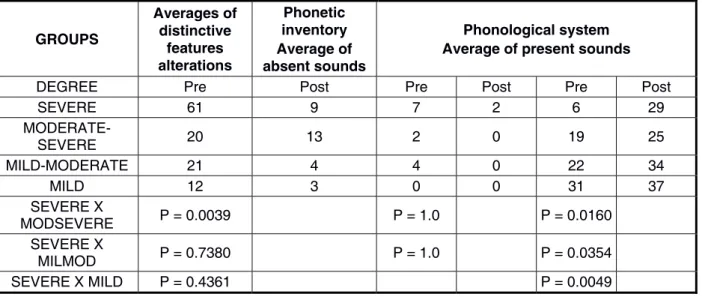
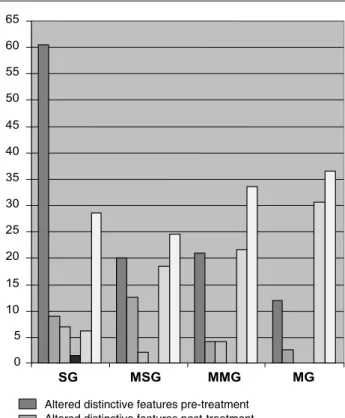
Figures 1 and 2 present the average of sounds
substitutions represented by the altered distinctive
features, the sounds which are absent in the
phonetic inventory and the sounds which are present
in the phonological system of the groups: severe, moderate-severe, mild-moderate and mild.
In relation to altered distinctive features,
represented by the substitution of the mentioned
sounds, the severe group (SG) presented average
of 61 occurrences of altered distinctive features
pre-treatment and 9 occurrences post-treatment.
The moderate severe group (MSG) presented
average of 20 occurrences pre-treatment and 13
occurrences post-treatment. The mild moderate
group (MMG) presented average of 21 occurrences
pre-treatment and 4 occurrences post-treatment and the mild group (MG) presented average of
12 occurrences pre-treatment and 3 occurrences
post-treatment.
About the average of absent sounds in the
phonetic inventory pre-treatment, the SG presented
7 absent sounds, followed by the MMG with 2
absent sounds. Only the SG still presented the
average of 2 absent sounds post-treatment. The
MG did not present absent sounds neither pre- nor post-treatment.
The phonological system of the SG presented
average of 6 present sounds pre-treatment and 29
present sounds post-treatment. The MSG presented
average of 19 present sounds pre-treatment and 25
present sounds post-treatment. The MMG presented
average of 22 present sounds pre-treatment and 34
present sounds post-treatment. The MG presented
average of 31 present sounds pre-treatment and 37
present sounds post-treatment.
DISCUSSION
In Figure 1, it is possible to verify the number
of distinctive features alterations pre- and post-treatment of the eight studied subjects. These alterations occurred mostly in the SG.
In Figure 2 and Figure 3, the average of altered
distinctive features pre- and post-treatment showed
statistically signiicant difference between the groups SG and MSG (p=0.003).
GROUPS
Averages of distinctive
features alterations
Phonetic inventory Average of absent sounds
Phonological system Average of present sounds
DEGREE Pre Post Pre Post Pre Post
SEVERE 61 9 7 2 6 29
MODERATE-SEVERE 20 13 2 0 19 25
MILD-MODERATE 21 4 4 0 22 34
MILD 12 3 0 0 31 37
SEVERE X
MODSEVERE P = 0.0039 P = 1.0 P = 0.0160
SEVERE X
MILMOD P = 0.7380 P = 1.0 P = 0.0354
SEVERE X MILD P = 0.4361 P = 0.0049
MODSEVERE – Moderate-Severe; MILMOD – Mild-Moderate.
In the subject 2 (Figure 1) it is clearly observed this development. This individual, in the initial evalu
-ation, presented 76 occurrences of sounds substi -tutions that characterized the distinctive features
alterations, and only one occurrence in the inal
evaluation.
In that subject, it was veriied the process of
substitution of many sounds by a glottal sound. The
presence of the feature [+ constricted glottis] in the Laryngeal Node, in relation to the voiceless glottal plosive, emphasized the deletion of the plosive and fricative Point of Consonant, what characterized
restricted phonetic inventory.
It was observed that, when the subject presented disorders with severe level, such as S2,
the treatment seems to propitiate higher number of
features distinction, because, in these cases, the
phonetic inventory is restricted and the phonological system presents little distributional possibilities.
The wide changes in the phonological system of the severe group (SG) after the performed treatment
relected the lowest average of altered features
pre-treatment.
S1 and S2, from the SG, presented the highest
number of absent sounds in the phonetic inventory
pre-treatment, with absent sounds post-treatment
only in S1 (Figure 1).
Also about the phonetic inventory (Figure 1 and
Figure 2), the SG, followed by the MMG and the MSG, presented the highest averages of absent sounds. However, it was not observed statistically signiicant difference among the different levels of
severity regarding the sounds which are absent in the phonetic inventory. Only the SG still presented absent sounds post-treatment.
So, the analysis of the absent sounds in the
phonetic inventory did not evidence differences among the degrees of severity of the phonological
disorders. These results are presented by the PCC,
which reveals differences in the system about the
use of the presented sounds, expressed by the
phonological systems analysis.
Nevertheless, although both subjects (S1 and S2) presented the same degree of severity, they responded to the treatment differently. Thus, it was not only considered the analysis based on PCC, performed in this study, other characteristics related to the children system seemed to inluence the phonological disorder severity, such as the lack of
communication and the speech unintelligibility.
In the phonological system (Figure 1), pre-treatment, S1 and S2 presented the lowest average of present sounds, followed by S3 and S4, S5 and S6, and, inally, S7 and S8. In the phonological system post-treatment, all subjects
presented higher number of present sounds in their phonological systems.
Changes in the children phonological systems with varied phonological disorders severity degrees were observed 1 using three different models of therapy, such as ABAB-Withdrawal and Multiple
Probes Approach. The studies concluded that these models were effective in the treatment of different phonological disorders severity degrees.
Recent studies using models with phonological basement 2,3 also observed that the development of the phonological systems of children with
phono-logical disorders, veriied through generalization,
were proportionate to the number of sounds which were established in these systems.
Another study 5 veriied wide changes in the
phonological systems of children with phonological
disorders in the levels: severe, moderate-severe and
mild-moderate. These children were treated through phonological models with contrastive approach.
0 5 10 15 20 25 30 35 40 45 50 55 60 65
SG MSG MMG MG
SG – Severe Group; MSG – Moderate-Severe Group; MMG – Mild-Moderate Group; MG – Mild Group
Figure 3 – Average of altered distinctive features, absent sounds in the phonetic inventory and absent sounds in the phonological system of different severity degrees of phonological disorders
Altered distinctive features pre-treatment Altered distinctive features post-treatment
In the average of present sounds in the phono-logical systems pre- and post-treatment (Figure 1
and Figure 3), it was possible to observe statisti
-cally signiicant differences between SG and MSG (p=0.001), between SG and MMG (p=0.03) and between SG and MG (p=0.004).
In the phonological system, the PCC evidenced
development in the different systems when comparing the different degrees of phonological
disorders severity degrees. So, the SG presented
higher development when submitted to treatment when compared with the other groups.
In cases of phonological disorders with mild
degree, the treatment seems to cause more differ
-ences among the features, because the phonetic
inventory is restricted and the phonological system presents a few distributional possibilities.
Expansions in phonological systems with different degrees of severity were observed in other studies 6,7 which used models with phonological basis. These models 7 favored higher number of sound acquisition in the phonetic inventory of subjects with severe and moderate-severe degree
of phonological disorders, as well as better perfor -mance of sounds acquisition in their phonological
system and reduction of altered distinctive features,
also in the severe and moderate-severe degrees.
For all subjects, regardless the severity of the phonological disorder, comparing the altered distinctive features (p=0.001), absent sounds in the phonetic inventory (p=0.02) and present sounds in the phonological system (p=0.01) pre- and post-treatment, there was signiicant development after
the performed treatment (Figure 1).
So, all subjects were beneited when submitted to the treatment which was proposed in this research,
but the disorders with severe degrees presented
statistically signiicant development when compared
with the other severity degrees of phonological disorder.
Some authors 8 veriied statistically signiicant
differences between initial and inal evaluations
regarding the number of sounds which were established in the phonological system and altered distinctive features also using the ABAB-Withdrawal and Multiple Probes Approach.
Other studies 9-12 also observed that the patients presented gains in their phonological systems in models with phonological basement. Some of them also used the ABAB-Withdrawal and Multiple Probes Approach. The present research agrees with the
indings mentioned in those studies.
CONCLUSION
The averages of substituted sounds represented by distinctive features alterations pre- and
post--treatment, between severe degree and moderate
--severe degree presented signiicant gradual
development.
The average of present sounds in the
phono-logical system (initial and inal) was statistically signiicant when comparing the severe group with the other groups: moderate-severe, mild-moderate
and mild.
The initial and inal evaluations demonstrated signiicant development in all phonological disorders severity degrees, provided by the treatment, when comparing the initial and inal evaluations of the phonological system, phonetic inventory and
distinctive features of all subjects with phonological disorders.
The most outdated phonological systems, mainly the phonological disorders with severe degree,
presented few distributional possibilities and restricted phonetic inventory. These characteristics cause more features distinction after the proposed treatment.
The ABAB-Withdrawal and Multiple Probes Approach were effective during the intervention of children with different phonological disorder
severity degrees, considering that all studied
groups presented development in their phonological
system, distinctive features and phonetic inventories
post-treatment when compared with pre-treatment.
AKNOWLWDGEMENTS
To the patients who participated in the research at the clinic school from Universidade Federal de
Santa Maria – RS, Brazil. To Cibele Rosa Gracioli,
REFERENCES
1. Keske-Soares M, Brancalioni AR, Marini C, Pagliarin KC, Ceron MI. Eicácia da terapia
para desvios fonológicos com diferentes modelos terapêuticos. Pró-Fono R. Atual. Cient.
2008;20(3):153-8.
2. Keske-Soares M, Pagliarin KC, Ceron MI. Terapia fonológica considerando as variáveis linguísticas. Rev. soc. bras. fonoaudiol. 2009;14(2):261-6. 3. Barberena LS, Keske-Soares M, Mota
HB. Generalização baseada nas relações implicacionais obtida pelo modelo “ABAB-Retirada e Provas Múltiplas”. Rev. soc. bras. Fonoaudiol.
2008;13(2):143-53.
4. Bagetti T, Mota HB, Keske-Soares M. Modelo de
oposições máximas modiicado: uma proposta de
tratamento para o desvio fonológico. Rev Soc Bras
Fonoaudiol. 2005;10(1):36-42.
5. Pagliarin KC, Mota HB, Keske-Soares M. Generalização estrutural a partir do tratamento por diferentes modelos de oposições. Rev soc Bras
fonoaudiol. 2011;16 (3):356-61.
6. Blanco AP. A generalização no modelo de
ciclos modiicado em pacientes com diferentes graus de severidade de desvio fonológico. 2005. 184 f. Dissertação (Mestrado em Distúrbios da
Comunicação Humana) – Universidade Federal de Santa Maria.
7.Pagliarin KC, Mota HB, Keske-Soares M. Análise da eicácia terapêutica em três modelos fonológicos
de abordagem contrastiva. Pró-Fono R. Atual.
Cient. 2009;21 (4):297-302.
8. Mota HB, Keske-Soares M, Bagetti T, Ceron MI, Melo Filha MGC. Análise comparativa da eiciência
de três diferentes modelos de terapia fonológica.
Pró-Fono R. Atual. Cient. 2007;19(1):67-74.
9. Donicht G, Pagliarin KC, Mota HB, Keske-Soares
M. O tratamento com os róticos e a generalização obtida em dois modelos de terapia fonológica. J.
Soc. Bras. Fonoaudiol. 2011;23(1):71-6.
10. Pagliarin KC, Ceron MI, Keske-Soares M. Modelo de oposições múltiplas modiicado:
abordagem baseada em traços distintivos. Rev.
soc. bras. fonoaudiol. 2009; 14(3):411-5.
11. Attoni TM, Albiero JK, Berticelli A, Keske-Soares M, Mota HB. Onset complexo pré e pós-tratamento
de desvio fonológico em três modelos de terapia fonológica. Rev. soc. bras. fonoaudiol.
2010;15(3):395-400.
12. Ceron MI, Keske-Soares M, Freitas GP, Gubiani
MB. Mudanças fonológicas obtidas no tratamento de sujeitos comparando diferentes modelos de terapia.
Pró-Fono R. Atual. Cient. 2010;22(4):549-54. 13. Tyler AA, Figurski GR. Phonetic inventory
changes after treating distinctions along an
implicational hierarchy. Clin Linguist & Phon. 1994;8(2): 91-107.
14. Tyler A, Edwards ML, Saxman J. Clinical
application of two phonologically based treatment
procedures. J. speech Hear Dis.1987;(52):393-409. 15. Bernhardt, B. Developmental implications of nonlinear phonological theory. Clinical Linguistics & Phonetics.1992; 6(4):259-81.
16. Shriberg LD, Kwiatkowski J. Phonological disorders: A diagnostic classiication system. Journal of Speech and Hearing Disorders. 1982;47:226-41. 17. Yavas MS, Hernandorena CLM, Lamprecht RR. Avaliação fonológica da criança. 2a ed. Porto Alegre: Artmed; 2003.
Received on: January 18, 2012 Accepted on: May 22, 2012
Mailing Address:
Luciana da Silva Barberena
Rua Três de Maio, nº 20 – Bairro Nonoai
Santa Maria – RS
CEP: 97060-550
E-mail: [email protected] RESUMO
Objetivo: analisar as mudanças fonológicas obtidas (sistema fonológico, inventário fonético e altera -ções de traços distintivos) pré e pós-tratamento utilizando o Modelo ABAB-Retirada e Provas Múltiplas em diferentes gravidades do desvio fonológico. Método: foram realizadas avaliações fonoaudiológi -cas em oito crianças com diferentes gravidades do desvio fonológico, cuja média de idade no início do tratamento era de 5:5. Todos receberam tratamento fonológico pelo Modelo “ABAB-Retirada” e Provas Múltiplas. Foram analisadas as evoluções quanto ao inventário fonético, sistema fonológico e alterações nos traços distintivos. Resultados: todas as gravidades apresentaram evoluções no sistema fonológico. Conclusões: os desvios fonológicos graves apresentaram maiores evoluções.