Revista Gaúcha
de Enfermagem
How to cite this article:
Mazza VA, Lima VF, Carvalho AKS, Weis-sheimer G, Soares LG. Online information as support to the families of children and adolescents with chronic disease. Rev Gaúcha Enferm. 2017 Mar;38(1):e63475. doi: http://dx.doi.org/10.1590/1983-1447.2017.01.63475.
doi: http://dx.doi.org/10.1590/1983-1447.2017.01.63475
Online information as support to the families of
children and adolescents with chronic disease
Informações on-line como suporte às famílias de crianças e adolescentes com doença crônica
Información en línea, apoyo a los niños de las familias y adolescentes con enfermedad crónica
a Universidade Federal do Paraná (UFPR), Departa-mento de Enfermagem, Programa de Pós-Graduação em Enfermagem. Curitiba, Paraná, Brasil. b Universidade Federal do Paraná (UFPR), Programa de Pós-Graduação em Enfermagem. Curitiba, Paraná, Brasil.
c Faculdades Pequeno Príncipe, Residência em Área Profi ssional Enfermagem em Saúde da Criança e do Adolescente. Curitiba, Paraná, Brasil.
Verônica de Azevedo Mazzaa Vanessa Ferreira de Limab Ana Karoline da Silva Carvalhoc Gisele Weissheimerb Larissa Gramazio Soaresb
ABSTRACT
Objective: To describe the use of online information as support to families of children and adolescents with chronic disease.
Methods: This is an integrative review conducted in August 2015, with an online search in the following databases: PubMed, Biblio-teca Virtual em Saúde, Cumulative Index to Nursing & Allied Health Literature, and Science Direct.
Results: Twelve studies were selected from the 293 studies found in the databases. After analysis, the following two categories emerged: Potentialities of the use of online information by families of children and adolescents with chronic disease, and Weaknesses of the use of online information by families of children and adolescents with chronic disease.
Conclusions: The internet off ers a wide range of information that helps families manage the care of children and adolescents with chronic diseases, but it also has characteristics that need to be analysed.
Keywords: Consumer health information. Internet. Chronic disease. Child. Adolescent. RESUMO
Objetivo: Descrever o uso de informações on-line como suporte às famílias de crianças e adolescentes com doença crônica.
Método: Trata-se de uma revisão integrativa realizada no mês de agosto de 2015, com busca on-line nas bases de dados: PubMed, Biblioteca Virtual em Saúde, Cumulative Index to Nursing & Allied Health Literature e Science Direct.
Resultados: Foram selecionados doze estudos de 293 encontrados. Após análise, elencaram-se duas categorias: Potencialidades do uso de informações on-line às famílias de crianças e adolescentes com doença crônica e Fragilidades do uso de informações on-line às famílias de crianças e adolescentes com doença crônica.
Conclusões: A Internet oferece amplitude de informações que subsidiam as famílias no gerenciamento do cuidado às crianças e aos adolescentes com enfermidades crônicas, no entanto, ainda possui particularidades que precisam ser analisadas durante a utilização desta rede virtual.
Palavras-chave: Informação de saúde ao consumidor. Internet. Doença crônica. Criança. Adolescente. RESUMEN
Objetivo: Describir el uso de la información en línea y apoyar a las familias de los niños y adolescentes con enfermedad crónica.
Método: Se trata de una revisión integradora realizada en agosto de 2015, con la búsqueda en línea, en bases de datos: PubMed, Biblioteca Virtual em Saúde, Cumulative Index to Nursing & Allied Health Literature y Science Direct.
Resultados: Un total de doce estudios de 293 encontrados. Tras el análisis se enumeraron dos categorías: Posible uso de información en línea para las familias de niños y adolescentes con enfermedad crónica y Debilidades de la información en línea para las familias de niños y adolescentes con enfermedad crónica.
INTRODUCTION
Health related issues are one of the main concerns of human beings(1), and people are increasingly accessing the internet in search of information about their health or the health of a family member or friend(2-3).
When it comes to chronic disease, internet access is even more common since the anxiety and hope of find-ing an immediate diagnosis and/or innovative treatment are even greater. Moreover, users with chronic diseases can share their experiences and seek additional informa-tion or even experiences that help them cope with their pathology(4).
The internet is admittedly an important means to self-care because it provides information and can enable inter-action between caregivers, health professionals, and indi-viduals affected by a chronic condition(5). Similarly, families search for information to manage the healthcare of chil-dren and adolescents from several sources, such as books, magazines, conversations with friends, relatives, health professionals(6), participation in support groups, social me-dia, and internet searches(7).
The internet allows the instant and simple exchang-ing of information and alternative treatment or diagno-ses that can help reduce the anxiety of sufferers or their family members, and increase their confidence and un-derstanding of a health condition before or after a med-ical consultation(6).
However, despite being a useful tool, the internet is growing uncontrollably and can provide inaccurate, mis-leading, biased and unreviewed data, which makes it diffi-cult to differentiate trusted from untrusted sources(2, 8).
In order to reduce any conflicts arising from unsubstan-tiated findings or reports viewed by users on the internet, health professionals must know the health-related web-sites and online tools available, and instruct users on the accuracy of the provided information(2).
The use of online healthcare information is a growing and little explored trend in the qualitative dimension and in understanding the impact of this trend on the care of children and adolescents with chronic illness, and all the related specificities and continuous demands. Therefore, health workers should incorporate the online universe in their practices as a way of responding to the needs of fam-ilies and of recognising application in the management of chronic diseases.
In view of the aspects mentioned above, the guiding question for this study was the following: What scientific knowledge has been produced on the use of online infor-mation as support for the families of children and
adoles-cents with chronic illness? In addition, the aim of this paper is to describe the use of online information as support for the families of children and adolescents with chronic illness.
METHODS
Research was based on the monograph entitled, “ Uti-lização de ferramentas de suporte on-line às famílias de cri-anças e adolescentes com doença crônica: uma revisão
in-tegrativa”(9). An integrative review is an investigation that
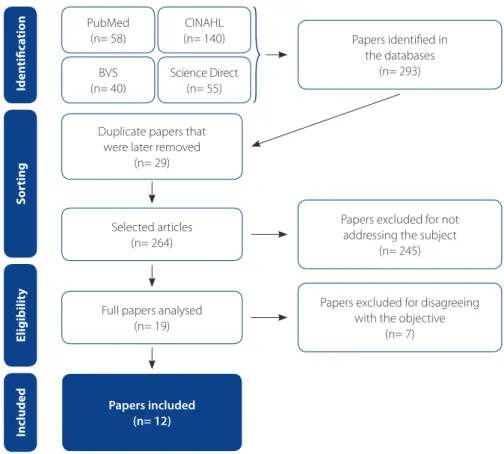
includes the analysis of relevant research and the synthe-sis of several studies to understand a particular subject(10). Similarly, this study was conducted according to the guide-lines of the Preferred Reporting Items for Systematic Re-views and Meta-Analyses do-Prism(11), as shown in Figure 1.
This review consisted of six steps(10). The first step was to identify the subject and establish the research question mentioned above. The second step was to define the cri-teria for inclusion and exclusion. The inclusion cricri-teria were primary studies, published in English and Portuguese, and available in full for free and online from the selected data-bases. The exclusion criteria were duplicate articles found in more than one database and studies that did not ad-dress the proposed theme. We did not use a timeframe to explore the knowledge produced to date.
The literature search was conducted in August 2015 on the websites PubMed, Virtual Health Library, Cumulative Index to Nursing & Allied Health Literature, Science Direct. The descriptors were associated as follows: “online health information OR consumer health information AND chron-ic diseases AND child”. The obtained results are shown in Figure 1.
The third step consisted of defining the characteristics that would be extracted from the sample, namely: publica-tion title, authors, year, country of origin of the study, jour-nal, database, methodological approach, data collection technique, and purpose of the research. In addition, the studies were reviewed according to the level of evidence as proposed by Melnyk and Fineout-Overn(12). This assess-ment focuses on evidence classification systems charac-terised in a hierarchical manner, according to the method-ological design.
RESULTS
Of the 293 publications found, 12 papers were eligible for this investigation. Of the total number of studies and the searched databases, 58 were found in PubMed, of which 51 did not address the subject and seven were selected for the sample. In BVS, 40 studies were found, of which 27 were duplicates, 11 did not address the subject, and two were selected. In CINAHL, 140 papers were found, of which two were duplicates, 137 did not address the study propos-al, and one was included in the sample. In Science Direct, 55 articles were identified, of which 53 did not address the subject in question, and two were selected for the study. Therefore, the universe of papers consisted of 12 studies, as shown in Chart 1.
The period of publication of the articles was from 2008 to 2015; five articles published in 2014, two in 2013, and one in 2008, 2009, 2011, 2012 and 2015. No publications were identified in previous years. All the identified studies were published in foreign journals; five were from North Ameri-ca, three from the United Kingdom, two from Sweden, one from Canada, and one in Italy. With regard to methodolo-gy, six articles adopted the quantitative approach and six
adopted the qualitative approach. In the level of evidence assessment, nine studies of the sample had level VI, one had level VII, and two were evaluated as level II.
The topics covered in the selected studies were as follows: two studies address the use of a tool to assess websites(23-24); six address the development, use, evalua-tion, and/or application of software for computers and smartphones(14, 16-17, 19, 21-22); two deal with the attitude and behaviour of health professionals and parents of children and adolescents when accessing online por-tals(18, 20); one paper compares the effectiveness of direct access to an online platform with regard to the consul-tation of health workers(15); and another demonstrates how the characteristics of parents influence searches of health information online(13).
The analysis of the selected studies revealed positive and negative aspects of the use of online information for the families of children and adolescents with chronic ill-ness, which resulted in two categories: Potentialities of the use of online information for the families of children and adolescents with chronic illness, and Weaknesses of the use of online information for the families of children and adolescents with chronic illness.
Figure 1 – Flow chart of the sample selection for the integrative literature review, prepared using PRISMA(11) Source: Research data, 2015.
PubMed (n= 58)
BVS (n= 40)
Science Direct (n= 55) CINAHL
(n= 140) Papers identified in the databases
(n= 293)
Papers excluded for not addressing the subject
(n= 245)
Papers excluded for disagreeing with the objective
(n= 7) Duplicate papers that
were later removed (n= 29)
Selected articles (n= 264)
Full papers analysed (n= 19)
Papers included (n= 12)
Iden
tiic
a
tion
S
or
ting
Included
E
ligibilit
Reference
Year/Place of study/Journal/
Database
Methodological approach/Level of
evidence
Objective
Stern et al.(13)
2011/United States of America (USA) Journal of Family Issues/ CINAHL
Quantitative/Level VI
Explore how the parental status, gender, and interaction between these two variables influence a range of aspects for the search for online health information.
Swallow et al.(14)
2014/United Kingdom/JMIR
Research Protocols:
JMIR ResProtoc/ PubMed
Quantitative/Level II
Evaluate the feasibility of a randomised clinical trial of Online Parent Information and Support in terms of recruitment and retention of mothers and fathers, data collection procedures and psychometric performance of the study measures on the target population, and investigate the trends of change of results measures in a small-scale randomised clinical trial in parents of children with chronic kidney disease stages 3-5.
Armstrong et al.(15)
2015/USA/JAMA Dermatology/ PubMed
Quantitative/Level II
Compare the effectiveness of access to an online model for tracking dermatologic care in children and adults with atopic dermatitis with personal visits at the consultation room.
Stinson et al.(16)
2014/Canada/ Pain Research & Management/ PubMed
Qualitative/Level VI
Evaluate the healthcare needs of adolescents through an online self-management programme for chronic pain in adolescents called iCanCopewithPain™.
Fore et al. (17)
2013/ EUA/ JMIR Research Protocols:JMIR ResProtoc/ PubMed
Qualitative/Level VI
Describe how the project Metas Dirigidas (“GDD”) was employed to understand the context and objectives of potential participants in a system that conceptualises a health-learning programme in a network of collaborative care for chronic diseases (C3N), specifically for paediatric inflammatory bowel disease.
Byczkowski et al.(18)
2014/ EUA/ Health Informatics Journal/ PubMed
Quantitative/Level VI
Understand the perception of parents of children with chronic diseases (diabetes, juvenile idiopathic arthritis and cystic fibrosis) on the usefulness and value of information available on the website intended for patients with chronic illness.
Swallow et al.(19)
2012/United Kingdom/Journal of Advanced Nursing/PubMed
Qualitative/Level VII
Present the report of a protocol for studying the creation and evaluation of an information pack for parents and online support for the home care of children with chronic kidney disease stages 3-5.
Nordqvist et al. (20)
2009/Sweden/ Journal of Medical Internet Research/ PubMed
Qualitative/Level VI
Explore the attitudes of paediatric health professionals in relation to the introduction of a local web portal for young patients with type 1 diabetes that offers interactive educational devices, social networking tools, self-service information, and locally produced treatment.
Timpka et al.(21)
2008/Sweden/ BMC Medical Informatics and Decision Making/ PubMed
Qualitative/Level VI To address the potential for developing web 2.0 services for young people with a chronic disease.
In the first category, the potentialities of the use of online information to support children and youths with chronic disease were: search for online information, both sexes, in families with chronically ill children, which serves as relief for the parents since they verified that the symp-toms and behaviours of their children are appropriate for the age and provide knowledge for the family members to discuss treatment with the physician(13); source of com-plementary knowledge(17); supports caregivers due to the dynamism, flow, and possibility of exchanging informa-tion(18, 20); helps parents cope with chronic diseases(14, 16, 19-22); attracts teenage audiences(16); contributes in self-care(17-18); has positive results in online therapeutic follow-up, as in the consultations at the doctors’ offices(15); and although the internet is widely accessed, health professionals con-tinue to be the main source of information(20).
In the second category, the weaknesses of the use of online information to support the parents of children and adolescents with chronic diseases were: difficulties in un-derstanding the information(14, 19); the “digital divide” (lim-ited knowledge of different languages, use of high-cost electronic devices, and access for the low-income popu-lation)(16, 19-21); restriction of online therapeutic models to populations in specific chronic conditions(15); low quali-ty(23-24) and reliability(24) of the available content; low avail-ability of data for adolescents(23); deficit of skills of health professionals to identify and conduct the use of online support tools(20-24), and ignorance of legal regulations on online communication(20).
DISCUSSION
The identified studies refer to the need for the pro-fessional appropriation of online care and information models given the broad expansion of internet and online tools. This issue leads to two distinct points: on the one hand, the internet allows the dissemination of informa-tion, whether through free content or online services, that can help families care for children and adolescents with permanent conditions, while on the other hand, quality content is not always available, part of the popu-lation has limited internet access, and the online service models apply to specific audiences.
The papers found are mostly related to chronic eases. However, they can be used to discuss different dis-eases and promote health during the other stages of the life cycle.
The potentialities of the use of online information for families of children and adolescents with chronic illness
Care for children and adolescents with chronic illness is complex for the family since it demands a wide range of actions to meet the needs of sufferers(25). In some cases, the families must use technologies that require specific tech-nical skills(26).
These different caregiving demands and little knowl-edge of the disease, especially with respect to prognosis, can Reference
Year/Place of study/Journal/
Database
Methodological approach/Level of
evidence
Objective
Swallow et al. (22)
2014/United Kingdom/BMC
Nephrology/VHL Qualitative/Level VI
Explore the views of parents, patients, and professionals about the content of the information proposed by the web-application Online Parent Information and Support (OPIS) for the care of children with chronic kidney disease.
Lam et al. (23)
2013/USA/Patient education and counseling/ Science Direct
Quantitative/Level VI Assess the quality, readability, and social impact of websites for adolescents diagnosed with osteosarcoma.
Cerminaraet al.(24)
2014/Italy/Epilepsy & Behavior/ Science Direct
Quantitative/Level VI
Assess and analyse the quality of online information about children with epilepsy and its treatment in English-speaking countries to identify shortcomings and recommend changes in online health resources for children’s epilepsy.
Chart 1 – Characterisation of the papers included in the review (conclusion)
cause insecurity in the families(27). Therefore, these families need to access reliable information that can reduce these in-securities and support care for the child or adolescent with chronic illness, and this information can be found online.
The family members of these sufferers search for infor-mation to acquire knowledge and adopt the appropriate care practices for their children(7) that complement the care provided by the healthcare professionals(16, 26). In a study conducted in the United States to examine the use of the internet to search for health-related information according to sex and the parental status, it was found that men and women with children search for information in a similar way, and both feel relief with the data found because they discover that most of the symptoms and behaviours are normal among children(13). Furthermore, the internet pro-motes access to information, and provides a huge amount of online content health-related issues(28).
The information available on the internet improves care and provides knowledge on clinical interventions and self-care(17-18). It also gives people the confidence to talk and question health workers about findings(13). These benefits create the initial conditions to transform the relationship between medical professionals and users or caregivers, without reducing the authority, social prestige, and knowl-edge of these professionals(1, 29).
Communication and information technologies are be-lieved to contribute to the success of a health system(17) and lead to the emergence of a new model of care in which individuals take control of their health by connect-ing with online communities and support networks(3). Consequently, health professionals need to reorganise care by including the virtual dimension to support family members in the care for children and adolescents with permanent conditions.
The internet allows the creation of online models for therapeutic follow-up of people with chronic diseases. A study conducted in the USA compared the effective-ness of the physical consultation with the online consul-tation among children and adults with atopic dermatitis, and found that patients who consulted the online model showed significant improvements – as did the ones who did physical consultations – resulting in the comfort of both parties without the need to travel to major centres in search of assistance(15).
The exchange of supplementary information between professionals and patients/caregivers through the online model promotes a network of support for these families with the integration of the health team that is jointly re-sponsible for the systematic care of the family that assumes the role of caregiver.
The dynamism of the internet provides a flow of simul-taneous communication and becomes an instrument of support to caregivers in decision making and reduces family stress, which only benefits the child and/or adolescent(18, 20-30).
In addition to the content available on the internet and online services, in order to cope with the chronic condi-tion, parents, children, and adolescents use applications that focus on the specific pathology(14, 16, 19-22). These tools allow them to expand their health education and manage their own condition as considered convenient(31). It is also attractive mostly to adolescents since they are the most ac-tive users of these applications(16). The use of these techno-logical innovations may not be entirely suitable for health professionals since they require qualifications to support and strengthen the use of these resources for healthcare.
Thus, professionals involved in the development of online support tools can expand their knowledge, and en-sure that important topics related to chronic disease are addressed and that interventions proposed on the internet are effective, which benefits the professionals, families, and the children and adolescents with chronic diseases(32).
The inclusion of the internet in the professional prac-tice goes beyond the recognition that patients and family members use online content, it also englobes the evalua-tion of this content to improve the quality of care. However, it is necessary to recognise the current challenge of linking the knowledge of professionals to information found on-line by users(33), and the use of other available resources, such as online models of assistance and applications.
Although the internet is a modern and expanding source of information, some families use the traditional model of acquiring information. Certain studies show that patients and caregivers still obtain information about their health condition and therapy from health profes-sionals(1-2, 7, 20, 28). This can be attributed to limited internet access and the non-preference of family members to this type of technology.
Weaknesses of the use of online information for families of children and adolescents with chronic illness
profes-sionals(8, 34). To involve users and help them understand the information, online platforms can use illustrations, videos and gamification techniques.
One of the major weaknesses found is possible difficul-ties in reading and understanding the information(14, 19); in this case health literacy is thought to facilitate a conscious and critical understanding and use of information in the scope of healthcare(35).
Regarding the inadequacy of the available content in online healthcare resources, some data is influenced by commercial interests(8) and most of this information is not edited or structured(36).
Moreover, the information that appears on the first search pages of the internet is often backed by the finan-cial investments of the platform, and does not always rank first because these websites are more frequently accessed or contain appropriate information.
Even with the exponential use of the internet, there is still the so-called “digital divide”(16, 19, 21, 37), which is defined as having access to the internet but not making use of it for a number of reasons(38). Firstly, there is a language bar-rier that prevents users from understanding the available information. Secondly, users need electronic devices that are generally expensive and inaccessible for low income populations, and they lack the knowledge of the tools, sites, and the organisation of the virtual environment to use the internet(8).
The virtual tools available include online models, which should be used discriminately and by specific persons. These models require the correct selection of the patient and disease, which is only applicable in cases of online as-sistance, to protect the health of patients(15). In addition to the online format, patients should attend physical consul-tations to verify the data that is submitted virtually. There-fore, the internet becomes an additional, contributory tool that must be correctly and sensibly used by health workers and patients.
Another weakness is the quality of the information that supports youths with chronic illness. Also, the content that targets this population is usually scarce, although it is provided in social networks that engage users(23). A study that evaluated sites about infant epilepsy found little reli-ability or quality in the provided information, reinforcing the importance of improving the tools that offer content on pathologies with the help of healthcare professionals and experts(24).
Also on the topic of health professionals, some stud-ies found that these workers can lack the skills to identify and guide the use of online support information(20, 24), and they are unaware of the legal aspects that permeate online
communication with patients(20). Therefore, it is crucial for health workers to be updated on the available health-relat-ed websites, and acquire the skills to determine the crhealth-relat-edi- credi-bility of the information provided(2) since it can be misun-derstood and compromise treatment(33).
CONCLUSIONS
The current expectation of available and accessible data and applicable models for the online care of children and adolescents with permanent diseases that accompany worldwide technological advancements is undeniable. Vis-ibly, investments are being made to support the expand-ing accessibility, quality and effectiveness of information, and the identification of weaknesses can help improve the provision of online information.
Although the diversity and number of website is steadi-ly growing, it is essential to improve the quality of health information available online. We suggest the use of evalua-tion criteria in the preparaevalua-tion of content and the involve-ment of healthcare experts in the developinvolve-ment of tools to ensure the provision of quality information with a theoreti-cal basis. We also stress the need to expand online informa-tion and support for youths with chronic diseases.
Research on this subject regarding the Brazilian scenar-io is still limited, and there are gaps in the care model re-lated to online support for the families of children and ad-olescents with chronic illness, and how this model is used. Further research is needed to shed additional light on tech-nological changes and how users and health professionals are making use of these innovations to improve healthcare. For professional healthcare management and practice, it is important to recognise the need to articulate common knowledge, professional knowledge, and this new online access to health-related content for the benefit of the fam-ilies of children or adolescents with chronic illness. Current-ly, the use of this online information is often submerged in the provided healthcare.
In this digital age, it is necessary to rethink the use of the internet in professional training as an element that creates and recreates care spaces and shares information, which implies the acquisition of knowledge and the de-velopment of new skills to incorporate care technologies.
REFERENCES
2. Hand F, Dowell DTM, Glynn RW, Rowley H, Mortell A. Patterns of internet use by parents of children attending a pediatric surgical service. Pediatr Surg Int. 2013 [cited 2016 Mar 17];29(7):729-33. Available from: http://dx.doi.org/10.1007/ s00383-013-3317-5.
3. Weiss JB, Berner ES, Johnson KB, Giuse DA, Murphy BA, Lorenzi NM. Recom-mendations for the design, implementation and evaluation of social support in online communities, networks, and groups. J Biomed Inform. 2013 [cited 2016] Mar 17];46(6):970-6. Available from: http://dx.doi.org/10.1016/j. jbi.2013.04.004.
4. Santos GS, Tavares CMM, Ferreira RE, Pereira CSF. Rede social e virtual de apoio ao adolescente que convive com doença crônica: uma revisão integra-tiva. Aquichan. 2015 [cited 2016 mar 17];15(1):60-74. doi: http://dx.doi. org/10.5294/aqui.2015.15.1.7.
5. Lee K, Hoti K, Hughes JD, Emmerton L. Dr Google and the consumer: a quali-tative study exploring the navigational needs and online health information-seeking behaviors of consumers with chronic health conditions. J Med Inter-net Res. 2014 [cited 2016 Set 20];16(12):e262. Available from: http://dx.doi. org/10.2196/jmir.3706.
6. Walsh AM, Hyde MK, Hamilton K, White KM. Predictive modelling : parents’ decision making to use on-line child health information to increase their un-derstanding and / or diagnose or treat their child’s health. BMC Med Inform Decis Mak. 2012 [cited 2016 Mar 17];12):144. Available from: http://dx.doi. org/10.1186/1472-6947-12-144.
7. Naftel RP, Safiano NA, Falola MI, Shannon CN, Wellons JC 3rd, Johnston Jr JM. Technology preferences among caregivers of children with hydrocephalus. J Neurosurg Pediatr. 2012 [cited 2016 Mar 17];11(1):26-36. Available from: http://thejns.org/doi/full/10.3171/2012.9.PEDS12208.
8. Mendonça APB, Neto AP. Critérios de avaliação da qualidade da informação em sites de saúde: uma proposta. RECIIS Rev Eletron Comum Inf Inov Saúde. 2015 [cited 2016 mar 17];9(1). Available at: http://www.reciis.icict.fiocruz.br/index. php/reciis/article/viewFile/930/1575.
9. Carvalho, AKS. Utilização de ferramentas de suporte on-line às famílias de crian-ças e adolescentes com doença crônica: uma revisão integrativa [monografia]. Curitiba (PR): Universidade Federal do Paraná; 2015.
10. Ganong LH. Integrative reviews of nursing research. Res Nurs Health.1987;10(1):1-11.
11. Moher D, Liberati A, Tetzlaff J, Altman DG. The PRISMA Group. Preferred Report-ing Items for Systematic Reviews and Meta-Analyses: The PRISMA Statement. J Clin Epidemiol. 2009 [cited 2016 Mar 17];62(10):1006-12. Available from: http://www.jclinepi.com/article/S0895-4356(09)00179-6/fulltext.
12. Melnyk BM, Fineout-Overholt E. Evidence-based practice in nursing and healthcare: a guide to best practice. Philadelphia: Lippincott, Williams & Wilkins; 2011.
13. Stern MJ; Cotten SR; Drentea P. The separate spheres of online health: gender, parenting, and online health information searching in the information age. J Fam Issues. 2012 [cited 2016 Mar 17];33(10):1324-50. Available from: http:// dx.doi.org/10.1177/0192513X11425459.
14. Swallow VM, Knafl K, Santacroce S, Campbell M, Hall AG, Smith T, et al. An in-teractive health communication application for supporting parents managing childhood long-term conditions: outcomes of a randomized controlled feasibil-ity trial. JMIR Res Protoc. 2014 [cited 2016 Mar 17];3(4):e69. Available from: http://www.researchprotocols.org/2014/4/e69/.
15. Armstrong AW, Johnson MA, Lin S, Maverakis E, Fazel N, Liu FT. Patient-centered, direct access online care for management of atopic dermatitis. JAMA Dermatol.
2015 [cited 2016 Mar 17];151(2):154-60. Available from: http://jamanetwork. com/journals/jamadermatology/fullarticle/1918745.
16. Stinson JN, Lalloo C, Harris L, Isaac L, Campbell F, Brown S, et al. iCanCope with PainTM: user-centred design of a web- and mobile-based self-management program for youth with chronic pain based on identified health care needs. Pain Res Manag. 2014 [cited 2016 Mar 17];19(5):257-65. Available from: https:// www.ncbi.nlm.nih.gov/pmc/articles/PMC4197753/ https://www.ncbi.nlm. nih.gov/pmc/articles/PMC4197753/.
17. Fore D, Goldenhar LM, Margolis PA, Seid M. Using Goal-Directed Design to Cre-ate a Novel System for Improving Chronic Illness Care. JMIR Res Protoc. 2013 [cited 2016 Mar 17];2(2):e43. Available from: Error! Hyperlink reference not valid. http://www.researchprotocols.org/2013/2/e43/.
18. Byczkowski TL, Munafo JK, Britto MT. Family perceptions of the usability and value of chronic disease web-based patient portals. Health Informatics J. 2014 [cited 2016 Mar 17];20(2):151-62. Available from: https://www.ncbi.nlm.nih. gov/pubmed/24056751.
19. Swallow V, Knafl K, Sanatacroce S, Hall A, Smith T, Campbell M, et al. The Online Parent Information and Support project, meeting parents’ information and sup-port needs for home-based management of childhood chronic kidney disease: research protocol. J Adv Nurs. 2012 [cited 2016 Mar 17];68(9):2095-102. Avail-able from: https://www.ncbi.nlm.nih.gov/pubmed/22224560.
20. Nordqvist C, Hanberger L, TimpkaT, Nordfeld S. Health professionals’ attitudes towards using a Web 2.0 portal for child and adolescent diabetes care: qualita-tive study. J Med Internet Res. 2009 [cited 2016 Mar 17];11(2):e12. Available from: http://www.jmir.org/2009/2/e12/.
21. Timpka T, Eriksson H, Ludvigsson J, Ekberg J, Nordfeldt S, Hanberger L. Web 2.0 systems supporting childhood chronic disease management: A pattern language representation of a general architecture. BMC Med Inform Decis Mak. 2008 [cited 2016 Mar 17];8:54. Available from: http://bmcmedinformdecis-mak.biomedcentral.com/articles/10.1186/1472-6947-8-54.
22. Swallow VM, Hall AG, Carolan I, Santacroce S, Webb NJ, Smith T, et al. Designing a web-application to support home-based care of childhood CKD stages 3-5: qualitative study of family and professional preferences. BMC Nephrol. 2014 [cited 2016 Mar 17];15:34. Available from: http://bmcnephrol.biomedcentral. com/articles/10.1186/1471-2369-15-34.
23. Lam CG, Roter DL, Cohen KJ. Survey of quality, readability, and social reach of web-sites on osteosarcoma in adolescents. Patient Educ Couns. 2013 [cited 2016 Mar 17];90(1):82-7. Available from: http://dx.doi.org.10.1016.j.pec.2012.08.006. 24. Cerminara C, Santarone ME, Casarelli L, Curatolo P, El Malhany N. Use of the
DIS-CERN tool for evaluating web searches in childhood epilepsy. Epilepsy Behav. 2014[cited 2016 Mar 17];4:119-21. Available from: http://linkinghub.elsevier. com/retrieve/pii/S1525505014004892.
25. Okido ACC, Hayashida M, Garcia Lima RA. Profile of technology-dependent children in RibeirãoPreto-SP. J Hum Growth Dev. 2012 [cited 2016 Set 16];22(3):291-6. Available from: http://pepsic.bvsalud.org/pdf/rbcdh/ v22n3/03.pdf.
26. Okido ACC, Cunha ST, Neves ET, Dupas G, Garcia de Lima RA. Techonology-de-pendent children and the demand pharmaceutical care. Rev Bras Enferm. 2016 [cited 2016 Set 27];69(4):671-7. Available from: http://www.scielo.br/pdf/ reben/v69n4/en_0034-7167-reben-69-04-0718.pdf
28. Moretti FA, Oliveira VE, Silva EMK. Acesso a informações de saúde na inter-net: uma questão de saúde pública? Rev Ass Med Bras. 2012 [cited 2016 mar 17];58(6):650-8. Available at: http://dex.doi.org/10.1590/S0104-42302012000600008.
29. Yeo Y. Indirect effects of contextual factors on patients’ consultations with healthcare professionals about health information found online. BMC Health Serv Res. 2016 [cited 2016 Set 28];16:447. Available from: https://www.ncbi. nlm.nih.gov/pmc/articles/PMC5006620/.
30. Araújo YB, Collet N, Gomes IP, Nóbrega RD. Enfrentamento do adolescente em condição crônica: importância da rede social. Rev Bras Enferm. 2011 [cited 2016 mar 17];12(3):431-40. Available at: http://www.scielo.br/pdf/reben/v64n2/ a10v64n2.pdf.
31. Singh A, Wilkinson S, Bragança S. Smartphones and pediatric apps to mobilize the medical home. J Pediatr. 2014 [cited 2016 Mar 17];165(3):606-10. Avail-able from: http://dx.doi.org/10.1016j.jpeds.2014.05.037.
32. Geense WW, van Gaal BG, Knoll JL, Cornelissen EA, Schoonhoven L, Kok G. On-line support program for parents of children with a chronic kidney disease using intervention mapping: a development and evaluation protocol. JMIR Res Protoc. 2016 [cited 2016 Mar 17];5(1):e1. Available from: https://www.researchpro-tocols.org/2016/1/e1/.
33. Bianco A, Zucco R, Nobile CGA, Pileggi C, Pavia M. Parents seeking health related information on the Internet: cross-sectional study. J Med Internet Res. 2013
[cited 2016 Mar 17];15(9):e204. Available from: http://dx.doi.org/10.2196/ jmir.2752.
34. Goldman RD. Online resources in pediatrics. Can Fam Physician. 2014 [cited 2016 Mar 17];60(5):443-4. Available from: http://www.ncbi.nlm.nih.gov/ pmc/articles/PMC4020646/pdf/0600443.pdf.
35. Loureiro LMJ, Mendes AMOC, Barroso MMDA, Santos JCP, Oliveira RA, Ferreira RO. Literacia em saúde mental de adolescentes e jovens: conceitos e desafios. Rev Enf Ref. 2012 [cited 2016 mar 17];6:157-66. Available at: http://www.sci-elo.mec.pt/scielo.php?script=sci_arttext&pid=S0874-02832012000100015. 36. Diaz JA, Griffith RA, Ng JJ, Reinert SE, Friedmann PD, Moulton AW. Patients’ use
of the Internet for medical information. J Gen Intern Med. 2002 [cited 2016 Mar 17];17(3):180-5. Available from: https://www.ncbi.nlm.nih.gov/pmc/articles/ PMC1495021/.
37. Nordfeldt S, Ängarne-Lindberg T, Nordwall M, Krevers B. Parents of adoles-cents with type 1 diabetes – their views on information and communica-tion needs and internet use: a qualitative study. PLoS One. 2013 [cited 2016 Mar 17];8(4):e62096. Available from: http://journals.plos.org/plosone/ article?id=10.1371/journal.pone.0062096.
38. Ronquillo C, Currie L. The digital divide: trends in global mobile and broadband Internet access from 2000-2010. Nurs Inform. 2012 [cited 2016 Mar 17]:346. Available from: https://www.ncbi.nlm.nih.gov/pmc/articles/PMC3799113/ pdf/amia_2012_ni_346.pdf.
Corresponding author:
Verônica de Azevedo Mazza E-mail: [email protected]