1. Doutorando em “Ejercicio Físico, Fisioterapia y Salud” pela Universi-dad de Murcia, Espanha.
2. Fisioterapeuta integrante do Grupo de Pesquisa em Plasticidade Mus-cular da Base de Pesquisa Movimento e Saúde do Departamento de Fisioterapia da UFRN.
3. Professor Assistente do Departamento de Fisioterapia da Universidade Federal do Rio Grande do Norte (UFRN).
Received in 11/8/05. Final version received in 25/5/06. Approved in 24/8/06.
Correspondence to: Zenewton André da Silva Gama, Avenida de Murcia, nº 65, 1ª derecha – 30102 – Cabezo de Torres, Murcia, España. E-mail: [email protected]
Influence of the stretching frequency using
proprioceptive neuromuscular facilitation in the
flexibility of the hamstring muscles
Zenewton André da Silva Gama1,2, Carlos Alexandre de Souza Medeiros2,
Alexandre Vinícyus Ribeiro Dantas2 and Túlio Oliveira de Souza3
O
RIGINALA
RTICLEKeywords: Flexibility. Proprioceptive Neuromuscular Facilitation. Hamstrings muscles. Movement breadth.
ENGLISH VERSION
ABSTRACT
Stretching techniques are one of the most used devices in reha-bilitation practice. However, some parameters such as frequency have not been studied when proprioceptive neuromuscular facilita-tion (PNF) techniques are used. The purpose of this study was to analyze in the short and middle-terms the optimal frequency to in-crease hamstring muscle flexibility, measured by knee extension range of motion (ROM). Thirty-six female subjects were selected, (mean (SD) age 21.7 (1.9) years) with limited hamstring muscle flex-ibility. The subjects were randomly assigned to four groups (n = 9). The three stretching groups received the intervention five days a week for two consecutive weeks. The three PNF stretching groups alternated concerning frequency with one, three, and six maneu-vers per session. Analysis of variance (ANOVA) was used for the first and final measures (≤ 0.05). A post hoc analysis using the Tukey test (≤ 0.05) was performed. Data indicated that the PNF stretching groups had a statistically significant ROM gain in relation to the con-trol group, but not among themselves. Concerning gain velocity, the groups that used three and six maneuvers had faster stretching gains (p < 0.05) than the one that used only one maneuver. The results showed that there was no difference in relation to delayed gains when one, three or six stretching maneuvers were used with the hold-relax technique on hamstring muscles.
INTRODUCTION
Movement Articular Breadth (MAB) or joints mobility depends on the peri and intra-articular soft tissues extensibility. The struc-tures and mechanisms which influence in the passive property of the muscle are: (1) the crossed connections between the actin and myosin filaments, called ‘resting filamentary tension’, and maybe the resistance of the actin and myosin filaments themselves; (2) the non-contractible proteins of the endosarcomeric and exosa-rcomeric cytoskeleton and (3) the endomysial, perimysial and epimy-sial connective tissues(1). The perimysial constitutes the tissue
which contributes the most to the passive resistance of the skele-tal muscle(2). Such fact was supported by Harrelson and
Leaver-Dunn(3) who suggest that the soft tissues, including the muscular
cuff and the connective tissue skeletons are the main responsible
for the greatest part of resistance to stretching of the normal re-laxed muscle. In humans, inadequate flexibility is a contributing factor for muscular injuries, especially concerning hamstring mus-cles(4).
Stretching exercises may be used in the sports and therapeutic environment in order to gain MAB. Low magnitude loads for ex-tended periods of time increase the plastic deformation of the non-contractible tissue, allowing a gradual remodeling of the collagen connections and water redistribution for the neighbor tissues(5).
In some studies, the stretching immediate effect may be ex-plained by the viscoelastic characteristics of the muscular compo-nents and by the short- term alterations in the muscular
extensibil-ity(4-6). Nevertheless, other studies reveal that the effectiveness of
the stretching techniques are more linked to alterations in the indi-vidual’s tolerance to stretching than to alterations in the muscles elasticity(7-8). Halbertsma and Göeken(9) affirm that stretching does
not make the hamstrings longer or less rigid, but simply influence in the tolerance to stretching.
The main stretching techniques vary in passive or static stretch-ing, ballistic or modalities that utilize Proprioceptive Neuromuscu-lar Facilitation (PNF). Several studies observed the differences in these techniques; the majority of them demonstrates advantage in the MAB gain for the stretching techniques that use PNF(10-13).
Stretching techniques with PNF are characterized by the use of active muscular contraction with the purpose to cause autogenic inhibition of the stretched muscle. When it is applied, a reflex muscular relaxing occurs, which associated with the passive stretch-ing, promotes an increase in the MAB gain(14). However, massive
research has used different stretching frequencies with PNF per session. For instance, with different objectives: Etnyre and Lee(15)
used stretching with PNF in the hamstring muscles; Sady et al.(10)
used three repetitions and Brasileiro et al.(16) used six stretching
repetitions per session.
In order to better know the passive stretching technique, some researchers verified the influence of frequency and quantity of stretching maneuvers. In order to improve the flexibility gain, Star-ring et al.(17) suggested a stretching session which consisted of 50
repetitions of 10 seconds in an interval of 15 minutes in the ham-string muscles. Grandi(18) used four repetitions of 18 seconds and
compared with one repetition of 30 seconds in the hamstring mus-culature for three weeks, stretching once a week. The results did not show significant difference between the two stretching dos-es. Bandy et al.(19) studied the duration and static stretching
Nonetheless, the frequency understanding in passive stretch-ing should not be simply applied to techniques which use PNF. Therefore, due to the importance of breadth gain in the sports and therapeutic environment, it is necessary to learn about the effects of the frequency variation in stretching with active inhibition.
The aim of this study was to examine the frequency effects of stretching with PNF, both after 10 stretching sessions and imme-diately after the stretching, concerning flexibility of the hamstring muscles.
METHODS
Subjects
Forty-one female individuals, mean age 21.7 (SD = 1.9) years were selected for this study. The sample was limited to the fe-male sex due to the subjects’ availability of this gender; moreover, research has demonstrated that the variations of the female hor-monal cycle, seric estradiol level or menstrual cycle do not influ-ence the muscular flexibility(20-21). The volunteers were young healthy
women, without any locomotion dysfunction, with limited flexibil-ity of the hamstrings, with the right knee active extension (KAE) with the hip at 90 degrees of flexion not being able to surpass 160 degrees. Subjects who presented body mass index higher than 28; genu flexum or recurvatum; vasomotor or cardiac pathologies; right knee pathologies history; backbone dysfunctions and recent lumbalgia case were excluded. The volunteers could not be ath-letes or be under a stretching program of the thigh posterior mus-culature. All volunteers signed a clarified consent form about the possible risks, having the right to withdraw from the research and their identities secret. This study was approved by the Ethics and Human Research Committee of the responsible institution. In case they miss any session; the exclusion would be immediate, which occurred with five subjects.
The subjects were randomly distributed in four groups. The first group was the control one, which was not submitted to the stretch-ing protocol and had its measurements taken on the first, pre-test and twelfth day-post test-. The other groups received the stretch-ing protocol with PNF bestretch-ing only different concernstretch-ing the number of repetitions of the maneuver per day, being the measurements daily performed, prior and post protocol. Group 0A (n = 9) was the control group; group 1A (n = 9) was submitted to a stretching ma-neuver with PNF; group 3A (n = 9), to three mama-neuvers and group 6A (n = 9) to six maneuvers.
Experimental procedure
Instruments
A board developed by Brasileiro et al. was used(16) (figure 1) for
the flexibility measurement of the hamstrings, based on the
max-imal angle of right KAE knee(22). The volunteer was positioned on
dorsal decubitus and had the right hip sustained at 90 degrees of flexion, with the left lower limb remaining extended on the board. The subject was restrained around the chest, pelvic waist and right and left thighs (figure 2). The height of the restrained resting arm for the right leg was adapted according to the dimension of the subject’s limb. The free arm was adjusted having as basis the lat-eral malleoli of the right leg. A universal goniometer was attached to the steady and mobile axes of the board in order to measure the extensor knee angle. A previous study was conducted with eight subjects in which the measurements obtained with the instrument were compared with photometry. The KAE measurements present-ed a high correlation coefficient (r = 0.99), demonstrating hence, the high trust worthiness concerning the photometric analyses(23).
Measurement protocol
Two daily measurements were performed; one prior and the other post stretching. The first measurement was preceded by five minutes of stationary cycling with standard resistance at mild intensity (25 Watts). The subject was placed on the board and three maximal active extensions of the right knee were required. The free arm was taken from the board to the maximal reached point. The single arithmetic mean of these three measurements was used. All participants were asked to suitably wear comfortable garments that would not restrict their movements both during the measure-ments and the stretching protocol.
The study was the blind type, since the researcher who mea-sured the flexibility did not know to which group the evaluated volunteer belong. After the first measurement, the volunteer would go to a reserved room for the stretching protocol. The intervention was conducted in a rotation system with two other researchers who oriented the volunteer not to reveal the number of stretching maneuvers she was being submitted to. After being submitted to the stretching maneuver(s), the volunteer was conducted once again to the room where the second measurement would occur.
Such procedure was performed five days a week during two consecutive weeks, from Monday to Friday, with a total of 10 in-terventions for each participant.
Stretching protocol
The maneuvers and the verbal commands were previously stan-dardized between the two researchers responsible for the stretch-ing protocol. The participants were instructed on the maneuver before the procedure. The PNF hold-relax technique was used. The quantity of maneuvers to which each volunteers was submitted was previously defined.
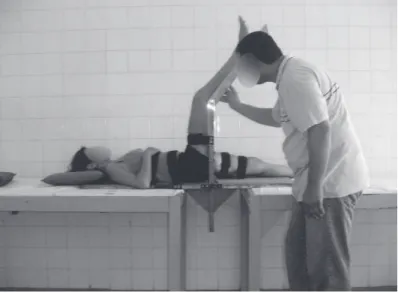
The participant was on prone position and had her left thigh sta-bilized by the researcher with the aid of a towel (figure 3). The
therapist passively flexed the participant’s right hip up to her pain threshold, position in which discomfort in the hamstrings was re-ported. At the researcher command, the volunteer was asked to perform maximal strength for leg extension, contracting the hip extensors for five seconds and the contraction was resisted by the therapist. The five seconds contraction was used because accord-ing to previous research, the optimum duration of the isometric contraction in the PNF techniques is of three to six seconds(24).
After five seconds, the volunteer would relax the musculature and immediately after had the hip passively flexed, with knee extend-ed, until discomfort was reported again. The limb was kept in this position for 30 seconds, time based on Bandy et al.(19) who
con-cluded that keeping the passive stretching for 30 seconds is more effective than 15 seconds, besides being as effective as keeping it for 60 seconds. The volunteers were instructed to totally relax the leg during the stretching, not offering any voluntary resistance. Such maneuver was repeated the number of times corresponding to the group to which the participant belonged, keeping an interval of 30 seconds in between them.
Statistical analysis
Descriptive statistics was used to analyze the following data: age; weight; height; body mass index; total flexibility gain; imme-diate gain and daily gain. One-way ANOVA variance analysis was also used in order to test the homogeneity of the initial angle mea-surements (pre-test) and age; weight; height and body mass index characteristics.
The post-test measurements were analyzed with one way ANO-VA variance analysis followed by the Tukey post-hoc test.
Finally, each experimental group was submitted to a one-way ANOVA variance analysis in order to verify in which session signif-icant gain of KAE occurred concerning the pre-test measurement. The control group was not included in this specific analysis since it did not have daily data. In all tests the adopted significance level was of p < 0.05. The SPSS program for Windows 12.0 was used for the data analysis.
RESULTS
The descriptive analysis of the groups indicated homogeneity (p > 0.05) concerning age; weight; height and body mass index (table 1). The four groups were submitted to one-way ANOVA variance analysis which did not show difference concerning the initial KAE
mean (F(3.32) = 0.4; p = 0.687); that is, the groups equally be-haved concerning the pre-test measurement.
After 10 stretching sessions with PNF, the one-way ANOVA vari-ance analysis showed statistically significant increase of the KAE variable in all stretching with PNF groups (p < 0.05); however, there was no variation between the pre and post-test measurements of the control group.
After having confirmed that the groups had different post-test measurements (F(3.32) = 13.4; p = 0.000), a post hoc Tukey anal-ysis revealed that the statistically significant difference was only among the experimental groups (groups 1A, 3A and 6A) and the control group (group 0A) (p = 0.000). The stretching with PNF groups were not different (p > 0.05) from each other. In other words, after 10 sessions, the flexibility gain was equal among the experimental groups, regardless the number of series variable (table 2).
Figure 2 – The subject was attached to the measurement instrument and performed maximal active extension of the knee in order to measure the flexibility of the hamstrings. The researcher verified the corresponding an-gle in the goniometer.
Figure 3 – Positioning for the performance of the stretching maneuver with PNF
TABLE 1
Characteristics concerning age; weight; height and body mass index (BMI)
Groups N Age (years) Weight (kg) Height (m) BMI
0A 9 23.11 (SD = 1.54) 57.22 (SD = 12.36) 1.63 (SD = 0.07) 21.35 (SD = 1.54) 1A 9 21.89 (SD = 1.45) 54.44 (SD = 03.61) 1.65 (SD = 0.04) 20.04 (SD = 1.45) 3A 9 20.11 (SD = 1.36) 54.11 (SD = 02.71) 1.62 (SD = 0.06) 20.62 (SD = 1.36) 6A 9 21.89 (SD = 2.26) 57.89 (SD = 10.47) 1.65 (SD = 0.07) 21.06 (SD = 2.26)
SD = Standard Deviation; The data were collected prior to the stretching protocol.
TABLE 2
Mean (standard deviation) of the initial and final measurements as well as the total gain after the 10 stretching sessions
Groups 0A 1A 3A 6A
Initial 149.4° (6.1°) 151.4° (3.5°)* 144.7° (9.3°)** 148.9° (9.6°)**
Final 150.9° (5.1°) 163.7° (5.8°)* 160.9° (8.6°)** 165.8° (3.1°)**
Gain 001.5° (1.1o) 012.3° (4.8o)* 016.2° (4.4o)** 016.9° (9.2o)** Significant difference concerning the initial measurement (*p < 0.01; **p < 0.00).
Concerning the immediate effect of stretching with PNF, that is, the difference between the pre and post-stretching measurements of the same session, group 1A increased an average of 4.6 de-grees between the beginning and the end of the session; group 3A increased 5.8 degrees, while group 6A immediately increased an average of 4.5 degrees.
previous session, characterizing thus, a loss in the immediate gain. However, such loss was not complete, being of 82% for group 1A; 77% for group 3A and 71.2% for group 6A. Thus, due to the re-maining percentage, the pre-stretching measurement discreetly increased (p > 0.05) at each day of intervention. Therefore, such continuous increase of MAB implied in a total gain higher at each stretching session until it became significant.
It was confirmed through a one-way ANOVA variance analysis in which session this accumulated gain became statistically signifi-cant concerning the initial measurement of the first day. Each group was individually evaluated comparing the pre-test KAE with the value found in each day of the stretching protocol. It was then observed that the 3A (F(1.8) = 8.1; p = 0.011) and 6A (F = (1.8) = 6.9; p = 0.018) groups reached a significant increase of the MAB on the fifth day, that is, after four stretching sessions; while group 1A increased only on the eighth day (F(1.8) = 6.1; p = 0.025); that is, after the seventh session (table 3).
only reached such difference on the eighth day (table 3). Such find-ing leads us to believe that in the middle run, the frequency of three repetitions with PNF would be more appropriate in order to promote a faster gain of flexibility in relation to the frequency of a stretching with PNF, without difference in this gain velocity when this frequency is increased to six repetitions with PNF. Once in sports rehabilitation the recovery time is a key factor, further stud-ies are needed for the determination of stretching with PNF pa-rameters which improve the MAB gain.
The groups which presented significant increase of flexibility first were the ones which had a higher daily gain, suggesting hence, that the optimum velocity for flexibility gain may be related with the decrease of the immediate loss effect, once it affects the daily gain. The loss of the immediate effect was confirmed in other stud-ies in the shoulder musculature(25) and hamstrings(26). The results
of the present study partly corroborate the findings by Spernoga et al.(26), who observed that the immediate gain of the hamstrings
stretching only remains for six minutes, when it is not considered significant any longer. In order to explain the loss of the immediate effect, it is known that besides the elastic effect of the muscular viscoelaticity(27), the relaxing after the stretching maneuver
stimu-lates the effects of the muscular thixotrophy which act in the tis-sue shortening. Tixotrophy is the property of a tistis-sue to become more liquid after movement and return to stiffness, gel state with relaxation(28-29). Muscular tixotrophy is the result of an increase in
the number of steady ligations between the actin and myosin when the muscle is relaxing. Therefore, the muscle stiffness increases. However, the results of the present study show that, even with a considerable loss of the immediate effect, 24 hours after stretch-ing there is still gain in breadth, hence, at each day, a residual breadth gain is incorporated. Thus, even with a significant loss of the stretch-ing immediate effect, the MAB increases every day of the proto-col. Therefore, although a single day is not necessary for the breadth gain, the sum of the residual gain made that after four sessions, groups 3A and 6A present significant gain of KAE and group 1A only after seven sessions.
Since the difference in the stretching sessions was constant -24 hours – this study does not answer whether the time between sessions influences in the immediate effect loss. Future studies should be conducted with the purpose to better understand the immediate effect loss after the application of stretching protocols. The understanding of this knowledge gap may help in the more suitable prescription of the optimum time of interval between stretching sessions with PNF.
The conclusions of this research are limited to stretching proce-dures which use PNF and the frequency of series mentioned in the study, namely, one, three and six stretching series. Future re-search may analyze whether a larger number of series may posi-tively influence the flexibility gain.
It was also confirmed that a percentage of the immediate effect is kept 24 hours post stretching with PNF; however, the curve of flexibility decrease was not analyzed, neither immediately after stretching nor after the 10 sessions protocol. Willy et al.(30) show
that there is a considerable loss of the gained MAB after an inter-ruption of four weeks, after a flexibility training of six weeks. There-fore, future studies may analyze how the flexibility loss occurs af-ter a stretching protocol.
These findings apply to hamstrings stretching, since due to par-ticularities of each muscle, the response to stretching may differ. Factors as the predominance of muscular fiber type, fibers dispo-sition, tendon structure and muscular function may influence in a different reaction of the musculotendinous unit for stretching.
Moreover, this study’s sample was relatively young, mean age 21.7 years, and presented a small standard deviation. The conclu-sions of this study should only be applied to groups of similar ages; besides that, future research is needed for subjects of other age group, particularly older individuals.
TABLE 3
Mean (standard deviation) of the KAE in each stretching session
Groups 0A 1A 3A 6A
01st session 149.4 (6.1) 151.4 (3.5) 144.7 (9.3) 148.9 (9.6)
02nd session 152.8 (5.5) 149.2 (8.9) 152.6 (8.6)
03rd session 153.8 (6.4) 150.4 (9.1) 155.4 (4.6)
04th session 154.9 (6.2) 150.8 (9.9) 156.4 (5.0)
05th session 157.9 (6.0) 152.2 (11.2)* 158.0 (3.7)*
06th session 157.3 (5.0) 153.4 (10.3)* 159.1 (1.9)*
07th session 158.0 (4.9) 155.6 (9.9)** 160.2 (2.4)**
08th session 159.2 (5.6)* 156.8 (9.4)** 161.6 (1.8)**
09th session 159.7 (6.5)* 158.1 (10.6)** 160.7 (3.1)** 10th session 150.9 (5.1) 163.7 (5.8)* 160.9 (8.6)** 165.8 (3.1)**
Significant difference concerning the first session measurement (*p < 0.05; **p < 0.01).
DISCUSSION
Some studies have been conducted with the aim to find the ideal frequency of stretching exercises(18-19). Nonetheless, none of
them have related frequency and stretching techniques which in-volve active muscular inhibition.
Bandy et al.(19) found results similar to the ones in the present
study, since they did not find significant difference when the fre-quency was increased from one to three repetitions per day using passive stretching. Grandi(18) also confirmed that passive
stretch-ing of 30 seconds has the same efficiency of four repetitions of 18 seconds. The results of the present study reveal that as expected, there was significant increase in flexibility of the hamstrings in all stretching with PNF groups after ten sessions, while the control group did not obtain flexibility increase. Groups 3A (16.2o) and 6A
(16.9o) presented a similar increase of flexibility. However, group
1A (12.3o) had a late gain relatively lower than the groups of three
to six repetitions with PNF. Under a clinical viewpoint, one may verify an advantage of approximately 38% of the group of three repetitions (3A) in relation to the one of one stretching with PNF (1A), being such data extremely important in protocols of two weeks of duration. Nevertheless, this difference among groups was not observed in the groups of three (3A) and six repetitions (6A). How-ever, statistically speaking, there was not significant difference when the late effect among the three experimental groups was compared. Probably, one (1) inhibition of the neurotendinous or-gan by active isometric contraction of five seconds is sufficient to acquire the expected muscular relaxing in a stretching session in the hamstring muscles. Three or six inhibitions associated with static stretching do not seem to be necessary in order to gain flex-ibility.
CONCLUSION
Therefore, it is concluded that stretching maneuvers with Prop-rioceptive Neuromuscular Facilitation are effective for the flexibili-ty increase of the hamstring muscles, regardless the frequency used (one; three or six maneuvers).
The late effect is the same concerning the MAB gain when one, three or six stretching maneuvers with PNF are used for a protocol with two weeks of duration.
Finally, the frequency of three maneuvers obtained a higher im-mediate effect when compared with the frequencies of one and six maneuvers, being also confirmed that three and six stretching maneuvers with PNF reach a significant gain of flexibility faster than a protocol of one stretching maneuver with PNF.
All the authors declared there is not any potential conflict of inter-ests regarding this article.
REFERENCES
1. Gajdosik RL. Passive extensibility of skeletal muscle: review of the literature with clinical implications. Clin Biomech. 2000;16:87-101.
2. Lieber RL. Skeletal muscle and function. Baltimore: Williams & Wilkins, 1992. 3. Harrelson GL, Leaver-Dunn D. Amplitude de movimento e flexibilidade. In:
An-drews JR, Harrelson GL, Wilk KE, editores. Reabilitação física das lesões des-portivas. Rio de Janeiro: Guanabara Koogan, 2000;106-27.
4. Best TM, McElhaney J, Garrett Jr WE, Myers BS. Characterization of the pas-sive responses of live skeletal muscle using the quasi-linear theory of viscoelas-ticity. J Biomech. 1994;27(4):413-9.
5. Taylor DC, Dalton Jr JD, Seaber AV, Garret Jr WE. Viscoelastic properties of muscle-tendon units: the biomechanical effects of stretching. Am J Sports Med. 1990;18(3):300-9.
6. Garrett WE Jr, Teitz CC, Miniaci A, Lee MH, Mann RA. Tendon problems in athletic individuals. Instr Course Lect. 1997;46:569-82.
7. Magnussom SP, Aagard P, Simonsen E, Bojsen-Müller F. A biomechanical evalu-ation of cyclic and static stretch in human skeletal muscle. Int J Sports Med. 1998;19:310-6.
8. Halbertsma JP, Mulder I, Goeken LN. Repeated passive stretching: acute effect on the passive muscle moment and extensibility of short hamstrings. Arch Phys Med Rehabil. 1999;80(4):407-14.
9. Halbertsma JP, Göeken LN. Stretching exercises: effect on passive extensibility and stiffness in short hamstrings of healthy subjects. Arch Phys Med Rehabil. 1994;75:976-81.
10. Sady SP, Wortman M, Blanke D. Flexibility training: ballistic, static or propriocep-tive neuromuscular facilitation? Arch Phys Med Rehabil. 1982;63:261-3. 11. Etnyre BR, Abraham LD. Gains in range of ankle dorsiflexion using three popular
stretching techniques. Am J Phys Med. 1986;65:189-96.
12. Davis DS, Ashby PE, McCale KL, McQuain JA, Wine JM. The effectiveness of 3 stretching techniques on hamstring flexibility using consistent stretching pa-rameters. J Strength Cond Res. 2005;19(1):27-32.
13. Funk DC, Swank AM, Mikla BM, Fagan TA, Farr BK. Impact of prior exercise on hamstring flexibility: a comparison of proprioceptive neuromuscular facilitation and static stretching. J Strength Cond Res. 2003;17(3):489-92.
14. Burke DG, Culligan LE. The theorical basis of proprioceptive neuromuscular fa-cilitation. J Strength Cond Res. 2000;14:496-500.
15. Etnyre BR, Lee EJ. Chronic and acute flexibility of men and women using three different stretching techniques. Res Quart Exerc Sport. 1988;59:222-8. 16. Brasileiro JS, Queiroz LL, Faria A, Parizotto NA. Influence of the cooling and the
heating in the stretching of the hamstring muscles. XIV International WCPT Con-gress. Barcelona (Spain), 7-12 June, 2003.
17. Starring DT, Gossman MR, Nicholson Jr GG, Lemons J. Comparison of cyclic and sustained passive stretching using a mechanical device to increase resting length of hamstring muscles. Phys Ther. 1988;68(3):314-20.
18. Grandi L. Comparação de duas doses ideais de alongamento. Acta Fis. 1998; 5(3):154-8.
19. Bandy WD, Irion JM, Briggler M. The effect of time and frequency of static stretching on flexibility of the hamstring muscles. Phys Ther. 1997;77:1090-6. 20. Medeiros CAS, Calazans MVF, Rocha VM. Avaliação da flexibilidade passiva da
articulação do ombro em diferentes fases do ciclo menstrual de jovens universi-tárias. Monografia (Graduação) – Curso de Fisioterapia, Universidade Federal do Rio Grande do Norte, Natal, 2004.
21. Chaves CPG, Simão R, Araújo CGS. Ausência de variação da flexibilidade du-rante o ciclo menstrual em universitárias. Rev Bras Med Esporte. 2002;8(6):212-18.
22. Gajdosik RL, Rieck MA, Sullivan DK, Wightman SE. Comparison of four clinical tests for assessing hamstring muscle length. J Orthop Sports Phys Ther. 1993; 18(5):614-8.
23. Souza TO, Medeiros CAS, Gama ZAS, Dantas AVR, Augusto DD, Sales ATN. Análise da correlação entre dois instrumentos de medição da extensão do joe-lho. In: Reunião Anual da SBPC, 56., 2004, Cuiabá. Anais eletrônicos. São Paulo: SBPC/UFMT, 2005. Disponível em: <http://www.sbpcnet.org.br/Anais/56ra>. Acesso em: 29 abr. 2005.
24. Cornelius WL, Rauschuber MR. The relationship between isometric contraction durations and improvement in acute hip joint flexibility. J Appl Sport Sci Res. 1987;1:39-41.
25. Viveiros L, Polito MD, Simão R, Farinatti, P. Respostas agudas imediatas e tar-dias da flexibilidade na extensão do ombro em relação ao número de séries e duração do alongamento. Rev Bras Med Esporte. 2004;10(6):459-63. 26. Spernoga SG, Uhl TL, Arnold BL, Gansneder BM. Duration of maintained
ham-string flexibility after a one-time, modified hold-relax stretching protocol. J Athl Train. 2001;36(1):44-8.
27. De Deyne PG. Application of passive stretch and its implications for muscle fibers. Phys Ther. 2001;81:819-27.
28. Walsh EG. Postural thixotropy: a significant factor in the stiffness of paralysed limbs? Paraplegia. 1992;30:113-5.
29. Lakie M, Robson LG. Thixotropic changes in human muscle stiffness and the effects of fatigue. Q J Exp Physiol. 1988;73(4):487-500.