DYNAMICS OF PHYSICAL AND FUNCTIONAL STATUS OF STUDENTS IN THE EXPERIMENT ON APPROVALS PERSONALITY ORIENTED PHYSICAL EDUCATION
Belykh S.I.
Donetsk National University
Annotation. The results of the testing of personality-oriented physical education. In the experiment involved 640 students. Found that the greatest increase in indicators of physical fitness in young men in the experimental group revealed a flexibility test (6.67%) and flexion extension Hand-ups (5.75.) The girls showed improvement in the flexibility test (7.09%) flexion and extension of hand-ups (6.14%). Clarified the nature and content of the personal-oriented physical education, especially its use in physical education students. Pedagogical conditions of effective application of personal-oriented physical education students in self-movement towards a healthy lifestyle. The data on the importance of physical culture for the prevention of self destructive behavior (drug addiction, alcoholism, smoking). Keywords: experiment, personal, physical education, functional, student.
Introduction1
Theoretical and methodic-practical parts of academic program of HEE discipline “Physical education”, which shall facilitate origination and improvement of students’ physical culture activity, are the most difficult for realization in educational process [3, 9]. That is why in the process of pedagogical experiment it was important to receive absent at present time confident scientific data about how personality-oriented physical education reflects in indicators of students’ physical condition and functional state in order to determine the ways of improvement of educational process on “Physical education”.
The work has been fulfilled as per plan of scientific & research works of Donetsk national university. Purpose, tasls of the work, material and methods
The purpose of the research is to theoretically ground and experimentally test effectiveness of pedagogic
conditions of application of students’ personality-oriented physical education.
The object of the research: integral process of physical education of Donetsk national university’s (DonNU) students, considering results of their medical examination.
The subject of the research: the process and results of application of personality-oriented physical education of 1st-2nd year students by means of creation of external and internal pedagogic conditions.
The hypothesis of the research was based on assumption that all pedagogical conditions of students’ personality-oriented physical education’s application for formation of healthy life style would be effective under following conditions:
- student’s personality, his independent activity, intellectual and health related actions are a center of educational system that would permit for pedagogic collective to organize the process of self-progressing in improvement of own health;
- pedagogical conditions of students’ personality-oriented physical education are conceptually grounded and classified that will permit for instructor to consciously create them, for them to ensure application of students’ personality-oriented physical education in their self-progressing in healthy life style;
- for creation of required conditions in educational process pedagogical tools are used in educational process, which are determined by peculiarities of self-progressing in healthy life-style process, that will facilitate active involvement of students in different kinds of activity, stimulating their demand in such self-progressing;
- application of already developed by us diagnostic system, which will ensure obtaining of objective data about effectiveness of created conditions, leading to improvement of different indicators of students' health.
The methods and organization of the research
We used approved at DonNU tests for evaluation of students’ physical condition and functional level. In pedagogical experiment, devoted to studying of physical condition, 640 students of Donetsk national university took part (in total: two control groups and two experimental groups of boys and girls of 1st and 2nd years of study, 160
persons in each group).
Basing on our understanding of the problem, the set purpose and hypothesis of the research, we formulated the following tasks of the research.
1. Specifying of sense and content or personality-oriented physical education, especially its application in physical education of university’s students.
2. Determination of pedagogic conditions of effective application of students’ personality-oriented physical education for their self-progressing in healthy life-style..
3. Experimental testing of effectiveness of developed pedagogical conditions of students’ personality-oriented physical education’s application in their self-progressing in healthy life style (HLS).
When organizing the research we based on the fact that in the basis of students’ personality-oriented physical culture there are indicators of their physical condition and functional state, level of somatic health’s potential, attitude to
© Belykh S.I., 2013
values of physical culture, level of mastering of system of theoretical and methodic-practical knowledge, skills and abilities. With it, formation of HEE students’ physical culture is the most effective on the base of qualitative improvement of educational process on discipline “Physical education” and complex using of all modern pedagogic technologies’ arsenal.
With organization of researches, oriented on evaluation of level of students’ physical culture’s formation and searching of ways for increasing of educational; process’s effectiveness we considered to be important to analyze the following:
1) indicators, determining students’ physical culture level;
2) indicators, characterizing peculiarities of educational process’s on formation of students’ physical culture organization;
3) possible changes in organization of educational process in non-professional physical culture education by means of new pedagogic technologies' introduction.
Results of the research
In context of the research personality-oriented approach was regarded as condition of harmonious development of student’s personality, corresponding to individual features and abilities, which shift him to position of active subject of physical culture activity. As a result student acquires abilities to reconstruct it. For example, if necessary, activity can be rather recreational or health-building; owing to it content of physical culture activity can be adjusted to certain period of human life.
Pedagogic conditions of realization of personality-oriented approach were: shifting of student from position of physical education’s object into position of self-organized and self-controlled subject; ensuring of subject-subjective interaction of participants of educational process; active mastering of physical culture’s value potential; creation of atmosphere of success in achieved results of activity not only in the course of academic classes but in other forms of physical culture activity; creation of personality-developing situations by instructors in the course of interactive training.
The created and used pedagogic conditions of personality-oriented approach’s realization and evaluation of physical condition’s indicators of experimental (160 boys and 160 girls) and control (the same quantity of boys and girls) groups at the beginning of experiment (September 2012) determined specificities of physical education’s construction in experimental group.
They were the following:
- application of already described technologies of non-professional physical culture education;
- stage-by-stage (from level of initial physical culture knowledge to level of advanced knowledge) formation of students personalities’ physical culture;
- application of level differentiation (selective, basing on subjective appraisal of physical culture and sport department’s instructor and elective, which is based on personal student’s choice of the level of theoretical and methodic physical culture content’s mastering).
Saturation with theoretical and methodic content of general character, stipulated by academic program on “Physical education”, was provided by personality-significant material at the account of its including in lectures and talks, business (situational and role) games and trainings, built on interactive basis.
Technological provision of stage-by-stage formation of personality development’s components in the field of physical culture implied:
- at diagnostic-orientating stage (September 2012) – evaluation of physical condition and level of physical culture knowledge of experimental and control groups’ students;
- at program-targeted stage (October 2012) – development by students personality-significant targets in mastering of physical culture, including of new and improvement of already used HLS elements for transition to higher level of personality’s physical culture;
- in the first part of operational-active stage (November 2012) – actualization of physical culture and health values, formation of personality-significant motive of the formed physical culture activity;
- in the second part of operational-active stage ( December 2012- April 2013) – organization of co-activity of all elements of built at DonNU system of personality oriented physical culture education for facilitating students’ achievement of personality-significant aims in mastering of physical culture;
- at evaluating-correction stage (May 2013) – we appraised results, achieved by students of experimental and control groups, corrected further activity of DonNU structural departments, which took part in improvement of created personality-oriented system of physical education.
As main scientific principles, revealing the sense of changes in student’s personality in the process of realization of conception and personality oriented program of physical education, we used the following thesis and starting points.
The process of personality’s formation and its future life are closely connected with construction and change of won image “I am healthy”, which, as starting point, take central place in human development and self-determination.
though internal conditions”. S.L. Rubinstein regards “internal conditions” not only as mechanical projection of objective reality but also as factors, which are capable to influence on external conditions and to actively change them.
At the same time it is impossible to imagine development and formation of mature “Self” conception without activity in society, without strive for success, opening of personality’s potential. Active subject’s attitude to own life and activity, in oue opinion, should be understood not only as subject’s active exploration of external space and forms of activity but also as modeling of own psycho-physical development, formation of world-vision, own opinion. Just in the process of understanding, development of inner potential person obtains ability to make own choice, to form attitude to one or another event of his life, to built model of his future existence. “Subject” is not only found and developed in his actions and acts of creative activity, he is created in them and determined” [7, pg.153,10].
From position of action’s approach, adequately functioning personality is a successful and well adapted personality. “Personality’s realization – I.G. Schedrin notes, - happens in the process of formation of his adapting activity, with harmonious interaction between ideals and values of group and values of personality” 8, pg.66 .
Basing on the presented psychological-pedagogical ideas, we followed the following organizational-methodic requirements in the course of stage-by stage formation of personality's physical culture components:
- teaching of informational-cognitive component stipulated application of pedagogic methods and techniques, which would facilitate more complete understanding and mastering of “Physical education” in the part of independent health related physical culture trainings and improvement of HLS elements;
- formation and development of value-motivational component of personality’s physical culture envisaged overcoming of negative settings (self-distrust as a successfully acting subject of physical culture activity, disbelief in possibility to actually improve own psycho-physical state and so on);
- formation of reflexive component was combined with development of demand in cognition, self-appraisal of own health related actions and their results, i.e. with adequate self self-appraisal. With it, usage and specifying of student’s purpose in mastering of physical culture achievements and their implementation for increasing of own psycho-physical potential, were assumed as compulsory condition;
- formation of subject-result component was based on formation of ability for organization of independent physical culture activity, including its planning and self-control over own health.
Thus, evaluation of students’ physical culture formation level was carried out both by traditional indicators of students’ physical conditions, dynamics of their health level and by analyzing of students’ attitude to physical culture values, by peculiarities of motivation and level of knowledge in the field of physical culture.
We share opinion of author [1] that readiness to physical culture activity is an integral, organized in system and personality-conditioned characteristics of personality as a subject of activity, which is adequate to its content and targets and which ensures practical achievement of desired results. Exactly such readiness shall be ensured by realization of Concept and programs of introduction of students’ personality-oriented physical education.
As a result, generalized aim is fulfillment of physical culture activity on personality-optimal and socially-acceptable levels. As per methodology of systemic approach readiness to such kind of activity is determined by targeted orientation of pedagogical innovations, by content, mechanism of origination and development.
Concerning content of the achieved readiness, it is determined as follows:
- personal, demand-originating attitude to given kind of activity (i,e, physical culture activity), which is concretized into conscious motivation of trainings (motivational component);
- developed, mobilized self-consciousness, which conditions reflexive attitude to own physical culture activity (reflexive component);
- available desirably sufficient level of physical abilities (physical component);
- knowledge of theoretical and methodic principles of physical culture activity (informational component); - mastering of means of physical culture activity (operational component).
It is evident that for achievement of readiness to physical culture activity it is necessary to ensure sufficient level of all mentioned components. And on the contrary, zero or low level of their development result s in disbalance, beaching or, even, stoppage of physical culture activity’s process.
In pedagogic experiment on studying of physical condition 640 students of Donetsk national university took part (in total: two control groups and two experimental groups of boys and girls of 1st and 2nd years of study, 160
persons in each group).
Evaluation of physical conditions of experimental and control groups’ students was carried out by results of tests, which were approved by physical education and sports department of DonNU, because as on the beginning of the experiments there were no single for all Ukrainian HEEs normative requirements on discipline “Physical education” [On organization of trainings in discipline “Physical education” at HEEs of Ukraine – Letter of Ministry of education and science of Ukraine No. 1/9-582, dt. 31.08.2009]. With it we considered that tests, results of which depend on two or more factors’ combination, factors which were difficult to be evaluated objectively, interpreting the obtained results, relate to group of heterogeneous ones. There is much greater quantity of such tests, in contrast to homogeneous ones, results of which, mainly, depend on one factor [2, pg.19].
Mean arithmetic value (Х) – determines the center of empiric distribution of the studied value. Mean square deviation (S) – is the main measure of statistic measurement of property’s variability of population’s members. Deviation of mean value (error of representativeness) (m) – is characterized between mean values of selective and general population, conditioned by the fact that selective population represents general population insufficiently accurately.
Thus, in the course of study of indicators of Don NU students’ physical condition and functional state we calculated the following indicators: mean arithmetic value ( ), mean square deviation (S), deviation of mean value (error of representativeness) (m).
We used set of 8 tests, in which student had to show maximally possible result in every test (except test of Ruffiet). All tests of the set were of heterogeneous type, because results depended on a number of different factors (level of tiredness, physical condition, motivation, testing procedure and etc.).
Testing results were evaluated in units of CI system and in conventional units. Timing was carried out with the help of electronic stop-watch (accuracy – 0.01 sec); results were rounded up to 0.1 sec.; long jump was measured with measuring tape with accuracy up to 0.01 m.
Accuracy of measurements was ensured by the instruments’ class of accuracy, standard character of tests and testing procedure.
Tests were carried out systematically; measurements were fulfilled by one and the same instructor at certain time as per one schema. Testing was conducted at physical education classes after preparatory part of the training.
For evaluation of strength pressing ups, raising and lowering of torso for 1 minute were used, for evaluation of quickness – 30 meters’ run and for evaluation of speed-power abilities – long jump from the spot and skipping over rope for 20 seconds were used.
In tests “long jump from the spot” and “30 meters’ run” student was given three attempts and the best result was entered in table. In other tests only one attempt was given.
For evaluation of general endurance we used tests “1000 meters’ run” and “3000 meters walking”; it was required to pass distance at most possible pace (only one attempt was given for running distance).
Flexibility was evaluated with the help of the following test: in sitting position, with legs stretched forward, it was necessary to bend forward maximally. Distance between heels was 20 cm. We measured distance between heels and point of fingers’ touching.
Ruffiet’s test was used for evaluation of organism’s physical workability. Only one attempt was given. Test was conducted at the beginning of training; the tested had several minutes’ rest before test.
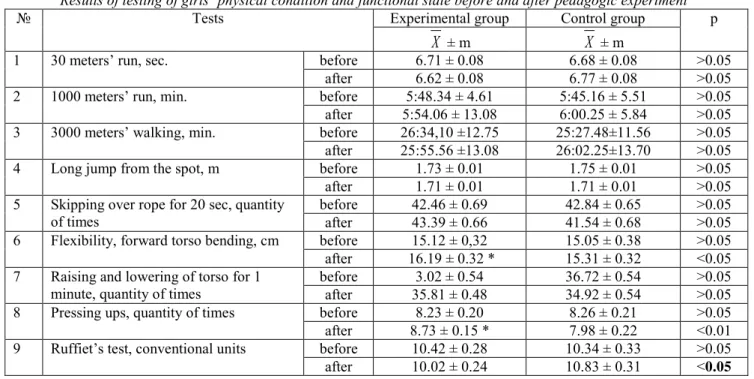
In table 1 there are presented results of testing of girls’ physical condition and workability before and after pedagogic experiment as well as errors of representativeness and confident statistic differences between obtained values.
Table 1 Results of testing of girls’ physical condition and functional state before and after pedagogic experiment
№ Tests Experimental group Control group р
Х
± mХ
± m1 30 meters’ run, sec. before 6.71 ± 0.08 6.68 ± 0.08 >0.05
after 6.62 ± 0.08 6.77 ± 0.08 >0.05
2 1000 meters’ run, min. before 5:48.34 ± 4.61 5:45.16 ± 5.51 >0.05
after 5:54.06 ± 13.08 6:00.25 ± 5.84 >0.05 3 3000 meters’ walking, min. before 26:34,10 ±12.75 25:27.48±11.56 >0.05 after 25:55.56 ±13.08 26:02.25±13.70 >0.05
4 Long jump from the spot, m before 1.73 ± 0.01 1.75 ± 0.01 >0.05
after 1.71 ± 0.01 1.71 ± 0.01 >0.05
5 Skipping over rope for 20 sec, quantity
of times before after 42.46 ± 0.69 43.39 ± 0.66 42.84 ± 0.65 41.54 ± 0.68 >0.05 >0.05 6 Flexibility, forward torso bending, cm before 15.12 ± 0,32 15.05 ± 0.38 >0.05 after 16.19 ± 0.32 * 15.31 ± 0.32 <0.05 7 Raising and lowering of torso for 1
minute, quantity of times before after 35.81 ± 0.48 3.02 ± 0.54 36.72 ± 0.54 34.92 ± 0.54 >0.05 >0.05 8 Pressing ups, quantity of times before 8.23 ± 0.20 8.26 ± 0.21 >0.05
after 8.73 ± 0.15 * 7.98 ± 0.22 <0.01
9 Ruffiet’s test, conventional units before 10.42 ± 0.28 10.34 ± 0.33 >0.05 after 10.02 ± 0.24 10.83 ± 0.31 <0.05 Notes: * - confident differences between values before and after certain group
From table 1 it is seen that during experiment in control group there were no confident changes of physical condition pressing ups in lying position’s indicators, but in experimental group indicators of flexibility, pressing ups
confidently increased. After experiment confident differences between experimental and control groups were found in tests No/No 6,8 and 9 (flexibility, pressing ups and Ruffiet’s test). (see fig.1).
Tests
Fig.1. Increment of indicators of girls’ physical condition during experiment:
EG – , CG – , 1 – 30 meters run; 2 –1000 meters’ run, 3 –3000 meters’ walking, 4 – long jump from the spot, 5 – skipping over rope for 20 sec, 6 – flexibility, forward torso bending, 7 – raising and lowering of torso for 1 minute., 8 – pressing ups, 9 – Ruffiet’s test.
In table 2 there are presented results of testing of boys’ physical condition and workability before and after pedagogic experiment as well as errors of representativeness and confident statistic differences between obtained values.
In table 1 there are presented results of testing of girls’ physical condition and workability before and after pedagogic experiment as well as errors of representativeness and confident statistic differences between obtained values.
Thus, (see fig.2) analysis of the obtained results permits to reveal confident differences between indicators before and after experiment in tests for flexibility, pressing ups in lying position in experiment6al group; in control group there were found no such confident differences.
Table 2 Results of testing of boys’ physical condition and functional state before and after pedagogic experiment
№ Tests Experimental group Control group р
Х
± mХ
± m1 30 meters’ run, sec. before 5.48 ± 0.06 5.47 ± 0.05 >0.05
after 5.42 ± 0.06 5.53 ± 0.05 >0.05
2 1000 meters’ run, min. before 4:18.26 ± 2.22 4:17.27 ± 2.45 >0.05
after 4:20.53 ± 1.95 4:24.11 ± 2.47 >0.05 3 3000 meters’ walking, min. before 19:34.29 ±18.64 19:37.34±18.55 >0.05 after 19:25.14 ±18.62 20:12.28±19.11 >0.05
4 Long jump from the spot, m before 2.15 ± 0,02 2.16 ± 0.02 >0.05
after 2.12 ± 0.01 2.08 ± 0.02 >0.05
5 Skipping over rope for 20 sec, quantity
of times before after 38.83 ± 0.55 39.31 ± 0.54 38.56 ± 0.54 37.85 ± 0.53 >0.05 >0.05 6 Flexibility, forward torso bending, cm before 10.43 ± 0.24 10.38 ± 0.33 >0.05 after 11.12 ± 0.25 * 10.12 ± 0.34 <0.05 7 Raising and lowering of torso for 1
minute, quantity of times before after 41.54 ± 0.58 42.47 ± 0.54 41.59 ± 0.64 40.93 ± 0.64 >0.05 >0.05 8 Pressing ups, quantity of times before 33.59 ± 0.62 33.67 ± 0.57 >0.05 after 35.52 ± 0.60 * 33.79 ± 0,53 <0.05 9 Ruffiet’s test, conventional units before 9.34 ± 0.36 9.30 ± 0.39 >0.05
after 8.94 ± 0.34 9.91 ± 0.36 <0.05
Notes: * - confident differences between values before and after certain group
After experiment confident differences between experimental and control groups were found in tests No/No 6,8 and 9 (flexibility, pressing ups and Ruffiet’s test).
In
cr
em
en
t of
in
dicato
rs
The highest increment of physical condition indicators of experimental group boys was found in tests for flexibility (6.67 %) pressing ups in lying position (5.75 %); in control group only one indicator increased - pressing ups in lying position (0.36 %). In girls’ group improvement of indicators was registered in tests for flexibility (7.09%) and pressing ups in lying position (6.14 %), while in control group – only in test for flexibility (1.73 %).
Tests
Fig.2. Increment of indicators of boys’ physical condition during experiment:
EG – , CG – , 1 – 30 meters run; 2 –1000 meters’ run, 3 –3000 meters’ walking, 4 – long jump from the spot, 5 – skipping over rope for 20 sec, 6 – flexibility, forward torso bending, 7 – raising and lowering of torso for 1 minute., 8 – pressing ups, 9 – Ruffiet’s test.
At the same time, indicators of experimental group’s boys in test “long jump from the spot” reduced by 1.62% and in test “1000 meters’ run”– by 0.95%, while in control group the highest reduction was registered in test “long jum from the spo” – by 3.57% and in Ruffiet’s test – by 6.61%. Experimental group’s girls showed the highest reduction in test “long jump from the spot” (1.25%) and in “1000 meters’ run”– (1.59%), while in control group the highest reduction was found in test “1000 meters’ run”– (4.39%), raising and lowering of torso for 1 minute – (4.90%) and Ruffiet’s test – (4.73%).
Comarative indicators of dynamics of changes during execution of tests by experimental and control groups (boys and girls) are given in table 3.
Table 3 Increment of indicators during pedagogic experiment in control and experimental groups
№ Tests Girls Boys
EG CG EG CG
1 30 meters’ run, sec. 1.35 % -1.40 % 1.08 % -1.05 %
2 1000 meters’ run, min. -1.59 % -4.39 % - 0.95 % -2.62 %
3 3000 meters’ walking, min. - 1.82 % - 2.27 % 0.79 % -2.96 %
4 Long jump from the spot, m - 1.25 % - 2.11 % -1.62 % -3.57 %
5 Skipping over rope for 20 sec, quantity of
times 2.21 % - 3.04 % 1.23 % -1.83 %
6 Flexibility, forward torso bending, cm 7.09 % 1.73 % 6.67 % -2.46 %
7 Raising and lowering of torso for 1 minute,
quantity of times - 0.58 % - 4.90 % 2.23 % -1.60 %
8 Pressing ups, quantity of times 6.14 % -3.35 % 5.75 % 0.36 %
9 Ruffiet’s test, conventional units 3.86 % -4.73 % 4.26 % -6.61 %
Notes: data in % show achieved increment of indicators, “minus” means their reduction Conclusions:
1. By the results of experiment indicators of experimental group in tests for flexibility, pressing ups in lying position and Ruffiet’s test confidently differ from indicators of control group. The highest increment of experimental group boys’ physical condition was registered in tests for flexibility (6.67 %) and pressing ups in lying position (5.75 %); in control group only one indicator increased - pressing ups in lying position (0,36 %). In girls’ group improvement of indicators was registered in felxibility test (7.09%) and pressing ups in lying position (6.14 %), while in control group – only in flexibility test (1.73 %).
2. The carried out pedagogic experiment proved the following ways of DonNU students’ physical culture formation:
In
cr
em
en
t of
in
dicato
rs
- passing of full volume of theoretical and methodic-practical parts of program “Physical education, with usage of informational technologies, active methods of teaching and interaction with students (for theoretical section: lecture-visualization, lecture delivered in problem way, argued information and so on; for practical section: analysis of specific situations, game and competition methods, simulation, discussions and etc.);
- expanding of theoretical and control parts of program on topics of healthy life style principles as well as role of physical culture in health protection. Special attention shall be paid to significance of physical culture means for prevention from self destructing behavior (drugs-taking, alcoholism, smoking etc.);
- organization of independent, at extra-curriculum time, studying by students of theoretical part of program with the help of computer manual “Personality-oriented physical education of students” (Donetsk, 2013), which was created at department of physical education and sports of Donetsk national university.
- conducting of individual consultations on organization of own physical activity, on choosing of forms and intensity of trainings, on provisioning with required theoretical and methodic-practical materials; solution of cognitive tasks in collaboration with instructor.
3. Thus, the offered forms, means and methods, which were tested in the course of pedagogical experiment, fulfilled at department of physical education and sports of Don NU in natural conditions of educational process, proved their effectiveness in formation of physical culture of student’s personality.
The prospects of further researches imply more profound studying of physical and functional state of students. References:
1 Avksent'ev E.N. Formirovanie gotovnosti studentov pedagogicheskikh vuzov k fizkul'turno-sportivnoj deiatel'nosti [Formation of readiness of pedagogical universities students to sports activity], Cand. Diss., Cheboksari, 2004, 184 p.
2 Godik M.A. Sportivnaia metrologiia [Sports metrology], Moscow, Physical Culture and Sport, 1988, 192 p. 3 Davidenko D.N. Teoriia i praktika fizicheskoj kul'tury [Theory and practice of physical culture], 2006, vol. 2,
pp. 2-6.
4 Denisova L.V., Khmel'nickaia I.V., Kharchenko L.A. Izmereniia i metody matematicheskoj statistiki v
fizicheskoj kul'ture i sporte [Measurement and statistical methods in physical education and sport], Kiev,
Olympic Literature, 2008, 127 p.
5 Zaciorskij V.A. Sportivnaia metrologiia [Sports metrology], Moscow, Physical Culture and Sport, 1982, 256 p.
6 Kostiuk G.S. Izbrannye psikhologicheskie trudy [Selected psychological works], Moscow, Pedagogy, 1998, 304 p.
7 Rubinshtejn S.L., Abul'khanova-Slavskaia K.A. Osnovy obshchej psikhologii [Fundamentals of general psychology], Sankt Petersburg, Peter, 1998, 688 p.
8 Shchedrik I.G. Psikhologicheskie osobennosti samoopredeleniia na etape perekhoda ot detstva k vzroslosti [Psychological characteristics of self-determination in the transition from childhood to adulthood], Cand. Diss., Moscow, 1989, 127 p.
9 Ennis C.D. Physical Education Curriculum Priorities: Evidence for Education and Skillfulness. Quest, 2011, vol. 63(1), pp. 5–18.