Artificial urinary sphincter revision for urethral atrophy:
comparing single cuff downsizing and tandem cuff
placement
_______________________________________________
Brian J. Linder
1, Boyd R. Viers
1, Matthew J. Ziegelmann
1, Marcelino E. Rivera
1, Daniel S. Elliott
11 Department of Urology, Mayo Clinic, Rochester, MN, USA
ABSTRACT
ARTICLE
INFO
______________________________________________________________ ______________________
Objective: To compare outcomes for single urethral cuff downsizing versus tandem cuff placement during artificial urinary sphincter (AUS) revision for urethral atrophy. Materials and Methods: We identified 1778 AUS surgeries performed at our institution from 1990-2014. Of these, 406 were first AUS revisions, including 69 revisions for ure-thral atrophy. Multiple clinical and surgical variables were evaluated for potential as-sociation with device outcomes following revision, including surgical revision strategy (downsizing a single urethral cuff versus placing tandem urethral cuffs).
Results: Of the 69 revision surgeries for urethral atrophy at our institution, 56 (82%) were tandem cuff placements, 12 (18%) were single cuff downsizings and one was relocation of a single cuff. When comparing tandem cuff placements and single cuff downsizings, the cohorts were similar with regard to age (p=0.98), body-mass index (p=0.95), prior pelvic radiation exposure (p=0.73) and length of follow-up (p=0.12). Notably, there was no difference in 3-year overall device survival compared between single cuff and tandem cuff revisions (60% versus 76%, p=0.94). Likewise, no signifi-cant difference was identified for tandem cuff placement (ref. single cuff) when evalu-ating the risk of any tertiary surgery (HR 0.95, 95% CI 0.32-4.12, p=0.94) or urethral erosion/device infection following revision (HR 0.79, 95% CI 0.20-5.22, p=0.77). Conclusions: There was no significant difference in overall device survival in patients undergoing single cuff downsizing or tandem cuff placement during AUS revision for urethral atrophy.
Keywords:
Urinary Sphincter, Artificial; Urinary Incontinence; Male
Int Braz J Urol. 2017; 43: 264-70
_____________________ Submitted for publication: April 28, 2016
_____________________ Accepted after revision: July 26, 2016
_____________________ Published as Ahead of Print: November 09, 2016
INTRODUCTION
While the use of an artificial urinary sphincter (AUS) in the management of severe male stress urinary incontinence has been asso-ciated with excellent long-term outcomes, many patients will experience recurrent incontinence (1-3). Notably, in several large series, urethral atro-phy has been reported as the most common cause for non-mechanical failure or device revision (4, 5). It has been hypothesized that in this setting
urethral atrophy occurs because the AUS achieves continence by applying constant circumferential compression of the corpus spongiosum, which over time leads to tissue atrophy (6).
Unfortunately, there is a paucity of data com-paring these management strategies, and tho-se currently available are not in the tho-setting of AUS revision for urethral atrophy (13). Given the lack of available data, the choice between these management options is based on the local tissue quality, location of the in-situ urethral cuff and surgeon preference.
Thus, we sought to compare outcomes for single urethral cuff downsizing versus tan-dem cuff placement during AUS revision for urethral atrophy.
MATERIALS AND METHODS
After obtaining Institutional Review Bo-ard approval, we identified 1778 AUS surgeries at our institution from June 1st 1990 to December 31st
2014. Of those patients, 406 were the initial AUS revisions (i.e. secondary surgery), including 69 for urethral atrophy. Patients were excluded from analysis if they underwent revision surgery at ano-ther institution, underwent primary AUS placement secondary to neurogenic bladder dysfunction, were less than 18 years old at the time of primary AUS placement, or declined research consent. Both the primary implantation and revision surgery were performed at our institution in all cases. All im-planted AUS devices were American Medical Sys-tems 800 (AMS 800; American Medical SysSys-tems, Inc., Minnetonka, Minnesota, USA). The revision surgeries were performed by three surgeons.
With regard to our approach to evaluation of recurrent stress urinary incontinence after AUS placement, we typically obtain a history and phy-sical, cystoscopy, and x-ray imaging (as contrast is instilled at the time of surgery in our primary placements). The diagnosis of urethral atrophy is confirmed during cystoscopy, when incomple-te urethral coaptation is visualized with device cycling (with adequate fluid in the system on ra-diographic imaging). Patients confirmed to have urethral atrophy are considered for surgical AUS revision depending on symptom severity, patient preferences and comorbidities.
The decision to proceed with single cuff downsizing versus tandem cuff placement was at the discretion of the treating surgeon. Our tandem
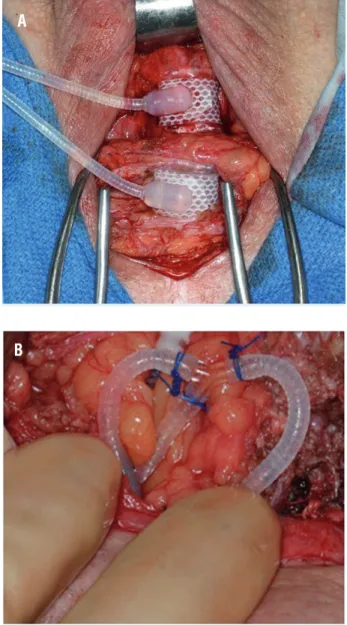
cuff placements are performed with the second cuff placed roughly 1-2cm distal to the primary cuff (Figure-1a). Additionally, we use a Y-shaped adapter, secured with free ties of non-absorbable suture to connect the pump tubing to both cuffs (Figure-1b). Furthermore, we add 1-3cc of fluid to the system to account for the additional volume se-questered in the cuff. In cases of severely atrophic urethral tissues (measurement <3.5cm), distal ure-thral tapering or difficult dissection planes (e.g. in some cases with prior pelvic radiation therapy or
Figure 1 - Tandem urethral cuff placement (a), connection of tandem urethral cuff to in-situ system (b).
A
urethral sling placement), we utilize a transcorporal approach, as previously described (11, 12). As all of the initial primary AUS placements in this study were performed at our institution, we are typically unable to relocate the cuff more proximally during subsequent revision surgery, as the primary cuff is placed as proximal as possible. Notably, we perform primary implantations with the cuff placed circu-mferentially around the bulbospongiosus muscle.
Individual charts were reviewed to evaluate pertinent clinical and surgical comorbidities, details of both the primary and secondary devices, primary device outcome including time to failure, revision management strategy (single cuff versus tandem cuff), and secondary device outcome. Given the re-trospective study design patients, we did not have standardized follow-up. Instead, following device placement, patients are evaluated six weeks post--operatively for device activation. Following this, patients are followed via office evaluation on an as needed basis. Additionally, the Mayo Clinic AUS Registry monitors outcomes periodically by corres-pondence to the patient. Details regarding device survival were obtained from last office examina-tion, subsequent operative report, written or tele-phone correspondence.
Statistical analysis was performed using the JMP 11 software package (SAS Institute, Inc.: Cary, NC). Patients were divided into cohorts based on management strategy, that is tandem cuff place-ments (including tandem and tandem transcorporal cuff placements) or single cuff downsizing. Con-tinuous features were summarized with medians and interquartile ranges (IQRs); categorical featu-res were summarized with frequency counts and percentages. Device survival was estimated as time from AUS revision for urethral atrophy to subse-quent repeat (tertiary) surgery (including explan-tation or device revision for any reason), or last known follow-up, using the Kaplan-Meier method and compared with the log-rank test. All statistical tests were 2-sided, with a p-value <0.05 considered statistically significant.
RESULTS
Of the 406 patients undergoing first time revision surgery during the study timeframe, 69
patients (17%) underwent revision surgery for stress urinary incontinence secondary to urethral atrophy. Three surgeons performed the revision cases; with regard to distribution, individually the surgeons performed 41 (59%), 18 (26%), and 10 (14%) procedures. The median time from pri-mary AUS placement to revision for atrophy was 4.92 years (IQR 2.67, 7.79). Of the 69 revision sur-geries for urethral atrophy at our institution, 56 procedures (82%) were tandem cuff placements, 12 (18%) were single cuff downsizings and in one case we were able to relocate the cuff proximally (single cuff). Of the 56 tandem cuff placements, 8 (14%) were performed with a transcorporal appro-ach. The distribution of surgeries by initial cuff size is shown in Figure-2. Notably, during primary implantation 87% of patients (60/69) had a 4.5cm cuff placed, 8.7% (6/69) had 4.0cm cuff, 2.9% (2/69) had a 5.0cm cuff placed and 1.4% (1/69) had a 5.5cm urethral cuff placed. No patients un-derwent implantation of 3.5cm urethral cuff with either primary or revisions surgery.
The demographics of patients undergoing single cuff downsizing compared to those under-going tandem cuff placement are shown in Ta-ble-1. Notably, the cohorts were similar with re-gard to age (p=0.84), body-mass index (p=0.99), prior pelvic radiation exposure (p=1.00) and time from primary surgery (p=0.53). There was no sig-nificant difference in the length of follow-up af-ter device revision between those that underwent single cuff downsizing, compared to tandem cuff placement (median 1.3 years versus 2.24 years; p=0.28).
There was no difference in 3-year ove-rall device survival compared between single cuff and tandem cuff revisions (60% vs. 76%, p=0.94) (Figure-3). Likewise, there was no association of tandem cuff placement (ref. single cuff) and the risk of tertiary surgery for any cause (HR 0.95, 95% CI 0.32-4.12, p=0.94). Furthermore, there was no association of the risk of urethral erosion/ device infection and tandem cuff placement (ref. single cuff) (HR 0.79, 95% CI 0.20-5.22, p=0.77). However, among those undergoing tandem ure-thral cuff placement, a transcorporal approach
(8/56) was associated with adverse 3-year devi-ce survival compared to those pladevi-ced without a transcorporal approach (44% vs. 80%, p=0.0016). Specifically, four patients that had transcorporal cuff placement had a repeat revision surgery, in-cluding three for device infection/erosion and one for device malfunction.
DISCUSSION
We found here in a cohort of patients un-dergoing AUS revision for urethral atrophy, that
Table 1 - Clinical and demographic features of patients undergoing Artificial Urinary Sphincter Revision for mechanical failure stratified by revision technique.
Single Cuff Downsizing
(n=12)
Tandem Cuff Placement
(n=56)
p value
Age, years, median (IQR) 75.5 (71.8, 79.3) 74.6 (68.6, 80.6) 0.84
Body-mass index, kg/m2, median (IQR) 28.7 (26.1, 29.9) 27.5 (25.3, 30.9) 0.99
Prior pelvic radiation 4 (33.3%) 19 (33.9%) 1.00
Coronary artery disease 4/9 (44.4%) 9/35 (25.7%) 0.41
Time to primary failure, years, median (IQR) 6.13 (3.77, 8.46) 4.92 (2.54, 7.59) 0.53
Figure 2 - Distribution of cuff downsizings and tandem cuff placements by initial cuff size.
69 revisions for urethral atrophy*
Initial 4.0 cm cuff N= 6
Initial 4.5 cm cuff** N= 60
9 Single Cuff Downsizings to 4.0 cm cuff in
same location
50 Tandem Cuff Placements
*Two pts winth a 5.0 cm urethral cuff -> downsized to 4.5 cm single cuff *One pt with a 5.5 cm urethral cuff -> downsized to 4.0 cm single cuff
there was not enough evidence to prove a diffe-rence in overall device survival in patients under-going single cuff downsizing versus tandem cuff placement. Furthermore, there was no significant difference in the risk of urethral erosion/device infection between the two cohorts. These results augment the existing literature by providing com-parative data on these management options in the setting of AUS revision for urethral atrophy.
Unfortunately, recurrent stress urinary incontinence following AUS implantation and subsequent revision surgery is not uncommon, impacting roughly 26% of patients undergoing primary AUS placement (1). Of these cases, a rate of revision surgery of 7.9% (range 1.9-28.6%) for urethral atrophy was reported in a pooled analy-sis (1). Notably, several surgical options for AUS revision in these cases have been reported, inclu-ding: changing the location of the urethral cuff (7), downsizing the single urethral cuff (8), pla-cement of a second (tandem) urethral cuff (9, 10), transcorporal cuff placement (11) or revising the pressure-regulating balloon (5). Notably, each
se-ries demonstrates excellent results for the techni-que proposed. For instance, in a study of 17 pa-tients treated for recurrent incontinence with cuff downsizing over a seven-year period, Saffrian et al. found improvements in pad use (from 3.9/day to 0.5/day) and patient satisfaction (from 15% to 80%) with this technique (8). However, there is no comparative group against which to evaluate the results. As such, the evidence base that could be used to guide surgical management in cases of AUS revision for urethral atrophy is limited.
The one area with comparative evidence is the use of a single versus double/tandem urethral cuff placement, however this is in a cohort of pa-tients undergoing primary AUS implantation (13, 14). In their initial study of 56 patients, O’Connor et al. found that in a matched analysis, double cuff placement was associated with a significantly greater rate of complete continence (p=0.008) and improvement in IIQ-7 scores (p=0.03) compared to single cuff placement (14). However, with longer follow-up (n=47), an average of 74.1 months for single cuff and 58 months for double-cuff, there
Figure 3 - Overall device survival following revision surgery for patients with single cuff downsizing or tandem cuff placement.
100%
80%
60%
40%
20%
0%
0 1 2 3
p=0.94
Device Sur
vival (%)
AUS Survival Following Revision (yrs)
% Survival (No. at Risk)
0 years
100% (56)
100% (12)
--- Tandem
--- Downsize
88% (43)
90% (8)
76% (28)
60% (5)
was no significant difference in overall continen-ce or quality of life between the two management strategies (13). We found similar results, with no evidence to support a significant difference in overall device survival or device infection/ure-thral erosion rates between single and double/tan-dem cuff placement in patients undergoing AUS revision for urethral atrophy.
Given these results, we have modified our practice and now, the typical initial approach to patients with recurrent bothersome stress urina-ry incontinence secondaurina-ry to urethral atrophy is downsizing the urethral cuff, with tandem cuff reserved for cases of recurrent atrophy or when downsizing cannot be performed. An advantage to initial urethral cuff downsizing is that no addi-tional periurethral dissection is necessary. Howe-ver, it is worth noting that we found no difference in device infection/urethral erosion rates in our series between single and double cuff surgeries.
In cases where the smallest available cuff is already in-situ or cuff downsizing has previou-sly failed, we proceed with additional urethral dis-section and either moving the urethral cuff or pla-cement of tandem urethral cuffs. As mentioned, all patients in this series underwent primary AUS placement at our institution, and thus relocation proximally was not physically possible. In this setting, tandem urethral cuff placement attempts to avoid increasing the pressure on the atrophic urethra segment and instead distributes additional compression to a second area of the urethra (9). It is worth noting that in order to account for the urethra tapering distally, we have used a transcor-poral technique at times for added tissue bulk in the setting of revision for urethral atrophy (12). In the current series tandem transcorporal cuff pla-cement was associated with adverse device sur-vival compared to non-transcorporal tandem cuff placement. Given the study design it is difficult to discern if this is due to underlying factors that prompted a transcorporal approach, or the surgical technique. Similar to the experience of others (6, 15), we do not increase the pressure in the abdo-minal fluid reservoir in cases of urethral atrophy. Likewise, it is our preference to avoid downsizing to a 3.5cm urethral cuff, as there is little experien-ce with this reported in the literature.
The limitations of our study, including its retrospective, non-randomized design should be noted. Given this, patient follow-up was not standardized and heterogeneous. While we verify follow-up through patient correspondence, some patients may undergo additional procedures with their local providers and may not be captured in our dataset. Additionally, we do not have func-tional outcomes available for patients that un-derwent revision for urethral atrophy, which li-mits our ability to determine if patient quality of life is different between these cohorts. As such, additional studies regarding the management of urethral atrophy following AUS placement, are needed to help define the optimal management strategy for these patients.
There was no significant difference in overall device survival in patients undergoing single cuff downsizing or tandem cuff placement during AUS revision for urethral atrophy. As such, we prefer to downsize the urethral cuff in the initial revision surgery to allow for tandem cuff placement during future revisions if needed.
CONFLICT OF INTEREST
None declared.
REFERENCES
1. Van der Aa F, Drake MJ, Kasyan GR, Petrolekas A, Cornu JN; Young Academic Urologists Functional Urology Group. The artificial urinary sphincter after a quarter of a century: a critical systematic review of its use in male non-neurogenic incontinence. Eur Urol. 2013;63:681-9.
2. Linder BJ, Rivera ME, Ziegelmann MJ, Elliott DS. Long-term Outcomes Following Artificial Urinary Sphincter Placement: An Analysis of 1082 Cases at Mayo Clinic. Urology. 2015;86:602-7.
3. Léon P, Chartier-Kastler E, Rouprêt M, Ambrogi V, Mozer P, Phé V. Long-term functional outcomes after artificial urinary sphincter implantation in men with stress urinary incontinence. BJU Int. 2015;115:951-7.
5. Wang R, McGuire EJ, He C, Faerber GJ, Latini JM. Long-term outcomes after primary failures of artificial urinary sphincter implantation. Urology. 2012;79:922-8.
6. Webster GD, Sherman ND. Management of male incontinence following artificial urinary sphincter failure. Curr Opin Urol. 2005;15:386-90.
7. Couillard DR, Vapnek JM, Stone AR. Proximal artificial sphincter cuff repositioning for urethral atrophy incontinence. Urology. 1995;45:653-6.
8. Saffarian A, Walsh K, Walsh IK, Stone AR. Urethral atrophy after artificial urinary sphincter placement: is cuff downsizing effective? J Urol. 2003;169:567-9.
9. Brito CG, Mulcahy JJ, Mitchell ME, Adams MC. Use of a double cuff AMS800 urinary sphincter for severe stress incontinence. J Urol. 1993;149:283-5.
10. DiMarco DS, Elliott DS. Tandem cuff artificial urinary sphincter as a salvage procedure following failed primary sphincter placement for the treatment of post-prostatectomy incontinence. J Urol. 2003;170:1252-4. 11. Guralnick ML, Miller E, Toh KL, Webster GD. Transcorporal
artificial urinary sphincter cuff placement in cases requiring revision for erosion and urethral atrophy. J Urol. 2002;167:2075-8.
12. Magera JS Jr, Elliott DS. Tandem transcorporal artificial urinary sphincter cuff salvage technique: surgical description and results. J Urol. 2007;177:1015-9.
13. O’Connor RC, Lyon MB, Guralnick ML, Bales GT. Long-term follow-up of single versus double cuff artificial urinary sphincter insertion for the treatment of severe postprostatectomy stress urinary incontinence. Urology. 2008;71:90-3.
14. O’Connor RC, Gerber GS, Avila D, Chen AA, Bales GT. Comparison of outcomes after single or DOUBLE-CUFF artificial urinary sphincter insertion. Urology. 2003;62:723-6. 15. Raj GV, Peterson AC, Toh KL, Webster GD. Outcomes
following revisions and secondary implantation of the artificial urinary sphincter. J Urol. 2005;173:1242-5.