DOI: 10.5935/2359-4802.20170053
Mailing Address: Rafael de Oliveira AlvimRua Alaor de Queiroz Araujo, 135/202. Postal Code: 29050-245, Enseada do Suá, Vitória, ES – Brazil E-mail: [email protected]; [email protected]
Arterial Stiffness: Pathophysiological and Genetic Aspects
Rafael de Oliveira Alvim,
1,2Paulo Caleb Junior Lima Santos,
1,3Luiz Aparecido Bortolotto,
1José Geraldo Mill,
2Alexandre da Costa Pereira
1Instituto do Coração (InCor), Faculdade de Medicina da Universidade de São Paulo, SP;
1Departamento de Saúde Coletiva, Universidade Federal do
Espírito Santo, Vitória, ES;
2Departamento de Farmacologia, Universidade Federal de São Paulo (EPM-UNIFESP),
3SP – Brazil
Manuscript received September 20, 2016; revised manuscript January 24, 2017; accepted April 11, 2017.
Vascular stiffness; polymorphism; heritability;
pathophysiology.
Keywords
Abstract
Cardiovascular diseases (CVD) are the main cause of
mortality and it represents a significant percentage of
hospitalizations. In the scenario of minimization of costs
of the health system, methods that identify subclinical
CVD would be important. Some guidelines include the
measures of aortic stiffness and intima-media thickness
of the carotid artery as methods to identify subclinical
CVD in hypertensive patients. The pulse wave velocity
(PWV) is the gold standard for the evaluation of arterial
stiffness. In this review, we report the pathophysiology,
the determinants of arterial stiffness, and justify its
inclusion in the assessment of hypertensive patient due
its direct association with cardiovascular risk, as show
in the I Diretriz Brasileira de Prevenção Cardiovascular.
In addition, we raised the main genetic studies of this
phenotype, due to its complexity, can be modulated by
dozens of genes. However, a better understanding of
the relationship genetic-arterial stiffness and, even an
intervention based on genotypes, should be achieved in
future studies.
Introduction
Circulation, “Cardiovascular Health in Brazil - Trends
and Perspectives”, addressed an issue of aging and
an increasing prevalence of obesity, hypertension and
diabetes in the Brazilian population. Despite the 24%
reduction in mortality rates for CVD, on the period
from 2000 to 2011, since CVD is a major public health
problem in the country, it is a leading cause of death and
represents a signiicant percentage of expenditures on
health with hospital admissions.
1The VII Brazilian Guideline of Hypertension includes
the measurement of arterial stiffness and the
intima-media thickness of the carotid artery as methods to
assess the additional risk in the hypertensive patient.
The PWV measurement constitutes the gold standard
for the evaluation of arterial stiffness, due to the
reproducibility and reliability of the method, as well as
the demonstration of its association with cardiovascular
risk in different populations.
2,3In this narrative review, we address the pathophysiology
and determinants of arterial stiffness. Still, we raised the
main genetic studies for this phenotype.
Aspects of arterial stiffness
Pathophysiology
Increased arterial stiffness is a complex phenomenon
characterized by decreased complacency (distensibility)
of the large arteries. The phenomenon occurs with aging
4and in the presence of diseases associated with the
cardiovascular system, such as: diabetes
5, atherosclerosis
6and chronic kidney disease
7. Clinically, increased
arterial stiffness may be manifested by increased pulse
pressure (PP) and isolated systolic hypertension.
8,9Aortic stiffening results in elevated systolic blood
pressure (SBP) and decreased diastolic blood pressure
(DBP). Thus, arterial stiffness is associated with increased
post-load of the left ventricle and decrease in mean
coronary perfusion pressure
10, which occurs mainly in
the diastole. These changes result in hypertrophy of the
left ventricle
11, worsening of coronary ischemia
12and
increased stress in the vascular wall
13which, in turn, may
Figure 1 – Diagram of the main effectors involved in the regulation of arterial stiffness.
NaCl: sodium chloride; VSMC: vascular smooth muscle cell; AGE's: advanced glycation end product; MMP: matrix metalloproteinases; I-CAM: intercellular adhesion molecule; TGF-β: transforming growth factor-beta.
Arterial stiffening occurs through a complex
interaction between dynamic and stable adaptations
involving cellular elements and the extracellular matrix
of the vascular wall. These changes are inluenced by
hemodynamic forces
15,16and extrinsic factors, such
as hormones
17and inlammatory mediators
18, which
may be related to sodium and glucose balance.
19Arterial rigidity is modulated by means of a ine balance
between production and degradation of elastin and
collagen. The loss or disorganization of elastin and its
replacement by collagen determines the increase in wall
stiffness. Therefore, imbalance of this system, which may
be caused by pro-inlammatory substances, alterations
in the inhibition or activation of metalloproteinases and
pressure overload may lead to collagen overproduction
and/or reduction of elastin, thus contributing to a
decrease in vascular distensibility,
20as shown in Figure 1.
Evaluation of arterial stiffness and cardiometabolic
phenotypes
The evaluation of arterial stiffness can be performed
by invasive and non-invasive methods. In the clinic,
non-invasive methods are increasingly applicable and
three techniques can be used: assessment of distensibility
(given by simultaneous measurement of intravascular
volume and pressure),
21arterial pulse waveform analysis
(arterial tonometry),
22and measurement of PWV.
The latter, according to consensus, is the gold standard
method for measuring arterial stiffness.
23The consolidation of the PWV measure in the
evaluation of arterial stiffness led several studies to
demonstrate the association of this phenotype with
several pathological conditions. Blacher et al.
24, studying
individuals with atherosclerosis, showed that PWV
is associated not only with the presence but also with
the extension of the atherosclerotic process. In another
study, London et al.
25showed higher PWV values in
patients with chronic kidney disease compared to healthy
controls. Toto-Moukouo et al.
26, evaluating the properties
other cardiovascular risk factors. Recently, Vlachopoulos
et al.
27, in a meta-analysis with 17 studies, reported that
elevated PWV (≥ 12 m / s) predicted a 102% increase
in the risk of mortality from cardiovascular events.
In addition, they showed that the 1 m/s increase in PWV
corresponded to a 15% increase in cardiovascular risk.
These data led to the inclusion of carotid-femoral PWV
as part of the evaluation of cardiovascular risk in primary
and secondary care.
Determinants of arterial stiffness
The main biological factor associated with
increased arterial stiffness is the progression of age.
4Hypertension,
28diabetes,
5dyslipidemia
29and obesity
30are
pointed out as potential promoters of increased arterial
stiffness. Some studies have argued that African ancestry
would be associated with greater arterial stiffness.
31Of all the above factors, age and high blood pressure are
the most relevant.
32Data from the
Framingham Heart Study
show that, up
to 50 years of age, the proportion of individuals with
high PWV (≥ 12 m / s) is relatively low (only 5-10%).
This proportion increases rapidly from this age, so that,
in the age group over 70 years, the prevalence is greater
than 60%.
33In recent years, studies have shown that the
increase in PWV with aging is not uniform throughout
the aorta.
34,35Hickson et al.
34reported that much of
the vascular stiffening occurs in the abdominal aorta
and presents an increase rate of 0.9 m/s per decade.
Recent studies have shown that increased arterial
stiffness associated with aging is closely related to
increased sympathetic nerve activity
36and, consequently,
exacerbation of the inlammatory process.
37It is important
to note that the chronic diseases most associated with
increased PWV (diabetes, hypertension and obesity
itself) have an underlying inlammatory component.
Thus, the PWV measurement could represent the clinical
sentinel monitoring the chronic inlammatory process in
these conditions.
The association between arterial hypertension
and increased arterial stiffness is well established.
Increased pressure causes increased pulsatile stress in
the vascular wall resulting in more rapid degradation
of elastin ibers.
38However, the cause/effect relationship
between hypertension and elevated arterial stiffness has
been much discussed in the last decade. Studies indicate
that high blood stiffness in normotensive individuals is
associated with the progression of blood pressure levels
and an increased risk of hypertension,
39,40suggesting that
stiffness could also be a cause and not a consequence of
pressure increase. The most probable is the existence of
a biunivocal relationship between these two variables.
Only long-term longitudinal studies can delimit the
contribution of pressure increase to increase stiffness or,
conversely, increase stiffness (which raises the afterload)
by determining adaptive pressure rise response.
Increased arterial stiffness associated with
diabetes has been widely reported in recent years.
41,42Alvim et al.,
5studying individuals from the Brazilian
general population, showed that diabetics had higher
PWV values compared to non-diabetics. The presence
of diabetes represented a 127% greater risk for increased
arterial stiffness when compared to the group of
individuals without diabetes. Experimental studies
have demonstrated that elevated glycemic levels may
intensify the inlammatory process, increase advanced
glycation products, and reduce NO bioavailability in
vessels.
43,44Despite the data presented, the association
between diabetes and increased arterial stiffness has been
contested. A systematic review, published in the journal
Hypertension,
45indicated that only 52% of the studies
suggested an association between these variables.
The inadequate lipid profile is recognized as an
important cardiovascular risk factor. In the last decades,
numerous studies have demonstrated the relationship
between LDL-c, HDL-c, triglycerides and total cholesterol
concentrations and the progression of atherosclerotic
disease.
46,47Part of these results can be explained by the
vascular dysfunction generated by the inlammatory
process increase, increase of the oxidative process, and
oxidation of the particles of LDL-c.
48,49However, despite
the strong correlation between atherosclerosis and
vascular dysfunction, the results of the studies associating
the lipid proile with arterial stiffness phenotypes are
controversial.
50,51Part of these contradictions can be
justiied, however, or by the differences between the
populations investigated or by the different methods
used in the determination of arterial stiffness.
The increased incidence of diabetes, metabolic
syndrome and systemic arterial hypertension is strongly
related to the obesity epidemic.
52In addition, obesity
is known to significantly increase CVD mortality.
53Recently, it has been suggested that vascular dysfunction,
Including increased arterial stiffness, may be the link
between obesity and CVD.
54Some studies have shown
arterial stiffness compared to their eutrophic pairs.
However, inverse association,
58or absence of association
after adjustment for blood pressure
59between PWV and
visceral obesity were also reported in other studies,
indicating the need for additional investigations to detect
the causal link between these phenotypes.
The more robust studies show that age and blood
pressure are the main determinants of arterial stiffness.
However, it is possible that other variables, such as
diabetes, dyslipidemias and obesity, are important actors
in this complex scenario.
Treatment
Due to the proven impact of increased arterial
stiffness on the risk of cardiovascular morbidity and
mortality, one issue that arises is the possibility of
treatment. Considering that the structural degeneration
of the elastic components of the great arteries is little
reversible with current pharmacological therapies,
60it is
extremely important to evaluate the impact of preventive
interventions, that is, to reduce the impact of aging on
increasing stiffness. The factors proposed so far include
sodium restriction in diet,
61regular physical exercise,
62elimination of smoking
63and reduction of alcohol
consumption,
64use of ish oils
65, and consumption of
foods rich in isolavonoids
66. There are controversies
about the contribution of drugs in reducing arterial
stiffness. Some studies have identiied positive results
using antihypertensives
67,68and hypolipidemic agents.
69,70The effect of antihypertensives, however, is due to the
reduction of blood pressure. Thus, pharmacological
treatment for other diseases, associated with the
measures mentioned above, which may attenuate the loss
of elastic ibers in the arteries, may have an additional
effect on the control of arterial stiffness.
Genetic aspects of arterial stiffness
Heritability of arterial stiffness
Several studies have shown the inluence of genetic
factors in the modulation of phenotypes related to arterial
stiffness.
71,72Concomitantly, numerous investigations
with families have shown moderate heritability (21-66%)
for traits associated with arterial stiffness.
73,74In a study of 1480 individuals belonging to 817 nuclei
of the
Framingham Study Offspring Cohort
, Mitchell
et al.
75demonstrated that the heritability of PWV was
40%. In another study involving pairs of dizygotic and
monozygotic twins living in Hungary and the United
States, Tarnoki et al.
76observed 51%, adjusted for age,
gender and country of origin. A study of 930 individuals
in the family of the
Erasmus Rucphen Family Study
(Sayed-Tabatabaei et al.
77) found that the heritability of PWV
was 26%, adjusted for several risk factors (gender, age,
mean arterial pressure, LDL-c , heart rate, and fasting
glycemia). Alvim et al.
78studying 1675 individuals from
a Brazilian population (
Baependi Heart Study
), observed a
moderate heritability of PWV (26%), after adjusting for
several confounding factors.
Thus, these studies indicate a significant variation
in the heritability values of PWV. Much of this
discrepancy could be explained by differences related
to the study design (twins or family nuclei), population
differences (ethnicity), and types of adjustments used
in statistical analyzes.
Genetic markers and arterial stiffness
The number of genetic studies involving vascular
phenotypes has grown exponentially in recent years.
Investigations using genome scanning methods have
pointed out that the arterial stiffness phenotype can
be modulated by different chromosomal regions.
75,79Despite the increasing investment in more sophisticated
methods of genetic evaluation, the association studies
with candidate genes remain the most abundant in
literature. Considering the arterial stiffness phenotype,
the most investigated polymorphisms come from
systems that directly or indirectly interact in the vascular
enhancer pathophysiology, such as the
renin-angiotensin-aldosterone system
(RAAS), proteins of the structure
Vascular, effectors related to endothelial function and
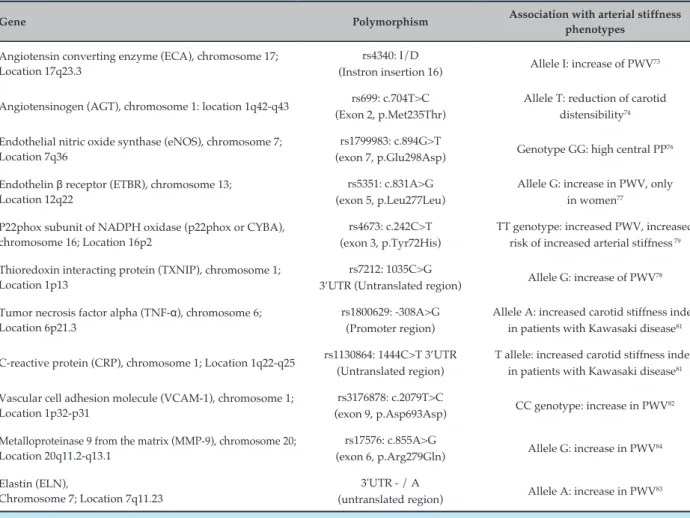
pro-inlammatory agents (Table 1).
RAAS, in addition to its important function in
the regulation of blood pressure, is prominent in the
vascular remodeling process. Therefore, it is evident
that genetic variants capable of affecting the activity
of its effectors (angiotensin, angiotensin-converting
enzyme, angiotensinogen and renin) could signiicantly
influence vascular pathophysiology. In this sense,
several studies have observed an association between
some polymorphisms in RAAS genes with arterial
stiffness phenotypes. Benetos et al.,
80studying healthy
Table 1 – Genetic variants associated with arterial stiffness
Gene Polymorphism Association with arterial stiffness
phenotypes
Angiotensin converting enzyme (ECA), chromosome 17; Location 17q23.3
rs4340: I/D
(Instron insertion 16) Allele I: increase of PWV
73
Angiotensinogen (AGT), chromosome 1: location 1q42-q43 rs699: c.704T>C (Exon 2, p.Met235Thr)
Allele T: reduction of carotid distensibility74
Endothelial nitric oxide synthase (eNOS), chromosome 7; Location 7q36
rs1799983: c.894G>T
(exon 7, p.Glu298Asp) Genotype GG: high central PP
76
Endothelin β receptor (ETBR), chromosome 13; Location 12q22
rs5351: c.831A>G (exon 5, p.Leu277Leu)
Allele G: increase in PWV, only in women77
P22phox subunit of NADPH oxidase (p22phox or CYBA), chromosome 16; Location 16p2
rs4673: c.242C>T (exon 3, p.Tyr72His)
TT genotype: increased PWV, increased risk of increased arterial stiffness 79
Thioredoxin interacting protein (TXNIP), chromosome 1; Location 1p13
rs7212: 1035C>G
3’UTR (Untranslated region) Allele G: increase of PWV
78
Tumor necrosis factor alpha (TNF-α), chromosome 6; Location 6p21.3
rs1800629: -308A>G (Promoter region)
Allele A: increased carotid stiffness index in patients with Kawasaki disease81
C-reactive protein (CRP), chromosome 1; Location 1q22-q25 rs1130864: 1444C>T 3’UTR (Untranslated region)
T allele: increased carotid stiffness index in patients with Kawasaki disease81
Vascular cell adhesion molecule (VCAM-1), chromosome 1; Location 1p32-p31
rs3176878: c.2079T>C
(exon 9, p.Asp693Asp) CC genotype: increase in PWV
82
Metalloproteinase 9 from the matrix (MMP-9), chromosome 20; Location 20q11.2-q13.1
rs17576: c.855A>G
(exon 6, p.Arg279Gln) Allele G: increase in PWV
84
Elastin (ELN),
Chromosome 7; Location 7q11.23
3'UTR - / A
(untranslated region) Allele A: increase in PWV
83
PWV: pulse wave velocity.
Bozec et al.,
81studying hypertensive patients,
demonstrated that the presence of the TT genotype of
the p.Met235Thr polymorphism of
angiotensinogen
(AGT)
was associated with lower compliance and greater carotid
artery wall stiffness.
Endothelium, which also plays a key role in vascular
physiology, mainly acts in the control of vascular tone
and low through the release of nitric oxide and other
vasoactive peptides.
82The importance of endothelial
integrity and function in vascular function is proven.
Evaluated the impact of genetic variants linked to
endothelial physiology with arterial stiffness phenotypes.
Mitchell et al.,
83studying the
Framingham Heart Study
population, demonstrated that the GG genotype of
the endothelial nitric oxide synthase (eNOS) enzyme
p.Glu298Asp polymorphism was associated with
high central PP, especially in women. However, the
data were not reproduced, as expected, for VWP.
Lajemi et al.,
84studying untreated hypertensive patients,
demonstrated the association of the G allele of the
c-30G> A polymorphism of the endothelin
β
receptor
(ETBR) with higher levels of PWV in women.
In addition, two studies with the Brazilian general
population observed associations of polymorphisms in
the
p22phox
and TXNIP genes with PWV.
85,86The irst
showed that individuals with TT genotype for
p22phox
c.242C>T polymorphism had a higher mean of PWV and
greater risk for increased arterial stiffness compared to
individuals with CC or CT genotypes.
86The second one
identiied individuals with CG or GG genotypes for the
TXNIP rs7212 polymorphism had a higher mean of PWV,
compared to individuals with genotype CC.
851. Ribeiro AL, Duncan BB, Brant LC, Lotufo PA, Mill JG, Barreto SM. Cardiovascular health in Brazil: trends and perspectives. Circulation. 2016;133(4):422-33.
2. Tolezani EC, Costa-Hong V, Correia G, Mansur AJ, Drager LF, Bortolotto LA. Determinants of functional and structural properties of large arteries in healthy individuals. Arq Bras Cardiol. 2014;103(5):426-32.
3. Sociedade Brasileira de Cardiologia; Sociedade Brasileira de Hipertensão, Sociedade Brasileira de Nefrologia. VII Diretrizes Brasileiras de hipertensão. Arq Bras Cardiol. 2016;107(1 supl.3):1-82.
4. Zhang Y, Agnoletti D, Xu Y, Wang JG, Blacher J, Safar ME. Carotid-femoral pulse wave velocity in the elderly. J Hypertens. 2014;32(8):1572-6.
5. de Oliveira Alvim R, Santos PC, Musso MM, de Sa Cunha R, Krieger JE, Mill JG, et al. Impact of diabetes mellitus on arterial stiffness in a representative sample of an urban Brazilian population. Diabetol Metab Syndr. 2013;5(1):45.
6. Tarnoki A, Tarnoki DL, Godor E, Littvay L, Horvath T, Jermendy A, et al. 2d.05: Relationship of coronary atherosclerosis with arterial stiffness and central systolic blood pressure. J Hypertens. 2015;33(Suppl 1):e29.
7. Chue CD, Townend JN, Steeds RP, Ferro CJ. Arterial stiffness in chronic kidney disease: causes and consequences. Heart. 2010;96(11):817-23.
8. Chobanian AV, Bakris GL, Black HR, Cushman WC, Green LA, Izzo JL, Jr, et al. The seventh report of the joint national committee on prevention,
References
in endothelial dysfunction and atherosclerosis.
87Thus, researchers investigated the possible impact of
genetic polymorphisms on proinflammatory genes
on arterial stiffness phenotypes. Cheung et al.,
88studying patients with a history of Kawasaki disease,
demonstrated the synergistic effect of the A-allele’s
308 A> G polymorphism of
tumor necrosis factor alpha
(TNF-
α
) and the T allele of the 1444 C> T polymorphism Of
the
C-reactive protein
(CRP) with the high arterial stiffness
index in the carotid artery. Moreover, considering the
pathophysiological role of adhesion molecules, Zhu
et al.
89demonstrated in young and healthy individuals
the association of the CC genotype of the p.Asp693Asp
polymorphism in the VCAM-1 gene (
vascular cell adhesion
molecules
) with higher levels of PWV.
In addition to the endocrine, inflammatory and
vasoactive endothelium-derived components, the
structural components of the vessel wall are also
protagonists in the vascular stiffening process, since
imbalance in the synthesis of collagen and/or elastin
contributes to the decrease of vascular distensibility.
20Iwai et al.,
90evaluating individuals from the Japanese
population, demonstrated the association of allele
A of the 3’-UTR
elastin polymorphism
(ELN) with higher
values of PWV. The inluence of polymorphisms on
genes of some metalloproteinases was also investigated.
Yasmin et al.,
91studying healthy subjects, demonstrated
the association of the G-allele of the c.855A> G
polymorphism of matrix metalloproteinase-9
(MMP-9) with
increased values of PWV.
The above studies reinforce the hypothesis that
genetic variants, located in different genes, contribute
to the modulation of the arterial stiffness phenotype.
Within this theme, larger studies that evaluate
the use of genetic markers in the prevention,
diagnosis, treatment and prognosis of the patient are
still necessary.
Conclusion
Knowing the physiopathological aspects, as well
as the determinants of arterial stiffness, it is plausible
that PWV is included as one of the components in CVD
prevention efforts, at least in hypertensive patients, as
indicated in the VII Brazilian Hypertension Guideline
and in the I Brazilian Guideline on Cardiovascular
Prevention. The assessment of arterial stiffness
can be done by the measurement of PWV or other
previously validated methods. Genetic data indicate
that dozens of genes can modulate this complex
phenotype. However, a better understanding of
the genetic-arterial rigidity relationship, and even a
genotype-based intervention, should constitute goals
to be achieved in future studies.
Author contributions
Conception and design of the research: Alvim RO,
Santos PCJL. Acquisition of data: Alvim RO, Santos PCJL.
Analysis and interpretation of the data: Alvim RO. Writing of
the manuscript: Alvim RO, Santos PCJL, Mill JG, Pereira AC.
Critical revision of the manuscript for intellectual content:
Alvim RO, Bortolotto LA, Mill JG, Pereira AC.
Potential Conflict of Interest
No potential conlict of interest relevant to this article
was reported.
Sources of Funding
There were no external funding sources for this study.
Study Association
detection, evaluation, and treatment of high blood pressure: the JNC 7 report. JAMA. 2003;289(19):2560-72.
9. Dart AM, Kingwell BA. Pulse pressure--a review of mechanisms and clinical relevance. J Am Coll Cardiol. 2001;37(4):975-84.
10. Nichols WW, O' Rourke MF, Vlachopoulos C. McDonald’s blood flow in arteries: theoretical, experimental and clinical principles. 6.ed. Boca Raton (FL): Taylor & Francis Group; 2011.
11. Yucel C, Demir S, Demir M, Tufenk M, Nas K, Molnar F, et al. Left ventricular hypertrophy and arterial stiffness in essential hypertension. Bratisl Lek Listy. 2015;116(12):714-8.
12. Leung MC, Meredith IT, Cameron JD. Aortic stiffness affects the coronary blood flow response to percutaneous coronary intervention. Am J Physiol Heart Circ Physiol. 2006;290(2):H624-30.
13. O'Rourke MF. Basic concepts for the understanding of large arteries in hypertension. J Cardiovasc Pharmacol. 1985;7(Suppl 2):S14-21.
14. Van Bortel L. Focus on small artery stiffness. J Hypertens. 2002;20(9):1707-9.
15. Wolinsky H, Glagov S. Structural basis for the static mechanical properties of the aortic media. Circ Res. 1964;14(5):400-13.
16. Tedla YG, Yano Y, Carnethon M, Greenland P. Association between long-term blood pressure variability and 10-year progression in arterial stiffness: the multiethnic study of atherosclerosis. Hypertension. 2017;69(1):118-27.
17. Aroor AR, Demarco VG, Jia G, Sun Z, Nistala R, Meininger GA, et al. The role of tissue renin-angiotensin-aldosterone system in the development of endothelial dysfunction and arterial stiffness. Front Endocrinol (Lausanne). 2013;4:161.
18. Labat C, Temmar M, Nagy E, Bean K, Brink C, Benetos A, et al. Inflammatory mediators in saliva associated with arterial stiffness and subclinical atherosclerosis. J Hypertens. 2013;31(11):2251-8.
19. Zieman SJ, Melenovsky V, Kass DA. Mechanisms, pathophysiology, and therapy of arterial stiffness. Arterioscler Thromb Vasc Biol. 2005;25(5):932-43.
20. Johnson CP, Baugh R, Wilson CA, Burns J. Age related changes in the tunica media of the vertebral artery: implications for the assessment of vessels injured by trauma. J Clin Pathol. 2001;54(2):139-45.
21. Gepner AD, Tedla Y, Colangelo LA, Tattersall MC, Korcarz CE, Kaufman JD, et al. Progression of carotid arterial stiffness with treatment of hypertension over 10 years: the Multi-Ethnic Study of Atherosclerosis. Hypertension. 2017;69(1):87-95.
22. Chester RC, Gornbein JA, Hundley WG, Srikanthan P, Watson KE, Horwich T. Reflection magnitude, a measure of arterial stiffness, predicts incident heart failure in men but not women: Multi-Ethnic Study of Atherosclerosis (MESA). J Card Fail. 2017;(16).3024-6.
23. Oliver JJ, Webb DJ. Noninvasive assessment of arterial stiffness and risk of atherosclerotic events. Arterioscler Thromb Vasc Biol. 2003;23(4):554-66.
24. Blacher J, Asmar R, Djane S, London GM, Safar ME. Aortic pulse wave velocity as a marker of cardiovascular risk in hypertensive patients. Hypertension. 1999;33(5):1111-7.
25. London GM, Marchais SJ, Safar ME, Genest AF, Guerin AP, Metivier F, et al. Aortic and large artery compliance in end-stage renal failure. Kidney Int. 1990;37(1):137-42.
26. Toto-Moukouo JJ, Achimastos A, Asmar RG, Hugues CJ, Safar ME. Pulse wave velocity in patients with obesity and hypertension. Am Heart J. 1986;112(1):136-40.
27. Vlachopoulos C, Aznaouridis K, Stefanadis C. Prediction of cardiovascular events and all-cause mortality with arterial stiffness: a systematic review and meta-analysis. J Am Coll Cardiol. 2010;55(13):1318-27.
28. Benetos A, Laurent S, Hoeks AP, Boutouyrie PH, Safar ME. Arterial alterations with aging and high blood pressure. A noninvasive study of carotid and femoral arteries. Arterioscler Thromb. 1993;13(1):90-7.
29. Wilkinson IB, Prasad K, Hall IR, Thomas A, MacCallum H, Webb DJ, et al. Increased central pulse pressure and augmentation index in subjects with hypercholesterolemia. J Am Coll Cardiol. 2002;39(6):1005-11.
30. Strasser B, Arvandi M, Pasha EP, Haley AP, Stanforth P, Tanaka H. Abdominal obesity is associated with arterial stiffness in middle-aged adults. Nutr Metab Cardiovasc Dis. 2015;25(5):495-502.
31. Santos PC, Alvim Rde O, Ferreira NE, de Sa Cunha R, Krieger JE, Mill JG, et al. Ethnicity and arterial stiffness in Brazil. Am J Hypertens. 2011;24(3):278-84.
32. Hae Guen S, Eung Ju K, Hong Seog S, Seong Hwan K, Chang Gyu P, Seong Woo H, et al. Relative contributions of different cardiovascular risk factors to significant arterial stiffness. Int J Cardiol. 2010;139(3):263-8.
33. Mitchell GF, Wang N, Palmisano JN, Larson MG, Hamburg NM, Vita JA, et al. Hemodynamic correlates of blood pressure across the adult age spectrum: noninvasive evaluation in the Framingham Heart Study. Circulation. 2010;122(14):1379-86.
34. Hickson SS, Butlin M, Graves M, Taviani V, Avolio AP, McEniery CM, et al. The relationship of age with regional aortic stiffness and diameter. JACC Cardiovasc Imaging. 2010;3(12):1247-55.
35. Taviani V, Hickson SS, Hardy CJ, McEniery CM, Patterson AJ, Gillard JH, et al. Age-related changes of regional pulse wave velocity in the descending aorta using Fourier velocity encoded M-mode. Magn Reson Med. 2011;65(1):261-8.
36. Barnes JN, Hart EC, Curry TB, Nicholson WT, Eisenach JH, Wallin BG, et al. Aging enhances autonomic support of blood pressure in women. Hypertension. 2014;63(2):303-8.
37. Zubcevic J, Jun JY, Kim S, Perez PD, Afzal A, Shan Z, et al. Altered inflammatory response is associated with an impaired autonomic input to the bone marrow in the spontaneously hypertensive rat. Hypertension. 2014;63(3):542-50.
38. McEniery CM, Spratt M, Munnery M, Yarnell J, Lowe GD, Rumley A, et al. An analysis of prospective risk factors for aortic stiffness in men: 20-year follow-up from the Caerphilly prospective study. Hypertension. 2010;56(1):36-43.
39. Kaess BM, Rong J, Larson MG, Hamburg NM, Vita JA, Levy D, et al. Aortic stiffness, blood pressure progression, and incident hypertension. JAMA. 2012;308(9):875-81.
40. O'Rourke MF, Staessen JA, Vlachopoulos C, Duprez D, Plante GE. Clinical applications of arterial stiffness; definitions and reference values. Am J Hypertens. 2002;15(5):426-44.
41. Lukich E, Matas Z, Boaz M, Shargorodsky M. Increasing derangement of glucose homeostasis is associated with increased arterial stiffness in patients with diabetes, impaired fasting glucose and normal controls. Diabetes Metab Res Rev. 2010;26(5):365-70.
42. Vyssoulis G, Pietri P, Vlachopoulos C, Alexopoulos N, Kyvelou SM, Terentes-Printzios D, et al. Early adverse effect of abnormal glucose metabolism on arterial stiffness in drug naive hypertensive patients. Diab Vasc Dis Res. 2012;9(1):18-24.
43. Aronson D. Cross-linking of glycated collagen in the pathogenesis of arterial and myocardial stiffening of aging and diabetes. J Hypertens. 2003;21(1):3-12.
44. Mazzone T, Chait A, Plutzky J. Cardiovascular disease risk in type 2 diabetes mellitus: insights from mechanistic studies. Lancet. 2008;371(9626):1800-9.
45. Cecelja M, Chowienczyk P. Dissociation of aortic pulse wave velocity with risk factors for cardiovascular disease other than hypertension: a systematic review. Hypertension. 2009;54(6):1328-36.
46. Expert Panel on Detection Evaluation, and Treatment of High Blood Cholesterol in Adults. Executive Summary of The Third Report of The National Cholesterol Education Program (NCEP) Expert Panel on Detection, Evaluation, And Treatment of High Blood Cholesterol In Adults (Adult Treatment Panel III). JAMA. 2001;285(19):2486-97.
48. Aviram M. Hyperlipidaemia and cardiovascular disease: inflammation and oxidative stress in diabetic patients. Curr Opin Lipidol. 2009;20(3):258-9.
49. Parthasarathy S, Raghavamenon A, Garelnabi MO, Santanam N. Oxidized low-density lipoprotein. Methods Mol Biol. 2010;610:403-17.
50. Homma S, Kato K, Hayashi J, Yamamoto M. Negative associations between arterial stiffness parameter evaluated by cardio-ankle vascular index and serum low-density lipoprotein cholesterol concentration in early-stage atherosclerosis. Angiology. 2015;66(2):143-9.
51. Wang F, Ye P, Luo L, Xiao W, Qi L, Bian S, et al. Association of serum lipids with arterial stiffness in a population-based study in Beijing. Eur J Clin Invest. 2011;41(9):929-36.
52. Leopold JA. Cellular and molecular mechanisms of arterial stiffness associated with obesity. Hypertension. 2013;62(6):1003-4.
53. Lewis CE, McTigue KM, Burke LE, Poirier P, Eckel RH, Howard BV, et al. Mortality, health outcomes, and body mass index in the overweight range: a science advisory from the American Heart Association. Circulation. 2009;119(25):3263-71.
54. Bastien M, Poirier P, Lemieux I, Despres JP. Overview of epidemiology and contribution of obesity to cardiovascular disease. Prog Cardiovasc Dis. 2014;56(4):369-81.
55. Sutton-Tyrrell K, Newman A, Simonsick EM, Havlik R, Pahor M, Lakatta E, et al. Aortic stiffness is associated with visceral adiposity in older adults enrolled in the study of health, aging, and body composition. Hypertension. 2001;38(3):429-33.
56. Wildman RP, Mackey RH, Bostom A, Thompson T, Sutton-Tyrrell K. Measures of obesity are associated with vascular stiffness in young and older adults. Hypertension. 2003;42(4):468-73.
57. Tounian P, Aggoun Y, Dubern B, Varille V, Guy-Grand B, Sidi D, et al. Presence of increased stiffness of the common carotid artery and endothelial dysfunction in severely obese children: a prospective study. Lancet. 2001;358(9291):1400-4.
58. Ferreira I, Snijder MB, Twisk JW, van Mechelen W, Kemper HC, Seidell JC, et al. Central fat mass versus peripheral fat and lean mass: opposite (adverse versus favorable) associations with arterial stiffness? The Amsterdam Growth and Health Longitudinal Study. J Clin Endocrinol Metab. 2004;89(6):2632-9.
59. Rodrigues SL, Baldo MP, Lani L, Nogueira L, Mill JG, Sa Cunha R. Body mass index is not independently associated with increased aortic stiffness in a Brazilian population. Am J Hypertens. 2012;25(10):1064-9.
60. Sakuragi S, Abhayaratna WP. Arterial stiffness: methods of measurement, physiologic determinants and prediction of cardiovascular outcomes. Int J Cardiol. 2010;138(2):112-8.
61. Gates PE, Tanaka H, Hiatt WR, Seals DR. Dietary sodium restriction rapidly improves large elastic artery compliance in older adults with systolic hypertension. Hypertension. 2004;44(1):35-41.
62. Endes S, Schaffner E, Caviezel S, Dratva J, Autenrieth CS, Wanner M, et al. Physical activity is associated with lower arterial stiffness in older adults: results of the SAPALDIA 3 Cohort Study. Eur J Epidemiol. 2016;31(3):275-85.
63. Jatoi NA, Jerrard-Dunne P, Feely J, Mahmud A. Impact of smoking and smoking cessation on arterial stiffness and aortic wave reflection in hypertension. Hypertension. 2007;49(5):981-5.
64. Sierksma A, Lebrun CE, van der Schouw YT, Grobbee DE, Lamberts SW, Hendriks HF, et al. Alcohol consumption in relation to aortic stiffness and aortic wave reflections: a cross-sectional study in healthy postmenopausal women. Arterioscler Thromb Vasc Biol. 2004;24(2):342-8.
65. Nestel P, Shige H, Pomeroy S, Cehun M, Abbey M, Raederstorff D. The n-3 fatty acids eicosapentaenoic acid and docosahexaenoic acid increase systemic arterial compliance in humans. Am J Clin Nutr. 2002;76(2):326-30.
66. Teede HJ, McGrath BP, DeSilva L, Cehun M, Fassoulakis A, Nestel PJ. Isoflavones reduce arterial stiffness: a placebo-controlled study in men and postmenopausal women. Arterioscler Thromb Vasc Biol. 2003;23(6):1066-71.
67. Kim JH, Oh SJ, Lee JM, Hong EG, Yu JM, Han KA, et al. The effect of an Angiotensin receptor blocker on arterial stiffness in type 2 diabetes mellitus patients with hypertension. Diabetes Metab J. 2011;35(3):236-42.
68. Mahmud A, Feely J. Antihypertensive drugs and arterial stiffness. Expert Rev Cardiovasc Ther. 2003;1(1):65-78.
69. Davenport C, Ashley DT, O'Sullivan EP, McHenry CM, Agha A, Thompson CJ, et al. The Effects of Atorvastatin on Arterial Stiffness in Male Patients with Type 2 Diabetes. J Diabetes Res. 2015;2015:846807.
70. Kanaki AI, Sarafidis PA, Georgianos PI, Kanavos K, Tziolas IM, Zebekakis PE, et al. Effects of low-dose atorvastatin on arterial stiffness and central aortic pressure augmentation in patients with hypertension and hypercholesterolemia. Am J Hypertens. 2013;26(5):608-16.
71. Camp NJ, Hopkins PN, Hasstedt SJ, Coon H, Malhotra A, Cawthon RM, et al. Genome-wide multipoint parametric linkage analysis of pulse pressure in large, extended utah pedigrees. Hypertension. 2003;42(3):322-8.
72. DeStefano AL, Larson MG, Mitchell GF, Benjamin EJ, Vasan RS, Li J, et al. Genome-wide scan for pulse pressure in the National Heart, Lung and Blood Institute's Framingham Heart Study. Hypertension. 2004;44(2):152-5.
73. Atwood LD, Samollow PB, Hixson JE, Stern MP, MacCluer JW. Genome-wide linkage analysis of pulse pressure in Mexican Americans. Hypertension. 2001;37(2 Pt 2):425-8.
74. Levy D, Larson MG, Benjamin EJ, Newton-Cheh C, Wang TJ, Hwang SJ, et al. Framingham Heart Study 100K Project: genome-wide associations for blood pressure and arterial stiffness. BMC Med Genet. 2007;8 Suppl 1:S3.
75. Mitchell GF, DeStefano AL, Larson MG, Benjamin EJ, Chen MH, Vasan RS, et al. Heritability and a genome-wide linkage scan for arterial stiffness, wave reflection, and mean arterial pressure: the Framingham Heart Study. Circulation. 2005;112(2):194-9.
76. Tarnoki AD, Tarnoki DL, Stazi MA, Medda E, Cotichini R, Nistico L, et al. Heritability of central blood pressure and arterial stiffness: a twin study. J Hypertens. 2012;30(8):1564-71.
77. Sayed-Tabatabaei FA, van Rijn MJ, Schut AF, Aulchenko YS, Croes EA, Zillikens MC, et al. Heritability of the function and structure of the arterial wall: findings of the Erasmus Rucphen Family (ERF) study. Stroke. 2005;36(11):2351-6.
78. Alvim RO, Horimoto AR, Oliveira CM, Bortolotto LA, Krieger JE, Pereira AC. Heritability of arterial stiffness in a Brazilian population: Baependi Heart Study. J Hypertens. 2017;35(1):105-10.
79. Turner ST, Fornage M, Jack CR, Jr., Mosley TH, Kardia SL, Boerwinkle E, et al. Genomic susceptibility loci for brain atrophy in hypertensive sibships from the GENOA study. Hypertension. 2005;45(4):793-8.
80. Benetos A, Gautier S, Ricard S, Topouchian J, Asmar R, Poirier O, et al. Influence of angiotensin-converting enzyme and angiotensin II type 1 receptor gene polymorphisms on aortic stiffness in normotensive and hypertensive patients. Circulation. 1996;94(4):698-703.
81. Bozec E, Lacolley P, Bergaya S, Boutouyrie P, Meneton P, Herisse-Legrand M, et al. Arterial stiffness and angiotensinogen gene in hypertensive patients and mutant mice. J Hypertens. 2004;22(7):1299-307.
82. Trepels T, Zeiher AM, Fichtlscherer S. The endothelium and inflammation. Endothelium. 2006;13(6):423-9.
83. Mitchell GF, Guo CY, Kathiresan S, Vasan RS, Larson MG, Vita JA, et al. Vascular stiffness and genetic variation at the endothelial nitric oxide synthase locus: the Framingham Heart study. Hypertension. 2007;49(6):1285-90.
84. Lajemi M, Gautier S, Poirier O, Baguet JP, Mimran A, Gosse P, et al. Endothelin gene variants and aortic and cardiac structure in never-treated hypertensives. Am J Hypertens. 2001;14(8 Pt 1):755-60.
86. de Oliveira Alvim R, Santos PC, Dias RG, Rodrigues MV, de Sa Cunha R, Mill JG, et al. Association between the C242T polymorphism in the p22phox gene with arterial stiffness in the Brazilian population. Physiol Genomics. 2012;44(10):587-92.
87. Libby P, Ridker PM, Maseri A. Inflammation and atherosclerosis. Circulation. 2002;105(9):1135-43.
88. Cheung YF, Huang GY, Chen SB, Liu XQ, Xi L, Liang XC, et al. Inflammatory gene polymorphisms and susceptibility to kawasaki disease and its arterial sequelae. Pediatrics. 2008;122(3):e608-14.
89. Zhu H, Yan W, Tan Y, Li K, Kapuku G, Treiber FA, et al. Adhesion molecule polymorphisms and pulse wave velocity in American youth. Twin Res Hum Genet. 2008;11(5):517-23.
90. Iwai N, Kajimoto K, Kokubo Y, Tomoike H. Extensive genetic analysis of 10 candidate genes for hypertension in Japanese. Hypertension. 2006;48(5):901-7.