DOI: 10.5935/2359-4802.20170065
ORIGINAL ARTICLE
Mailing Address: Fátima Derlene da Rocha Araújo
Rua Indiana, 789, apto. 301. Postal Code: 30460-350. Jardim América, Belo Horiozonte, MG − Brazil E-mail: [email protected]; [email protected]
Doppler Echocardiographic Follow-Up of Mitral and Aortic Regurgitation in Children
and Adolescents with Subclinical and Mild Rheumatic Carditis
Lelia Maria de Almeida Carvalho, Fátima Derlene da Rocha Araújo, Zilda Maria Alves Meira
Hospital das Clínicas, Universidade Federal de Minas Gerais, Belo Horizonte, MG − Brazil
Manuscript received November 16, 2016, revised manuscript March 07, 2017, accepted April 17, 2017.
Abstract
Background: Mild rheumatic carditis (MRC) and subclinical rheumatic carditis (SRC) are basically differentiated through auscultation of mitral regurgitation murmur. The evolution of these forms is not well established in the literature.
Objective: To evaluate the evolution of mild and subclinical rheumatic carditis, considering mitral and aortic regurgitation (acute phase) and regression, maintenance or worsening of these diseases at the end of follow-up (chronic phase).
Methods: Retrospective, longitudinal study, including patients with mild and subclinical rheumatic carditis. The echocardiographic evolution of mitral and aortic regurgitation was compared in both groups, considering the analysis at the end of follow-up. The Chi-square test and Kaplan-Meier survival curves were used, with significance level established at p < 0.05.
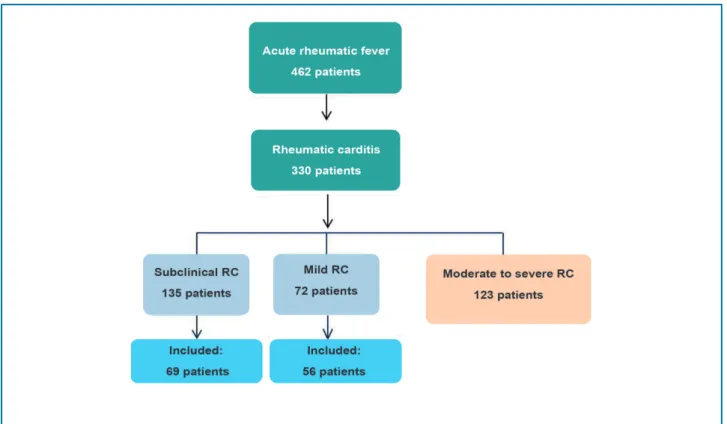
Results: A total of 125 patients were included, 69 (55.2%) with subclinical rheumatic carditis and 56 (44.8%) with mild rheumatic carditis, with a mean age in the acute phase of 10.4 ± 2.6 years and, at the end of study, 19.9 ± 4.6 years. The time of follow-up ranged from 2 to 23 years (mean: 9.38 ± 4.3 years). In the acute phase, mild/moderate or moderate mitral regurgitation was more frequent in patients with mild rheumatic carditis (p = 0.001). Mild or mild/moderate aortic regurgitation was also more common in the mild rheumatic carditis group (p = 0.045). In the chronic phase, we observed that both mitral (p < 0.0001) and aortic regurgitation (p = 0.009) were more frequent in patients with mild rheumatic carditis, and survival free of rheumatic heart disease was higher in the subclinical rheumatic carditis group (p = 0.010). Residual mitral regurgitation was higher in the mild rheumatic carditis group p < 0.0001), and residual aortic regurgitation was similar in both groups (p = 0.099).
Conclusion: Mitral regurgitation resolution was higher in patients with subclinical rheumatic carditis, and the involution of aortic regurgitation was less frequent and similar in both groups. (Int J Cardiovasc Sci. 2017;30(5):391-400)
Keywords: Myocarditis; Rheumatic Heart Disease; Mitral Valve / abnormalities; Aortic Valve / abnormalities; Echocardiography, Doppler; Child; Adolescent.
Introduction
Rheumatic fever (RF) is still responsible for high morbidity and mortality in young individuals in developing countries, despite the decline in Acute RF (ARF) and Chronic Rheumatic Cardiopathy (CRC) in developed countries.1-4 Brazil is considered a country
with a medium prevalence of the disease, with a rate of
3.6/1,000.2 Echocardiographic (echo) screening studies
carried out in schoolchildren in the metropolitan area of Belo Horizonte, state of Minas Gerais, Brazil, showed a prevalence of around 40/1,000.5,6
392
Carvalho et al.
Follow-up of subclinical and mild rheumatic carditis
Int J Cardiovasc Sci. 2017;30(5):391-400 Original Article
and/or aortic regurgitation murmurs, with or without signs and symptoms of heart failure. Mild carditis is characterized by MR murmur auscultation, whereas in the subclinical form, cardiac auscultation is normal, and the echocardiographic alterations are similar to those observed in mild carditis. The evolution of these two forms of carditis is not well established in the literature, particularly in relation to subclinical carditis. In moderate or severe carditis, a higher frequency of residual valve lesions is expected. However, in mild and subclinical cardiac involvement, the possibility of resolution of these lesions is not known, or even if evolution to more severe regurgitation or mitral stenosis will occur.7-9
In the last review of the Jones criteria,10 subclinical
carditis was considered the major manifestation in all patients, whether from countries with high or low prevalence. In our service, echocardiography has been performed since 1992 in all patients diagnosed with ARF, with or without cardiac auscultation, and during patient follow-up.
The aim of this study was to evaluate the evolution of mild and subclinical rheumatic carditis, considering mitral and/or aortic valve regurgitation (acute phase) and disease regression, maintenance or worsening at the end of follow-up (chronic phase).
Methods
This was a retrospective, longitudinal, observational study (concurrent cohort), carried out in an outpatient clinic specific for the care of patients with RF. The patients were recruited from data recorded in the service, from 1992 to 2014.
Patients with a diagnosis of ARF according to the Jones criteria,10,11 with subclinical carditis
(normal cardiac auscultation and mitral and/or aortic regurgitation in the echocardiography) and mild carditis (MR murmur and mitral and/or aortic regurgitation in the echocardiography) making regular use of secondary prophylaxis were included. All patients had echocardiographic examination performed in the acute and chronic phases, after a follow-up period of 2 or more years.
Patients were allocated to two groups, namely those with subclinical rheumatic carditis (SRC) and mild rheumatic carditis (MRC).
The degree of valvular regurgitation at the echocardiographic Doppler examination in the acute
and chronic phases was classified as absent, mild, mild/ moderate, and moderate according to criteria established by the American Society of Echocardiography (ASE)12.
The morphological and Doppler echocardiographic criteria used for the definition of MR and non-physiological Aortic Regurgitation (AoR) were based on a consensus established by the World Health Organization working group and other authors.11-15
In the analysis of the evolution of the valvular lesions, the first echocardiography of the acute phase and the last one of the chronic phase were considered. Residual valvulopathy was defined as the presence of any degree of MR associated with AoR or greater than mild MR. The good evolution was defined as absence of valvular dysfunction or permanence of mild MR in the last evaluation.
The research protocol was approved by the UFMG Research Ethics Committee (CAAE 31821614.0.0000.5149).
Statistical Analysis
The analyses were processed using the Statistical Package for Social Sciences (SPSS), version 22.0 (SPSS Inc., Chicago, IL, USA). The normal distribution of the variables was tested by the Shapiro-Wilkstest. The continuous quantitative variables with normal distribution wereshown as mean and standard deviation, and the variables with non-parametric distribution, as median and their maximum and minimum values. Categorical variables were described as numbers and/ or percentages. The unpaired Student’s t test was used
to compare age means. For the categorical variables, Pearson’s chi-square test or Fisher’s test was used, as appropriate. For the evaluation of survival free of residual valvulopathy, the Kaplan-Meier curve was used with the log-rank test. All tests were performed considering a significance level of 5%, two-tailed probability and 95% Confidence Interval (95% CI).
Results
Figure 1 – Flowchart: selection of patients with subclinical and mild rheumatic.
Table 1 − General characteristics of patients with subclinical (n = 69) and mild (n = 56) carditis
Characteristics
Rheumatic carditis
p value
Subclinical Mild
Female gender 44 36 0.551
Presenceof chorea 53 16 < 0.0001
Presenceofarthritis 24 47 < 0.0001
Ageat theacute phase, mean, years 10.3 ± 2.6 10.4 ± 2.7 0.913
Age at theendof the study,mean, years 19.2 ± 4.1 20.7 ± 5.0 0.071 The age of presentation of the acute phase was 5 to
15 years (mean of 10.4 ± 2.6 years). The age at the end of the study was 10 to 34 years (mean 19.9 ± 4.6 years), and follow-up ranged from 2 to 23 years (mean of 9.38 ± 4.3 years). At the end of the study, 51.2% patients were aged between 10 and 20 years and 47.2% between 21 and 30 years. There was a predominance of females (64%) and ARF was more frequent in the age range of 5 to 10 years (54.4%).
There was a higher association of chorea with subclinical carditis (p < 0.0001) and of arthritis with
mild carditis (p < 0.0001). The general characteristics of the population of the two groups are shown in table 1.
394
Table 2 − Valvular involvement in subclinical and mild rheumatic carditis
Valve involvement Rheumatic carditis
Subclinical Mild
Isolated MR 49 29
Isolated AoR 1 1
RM + AoR 19 26
MR: mitralregurgitation; AoR: aortic regurgitation. Carvalho et al.
Follow-up of subclinical and mild rheumatic carditis
Int J Cardiovasc Sci. 2017;30(5):391-400 Original Article
Echocardiographic analysis of rheumatic mitral and aortic valve disease (acute phase)
All patients with mild rheumatic carditis had MR at the echocardiography performed in the acute phase. Only one patient with subclinical rheumatic carditis did not have MR, but showed altered mitral valve morphology and mild non-physiological AoR. In the MRC Group, there was a higher frequency of mild/
moderate or moderate MR when compared to the SRC Group (p = 0.001).
AoR was present in 20 (29%) patients with subclinical rheumatic carditis and 27 (48%) with mild rheumatic carditis. In the SRC group, all AoR cases were mild ones, but in the MRC group, there were four cases of mild/ moderate AoR (p = 0.045). The mitral and aortic valve involvement in each group is shown in table 2.
Echocardiographic analysis of rheumatic mitral and aortic valve diseases (chronic phase)
In the chronic phase of RF (Figure 2), according to the echocardiographic evaluation, MR was present in 47 (68%) patients of the SRC Group, and in only two the degree of the lesion was mild / moderate. In the MRC group, MR persisted in 54 (96.4%), of which 15 (28.8%) had mild / moderate or moderate degree (p < 0.0001).
Regarding the echocardiographic assessment of the aortic valve in the chronic phase (Figure 3), AoR was mild in nine (13%) patients of the SRC Group and in 19 (34%) patients in the MRC Group, whereas mild/ moderate AoR was found in four patients from the MRC Group (p = 0.009).
The type of mitral and aortic valve involvement in each group is described in table 3.
Evolutionary analysis of valve lesions
The time of echocardiography in the chronic phase ranged from 2 to 23 years, with a mean of 9.38 ± 4.3 years (median of 9 years).
Regarding the MR evolution, it was observed that of the 69 patients in the SRC Group, 22 (31.9%) had full resolution. Among those who had full resolution, in 18 (81.8%) the MR was mild and in four (18.2%) the MR was mild / moderate in the acute phase. Of the 56 patients in
the MRC Group, only four (7.1%) had full MR resolution, one (25%) mild MR and three (75%) moderate MR in the acute phase. A higher rate of MR resolution was observed in the SRC Group (p < 0.0001). MR also regressed more frequently when it was isolated and not associated with AoR (p < 0.0001, odds ratio 2.51, 95%CI: 1.53-4.09) in both groups. None of the patients showed evolution to stenotic lesions. Only two patients from the SRC group had mild worsening of the MR: from mild in the acute phase to mild/moderate in the chronic phase.
Regarding the evolution of the AoR, in patients with subclinical rheumatic carditis, resolution occurred in 13 (18.8%) of them, all of them with previously mild AoR. In patients with mild rheumatic carditis, AoR resolution was observed in nine (16.1%) patients, all of them also with previously mild lesions. There was no difference between the groups (p = 0.099). Neither of the two groups showed mild to moderate AoR resolution.
Data on the echocardiographic evolution of mitral and aortic valve lesions are shown in Figures 2 and 4.
Figure 2 – Echocardiographic evolution of mitral regurgitation in patients with subclinical (A) and mild (B) rheumatic carditis.
The survival curves for residual valvulopathy (CRC) and for residual aortic valvulopathy are shown in Figures 3 and 5.
Discussion
The frequency of mild and subclinical rheumatic carditis in the study population was 40.9% and 21.8%, respectively. The literature shows great variation in the frequency of subclinical rheumatic carditis, varying from 16.7 to 43.3%,7,16-20 the same occurring in relation to
mild rheumatic carditis, which can be explained by the difference in the classification criteria.7,8,16,19
The highest observed association frequency between arthritis with mild rheumatic carditis and of chorea with subclinical rheumatic carditis agrees with that described by other authors. 8,19-24 There was also agreement on
the predominance of mitral valve involvement in both groups, both in the acute and chronic phases. 7-9,25
Previous studies have concluded that CRC progression is proportional to the severity of carditis: the more severe the valve lesion in the initial outbreak, the worse the valve damage in the chronic phase.7 However, the
echocardiographic evolution of valvular lesions (mitral and aortic) observed in patients with SRC and MRC regarding progression to greater severity or onset of stenotic lesions, or whether they remain stable or regress, remains to be elucidated.
Historically, prior to the use of the echocardiographic examination, Décourt26 described that, in patients
396
Figure 3 – Echocardiographic evolution of aortic regurgitation in patients with subclinical (A) and mild (B) rheumatic carditis.
Table 3 − Chronic rheumatic valve disease in patients with subclinical and mild carditis
Valve involvement Rheumatic carditis
Subclinical Mild
Absent 20 1
Isolated MR 38 36
Isolated AoR 2 1
MR + AoR 9 18
MR: mitral regurgitation; AoR: aortic regurgitation. Carvalho et al.
Follow-up of subclinical and mild rheumatic carditis
Int J Cardiovasc Sci. 2017;30(5):391-400 Original Article
clinical examination remained normal in the follow-up of patients who had no cardiac abnormalities in the acute phase, without murmurs. Differently from this pre-echocardiographic era, when only the clinical evolution (murmur persistence) was considered, later studies
Figure 4 – Kaplan-Meier curve of survival free of residual valvulopathy (greater than light mitral regurgitation, associated or not to aortic regurgitation) in patients with subclinical and mild carditis.
had total MR resolution. These data corroborate the findings of a previous study, in which MR resolution was observed in 28% of patients with subclinical rheumatic carditis.8
Several authors have concluded that subclinical valvular lesions may persist for a long time. Figueroa et al.18 observed that half of the patients, at the end of
5 years of follow-up, remained with valvular lesions at the echocardiographic examination, with no evolution being observed to severe regurgitation or stenotic lesion. Of the 40 patients with subclinical rheumatic carditis from the Ozkutho and Hallioglu study,28 33 had MR,
6 has AoR and only one had MR associated with AoR. After a mean follow-up period of 18 months, it was observed that the valvular lesion disappeared in 23 patients (57.5%). However, in the present study, considering a mean evolution of 10 years, there was a lower frequency of total MR regression, which occurred in 22/69 patients (31.9%). Karaaslanet al.29 followed
23 patients with subclinical rheumatic carditis (19 with MR, one with AoR and three with MR and AoR), for a mean follow-up period of 9.91 months.
The echocardiographic analysis in this period showed that the degree of MR improved in 13 patients (59.1%) and disappeared completely in six (27.3%). The AoR improved in two and disappeared completely in two.
Meira et al.,7 in a comparative study of the
echocardiographic evolution of valvular lesions in 258 children and adolescents with RF during a follow-up period of 2 to 15 years, observed the regression of the lesions in 25% in the patients with mild rheumatic carditis, 2.5% of those with moderate carditis and in none of those with severe carditis. When compared to the present study, regression in the MRC group occurred in 7% of patients.
Pekpaket al.,30 when assessing 56 patients with ARF,
398
Figure 5 – Kaplan-Meier curve for survival free of residual aortic valvulopathy in patients with subclinical and mild carditis. Carvalho et al.
Follow-up of subclinical and mild rheumatic carditis
Int J Cardiovasc Sci. 2017;30(5):391-400 Original Article
Basturk et al.31 followed 30 patients with subclinical
rheumatic carditis and compared their echocardiographic evolution with that of 82 patients with clinical carditis after at least 2 years of disease. They observed that the regression rate was similar in both groups and there was no resolution of isolated AoR, but there was a significant recovery of the isolated MR or when associated with AoR. The current study is the first to compare the echocardiographic evolution of subclinical with mild rheumatic carditis, during a mean period of almost a decade. The most favorable evolution was that of MR in the SRC Group and was associated with the occurrence of MR alone in ARF. A greater persistence of alterations was observed in patients with an association of MR and AoR. In this association, there is a lower probability that the mitral and aortic dysfunctions will be physiological. This fact allows us to infer it may be difficult to differentiate non-physiological mild MR from physiological MR. When murmur corresponding to MR occurs, there is more significant valve dysfunction at the echocardiographic examination, and the possibility of confusion with physiological MR is also less likely. Physiological AoR is rare at the assessed age range, and neither patients with mild rheumatic carditis nor those with subclinical rheumatic carditis had a corresponding murmur in the acute phase.
In patients with other major manifestations in the acute phase (chorea and / or arthritis), the echocardiographic assessment at this phase does not influence the diagnosis or the therapeutic approach, but it is important to determine if there is persistence or worsening of valve involvement during the follow-up of these patients, with echocardiographic assessment being carried out at the end of the period proposed for secondary prophylaxis. Patients with normal auscultation at 25 years of age or after 10 years of secondary prophylaxis may present with greater than mild valvular dysfunction or even progress to mitral stenosis (valve area < 4 cm2 and > 2.5 cm2).8
Limitations
1. Seckeler MD, Hoke TR. The worldwide epidemiology of acute rheumatic fever and rheumatic heart disease. Clin Epidemiol. 2011; 3:67-84. 2. Meira ZM, de Castilho SR, Barros MV, Vitarelli AM, Capanema
FD, Moreira NS, et al. [Prevalence of rheumatic fever in children from a public high school in Belo Horizonte]. Arq Bras Cardiol. 1995;65(4):331-4.
3. Steer AC. Historical aspects of rheumatic fever. J Paediatr Child Health. 2015;51(1):21-7.
4. Rothenbühler M, O’Sullivan CJ, Stortecky S, Stefanini GG, Spitzer E, Estill J, et al. Active surveillance for rheumatic heart disease in endemic regions: a systematic review and meta-analysis of prevalence among children and adolescents. Lancet Glob Health. 2014;2(12):e717-26. 5. Nascimento BR, Beaton AZ, Nunes MC, Diamantino AC, Carmo GA,
Oliveira KK, et al; PROVAR (Programa de RastreamentO da VAlvopatia Reumática) investigators. Echocardiographic prevalence of rheumatic heart disease in Brazilian schoolchildren: data from the PROVAR study. Int J Cardiol. 2016;219:439-45.
6. Miranda LP, Camargos PA, Torres RM, Meira ZM. Prevalence of rheumatic heart disease in a public school of Belo Horizonte. Arq Bras Cardiol. 2014;103(2):89-97.
7. Meira ZM, Goulart EM, Mota Cde C. Comparative study of clinical and Doppler echocardiographic evaluations of the progression of valve diseases in children and adolescents with rheumatic fever. Arq Bras Cardiol. 2006;86(1):32-8.
8. Araújo FD, Goulart EM, Meira ZM. Prognostic value of clinical and Doppler echocardiographic findings in children and adolescents with significant rheumatic valvular disease. Ann Pediatr Cardiol. 2012;5(2):120-6.
9. Meira ZM, Goulart EM, Colosimo EA, Mota CC. Long term follow up of rheumatic fever and predictors of severe rheumatic valvar disease in brasilian children and adolescents. Heart. 2005;91(8):1019-22. 10. Gewitz MH, Baltimore RS, Tani LY, Sable CA, Shulman ST,
Carapetis J, et al; American Heart Association Committee on Rheumatic Fever, Endocarditis, and Kawasaki Disease of the Council on Cardiovascular Disease in the Young. Revision of the Jones Criteria for the diagnosis of acute rheumatic fever in the era of doppler echocardiography: a scientific statement from the American Heart Association. Circulation. 2015;131(20):1806-18.
11. Barbosa PJ, Müller RE, Latado AL, Achutti AC, Ramos AI, Weksler C, et al.; Sociedade Brasileira de Cardiologia / Sociedade Brasileira de Pediatria / Sociedade Brasileira de Reumatologia. Diretrizes brasileiras para o diagnóstico, tratamento e prevenção da febre reumática. Arq Bras Cardiol. 2009;93(3 supl.4):1-18.
12. Quiñones MA, Otto CM, Stoddard M, Waggoner A, Zoghbi WA; Doppler Quantification Task Force of the Nomenclature and Standards Committee of the American Society of Echocardiography. Recommendations for quantification of Doppler echocardiography: a report from the Doppler Quantification Task Force of the Nomenclature and Standards Committee of the American Society of Echocardiography. J Am Soc Echocardiogr. 2002;15(2):167-84.
References
Conclusion
The best evolution of subclinical rheumatic carditis was attributed to the lower frequency of residual mitral regurgitation. However, considering the evolution of aortic regurgitation, there was no difference between patients who had subclinical or mild rheumatic carditis. This fact may be related to the difficulty in the echocardiographic differentiation between mild physiological and non-physiological mitral regurgitation. Despite well-established echocardiographic criteria for the determination of mild non-physiological mitral regurgitation, there is still the influence of the echocardiographist’s experience. Considering the evolution of aortic regurgitation, both in patients with subclinical rheumatic carditis and in those with mild rheumatic carditis, the medical conduct regarding the duration of secondary prophylaxis should be similar in the two groups, that is, up to 25 years of age or more, if there is worsening of the valve lesion. Thus, patients with subclinical or mild rheumatic carditis and aortic regurgitation alone or associated with mild mitral regurgitation would undergo prophylaxis for a similar period of time. As for patients in the subclinical rheumatic carditis group with isolated mild mitral regurgitation, whose evolution is more favorable, prophylaxis could
be maintained up to 21 years, as currently recommended, unless there is worsening of the valve lesion.
Author contributions
Conception and design of the research: Meira ZMA. Acquisition of data: Meira ZMA, Araújo FDR, Almeida LMC. Analysis and interpretation of the data: Meira ZMA, Araújo FDR, Almeida LMC. Statistical analysis: Araújo FDR, Almeida LMC. Writing of the manuscript: Meira ZMA, Araújo FDR, Almeida LMC. Critical revision of the manuscript for intellectual content: Meira ZMA.
Potential Conflict of Interest
No potential conflict of interest relevant to this article was reported.
Sources of Funding
There were no external funding sources for this study.
Study Association
400
13. Paar JA, Berrios NM, Rose JD. Prevalence of rheumatic heart disease in children and young adults in Nicaragua. Am J Cardiol. 2010;105(12):1809-14.
14. Veasy LG. Rheumatic fever: T. Duckett Jones and the rest of the story. Cardiol Young. 1995;5:293-301.
15. World Health Organization. (WHO). Rheumatic fever and rheumatic heart disease: report of a WHO Expert Consultation. Geneva; 2004. 16. Hilário MO, Andrade JL, Gasparian AB, Carvalho AC, Andrade CT,
Len CA. The value of echocardiography in the diagnosis and followup of rheumatic carditis in children and adolescents: a 2 year prospective study. J Rheumatol. 2000;27(4):1082-6.
17. Saxena A. Diagnosis of rheumatic fever: current status of Jones Criteria and role of echocardiography. Indian J Pediatr. 2000;67(3Suppl):S11-4. 18. Figueroa FE, Fernandez MS, Valdes P, Wilson C,Lanas F,Carrión F,
et al. Prospective comparison of clinical and echocardiographic diagnosis of rheumatic carditis: long term follow up of patients with subclinical disease. Heart. 2001;85(4):407-10.
19. Lanna CC, Tonelli E, Barros MV, Goulart EM, Mota CC. Subclinical rheumatic valvitis: a long-term follow-up.Cardiol Young.2003;13(5):431-8. 20. Panamonta M, Chaikitpinyo A, Kaplan EL, Pantongwiriyakul A,
Tassniyom S, Sutra S. The relationship of carditis to the initial attack of Sydenham’s chorea. Int J Cardiol. 2004;94(2-3):241-8.
21. Vijayalakshmi IB, Mithravinda J,Deva AN. The role of echocardiography in diagnosing carditis in the setting of acute rheumatic fever. Cardiol Young. 2005;15(6):583-8.
22. Swedo SE. Sydenham’s chorea: a model for childhood autoimmune neuropsychiatric disorders. JAMA. 1994;272(22):1788-91.
23. Carapetis JR, Currie BJ, Mathews JD. Cumulative incidence of rheumatic fever in an endemic region: a guide to the susceptibility of the population? Epidemiol Infect. 2000;124(2):239-44.
24. Veasy LG, Wiedmeier SE, Orsmond GS, Ruttenberg HD, Boucek MM, Roth SJ, et al. Resurgence of acute rheumatic fever in the intermountain area of the United States. N Engl J Med. 1987;316(8):421-7.
25. Kumar R, Sharma YP, Thakur JS, Patro BK,Bhatia A,Singh IP. Streptococcal pharyngitis, rheumatic fever and rheumatic heart disease: eight-year prospective surveillance in Rupnagar district of Punjab, India. Natl Med J India. 2014; 27(2):70-75.
26. Décourt LV. Doença reumática. São Paulo: Sarvier; 1972.
27. Thomas GT. Five-year follow-up on patients with rheumatic fever treated by bed rest, steroids, or salicylate. Br Med J. 1961;1(5240):1635-9. 28. Ozkutlu S, Hallioglu O, Ayabakan C. Evaluation of subclinical valvar
disease in patients with rheumatic fever. Cardiol Young. 2003;13(6):495-9. 29. Karaaslan S, Demirören S, Oran B, Baysal T, Başpinar O, Uçar C. Criteria
for judging the improvement in subclinical rheumatic valvitis. Cardiol Young. 2003;13(6):500-5.
30. Pekpak E, Atalay S, Karadeniz C, Demir F, Tutar E, Uçar T. Rheumatic silent carditis: echocardiographic diagnosis and prognosis of long-term follow up. Pediatr Int. 2013;55(6):685-9.
31. Basturk A, Oztarhan K, Kavuncuoğlu S, PolatC. Significance of silent
carditis and investigation of follow-up signs in acute rheumatic fever. Future Cardiol. 2016;12(3):281-7.
32. Reményi B, Wilson N Steer A,Ferreira B,Kado J,Kumar K, et al. World Heart Federation Criteria for echocardiographic diagnosis of rheumatic heart disease - an evidence based guideline. Nat Rev Cardiol. 2012;9(5):297-309.
Carvalho et al.
Follow-up of subclinical and mild rheumatic carditis