ORIGINAL ARTICLE
356
Effects of prostatic inflammation on LUTS and alpha blocker
treatment outcomes
_______________________________________________
Ha Na Lee
1, Tae-Hyoung Kim
2, Sun-Ju Lee
3, Won Yeol Cho
4, Bong Suk Shim
51Department of Urology, Ewha Womans University Medical Center Seoul Seonam Hospital; 2Chung-Ang
University Hospital, Chung-Ang University College of Medicine; 3Kyung Hee University Hospital, Kyung Hee University School of Medicine; 4Dong-A University Hospital, Dong-A University School of Medicine, Busan and 5Ewha Womans University Mok-dong Hospital, Ewha Womans University School of Medicine, Seoul, Korea
ABSTRACT
ARTICLE
INFO
______________________________________________________________ ______________________
Purpose: To evaluate the association between prostatic inflammation and lower urina-ry tract symptoms (LUTS), and to identify the effects of prostatic inflammation on the treatment with an alpha blocker.
Materials and Methods: 111 Participants who were aged ≥ 50 years, the presence of LUTS (maximal flow rate < 20 m/s, IPSS ≥ 11), and an elevated PSA level (3-20ng/mL) were treated with tamsulosin 0.2mg once daily for 3 months after prostate biopsies. Prosta-tic inflammation was scored as none (0), mild (I), moderate (II), or marked (III). LUTS parameters including urine flow rates, IPSS, PSA, and prostate volume were evaluated.
Results: Inflammation grading resulted in 25, 60, and 26 patients that were grade 0, I, and II, respectively. Lower grade inflammation was related to higher urine flow rate at baseline. Patients with higher inflammation grades had larger prostate volumes, larger total and transitional zone volumes, and higher PSA levels. Overall, urine flow rates and residual urine volume were improved after 3 months of alpha blocker therapy. Eighty percent of patients with grade 0 inflammation, 73% of patients with grade I inflammation, and 92.3% of patients with grade II inflammation showed improvement of LUTS after treatment. Longer duration of treatment was related to a decreased chan-ce of improvement of LUTS. Patients with increased IPSS voiding subscales could be predictive of improvement of LUTS.
Conclusions: Patients with high grade inflammation had lower flow rates and higher prostatic volumes than patients with low grade inflammation. Inflammation grade did not affect the outcomes of alpha blocker treatment.
Key words:
Prostatitis; Prostatic Hyperplasia; Therapeutics; Adrenergic alpha-Antagonists
Int Braz J Urol. 2014; 40: 356-66
_____________________
Submitted for publication: August 13, 2013
_____________________
Accepted after revision: January 15, 2014
INTRODUCTION
Although the pathogenesis of benign pros-tatic hyperplasia (BPH) is not yet completely un-derstood, there is some evidence that prostatic in-flammation could be a key contributor to prostate enlargement and progression of BPH. The presence
of chronic histologic inflammation is a common finding in prostatic tissue on biopsies of surgical specimens from patients with and without lower urinary tract symptoms (LUTS) or prostatitis (1-3). Although it is not yet defined when and why chro-nic inflammation occurs, it has been hypothesized that BPH is an immune-mediated inflammatory
Vol. 40 (3): 356-366, May - June, 2014
IBJU| EFFECTS OF PROSTATIC INFLAMMATION ON LUTS
357
disease (2,4,5). Various growth factors and cytoki-nes including T and B lymphoid cells and macro-phages have been shown to be involved in both the inflammatory process and in the interactions between epithelial and stromal prostatic cells (2).
Several studies have investigated the re-lationship between histologic prostatic inflamma-tion and LUTS related BPH (6-8). Chronic prostate inflammatory infiltrates were at a higher risk of BPH progression and acute urinary retention when compared with patients without inflammatory in-filtrates at baseline. Depending on the relationship between prostatic inflammation and LUTS, medi-cations with anti-inflammatory effects could be a novel treatment option for the management of BPH related LUTS. We evaluated the association betwe-en prostatic inflammation and LUTS. We also cha-racterized the effects of prostatic inflammation on the treatment of LUTS with an alpha blocker.
MATERIALS AND METHODS
Study participants
The protocol and procedures used in this study were approved by the Institutional Review Board at Ewha Medical Center. Data was retrospec-tively collected from 10 hospitals in Korea. Patients who met the following criteria were included in the study: (i) men, aged ≥ 50 years, (ii) total IPSS ≥ 11, (iii) maximum flow rate (MFR) < 20mL/sec. and voided volume ≥ 120mL, (iv) total prostate volume between 20 and 50g, (v) baseline serum prostate specific antigen (PSA) level between 3 and 20ng/ mL, and (vi) pathologically confirmed BPH on tissue obtained via transrectal ultrasound-guided biopsy. Exclusion criteria for this study included: (i) history of 5-alpha reductase inhibitor or alpha1--blocker use or a history of surgical therapy for BPH within 6 months of this study, (ii) neurogenic bladder, (iii) known history of an urothelial tumor such as prostate cancer or bladder cancer, and his-tory of a urethral stricture or bladder neck obstruc-tion, (iv) history of orthostatic hypotension with syncope, (v) history of chronic prostatitis/chronic prostatic pain syndrome, (vi) history of acute bac-terial prostatitis within 6 months of this study, (vii) history of acute urinary tract infection within 1 month of this study, and (viii) history of unstable
angina, myocardial infarction, or cerebro-vascular disease within 6 months of this study.
Evaluations
All data included in this study were obtai-ned from patients who underwent transrectal ul-trasound-guided biopsy of the prostate to rule out prostate cancer. All patients were treated with tam-sulosin 2mg once daily for 3 months post-biopsy. Inflammation grades were reviewed by a single pathologist. The pathologist assessed the prostatic strips throughout whole specimens. Inflammation was assessed across all cores. Scoring of inflam-mation was based on a histologic grading system as follows: (i) grade 0, no inflammation; (ii) grade I, scattered inflammatory cell infiltrate without no-dules; (iii) grade II, no confluent lymphoid nono-dules; (iv) grade III, large inflammatory areas with con-fluence (9). We assessed all specimens for degree of inflammation according to the most frequent and most severe scores.
IBJU| EFFECTS OF PROSTATIC INFLAMMATION ON LUTS
358
Statistical analysis
We assessed differences in clinical para-meters such as MFR, average flow rate (AFR), PVR, IPSS, prostate volume, and PSA level using paired t-tests or Wilcoxon signed-rank tests with Bonferroni correction. We analyzed diffe-rences in clinical parameters according to the inflammation grade using Kruskal-Wallis tests and Wilcoxon rank-sum tests with Bonferroni adjustment. All analyses were performed using SAS software version 9.1.3 (SAS Institute Inc., Cary, NC, USA).
RESULTS
Participants
A total of 111 patients from 10 hospitals were included in this study. Inflammation grades
were assigned based on the most frequent score, with 25 patients at grade 0, 60 at grade I, and 26 at grade II. The mean age of each group was 64.3 (grade 0), 65.6 (grade I), and 64.9 years (grade II). The duration of treatment for each group was 6.9, 5.6, and 4.5 months (grades 0, I, and II, respective-ly). There were no significant differences in demo-graphic data between the groups (Table-1).
Baseline LUTS parameters and prostatic inflam-mation grades
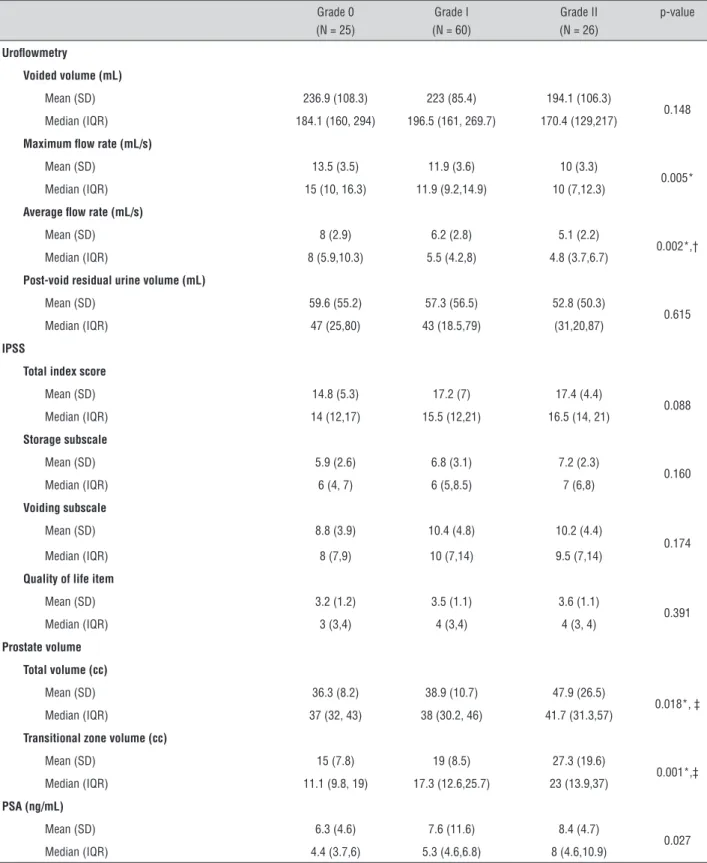
Differences in baseline LUTS parameters ac-cording to inflammation grade were evaluated. The mean MFR of each group was 13.5 (grade 0), 11.9 (grade I), and 10 (grade II). The mean AFR of each group was 8 (grade 0), 6.2 (grade I), and 5.1 (grade II). Lower grade inflammation was associated with higher MFR and AFR (p < 0.05). Mean total pros-tate volume in each group was 36.3 (grade 0), 38.9
Table 1 - Demographic data of study participants (mean [SD], median [IQR]).
Grade 0* (N = 25)
Grade I* (N = 60)
Grade II* (N = 26)
p-value**
Age
Mean (SD) 64.3 (7.4) 65.6 (7) 64.9 (8)
0.658
Median (IQR) 64 (60,68) 66 (61,69.5) 68 (58,70)
BMI
Mean (SD) 23.8 (3.5) 23.5 (2.8) 24.9 (3.3)
0.265
Median (IQR) 23.5 (22.4,24.8) 23.4 (21.4,25.2) 24.4 (22.4, 27.7)
Systolic BP
Mean (SD) 123.4 (12.5) 123 (11.3) 124.6 (13.8)
0.983
Median (IQR) 125 (110,130) 120 (120,130) 121 (117,130)
Diastolic BP
Mean (SD) 78.1 (9.1) 77.3 (8.9) 77.3 (12)
0.832
Median (IQR) 80 (70,85) 78.5 (70,82) 80 (70,84)
Treatment duration (months)
Mean (SD) 6.9 (7.1) 5.6 (10.7) 4.5 (5) 0.092
Median (IQR) 4 (3,7) 3 (3,3.8) 3.3 (3,4)
DM (n[%]) 4 (16.0) 2 (3.3) 5 (19.2) 0.022
Hypertension (n[%]) 8 (32.0) 11 (18.3) 3 (11.5) 0.170
CVA (n,[%]) 3 (12.0) 2 (3.3) 0 (0) 0.121
SD = standard deviation; IQR = interquartile range. * Inflammation grade was based on the most frequent score assigned to prostate specimens. ** Statistical analysis using
IBJU| EFFECTS OF PROSTATIC INFLAMMATION ON LUTS
359
(grade I), and 47.9 (grade II). Higher grade inflam-mation was associated with larger prostate volumes including total and transitional zone volumes (p < 0.05). Baseline IPSS and QoL scores were unrelated to prostatic inflammation grade. In terms of serum PSA, patients with higher inflammation grades had significantly higher PSA levels (p < 0.05) (Table-2).
Alpha blocker treatment effects according to in-flammation grade
We evaluated changes in clinical parame-ters and symptom scores according to inflamma-tion grade after 3 months of treatment with an al-pha blocker (Table-3). Voided volume, MFR, AFR, and PVR improved after 3 months of alpha blocker therapy, although these changes were unrelated to inflammation grade (p > 0.05). Similarly, IPSS im-proved after alpha blocker treatment, independent of inflammation grade.
The association between inflammation grade and symptomatic improvement
We evaluated whether or not improve-ment of LUTS was related to inflammation grade. According to the most popular inflammation sco-ring system, 80% of patients with grade 0 pros-tatic inflammation experienced improvement in their LUTS. Seventy-three percent and 92.3% of patients with grade I and grade II inflammation, respectively, had improvement of LUTS. There was no significant difference in improvement rates among the three groups (p = 0.1363). According to the most stringent inflammation scoring sys-tem, 82% of patients who had grade 0 inflamma-tion experienced improvement. Addiinflamma-tionally, 72%, 83.7%, and 100% of patients with grade I, II, and III inflammation, respectively, had improvement of LUTS (p = 0.3185) (Table-4).
Predictive factors for treatment responses to al-pha blockers
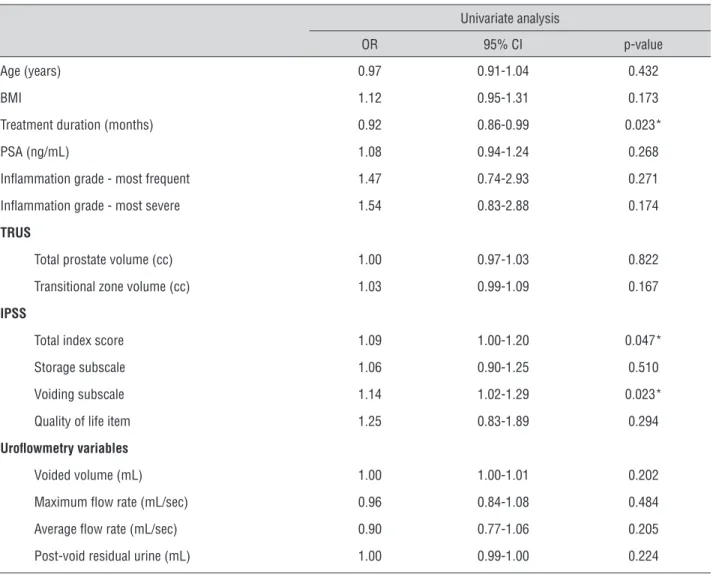
Factors that predicted symptomatic impro-vement as a result of alpha blocker therapy were evaluated using univariate and multivariate analy-sis. Longer duration of medication use was related to decreased symptomatic improvement (OR = 0.92, 95% CI 0.85 - 0.99). Increased IPSS voiding subsca-les were associated with an increase in
symptoma-tic improvement (OR = 1.17, 95% CI 1.02 - 1.34). Thus, more severe symptoms, which were represen-ted by high IPSS voiding scores, could be predictive of improvement of LUTS with alpha blocker thera-py (Tables 5 and 6).
Safety
Systolic blood pressures were decreased by a mean of 4.3mmHg after 3 months of treat-ment with an alpha blocker compared to baseline, while diastolic blood pressures were decreased by a mean of 4.7mmHg. There were no serious adver-se events related to treatment with tamsulosin.
DISCUSSION
The present study sought to evaluate whe-ther whe-there is a correlation between histologically graded prostatic inflammation and prostate-rela-ted lower urinary tract symptoms. Our data suggest that prostatic inflammation grades are associated with LUTS, and that high grade inflammation was associated with lower urine flow rates and higher prostate volumes than low grade inflammation.
Prostatic inflammation is gaining incre-asing attention as a potential etiologic factor in prostate cancer, benign prostatic hyperplasia, lo-wer urinary tract symptoms, and chronic pelvic pain syndrome (CPPS). In a mouse model, acute bacterial inflammation of the prostate was associa-ted with epithelial proliferation and reactive hyper-plasia (10). This study concluded that transurethral inoculation of uropathogenic E.coli 1677 reliably infected the mouse prostate, produced a significant inflammatory response, and induced quantifiable epithelial proliferation and reactive hyperplasia.
IBJU| EFFECTS OF PROSTATIC INFLAMMATION ON LUTS
360
Table 2 - Differences in baseline LUTS parameters according to inflammation grade.
Grade 0 (N = 25)
Grade I (N = 60)
Grade II (N = 26)
p-value
Uroflowmetry
Voided volume (mL)
Mean (SD) 236.9 (108.3) 223 (85.4) 194.1 (106.3)
0.148 Median (IQR) 184.1 (160, 294) 196.5 (161, 269.7) 170.4 (129,217)
Maximum flow rate (mL/s)
Mean (SD) 13.5 (3.5) 11.9 (3.6) 10 (3.3)
0.005*
Median (IQR) 15 (10, 16.3) 11.9 (9.2,14.9) 10 (7,12.3)
Average flow rate (mL/s)
Mean (SD) 8 (2.9) 6.2 (2.8) 5.1 (2.2)
0.002*,†
Median (IQR) 8 (5.9,10.3) 5.5 (4.2,8) 4.8 (3.7,6.7)
Post-void residual urine volume (mL)
Mean (SD) 59.6 (55.2) 57.3 (56.5) 52.8 (50.3)
0.615
Median (IQR) 47 (25,80) 43 (18.5,79) (31,20,87)
IPSS
Total index score
Mean (SD) 14.8 (5.3) 17.2 (7) 17.4 (4.4)
0.088
Median (IQR) 14 (12,17) 15.5 (12,21) 16.5 (14, 21)
Storage subscale
Mean (SD) 5.9 (2.6) 6.8 (3.1) 7.2 (2.3)
0.160
Median (IQR) 6 (4, 7) 6 (5,8.5) 7 (6,8)
Voiding subscale
Mean (SD) 8.8 (3.9) 10.4 (4.8) 10.2 (4.4)
0.174
Median (IQR) 8 (7,9) 10 (7,14) 9.5 (7,14)
Quality of life item
Mean (SD) 3.2 (1.2) 3.5 (1.1) 3.6 (1.1)
0.391
Median (IQR) 3 (3,4) 4 (3,4) 4 (3, 4)
Prostate volume Total volume (cc)
Mean (SD) 36.3 (8.2) 38.9 (10.7) 47.9 (26.5)
0.018*, ‡
Median (IQR) 37 (32, 43) 38 (30.2, 46) 41.7 (31.3,57)
Transitional zone volume (cc)
Mean (SD) 15 (7.8) 19 (8.5) 27.3 (19.6)
0.001*,‡ Median (IQR) 11.1 (9.8, 19) 17.3 (12.6,25.7) 23 (13.9,37)
PSA (ng/mL)
Mean (SD) 6.3 (4.6) 7.6 (11.6) 8.4 (4.7)
0.027
Median (IQR) 4.4 (3.7,6) 5.3 (4.6,6.8) 8 (4.6,10.9)
SD = standard deviation; IQR = interquartile range. *Significant difference between grades 0 and II, † significant difference between grades 0 and I, ‡ significant difference
IBJU
|
EFFECTS OF PROST
A
TIC INFLAMMA
TION ON LUTS
3
61
Table 3 - Changes in clinical parameters and symptom scores according to inflammation grade after 3 months of alpha blocker treatment.
Grade 0 (N = 25)
Grade I (N = 60)
Grade II (N = 26)
p-value
3 months Change from
baseline to 3 months
3 months Change from
baseline to 3 months
3 months Change from
baseline to 3 months
Uroflowmetry
Voided volume (mL)
Mean (SD) 243 (120.3) 6.2 (115.2) 258.4 (89.6) 33.2 (77.4) 217.5 23.4 (103.3)
0.301
Median (IQR) 192.4 (170,
340)
17 (-29,51) 243 (200,298.1) 35 (-7,69.5) (89.2) 210 (160, 235)
27 (0, 59)
Maximum flow rate (mL/s)
Mean (SD) 16.4 (5.4) 2.9 (5) 15.1 (5.5) 3.2 (5.8) 13.9 (4.7) 3.9 (4.4)
0.423 Median (IQR) 16 (13,17.9) 3 (0.9,4.6) 14.8 (12.3,18.3) 2.8 (-0.9,6.4) 12.8 (11.3, 18.1) 4.6 (1.5, 6.3)
Average flow rate (mL/s)
Mean (SD) 10 (4) 1.9 (3.2) 8.4 (5.5) 2.2 (5.5) 6.8 (2.8) 1.7 (2.3)
0.899
Median (IQR) 10.5 (6.8,12) 2 (0.5,2.7) 7.6 (5.3,10) 1.6, (0,3.2) 6.3 (5.2, 8.4) 1.2 (0, 2.6)
Post-void residual urine volume (mL)
Mean (SD) 34.1 (19.5) -25.6(50.1) 36 (29.5) -22 (51.4) 37 (35.1) -15.7 (39.2)
0.507
Median (IQR) 33 (20,45) -18 (-32,-9) 33 (20,48) -10 (-40,12) 27.5 (16.7, 41) -5.5 (-24, 0)
IBJU
|
EFFECTS OF PROST
A
TIC INFLAMMA
TION ON LUTS
362
Total index score
Mean (SD) 9.6 (3.6) -5.1 (4) 11.4 (6.4) -5.8 (6.9) 9.9 (5.7) -7.5 (5) 0.232
Median (IQR) 9 (7,12) -4 (-6,-2) 11 (6.5, 14) -6 (-9.5, -0.5) 9 (6, 13) -6 (-11, -4)
Storage subscale
Mean (SD) 4.4 (2.1) -1.5 (2.2) 4.8 (2.7) -2 (2.9) 4.2 (2.1) -3 (2.5) 0.088
Median (IQR) 4 (3,5) -1 (-2,0) 4 (3, 6) -1.5 (-4,0) 4 (3, 6) -2 (-5, -1)
Voiding subscale
Mean (SD) 5.2 (2.1) -3.6 (3.2) 6.6 (4.2) -3.9 (4.7) 5.7 (4) -4.5 (4.1) 0.733
Median (IQR) 5 (4-7) -3 (-5,-2) 6 (3,8) -3 (-6,-1) 5 (2, 7) -4 (-6, -2)
Quality of life score
Mean (SD) 2.2 (1) -1.1 (1.3) 2.4 (1.3) -1.1 (1.2) 2.5 (1) -1.1 (1.1) 0.953
Median (IQR) 2 (2,2) -1 (-2,0) 2 (2,3) -1 (-2,0) 3 (2, 3) -1 (-2, 0)
PSA (ng/mL)
Mean (SD) 6 (5.8) -0.3 (3.9) 5.4 (3) -2.3 (12) 6.9 (3.3) -1.5 (3.9) 0.377
Median (IQR) 3.9 (3.3,5.4) -0.3 (-0.7,0.2) 4.7 (3.5,6.4) -0.6 (-1.8,0) 6.3 (4.2,10.1) -0.9 (-3.1, 0.2)
IBJU| EFFECTS OF PROSTATIC INFLAMMATION ON LUTS
363
Table 4 - The association between inflammation grade and symptomatic improvement.
Improvement No improvement p-value
Inflammation grade - most frequent
0 [n, (%)] 20 (80) 5 (20) 0.1363
I [n, (%)] 44 (73.3) 16 (26.7)
II [n, (%)] 24 (92.3) 2 (7.7)
Inflammation grade – most severe
0 [n, (%)] 9 (81.8) 2 (18.2) 0.3185
I [n, (%)] 32 (71.7) 13 (28.9)
II [n, (%)] 41 (83.7) 8 (16.3)
III [n, (%)] 6 (100.0) 0 (0)
Table 5 - Predictive factors of symptomatic improvement after alpha blocker therapy on univariate analysis.
Univariate analysis
OR 95% CI p-value
Age (years) 0.97 0.91-1.04 0.432
BMI 1.12 0.95-1.31 0.173
Treatment duration (months) 0.92 0.86-0.99 0.023*
PSA (ng/mL) 1.08 0.94-1.24 0.268
Inflammation grade - most frequent 1.47 0.74-2.93 0.271
Inflammation grade - most severe 1.54 0.83-2.88 0.174
TRUS
Total prostate volume (cc) 1.00 0.97-1.03 0.822
Transitional zone volume (cc) 1.03 0.99-1.09 0.167
IPSS
Total index score 1.09 1.00-1.20 0.047*
Storage subscale 1.06 0.90-1.25 0.510
Voiding subscale 1.14 1.02-1.29 0.023*
Quality of life item 1.25 0.83-1.89 0.294
Uroflowmetry variables
Voided volume (mL) 1.00 1.00-1.01 0.202
Maximum flow rate (mL/sec) 0.96 0.84-1.08 0.484
Average flow rate (mL/sec) 0.90 0.77-1.06 0.205
IBJU| EFFECTS OF PROSTATIC INFLAMMATION ON LUTS
364
Table 6 - Predictive factors of symptomatic improvement after alpha blocker therapy on multivariate analysis.
Multivariate analysis
OR 95% CI p-value
Age (years) 0.97 0.91-1.05 0.462
BMI 1.15 0.95-1.40 0.157
Treatment duration (months) 0.92 0.85-0.99 0.025*
PSA (ng/mL) 1.06 0.90-1.26 0.477
Inflammation grade - most frequent
Grade I vs grade 0 0.44 0.12-1.65 0.223
Grade II vs grade 0 2.52 0.32-19.96 0.382
Total prostate volume (cc) 0.99 0.95-1.02 0.460
IPSS
Storage subscale 0.98 0.79-1.21 0.826
Voiding subscale 1.17 1.02-1.34 0.024*
*p<0.05
REDUCE population, there was evidence of a weak relationship between the degree of LUTS and the degree of chronic inflammation (8). Collins et al. previously reported that prostatitis may be a risk factor for the development of pathologic prostatic hyperplasia into clinical prostatic hyperplasia (11). Additionally, inflammation detected on prostate biopsies performed during a baseline assessment in a subgroup of over 1000 patients enrolled in the MTOPS study predicted progression including symptom worsening, acute urinary retention, and the need for operative management in placebo--treated patients (12).
Basic and clinical research have sought to better elucidate the prostatic inflammation pa-thways and their relationship with BPH and pros-tate cancer, with a goal of identifying new thera-peutic targets and strategies for reducing the risk of benign and malignant tumors of the prostate (13). Nickel raised the possibility of using anti--inflammatory agents as an additional treatment option for patients with BPH (6). Several reports have suggested that combination therapy of an al-pha-blocker and an anti-inflammatory agent was more effective for treatment of BPH than mono-therapy with an alpha blocker (14-16). Therefore,
the management of intraprostatic inflammation plays an important role in the improvement of IPSS in patients with prostatic hyperplasia (17).
IBJU| EFFECTS OF PROSTATIC INFLAMMATION ON LUTS
365
Regarding factors that were predictive of alpha blocker treatment outcomes, more severe symptoms and shorter duration of treatment pre-dicted improvement of symptoms. This is likely because symptom severity may not be directly re-lated to the duration of treatment. We were unable to demonstrate a relationship between improve-ment of symptoms after alpha blocker treatimprove-ment and inflammation grade.
This study was inherently limited by its retrospective design, though data were collected from 10 different hospitals to decrease the risk of bias. We included patients with PSA levels of 3-20ng/mL and excluded one patient who was found to have prostate cancer on tissue biopsy. These inclusion criteria reflect those of a previous study by Kryvenko et al. That group analyzed the association between prostatic inflammation and pre-neoplastic lesions as risk factors for prostate cancer (18). They concluded that clinicians should consider patterns and extent of inflammation when managing high-risk patients with negative biopsy results. Therefore, the evaluation of pattern and extent of inflammation in prostate tissue has emerged as an important factor influencing treat-ment. Further studies will be required to confirm and extend these collective results.
CONCLUSIONS
Patients with high grade inflammation had lower urine flow rates and higher prostate volumes than patients with low grade inflam-mation. Prostatic inflammation grade did not affect outcomes of alpha blocker treatment. More severe symptoms, which were represented by high IPSS voiding scores, could be predictive of improvement of LUTS after treatment with an alpha blocker. Further studies will be required to investigate the causally related link between these findings.
CONFLICT OF INTEREST
None declared.
REFERENCES
1. Schatteman PH, Hoekx L, Wyndaele JJ, Jeuris W, Van Marck E: Inflammation in prostate biopsies of men without prostatic malignancy or clinical prostatitis: correlation with total serum PSA and PSA density. Eur Urol. 2000; 37: 404-12.
2. Kramer G, Mitteregger D, Marberger M: Is benign prostatic hyperplasia (BPH) an immune inflammatory disease? Eur Urol. 2007; 51: 1202-16.
3. Mishra VC, Allen DJ, Nicolaou C, Sharif H, Hudd C, Karim OM, et al.: Does intraprostatic inflammation have a role in the pathogenesis and progression of benign prostatic hyperplasia? BJU Int. 2007; 100: 327-31.
4. Kramer G, Marberger M: Could inflammation be a key component in the progression of benign prostatic hyperplasia? Curr Opin Urol. 2006; 16: 25-9.
5. Steiner GE, Newman ME, Paikl D, Stix U, Memaran-Dagda N, Lee C, et al.: Expression and function of pro-inflammatory interleukin IL-17 and IL-17 receptor in normal, benign hyperplastic, and malignant prostate. Prostate. 2003; 56: 171-82.
6. Nickel JC: Inflammation and benign prostatic hyperplasia. Urol Clin North Am. 2008; 35: 109-15.
7. Nickel JC, Downey J, Young I, Boag S: Asymptomatic inflammation and/or infection in benign prostatic hyperplasia. BJU Int. 1999; 84: 976-81.
8. Nickel JC, Roehrborn CG, O’Leary MP, Bostwick DG, Somerville MC, Rittmaster RS: The relationship between prostate inflammation and lower urinary tract symptoms: examination of baseline data from the REDUCE trial. Eur Urol. 2008; 54: 1379-84.
9. Irani J, Levillain P, Goujon JM, Bon D, Doré B, Aubert J: Inflammation in benign prostatic hyperplasia: correlation with prostate specific antigen value. J Urol. 1997; 157: 1301-3. 10. Boehm BJ, Colopy SA, Jerde TJ, Loftus CJ, Bushman
W: Acute bacterial inflammation of the mouse prostate. Prostate. 2012; 72: 307-17.
11. Collins MM, Meigs JB, Barry MJ, Walker Corkery E, Giovannucci E, Kawachi I: Prevalence and correlates of prostatitis in the health professionals follow-up study cohort. J Urol. 2002; 167: 1363-6.
12. Roehrborn CG: Definition of at-risk patients: baseline variables. BJU Int. 2006; 97(Suppl 2): 7-11; discussion 21-2. 13. De Nunzio C, Kramer G, Marberger M, Montironi R, Nelson
IBJU| EFFECTS OF PROSTATIC INFLAMMATION ON LUTS
366
14. Ozdemir I, Bozkurt O, Demir O, Aslan G, Esen AA: Combinationtherapy with doxazosin and tenoxicam for the management of lower urinary tract symptoms. Urology. 2009; 74: 431-5. 15. Di Silverio F, Bosman C, Salvatori M, Albanesi L, Proietti
Pannunzi L, Ciccariello M, et al.: Combination therapy with rofecoxib and finasteride in the treatment of men with lower urinary tract symptoms (LUTS) and benign prostatic hyperplasia (BPH). Eur Urol. 2005; 47: 72-8; discussion 78-9. 16. Minnery CH, Getzenberg RH: Benign prostatic hyperplasia
cell line viability and modulation of jm-27 by doxazosin and Ibuprofen. J Urol. 2005; 174: 375-9.
17. Kwon YK, Choe MS, Seo KW, Park CH, Chang HS, Kim BH, et al.: The effect of intraprostatic chronic inflammation on benign prostatic hyperplasia treatment. Korean J Urol. 2010; 51: 266-70.
18. Kryvenko ON, Jankowski M, Chitale DA, Tang D, Rundle A, Trudeau S, et al.: Inflammation and preneoplastic lesions in benign prostate as risk factors for prostate cancer. Mod Pathol. 2012; 25: 1023-32. Erratum in: Mod Pathol. 2013; 26: 464.
_______________________ Correspondence address:
![Table 1 - Demographic data of study participants (mean [SD], median [IQR]).](https://thumb-eu.123doks.com/thumbv2/123dok_br/15148060.519302/3.897.80.814.583.1047/table-demographic-data-study-participants-mean-median-iqr.webp)