Copyright © ABE&M todos os dir
eitos r
eser
vados.
1 Department of Pharmacology 2 Research Center for Heart, Brain,
Hormone and Healthy Ageing
3 Department of Medicine,
University of Hong Kong, Hong Kong, China
Correspondence to:
Yu Wang
Department of Pharmacology, University of Hong Kong, L2-53, 21 Sassoon Road
Hong Kong [email protected]
Received in Dec/01/2008 Accepted in Jan/10/2009
Protective roles of adiponectin in
obesity-related fatty liver diseases: mechanisms
and therapeutic implications
Adiponectina e seu papel na proteção contra a doença hepática gordurosa na obesidade: mecanismos e implicações terapêuticas
Yu Wang1,2, Mingyan Zhou1,2, Karen S. L. Lam2,3, Aimin Xu1,2,3
ABSTRACT
Adiponectin is an insulin-sensitizing adipokine possessing multiple beneficial effects on obesi-ty-related medical complications. This adipokine is secreted from adipocytes into the circulation as three oligomeric isoforms, including trimer, hexamer and the high molecular weight (HMW) oligomeric complex. Each oligomeric isoform of adiponectin possesses distinct biological pro-perties and activates different signaling pathways in various target tissues. The hepato-protec-tive activities have been demonstrated by many clinical and experimental studies. The decre-ased level of serum adiponectin represents an independent risk factor for nonalcoholic fatty liver disease (NAFLD) and liver dysfunctions in humans. In animals, elevation of circulating adiponectin by either pharmacological or genetic approaches leads to a significant alleviation of hepatomegaly, steatosis and necro-inflammation associated with various liver diseases. In adiponectin knockout mice, there is a pre-existing condition of hepatic steatosis and mitochon-dria dysfunction, which might contribute to the increased vulnerabilities of these mice to the se-condary liver injuries induced by obesity and other conditions. This review aims to summarize recent advances on delination of the structural, molecular and cellular mechanisms underlying the hepato-protective properties of adiponectin. Arq Bras Endocrinol Metab. 2009;53(2):201-212.
Keywords
Adiponectin; NASH; hepatic steatosis; insulin resistance
RESUMO
A adiponectina é uma adipocitocina com ação insulino-sensibilizadora com múltiplos efeitos benéficos sobre as complicações clínicas da obesidade. Essa adipocitocina é secretada pelos adipócitos na circulação sistêmica em três isoformas oligoméricas, incluindo as formas em trímeros, hexâmeros e complexas de alto peso molecular (HMW). Cada forma oligomérica da adiponectina apresenta propriedades biológicas distintas e ativam diferentes vias de sinali-zação celular em diversos tecidos. Suas atividades hepatoprotetoras têm sido descritas em vários estudos clínicos e experimentais. Em humanos, os níveis reduzidos da adiponectina sé-rica, características da obesidade, representam um fator de risco independente para a doença hepática gordurosa não-alcoólica (NAFLD), incluindo variados graus de disfunções hepáticas. Em animais, a elevação dos níveis circulantes de adiponectina, por manipulações genéticas ou farmacológicas, conduz a uma atenuação da hepatomegalia, da esteatose e da necroinflama-ção usualmente associadas a várias doenças hepáticas. No animal sem o gene da adiponec-tina (knockout), existe uma condição preexistente de esteatose e disfunção mitocondrial que contribui para a vulnerabilidade desses animais aos processos de lesões teciduais hepáticos induzidos pela obesidade e outras condições. Esta revisão sumariza os recentes avanços na compreensão e caracterização dos mecanismos celulares, moleculares e estruturais das ações hepatoprotetoras da adiponectina. Arq Bras Endocrinol Metab. 2009;53(2):201-212.
Descritores
Copyright © ABE&M todos os dir
eitos r
eser
vados.
INTRODUCTION
N
onalcoholic fatty liver disease (NAFLD) is the most common type of chronic liver injury in many countries (1,2). NAFLD includes a spectrum of syndromes ranging from simple steatosis, nonalcoholic steatohepatitis (NASH) to fibrosis, cirrhosis and he-patocellular carcinoma (3). The overall prevalence of NAFLD is 15%-40% in Western countries and 9%-40% in the Asian population (4), and has dramatically in-creased over the past 15 years, mainly as a consequence of its close association with two major worldwide epi-demics, obesity and type 2 diabetes mellitus (T2DM) (5). Mortality in patients with NAFLD is significantly higher than that in the age and gender-matched gen-eral population (6). Disease progression to NASH and cirrhosis appears to be very slow, and only a few pa-tients develop life-threatening advanced liver disease. In many cases of NAFLD, the risks of developing meta-bolic and cardiovascular morbidities are much higher than of hepatic diseases (7, 8). In fact, NAFLD is con-sidered as the hepatic manifestation of the metabolic syndrome, which refers to a cluster of cardiovascular risk factors associated with insulin resistance, including central obesity, hypertension, dyslipidemia and T2DM (9). The association between NAFLD and metabolic syndrome has been established in many cross-sectional and prospective studies (8). NAFLD significantly in-creases the risk of diabetes and is a better predictor of the development of metabolic disorders than obesity itself (10). Recent studies have reported an association of NAFLD with multiple classical and non-classical risk factors for cardiovascular diseases (7). NAFLD predicts future cardiovascular events independently of other prognostic factors, including the component of metabolic syndrome. In summary, NAFLD is asso-ciated with a future high incidence of metabolic and cardiovascular complications and should be considered beyond a hepatic disease confined to classical boundar-ies. Understanding the disease and its management is a vital issue in nowadays clinical practice.PATHOGENESIS OF NAFLD
Although the pathogenesis of NAFLD remains largely unknown, insulin resistance, oxidative stress and in-flammation play important roles in the development and progression of NAFLD (11,12). Fatty liver itself is a status of insulin resistance. Hepatic fat accumulation
can lead to hepatic insulin resistance, which may occur before the alterations in peripheral insulin actions and may induce peripheral insulin resistance (13,14). Insu-lin regulates the uptake, oxidation and storage of fuel within insulin-sensitive tissues including the liver, skel-etal muscle and fat. Peripheral insulin resistance impairs glucose uptake from blood into skeletal muscle and adi-pose tissue; serum non-esterified fatty acid (NEFA) lev-els may also be elevated due to the failure of insulin to suppress lipolysis (15,16). In the liver, insulin resistance is associated with increased cellular contents of fatty ac-ids and their metabolites (fatty acyl-CoAs, diacylglycer-ides and ceramdiacylglycer-ides) (17-19). Hyperinsulinemia caused by insulin resistance, in the presence of increased circu-lating levels of NEFA, enhances the hepatic uptake of fatty acid and promotes lipogenesis (1,20). In addition, defects in mitochondrial β-oxidation, enhanced fatty acid synthesis and impaired secretion of triacylglycer-ide (TG)-rich very low density lipoproteins (VLDL) also contribute to hepatic steatosis (21-23). A grow-ing body of evidence from animal models suggests a “two-hit” hypothesis responsible for the development of NAFLD (24-26). With this theory, the first hit is the occurrence of fatty liver (steatosis), followed by a second event leading to the development of NASH. The potential secondary hits include endotoxin expo-sure, alcohol consumption and virus infections etc., which expand hepatic lipid stores, cause hepatocellu-lar injury, promote oxidative stress and inflammation in the liver. Lipotoxicity and the release of cytokines and other pro-inflammatory mediators play important roles during this process. Moreover, inflammation in the development of NASH can further impede insulin signaling (27). Histologically, NASH is manifested by hepatocyte nuclear ballooning, hepatocyte apoptosis, Mallory’s hyaline and inflammation foci (28). NAFLD patients have a high circulating FFAs level correlating with the severity of liver disease. Overloaded FFAs may exhibit lipotoxicity by inducing the expression of proin-flammatory cytokines such as tumor necrosis factor al-pha (TNF-α) (29).
VISCERAL OBESITY, ADIPOKINES AND NAFLD
Copyright © ABE&M todos os dir
eitos r
eser
vados.
a key mediator of NASH and is strongly associated with alanine aminotransferase (ALT) levels in the nondia-betic obese population (31, 33, 34). The importance of visceral fat in the pathogenesis of NAFLD has also been shown in many animal models including fa/fa
obese rats. In these animals, surgical resection of intra-abdorminal fat depots reverses hepatic insulin resistance and steatosis (35).
Recent evidence suggests that visceral adipose tis-sue is a metabolic and inflammatory organ that signals and modulates the action and metabolism of the brain, liver, muscle and cardiovascular system (36,37). The imbalanced production of pro- and anti-inflammatory adipokines secreted from fat contributes to the patho-genesis of NAFLD (38). Modulation of endocrine/ immune/inflammatory interactions of adipose tissue may provide novel therapeutic (pharmacologic) targets for the treatment of NAFLD. For example, in patients with severe lipodystrophy, injection with leptin reverses nonalcoholic fatty liver diseases (39,40). However, in cases of NAFLD associated with obesity, serum levels of leptin are increased and the liver becomes refractory to the “anti-steatotic” effects of leptin (41-43). Leptin infusion is therefore unlikely to be of therapeutic val-ues for patients with NAFLD. Tumor necrosis factor α (TNFα), a pro-inflammatory adipokine, interferes with insulin signaling and favors steatosis, and may play a casual role in the pathogenesis of NASH (38). Circu-lating levels of TNFα and hepatic expression of its type 1 receptor are increased in NASH, but could not dis-criminate steatohepatitis from steatosis (44-46). Neu-tralization of TNFα activity improves fatty liver disease in animals (47). Conversely, nutritional steatohepatitis can still be produced experimentally in both TNFα and TNFα type 1 receptor knockout mice, suggesting that this adipokine might not be an essential mediator of NAFLD (48,49).
In contrast to leptin and TNFα, adiponectin is more closely implicated in the pathogenesis of NA-FLD/NASH. Unlike other adipokines, serum levels of adiponectin are decreased in obesity and its associated medical complications (50). A negative association be-tween serum levels of adiponectin and liver enzyme lev-els has been shown in healthy subjects (51). Numerous epidemiological investigations in diverse ethnic groups have identified lower adiponectin level as an indepen-dent risk factor for non-alcoholic fatty liver diseases and liver dysfunctions (37). Compared with healthy con-trols, adiponectin levels are lower by more than 50%
in NASH patients (52). Adiponectin expression is de-creased by 20%~40% during the development of NA-FLD, from simple steatosis to NASH (52,53). More-over, NASH patients with lower levels of adiponectin show higher grades of inflammation, suggesting that adiponectin deficiency is an important risk factor for the development of fatty liver, steatohepatitis and other forms of liver injuries (52-55). In patients with T2DM, plasma adiponectin concentrations are inversely related to hepatic fat content (56). Hui and cols. have shown a direct relationship between hypoadiponectinemia and NASH independent of insulin resistance (52). Animal-based studies have demonstrated that adiponectin pos-sesses potent protective activities against various forms of liver injuries, including those induced by carbon tet-rachloride, lipopolysaccharide (LPS)/D-galactosamine, pharmacological compounds, bile duct ligations and methionine-deficient diet etc. (57-61). In animal mod-els of both alcoholic and nonalcoholic steatohepatitis, exogenous adiponectin reduces hepatomegaly, depletes lipid accumulation, quenches hepatic inflammation and decreases hepatic expression and plasma concentrations of TNFα (62). Adiponectin knockout mice exhibit an enhanced pattern of hepatic fibrosis induced by carbon tetrachloride (58). The lack of adiponectin expression could accelerate hepatic tumor formation in a NASH model in mice (63). Among the known adipokines, adi-ponectin stands out for its insulin-sensitizing and anti-inflammatory roles, and may be used as a promising drug candidate for the treatment of liver diseases.
STRUCTURAL BASIS AND SIGNALING
MECHANISMS UNDERLYING THE
HEPATO-PROTECTIVE FUNCTIONS OF ADIPONECTIN
support-Copyright © ABE&M todos os dir
eitos r
eser
vados.
ing the role of adiponectin as a major protective agent against obesity-related NAFLD.
Polymorphism of the multimeric structures of adiponectin
A unique feature of adiponectin structure is its ability to assemble into several characteristic oligomeric isoforms, including trimer (low molecular weight, LMW), hex-amer (middle molecular weight, MMW) and the oligo-meric complexes consisting of 18 protomers or above (high molecular weight, HMW). (73). Adiponectin presents predominantly in the circulation as these three oligomeric complexes (74-79). The trimeric adiponec-tin is the basic building block of adiponecadiponec-tin. The sub-units in the trimer are associated via hydrophobic in-teractions. The hexameric adiponectin is formed by two LMW adiponectin molecules linked by disulfide bonds. The structural properties of the HMW adiponectin re-main poorly characterized due to the heterogeneous na-ture of this isoform. Analysis of adiponectin oligomers by non-denaturing and non-heating gel electrophoresis shows that the human HMW adiponectin composes of a mixture of 18-30 mers, or even larger molecular weight species (73,78,80,81). Dynamic light scattering and transmission electron microscopy shows that the bovine HMW adiponectin forms a bouquet-like archi-tecture resembling that of complement C1q (82). Six globular objects can be seen atop a thin stalk, which presumably correspond to the six LMW adiponectins. The stalks bunch together in a manner that is consis-tent with the requirement for NH2-terminal disulfide bonding. The side views of HMW adiponectin suggest a conical structure of the oligomer with the COOH-terminal portion forming the base. Interestingly, these globular domains are arranged in a tight ring. This circular arrangement might enable polyvalent interac-tions of the globular domains with a single receptor. Recently, the HMW oligomeric structures formed by multiples of adiponectin trimers have been determined by single-particle analysis of electron micrographs (83). Pleiomorphic ensembles of collagen-like stretches of the trimers lead to a highly dynamic structure of HMW adiponectin, which could be classified into two major classes, the fan-shaped (class I) and bouquet-shaped (class II). In both of these conformations, the globular domains assume a variety of arrangements, covering an area of up to 4.9 × 10⁵ Å2 and up to 320Å apart. The conformational flexibility of the HMW oligomer can
allow it to access and cluster disparate target ligands or receptors, which may be necessary to activate cellular signaling leading to the remarkable functional diversity of adiponectin.
The HMW adiponectin as a major bioactive form in liver
Obese individuals have different distribution of adi-ponectin oligomers compared with lean control. Rela-tively lower content of HMW adiponectin is closely as-sociated with obesity-related metabolic complications (81). The increases in the ratio of HMW versus total adiponectin, but not total adiponectin level per se, cor-relate well with improved insulin sensitivity during treatment with the insulin-sensitizing drug thiazolidin-ediones in both diabetic mice and patients with T2DM. On the other hand, weight reduction by either calorie restriction or gastric bypass surgery results in a selec-tive elevation of the HMW adiponectin, but not the trimeric and hexameric complexes (84-86). In line with these data from the epidemiological studies, there is also genetic evidence supporting the role of HMW adiponectin as a major insulin-sensitizing isoform in humans. Kadowaki and colleagues have reported two rare mutations (G84R and G90S) located within the collagenous domain which are closely associated with insulin resistance and T2DM (76). Interestingly, sub-jects with either of these mutations have extremelylow levels of HMW adiponectin. Moreover, recombinant adiponectin with either of these mutations expressed in NIH-3T3 fibroblastsfailed to form HMW oligomers. An independent inverse association exists between ALT and HMW adiponectin (87). Taken together, these epidemiological and genetic data suggest that the ben-eficial effects of adiponectin in humans might be medi-ated primarily by its HMW isoform, and the deficiency of this oligomer is an important etiological factor that links obesity with its medical complications.
Copyright © ABE&M todos os dir
eitos r
eser
vados.
injection of the HMW adiponectin, but not the hexa-meric adiponectin, leads to a dose-dependent decrease in serum glucose levels (81). The formation of the HMW oligomers is obligatory to mediate the insulin-sensitizing effects of adiponectin on suppression of he-patic gluconeogenesis in primary rat hepatocytes (80). Acute injection of recombinant adiponectin enriched with the HMW oligomers results in a marked activa-tion of AMP-activated kinase (AMPK) in the liver, while chronic infusion with this protein leads to pro-longed alleviation of hyperglycemia and insulin resis-tance in db/db diabetic mice (89). These animal-based evidences are consistent with the clinical observations showing that the ratio of HMW/total adiponectin correlates closely with hepatic insulin sensitivity (81). The role of the HMW oligomer as a predominant ac-tive form of adiponectin mediating its hepatic actions is also supported by two recent independent reports demonstrating that the insulin-sensitizing effects of the PPARγagonists thiazolidinediones were diminished in
ob/ob obese mice with the targeted mutation of the adi-ponectin gene (90,91). Notably, treatment with thiaz-olidinediones has been shown to cause a selective eleva-tion of the HMW oligomeric adiponectin (79,81). In addition to the hepatic insulin-sensitizing activity, the HMW adiponectin has also been suggested to be the most potent isoform for alleviation of fatty liver disease in high fat diet-induced obese mice (92), and inhibi-tion of apolipoprotein B and E release from human he-patocytes (93). HMW adiponectin dose-dependently suppressed growth factor-induced hepatic stellate cell proliferation (94). Together, these data suggest that the beneficial effects of adiponectin in the hepatic tis-sue are mediated predominantly by its HMW form.
Receptors and postreceptor signaling pathways mediating the hepato-protective functions of adiponectin
Two adiponectin receptors (adipoR1 and adipoR2) have been identified and found to be expressed in various tis-sues (95). AdipoR1 is abundantly expressed in skeletal muscles, whereas adipoR2 is present predominantly in the liver, suggesting a role of adipoR2 in hepatic adi-ponectin signaling (68,96). The physiological roles of adipoR1 and adipoR2 have recently been investigated by several laboratories in adipoR1/2 knockout mice. Both
adipoR1 and adipoR2 knockout mice exhibit mild insulin resistance (97). In adipoR1/R2 double knockout mice,
the binding and actions of adiponectin are abolished, re-sulting in increased tissue triglyceride content, inflamma-tion and oxidative stress (97). AdipoR2 knockout mice reported by Liu and cols. displayed reduced diet-induced insulin resistance, but promoted T2DM (98). These data support the physiological roles of adipoR1 and adipoR2 as the predominant receptors for adiponectin in the reg-ulation of glucose and lipid metabolism. Despite this in-formation, the detailed roles and expression of adipoRs in NAFLD are not conclusive (99-102).
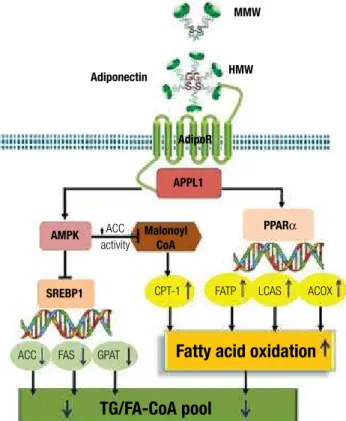
Adiponectin has been shown to stimulate AMP-activated protein kinase (AMPK) in almost all its major target tissues, including skeletal muscle, liver, heart, endothelium, adipocytes and brain (75,89,103-106). Notably, most biological effects of adiponectin in these target tissues are abrogated by expression of a domi-nant negative version of AMPK, supporting its obliga-tory role in mediating adiponectin’s multiple actions. The precise mechanisms whereby adiponectin activates AMPK through its receptors remain to be determined. APPL1, an adaptor protein containing pleckstrin ho-mology domain, phosphotyrosine binding domain and leucine zipper motif, appears to be a key signal-ing molecule that couples adiponectin receptors and its downstream AMPK activation (103,107). Adiponec-tin enhances the binding of APPL1 to both adipoR1 and adipoR2, and these interactions are essential for subsequent phosphorylation and activation of AMPK. Studies also indicate the important role of APPL1 in the metabolic syndrome (108,109). AMPK activation in turn phosphorylates acetyl Coenzyme A carboxylase (ACC) and attenuates ACC activity. Inhibition of ACC reduces lipid synthesis and enhances fatty acid oxida-tion by blocking the producoxida-tion of malonyl-CoA, an allosteric inhibitor of carnitine palmitoyl transferase 1 (CPT-1), the rate-limiting enzyme in fatty acid oxida-tion. In addition, activation of AMPK downregulates the expression of sterol regulatory element-binding protein 1c (SREBP1c), a transcription factor that regulates cholesterol and lipid synthesis. Reduction of SREBP1c results in downregulation of genes in-volved in lipogenesis, including ACC, fatty acid syn-thase (FAS), and glycerol-3-phosphate acyltransferase (GPAT) (104,110,111).
Copyright © ABE&M todos os dir
eitos r
eser
vados.
coactivator-1α (PGC-1α) (112). These signaling path-ways mediated by adiponectin lead to enhanced fat oxidation, reduced lipid synthesis and prevention of he-patic steatosis (Figure 1).
IL6 production stimulated by LPS and induces IL10 ex-pression. The attenuation of proinflammatory cytokine production by adiponectin is mediated in part by attenu-ating the translocation of NFκB to the nucleus (120). Adiponectin can also induce the expression of anti-in-flammation cytokine interleukin-1-receptor antagonist (IL-1RA) (121,122). The anti-inflammatory effects of adiponectin in macrophages may involve Toll-like recep-tor-4 (TLR-4) signaling pathway. However, the mecha-nisms by which adiponectin suppresses TLR-4 mediated responses are not well understood (123).
The transformation of hepatic stellate cells (HSC) into myofibroblasts is the key step initiating the fibrotic process during liver injury (124,125). The activated hepatic stellate cells increase the accumulation of ex-tracellular matrix. Both adiponectin receptors, adipoR1 and adipoR2, are expressed in HSC. Adiponectin treat-ment maintains HSC quiescence, inhibits platelet-de-rived growth factor (PDGF)-stimulated proliferation and migration of human HSCs, and reduces the secre-tion of monocyte chemoattractant protein-1 through AMPK-dependent mechanisms (94,125,126). Addi-tionally, adiponectin also regulates hepatic expression of TGFβ1, a pro-fibrotic factor involved in HSC acti-vation (58,127). Inhibition of adipoR2 expression by short hairpin RNAi-expressing adenovirus can induce TGFβ1 expression, and overexpression of adipoR2 di-minishes TGFβ1 mRNA level.
Regulatory role of adiponectin on mitochondria activities
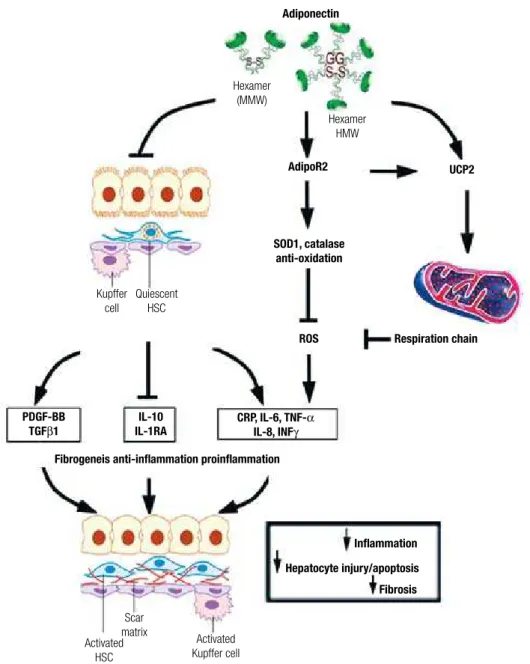
Mitochondrial dysfunction represents a central mecha-nism linking obesity with associated metabolic compli-cations (128). In patients with NASH, the hepatic mi-tochondria exhibit ultrastructural lesions and decreased activity of the respiratory chain complexes (129,130). In this condition, the decreased activity of the respira-tory chain results in accumulation of reactive oxygen species (ROS) that oxidize fat deposits to form lipid peroxidation products, which in turn, cause steatohepa-titis, necrosis, inflammation and fibrosis. The increased mitochondrial ROS formation in steatohepatitis could directly damage mitochondria DNA (mtDNA) and re-spiratory chain polypeptides, induce NFκB activation and the hepatic synthesis of TNFα (131). Oxidative phosphorylation reactions mediated by mitochondria respiratory chain (MRC) complexes are directly in-volved in regulating intracellular ROS activities and
Figure 1. A summary of multiple signaling pathways that mediate the anti-steatotic effects of adiponectin.
Adiponectin
AdipoR MMW
HMW
APPL1
Fatty acid oxidation
TG/FA-CoA pool
AMPK
SREBP1
ACC activity
CPT-1
ACC
FATP LCAS ACOX
PPARα Malonoyl
CoA
FAS GPAT
Cellular mechanisms contributing to the anti-inflammatory activities of adiponectin in NAFLD
Copyright © ABE&M todos os dir
eitos r
eser
vados.
Figure 2. A summary of multiple pathways underlying the protective effects of adiponectin against liver injury.
Adiponectin
AdipoR2
Fibrogeneis anti-inflammation proinflammation
Inflammation
Hepatocyte injury/apoptosis Fibrosis SOD1, catalase
anti-oxidation
Activated HSC
Scar matrix
Activated Kupffer cell Kupffer
cell
Quiescent HSC
Hexamer (MMW)
Hexamer HMW
UCP2
Respiration chain
CRP, IL-6, TNF-α IL-8, INFγ IL-10
IL-1RA PDGF-BB
TGFβ1
ROS
preventing accumulation of lipids and lipid peroxida-tion products in the liver.
We have found that mice without adiponectin show an increased lipid accumulation even under normal chow feeding. This pre-existing hepatic steatotic condi-tion might be the direct consequence of dysregulated mitochondria functions (117). Adiponectin treatment restores the MRC activities, decreases the levels of mi-tochondrial lipid peroxidation products through regu-lating hepatic mitochondrial functions, which might represent a common mechanism underlying the multi-ple beneficial activities of this hormone in various obe-sity-related pathologies. Moreover, we have provided
Copyright © ABE&M todos os dir
eitos r
eser
vados.
functions (Figure 2). It is known that UCP2 possesses anti-oxidant activities through inhibition of ROS pro-duction from mitochondria (132). It can also inhibit the production of pro-inflammatory cytokines in both macrophage and Kupffer cells (133). A growing body of evidence suggests that UCP2 may play a beneficial role in various stages of fatty liver diseases (133,134). These results suggest the existence of a reciprocal rela-tionship between uncoupling proteins and adiponectin. However, the detailed signaling mechanisms underly-ing adiponectin-induced UCP2 expression are not clear and warrant further investigations.
ELEVATION OF ADIPONECTIN PRODUCTION AS A
THERAPEUTIC STRATEGY FOR THE TREATMENT
OF NAFLD
To date, there have been very few effective drug treat-ments for NAFLD and NASH. Early diagnosis and management of the underlying condition remains the mainstay of treatment. The present “gold standard” for treatment of NAFLD is weight reduction or a re-duction of central obesity (4). These “life-style adjust-ment” or anti-obesity measures (including bariatric sur-gery) impressively reduce liver cell injury, inflammation and hepatic fibrosis, as well as steatosis (135,136). The potential for correcting steatosis by dietary or pharma-cological approaches should provide a sound therapeu-tic approach for the treatment of steatosis and steato-hepatitis. Strategies to block oxidative stress are of great interest, with some evidence that ALT normalization or histological improvement occurs with vitamin E (alone or with vitamin C or pioglitazone) and betaine (137). However, more definitive studies are needed before these or other antioxidants and antifibrotic agents (in-cluding silymarin) can be routinely recommended.
Adiponectin and its agonists might represent emerging therapeutic agents for the treatment and/or prevention of liver dysfunctions. Adiponectin replacement therapy is not yet available as a treatment option. Pharmacological intervention aimed at elevating adiponectin production might hold promise for the treatment and/or prevention of NAFLD. We have recently reported the identification of two structurally related natural compounds (astragalo-side II and isoastragalo(astragalo-side I) from the medicinal herb Radix Astragali that possess such an activity (138). Astra-galoside II and isoastraAstra-galoside I selectively increase adi-ponectin secretion in primary adipocytes without any ob-vious effects on a panel of other adipokines. Furthermore,
an additive effect on induction of adiponectin production has been observed between these two compounds and rosiglitazone. Chronic administration of astragaloside II and isoastragaloside I in both dietary and genetic obese mice significantly elevated serum levels of total adiponec-tin and selectively increased the composition of its high molecular weight oligomeric complex. These changes are associated with an alleviation of hyperglycemia, glucose intolerance and insulin resistance. These results suggest that pharmacological elevation of circulating adiponectin alone is sufficient to ameliorate insulin resistance and dia-betes. The two natural compounds might also provide the lead as a novel class of therapeutics for obesity-related diseases, such as NAFLD.
CONCLUSION REMARKS
Adiponectin is an abundant adipocyte-derived hormone with well established anti-inflammatory and insulin sen-sitizing properties. The significance of adiponectin in protecting obesity-related NAFLD has been increasing-ly recognized. Despite the knowldege advances made in recent years, the detailed molecular and cellular mecha-nisms underlying its hepato-protective functions remain largely uncharacterized. Nevertheless, adiponectin-based therapeutics for NAFLD represent a promising area for further investigation.
Acknowledgement: Research in the author’s laboratory is sup-ported by grants from Research Grants Council of Hong Kong (Project number 777908, 778007 and 7645/06M).
Disclosure: No potential conflict of interest relevant to this article was reported.
REFERENCES
Angulo P. Nonalcoholic fatty liver disease. N Engl
1. J Med. 2002; 346(16):1221-31.
Farrell GC. Non-alcoholic steatohepatitis: what is it, and why is 2.
it important in the Asia-Pacific region? J Gastroenterol Hepatol. 2003;18(2):124-38.
Matteoni CA, Younossi ZM, Gramlich T, Boparai N, Liu YC, Mc-3.
Cullough AJ. Nonalcoholic fatty liver disease: a spectrum of clinical and pathological severity. Gastroenterology. 1999;116(6):1413-9. Farrell GC, Larter CZ. Nonalcoholic fatty liver disease: from stea-4.
tosis to cirrhosis. Hepatology. 2006;43(2 Suppl 1): S99-S112. Adams LA, Angulo P. Recent concepts in non-alcoholic fatty liver 5.
disease. Diabet Med. 2005;22(9):1129-33.
Ong JP, Pitts A, Younossi ZM. Increased overall mortality and 6.
liver-related mortality in non-alcoholic fatty liver disease. J He-patol. 2008;49(4):608-12.
Targher G, Marra F, Marchesini G. Increased risk of cardiovascu-7.
Copyright © ABE&M todos os dir
eitos r
eser
vados.
Watanabe S, Yaginuma R, Ikejima K, Miyazaki A. Liver diseases 8.
and metabolic syndrome. J Gastroenterol. 2008;43(7):509-18. Machado M, Cortez-Pinto H. Non-alcoholic steatohepatitis 9.
and metabolic syndrome. Curr Opin Clin Nutr Metab Care. 2006;9(5):637-42.
Shibata M, Kihara Y, Taguchi M, Tashiro M, Otsuki M. Nonalcoho-10.
lic fatty liver disease is a risk factor for type 2 diabetes in middle-aged Japanese men. Diabetes Care. 2007;30(11):2940-4. Machado M, Cortez-Pinto H. Non-alcoholic fatty liver disease and 11.
insulin resistance. Eur J Gastroenterol Hepatol; 2005;17(8):823-6. Mehta K, Van Thiel DH, Shah N, Mobarhan S. Nonalcoholic fatty 12.
liver disease: pathogenesis and the role of antioxidants. Nutr Rev. 2002;60(9):289-93.
Gastaldelli A, Cusi K, Pettiti M, Hardies J, Miyazaki Y, Berria R, et 13.
al. Relationship between hepatic/visceral fat and hepatic insulin resistance in nondiabetic and type 2 diabetic subjects. Gastroen-terology. 2007;133(2):496-506.
Vuguin P, Raab E, Liu B, Barzilai N, Simmons R. Hepatic insulin 14.
resistance precedes the development of diabetes in a model of intrauterine growth retardation. Diabetes. 2004;53(10):2617-22. Blaak EE. Fatty acid metabolism in obesity and type 2 diabetes 15.
mellitus. Proc Nutr Soc. 2003;62(3);753-60.
DeFronzo RA, Gunnarsson R, Björkman O, Olsson M, Wahren J. 16.
Effects of insulin on peripheral and splanchnic glucose metabo-lism in noninsulin-dependent (type II) diabetes mellitus. J Clin Invest. 1985;76(1):149-55.
Banerji MA, Buckley MC, Chaiken RL, Gordon D, Lebovitz HE, Kral 17.
JG. Liver fat, serum triglycerides and visceral adipose tissue in insulin-sensitive and insulin-resistant black men with NIDDM. Int J Obes Relat Metab Disord. 1995;19(12):846-50.
Holland WL, Brozinick JT, Wang LP, Hawkins ED, Sargent KM, Liu 18.
Y, et al. Inhibition of ceramide synthesis ameliorates glucocorti-coid-, saturated-fat-, and obesity-induced insulin resistance. Cell Metab. 2007;5(3):167-79.
Kelley DE, McKolanis TM, Hegazi RA, Kuller LH, Kalhan SC. Fatty 19.
liver in type 2 diabetes mellitus: relation to regional adiposity, fat-ty acids, and insulin resistance. Am J Physiol Endocrinol Metab. 2003;285(4):E906-16.
Assimacopoulos-Jeannet F, Brichard S, Rencurel F, Cusin I, Jean-20.
renaud B. In vivo effects of hyperinsulinemia on lipogenic enzy-mes and glucose transporter expression in rat liver and adipose tissues. Metabolism. 1995;44(2):228-33.
Minehira K, Young SG, Villanueva CJ, Yetukuri L, Oresic M, Hel-21.
lerstein MK, et al. Blocking VLDL secretion causes hepatic steato-sis but does not affect peripheral lipid stores or insulin sensitivity in mice. J Lipid Res. 2008;49(9):2038-44.
Grefhorst A, Hoekstra J, Derks TG, Ouwens DM, Baller JF, Ha-22.
vinga R, et al. Acute hepatic steatosis in mice by blocking beta-oxidation does not reduce insulin sensitivity of very-low-density lipoprotein production. Am J Physiol Gastrointest Liver Physiol. 2005;289(3):G592-8.
Dentin R, Benhamed F, Hainault I, Fauveau V, Foufelle F, Dyck 23.
JR, et al. Liver-specific inhibition of ChREBP improves hepa-tic steatosis and insulin resistance in ob/ob mice. Diabetes. 2006;55(8):2159-70.
Day CP, James OF. Steatohepatitis: a tale of two “hits”? Gastroen-24.
terology. 1998;114(4):842-5.
Brunt EM. Nonalcoholic steatohepatitis. Semin Liver Dis. 25.
2004;24(1):3-20.
Charlton M. Noninvasive indices
26. of fibrosis in NAFLD: starting to think about a three-hit (at least) phenomenon. Am J Gastroente-rol. 2007;102(2):409-11.
de Luca C, Olefsky JM. Inflammation and insulin resistance. FEBS 27.
Lett. 2008;582(1):97-105.
Liou I,
28. Kowdley KV. Natural history of nonalcoholic steatohepati-tis. J Clin Gastroenterol. 2006;40 Suppl 1:S11-6.
Feldstein AE, Werneburg NW, Canbay A, Guicciardi ME, Bronk 29.
SF, Rydzewski R, et al. Free fatty acids promote hepatic lipotoxici-ty by stimulating TNF-alpha expression via a lysosomal pathway. Hepatology. 2004;40(1):185-94.
Jeong SK, Kim YK, Park JW, Shin YJ, Kim DS. Impact of visceral 30.
fat on the metabolic syndrome and nonalcoholic fatty liver disea-se. J Korean Med Sci. 2008;23(5):789-95.
van der Poorten D, Milner KL, Hui J, Hodge A, Trenell MI, Kench 31.
JG, et al. Visceral fat: a key mediator of steatohepatitis in meta-bolic liver disease. Hepatology. 2008;48(2):449-57.
Jakobsen MU, Berentzen T, Sørensen TI, Overvad K. Abdominal 32.
obesity and fatty liver. Epidemiol Rev. 2007;29:77-87.
Song HR, Yun KE, Park HS. Relation between alanine ami-33.
notransferase concentrations and visceral fat accumulation among nondiabetic overweight Korean women. Am J Clin Nutr. 2008;88(1):16-21.
Koda M, Kawakami M, Murawaki Y, Senda M. The impact of vis-34.
ceral fat in nonalcoholic fatty liver disease: cross-sectional and longitudinal studies. J Gastroenterol. 2007;42(11):897-903. Gabriely I, Barzilai N. Surgical removal of visceral adipose tissue: 35.
effects on insulin action. Curr Diab Rep. 2003;3(3):201-6. Antuna-Puente B, Feve B, Fellahi S, Bastard JP. Adipokines: the 36.
missing link between insulin resistance and obesity. Diabetes Metab. 2008;34(1):2-11.
Kamada Y, Takehara T, Hayashi N. Adipocytokines and liver disea-37.
se. J Gastroenterol. 2008;43(11):811-22.
Tilg H, Hotamisligil GS. Nonalcoholic fatty liver disease: Cytoki-38.
ne-adipokine interplay and regulation of insulin resistance. Gas-troenterology. 2006;131(3):934-45.
Javor ED, Ghany MG, Cochran EK, Oral EA, DePaoli AM, Premku-39.
mar A, et al. Leptin reverses nonalcoholic steatohepatitis in pa-tients with severe lipodystrophy. Hepatology. 2005;41(4):753-60. Javor ED, Cochran EK, Musso C, Young JR, Depaoli AM, Gorden 40.
P. Long-term efficacy of leptin replacement in patients with gene-ralized lipodystrophy. Diabetes. 2005;54(7):1994-2002.
Huang XD, Fan Y, Zhang H, Wang P, Yuan JP, Li MJ, Zhan XY. Se-41.
rum leptin and soluble leptin receptor in non-alcoholic fatty liver disease. World J Gastroenterol., 2008;14(18):2888-93.
Kim IK, Kim J, Kang JH, Song J. Serum Leptin as a Predictor 42.
of Fatty Liver in 7-Year-Old Korean Children. Ann Nutr Metab. 2008;53(2):109-16.
Marra F. Leptin and liver tissue repair: do rodent models provide 43.
the answers? J Hepatol. 2007;46(1):12-8. Crespo J, Cayón A, Fernánd
44. ez-Gil P, Hernández-Guerra M, Mayor-ga M, Domínguez-Díez A, et al. Gene expression of tumor necro-sis factor alpha and TNF-receptors, p55 and p75, in nonalcoholic steatohepatitis patients. Hepatology. 2001;34(6):1158-63. Ribeiro PS, Cortez-Pinto H, Solá S, Castro RE, Ramalho RM, 45.
Baptista A, et al. Hepatocyte apoptosis, expression of death re-ceptors, and activation of NF-kappaB in the liver of nonalcoho-lic and alcohononalcoho-lic steatohepatitis patients. Am J Gastroenterol. 2004;99(9):1708-17.
Younossi ZM, Jarrar M, Nugent C, Randhawa M, Afendy M, Stepano-46.
va M, et al. A novel diagnostic biomarker panel for obesity-related no-nalcoholic steatohepatitis (NASH). Obes Surg. 2008;18(11):1430-7. Li Z, Yang S, Lin H, Huang J, Watkins PA, Moser AB, et al. Probiotics 47.
and antibodies to TNF inhibit inflammatory activity and improve nonalcoholic fatty liver disease. Hepatology. 2003;37(2):343-50. Deng QG, She H, Cheng JH, French SW, Koop DR, Xiong S, Tsuka-48.
Copyright © ABE&M todos os dir
eitos r
eser
vados.
Schnyder-Candrian S, Czarniecki J, Lerondel S, Corpataux J, 49.
Ryffel B, Schnyder B. Hepatic steatosis in the absence of tumor necrosis factor in mice. Cytokine. 2005;32(6):287-95.
Trujillo ME, Scherer PE. Adiponectin--journey from an adipocyte 50.
secretory protein to biomarker of the metabolic syndrome. J In-tern Med. 2005;257(2):167-75.
Lopez-Bermejo A, Botas-Cervero P, Ortega-Delgado F, Delgado 51.
E, García-Gil MM, Funahashi T, et al. Adiponectin, hepatocellu-lar dysfunction and insulin sensitivity. Clin Endocrinol (Oxf). 2004;60(2):256-63.
Hui JM, Hodge A, Farrell GC, Kench JG, Kriketos A, George J. 52.
Beyond insulin resistance in NASH: TNF-alpha or adiponectin? Hepatology. 2004;40(1):46-54.
Shimada M, Kawahara H, Ozaki K, Fukura M, Yano H, Tsuchishi-53.
ma M, et al. Usefulness of a combined evaluation of the serum adiponectin level, HOMA-IR, and serum type IV collagen 7S level to predict the early stage of nonalcoholic steatohepatitis. Am J Gastroenterol. 2007;102(9):1931-8.
Musso G, Gambino R, Biroli G, Carello M, Fagà E, Pacini G, et 54.
al. Hypoadiponectinemia predicts the severity of hepatic fibrosis and pancreatic Beta-cell dysfunction in nondiabetic nonobese patients with nonalcoholic steatohepatitis. Am J Gastroenterol. 2005;100(11):2438-46.
Aygun C, Senturk O, Hulagu S, Uraz S, Celebi A, Konduk T, et al. Se-55.
rum levels of hepatoprotective peptide adiponectin in non-alcoholic fatty liver disease. Eur J Gastroenterol Hepatol. 2006;18(2):175-80. Bajaj M, Suraamornkul S, Piper P, Hardies LJ, Glass L, Cersosimo 56.
E, et al. Decreased plasma adiponectin concentrations are clo-sely related to hepatic fat content and hepatic insulin resistance in pioglitazone-treated type 2 diabetic patients. J Clin Endocrinol Metab. 2004;89(1):200-6.
Ikejima K, Okumura K, Kon K, Takei Y, Sato N. Role of adipocytoki-57.
nes in hepatic fibrogenesis. J Gastroenterol Hepatol. 2007;22 Suppl 1:S87-92.
Kamada Y, Tamura S, Kiso S, Matsumoto H, Saji Y, Yoshida Y, et 58.
al. Enhanced carbon tetrachloride-induced liver fibrosis in mice lacking adiponectin. Gastroenterology. 2003;125(6):1796-807. Masaki T, Chiba S, Tatsukawa H, Yasuda T, Noguchi H, Seike M, 59.
Yoshimatsu H. Adiponectin protects LPS-induced liver injury throu-gh modulation of TNF-alpha in KK-Ay obese mice. Hepatology. 2004;40(1):177-84.
Matsum
60. oto H, Tamura S, Kamada Y, Kiso S, Fukushima J, Wada A, et al. Adiponectin deficiency exacerbates lipopolysaccharide/ D-galactosamine-induced liver injury in mice. World J Gastroen-terol. 2006;12(21):3352-8.
Thakur V, Pritchard MT, McMullen MR, Nagy LE. Adiponectin nor-61.
malizes LPS-stimulated TNF-alpha production by rat Kupffer cells after chronic ethanol feeding. Am J Physiol Gastrointest Liver Physiol. 2006;290(5):G998-1007.
Xu A , Wang Y, Keshaw H, Xu LY, Lam KS, Cooper GJ. The fat-de-62.
rived hormone adiponectin alleviates alcoholic and nonalcoholic fatty liver diseases in mice. J Clin Invest. 2003;112(1):91-100. Kamada Y, Matsumoto H, Tamura S, Fukushima J, Kiso S, Fukui 63.
K, et al. Hypoadiponectinemia accelerates hepatic tumor forma-tion in a nonalcoholic steatohepatitis mouse model. J Hepatol. 2007;47:556-64.
Hu E, Liang P, Spiegelman BM. AdipoQ is a novel adipose-specific 64.
gene dysregulated in obesity. J Biol Chem. 1996;271:10697-703. Maeda K, Okubo K, Shimomura I, Funahashi T, Matsuzawa Y, 65.
Matsubara K. cDNA cloning and expression of a novel adipose specific collagen-like factor, apM1 (AdiPose Most abundant Gene transcript 1). Biochem Biophys Res Commun. 1996;221:286-9. Nakano Y, Tobe T, Choi-Miura
66. NH, Mazda T, Tomita M. Isolation and characterization of GBP28, a novel gelatin-binding protein purified from human plasma. J Biochem. 1996;120:803-12.
Scherer PE, Williams S, Fogliano M, Baldini G, Lodish HF. A novel 67.
serum protein similar to C1q, produced exclusively in adipocytes. J Biol Chem. 1995;270:26746-9.
Kadowaki T, Yamauchi T, Kubota N, Hara K, Ueki K, Tobe K. Adipo-68.
nectin and adiponectin receptors in insulin resistance, diabetes, and the metabolic syndrome. J Clin Invest. 2006;116:1784-92. Lam KS, Xu A. Adiponectin: protection of the endothelium. Curr 69.
Diab Rep. 2005;5:254-9.
Yamauchi T, Hara K, Kubota N, Terauchi Y, Tobe K, Froguel P, et al. 70.
Dual roles of adiponectin/Acrp30 in vivo as an anti-diabetic and anti-atherogenic adipokine. Curr Drug Targets Immune Endocr Metabol Disord. 2003;3:243-54.
Zhu W, Cheng KK, Vanhoutte PM, Lam KS, Xu A. Vascular effects 71.
of adiponectin: molecular mechanisms and potential therapeutic intervention. Clin Sci (Lond). 2008;114:361-74.
Oh DK, Ciaraldi T, Henry RR. Adiponectin in health and disease. 72.
Diabetes Obes Metab. 2007;9:282-9.
Wang Y, Lam KS, Yau MH, Xu A. Post-translational modifications 73.
of adiponectin: mechanisms and functional implications. Bio-chem J. 2008;409:623-33.
Tsao TS, Murrey HE, Hug C, Lee DH, Lodish HF. Oligomerization 74.
state-dependent activation of NF-kappa B signaling pathway by adipocyte complement-related protein of 30 kDa (Acrp30). J Biol Chem. 2002;277:29359-62.
Tsao TS, Tomas E, Murrey HE, Hug C, Lee DH, Ruderman NB, et 75.
al. Role of disulfide bonds in Acrp30/adiponectin structure and signaling specificity. Different oligomers activate different signal transduction pathways. J Biol Chem. 2003;278:50810-7.
Waki H, Yamauchi T, Kamon J, Ito Y, Uchida S, Kita S, et al. Im-76.
paired multimerization of human adiponectin mutants associa-ted with diabetes. Molecular structure and multimer formation of adiponectin. J Biol Chem. 2003;278:40352-63.
Xu A, Chan KW, Hoo RL, Wang Y, Tan KC, Zhang J, et al. Testos-77.
terone selectively reduces the high molecular weight form of adi-ponectin by inhibiting its secretion from adipocytes. J Biol Chem. 2005;280:18073-80.
Richards AA, Stephens T, Charlton HK, Jones A, Macdonald GA, 78.
Prins JB, Whitehead JP. Adiponectin multimerization is depen-dent on conserved lysines in the collagenous domain: evidence for regulation of multimerization by alterations in posttranslatio-nal modifications. Mol Endocrinol. 2006;20:1673-87.
Pajvani UB, Du X, Combs TP, Berg AH, Rajala MW, Schulthess T, 79.
et al. Structure-function studies of the adipocyte-secreted hormo-ne Acrp30/adipohormo-nectin. Implications fpr metabolic regulation and bioactivity. J Biol Chem. 2003;278:9073-85.
Wang Y, Xu A, Knight C, Xu LY, Cooper GJ. Hydroxylation and 80.
glycosylation of the four conserved lysine residues in the collage-nous domain of adiponectin. Potential role in the modulation of its insulin-sensitizing activity. J Biol Chem. 2002;277:19521-9. Pajvani UB, Hawkins M, Combs TP, Rajala MW, Doebber T, Berger 81.
JP, et al. Complex distribution, not absolute amount of adiponec-tin, correlates with thiazolidinedione-mediated improvement in insulin sensitivity. J Biol Chem. 2004;279:12152-62.
Suzuki S, Wilson-Kubalek EM, Wert D, Tsao TS, Lee DH. The oli-82.
gomeric structure of high molecular weight adiponectin. FEBS Lett. 2007;581:809-14.
Radjainia M, Wang Y, Mitra AK. Structural polymorphism of oli-83.
gomeric adiponectin visualized by electron microscopy. J Mol Biol. 2008;381:419-30.
Bobbert T, Rochlitz H, Wegewitz U, Akpulat S, Mai K, Weickert 84.
MO, et al. Changes of adiponectin oligomer composition by mo-derate weight reduction. Diabetes. 2005;54:2712-9.
Salani B, Briatore L, Andraghetti G, Adami GF, Maggi D, Cordera 85.
bi-Copyright © ABE&M todos os dir
eitos r
eser
vados.
liopancreatic diversion in obese subjects. Obesity (Silver Spring). 2006;14:1511-4.
Swarbrick MM, Austrheim-Smith IT, Stanhope KL, Van Loan MD, 86.
Ali MR, Wolfe BM et al. Circulating concentrations of high-mole-cular-weight adiponectin are increased following Roux-en-Y gas-tric bypass surgery. Diabetologia. 2006;49:2552-8.
Liu Y, Retnakaran R, Hanley A, Tungtrongchitr R, Shaw C, Swee-87.
ney G. Total and high molecular weight but not trimeric or hexa-meric forms of adiponectin correlate with markers of the metabo-lic syndrome and liver injury in Thai subjects. J Clin Endocrinol Metab. 2007;92:4313-8.
Berg AH, Combs TP, Du X, Brownlee M, Scherer PE. The adi-88.
pocyte-secreted protein Acrp30 enhances hepatic insulin action. Nat Med. 2001;7:947-53.
Wang Y, Lam KS, Chan L, Chan KW, Lam JB, Lam MC, et al. Post-89.
translational modifications of the four conserved lysine residues within the collagenous domain of adiponectin are required for the formation of its high molecular weight oligomeric complex. J Biol Chem. 2006;281:16391-400.
Kubota N, Terauchi Y, Kubota T, Kumagai H, Itoh S, Satoh H, et 90.
al. Pioglitazone ameliorates insulin resistance and diabetes by both adiponectin-dependent and -independent pathways. J Biol Chem. 2006;281:8748-55.
Nawrocki AR, Rajala MW, Tomas E, Pajvani UB, Saha AK, Trum-91.
bauer ME, et al. Mice lacking adiponectin show decreased hepa-tic insulin sensitivity and reduced responsiveness to peroxisome proliferator-activated receptor gamma agonists. J Biol Chem. 2006;281:2654-60.
Wang Y, Lu G, Wong WP, Vliegenthart JF, Gerwig GJ, Lam KS, 92.
et al. Proteomic and functional characterization of endogenous adiponectin purified from fetal bovine serum. Proteomics. 2004;4:3933-42.
Neumeier M, Sigruener A, Eggenhofer E, Weigert J, Weiss TS, 93.
Schaeffler A, et al. High molecular weight adiponectin reduces apolipoprotein B and E release in human hepatocytes. Biochem Biophys Res Commun. 2007;352:543-8.
Adachi M, Brenner DA. High molecular weight adiponectin inhi-94.
bits proliferation of hepatic stellate cells via activation of ade-nosine monophosphate-activated protein kinase. Hepatology. 2008;47:677-85.
Kadowaki T, Yamauchi T. Adiponectin and adiponectin receptors. 95.
Endocr Rev. 2005;26:439-51.
Kadowaki T, Yamauchi T, Kubota N. The physiological and pa-96.
thophysiological role of adiponectin and adiponectin receptors in the peripheral tissues and CNS. FEBS Lett. 2008;582:74-80. Yamauchi T, Nio Y, Maki T, Kobayashi M, Takazawa T, Iwabu M, 97.
et al. Targeted disruption of AdipoR1 and AdipoR2 causes abro-gation of adiponectin binding and metabolic actions. Nat Med. 2007;13:332-9.
Liu Y, Michael MD, Kash S, Bensch WR, Monia BP, Murray SF, 98.
et al. Deficiency of adiponectin receptor 2 reduces diet-induced insulin resistance but promotes type 2 diabetes. Endocrinology. 2007;148:683-92.
Kaser S, Moschen A, Cayon A, Kaser A, Crespo J, Pons-Romero 99.
F, et al. Adiponectin and its receptors in non-alcoholic steatohe-patitis. Gut. 2005;54:117-21.
Nannipieri M, Cecchetti F, Anselmino M, Mancini E, Marchetti G, 100.
Bonotti A, et al. Pattern of expression of adiponectin receptors in human liver and its relation to nonalcoholic steatohepatitis. Obes Surg. 2008;oct 16 [Epub ahead of print].
Uribe M, Zamora-Valdés D, Moreno-Portillo M, Bermejo-Martínez 101.
L, Pichardo-Bahena R, Baptista-González HA, et al. Hepatic ex-pression of ghrelin and adiponectin and their receptors in patients with nonalcoholic fatty liver disease. Ann Hepatol. 2008;7:67-71.
Vuppa
102. lanchi R, Marri S, Kolwankar D, Considine RV, Chalasani N. Is adiponectin involved in the pathogenesis of nonalcoholic ste-atohepatitis? A preliminary human study. J Clin Gastroenterol. 2005;39:237-42.
Cheng KK, Lam KS, Wang Y, Huang Y, Carling D, Wu D, et al. 103.
Adiponectin-induced endothelial nitric oxide synthase activation and nitric oxide production are mediated by APPL1 in endothelial cells. Diabetes. 2007;56:1387-94.
Yamauchi T, Kamon J, Minokoshi Y, Ito Y, Waki H, Uchida S, et 104.
al. Adiponectin stimulates glucose utilization and fatty-acid oxi-dation by activating AMP-activated protein kinase. Nat Med. 2002;8:1288-95.
Shibata R, Ouchi N, Ito M, Kihara S, Shiojima I, Pimentel DR, et al. 105.
Adiponectin-mediated modulation of hypertrophic signals in the heart. Nat Med. 2004;10:1384-9.
Kubota N, Yano W, Kubota T, Yamauchi T, Itoh S, Kumagai H, et al. 106.
Adiponectin stimulates AMP-activated protein kinase in the hypo-thalamus and increases food intake. Cell Metab. 2007;6:55-68. Mao X, Kikani CK, Riojas RA, Langlais P, Wang L, Ramos FJ, et al. 107.
APPL1 binds to adiponectin receptors and mediates adiponectin signalling and function. Nat Cell Biol. 2006;8:516-23.
Chandrasekar B, Boylston WH, Venkatachalam K, Webster NJ, 108.
Prabhu SD, Valente AJ. Adiponectin blocks interleukin-18-media-ted endothelial cell death via APPL1-dependent AMP-activainterleukin-18-media-ted protein kinase (AMPK) activation and IKK/NF-kappaB/PTEN sup-pression. J Biol Chem. 2008;283:24889-98.
Saito T, Jones CC, Huang S, Czech MP, Pilch PF. The interaction of 109.
Akt with APPL1 is required for insulin-stimulated Glut4 transloca-tion. J Biol Chem. 2007;282:32280-7.
Woods A, Azzout-Marniche D, Foretz M, Stein SC, Lemarchand P, 110.
Ferré P, et al. Characterization of the role of AMP-activated pro-tein kinase in the regulation of glucose-activated gene expression using constitutively active and dominant negative forms of the kinase. Mol Cell Biol. 2000;20:6704-11.
Tomita K, Tamiya G, Ando S, Kitamura N, Koizumi H, Kato S, 111.
et al. AICAR, an AMPK activator, has protective effects on al-cohol-induced fatty liver in rats. Alcohol Clin Exp Res. 2005;29 Suppl12:240S-5S.
You M, Considine RV, Leone TC, Kelly DP, Crabb DW. Role of adi-112.
ponectin in the protective action of dietary saturated fat against alcoholic fatty liver in mice. Hepatology. 2005;42:568-77. Carter-Kent C, Zein NN, Feldstein AE. Cytokines in the pathogene-113.
sis of fatty liver and disease progression to steatohepatitis: impli-cations for treatment. Am J Gastroenterol. 2008;103:1036-42. Choi KM, Ryu OH, Lee KW, Kim HY, Seo JA, Kim SG, et al. Serum 114.
adiponectin, interleukin-10 levels and inflammatory markers in the metabolic syndrome. Diabetes Res Clin Pract. 2007;75:235-40. Engeli S, Feldpausch M, Gorzelniak K, Hartwig F, Heintze U, Janke 115.
J, et al. Association between adiponectin and mediators of in-flammation in obese women. Diabetes. 2003;52:942-7.
Park PH, Thakur V, Pritchard MT, McMullen MR, Nagy LE. Regula-116.
tion of Kupffer cell activity during chronic ethanol exposure: role of adiponectin. J Gastroenterol Hepatol. 2006;21 Suppl 3:S30-3. Zhou M, Xu A, Tam PK, Lam KS, Chan L, Hoo RL, et al. Mito-117.
chondrial dysfunction contributes to the increased vulnerabi-lities of adiponectin knockout mice to liver injury. Hepatology. 2008;48:1087-96.
Choi
118. S, Diehl AM. Role of inflammation in nonalcoholic steatohe-patitis. Curr Opin Gastroenterol. 2005;21:702-7.
Jarrar MH, Baranova A, Collantes R, Ranard B, Stepanova M, Ben-119.
nett C, et al. Adipokines and cytokines in non-alcoholic fatty liver disease. Aliment Pharmacol Ther. 2008;27:412-21.
Wulster-Radcliffe MC, Ajuwon KM, Wang J, Christian JA, Spurlo-120.
Copyright © ABE&M todos os dir
eitos r
eser
vados.
Kumada M, Kihara S, Ouchi N, Kobayashi H, Okamoto Y, Ohashi 121.
K, et al. Adiponectin specifically increased tissue inhibitor of metalloproteinase-1 through interleukin-10 expression in human macrophages. Circulation. 2004;109:2046-9.
Wolf AM, Wolf D, Rumpold H, Enrich B, Tilg H. Adiponectin indu-122.
ces the anti-inflammatory cytokines IL-10 and IL-1RA in human leukocytes. Biochem Biophys Res Commun. 2004;323:630-5. Yamaguchi N, Argueta JG, Masuhiro Y, Kagishita M, Nonaka K, 123.
Saito T, et al. Adiponectin inhibits Toll-like receptor family-indu-ced signaling. FEBS Lett. 2005;579:6821-6.
Bertolani C, Marra F. The role of adipokines in liver fibrosis. Pa-124.
thophysiology. 2008;15:91-101.
Ding X, Saxena NK, Lin S, Xu A, Srinivasan S, Anania FA. The ro-125.
les of leptin and adiponectin: a novel paradigm in adipocytokine regulation of liver fibrosis and stellate cell biology. Am J Pathol. 2005;166:1655-69.
Caligiuri A, Bertolani C, Guerra CT, Aleffi S, Galastri S, Trappolie-126.
re M, et al. Adenosine monophosphate-activated protein kinase modulates the activated phenotype of hepatic stellate cells. He-patology. 2008;47:668-76.
Tomita K, Oike Y, Teratani T, Taguchi T, Noguchi M, Suzuki T, 127.
et al. Hepatic AdipoR2 signaling plays a protective role against progression of nonalcoholic steatohepatitis in mice. Hepatology. 2008;48:458-73.
Parish R, Petersen KF. Mitochondrial dysfunction and type 2 dia-128.
betes. Curr Diab Rep. 2005;5:177-83.
Perez-Carreras M, Del Hoyo P, Martín MA, Rubio JC, Martín A, 129.
Castellano G, et al. Defective hepatic mitochondrial respiratory chain in patients with nonalcoholic steatohepatitis. Hepatology. 2003;38:999-1007.
Sanyal AJ, Campbell-Sargent C, Mirshahi F, Rizzo WB, Contos 130.
MJ, Sterling RK, et al. Nonalcoholic steatohepatitis: association of insulin resistance and mitochondrial abnormalities. Gastroen-terology. 2001;120:1183-92.
Fromenty B, Robin MA, Igoudjil A, Mansouri A, Pessayre D. The 131.
ins and outs of mitochondrial dysfunction in NASH. Diabetes Me-tab. 2004;30:121-38.
Negre-Salvayre A, Hirtz C, Carrera G, Cazenave R, Troly M, Salvayre 132.
R, et al. A role for uncoupling protein-2 as a regulator of mitochon-drial hydrogen peroxide generation. FASEB J. 1997;11:809-15. Bai Y, Onuma H, Bai X, Medvedev AV, Misukonis M, Weinberg 133.
JB, et al. Persistent nuclear factor-kappa B activation in Ucp2-/- mice leads to enhanced nitric oxide and inflammatory cytokine production. J Biol Chem. 2005;280:19062-9.
Baffy G. Uncoupling protein-2 and non-alcoholic fatty liver disea-134.
se. Front Biosci. 2005;10:2082-96.
Petersen KF, Dufour S, Befroy D, Lehrke M, Hendler RE, Shulman 135.
GI. Reversal of nonalcoholic hepatic steatosis, hepatic insulin resistance, and hyperglycemia by moderate weight reduction in patients with type 2 diabetes. Diabetes. 2005;54:603-8.
Dixon JB, Bhathal PS, Hughes NR, O’Brien PE. Nonalcoholic fatty 136.
liver disease: Improvement in liver histological analysis with wei-ght loss. Hepatology. 2004;39:1647-54.
Angulo P. Current best treatment fo
137. r non-alcoholic fatty liver dise-ase. Expert Opin Pharmacother. 2003;4:611-23.
Xu A, Wang H, Hoo RL, Sweeney G, Vanhoutte PM, Wang Y, et 138.