Licenciado sob uma Licença Creative Commons DO): http://dx.doi.org. . / - . . .AO
[T]
Use of custom insoles for redistributing plantar
pressure, decreasing musculoskeletal pain and
reducing postural changes in obese adults
[)]
Uso da palmilha para redistribuir a pressão plantar,
diminuir a dor musculoesquelética e reduzir as
alterações posturais em adultos obesos
[A]
Elisa Isis Ferreira[a], Carlos Alberto Vargas Ávila[b], Marco Fabio Mastroeni[c]*
[a] Associação Catarinense de Ensino ACE , Departamento de Fisioterapia, Joinville, SC, Brazil
[b] Fundação Universidade Regional de Blumenau FURB , Departamento de Educação Física, Blumenau, SC, Brazil [c] Universidade da Região de Joinville Univille , Joinville, SC, Brazil
[R]
Abstract
Introduction: )nsoles are used for different purposes and they can be an additional factor aiding weight loss in obese people due to their contribution in reducing musculoskeletal pain. Objective: The aim of the present study was to assess the effect of custom insoles for redistributing plantar pressure, decreasing musculoskeletal pain and reducing postural changes in obese adults. Materials and methods: Data was obtained from morbidly obese people, who had a Body Mass )ndex BM) ≥ and < kg/m², at three moments: before the insole was provided, immediately after insole use began and after two months of use. Anthropometric, postural, musculoskeletal pain and computerized baropodometry data were collected.
Results: When comparing the stages before the use of the insole and after two months of use, significant p < . decreases were observed in the number of people with right lateral postural misalignment, in the
* E)F: MSc, e-mail: [email protected] CAVA: MSc, e-mail: [email protected]
intensity of the musculoskeletal pain of the body segments evaluated except for the right knee , and in the mean of the peak plantar pressure values. )n terms of total plantar contact area, the mean increased signifi-cantly p < . in both right and left feet after the intervention. Conclusion: This study demonstrated that the daily use of proprioceptive insoles contributed to reducing peak plantar pressure, musculoskeletal pain and lateral postural deviations. The use of proprioceptive insoles may be an important strategy to encour-age obese people to exercise and, consequently, reduce weight.
[P]
Keywords: Plantar pressure. Excess weight. Rehabilitation. Musculoskeletal pain. Posture. [B]
Resumo
Introdução: Palmilhas têm sido utilizadas por diferentes razões, e podem auxiliar na perda de peso em pessoas obesas por contribuírem na redução da dor musculoesquelética. Objetivos: O objetivo do presente estudo foi avaliar o efeito da palmilha na redistribuição da pressão plantar, na diminuição da dor musculoesquelética e na redução das alterações posturais em adultos obesos. Materiais e métodos: Os dados foram obtidos de pacientes com obesidade mórbida e Índice de Massa Corporal (IMC) ≥ 35 e < 45 kg/m², em três diferentes momentos: antes do fornecimento da palmilha, imediatamente após o uso da palmilha e após dois meses de uso da palmilha. Foram coletados dados relacionados à antropometria, postura, dor musculoesquelética e baropodometria computado-rizada. Resultados: Quando comparadas as etapas antes do uso das palmilhas e após dois meses de uso, houve redução significativa (p < 0,05) no número de indivíduos com desvio lateral direito, na intensidade da dor mus-culoesquelética dos segmentos corporais avaliados (exceto para o joelho direito) e nos valores médios dos picos de pressão plantar. No que tange à área total de contato plantar, sua média aumentou de forma significativa (p < 0,05) em ambos os pés, direito e esquerdo, após a intervenção. Conclusão: Este estudo demonstrou que o uso diário de palmilhas proprioceptivas contribuiu na redução dos picos de pressão plantar, da dor musculoesquelé-tica e dos desvios posturais laterais. O uso de palmilhas proprioceptivas pode ser uma importante estratégia para estimular indivíduos obesos a praticarem exercícios e, consequentemente, reduzirem seu peso. [K]
Palavras-chave: Pressão plantar. Excesso de peso. Reabilitação. Dor musculoesquelética. Postura.
Introduction
Obesity is a chronic non-transmissible disease that causes several morphophysiological changes in the subject, including the adaptation of the musculoskel-etal system, as a result of the excess body weight . Excess weight negatively affects the joints of the lower limbs and can cause their misalignment , metatar-salgia , osteoarthritis , , limitations in muscle strength, decreased mobility, and altered position-ing of the feet, which affects the posture .Obesity also increases the ground contact area of the feet, altering the plantar pressure distribution and induc-ing pressure peaks in certain parts of the foot , . The peak plantar pressure is the highest pressure registered on each part of the foot, and its evaluation provides a strong clinical tool for understanding the structural and functional consequences of obesity . Custom insoles provide an interface between the
215 Materials and methods
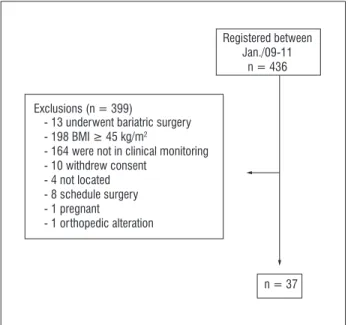
The convenience sample was constituted by indi-viduals registered in an association for morbidly obese people in Joinville, Santa Catarina state, Brazil, who had a Body Mass )ndex BM) ≥ and < kg/m and were receiving clinical monitoring prior to bariat-ric surgery in the period between January and January . Thirty-seven subjects were selected and composed the study sample Figure .
the insoles and were evaluated again through postural analysis and baropodometry. )n addition to the insoles, each volunteer also received a form to record the num-ber of hours of insole use per day over the following two months. The second stage occurred in April , after two months of wearing the insoles, when the subjects were evaluated again regarding posture, pain, and baropodometric variables. )n the second stage, data were collected individually, over approximately minutes, in a physiotherapy clinic. During the study period, the activities the volunteers performed prior to the study remained unchanged: They did not practice physical activity, diet or use drugs to reduce weight.
The anthropometric evaluation was performed by taking weight and height measurements. The volun-teers’ weight was assessed on a digital scale W- ™
Wiso, China with a capacity of kg and divisions of g. (eight was measured with a portable sta-diometer Seca™ TBW, São Paulo, BR , with a
mea-suring range of – cm and graduations of mm. After obtaining the weight and height, the BM) was calculated by dividing the weight in kilograms by the square of the height in meters. Classification of BM) values was based on the criteria established by the World (ealth Organization .
The evaluation of anterior, posterior and lateral postural variations was carried out with the aid of a Simetrograph, WCS™ Cardiomed, Curitiba, BR ,
and pain was measured using a Visual Analog Pain Scale VAS .
The baropodometric analysis was conducted using pressure sensor insoles connected by eight-meter wires to an F-Scan™ baropodometer Tekscan, Boston, USA .
The analysis was performed simultaneously for both feet with the patient in a standing position, thus ob-taining both static and dynamic data standing and walking . The analysis of the data was carried out using Cavanagh’s criteria , which categorize the plantar region in three main parts: forefoot, midfoot and hindfoot.
Comfort model™ baropodometer Podaly, Brusque,
BR insoles were manufactured according to the char-acteristics of each patient from the data collected in the baropodemetric analysis. Obese people have greater difficulty wearing closed shoes, and to ensure compliance, subjects were instructed to wear them for at least six hours a day until the second stage of the study, when new evaluations were made.
Data analysis was performed using the Statistical Package for the Social Sciences SPSS , version .
Exclusions (n = 399)
Registered between Jan./09-11
n = 436
n = 37 - 13 underwent bariatric surgery
- 198 BMI ≥ 45 kg/m2
- 164 were not in clinical monitoring - 10 withdrew consent
- 4 not located - 8 schedule surgery - 1 pregnant
- 1 orthopedic alteration
Figure 1 - Flow chart of subjects
With the information obtained from the associa-tion for morbidly obese people, the volunteers were contacted and invited to participate in the study. Before commencing the study, all procedures and methods were approved by the Ethics Committee for (uman Research, (ans Dieter Schmidt Regional (ospital, Joinville SC , case No. / . All study subjects freely signed the informed consent form.
Data collection was organized in two stages; the first occurred in February , when the subjects were questioned regarding their socio-economic status and demographic profile. At this stage, the volunteers were evaluated in relation to anthropo-metric measurements, postural analysis anterior, posterior, and lateral views , musculoskeletal pain, and baropodometry.
software. Continuous variables were presented as means and standard deviations SD. For data analy-sis, to compare two means with non-normal distribu-tions, Wilcoxon’s non-parametric test was used. To examine differences in postural evaluation between phases the McNemar test was used. Data normality was verified using the Kolmogorov-Smirnov test. All tests were considered significant when p < . .
Results
Of the individuals selected for the first stage of the study, five did not participate in the second stage. Three of them underwent bariatric surgery during the data collection, and two of them refused to con-tinue in the research, leaving a total of individuals for the second stage.
The mean age of the subjects was . years SD = . years ; the minimum and maximum ages were and years, respectively. The socio-demographic characteristics are described in Table . The majority of the individuals . % were female, aged or older, elementary school graduates . % , married . % and with a monthly household income equal to or greater than four minimum salaries Table . The mean BM) and weight before insole use were significantly higher p < . than after two months of use BM): . ± . kg/m vs. . ± . kg/m ; Weight: . ± . kg vs. . ± . kg .
For the postural data evaluation, the McNemar test showed a significant p = . decrease in the number of people with right lateral misalign-ment two months after the intervention began to . There was also a reduction in the number of subjects with left lateral misalignment to , however, this was not statistically significant p = . . There was no reduction in the number of people with anterior and posterior postural de-viations in the same period.
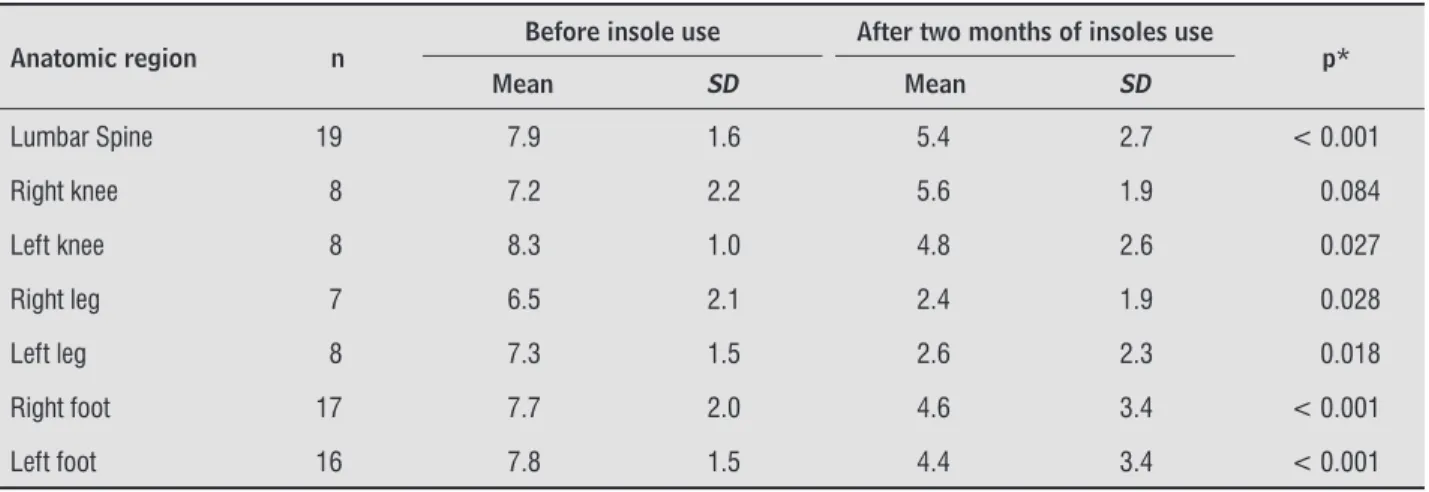
The Wilcoxon test revealed a significant reduc-tion in the intensity of musculoskeletal pain in the body segments evaluated before and after the use of the proprioceptive insoles for two months, with the exception of the right knee Table .
The data of the peaks of plantar pressure and the total area of plantar contact of the obese subjects, ac-cording to the stage of the study, are shown in Table . There were no significant differences between the mean peak plantar pressure and the total area of plantar contact in the three regions of both feet when comparing pre-intervention before insoles values to those after two months of insole use. The same variables were compared for the point immediately after insole use began and two months later; there was a significant p< . reduction of the mean of peak plantar pressure values only in the right foot. )n terms of total plantar contact area, the mean in-creased significantly p < . in both feet after the intervention Table .
Table 1 - Socio-demographic characteristics of the obese adults, according to absolute (n) and relative (%) frequencies. Joinville, SC, Brazil, 2010
Characteristics n %
Sex
Male 4 12.5
Female 28 87.5
Age (years)
< 30 10 31.3
30 to 39.9 7 21.9
≥ 40 15 46.9
Education
Elementary School 14 43.8
High School and higher education 18 56.3
217
Table 1 - Socio-demographic characteristics of the obese adults, according to absolute (n) and relative (%) frequencies. Joinville, SC, Brazil, 2010
Characteristics n %
Marital status
Married/unmarried unions 26 81.3
Others 6 18.8
Household income (MS = $ 328.00)
< 2 1 3.1
2 to 3 6 18.8
≥ 4 25 78.1
Note: MS = minimum salary, in US dollars.
(Conclusion)
Table 2 - Absolute frequency (n), mean and standard deviation (SD) for pain before and after two months of insole use by obese adults, according to the anatomic region. Joinville, SC, Brazil, 2010
Anatomic region n
Before insole use After two months of insoles use
p*
Mean SD Mean SD
Lumbar Spine 19 7.9 1.6 5.4 2.7 < 0.001
Right knee 8 7.2 2.2 5.6 1.9 0.084
Left knee 8 8.3 1.0 4.8 2.6 0.027
Right leg 7 6.5 2.1 2.4 1.9 0.028
Left leg 8 7.3 1.5 2.6 2.3 0.018
Right foot 17 7.7 2.0 4.6 3.4 < 0.001
Left foot 16 7.8 1.5 4.4 3.4 < 0.001
Note: *Wilcoxon Test.
Table 3 - Means and standard deviations (SD) of the peaks of plantar pressure and the total area of plantar contact of the obese subjects, according to the stage of the study. Joinville, SC, Brazil, 2010
Variables
Before insoles Immediately after insole use began
After two months of insoles use
Mean SD Mean SD Mean SD
Peak plantar pressure
Right foot
Total 6.4* 3.7 9.0 5.2 5.6 1.9
Forefoot 7.4* 3.4 11.1 6.5 7.2 2.7
Midfoot 6.8* 7.7 9.7 7.8 5.3 1.9
Hindfoot 4.9* 2.8 6.3 4.2 4.5 2.0
Table 3 - Means and standard deviations (SD) of the peaks of plantar pressure and the total area of plantar contact of the obese subjects, according to the stage of the study. Joinville, SC, Brazil, 2010
Variables
Before insoles Immediately after insole use began
After two months of insoles use
Mean SD Mean SD Mean SD
Left foot
Total 6.0 3.0 6.5 2.9 5.7 2.2
Forefoot 7.8 3.9 9.1 5.6 7.8 3.7
Midfoot 5.7 4.6 5.3 1.9 4.9 2.3
Hindfoot 4.5 2.1 5.2 3.1 4.4 1.9
Total area of the foot
Right 117.4* 21.5 107.3 23.7 120.2 19.9
Left 123.9* 26.8 125.6 21.4 131.7 17.3
Note: *p < 0.05, signifi cant difference with “after two months of insoles use”. Wilcoxon test.
(Conclusion)
Discussion
Several studies in the scientific literature involv-ing the evaluation of plantar pressure in obese in-dividuals have shown that their mean peak plantar pressure is greater than that of eutrophic individuals , , , .(owever, there have been few stud-ies of interventions with insoles in obese people or that show the relationship between insole use and postural changes. )n this respect, the findings of the present study demonstrate that the use of proprio-ceptive insoles as a coadjuvant treatment to reduce musculoskeletal pain has a beneficial effect. )nsole use is also associated with several baropodometric and postural changes that will be further discussed.
Obese individuals are more likely to present or-thopedic disorders, primarily postural deviations, as a result of several factors, such as joint overloading, a decrease in postural stability, and an increase in energy expenditure while performing normal activi-ties . The joint misalignments caused by obesity affect the lower limbs and cause pain at an early age . Postural control can also be influenced by strength and range of motion limitations, pain or the position-ing of the feet . The improvement of postural con-trol through the use of insoles alters the activity of the plantar nerve receptors and stimulates the sensorimo-tor system . Postural change was also verified in this study; reduction in the percentage of individuals with right lateral postural deviations after two months
of using proprioceptive insoles was observed. )n this case, the reduction of unilateral musculoskeletal pain led to a reduction in the burden on the asymptomatic side of the body. )n addition, the postural bars placed inside the insoles affected the postural adjustment. (owever, there was no reduction in the anterior dis-placement of the body, which can be explained by the fact that the individuals did not lose weight over the two months of the intervention; their large abdomens and breasts maintained the forward displacement of the center of gravity. Other studies have also found similar results with respect to posture , , however, there are no studies on the use of insoles for postural correction in obese people.
When musculoskeletal pain was investigated, the use of insoles significantly reduced the pain in the body parts evaluated, with the exception of the right knee. )t is believed that the reduction of pain occurred because of the repositioning of the joints of the lower limbs, which are exposed to the burden of the body weight. )nfluenced by the insoles, this repositioning relieved the muscular, ligament and joint tension and therefore eased the pain. This result is important be-cause several studies have reported the presence of pain in obese individuals , , - , especially in the lower limbs and in the lumbar spine , . Some authors have also reported a greater frequency of tendinopathies in these individuals .
219 the center of gravity, which forces the lumbar spine
to help maintain postural balance and therefore causes pain. )n this study, after eight weeks of using custom insoles as the only intervention, there was a . % reduction in lower back pain in the individuals inves-tigated, revealing the therapeutic potential of this type of treatment. Another intervention study found even higher values with obese individuals. According to these authors, there was a . % reduction in lower back pain after – weeks of intense physical therapy without the use of insoles. )n this study, subjects with an average BM) of less than kg/m , i.e., individuals with a lower weight, felt less pain in the lumbar region.
)n addition to lumbar pain, the volunteers in the present study also reported pain in the feet. The data obtained showed reductions of . % and . % in the pain in the right and left feet, respectively, after two months of intervention. A positive effect due to the use of insoles for pain reduction was also found by some authors, with a reduction of . % in foot pain on the first day of use of the insoles and a further . % reduction after one month . We believe that the lower mean BM) of their subjects . kg/m accounts for the difference in pain reduction com-pared to that of the present study. )n other words, conservative treatment of musculoskeletal pain is more effective in non-obese individuals.
Several studies conducted with people with osteo-arthritic pain have revealed that obesity can be one of its causes , , , - . One study reported a . % reduction in knee pain after one month of insole use in eutrophic individuals . Other authors have re-vealed that, in addition to reducing pain, insoles have improved the functionality of the knees , . The use of insoles can also reduce biomechanical changes at the knee during walking, reducing the risk and pro-gression of osteoarthritis , - . The data obtained in the present study suggest that the . % decrease in pain in the right knee and . % decrease in the left knee are related to the levels of lateral postural devia-tion, as there was a reduction of . % and . % in the number of individuals diagnosed with lateral de-viation on the right and left side, respectively, after the intervention. That is, individuals who do not display lateral deviations have less pain due to the reduction of excessive weight.
Another important aspect of this study concerns the reduction of peak plantar pressure before and after the intervention. After two months of using the custom insoles, there was a reduction in the mean
peak plantar pressure values in the three regions of both feet. )n contrast, there was also an increase in the mean values of the total area of plantar con-tact for both feet. Although these changes were not significant from a statistical perspective, this result was expected because whenever the contact area in-creases with no weight loss, a reduction of plantar pressure consequently occurs. The pressure values immediately after insole use began were compared with the data obtained two months later. The mean peak plantar pressure was higher than the values obtained in the pre-intervention and two month stages; the reduction of these values between the two stages was also higher. That is, the mean peak plantar pressure values obtained after two months of intervention were lower than the pre-intervention values . % for the right foot and . % for the left foot . This reduction of plantar pressure with the use of insoles may be caused by increased foot con-tact area, changing the positioning of the feet on the insoles, aligning the joints and reducing the stress on tendons and ligaments. Similar results have also been reported by other authors, who demonstrated a reduction in pain with the redistribution of plantar pressure in the three regions of the feet , . The use of custom insoles can significantly reduce the risk of osteoarthritis progression, this being a simple and cheap treatment .
Our results were similar to those of other stud-ies with obese individuals, revealing that the highest peak plantar pressure occurred in the forefoot region, due to forward displacement of the center of gravity , . Even though these peaks of plantar pressure were higher in the forefoot region, they were reduced in both feet after two months of intervention.
The limitations of this study are partially a result of the size of the sample, as studies involving few people make it difficult to pinpoint differences among the subgroups and increase the sampling error.
Conclusion
. Filippin N, Barbosa V, Sacco ), da Costa PL. Effects of obesity on plantar pressure distribution in children. Rev Bras Fisioter. ; : - .
. Qiu F, Cole M(, Davids KW, (ennig EM, Silburn PA, Netscher (, et al. Enhanced somatosensory infor-mation decreases postural sway in older people. Gait Posture. ; : - . doi: . /j. gaitpost. . . .
. Turpin KM, De Vincenzo A, Apps AM, Cooney T, MacK-enzie MD, Chang R, et al. Biomechanical and clinical outcomes with shock-absorbing insoles in patients with knee osteoarthritis: immediate effects and changes after month of wear. Arch Phys Med Rehabil. ; : - . doi: . /j.apmr. . . . . Bateni (. Changes of postural steadiness following
use of prefabricated orthotic insoles. J Appl Biomech. ; : - .
. Mangwani J, Giles C, Mullins M, Salih T, Natali C. Obe-sity and recovery from low back pain: a prospective study to investigate the effect of body mass index on recovery from low back pain. Ann R Coll Surg Engl.
; : - . doi: . / x .
. Stone AA, Broderick JE. Obesity and pain are asso-ciated in the United States. Obesity Silver Spring .
; : - . doi: . /oby. . . . World (ealth Organization. Obesity: preventing and
managing the global epidemic. Report of a W(O consultation. World (ealth Organ Tech Rep Ser.
; :i-xii, - .
. Cavanagh PR, Rodgers MM. The arch index: a use-ful measure from footprints. J Biomech. ; :
- .
. Birtane M, Tuna (. The evaluation of plantar pres-sure distribution in obese and non-obese adults. Clin Biomech Bristol, Avon . ; : - . doi:
. /j.clinbiomech. . . .
. (ills AP, (ennig EM, McDonald M, Bar-Or O. Plantar pressure differences between obese and non-obese adults: a biomechanical analysis. )nt J Obes Relat Metab Disord. ; : - . doi: . / sj.ijo. .
. Brandalize M, Leite N. Orthopedic alterations in obese children and adolescents. Fisioter Mov. ;
: - . surgical procedure. (owever, we suggest that further
studies should be conducted with larger samples and over longer periods of investigation.
Acknowledgments
We thank the Department of Physical Education of the University of Blumenau, Santa Catarina, Brazil, for the loan of the F-Scan equipment; and the Joinville Association of Morbid Obesity for allowing the use of the data. This study was supported by research grants from the University of Joinville Region.
References
. Bankoff ADP, Zamai CA, Schimdt A, Ciol P, Barros DD. Estudo das alterações morfológicas do sistema loco-motor: postura corporal obesidade. Rev Edu Física/ UEM. ; : - .
. Pinto ALS, (olanda PMB, Radu AS, Villares SM, Lima FR. Musculoskeletal findings in obese children. J Paediatr Child (ealth. ; : - .
. Chang B-C, Wang J-Y, (uang B-S, Lin (-Y, Lee WC. Dynamic impression insole in rheumatoid foot with metatarsal pain. Clin Biomech Bristol, Avon . ;
: - .
. Russell EM, (amill J. Lateral wedges decrease biome-chanical risk factors for knee osteoarthritis in obese women. J Biomech. ; : - .
. Lee R, Kean W. Obesity and knee osteoarthritis. )nflam-mopharmacology. ; : - . doi: . /
s - - - .
. (orak FB. Postural orientation and equilibrium: what do we need to know about neural control of balance to prevent falls? Age Ageing. ; Suppl :ii - . doi: . /ageing/afl .
. Lee YS. The role of genes in the current obesity epi-demic. Ann Acad Med Singapore. ; : - . . Dowling AM, Steele JR, Baur LA. Does obesity
influ-ence foot structure and plantar pressure patterns in prepubescent children? )nt J Obes Relat Metab Disord.
221 . Fantini Pagani C(, (inrichs M, Bruggemann GP. Kinetic
and kinematic changes with the use of valgus knee brace and lateral wedge insoles in patients with medial knee osteoarthritis. J Orthop Res. ; : - . doi: . /jor. .
. Kuroyanagi Y, Nagura T, Matsumoto (, Otani T, Suda Y, Nakamura T, et al. The lateral wedged insole with subtalar strapping significantly reduces dynamic knee load in the medial compartment gait analysis on patients with medial knee osteoarthritis. Osteo-arthritis Cartilage. ; : - . doi: . /j. joca. . . .
. Toda Y, Tsukimura N. )nfluence of concomitant heeled footwear when wearing a lateral wedged insole for medial compartment osteoarthritis of the knee. Osteo-arthritis Cartilage. ; : - . doi: . /j. joca. . . .
. Stolwijk NM, Louwerens JW, Nienhuis B, Duysens J, Keijsers NL. Plantar pressure with and without cus-tom insoles in patients with common foot complaints. Foot Ankle )nt. ; : - . doi: . /fai.
. .
. Kanatli U, Yetkin (, Simsek A, Ozturk AM, Esen E, Besli K. [Pressure distribution patterns under the metatarsal heads in healthy individuals]. Acta Orthop Traumatol Turc. ; : - .
Received: / / Recebido: / /
Approved: / / Aprovado: / / . McKeon PO, Stein AJ, )ngersoll CD, (ertel J. Altered
plantar-receptor stimulation impairs postural control in those with chronic ankle instability. J Sport Rehabil.
; : - .
. Bihari V, Kesavachandran C, Pangtey BS, Srivastava AK, Mathur N. Musculoskeletal pain and its associated risk factors in residents of National Capital Region. )ndian J Occup Environ Med. ; : - . doi:
. / - . .
. Chan G, Chen CT. Musculoskeletal effects of obesity. Curr Opin Pediatr. ; : - . doi: . / MOP. b e a .
. (ills AP, (ennig EM, Byrne NM, Steele JR. The biome-chanics of adiposity: structural and functional limita-tions of obesity and implicalimita-tions for movement. Obes Rev. ; : - .
. Cimolin V, Vismara L, Galli M, Zaina F, Negrini S, Capo-daglio P. Effects of obesity and chronic low back pain on gait. J Neuroeng Rehabil. ; : . doi: . /
- - - .
. Battery L, Maffulli N. )nflammation in overuse tendon injuries. Sports Med Arthrosc. ; : - . doi:
. /JSA. b e e a .
. Chacur EP, Silva L, Luz GCP, Silva PLd, Baraúna MA, Cheik NC. Obesidade e sua correlação com a osteo-artrite de joelho em mulheres. Fisioter Mov. ;
: - .
. (inman RS, Bennell KL. Advances in insoles and shoes for knee osteoarthritis. Curr Opin Rheumatol. ; : - . doi: . / BOR. b e c .
. Sinusas K. Osteoarthritis: diagnosis and treatment. Am Fam Physician. ; : - .
. Erhart JC, Mundermann A, Elspas B, Giori NJ, Andriac-chi TP. Changes in knee adduction moment, pain, and functionality with a variable-stiffness walking shoe after months. J Orthop Res. ; : - . doi:
. /jor. .
. Kutzner ), Damm P, (einlein B, Dymke J, Graichen F, Bergmann G. The effect of laterally wedged shoes on the loading of the medial knee compartment-in vivo measurements with compartment-instrumented knee implants. J Orthop Res. ; : - . doi: