S
Y
S
TEMA
TIC
RE
VIE
Correspondence to: Laura Alice Santos de Oliveira – Praça das Nações, 34, 3º andar – CEP: 21041-020 – Rio de Janeiro (RJ), Brasil – E-mail: [email protected] Presentation: jul. 2013 – Accepted for publication: sep. 2013 – Financing source: none – Conflict of interests: nothing to declare.
ABSTRACT | The spinocerebellar ataxia (SCA) is an
in-herited disorder that leads to progressive degeneration of the cerebellum and its pathways with impairments of balance and other functions. Physical therapy studies for SCA treatment and their methodological quality were examined. We also investigated if the benefits achieved with treatment can be retained. The interventions iden-tified included balance, gait and coordination training; strengthening; weights around the limbs during exercise and transcranial magnetic stimulation. The long-term im-provements were related to the degree of SCA evolution and the continuity of exercise practice. Nevertheless, further studies with higher scientific accuracy are neces-sary to elect the best physical therapy approaches for SCA patients.
Keywords | spinocerebellar ataxia; physiotherapy; hereditary ataxia.
RESUMO | A ataxia espinocerebelar (SCA) é uma afecção
hereditária que cursa com a degeneração progressiva do cerebelo e suas vias, causando alterações do equilíbrio e de outras funções. O efeito das abordagens da fisioterapia no tratamento da SCA e a qualidade metodológica des-ses estudos foram analisados. Foi investigado ainda se os benefícios alcançados com o tratamento são retidos. As intervenções encontradas incluem treino do equilíbrio, marcha e coordenação; fortalecimento; caneleiras nos membros durante exercícios e aplicação de estimulação
spinocerebellar ataxia: a systematic review
Abordagem isioterapêutica da ataxia espinocerebelar: uma revisão sistemática
El abordaje isioterapéutico de la ataxia espinocerebelosa: una revisión sistemática
Camilla Polonini Martins1, Erika de Carvalho Rodrigues1,2, Laura Alice Santos de Oliveira1,3Study conducted at the Centro Universitário Augusto Motta(UNISUAM) – Rio de Janeiro (RJ), Brazil.
1Graduate Program of Rehabilitation Sciences at UNISUAM – Rio de Janeiro (RJ), Brazil. 2Instituto D’or de Pesquisa e Ensino – Rio de Janeiro (RJ), Brazil.
3Physical Therapy course of Instituto Federal do Rio de Janeiro(IFRJ) – Rio de Janeiro (RJ), Brazil.
magnética transcraniana. A retenção das melhoras obti-das com o tratamento foi relacionada ao grau de evolução da SCA e à continuidade da prática de exercícios. Porém, novos estudos com maior rigor científico são necessários para eleger as abordagens mais adequadas para o trata-mento de portadores de SCA.
Descritores | ataxias espinocerebelares; fisioterapia; ataxias hereditárias.
RESUMEN | La ataxia espinocerebelosa (SCA) es una
afec-ción hereditaria que cursa con la degeneraafec-ción progresiva del cerebelo y de sus vías, lo que causa alteraciones del equilibrio y de otras funciones. El resultado de los aborda-jes de la fisioterapia en el tratamiento de la SCA y la cuali-dad metodológica de estos estudios fueron analizados. Se investigó si los beneficios alcanzados con el tratamiento fueron retenidos. Las intervenciones encontradas incluyen entrenamiento del equilibrio, marcha y coordinación; forta-lecimiento; canilleras en los miembros durante ejercicios y aplicación de la estimulación magnética transcraneana. La retención de las mejorías obtenidas con el tratamiento fue relacionada al grado de evolución de la SCA y a la continui-dad de la práctica de ejercicios. Aunque nuevos estudios con mayor carácter científico son necesarios para elegir los abordajes más adecuados para el tratamiento de los portadores de la SCA.
INTRODUCTION
he irst report of autosomal dominant cerebellar ataxia
(ADCA) was made by Pierre Marie in 18931. Since
then, several classiications for these ataxias have been proposed by diferent authors. Harding’s
classiica-tion2 became widely accepted, grouping the ADCAs
for their clinical characteristics (ADCA I to III). he evolution of genetic research enabled the connection between the clinical disorders of ataxia and the afected chromosomal locus. After the description of the irst defective gene to cause ADCA, each new defective
gene was numbered3, and ADCA began to be known
as spinocerebellar ataxia (SCA). he current classiica-tion based on genetic changes comprehends 31 types of
SCA4. Its prevalence is of 0.9 to 3:100,000, ranging
ac-cording to type and continent5. SCA 1, 3 and 6 are the
most common ones throughout the world1. In Brazil,
SCA3, also known as Machado-Joseph disease, is the
most prevalent type6-8.
All kinds of SCA cause progressive cerebellar degeneration, but each type has additional clinical characteristics related to the other afected regions, especially by type (brain stem, cortex, bone
mar-row, cranial nerves and diencephalon)3. For instance,
SCA7 is followed by visual loss, and SCA4, of
sen-sory ataxia9. he degeneration caused by SCA, among
other problems, leads to balance and gait chang-es, which increase the risk of falls. In fact, Van de
Warrenburg et al.10, in a study with 42 patients with
SCA, demonstrated that 93% of them reported one or more falls in the period of one year. hese falls can induce a vicious circle of immobility and the fear of
falling10. he progressive character of SCA, added to
this vicious circle, leads to the accumulation of motor loss, thus producing an inexorable scenario of
im-mobility and wheelchair dependency around the 15th
year of disease evolution9.
here is evidence concerning an important
contribu-tion of the cerebellum in the motor learning process11-15.
Several studies have demonstrated that patients with cerebellar lesions may present impairment in the
learn-ing of motor skills16-18. herefore, some authors question
if the rehabilitation of patients with SCA could have any positive efect on their motor condition. he validity of rehabilitation in such cases becomes even more con-troversial, given the progressive aspect of the disease: it is questionable if the possible functional gain obtained with physical therapy intervention can be maintained in the long term.
In this context, the objectives of this review are: (1) to identify the current physical therapy approach for the treatment of SCA; (2) to analyze the methodologi-cal quality of the available studies concerning the treat-ment of motor sequels caused by SCA; (3) to assess if the beneits from the treatment can be retained in the long term.
METHODOLOGY
A systematic literature review was conducted in the electronic data bases MEDLINE, SciELO, PEDro, Cochrane and Scopus, using the following MeSH descriptors, with their respective translations to Portuguese: “spinocerebellar ataxia”, “spinocerebel-lar degenerations”, ‘‘Machado-Joseph disease’’, “pro-gressive ataxia”, “rehabilitation” and “physiotherapy”. Each search was performed with at least two com-bined descriptors so that one of them would be re-lated to the pathology (ex.: “spinocerebellar ataxia”; “Machado-Joseph disease”) and another one to the treatment (ex.: “rehabilitation”; “physiotherapy”). he search was complemented by related references cited by the found publications.
Clinical trials published in Portuguese, English and Spanish from 2000 on were included. here was no restriction as to the type of used physical therapy approach. Identiication, selection and the posterior quality assessment of the article by means of the
phys-iotherapy evidence database scale (PEDro)19 was made
by two researchers, independently. he articles were in-cluded when they received at least ive out of the total of ten points in the PEDro scale.
RESULTS
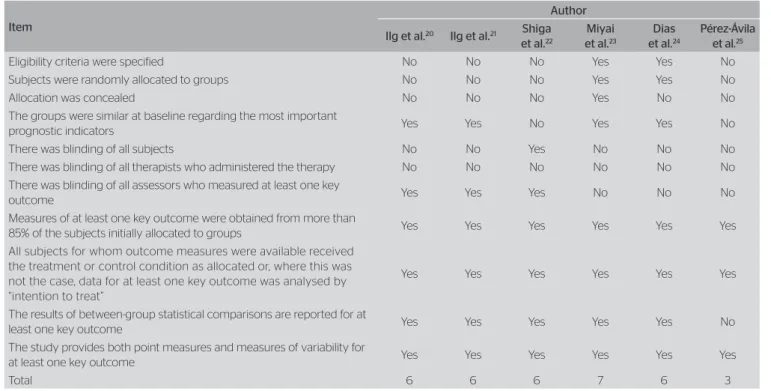
In the conducted search, 252 studies were found. Out of these, 246 were excluded for not meeting the inclusion criteria. Among the six eligible studies, one of them did not reach the minimum score for inclusion (Figure 1 and Table 1). herefore, ive articles were included in this review.
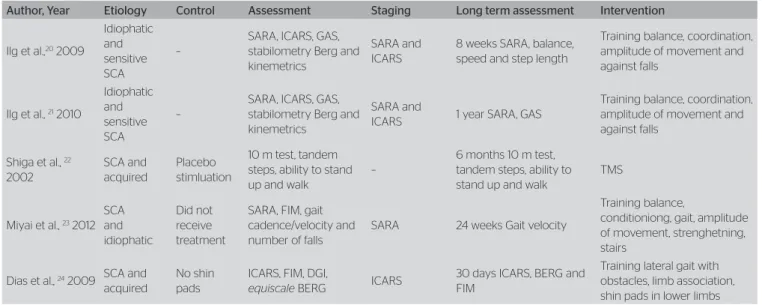
Ilg et al.20 performed training of balance,
of ataxia). Training was conducted three times a week for four weeks (1h/day). After four weeks, patients were training at home for eight weeks. Scales assessing the staging of ataxia were used (impairment severity): SARA (Scale for the Assessment and Rating of Ataxia) and ICARS (International Cooperative Ataxia Rating Scale); for the treatment objectives of the patients, GAS (Goal Attainment Score) was used; for quantitative gait analysis (kinemetrics) and balance assessment (stabi-lometry, Berg scale and anticipatory reaction time). After practice, the staging of the disease improved for all of the patients. Only the group with cerebellar ataxia demonstrated signiicant balance improvement, increased velocity and step length, maintaining the ben-eits after eight weeks. his retention was not correlated with the staging of ataxia.
To assess the long term eicacy of this protocol, Ilg
et al.21 compared the results before and after 4 weeks of
training with the results presented after 1 year, by 14 out of the 16 patients analyzed in the prior study. he pa-tients performed the same exercises at home (1h/day), except for those that presented risk of falling, for 1 year. After this period, the staging of ataxia remained signii-cantly better in relation to pre-intervention values. he improvement in GAS was also maintained. he beneits for balance and gait speed, however, did not remain sig-niicant. he authors concluded that the treatment was eicient in the long term.
Shiga et al.22 summoned 74 patients with SCA
and other ataxias and employed transcranial magnetic stimulation (TMS) over the cerebellum of 39 of them (stimulation group), while 35 of them received false stimulation (placebo group). Ten simple TMS pulses were applied once a day for 21 days. he stimulation group presented signiicant cadence improvement, as well as in relation to the time spent in the 10 m walk-ing test, besides the increased number of possible steps in tandem and the ability to stay standing. After the 21 days of stimulation, 1 group of patients continued to receive TMS pulses once or twice a week. hey retained the improvement obtained in the study for at least six months. Another group received TMS pulses only every two weeks. In this group, the scores of the used assess-ment methods returned to baseline two weeks after the end of applications.
Table 1. Quality assessment by thePhysiotherapy Evidence Database Scale
Item
Author
Ilg et al.20 Ilg et al.21 Shiga
et al.22
Miyai et al.23
Dias et al.24
Pérez-Ávila et al.25
Eligibility criteria were specified No No No Yes Yes No Subjects were randomly allocated to groups No No No Yes Yes No Allocation was concealed No No No Yes No No The groups were similar at baseline regarding the most important
prognostic indicators Yes Yes No Yes Yes No There was blinding of all subjects No No Yes No No No There was blinding of all therapists who administered the therapy No No No No No No There was blinding of all assessors who measured at least one key
outcome Yes Yes Yes No No No
Measures of at least one key outcome were obtained from more than
85% of the subjects initially allocated to groups Yes Yes Yes Yes Yes Yes All subjects for whom outcome measures were available received
the treatment or control condition as allocated or, where this was not the case, data for at least one key outcome was analysed by “intention to treat”
Yes Yes Yes Yes Yes Yes
The results of between-group statistical comparisons are reported for at
least one key outcome Yes Yes Yes Yes Yes No The study provides both point measures and measures of variability for
at least one key outcome Yes Yes Yes Yes Yes Yes
Total 6 6 6 7 6 3
Figue 1. Flowchart of article selection
Found articles 252
Excluded articles 246
Articles selected for quality assessment
6
Included articles 5 Repeated articles
77
Only three studies22-24 compared the performance
of a trained group and a control group. his limitation does not make it possible to rule out the placebo efect, nor to assess if the beneits reported by them are only due to the proposed training.
Only Dias et al.24 assessed if the protocols had an
impact on the performance of activities and on the pa-tient’s independence. his is essential to observe the im-provement in the quality of their daily lives.
Out of the ive studies in this review, four of
them20,21,23,24 described the staging of SCA. his is
nec-essary to investigate if, after treatment, the clinical con-dition of the patient, in short and long terms, became worsen, better or stable. Such description can also help identify the adequate treatments for the diferent stages
of the disease. Ilg et al.20, Miyai et al.23 and Dias et al.24
reported improved staging of ataxia after the treatment.
Ilg et al.20 stated that a short period after the end of the
intervention proposed in their study, the improvement obtained in the assessments had no correlation with the
staging of SCA. In the long term, Miyai et al.23 observed
that patients who mostly retained the improvements
were those with less severe ataxia. Ilg et al.21
demon-strated that one year after the end of their protocol, pa-tients still had signiicantly better scores at SARA than in the irst evaluation.
Apparently, maintaining the improvement obtained with interventions depends on continuing to practice
exercises. Ilg et al.20,21 and Miyai23 recommended the
daily practice of their protocols to patients after evalu-ation if there was long term retention, which happened
in all of the cases. Shiga22 also maintained the
appli-cation of TMS pulses with better results in the group that continued to receive frequent applications. On the other hand, Dias et al.24 reported the maintenance of improvement 30 days after the end of the intervention, even without continuing to practice. he gain retention described in some studies may indicate that patients with cerebellar lesions are able to retain learning, even though their lesions are located in the cerebellum, which is such an important area for motor learning. Still, it is hard to distinguish if the lack of beneit retention after an exercise program is owed to the progressive degen-eration, characteristic of the disease, to the inability to retain the learned movement patterns or to the need to elect more appropriate exercises for these patients.
Most of the found studies employed balance, gait, muscle strengthening, stretching and coordination exercises. However, none determined which the most eicient one was. herefore, the good results found
Miyai et al.23 assessed the efects of a short-term
treatment in 16 people with idiopathic ataxia and 26 SCA, dividing them in 2 groups (immediate and con-trol), with 21 patients each. Only the immediate group performed 1 hour daily trainings with conditioning ex-ercises, amplitude of movement, muscle strengthening, stairs, static balance and gait for four weeks. In order to assess both groups, some tools were used: Sara, FIM (functional independence measure), functional ambu-lation categories, and gait speed/cadence, besides the number of falls per week. After practice, the immedi-ate group presented improvements in all of the evalua-tions, except for cadence, when compared to the control group. After the four weeks, the control group was also trained and their data were analyzed together with the immediate group, accounting for 42 assessed patients before, right after and 4, 12 and 24 weeks after inter-vention. After two years, only the improvement in gait speed was maintained. However, it was observed that 22 out of the 42 patients had retained improvement in at least one of the assessed parameters during the period. By analyzing the correlation between staging and the assessed parameters, it was concluded that patients who retained some sort of improvement were those with less severe degrees of ataxia.
Dias et al.24 conducted gait training with 10 patients
(5 with SCA) wearing a 500 g shin pad on each lower limb (weight group), and with 11 patients (6 with SCA) without the shin pad (no weight group). he practice consisted of lateral gait, in a straight line, with obstacles and movements of the upper limbs. After 20 sessions of 30 min, there was signiicant balance improvement, as well as in the risk of falls, in FIM and in the staging of ataxia, only for the weight group. hese results were maintained 30 days after the end of the intervention. he authors defend gait improvement even if there were no diferences in Dynamic Gait Index scores.
DISCUSSION
in this study indicate that diferent types of exercise could be equally beneicial for these patients. Indeed,
Fryer et al.26 noticed a beneicial efect of non-speciic
exercises for the progression of cerebellar degenera-tion in rats with SCA1. hese indings may corrob-orate the idea that immobility leads to motor loss, which goes beyond those promoted by the character-istic degeneration of SCA itself. herefore, it seems that keeping patients active alone can already being some sort of beneit.
Additionally, Dias et al.24 showed that, regardless of
the type of employed exercise, the use of shin pads on the lower limbs during practice can increment its ben-eicial efect.
Most studies, except for the one of Ilg et al.20, do not
describe the intervention protocol in detail. Such de-tails are important to ensure replicability in new studies, including multicenter clinical trials, and to enable the reproduction of the protocol in clinical practice.
CONCLUSION
In this review, studies demonstrating the positive ef-fects of interventions to treat the sequels of SCA were identiied: balance, gait and coordination train-ing, muscle strengthening and stretchtrain-ing, use of shin pads in lower limbs and the application of TMS pulses on the cerebellum. Treatment seems to be more ei-cient less impaired patients. Besides, retaining the im-provements obtained in the long term was related to the degree of disease evolution and to the continuous
practice of exercises, even if at home. Future studies in-cluding only patients with SCA, which would describe the staging of the disease, including a proper control group, blind evaluators, description of the impact of treatment on activities and participation and contain-ing a detailed description of the intervention protocol are necessary to select the most adequate approaches for the treatment of patients with SCA. hese studies may contribute with the elaboration of protocols based on important evidence to face the problems caused by SCA properly.
ACKNOWLEDGEMENTS
he authors would like to thank Anke Bergman for re-viewing the methodology of this article.
REFERENCES
1. Seidel K, Siswanto S, Brunt ERP, Den Dunnen W, Korf H-W, Rüb U. Brain pathology of spinocerebellar ataxias. Acta Neuropatol. 2012;124(1):1-21. 2. Harding AE. The clinical features and classification of the late
onset autosomal dominant cerebellar ataxias. A study of 11 families, including descendants of the “the Drew family of Walworth”. Brain. 1982;105(Pt 1):1-28.
3. Klockgether T, Paulson H. Milestones in ataxia. Mov Disord. 2011;26(6):1134-41.
4. Durr A. Autosomal dominant cerebellar ataxias: polyglutamine expansions and beyond. Lancet Neurol . 2010;9(9):885-94.
Table 2. Summary of the analyzed articles
Author, Year Etiology Control Assessment Staging Long term assessment Intervention
Ilg et al.,20 2009
Idiophatic and sensitive SCA
–
SARA, ICARS, GAS, stabilometry Berg and kinemetrics
SARA and ICARS
8 weeks SARA, balance, speed and step length
Training balance, coordination, amplitude of movement and against falls
Ilg et al., 21 2010
Idiophatic and sensitive SCA
–
SARA, ICARS, GAS, stabilometry Berg and kinemetrics
SARA and
ICARS 1 year SARA, GAS
Training balance, coordination, amplitude of movement and against falls
Shiga et al., 22
2002
SCA and acquired
Placebo stimluation
10 m test, tandem steps, ability to stand up and walk
–
6 months 10 m test, tandem steps, ability to stand up and walk
TMS
Miyai et al., 23 2012
SCA and idiophatic
Did not receive treatment
SARA, FIM, gait cadence/velocity and number of falls
SARA 24 weeks Gait velocity
Training balance,
conditioniong, gait, amplitude of movement, strenghetning, stairs
Dias et al., 24 2009 SCA and
acquired
No shin pads
ICARS, FIM, DGI,
equiscale BERG ICARS
30 days ICARS, BERG and FIM
5. Marsden J, Harris C. Cerebellar ataxia: pathophysiology and rehabilitation. Clin Rehabil . 2011;25(3):195-216.
6. Silveira I, Lopes-Cendes I, Kish S, Maciel P, Gaspar C, Coutinho P, et al. Frequency of spinocerebellar ataxia type 1, dentatorubropallidoluysian atrophy, and Machado-Joseph disease mutations in a large group of spinocerebellar ataxia patients. Neurology . 1996;46(1):214-8.
7. Jardim LB, Silveira I, Pereira ML, Ferro A, Alonso I, Do Céu Moreira M, et al. A survey of spinocerebellar ataxia in South Brazil - 66 new cases with Machado-Joseph disease, SCA7, SCA8, or unidentified disease-causing mutations. J Neurol . 2001;248(10):870-6.
8. Lopes-Cendes I, Teive HG, Calcagnotto ME, Da Costa JC, Cardoso F, Viana E, et al. Frequency of the diferent mutations causing spinocerebellar ataxia (SCA1, SCA2, MJD/SCA3 and DRPLA) in a large group of Brazilian patients. Arq Neuropsiquiatr . 1997;55(3B):519-29.
9. Teive HAG. Spinocerebellar ataxias. Arq Neuropsiquiatr . 2009;67(4):1133-42.
10. Van de Warrenburg BPC, Steijns JAG, Munneke M, Kremer BPH, Bloem BR. Falls in degenerative cerebellar ataxias. Mov Disord . 2005;20(4):497-500.
11. Martin TA, Keating JG, Goodkin HP, Bastian AJ, Thach WT. Throwing while looking through prisms I. Focal olivocerebellar lesions impair adaptation. Brain. 1996;119(Pt 4):1183-98.
12. Doyon J, Song AW, Karni A, Lalonde F, Adams MM, Ungerleider LG. Experience-dependent changes in cerebellar contributions to motor sequence learning. Proc Natl Acad Sci USA. 2002;99(2):1017-22. 13. Imamizu H, Miyauchi S, Tamada T, Sasaki Y, Takino R, Pütz B, et al.
Human cerebellar activity reflecting an acquired internal model of a new tool. Nature . 2000;403(6766):192-5.
14. Nezafat R, Shadmehr R, Holcomb H. Long-term adaptation to dynamics of reaching movements: a PET study. Exp Brain Res . 2001;140(1):66-76.
15. Yeo CH, Hardiman MJ, Glickstein M. Ex mental Classical conditioning of the nictitating membrane response of the rabbit. Exp Brain Res. 1985;60(1):99-113.
16. Maschke M, Gomez CM, Ebner TJ, Konczak J. Hereditary cerebellar ataxia progressively impairs force adaptation during goal-directed arm movements. J Neurophysiol . 2004;91(1):230-8.
17. Molinari M, Leggio MG, Solida A, Ciorra R, Misciagna S, Silveri MC, et al. Cerebellum and procedural learning: evidence from focal cerebellar lesions. Brain . 1997;120(Pt 10):1753-62.
18. Iofe ME, Ustinova KI, Chernikova LA, Kulikov MA. Supervised learning of postural tasks in patients with poststroke hemiparesis, Parkinson’s disease or cerebellar ataxia. Exp Brain Res . 2006;168(3):384-94. 19. Physiotherapy Evidence Database Escala de PEDro; 2009 [cited
2013 Jul 15]. Available from: http:// www.pedro.org.au/portuguese/ downloads/pedro-scale/
20. Ilg W, Synofzik M, Brötz D, Burkard S, Giese MA, Schöls L. Intensive coordinative training improves motor performance in degenerative cerebellar disease. Neurology . 2009;73(22):1823-30.
21. Ilg W, Brötz D, Burkard S, Giese MA, Schöls L, Synofzik M. Long-term efects of coordinative training in degenerative cerebellar disease. Mov Disord . 2010;25(13):2239-46.
22. Shiga Y, Tsuda T, Itoyama Y, Shimizu H, Miyazawa K-I, Jin K, et al. Transcranial magnetic stimulation alleviates truncal ataxia in spinocerebellar degeneration. J Neurol Neurosurg Psychiatry. 2002;72(1):124-6.
23. Miyai I, Ito M, Hattori N, Mihara M, Hatakenaka M, Yagura H, et al. Cerebellar ataxia rehabilitation trial in degenerative cerebellar diseases. Neurorehabil Neural Repair . 2012;26(5):515-22.
24. Dias ML, Toti F, Regina S, Almeida M, Oberg TD. Efeito do peso para membros inferiores no equilíbrio estático e dinâmico nos portadores de ataxia. Acta Fisiátrica. 2009;16(3):3-7.
25. Pérez-Avila I, Fernández-Vieitez JA, Martínez-Góngora E, Ochoa-Mastrapa R, Velázquez-Manresa MG. Efects of a physical training program on quantitative neurological indices in mild stage type 2 spinocerebelar ataxia patients. Rev Neurol . 2004;39(10):907-10. 26. Fryer JD, Yu P, Kang H, Mandel-Brehm C, Carter AN, Crespo-Barreto