https://doi.org/10.1590/0004-282X20170146
ARTICLE
Impact of disease duration on functional status
of patients with spinocerebellar ataxia type 2
Repercussões do tempo de evolução sobre o perfil funcional de pacientes com ataxia
espinocerebelar do tipo 2
Thiago R. Padilha Amarante1, Sibele Y. M. Takeda2, Hélio A. G. Teive3,4, Marise Bueno Zonta1
Spinocerebellar ataxias (SCAs) are a large, complex group of neurodegenerative diseases characterized by progressive cerebellar ataxia with oculomotor abnormalities, dysarthria, pyramidal and extrapyramidal signs, pigmentary retinopathy, peripheral neuropathy and cognitive dysfunction, among other manifestations1,2. More than 40 types of SCA have been identiied
to date, including SCA type 2 (SCA2), which is caused by a CAG trinucleotide repeat expansion on chromosome 12q23-24.11.
he third most common form of SCA in Brazil is SCA2.
Symptoms typically begin in the third decade of life and are asso-ciated with worse disease prognosis when they appear early1.
Clinical manifestations of the disease include action and rest tremor, polyneuropathy, upper motor neuron impair-ment and parkinsonism, which may predominate in some cases3. A balance deicit is one of the most characteristic
signs of SCA and one of the main factors directly afecting
posture and functionality4. Increased disease severity implies greater impairment of postural balance and functionality, and increased risk of falls4,5.
An annual increase in the Scale for the Assessment and Rating of Ataxia (SARA) score of between 1.40 and 1.49 has been reported in patients with SCA26,7, but progression
1 Universidade Federal do Paraná, Programa de Residência Integrada Multiproissional em Cuidados Hospitalares - Saúde para Adultos e Idosos, Curitiba PR, Brasil;
2 Universidade Federal do Paraná, Departamento de Prevenção e Reabilitação de Fisioterapia, Curitiba PR, Brasil;
3 Universidade Federal do Paraná, Hospital de Clínicas, Departamento de Medicina Interna, Curitiba PR, Brasil;
4 Universidade Federal do Paraná, Unidade dos Distúrbios do Movimento, Curitiba PR, Brasil.
Correspondence: Thiago R. Padilha Amarante; Av. Marechal Floriano Peixoto, 630 / 11; 80010-130 Curitiba PR, Brasil; Email: [email protected] Conflict of interest: There is no conlict of interest to declare.
Received 24 March 2017; Received in inal form 01 August 2017; Accepted 04 August 2017. ABSTRACT
Objective: To correlate disease duration in spinocerebellar ataxia type 2 (SCA2) with disease severity, balance and functionality.
Method: Sixteen SCA2 patients were analyzed for: disease duration, disease severity (SARA score), balance (Berg balance scale score) and functionality (FIM and Lawton scores). Results: Greater severity was correlated with worse functionality (Lawton: r = -0.0561, FIM: r = -0.6402) and balance (r = -0.7188). Longer disease duration was correlated with greater severity (p = 0.0002) and reduced functionality (FIM: p = 0.005; Lawton: p = 0.0402) and balance (p = 0.0036). A year increase in disease duration corresponded to a 0.8-point increase on the SARA scale, a 1.38-point decrease in FIM score, a 2.30-point decrease on the Berg balance scale and a 0.45-point decrease on the Lawton scale. Conclusion: Longer disease duration in this series of SCA2 patients was correlated with greater disease severity, worse balance and greater functional dependency.
Keywords: spinocerebellar ataxias; severity of illness index; postural balance.
RESUMO
Objetivo: Correlacionar com o tempo de evolução da doença em pacientes com ataxia espinocerebelar do tipo 2 (SCA2) com a gravidade, equilíbrio e funcionalidade. Método: Foram considerados dados de 16 indivíduos: tempo de evolução, nível de gravidade (SARA) e escores de equilíbrio (BERG) e funcionalidade (MIF e LAWTON). Resultados: A maior gravidade esteve relacionada aos piores escores de funcionalidade (LAWTON: r = -0,0561, MIF: r = -0,6402) e de equilíbrio (r = -0,7188). O maior tempo de evolução esteve relacionado à maior gravidade (p = 0,0002) e menor funcionalidade (MIF: p = 0,005; Lawton (p = 0,0402) e equilíbrio (p = 0,0036) sendo que para o aumento de um ano no tempo de evolução, espera-se um aumento de 0,8 pontos no escore da SARA, e decréscimo de 1,38 pontos na MIF, 2,30, na Berg e 0,45 na Lawton. Conclusão: O tempo de evolução dos sintomas está associado a maior gravidade da doença, pior equilíbrio e maior dependência funcional em pacientes comSCA2.
of functional loss and loss of balance have not yet been extensively described.
he aim of this study was, therefore, to assess function
-ality and balance in individuals with SCA2 and to correlate these with disease severity and duration.
METHODS
his was a retrospective, descriptive, cross-sectional study
and was approved by the Committee for Ethics in Research at the Hospital de Clínicas, Federal University of Paraná (HC-UFPR) (CAAE: 48399915.7.0000.0096, ref. no.: 1.280.919).
he study sample was non-probabilistic and comprised
men and women who were being followed up at the ataxia outpatient unit in the movement disorders unit at the Hospital de Clínicas, Federal University of Paraná.
Inclusion criteria were: being at least 18 years old; having a clinical diagnosis of SCA2; having a positive genetic test for SCA2 or having a family member who had a positive genetic test for SCA2; and taking coenzyme Q10 (100–500 mg/day) regularly. Individuals who had any musculoskeletal disorders
that could afect their balance or functionality or who had
other concomitant neurological disease (non-ataxic manifes-tations) were excluded.
Sixteen patients who had been diagnosed with SCA2 and had complete medical records were included in the study.
he following information was collected: age, gender,
diagnosis, age of onset of ataxic symptoms, disease dura-tion, disease severity, balance and functional-independence scores, and number of CAG repeats.
Balance was assessed on the Berg balance scale, which
has 14 items and a maximum score of 56. Scores of less than 46 indicate a high risk for falls8
.
Functional independence was assessed using the Functional Independence Measure (FIM), which assesses motor and cognitive domains. Scores vary from 18 to 126, and a high score indicates good functional independence.
he FIM measures disability in patients with functional limitations due to various causes and quantiies their need for
assistance when performing motor and cognitive tasks
asso-ciated with activities of daily living. he validated Brazilian version was published in 2004. he instrument is used in
interviews with the patient and/or the patient’s care-giver. In this study, it was only used with the patient9.
Independence for instrumental activities of daily living was assessed on the Lawton scale10, which consists of seven
items and has a total score ranging from 7 (dependence on others to help carry out activities) to 21 (complete
indepen-dence). he Lawton scale is an appropriate instrument to
assess abilities that are considered more complex than the basic activities of daily living, such as shopping, doing house-work and using transportation, and is useful for identify-ing a person’s functional ability at a given time and how this
improves or deteriorates over time11. he severity of ataxia
was assessed on the SARA scale.
All the scales used in this study were translated into
Portuguese and validated for Brazil12,13,14,15,.
Statistical analysis
he descriptive analysis was based on the mean and stan
-dard deviation of the scores for severity, balance, instrumental activities of daily living and functionality. Correlations between parametric data were investigated using the Pearson
correla-tion coeicient and Biostat® 5.0 for Windows. he Shapiro-Wilk
test was used to test for normality. Analysis of variance, applied to regression, was used to test for a relationship between dis-ease duration and severity, functionality and balance.
he scale of magnitudes for efect statistics proposed by Hopkins was used to interpret the correlation coeicients:
< 0.1 = trivial; 0.1 to 0.29 = small; 0.30 to 0.49 = moderate; 0.50 to 0.69 = large; 0.70 to 0.90 = very large; > 0.90 = nearly perfect.
A level of signiicance of p < 0.05 was used.
RESULTS
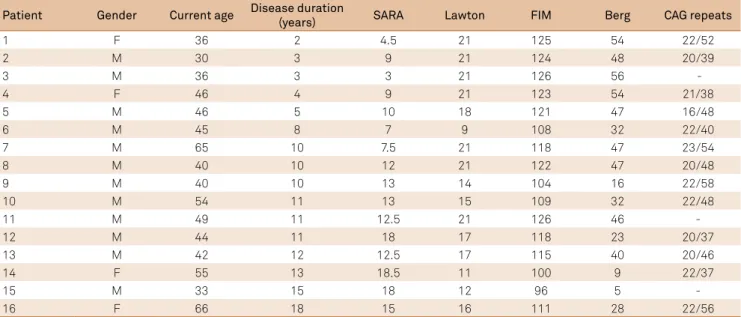
Of the 16 patients evaluated, 75% (n = 12) were male. Mean age was 45.43 ± 10.41 years, and mean age at onset of symptoms was 35 ± 8.72 years. Mean disease duration was 9.12 ± 4.61 years, mean disease severity (SARA score)
11.4 ± 4.65, mean balance score on the Berg scale 37.25 ± 15.61,
mean FIM score 115.37 ± 9.64 and mean score on the Lawton scale 17.25 ± 4.09. Disease duration, SARA, Lawton, FIM and
Berg scores and number of CAG repeats for each patient are
shown in Table 1.
here was a strong negative correlation between scores on
the SARA and Lawton scales (r = -0.0561), a strong negative correlation between SARA scores and FIM scores (r = -0.6402),
a strong negative correlation between SARA scores and Berg
scores (r = -0.7188), a strong positive correlation between Lawton scores and FIM scores (r = 0.8963), a strong negative
correlation between Lawton scores and Berg scores (r = -0.8340) and an almost perfect correlation between FIM scores and Berg scores (r = 0.9674). he results of the correlation tests between the SARA, Berg, FIM and Lawton scores are shown in Table 2.
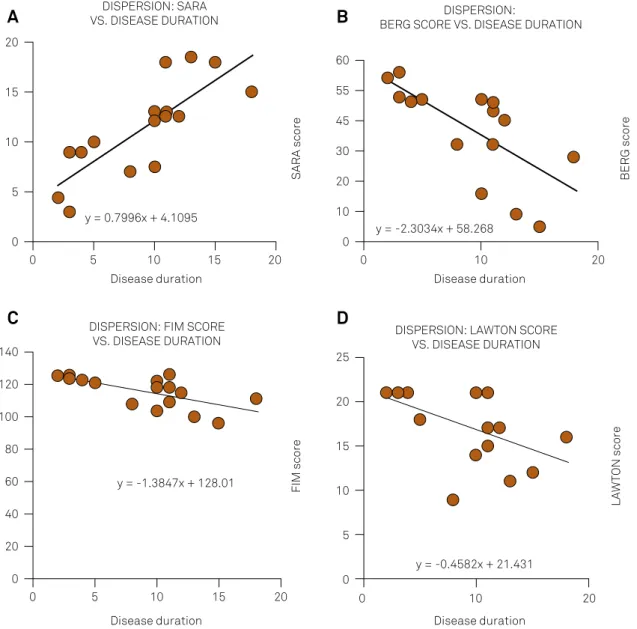
Linear regression revealed a signiicant relationship
between disease duration and the SARA score (p = 0.0002),
FIM score (p = 0.0051), Berg balance score (p = 0.0036) and Lawton score (p = 0.0402). hese results are shown in the
Figure and interpreted in Table 3.
DISCUSSION
his study of 16 SCA2 patients revealed signiicantly
greater disease duration was correlated with greater severity, worse balance and greater functional impairment.
Mean age at onset of symptoms in the study series was 35 years, in agreement with the literature, in which the age of
onset is reported to be between the third and ifth decades of
life16. he main symptoms of ataxia are a balance deicit and
worsening gait. he disease initially afects the legs, but as it
progresses the symptoms extend to the trunk and arms2.
he mean Berg score was 37.25 ± 15.61, and minimum and maximum scores were 5 and 56. he Berg test is objective
and can identify an increased propensity for falls. Although a lower score on this scale is associated with a greater risk of falls, the relationship is not linear: between 56 and 54,
a one-point decrease on the Berg scale is associated with a
3% to 4% increase in the risk of falls, but between 54 and 46, a one-point decrease on the scale is associated with a 6% to
8% increase. Below 36 there is an almost 100% risk of falls. Hence, changes in the Berg score can lead to very difer -ent forecasts for the probability of falls8. It is reasonable to
conclude, therefore, that the risk of falls for the patients in this study is close to 100%.
he cerebellum plays a crucial role in the control of move
-ment, locomotion and postural stability. Cerebellar
degener-ation in individuals with SCA2 can therefore afect postural
control. It has also been suggested that postural instability
is one of the main signs of SCA2 and leads to balance dei
-cits and, consequently, limitations on the individual’s ability to perform activities of daily living17.
he ability to maintain balance is an integral part of
gross motor skills, and poor balance and inadequate
pos-ture result in diiculties performing activities of daily living18.
In this series, the main functional diiculties involved loco
-motion (walking, moving around in a wheel chair and going
up and down stairs). he implications for mobility are pro
-found: more than 50% of patients with inherited
neurologi-cal diseases report having incurred injuries as a result of falls,
leading to morbidity and reduced quality of life. In addition, repeated falls instill intense fear of falling, so that patients restrict their activities and become less independent, limit-ing their ability to perform physical activities, which in turn
afects their posture and gait control19.
In a study that assessed balance and functionality in 44 patients with SCA, Aizawa et al.20 concluded that
indi-viduals with SCA have signiicant balance impairment and an increased risk of falls and that this afects their abil -ity to perform certain activities, such as self-care, transfers,
locomotion and instrumental activities of daily living. hey
also concluded that the more severe the ataxia, the greater the balance and functional impairment, corroborating the results of the present study.
Torrani et al.21, in a study that investigated whether there was
a correlation between functional independence and balance in
Table 1. Disease duration and functional independence, disease severity and balance scores for each patients.
Patient Gender Current age Disease duration
(years) SARA Lawton FIM Berg CAG repeats
1 F 36 2 4.5 21 125 54 22/52
2 M 30 3 9 21 124 48 20/39
3 M 36 3 3 21 126 56
-4 F 46 4 9 21 123 54 21/38
5 M 46 5 10 18 121 47 16/48
6 M 45 8 7 9 108 32 22/40
7 M 65 10 7.5 21 118 47 23/54
8 M 40 10 12 21 122 47 20/48
9 M 40 10 13 14 104 16 22/58
10 M 54 11 13 15 109 32 22/48
11 M 49 11 12.5 21 126 46 -
12 M 44 11 18 17 118 23 20/37
13 M 42 12 12.5 17 115 40 20/46
14 F 55 13 18.5 11 100 9 22/37
15 M 33 15 18 12 96 5 -
16 F 66 18 15 16 111 28 22/56
F: female; M: male; SARA: total SARA (Scale for the Assessment and Rating of Ataxia; FIM: Functional Independence Measure) score; Berg: total score on the Berg scale; FIM: total score on the Functional Independence Measure scale; Lawton: total score on the Lawton independence for instrumental activities of daily living (ADL) scale.
Table 2. Correlation between SARA, Berg, FIM and Lawton scores, p > 0.05*.
Variable SARA Berg FIM Lawton
SARA 1
Berg (r) = -0.7188* 1
(p) = 0.0017
FIM (r) = -0.6402* (r) = 0.9674* 1
(p) = 0.0075 (p) = < 0.0001
Lawton (r) = -0.5061* (r) = -0.8340* (r) = -0.8963* 1 (p) = 0.0454 (p) = < 0.0001 (p) = < 0.0001
patients with SCA, concluded that the correlation between
func-tional performance and balance was signiicant. hey found that the greater the score on the Berg scale, the greater the FIM score. Again, their indings corroborate the results of this study.
he relationship between the scores on the FIM and
Lawton scales shows clearly that a change in an individual’s
functionality directly afects his ability to perform instrumen
-tal activities of daily living, relecting the major impact that
certain diseases can have on patients’ lives. Independence in basic activities of daily living, such as self-care and transferring, as well as in more complex, or instrumental, activities, such as preparing meals and using transportation, are important markers of functionality. Functionality, in turn, is dependent
on balance, which was assessed here with the BERG balance scale. he instruments for assessing functional ability and bal -ance used in this study not only allow the patient’s need for
Table 3. Interpretation of the results of the linear regression analysis.
Variable Interpretation
Disease duration vs. SARA A 0.7996-point increase in SARA score can be expected for a year increase in disease duration
Disease duration vs. FIM A 1.38-point decrease in FIM score can be expected for a year increase in disease duration
Disease duration vs. Berg A 2.3034-point decrease in Berg score can be expected for a year increase in disease duration
Disease duration vs. Lawton A 0.4582-point decrease in Lawton score can be expected for a year increase in disease duration SARA: Scale for the Assessment and Rating of Ataxia; FIM: Functional Independence Measure.
SARA: Scale for the Assessment and Rating of Ataxia; FIM: Functional Independence Measure
Figure. Relationship between disease duration and (A) disease severity (SARA), (B) balance (Berg) and (C) functionality (FIM and Lawton).
DISPERSION: SARA
VS. DISEASE DURATION BERG SCORE VS. DISEASE DURATIONDISPERSION:
DISPERSION: FIM SCORE VS. DISEASE DURATION
Disease duration Disease duration
DISPERSION: LAWTON SCORE VS. DISEASE DURATION
Disease duration Disease duration
SARA score BERG score
FIM score
LAWTON score
y = 0.7996x + 4.1095
y = -2.3034x + 58.268
y = -1.3847x + 128.01
y = -0.4582x + 21.431 20
15
10
5
0
0 5 10 15 20
60
55
30
10
0 45
20
0 10 20
140
100
60
40
20
0 120
80
0 5 10 15 20 0 10 20
25
15
5
0 20
10
A
B
care and his/her degree of independence to be quantiied,
but also can be markers of disease progression over time,
as observed here. he cross-sectional nature of this study can
be considered a limitation, as longitudinal analyses with these instruments could provide information on progression of func-tional disability in individual tasks.22
LeónCarrión et al.23, in a study involving patients with
neu-rological sequelae following traumatic brain injury, reported
a reduction in incapacity after an intensive multidisciplinary
therapy program. hey observed improvements of over 70% in functional, cognitive, emotional and behavioral deicits.
In a study by Lana et al.24 of patients with Parkinson’s
dis-ease, dimensions related to physical aspects of the disease
adversely afected patients’ quality of life and limited their
activities. As quality of life was not assessed in the present study, further studies focusing on this issue in patients with SCA should be carried out.
Multicenter studies with a greater number of subjects
diagnosed with SCA2 should also be carried out, as well as studies using other instruments to assess functionality in these patients and the repercussions of non-cerebellar mani-festations, such as spasticity, neuropathy and extrapyramidal signs, on functionality and balance.
In conclusion, disease duration in this series of SCA2 patients was correlated with greater disease severity, worse balance and greater functional dependency.
References
1. Teive HAG, Ashizawa T. Primary and secondary
ataxias. Curr Opin Neurol. 2015;28(4):413-22. https://doi.org/10.1097/WCO.0000000000000227
2. Sun YM, Lu C, Wu ZY. Spinocerebellar ataxia: relationship between
phenotype and genotype: a review. Clin Genet. 2016;90(4):305-14. https://doi.org/10.1111/cge.12808
3. Magaña JJ, Velázquez-Pérez L, Cisneros B. Spinocerebellar
ataxia type 2: clinical presentation, molecular mechanisms, and therapeutic perspectives. Mol Neurobiol. 2013;47(1):90-104. https://doi.org/10.1007/s12035-012-8348-8
4. Luo L, Wang J, Raymond YL, Figueroa KP, Pulst SM, Kuo PH et al. The initial
symptom and motor progression in spinocerebellar ataxias. Cerebellum. 2017;16(3):615-22. https://doi.org/10.1007/s12311-016-0836-3
5. Araujo MJL, Cardoso PL, Silva LC, Oliveira DA. A atuação da
isioterapia neurofuncional na doença de José-Machado: relato de caso. Neurobiologia. 2010;73(1):75-83.
6. Jacobi H, Montcel ST, Bauer P, Giunti P, Cook A, Labrum R et al.
Long-term disease progression in spinocerebellar ataxia types 1, 2, 3, and 6: a longitudinal cohort study. Lancet Neurol. 2015;14(11):1101-8. https://doi.org/10.1016/S1474-4422(15)00202-1
7. Lee YC, Liao YC, Wang PS, Lee IH, Lin KP, Soong BW.
Comparison of cerebellar ataxias: a three-year prospective longitudinal assessment. Mov Disord. 2011;26(11):2081-7. https://doi.org/10.1002/mds.23809
8. Berg KO, Wood-Dauphinee SL, Williams JI, Maki BE. Measuring
balance in the elderly: validation of an instrument. Can J Public Health. 1992;83 Suppl2:S7-1.
9. Assis CS, Batista LC, Wolosker N, Zerati AE, Gengo RC.
Functional independence measure in patients with intermittent claudication. Rev Esc Enferm USP. 2015;49(5):756-61. http://dx.doi.org/10.1590/S0080-623420150000500007
10. Lawton MP, Brody EM. Assesment of older people: self-maintaining
and instrumental activities of daily living. Gerontologist. 1969;9(3):179-86. https://doi.org/10.1093/geront/9.3_Part_1.179
11. FhonJR, Diniz MA, Leonardo KC, Kusumota L,
Haas VJ, Partezani RA. Frailty syndrome related to disability in the elderly. Acta Paul Enferm. 2012;25(4):589-94. http://dx.doi.org/10.1590/S0103-21002012005000016
12. Riberto M, Miyazaki MH, Jucá SSH, Sakamoto H, Pinto PPN,
Battistella LR. Validação da versão brasileira da Medida de Independência Funcional. Acta Fisiatr. 2004;11(2):72-6. http://dx.doi.org/10.5935/0104-7795.20040003
13. Miyamoto ST, Lombardi J, Berg KO, Ramos LR, Natour J. Brazilian version
of the Berg balance scale. Braz J Med Biol Res 2004;37(9):1411-21. https://doi.org/10.1590/S0100-879X2004000900017
14. Santos RL, Junior JS. [Reliability of the Brazilian version of the Scale
of Instrumental Activities of Daily Living[. RBPS. 2008;21(4):290-6. Portuguese. https://doi.org/10.5020/18061230.2008.p290
15. Braga Neto P, Godeiro Junior C, Dutra LA, Pedroso JL, Barsottini OGP.
Translation and validation into Brazilian version of the Scale of the Assessment and Rating of Ataxia (SARA). Arq Neuropsiquiatr. 2010;68(2):228-30. https://doi.org/10.1590/S0004-282X2010000200014
16. Weyer A, Abele M, Schmitz-Hübsch T, Schoch B, Frings M,
Timmann D et al. Reliability and validity of the scale for the assessment and rating of ataxia: a study in 64 ataxia patients. Mov Disord. 2007(22):1633-7. https://doi.org/10.1002/mds.21544
17. Velázquez-Pérez L, Rodríguez-Labrada R, García-Rodríguez JC,
Almaguer-Mederos LE, Cruz-Mariño T, Lafita-Mesa JM. A comprehensive review of Spinocerebellar ataxia type 2 in Cuba. Cerebellum.
2011;10(2):184-98. https://doi.org/10.1007/s12311-011-0265-2
18. Leonardi MM, Lopes GJ, Bezerra PP, Borges AP. [Impact of static and
dynamic imbalance in the risk of falls in paients with spinocerebellar ataxia]. Rev Neurocienc. 2008:17(2):178-82. Portuguese.
19. Kembhavi G, Darrah J, Magill-Evans J, Loomis J. Using the
berg balance scale to distinguish balance abilities in children with cerebral palsy. Pediatr Phys Ther. 2002;14(2):92-9. https://doi.org/10.1097/00001577-200214020-00005
20. Aizawa CY, Pedroso JL, Braga Neto P, Callegari MR, Barsottini OG.
Patients with autosomal dominant spinocerebellar ataxia have more risk of falls, important balance impairment, and decreased ability to function. Arq Neuropsiquiatr 2013;71(8):508-11. https://doi.org/10.1590/0004-282X20130094
21. Torriani C, Mota EPO, Gomes CS, Batista C, Costa MC, Vieira EM et al.
Avaliação comparativa do equilíbrio dinâmico em diferentes pacientes neurológicos por meio do teste Get Up And Go. Rev Neurocienc. 2006;14(3):135-9.
22. Edwards DF, Hahn M, Baum C, Dromerick AW. The
impact of mild stroke on meaningful activity and life satisfaction. J Stroke Cerebrovasc Dis. 2006;5(4):151-7. https://doi.org/10.1016/j.jstrokecerebrovasdis.2006.04.001
23. León-Carrión J, Machuca-Murga F, Murg- Sierra M,
Domínguez-Morales R. Eicacia de un programa de tratamiento intensivo, integral y multidisciplinar de pacientes con traumatismo craneoencefálico: valores médico legales. Rev Neurol.
2001;33(4),377-83.
24. Lana R, Alvares L, Nasciutti-Prudente C, Goulart F,