Low-cost vascular anastomosis training:
the surgeon goes to market
Treinamento de anastomoses vasculares de baixo custo: o cirurgião vai à feira
Hícaro Donato Grahem1, Renan Kleber Costa Teixeira1
*
, Daniel Haber Feijó1, Vitor Nagai Yamaki1, André Lopes Valente1, Denilson José Silva Feitosa Júnior1, José Maciel Calda dos Reis1, Rui Sérgio Monteiro de Barros1
Abstract
Vascular anastomoses are common procedures and are performed by most surgeons. Training is primarily conducted in human beings, which violates current ethical principles. his is because current training models are expensive and in short supply. his study was designed to investigate the feasibility of three vegetable models of vascular anastomosis. Five units each of scallions, green beans, and yardlong beans were used. An end-to-end anastomosis was attempted with each specimen. Anastomoses were only successful in green beans and yardlong beans. Since they are narrower, the yardlong beans are the most similar to human vessels.
Keywords: surgery; medical education; training; training by simulation.
Resumo
Anastomoses vasculares são procedimentos comuns realizados por grande parte dos cirurgiões e cujo treinamento ocorre principalmente em seres humanos, contrariando os princípios éticos vigentes. Esse fato se deve, sobretudo, à carência e ao alto custo relacionados aos atuais modelos de treinamento. Assim, este estudo visa avaliar a viabilidade de três vegetais para a realização de anastomoses vasculares. Foram utilizadas cinco unidades de cebolinha, vagem e feijão-verde. Em cada uma tentou-se realizar uma anastomose término-terminal. Conseguiu-se a realização da anastomose apenas na vagem e no feijão-verde. Contudo, por apresentar uma menor espessura, o feijão-verde assemelhou-se mais aos vasos humanos.
Palavras-chave: cirurgia; educação médica; capacitação; treinamento por simulação.
1Universidade do Estado do Pará – UEPA, Belém, PA, Brazil.
Financial support: None.
Conlicts of interest: No conlicts of interest declared concerning the publication of this article. Submitted: January 30, 2017. Accepted: May 03, 2017.
INTRODUCTION
Constructing vascular anastomoses is a common practice in many surgical specialties and is not limited to vascular and cardiovascular surgeons, since there are many situations in which it is necessary to reestablish blood low to an organ or tissue, such as, for example, for patches, reimplants, and transplants, and in trauma surgery.1-3
In the majority of cases, surgery novices’ irst training in this skill is given in human beings, which can result in harm to patients and increased hospital expenses because of increased length of stay and additional procedures.2,4,5 With the objective of reducing this
harm, there has been increasing use of simulators in medical education, because they enable training at any time, reduce the risk to patients, allow the level of dificulty to be controlled, and allow training to be conducted at successively higher skill levels.3,6
Therefore, preliminary training with simulators should be a basic step in the education of future surgeons.2,3,6 However, the elevated costs of the
simulators currently available on the market have restricted this type of training to large centers. There is therefore a need to identify alternative models that are less expensive, that can reproduce the skill acquisition offered by current systems, that avoid unnecessary use of animals in experiments, and that respect current ethical principles.1-7
Many products of vegetable origin have similar characteristics to blood vessels (long, cylindrical, and with an internal lumen). This study was conducted to assess the feasibility of three types of vegetables for use a as a low-cost and easily-obtained model of vascular anastomosis.
METHODS
This is an experimental study to evaluate the feasibility of using three types of vegetable for training in vascular anastomoses. The vegetable models chosen for the experiment were: 1) scallions (Allium schoenoprasum); 2) green beans (Phaseolus vulgaris); 3) and yardlong beans (Vigna unguiculata) (Figure 1). These vegetables were chosen because they are long and cylindrical in shape and have an internal lumen, similar to blood vessels. Before starting the procedures, seeds were removed from the yardlong beans, to achieve initial patency.
Five units of each vegetable specimen were tested. In each case an end-to-end anastomosis was attempted, using the triangulation technique.4,6
The method was standardized with 10 stitches: two at angles of 0° and 180°, four in the anterior wall and
four in the posterior wall. Sutures were performed using 6-0 polypropylene thread. All procedures were performed by a single researcher.
Before performing each anastomosis, one of the extremities of the vegetable specimen was cannulated with a nº16 urinary catheter connected to a 60 mL syringe, and at the other extremity a hole was bored in the side wall using a 21G needle. Both extremities were ligated with 0 cotton thread, enabling assessment of initial low before conducting the procedure (attempting to identify possible sources of leakage) and after anastomosis; which was deined as patent if the water instilled via the cannula exited via the lateral oriice.
The parameters analyzed were cost of the model, feasibility of anastomosis and patency before the procedure and after anastomosis. Microsoft Word and Excel were used for data analysis, to plot graphs, and to edit photographs.
RESULTS
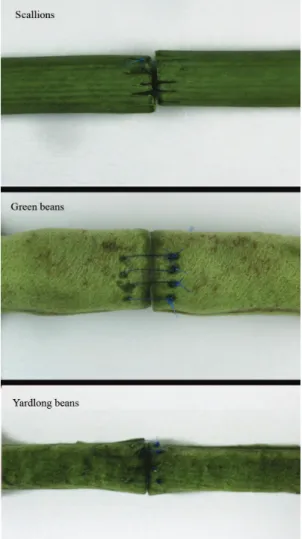
All three vegetables tested exhibited positive patency before the procedures. With relation to construction of anastomoses, it did not prove to be feasible to use scallions as a model for training because they have longitudinal ibers and knots came loose while they were being tied, making it impossible to accomplish the correct surgical technique (Figure 2).
After the seeds were removed from the yardlong beans, the empty pods proved to be a feasible model for vascular training. All attempts resulted in positive inal patency; and the dimensions of their walls are similar to those of the walls of human vessels. The cost, length, diameter, and wall thickness for each training model tested are listed in Table 1.
DISCUSSION
Vascular anastomoses are essential surgical procedures in many different specialties.1-3 The learning curve for
acquiring this skill is long, because there are a large number of factors that modify the inal outcome of vascular patency. During the early stages of acquisition of this skill, use of alternative, non-living, models that can be used to simulate surgical steps should be encouraged, thereby minimizing mistakes in human beings.1,3,4,8
This study evaluated three vegetable models of vascular anastomoses, hoping to identify a low cost alternative that could be easily reproduced at different training centers. Of the models studied, it was only possible to achieve successful anastomosis in the green beans and yardlong beans; the second of which appears more advantageous because it is less thick and better simulates the morphological characteristics of an arterial vessel.9 However, there are also limitations
to the utility of yardlong beans, primarily the fact that they cannot be used to simulate an important morphological characteristic of veins – their valves.10
Since scallions have ibers aligned longitudinally, it was not possible to construct an anastomosis with them, but their very ine walls are similar to veins and although they cannot be used to practice vascular sutures, when handled they do simulate the delicacy of veins.
The greater thickness of green beans in comparison with yardlong beans make this model suitable for the initial stages of training, since they maintain their
Figure 2. Final appearance of the vegetables after anastomoses.
Table 1. Costs related to training models.
Price Quantity Length Internal
diameter Wall thickness
Scallions (Allium schoenoprasum) R$ 1.60 45 units 27 cm 0.8 mm 1 mm Green beans (Phaseolus vulgaris) R$ 2.70 50 units 15 cm 1 cm 3 mm Yardlong beans (Vigna unguiculata) R$ 1.60 18 units 39 cm 1 cm 1 mm
Anatomic forceps R$ 11.19 1 unit Not applicable
Needle holder R$ 23.97 1 unit Not applicable
Scissors R$ 31.33 1 unit Not applicable
Box of gloves R$ 22.00 1 box Not applicable
Polypropylene thread R$ 35.00 6 boxes Not applicable
shape better, facilitating anastomosis.1,3,5,8 One of the
disadvantages of using yardlong beans is the need to remove the beans from the pods, which could damage them as a training model.
Other types of vascular sutures, such as longitudinal, oblique and types such as end-to-end, end-to-side, and side-to-side, can also be conducted with these models.2,4,11 Another relevant fact related to this method
is that the handling techniques and skills acquired can be applied to other suture techniques, such as intestinal anastomoses; although it is unlikely to be possible to achieve the two suture layers generally used in this type of anastomosis.12
One of the limitations of using these vegetable models is that an objective assessment cannot be made of the quality of the distance between stitches, since, in contrast with in vivo models in which coagulation occurs between sutures, in the vegetable model there will always be leakage between sutures, so this cannot be used to determine whether the distance between stitches is correct. Nevertheless, these characteristics do not rule out using this model as an initial step in the learning curve of several aspects related to materials, threads and tissues.1-5,8
The cost of the training described was approximately R$320.00, with the greatest cost related to acquisition of suture threads. We therefore believe that use of vegetables could be adopted for practicing vascular anastomoses and could be incorporated into residency and undergraduate medicine programs.12 However, there
are several improvements that need to be made to the model, such as assessing side-to-end anastomoses, and using it in dolls that simulate surgical procedures in greater detail and are connected to pulsating pressure systems.4
It is therefore concluded that, of the models tested, yardlong beans exhibited the best characteristics for use in initial training in vascular anastomoses, because it has dimensions and consistency similar to human vessels and because of its resistance when tying surgical knots.
REFERENCES
1. Sigounas VY, Callas PW, Nicholas C, et al. Evaluation of simulation-based training model on vascular anastomotic skills for surgical residents. Simul Healthc. 2012;7(6):334-8. PMid:22960701. http:// dx.doi.org/10.1097/SIH.0b013e318264655e.
2. Kallás IE, Kallás AC, Callas E. Anastomoses arteriais: passado, presente e futuro. Acta Cir Bras. 1999;14(4):221-7. http://dx.doi. org/10.1590/S0102-86501999000400013.
3. Feliciano DV, Moore EE, Biffl WL. Western trauma association critical decisions in trauma: management of abdominal vascular trauma. J Trauma Acute Care Surg. 2015;79(6):1079-88. PMid:26680144. http://dx.doi.org/10.1097/TA.0000000000000869.
4. Eckstein HH, Schmidli J, Schumacher H, et al. Rationale, scope, and 20-year experience of vascular surgical training with lifelike pulsatile flow models. J Vasc Surg. 2013;57(5):1422-8. PMid:23601597. http://dx.doi.org/10.1016/j.jvs.2012.11.113.
5. Okhah Z, Morrissey P, Harrington DT, Cioffi WG, Charpentier KP. Assessment of surgical residents in a vascular anastomosis laboratory. J Surg Res. 2013;185(1):450-4. PMid:23800439. http:// dx.doi.org/10.1016/j.jss.2013.04.090.
6. Achar RA, Lozano PA, Achar BN, Pereira Filho GV, Achar E. Experimental model for learning in vascular surgery and microsurgery: esophagus and trachea of chicken. Acta Cir Bras. 2011;26(2):101-6. PMid:21445471. http://dx.doi.org/10.1590/ S0102-86502011000200005.
7. Brito CV, Soares RH, Botelho NM. Laboratory animals and analgesia: the responsibility of ethics committees and the obligations of researchers. Rev Bioet. 2016;24(3):528-31.
8. Amato AC, Freitas SL, Veloso PM, Correia TCV, Santos RV, Amato SJTA. Gelatin model for training ultrasound-guided puncture. J Vasc Bras. 2015;14(3):200-4. http://dx.doi.org/10.1590/1677-5449.0088.
9. Wilasrusmee C, Lertsithichai P, Kittur DS. Vascular anastomosis model: relation between competency in a laboratory-based model and surgical competency. Eur J Vasc Endovasc Surg. 2007;34(4):405-10. PMid:17681827. http://dx.doi.org/2007;34(4):405-10.1016/j.ejvs.2007.05.015.
10. Teixeira RK, Yamaki VN, Valente AL, et al. Existem válvulas na veia femoral em ratas Wistar? J Vasc Bras. 2015;14(4):368-71. http:// dx.doi.org/10.1590/1677-5449.004515.
11. Price J, Naik V, Boodhwani M, Brandys T, Hendry P, Lam BK. A randomized evaluation of simulation training on performance of vascular anastomosis on a high-fidelity in vivo model: the role of deliberate practice. J Thorac Cardiovasc Surg. 2011;142(3):496-503. PMid:21742349. http://dx.doi.org/10.1016/j.jtcvs.2011.05.015.
*
Correspondence
Renan Kleber Costa Teixeira Universidade do Estado do Pará – UEPA Rua dos Mundurucus, 2256/1401 CEP 66035-360 - Belém (PA), Brazil Tel.: +55 (91) 98145-1108 E-mail: [email protected]
Author information
HDG - Medical student (3th year), Faculdade Metropolitana da Amazônia (FAMAZ). RKCT – Medical doctor, MSc from Programa de Pós-graduação em Cirurgia e Pesquisa Experimental, Universidade do Estado do Pará (UEPA). DHF - Medical student (6th year), Universidade do Estado do Pará (UEPA). VNY – Medical doctor, Universidade do Estado do Pará (UEPA). ALV and DJSFJ - Medical students (5th year), Universidade do Estado do Pará (UEPA). JMCR - Vascular surgeon, MSc in Surgery, Replacement professor, Universidade do Estado do Pará (UEPA). RSMB - Orthopedist and hand surgeon, PhD in Orthopedics, Adjunct professor level IV, Universidade do Estado do Pará (UEPA).
Author contributions
Conception and design: HDG, DJSFJ, JMCR Analysis and interpretation: RKCT, VNY, DHF, ALV Data collection: HDG, DJSFJ, RKCT Writing the article: HDG, VNY, DHF, ALV Critical revision of the article: RSMB, JMCR, RKCT Final approval of the article*: HDG, RKCT, DHF, VNY, ALV, DJSFJ, JMCR, RSMB Statistical analysis: N/A. Overall responsibility: RKCT