Perioperative Outcomes of Open Radical Prostatectomy versus
Laparoscopic Radical Prostatectomy in Asian Men: Comparison
of Two Initial Series by the same Surgeon
Sunai Leewansangtong, Wirat Wiangsakunna, Tawatchai Taweemankongsap
Division of Urology, Department of Surgery, Faculty of Medicine Siriraj Hospital, Mahidol University,
Bangkoknoi, Bangkok, Thailand
ABSTRACT
Purpose: To compare the perioperative outcomes in 2 initial series of open radical prostatectomy (ORP) and laparoscopic radical prostatectomy (LRP) in Asian men with prostate cancer.
Materials and Methods: From March 1999 to February 2007, the irst 100 consecutive patients who underwent ORP and
the irst 100 consecutive patients who underwent LRP by the same surgeon (SL) were assessed. Mean age, clinical stage, preoperative PSA level, Gleason score, operative time, estimated blood loss, blood transfusion rate, perioperative com
-plications, pathological stage and margin status were compared between the 2 groups.
Results: For each 100 patients in ORP and LRP, mean age and clinical stage were not signiicantly different. The operative
time in LRP was signiicantly longer than ORP (188 ± 55 versus 114 ± 31 minute, p value = 0.01). Mean estimated blood loss and blood transfusion rate in LRP was signiicantly lower than ORP, 521 ± 328 versus 809 ± 510 mL (p value = 0.03) and 27% versus 55% (p value = 0.01), respectively. For pathological organ conined disease, the free surgical margin rate of ORP and LRP was not signiicantly different (88.9% versus 91.3%, respectively, p = 0.58). There was no signiicant major complication in either group.
Conclusions: For initial experience by a single surgeon, LRP is comparable to ORP with no signiicant morbidity. LRP had
longer operative time. However, LRP decreased blood loss and blood transfusion. For localized prostate cancer, free surgi
-cal margin rate of ORP and LRP was not signiicantly different.
Key words: prostate neoplasms; prostatectomy; laparoscopy
Int Braz J Urol. 2009; 35: 151-7
INTRODUCTION
Radical prostatectomy has been a standard treatment for clinical localized prostate cancer. Open retropubic radical prostatectomy (ORP) has been accepted as a standard technique (1-3). For over a decade, minimal invasive surgery techniques have been widely used for prostate cancer in urology, and laparoscopic radical prostatectomy (LRP) in particular has become a standard treatment for clinically local-ized prostate cancer (4-6). Reported data in western
LRP requires longer operative time and is more costly than ORP. Since there are few published data regard -ing these issues in South East Asia, this study was conducted in Thai men to compare perioperative data and pathological outcomes between LRP and ORP. To reduce variations in surgical skill and experience of the surgeon, all patients in two initial series of ORP and LRP were operated on by single surgeon.
MATERIALS AND METHODS
From March 1999 to February 2007, the irst 100 consecutive patients who underwent ORP and the irst 100 consecutive patients who underwent LRP by single surgeon (SL) at Siriraj Hospital, Bangkok, were retrospectively evaluated. Pathology results in all patients conirmed adenocarcinoma of the prostate gland. All patients had clinical localized (cT1 or cT2) or clinical locally advanced (cT3) prostate cancer and negative bone CT scan. In each group, most patients were diagnosed using a transrectal ultrasound guide biopsy if they had elevated prostate-speciic antigen (PSA) or abnormal digital rectal examination (DRE) or both. However, some patients with previous trans -urethral prostatectomy (TURP) were diagnosed with prostate cancer somewhere else and referred to our hospital for further deinite treatment. All treatment options were informed and decided by the patients alone. During 1999-2004, all patients in this series underwent ORP. LRP in this series was initially per-formed in February 2005, then, LRP was perper-formed parallel to ORP. In 2006 and 2007, almost all patients in this series underwent LRP. All surgical procedure
options were also decided by the patients themselves. All ORPs were performed using the retrograde tech -nique described by Walsh (10). Of the 100 patients with LRP, 42 and 58 patients underwent the procedure via an intraperitoneal or extraperitoneal approach, re-spectively. To compare the perioperative data, morbidity and pathological outcomes between ORP and LRP, patients’ age, clinical stage, preoperative PSA level, Gleason score, operating time, estimated blood loss, blood transfusion rate, perioperative complications, pathological stage and margin status were compared. Mean data were compared using the Student’s t-test. Chi-square test was used for descriptive data. All data were analyzed by SPSS software program.
RESULTS
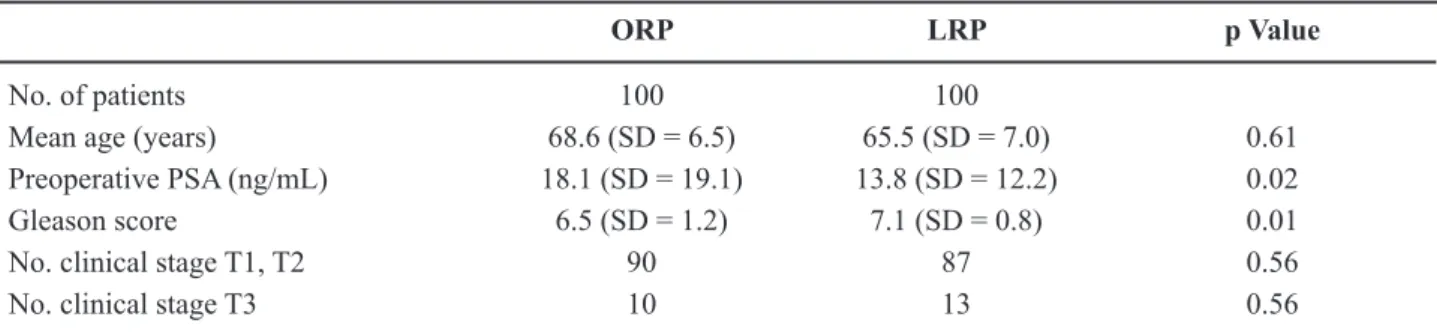
The patient characteristics of age, clinical stage, preoperative PSA level and Gleason score be -tween ORP and LRP are shown in Table-1. Mean age and clinical stage were not different between ORP and LRP. Mean preoperative PSA level in ORP was higher than that in LRP. However, mean Gleason Score in LRP was higher than that in ORP. Of 100 patients in each group, 8 in ORP and 17 patients in LRP had previous TURP. Table-2 shows operative and pathological data in both groups. The operative time in LRP was signiicantly higher than that in ORP. In contrast, estimated blood loss and blood transfusion rate were signiicantly lower in LRP. Of 100 patients in ORP, 72 and 28 patients had pathological local -ized (pT2) and pathological locally advanced disease (pT3), respectively. Of 100 patients in LRP, 69 and
Table 1 – Patient characteristics in ORP and LRP.
ORP LRP p Value
No. of patients 100 100
Mean age (years) 68.6 (SD = 6.5) 65.5 (SD = 7.0) 0.61 Preoperative PSA (ng/mL) 18.1 (SD = 19.1) 13.8 (SD = 12.2) 0.02
Gleason score 6.5 (SD = 1.2) 7.1 (SD = 0.8) 0.01
No. clinical stage T1, T2 90 87 0.56
No. clinical stage T3 10 13 0.56
31 patients had pT2 and pT3, respectively. In both groups, there was no signiicantly different proportion of the prostate affected or a locally advanced disease. Overall free margin rate in ORP and LRP were not signiicant different (p = 0.38). Table-3 shows margin status in pT2 and pT3 stage between ORP and LRP. Of 72 and 69 patients with pT2 in ORP and LRP, 64 (88.9%) and 63 (91.3%) margin free, respectively. It was not signiicantly different (P = 0.58). In pT3, posi -tive margin rate were high in both groups. However, it was not signiicantly different between ORP and LRP (p = 0.43). For pathological stage and margin status, our data showed that ORP and LRP were also not statistically different.
There were 3 complications in ORP. One patient had prolonged urinary leakage for 2 weeks and conservatively treated. Two patients had wound infection. For LRP, 5 patients required a conversion to ORP. Three patients had no progression in surgi -cal technique for LRP due to the learning curve.
All of these 3 patients were in the irst 5 patients in this series. One patient had CO2 retention during suturing of an anastomosis and needed a conversion to ORP. Another had incidental colonic cancer and also required conversion to colonic resection. There was prolonged urinary leakage in 3 patients in LRP. However, all patients were treated conservatively. One patient in LRP had urine collection in pelvic cavity due to voiding obstruction. There was no rectal injury in either group.
All patients had no preoperative incontinence in either group. After surgery, we deined incontinence status as 3 degrees according to the number of pads used for the entire day. No pad was considered as any incontinence, 1 or 2 pads were considered as inconti-nence and 3 or more pads were considered as severe incontinence. For 6 months, of 100 patients in ORP, 90 patients had no pad, 7 patients had incontinence that needed 1 or 2 pads. Three patients had severe incontinence that required 3 or more pads or other de
-Table 2 – Operative and pathological data in 100 patients of ORP and 100 patients of LRP.
ORP LRP p Value
Operative time (min.) 114 (SD = 31) 188 (SD = 55) 0.01
Estimate blood loss (mL) 809 (SD = 510) 521 (SD = 328) 0.03
Blood transfusion (%) 55 27 0.01
Pathological localized stage (%) 72 69 0.64
Over all free margin rate (%) 73 71 0.38
ORP = open retropubic radical prostatectomy; LRP = laparoscopic radical prostatectomy; SD = standard deviation.
Table 3 – Surgical margin in pathological localized disease and pathological locally advanced disease between ORP and LRP.
Number of Patients
ORP LRP p Value
Localized staging 72 69
Free margin 64 (88.9%) 63 (91.3%) 0.58 Positive margin 8 (11.1%) 6 (8.7%) 0.58 Locally advanced staging 28 31
Free margin 9 (32.1%) 8 (25.8%) 0.43 Positive margin 19 (67.9%) 23 (74.2%) 0.43
vices. For 100 patients in LRP, 92 patients had no pad, 6 patients had incontinence that needed 1 or 2 pads. Two patients had severe incontinence that needed 3 or more pads or other devices. As regards potency, it was dificult to evaluate in this series. Bilateral nerve sparing procedure did not performed in the patients with high-risk cancer such as cT3, PSA higher than 10 ng/mL, Gleason score 8 or above, patients who had previous impotence or patients who did not have sexual interest. In addition, end point of this study was short for perioperative period. Thus, our data regarding potency was limited. However, several of the younger patients with bilateral nerve sparing had potency after surgery.
COMMENTS
ORP has been used as a standard technique for clinical localized prostate cancer (1-3). Since minimal invasive surgery has increased worldwide, LRP has been increasingly performed and has become a stan -dard technique in many centers (4-6). Our hospital also uses LRP as a standard operation for clinical localized prostate cancer. A number of reported data suggest that LRP has several advantages such as small incision, fast recovery, less pain, magniied picture for accurate dissection and reduced blood loss. However, LRP is a dificult procedure that needs surgical skill and long learning curve (7,11). Outcomes of radical prostatec -tomy are also depended on several factors including surgical skill and experience of the surgeon and surgi -cal team. There are many reported series comparing data between ORP and LRP in the literature (4,7-9), the majority published in the western countries. Our study comparing ORP and LRP was limited to the South East Asia region. It was retrospectively carried-out to evaluate ORP and LRP in Thai men. To exclude variation of surgical skill and experience of surgeon, the irst 100 cases of ORP and the irst 100 cases of LRP performed by a single surgeon were compared.
Each cohort group showed the same patient characteristics except for preoperative PSA. Preop -erative PSA in our series was higher than other series (8,9,11). At present, there has been no oficial prostate cancer screening program in Thailand. In the past, most patients who had PSA testing were men with
lower urinary tract symptoms (LUTS) and diagnosed as benign prostatic hyperplasia (BPH). Since there has been more prostate cancer awareness in recent years, PSA testing was used more in men without LUTS or BPH. More patients presented with abnormal PSA regardless of LUTS or BPH. Therefore, more patients have presented with lower PSA in recent years. For these reasons, patients in ORP group who were di -agnosed in the past had higher PSA than patients in LRP group who presented in recent years. However, preoperative PSA in both groups were higher than in the western countries. Another reason was that the treatment option for prostate cancer was decided by the patients, and most Thai patients preferred radical prostatectomy even when there were high risks (PSA > 10 ng/mL).
Our data showed that LRP had signiicant less blood loss and blood transfusion than ORP because LRP had magniied structure of organs and surround -ing tissues result-ing in more accurate dissection. However, LRP had longer operative time. There was no mortality. The morbidities could be managed safely. Incontinence rate was comparable to other series (4-7). This study also concluded that LRP was a safe procedure even in the initial period.
-ing curve period. The most common site of positive margin was apex. It requires experience to completely remove tumors that were located beyond the prostate gland with preserving enough urethral length for con -tinence. As mention above, the proportion of pT3 in our series was almost one-third. Thus, overall positive margin rates in both groups were higher than other series. However, the overall free margin rate between ORP and LRP was not different. Since our data only concerns a limited follow-up period, the outcomes for cancer control will require long term evaluation.
All data of perioperative surgical parameters, morbidities and pathological results showed that LRP was comparable to ORP even during the period of the initial series for the surgeon. Our results suggest that LRP could be considered a standard technique as ORP for clinical localized prostate cancer in Asian men.
The procedure of radical prostatectomy is an issue that needs experiences of surgical skill and number of cases to overcome the learning curve. For ORP, the bleeding and blood transfusion rate was high. At the beginning, almost patients needed a blood transfusion. When we had more experience, bleeding and blood transfusion were reduced. For LRP, it was a very dificult procedure when we performed in the early period. Three cases of LRP that need conver-sion to ORP because of no progresconver-sion were in the beginning period. When we had more experience, the operating time decreased from 5 hours to 2-3 hours and estimated blood loss and blood transfusion rate greatly decreased. The important factor to improve skill is to continuously perform the procedure. In Thailand, most cases of radical prostatectomy are performed at the referral center such as the university hospital. At present, ORP is increasingly performed in many hospitals. In contrast, LRP is still limited to few hospitals. Thus, most patients with clinical lo-calized prostate cancer are referred to the university hospital. In Thailand, even the prevalence of prostate cancer is not as high as those in the western countries; more prostate cancer awareness in recent years has caused more clinical localized cancer to be detected. In addition, our university hospital is a medical center where the majority of patients with prostate cancer are referred to and therefore, we continue perform LRP on a regular basis.
CONCLUSIONS
For initial experience by a single surgeon, LRP is comparable to ORP without signiicant mor -bidity but LRP had a longer operative time. However, LRP decreased blood loss and blood transfusion. For localized prostate cancer, free surgical margin rate of ORP and LRP was not signiicantly different. With increasing experience the laparoscopic technique should be considered a feasible procedure for patients with prostate cancer.
CONFLICT OF INTEREST
None declared.
REFERENCES
1. Han M, Partin AW, Pound CR, Epstein JI, Walsh PC: Long-term biochemical disease-free and cancer-spe
-ciic survival following anatomic radical retropubic prostatectomy. The 15-year Johns Hopkins experience. Urol Clin North Am. 2001; 28: 555-65.
2. Hull GW, Rabbani F, Abbas F, Wheeler TM, Kattan MW, Scardino PT: Cancer control with radical pros
-tatectomy alone in 1,000 consecutive patients. J Urol. 2002; 167: 528-34.
3. Klevecka V, Burmester L, Musch M, Roggenbuck U, Kroepl D: Intraoperative and early postoperative
complications of radical retropubic prostatectomy.
Urol Int. 2007; 79: 217-25.
4. Touijer K, Eastham JA, Secin FP, Romero Otero J, Serio A, Stasi J, et al.: Comprehensive prospective
comparative analysis of outcomes between open and
laparoscopic radical prostatectomy conducted in 2003 to 2005. J Urol. 2008; 179: 1811-7; discussion 1817. 5. Stolzenburg JU, Rabenalt R, DO M, Ho K, Dorschner
W, Waldkirch E, et al.: Endoscopic extraperitoneal radical prostatectomy: oncological and functional re
-sults after 700 procedures. J Urol. 2005; 174: 1271-5; discussion 1275.
6. Goeman L, Salomon L, La De Taille A, Vordos D, Hoznek A, Yiou R, et al.: Long-term functional and oncological results after retroperitoneal laparoscopic prostatectomy according to a prospective evaluation of 550 patients. World J Urol. 2006; 24: 281-8. 7. Lepor H: Open versus laparoscopic radical prostatec
EDITORIAL COMMENT
The paper presents an interesting retrospec -tive study relevant to countries where daVinci robot is not widely available. In fact, it seems to be an honest report of two series of radical prostatectomies that started at different times. The author has performed open surgery for the irst time in 1999 and laparo -scopic procedure in 2005. After performing open radical prostatectomy for some years, he began per -forming it laparoscopically in elective patients. The low volume of this surgery (200 in 8 years) makes its mastery harder. Finally, the authors developed a preference for laparoscopy despite similar rates of positive margins and functional results. It would be
interesting to know what the surgeon’s previous ex -perience in laparoscopy was before he started doing radical prostatectomy. Also, we could not follow the evolution of the learning curve neither in open nor in laparoscopic surgeries. The operative time was rela -tively short but the bleeding and the transfusion rates were higher than those in other series were. Perhaps the inal message of the article is that most urologists that perform open radical prostatectomy who have had the perseverance to climb up the learning curve of radical prostatectomy eventually prefer doing it laparoscopically.
Dr. Anuar I. Mitre
Division of Urology, University of Sao Paulo, USP Sao Paulo, SP, Brazil E-mail: [email protected]
8. Ghavamian R, Knoll A, Boczko J, Melman A: Com -parison of operative and functional outcomes of lapa-roscopic radical prostatectomy and radical retropubic
prostatectomy: single surgeon experience. Urology. 2006; 67: 1241-6.
9. Guazzoni G, Cestari A, Naspro R, Riva M, Centemero A, Zanoni M, et al.: Intra-and peri-operative outcomes comparing radical retropubic and laparoscopic radical prostatectomy: results from a prospective, randomised, single-surgeon study. Eur Urol. 2006; 50: 98-104.
10. Walsh PC: Anatomic radical prostatectomy: evolution of the surgical technique. J Urol. 1998; 160: 2418-24.
11. Ferguson GG, Ames CD, Weld KJ, Yan Y, Venkatesh R, Landman J: Prospective evaluation of learning curve for laparoscopic radical prostatectomy: identiication of factors improving operative times. Urology. 2005; 66: 840-4.
Accepted after revision: December 5, 2008
Correspondence address:
Dr. Sunai Leewansangtong Division of Urology
Faculty of Medicine Siriraj Hospital
Mahidol University
Bangkoknoi, Bangkok 10700, Thailand Fax: + 66 2411-2011
EDITORIAL COMMENT
Laparoscopic radical prostatectomy (LRP) is increasingly performed at specialized centers worldwide. With gathering experience, the laparo -scopic technique has been shown to be feasible and reproducible (1).
The laparoscopic approach offers the advan-tages of laparoscopic surgery as less postoperative pain, fewer analgesics drugs and early mobilization. The magniication of the surgical ield, allow a clear operative ield with better view during the dissection of the neurovascular bundles and the urethro-vesical anastomosis.
The authors show in this paper a longer op -erative time with the LRP. However, LRP decreased blood loss and blood transfusion. For this population of localized prostate cancer, free surgical margin rate of ORP and LRP was not signiicantly different.
Outcomes of radical prostatectomy are de-pendent on several factors including surgical skill and experience of surgeon and surgical team. Besides, radical prostatectomy requires a suficient number of cases to overcome the learning curve. It should be learned within an intensive teaching program (2).
Although long-term oncological outcomes are not available for the majority of genitourinary malignancies treated by the laparoscopic approach, the intermediate-term data are encouraging and comparable to open surgery. Multicenter studies with longer follow-up are necessary.
REFERENCES
1. Gill IS, Ukimura O, Rubinstein M, Finelli A, Moinza
-deh A, Singh D, et al.: Lateral pedicle control during laparoscopic radical prostatectomy: reined technique. Urology. 2005; 65: 23-7.
2. Eden CG, Neill MG, Louie-Johnsun MW: The irst
1000 cases of laparoscopic radical prostatectomy in
the UK: evidence of multiple ‘learning curves’. BJU Int. 2008; 19. [Epub ahead of print]
Dr. Mauricio Rubinstein
Section of Urology Federal Univ. of Rio de Janeiro State Rio de Janeiro, RJ, 20270-004, Brazil E-mail: [email protected]
EDITORIAL COMMENT
The authors present the results of a nonran-domized series within the learning curves of both radical retropubic prostatectomy and laparoscopic radical prostatectomy. The results of the laparoscopic approach are surprisingly good for the irst 100 cases, even in terms of surgical time and urinary continence. This fact relects a special skill with the laparoscopic technique acquired by the single surgeon before the beginning of this series and, at the same time, a previ -ous huge experience with open radical prostatectomy, or a bias during the selection of the patients.
The authors should explain the extremely high rates of blood transfusion in both groups, respectively
27% (LRP) and 55% (ORP). These numbers are not compatible with the contemporary data from the lit-erature.
The authors could give us their results and their position about the differences between extra-peritoneal (58 cases) and transextra-peritoneal (42 cases) laparoscopic surgery.