Reducing the Number of Sutures for Vesicourethral Anastomosis
in Radical Retropubic Prostatectomy
Evangelos M. Mazaris, Eleftherios Chatzidarellis, Ioannis M. Varkarakis, Athanasios Dellis,
Charalambos Deliveliotis
Second Department of Urology, Sismanoglio Hospital, University of Athens, Athens, Greece
ABSTRACT
Objectives: To prospectively evaluate the outcome of using a two-suture technique for the vesicourethral anastomosis (VUA) during radical retropubic prostatectomy (RRP).
Materials and Methods: Two groups of 50 patients each underwent nerve-sparing RRP for localized prostate cancer by one surgeon. In one group, the vesicourethral anastomosis was performed using 2 Vicryl 2-0 stitches placed at the 3- and 9-o’clock positions and in the other group 6 Vicryl 2-0 stitches were placed at the 2-, 4-, 6-, 8-, 10- and 12-o’clock posi-tions. The intraoperative and perioperative parameters analyzed were time to perform the VUA, time to remove the drain and hospitalization. The rate of incontinence, anastomotic stricture and erectile function were included in the outcome analysis.
Results: The anastomotic time differed statistically between the 2 groups (mean 3.3 minutes for the 2-suture group and 10.5 minutes for the 6-suture group, p < 0.0001) with similar periods of drain removal (mean 3.12 days for the 2-suture group and 3.45 days for the 6-suture group; p = 0.13) and hospitalization (mean 4.66 days for the 2-suture group and 5.3 days for the 6-suture group; p = 0.09). The functional outcome was excellent for the 2-suture group with no patient suffering from incontinence or anastomotic strictures 1 year postoperatively, while in the 6-suture group there were 2 patients (4%) suffering from incontinence (2 underwent sling procedure) and 1 patient suffered from anastomotic stricture.
Conclusion: The low number of sutures in the 2-suture VUA technique reduces operating times, does not inluence peri -operative and intra-operative parameters and results in excellent functional outcome.
Key words: prostatic neoplasm; prostatectomy; anastomosis, surgical; sutures; treatment outcome
Int Braz J Urol. 2009; 35: 158-63
INTRODUCTION
Radical retropubic prostatectomy (RRP) is one of the treatment modalities recommended for clinically organ-conined prostate cancer. The bet -ter understanding of pelvic anatomy has led to the development of the anatomic approach of RRP (1) and to the reduction of speciic complications of the operation such as incontinence, anastomotic stricture and impotence.
is now becoming important in the laparoscopic era where intracorporeal suturing is dificult and intra -peritoneal leak could be a problem. We examined the feasibility of an interrupted two-suture vesicourethral anastomosis technique and its effect on the outcome of prostate cancer patients after open radical retropubic prostatectomy.
MATERIALS AND METHODS
From September 2005 to October 2006, we prospectively evaluated 100 patients, divided randomly into two groups of 50 patients each, by consecutive allocation to each group, who underwent nerve-sparing RRP by a single surgeon, after obtain-ing institutional review board approval. Patients who had undergone preoperative androgen ablation, local radiotherapy, previous transurethral or suprapubic resection of the prostate or underwent non nerve-spar-ing RRP were excluded from the study.
All patients underwent bilateral pelvic lymphadenectomy and standard nerve-sparing RRP as described by Walsh (1). The bladder neck was preserved and bladder neck mucosal eversion was performed routinely using 4 to 6 circumferential absorbable sutures 3-0. In one group the vesico-urethral anastomosis was performed using 2 Vic-ryl (Ethicon, NJ, USA) 2-0 stitches placed at the 3- and 9-o’clock positions and in the other group 6 Vicryl 2-0 stitches were placed at the 2-, 4-, 6-, 8-, 10- and 12-o’clock positions. The VUA was
carried-out on a 22F 3-way Couvelaire catheter, which was removed on the 10th postoperative day without performing a cystogram. Two drains were also routinely placed laterally to the anastomosis. They were removed when daily drain output was less than 50 mL.
The following intraoperative and postopera-tive parameters were recorded: time to perform VUA, blood loss, pre-and postoperative hemoglobin, drain output, time to drain removal and consequent transfu-sions. Follow-up consisted of visits every 3 months for 1 year, during which physical examination was performed and PSA values measured. All patients were encouraged to execute pelvic loor exercises (Kegel) (4) and phosphodiesterase-5 (PDE5) inhibi-tors were also administered early postoperatively (5). Continence was evaluated by the number of pads used daily as reported by the patients during the follow-up visits. They were deined as continent when no more than one pad daily was required (6).
The statistical analysis was performed by Student’s t-test for quantitative data and the chi-square test for categorical data. Results were considered statistically signiicant at p ≤ 0.05.
RESULTS
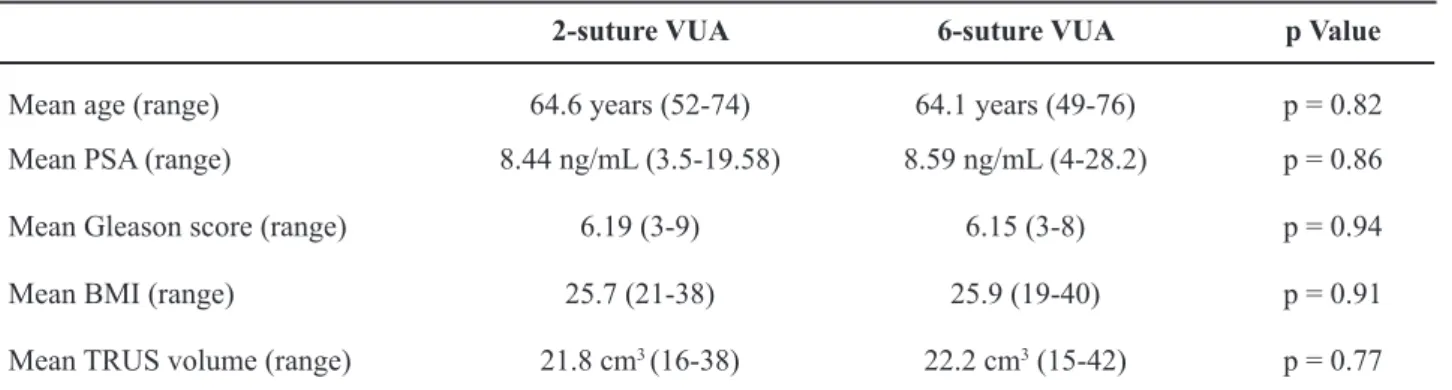
Patient characteristics such as age, PSA value, body mass index, prostate volume measured by tran-srectal ultrasound and Gleason score are presented in Table-1.
Table 1 – Patient characteristics.
2-suture VUA 6-suture VUA p Value
Mean age (range) 64.6 years (52-74) 64.1 years (49-76) p = 0.82
Mean PSA (range) 8.44 ng/mL (3.5-19.58) 8.59 ng/mL (4-28.2) p = 0.86
Mean Gleason score (range) 6.19 (3-9) 6.15 (3-8) p = 0.94
Mean BMI (range) 25.7 (21-38) 25.9 (19-40) p = 0.91
Mean TRUS volume (range) 21.8 cm3 (16-38) 22.2 cm3 (15-42) p = 0.77
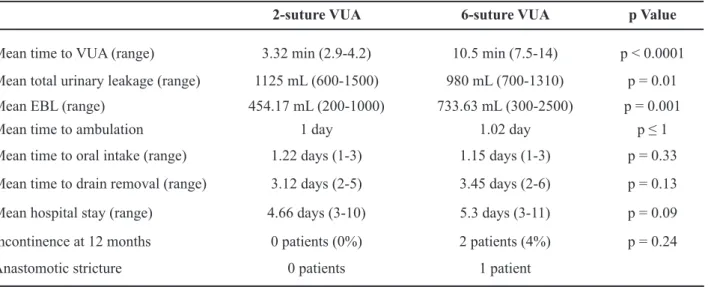
The analysis of the intraoperative parameters revealed a mean time to perform the vesicourethral anastomosis (VUA) of 3.3 minutes for the 2-suture technique and 10.5 minutes for the 6-suture technique (Table-2). Urinary leakage occurred in 4 patients (8%) in each of the two groups while the mean volume was 1125 mL for the 2-suture technique compared with a signiicantly less mean volume of leakage of 980 mL for the 6-suture technique. Urinary leakage in both groups subsided spontaneously with patient mobilization and all drains in these patients had been removed by the 3rd or 4th postoperative day, thus all patients were discharged without drains.
During the postoperative course the mean time to ambulation was 1 day for the 2-suture tech-nique and 1.02 days for the 6-suture techtech-nique, the mean time to oral intake was 1.22 (range 1-4) days and 1.15 (range 1-3) days respectively. Timescale to drain removal and patient discharge did not differ statistically between the two groups (Table-2).
No signiicant postoperative bleeding was observed as only 2 patients (4%) were transfused with 3 blood units in total in each group postoperatively.
Regarding the 2-suture technique, no patient suffered from incontinence 1 year postoperatively, while with the 6-suture technique, 2 (4%) patients were incontinent in the same period and a male sling
was placed successfully. No patient suffered from anastomotic stricture with the 2-suture technique while 1 patient suffered from stricture with the 6-suture technique, which was endoscopically treated (Table-2).
COMMENTS
The creation of the VUA is a crucial step in RRP since it affects future outcomes and thus the quality of life of such patients postoperatively. It seems that prevention of anastomotic stricture (2) and urinary continence (7) depends on a well-healed vesicourethral anastomosis. The general principle to achieve this, regardless of the anastomotic technique used, is a watertight, tension-free anastomosis with mucosal-to-mucosal coaptation and proper urethral alignment (8).
Recently, a VUA technique using two inter-rupted sutures with equal outcomes while offering reduced anastomotic time was reported (6). The task of performing a 2-suture technique for the VUA is not only convenient for open RRP but may also simplify the procedure for the laparoscopic approach since suturing during laparoscopy is more challeng-ing. Leakage was signiicantly higher in the 2-suture
Table 2 – Intraoperative and postoperative parameters as well as functional outcome.
2-suture VUA 6-suture VUA p Value
Mean time to VUA (range) 3.32 min (2.9-4.2) 10.5 min (7.5-14) p < 0.0001
Mean total urinary leakage (range) 1125 mL (600-1500) 980 mL (700-1310) p = 0.01
Mean EBL (range) 454.17 mL (200-1000) 733.63 mL (300-2500) p = 0.001
Mean time to ambulation 1 day 1.02 day p ≤ 1
Mean time to oral intake (range) 1.22 days (1-3) 1.15 days (1-3) p = 0.33
Mean time to drain removal (range) 3.12 days (2-5) 3.45 days (2-6) p = 0.13
Mean hospital stay (range) 4.66 days (3-10) 5.3 days (3-11) p = 0.09
Incontinence at 12 months 0 patients (0%) 2 patients (4%) p = 0.24
Anastomotic stricture 0 patients 1 patient
technique; however, it stopped spontaneously with ambulation and was drained effectively, thus resulting in no patients with incontinence or anastomotic stric-ture. Our two-suture technique for the VUA is faster and less challenging than using a four (2), six (1) or eight-suture (3) or even a running suture (9) technique since it is obvious that by using more sutures is more time-consuming and complicated. Some surgeons place their sutures in the urethra before dividing it completely and leave them on the surgical table until the bladder neck is ready for the VUA; while others place their sutures creating the VUA after the prostate has been removed. In the irst case sometimes sutures become entangled increasing the surgical time. It is evident that by using only two sutures entangle-ment is more dificult and disentangleentangle-ment easier. Furthermore, in contrast to a recent study using the two-suture technique (6) the placement of sutures in the 3 and 9 o’clock positions instead of the 6 and 12 o’clock, avoids the rectum and the rectourethralis muscle dorsally and branches of the Santorini plexus anteriorly.
Moreover, in the present series preservation of the bladder neck was selected since earlier return to continence and a reduction in the stricture rate have been reported when using such technique (10). We also everted the bladder mucosa permitting a close coaptation with the urethral mucosa and tried to avoid interposition of perivesical fat when tying the sutures (11).
In the present series no patient with the 2-suture and 1 patient with the 6-2-suture technique de-veloped an anastomotic stricture, which rates vary in the literature from 0.5% to 32% (12), despite having 4 patients in each group with urinary leak in the early postoperative period, which has been described as a risk factor (13) for stricture formation. The incidence of urinary leak for the 2-suture technique was higher compared with the 6-suture technique in accordance with other studies (6). In all of these patients the leak ceased spontaneously with ambulation and an unob-structed urethral catheter. On the contrary, it seems that the degree of tightness of the anastomosis (9) with a compromised vascular supply to the bladder neck and the urethra is a predisposing factor for stricture formation, thus by using two sutures we avoid such tightness. Furthermore, we used a 3-way wide catheter
of 22F without traction, in order to achieve healing of the suture line since it has been proven that the incidence of anastomotic stricture is reduced with a wider caliber of the anastomosis (14). A large bore catheter results in better drainage, which decreases the potential for leakage. Postoperative bleeding was also minimal in our patients, thus avoiding another risk factor for stricture formation. By using drains, especially large ones in the early postoperative period, better removal of luid or blood from the anastomotic site is achieved, in order to avoid ibrosis and stricture formation.
The rates of incontinence after RRP have been reported from 2.5% to 87% (15), yet a 12-month pe-riod is necessary before deining a patient’s continence status (16). Several risk factors have been reported to contribute to continence after RRP such as patient age, disease stage, surgical technique, preoperative continence and previous transurethral resection of the prostate (17). In our series the rate of incontinence was very low, consistent with other reports (9) and it is noteworthy that no patient suffered from incontinence 1 year after the operation with the 2-suture technique while 2 patients were incontinent with the 6-suture technique.
In order to preserve continence, the mem-branous urethra, the sphincter mechanism and its innervations as well as the anastomotic blood sup-ply should be preserved. The “continence nerves” seem to be damaged during blunt dissection of the posterior periurethral tissues near the junction of the levator ani muscle and during placement of the anastomotic sutures at the 5- and 7-o’clock posi-tions (6). By placing sutures in the 3- and 9-o’clock positions we can avoid such nerves. Additionally, by using the nerve-sparing procedure we improved our continence rates (18), which are possibly attributed to the meticulous dissection of the nerves from the apex of the prostate instead of the preservation of the neurovascular bundle. Furthermore, preservation of the bladder neck especially of its circular ibers, as in this series of patients, contributes to return of continence (19).
differences in the surgical technique and the number of sutures used for the VUA. Prospective comparative studies with several techniques for VUA are required, in order to conirm the superior results of a 2-suture technique. However, we must acknowledge that these 50 patients, with this speciic surgical technique of reduced number of sutures for the VUA, had excellent outcome with minimal complications compared with the same number of patients with a 6-suture technique, thus, proving effective, less challenging and conve-nient for use in open RRP. We must also acknowledge that in our study patients were discharged in their majority between the 4th and 5th postoperative day, due to special circumstances existing in our country (long distance from permanent residence, National Health System environment, no pressure by insurance companies, etc).
CONCLUSION
The reduced number of sutures used for the VUA in the present study reduced surgical time safely, is easier to perform and achieved excellent func-tional outcomes. Although urinary extravasation was higher in the intraoperative period, it was managed conservatively and stopped spontaneously having no effect on stricture formation. The reduced number of sutures for the VUA seems to have a lower incidence of incontinence and anastomotic stricture resulting in minimal late complications after RRP.
CONFLICT OF INTEREST
None declared.
REFERENCES
1. Walsh PC: Anatomic radical prostatectomy: evolution of the surgical technique. J Urol. 1998; 160: 2418-24.
2. Borboroglu PG, Sands JP, Roberts JL, Amling CL: Risk factors for vesicourethral anastomotic stricture after radical prostatectomy. Urology. 2000; 56: 96-100.
3. Srougi M, Nesrallah LJ, Kauffmann JR, Nesrallah A, Leite KR: Urinary continence and pathological out-come after bladder neck preservation during radical retropubic prostatectomy: a randomized prospective trial. J Urol. 2001; 165: 815-8.
4. Van Kampen M, De Weerdt W, Van Poppel H, De
Ridder D, Feys H, Baert L: Effect of pelvic-loor
re-education on duration and degree of incontinence after radical prostatectomy: a randomized controlled trial. Lancet. 2000; 355: 98-102.
5. Montorsi F, Briganti A, Salonia A, Rigatti P, Burnett AL: Current and future strategies for preventing and managing erectile dysfunction following radical pros-tatectomy. Eur Urol. 2004; 45: 123-33.
6. Gallo L, Perdonà S, Autorino R, Menna L, Claudio L, Marra L, et al.: Vesicourethral anastomosis during radical retropubic prostatectomy: does the number of sutures matter? Urology. 2007; 69: 547-51.
7. Steiner MS, Morton RA, Walsh PC: Impact of ana-tomical radical prostatectomy on urinary continence. J Urol. 1991; 145: 512-4; discussion 514-5.
8. Walsh PC, Quinlan DM, Morton RA, Steiner MS: Radical retropubic prostatectomy. Improved anasto-mosis and urinary continence. Urol Clin North Am. 1990; 17: 679-84.
9. Miki T, Okihara K, Ukimura O, Usijima S, Yoneda K, Mizutani Y, et al.: Running suture for vesicourethral anastomosis in minilaparotomy radical retropubic prostatectomy. Urology. 2006; 67: 410-2.
10. Shelfo SW, Obek C, Soloway MS: Update on blad-der neck preservation during radical retropubic prostatectomy: impact on pathologic outcome, anastomotic strictures, and continence. Urology. 1998; 51: 73-8.
11. Tomschi W, Suster G, Höltl W: Bladder neck strictures after radical retropubic prostatectomy: still an unsolved problem. Br J Urol. 1998; 81: 823-6.
12. Popken G, Sommerkamp H, Schultze-Seemann W, Wetterauer U, Katzenwadel A: Anastomotic stricture
after radical prostatectomy. Incidence, indings and
treatment. Eur Urol. 1998; 33: 382-6.
13. Surya BV, Provet J, Johanson KE, Brown J: Anasto-motic strictures following radical prostatectomy: risk factors and management. J Urol. 1990; 143: 755-8. 14. McCarthy J, Catalona W: Nerve Sparing Radical
Retropubic Prostatectomy. In: Marshall F (ed.), Text-book of Operative Urology, 1st ed., Philadelphia, WB Saunders. 1996, pp. 537-44.
16. Poore RE, McCullough DL, Jarow JP: Puboprostatic ligament sparing improves urinary continence after radical retropubic prostatectomy. Urology. 1998; 51: 67-72.
17. Eastham JA, Kattan MW, Rogers E, Goad JR, Ohori M, Boone TB, et al.: Risk factors for urinary inconti-nence after radical prostatectomy. J Urol. 1996; 156: 1707-13.
18. Burkhard FC, Kessler TM, Fleischmann A, Thalmann GN, Schumacher M, Studer UE: Nerve sparing open
radical retropubic prostatectomy--does it have an impact on urinary continence? J Urol. 2006; 176: 189-95.
19. Selli C, De Antoni P, Moro U, Macchiarella A, Gianna-rini G, Crisci A: Role of bladder neck preservation in urinary continence following radical retropubic pros-tatectomy. Scand J Urol Nephrol. 2004; 38: 32-7. 20. Patel R, Lepor H: Removal of urinary catheter on
postoperative day 3 or 4 after radical retropubic pros-tatectomy. Urology. 2003; 61: 156-60.
Accepted after revision: November 14, 2008
Correspondence address: Dr. Evangelos Mazaris 89 Agiou Ioannou Street
Agia Paraskevi, Athens, 15342, Greece Fax: + 30 210 804-4703