J Bras Pneumol. 2008;34(2):103-106
103
Brief Communication
* Study carried out at the Health Sciences Center of the Universidade Estadual de Londrina – UEL, State University of Londrina – Londrina, Brazil.
1. Coordinator of the Work Group of Public Programs for Asthma. Sociedade Brasileira de Pneumologia e Tisiologia – SBPT, Brazilian Thoracic Society – Brasília, Brazil.
2. Adjunct Professor of Pulmonology. Universidade Estadual de Londrina – UEL, State University of Londrina – Londrina, Brazil. 3. Medical student. Universidade Estadual de Londrina – UEL, State University of Londrina – Londrina, Brazil.
Correspondence to: Alcindo Cerci Neto. Av. Duque de Caxias, 1980 - SL 202, CEP 96010-420, Londrina, PR, Brasil. Tel 55 43 3323-9784. E-mail: [email protected]
Submitted: 13 February 2007. Accepted, after review: 14 June 2007.
Brazilian examples of programs for the control of asthma*
Alcindo Cerci Neto1, Olavo Franco Ferreira Filho2, Tatiara Bueno3
Abstract
The aim of this study was to determine which Brazilian programs demonstrate experience in asthma management. Data on and characteristics of those programs were obtained by electronic mail. The variables studied were related to the program itself, its patients and staff. Descriptive statistics were used in the study, which evaluated 17 programs. All programs received public funding, produced educational/training materials and had specialized physicians on staff. We concluded that the experience accumulated by all the programs can be used as one of the pillars of a national program for the control of asthma in Brazil.
104 Cerci Neto A, Ferreira Filho OF, Bueno T
J Bras Pneumol. 2008;34(2):103-106
to the health care facilities of the members who answered “yes” in order to determine the public health strategies adopted, some epidemiological aspects of patients (age and gender), as well as the makeup of the teams of health professionals involved in the programs (number of professionals, professional category and type of professional training) and their practices (educational activi-ties and number of daily/monthly visits). We also asked how long the program had been in opera-tion, whether charts/educational materials had been produced and what were the sources of financial support (state agencies, municipal agencies or both).
The objective of the present study was to inves-tigate comprehensive programs. Therefore, after a preliminary analysis of the forms, programs that had been in operation for less than two years were excluded, as were those aimed only at the treat-ment of severe asthma. Only descriptive statistics were used in the analysis of the results.
Of the 55 programs operating out of health care facilities at which those who answered “yes” to the initial question worked, 28 (51%) were sponsored by health departments (27 municipal and 10 state), and 27 (49%) were sponsored by institutions of higher learning. A second questionnaire containing questions on infrastructure and human resources was distributed to those same 55 health care facili-ties. A total of 38 programs (69%) were excluded from the study: 11 because the health care facili-ties out of which they operated did not respond to the second questionnaire; 17 because they focused only on severe asthma; and 10 because they had been in operation for less than 2 years. Therefore, 17 asthma control programs were studied, 4 of which were coordinated by ASBAI members, 4 by SBP members, 3 by SBPT members and 1 by a member of the Brazilian Society of Family and Community Medicine. Of those 17 programs, 14 (82%) offered treatment for all age brackets, and only 3 (18%) served children and adolescents exclusively. All of the programs received public funding for medica-tion and salaries. Of the 17 programs evaluated, 4 (23%) received state funding exclusively, whereas 13 (77%) received state and municipal funding.
The mean age of the programs was 5.2 years (standard deviation, 3 years). Although most programs served populations in the southeastern or southern region of the country (8 programs and Asthma is considered a chronic disease, of
vari-able severity and high prevalence. Due to these characteristics, the appropriate management of asthma requires the involvement of all levels of the health care system. Professionals working in various sectors involved in the care of asthma patients have long requested efficacious public policies that ensure effective, satisfactory treatment, focusing on individuals within their social context. In 1999, the National Ministry of Health, Sociedade Brasileira de Pneumologia e Tisiologia (SBPT, Brazilian Thoracic Society), Associação Brasileira de Alergia e Imunopatologia (ASBAI, Brazilian Association of Allergists and Immunopathologists), Sociedade Brasileira de Clínica Médica (Brazilian Clinical Medicine Society) and Sociedade Brasileira de Pediatria (SBP, Brazilian Pediatric Society) committed themselves to establishing guidelines for the creation of the Plano Nacional de Controle da Asma (PNCA, National Asthma Control Plan). Subsequently, some asthma control programs were created, consolidated and expanded. This effort created accumulated experience in multidiscipli-nary treatment and better disease control, as well as decreasing morbidity and reducing the number of emergency room visits.(1) In 2001, after extensive
debates, the Carta de Salvador (Salvador Charter) was delivered to the National Ministry of Health, drawing attention to the urgency of the definite implementation of the PNCA.(2) Since 2003, the
government has shown considerable interest in this process and has begun to provide severe asthma patients with free medication (directive GM 1318; currently, directive 2577).(3) In 2005, the government
began to provide free medication for individuals with moderate or mild asthma (directive GM 2084).
(4) Asthma control programs have played a central
role in the development of this policy.(5)
A small pilot study was developed in order to determine which national programs have the most extensive experience in the management of asthma, to delineate the epidemiological profile of patients, to characterize the teams of professionals involved in these projects and to describe the public health strategies adopted.
Brazilian examples of programs for the control of asthma
J Bras Pneumol. 2008;34(2):103-106
105
a better management of the disease and patients. Consequently, since 2003, with full funding for the acquisition of medications for asthma,(6) the number
of programs increased significantly. Our findings reveal the importance of public funding for the consolidation of asthma control initiatives,(6) since
all of the programs included in the final sample received state or municipal funding.
The concentration of programs in the southern and southeastern regions (65%) might be due to the higher overall socioeconomic level in these regions or even to better health care structure. In addition, the southeastern region is the most heavily popu-lated. Therefore, it is necessary to invest more in human resources in the other regions of the country, especially in the northern region, where none of the programs currently in operation met the criteria of the present study.
Although the 17 programs included in this study were those deemed to be the most comprehensive, only 8 of those programs developed educational activities to control asthma. It is known that such activities are extremely important for increasing treatment compliance, improving quality of life and decreasing disease severity. These activities are undoubtedly the key to any health care program. Nevertheless, it was laudable that all programs had referral centers for asthma that were staffed by specialized, skilled physicians and were incorporated into the primary health care system.
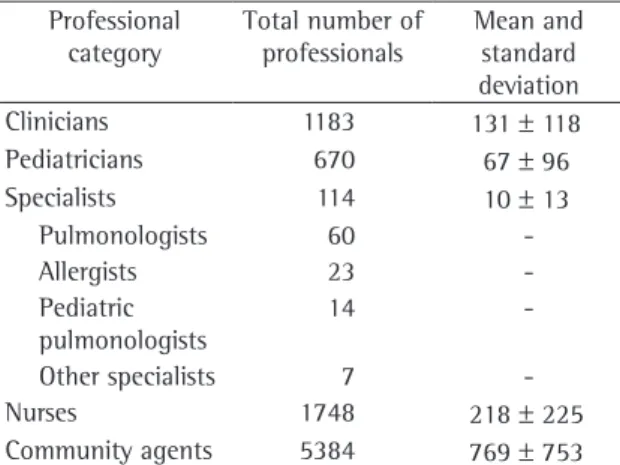
Table 1 shows that the absolute number of profes-sionals involved in the asthma control programs was satisfactory: 1183 clinicians, 670 pediatricians and 114 specialist physicians. In total, there were 1967 physicians, who can be considered dissemi-nators of acquired knowledge to all parts of the country. In addition, the environment is extremely favorable, since there is full public funding for the programs.
The analysis of the programs showed that nursing professionals play an important role in this network. Some time ago, the British health care system created nursing visits for patients with asthma, as recommended in the British Guideline on the Management of Asthma.(7) The number of
nurses involved in the treatment of asthma was higher than that of clinicians, even in the mean number of visits/month/program.
Of the programs evaluated, only 41% adopted public health strategies, such as family health 3 programs, respectively), 3 programs operated in
the northeast, and 2 operated in the central-west. None of the programs evaluated were operating in the northern region of the country. All 17 programs produced training/administrative materials (forms, protocols, routines, flowcharts and schedules), as well as educational materials (leaflets and brochures). A total of 8 programs (47%) developed educational activities (lectures or individual visits) within the community.
In addition, all programs had referral centers with specialists (allergists, otorhinolaryngologists, pulmonologists and pediatric pulmonologists), who developed activities incorporated into the basic health care system. Nevertheless, only 7 programs (41%) involved community health care agents, and only 8 (47%) of the programs employed home visits by nurses. The total number of professionals involved in the programs is shown in Table 1.
The mean number of medical visits/month was 160, and the mean number of nurse visits/month was 154.
In the present study, we tried to identify asthma control programs that had been in operation for at least two years and that were structured such that they provided holistic treatment to patients with asthma. Despite the fact that there are many practical functional initiatives for the treatment of patients with asthma, the exclusion of 27 of 55 programs studied shows that a significant number of those initiatives are still in the early structuring phase. The creation of the first PNCA acted as a stimulus and incentive for health professionals who longed for
Table 1 - Number and type of professionals involved in the asthma control programs.
Professional category
Total number of professionals
Mean and standard deviation
Clinicians 1183 131 ± 118
Pediatricians 670 67 ± 96
Specialists 114 10 ± 13
Pulmonologists 60
-Allergists 23
-Pediatric pulmonologists
14
-Other specialists 7
-Nurses 1748 218 ± 225
106 Cerci Neto A, Ferreira Filho OF, Bueno T
J Bras Pneumol. 2008;34(2):103-106
References
1. Holanda, MA. Asmáticos brasileiros: o tratamento desejado. J Pneumol. 2000; 26(3):187-8.
2. Silva LC, Freire LM, Mendes NF, Lopes AC, Cruz A. Carta de Salvador. J Pneumol. 2002;28(suppl 1):S2.
3. Portal da Saúde [homepage on the Internet]. Brasília: Imprensa Nacional - Diário Oficial da União; c1998 [updated 2006 Out 27; cited 2007 Jun 01]. [Adobe Acrobat document, 78p.] Available from: http://portal.saude.gov.br/portal/ arquivos/pdf/PT_2577_Comp_Medicam_Disp_Excep.pdf 4. Portal da Saúde [homepage on the Internet]. Brasília:
Imprensa Nacional - Diário Oficial da União; c1998 [updated 2006 Out 27; cited 2007 Jun 01]. [Adobe Acrobat document, 7p.] Available from: http://dtr2004.saude.gov.br/ dab/legislacao/portaria2084_26_10_05.pdf
5. Portal da Saúde [homepage on the Internet]. Brasília: Imprensa Nacional - Diário Oficial da União, c1998 [updated 2006 Out 27; cited 2007 Jun 01]. Available from: http:// dtr2001.saude.gov.br/sas/PORTARIAS/Port2006/GM/ GM-698.htm
6. Botega, A. Santos, MR. Descentralização das ações de assistência farmacêutica - asma e rinite. Cerci Neto A, organizer. Asma em saúde pública. 1a ed. São Paulo: Manole; 2007. p.23-7.
7. British Thoracic Society; Scottish Intercollegiate Guidelines Network. British guideline on the management of asthma. Thorax. 2003;58(Suppl 1):S1-S94.
8. Silva CM, coordinator. Asma e rinite: linhas de conduta em atenção básica. 1st ed. Brasília: Ministério da Saúde; 2004.
care, outreach, humanizing practices and visits by community health care agents. Those strategies are fundamental for increasing asthma patient access to health care services, as well as to providing holistic treatment for those patients.(8)