www.jped.com.br
ORIGINAL ARTICLE
Comparison of six-minute walk test in children with
moderate/severe asthma with reference values
for healthy children
夽
Lívia Barboza de Andrade
∗, Diogo A.R.G. Silva, Taíza L.B. Salgado,
José N. Figueroa, Norma Lucena-Silva, Murilo C.A. Britto
Instituto de Medicina Integral Prof. Fernando Figueira, Recife, PE, Brazil
Received 20 June 2013; accepted 21 August 2013 Available online 1 November 2013
KEYWORDS
Asthma; Children;
Pulmonary function; Quality of life
Abstract
Objective: to compare physical performance and cardiorespiratory responses in the six-minute walk test (6MWT) in asthmatic children with reference values for healthy children in the same age group, and to correlate them with intervening variables.
Methods: this was a cross-sectional, prospective study that evaluated children with moder-ate/severe asthma, aged between 6 and 16 years, in outpatient follow-up. Demographic and spirometric test data were collected. All patients answered the pediatric asthma quality of life (QoL) questionnaire (PAQLQ) and level of basal physical activity. The 6MWT was performed, fol-lowing the American Thoracic Society recommendations. Comparison of means was performed using Student’st-test and Pearson’s correlation to analyze the 6MWT with study variables. The significance level was set at 5%.
Results: 40 children with moderate or severe asthma were included, 52.5% males, 70% with normal weight and sedentary. Mean age was 11.3±2.1 years, mean height was 1.5±0.1 m, and mean weight was 40.8±12.6 Kg. The mean distance walked in the 6MWT was significantly lower, corresponding to 71.9%±19.7% of predicted values; sedentary children had the worst values. The difference between the distance walked on the test and the predicted values showed positive correlation with age (r = 0.373, p = 0.018) and negative correlation with cardiac rate at the end of the test (r = -0.518, p < 0.001). Regarding QoL assessment, the values in the question about physical activity limitations showed the worst scores, with a negative correlation with walked distance difference (r = -0.311, p = 0.051).
Conclusions: asthmatic children’s performance in the 6MWT evaluated through distance walked is significantly lower than the predicted values for healthy children of the same age, and is directly influenced by sedentary life style.
© 2013 Sociedade Brasileira de Pediatria. Published by Elsevier Editora Ltda. All rights reserved.
夽 Please cite this article as: de Andrade LB, Silva DA, Salgado TL, Figueroa JN, Lucena-Silva N, Britto MC. Comparison of six-minute walk
test in children with moderate/severe asthma with reference values for healthy children. J Pediatr (Rio J). 2014;90:250---7. ∗Corresponding author.
E-mail:[email protected], [email protected] (L.B.d. Andrade).
PALAVRAS-CHAVE
Asma; Crianc¸as;
Func¸ão pulmonar; Qualidade de vida
Comparac¸ão do teste de caminhada de 6 minutos em crianc¸as com asma moderada/grave com valores de referência para saudáveis
Resumo
Objetivo: comparar o desempenho físico e cardiorrespiratório do teste de caminhada de seis minutos (TC 6 min) em crianc¸as asmáticas com valores de referência para saudáveis da mesma faixa etária e correlacioná-los com variáveis intervenientes.
Métodos: estudo transversal, prospectivo,em crianc¸as com asma moderada/grave, entre seis e 16 anos, em acompanhamento ambulatorial. Coletaram-se dados demográficos e espirométri-cos. Os pacientes responderam questionário de qualidade de vida em asma (PAQLQ) e nível de atividade física basal. O TC 6 min foi realizado segundo recomendac¸ões da American Thoracic Society. Para comparac¸ões de médias usou-se teste t e correlac¸ão de Pearson para analisar o TC 6 min com variáveis estudadas. Nível de significância de 5%.
Resultados: incluídas 40 crianc¸as, 52,5% meninos, 70% eutróficas e sedentárias. A média de idade 11,3±2,1 anos, altura 1,5±0,1 m e peso 40,8±12,6 Kg. A média da distância percorrida no TC 6 min foi significativamente inferior correspondendo a 71,9%±19,7 dos valores previstos, onde as crianc¸as sedentárias exibiram os piores valores. A diferenc¸a entre a distância percorrida no teste e os valores preditos mostrou correlac¸ão positiva com a idade (r = 0,373, p = 0,018) e negativa com a frequência cardíaca ao final do teste (r = -0,518, p < 0,001). Na avaliac¸ão da qualidade de vida, os valores do quesito limitac¸ões das atividades físicas, demonstraram pior pontuac¸ão com correlac¸ão negativa com a diferenc¸a das distâncias percorridas (r = -0,311, p = 0,051).
Conclusões: o desempenho do TC6 min em crianc¸as asmáticas avaliado através da distância percorrida é significativamente inferior aos valores previstos para saudáveis da mesma faixa etária, sendo influenciado diretamente pelo sedentarismo.
© 2013 Sociedade Brasileira de Pediatria. Publicado por Elsevier Editora Ltda. Todos os direitos reservados.
Introduction
Asthma is a common disorder, characterized by an inflammatory status in which many cells and mediators have strong participation.1,2 It affects patients and their
families, in a complex and prolonged way.2 The
preva-lence in Brazil among schoolchildren and adolescents is estimated at 19% and 24%, respectively, with regional variations.3
Asthmatic children are generally less active than their healthy peers.4 This reduction in physical activity is
jus-tified by factors such as attitude towards illness, family taboos, poorly grounded advice, and inaccurate percep-tion of symptoms, among others.4,5 The reduced capacity
to exercise, participate in recreational activities, and even dyspnea itself result in functional limitations, so that a vicious cycle is created, thus progressively deteriorating car-diac performance.4---6
A sedentary lifestyle can be among the most often cited risk factors for increased prevalence and severity of asthma.6 Rasmussen et al. showed that in 757 Danish
chil-dren, decreased physical activity correlated with the onset of asthma in adolescence.7 Recently, it was observed that
children with asthma have reduced maximal oxygen uptake and muscle endurance in the lower limbs, when compared to healthy children.8
The objective measurement of physical fitness in asth-matic children appears important to determine exercise capacity in order to guide physical activity and rehabilitation that is adequate to disease severity.9
Walking tests are used to evaluate the functional capac-ity of patients with pulmonary disease with limited effort. They are easy to perform, reproducible, inexpensive, and present good correlation with maximal oxygen consumption obtained in maximal cardiopulmonary exercise testing.10,11
In spite of the description of submaximal exercise tests in adults with pulmonary disease,12 the literature is scarce
in asthmatic children, especially those with moderate and severe disease. When researching the past ten years in PubMed (using the keywords
exercise, test, child, asthma), it can be observed that most studies have focused on exercise-induced bron-chospasm, leaving unclear the issue of functional capacity assessment and its association with pulmonary function, physical activity, body mass index, medication use, and qual-ity of life (QoL), which justifies this study.
Thus, this study aimed to compare the physical per-formance and cardiorespiratory responses obtained in the six-minute walking test (6MWT) in children with moder-ate and severe asthma with reference values for healthy age-matched controls, and to correlate these results with possible intervening variables.
Material and methods
from the outpatient pediatric pulmonology and respiratory physical therapy clinic from the Instituto de Medicina Inte-gral Professor Fernando Figueira (IMIP), from October of 2011 to March of 2013. At assessment, the children were clinically stable, outside the crisis period, and had cognitive capacity to perform the procedures.
Patients with other chronic pulmonary or musculoskele-tal diseases were excluded from the study, as well as those with a cognitive impairment that prevented understand-ing of the requirements of the tests. Parents and guardians signed an informed consent, and the study was approved by the Research Ethics Committee of IMIP, under number (1900-10). No monetary compensation was offered to any of the study participants.
Test procedure and data collection
After an interview to complete patient history and identi-fication, data were collected regarding the assessment of physical activity level at baseline, weight and height mea-surement, and the QoL questionnaire was applied. Finally, the pulmonary function test was applied, and the children were referred to perform the 6MWT. The tests were per-formed by the main investigator (LBA) and a properly trained professional (DARGS).
To assess the level of physical activity at baseline, a score was applied, which was adapted from the habitual level of physical activity (HLPA) questionnaire by Santuz et al.13In it,
the gradations were established as: 0 (sedentary), 1 (regular activity up to two hours a week), and 2 (competitive activity or performed for more than two hours a week).
The measurement of height (m) and weight (kg) was per-formed in an anthropometric scale (Filizola - São Paulo, SP, Brazil) with children barefoot and wearing light clothing (shorts and T-shirts). After the measurements, participants were classified as eutrophic, overweight, and obese, accord-ing to body mass index for the gender.
Pulmonary function
The assessment of pulmonary function by spirometry was performed using a portable digital spirometer (Clement Clarke International - England; OneFlow model) and the technical procedures, and criteria for acceptability and reproducibility followed the norms of ATS/ERS (Ameri-can Thoracic Society/European Respiratory Society).14 The
forced expiratory volume in one second (FEV1), forced vital
capacity (FVC), peak expiratory flow (PEF), and FEV1/FVC
ratio were determined. For spirometry assessment, children did not use a short-acting bronchodilator during the four hours before the test. A five to ten-minute resting period was necessary before the test was performed.
After receiving the instructions, the children were asked to start the test. A maximal inspiration was emphasized, followed by a fast maximal expiration, following the criteria established by ATS.14The tests were performed individually
in the standing position using a nose clip. For best viewing of results, spirometric values were expressed in absolute values and percentages of predicted values.15
6MWT
Submaximal functional capacity was evaluated through the 6MWT, according to ATS standards,11 in a level corridor 30
meters long. After resting for 20 minutes, the children were instructed to walk as far as possible for six minutes with-out running, knowing that they could interrupt the test at any time. They were verbally encouraged at every minute, according to the standardization, and at the end of the six minutes, they were asked to stop where they were and the total distance in meters was recorded.
The parameters evaluated in the pre- and post-test included heart rate (HR) and pulse oxygen saturation (SpO2)
by pulse oximetry (EMAI, model OXP-10 Medical Hospital Equipment - São Paulo, Brazil), blood pressure through a sphygmomanometer (CE0050, Tycos, Welch Allyn - Skaneate-les Falls, New York, United States), respiratory rate (RR) (counted by chest wall movements per minute), and the score in the modified Borg scale to measure dyspnea intensity.16 The criteria for test interruption were: severe
dyspnea or fatigue expressed by the patient, SpO2< 85%, or
refusal to continue the test.
Based on the reference values suggested by Priesnitz et al.17for healthy Brazilian children, the predicted walked
distance in the 6MWT was calculated for children with asthma using the formula 6MWT = 145.343 + [11.78×Age (years)] + [292.22×height (m)] + [0.611×(HRFinal-HRInitial)]
- [2.684×weight (kg)] for evaluation of test performance. The choice of this formula is justified by the fact that it is the only equation developed for Brazilian children, even though it was designed for healthy individuals. Furthermore, the predicted distance calculation takes into account other variables that were evaluated in the study, including age, height, and weight. Based on these values, the mean dif-ference between the distance walked by the patient in the 6MWT (DWpat) and the predicted walked distance (DWpred) were obtained.
QoL in asthmatic patients
QoL assessment was performed using the Pediatric Asthma Quality of Life Questionnaire (PAQLQ), validated for Portuguese.18 The PAQLQ contains 23 questions for the age
group of 7 to 17 years, and comprises three domains: symptoms (ten questions), physical activity limitations (five questions), and emotions (eight questions). Questions are asked in person, without the presence of parents, and were directed to the patient’s experiences in the week prior to interview. The assessment is measured through a seven-point response scale, where 1 indicates maximum impairment, and 7, no impairment; thus, the higher the final value, the better the patient’s QoL.18,19 The results were
expressed as the means of total scores.
Statistical analysis
Table 1 Characterization of the study sample.a
Analyzed variables Value
Age (years) (mean±SD) 11.3±2.1
Male gender 52.5%
Weight (kg) (mean±SD) 40.8±12.6 Height (m) (mean±SD) 1.5±0.1
BMI (mean±SD) 18.7±3.5
Eutrophic 70%
Overweight/obese 30%
Pulmonary function (% of predicted)
FEV1 79%±0.12
FVC 88%±14
FEV1/FVC ratio 0.84%±0.09
PEF 341.3±66.6
Basal level of physical activity (hours/week)
Sedentary 70%
> two activities 30%
Type of asthma
Moderate 35%
Severe 65%
Use of medications
ICs low/medium dose 40%
ICs low/medium dose + long acting2 60%
6MWT
Distance walked by patient (m) 430.4±116.7 Predicted distance (m) 600.5±42.9
BMI, body mass index; FEV1, forced expiratory volume in one
second; FVC, forced vital capacity; ICs, inhaled corticosteroids; PEF, peak expiratory flow; SD, standard deviation; 6MWT, six-minute walk test;2, beta-agonist bronchodilators.
a Results shown as mean and standard deviation.
Student’st-test was used for comparison of means. The correlation between the difference in the distance walked in 6MWT and the predicted distance with intervening variables (pulmonary function, weight, height, HR, HR difference, Borg, and QoL) was assessed using Pearson’s correlation coefficient (symmetric distribution). The significance level was set at 5%, and the analyses and data processing were performed using STATA 12.1 SE.
Results
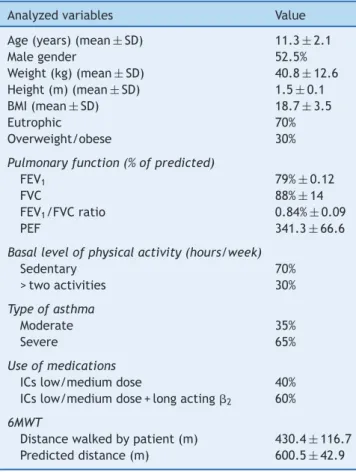
A total of 40 children with moderate and severe asthma, with mean age 11.3±2.1 years, of whom 52.5% were males, were included in the study. The sample characterization with anthropometric and lung function data, trophism, base-line physical activity level, medication use, and distance walked in the 6MWT are shown in Table 1.
The mean distance walked in the 6MWT (DWpat) was 430.3±116.7 m, while the mean distance predicted by the formula (DWpred) was 600.5±42.9 m; this difference was significant (p < 0.001). DWpat represented 71.9±19.7% of DWpred. The greater the difference between DWpat and DWpred, the lower the physical fitness and conditioning of the child.
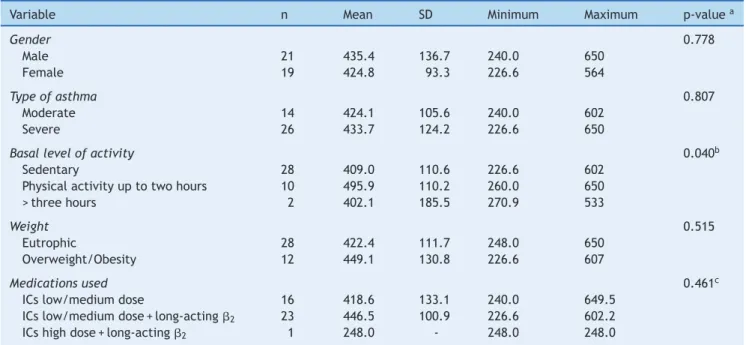
Table 2 shows the comparison of means between DWpat with clinical and demographic variables. There was a sig-nificant influence of baseline physical activity level, as sedentary children walked a shorter distance than active ones.
The difference of DWpat with DWpred showed a positive correlation with age (r = 0.373, p = 0.018), and a negative correlation with HR at the end of the test (r = -0.518, p < 0.001) and the difference of HR (before and after the 6MWT) (r = -0.359, p = 0.023), as shown in Fig. 1.
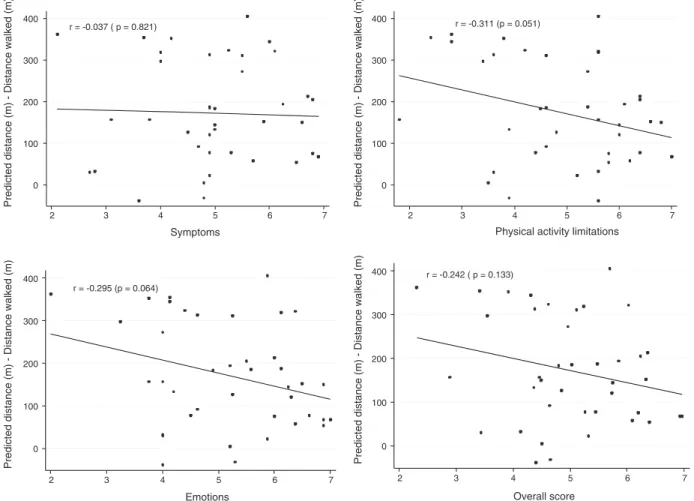
Regarding the assessment of QoL, the overall mean of PAQLQ scores was 5.13±1.24. The item that showed the greatest impairment on the children’s QoL was physical activity limitations (4.89±0.11), followed by symptoms (5.03±1.55), and finally, emotions (5.18±0.14).
A negative correlation of the difference of DWpat with DWpred was observed only with the activity limitation criterion (r = -0.311, p = 0.051). Regarding the criteria of emotions and symptoms, as well as the overall mean of the questionnaire, no significant correlation was observed (Fig. 2).
Discussion
The results demonstrated that children with moderate and severe asthma walked a shorter distance in the 6MWT than the predicted values for healthy children, averaging 71.9% of the predicted distance for age and height. This difference suggests a lower level of fitness in this population.
Several anthropometric, clinical, and emotional factors can influence the distance walked in a walk test, both in healthy and sick individuals. This study demonstrated that children who had lower baseline physical activity, that is, were more sedentary, walked a shorter distance in the 6MWT when compared to those that practiced more than two or three hours of weekly physical activities. Corroborating this finding, Teoh et al. reported that up to 30% of asthmatic children had exercise limitations, with reduced daily physi-cal activity.20Iwana et al. also found a significant correlation
between the baseline level of physical activity and the dis-tance walked in the 6MWT in asthmatic children.21
Previous studies indicate that several factors may influ-ence the capacity of asthma patients to exercise; among them, the level of habitual activity is often cited.21,22 It
is stated that although the symptoms of the disease lead children to avoid physical activity, according to current treatment guidelines, the diagnosis of asthma should not prevent a child from practicing physical activity, as moder-ate intensity physical activity is a recognized goal of disease control.4,23
An American study of 137 asthmatic children demon-strated that they are less active than their peers in all classifications used to define physical activity level.23In
Ger-many, a survey was conducted in 46 schools; 254 physical education teachers were interviewed, and it was observed that only 60% of asthmatic children participated in physical activities.24
Table 2 Comparison of walked distance, according to demographic and clinical variables.
Variable n Mean SD Minimum Maximum p-valuea
Gender 0.778
Male 21 435.4 136.7 240.0 650
Female 19 424.8 93.3 226.6 564
Type of asthma 0.807
Moderate 14 424.1 105.6 240.0 602
Severe 26 433.7 124.2 226.6 650
Basal level of activity 0.040b
Sedentary 28 409.0 110.6 226.6 602
Physical activity up to two hours 10 495.9 110.2 260.0 650
> three hours 2 402.1 185.5 270.9 533
Weight 0.515
Eutrophic 28 422.4 111.7 248.0 650
Overweight/Obesity 12 449.1 130.8 226.6 607
Medications used 0.461c
ICs low/medium dose 16 418.6 133.1 240.0 649.5
ICs low/medium dose + long-acting2 23 446.5 100.9 226.6 602.2
ICs high dose + long-acting2 1 248.0 - 248.0 248.0
ICs, inhaled corticosteroids; SD, standard deviation;2, beta-agonist bronchodilators.
aStudent’st-test.
b Comparison between the groups sedentary and physical activity up to two hours. c Comparison between ICs low/medium dose and ICs low/medium dose + long-acting
2groups.
r = 0.373 (p = 0.018)
0 100 200 300 400
0 100 200 300 400
0 100 200 300 400
Predicted distance (m) - Distance walked (m)
6 8 10 12 14 16
Age (Years)
r = –0.433 (p = 0.005)
Difference in distance walked - Predicted distanc
e
-20 0 20 40
Final heart rate - Initial heart rate
r = –0.518 (p < 0.001)
Predicted distance (m) - Distance walked (m)
60 80 100 120 140
Heart rate at the end of test
r = -0.037 ( p = 0.821)
Predicted distance (m) - Distance walked (m) Predicted distance (m) - Distance walked (m)
2 3 4 5 6 7
Symptoms
r = -0.311 (p = 0.051)
2 3 4 5 6 7
Physical activity limitations
r = -0.295 (p = 0.064)
0 100 200 300 400 0 100 200 300 400
0 100 200 300 400 0 100 200 300 400
Predicted distance (m) - Distance walked (m) Predicted distance (m) - Distance walked (m)
2 3 4 5 6 7
Emotions
r = -0.242 ( p = 0.133)
2 3 4 5 6 7
Overall score
Figure 2 Correlation coefficient of the difference between the distance walked in the 6MWT and PAQLQ scores (physical activity limitations, emotions, symptoms, and overall score, respectively), from left to right. PAQLQ, Pediatric Asthma Quality of Life Questionnaire; 6MWT, six-minute walk test.
deconditioning, leading to a reduction in exercise capacity. This may impact the child’s overall health status, well-being, and QoL.19 Lang et al. demonstrated that children
whose parents believe that exercise can improve asthma control are more active.22
Another study that also assessed functional capacity in children with asthma found that 88% of asthmatics and 56% of healthy children performed less than two hours of phys-ical activity weekly; this difference was significant. It was also shown that parents considered physical activities to be dangerous to their children, for fear of triggering crises, according to their responses to a questionnaire.25Thus, most
children are exempted from the mandatory physical activity in schools, a fact also observed, although not measured, in several children in the present study.
It is known that the quantification of daily physical activ-ity through questionnaires has the advantage of being low cost and easy to apply; however, it depends on factors such as understanding of the information and individual charac-teristics such as age, culture and educational level. Studies with motion sensors are suggested so that a sample of con-firmed sedentary individuals can be evaluated.
No association was observed in the present study between the distance walked in the 6MWT and gender, asthma severity, trophism, or medication use. In accordance with the present results, another study also did not observe
an association between physical fitness and asthma sever-ity; however, it reported a strong association of maximal oxygen uptake with psychological factors, such as perceived competence during physical activity and attitudes towards exercise.23
Gender did not influence the distance walked by the chil-dren in several studies with healthy individuals;17,26,27 this
result can be explained by the greater musculoskeletal sim-ilarity between the genders before adolescence. Regarding BMI, the results with healthy children are differing.17,27
There have been no reports in the literature on the influence of medication use and the performance in the 6MWT.
In this study, the difference in DWpat and DWpred was evaluated, suggesting that the greater the difference, the lower the physical fitness and conditioning of the child. This difference in distance walked was positively correlated with age, thus older children showed greater difference. Studies with healthy children have reported that the older the child, the greater the distance walked in the test.17,26,28 These
A negative correlation was also observed between the difference in distance walked with HR at the end of the test and the difference in HR (before and after 6MWT), where children who performed better on the test, i.e., were closer the predicted values, showed higher HR at the end of the test and higher difference in HR values. As expected, HR increased when walking longer distances in response to the required physiological demands, matching better per-formance in the test.
Some studies conducted in healthy children have demon-strated a correlation between height and gender with the distance walked; taller children and male children had bet-ter performance.17,26,27 However, this association was not
observed in the present study.
It is suggested that the assessment of QoL should be incor-porated into clinical evaluation, as chronic illnesses affect the different dimensions of patients’ lives. The QoL of asth-matic children can be influenced by a number of interacting factors, such as symptom severity, morbidity, gender, and capacity to cope with difficulties, demonstrating a clear association between QoL impairment and asthma.19,29In the
present study, a overall mean PAQLQ score of 5.13±1.24 was observed, indicating good QoL; however, when the items were evaluated separately, a worse mean value was observed regarding the aspect of limitation of activities. This value was negatively correlated with the difference between the DWpat and DWpred, indicating that children with more physical limitations had a worse performance in the test.
Some studies have also shown similar values of total PAQLQ score in asthmatic children, with averages ranging from 5.03±0.730 to 5.7
±1.3.29 In the study by Basaran
et al.,30similarly to the present study, the score that showed
the worst value was limitation of activities, where 86% had difficulty in running, 52% in climbing, and 38% in playing soccer or other sports.
Reduced levels of physical activity, while there has been an increase in the incidence and prevalence of asthma in children, is of concern, as it may result in a growing number of asthmatic patients who will fail to achieve good health and QoL.4
Formal exercise tests, such as the 6MWT, may help deter-mine whether the etiology of reduced exercise capacity in children with respiratory disease is due to the cardiorespi-ratory limitation or physical deconditioning. Many authors have reported that the numerical value of FEV1 poorly
reflects patients’ daily experiences, and does not assess the impact of asthma on the individual concerned.29,30
There-fore, it is suggested that submaximal exercise tests may be incorporated into the evaluation of these patients.
The small sample size, the sedentary life style assess-ment, and the lack of studies with asthmatic children to compare results are the main limitations of this study. Future studies incorporating such requirements, in addition to the inclusion of comparison groups and maximum stress tests, may contribute to the clarification of the subject.
In conclusion, the results of the present study demon-strated that the assessed children with moderate and severe asthma showed worse performance in the 6MWT when the distance walked was compared to predicted values for healthy children; a sedentary lifestyle was the main fac-tor that influenced the walked distance. The difference
between the values of the DWpat and the DWpred was lower in younger children and in those with higher HR at the end of the test.
QoL had a good overall score, but it presented worse val-ues regarding the physical activity limitation item, which correlated with a greater difference in the distance walked values. A better understanding of the associations and evo-lution of functional capacity is a relevant pediatric clinical issue, contributing to improve the follow-up of children with asthma
Conflicts of interest
The authors declare no conflicts of interest.
References
1. Sociedade Brasileira de Pneumologia e Tisiologia. Diretrizes da Sociedade Brasileira de Pneumologia e Tisiologia para o manejo da asma. J Bras Pneumol. 2012;38:S1---46.
2. Global Initiative for Asthma (GINA). Global strategy for the diagnosis and management of asthma in children 5 years and younger. Bethesda, MD: GINA; 2009. p. 21.
3. Solé D, Wandalsen GF, CameloNunes IC, Naspitz CK, ISAAC -Brazilian Group. Prevalence of symptoms of asthma, rhinitis, and atopic eczema among Brazilian children and adolescents identified by the International Study of Asthma and Allergies in Childhood (ISAAC) - Phase 3. J Pediatr (Rio J). 2006;82:341---6. 4. Williams B, Powell A, Hoskins G, Neville R. Exploring and
explaining low participation in physical activity among chil-dren and young people with asthma: a review. BMC Fam Pract. 2008;9:40.
5. Welsh L, Kemp JG, Roberts RG. Effects of physical condition-ing on children and adolescents with asthma. Sports Med. 2005;35:127---41.
6. Lucas SR, Platts-Mills TA. Physical activity and exercise in asthma: relevance to etiology and treatment. J Allergy Clin Immunol. 2005;115:928---34.
7. Rasmussen F, Lambrechtsen J, Siersted HC, Hansen HS, Hansen NC. Low physical fitness in childhood is associated with the development of asthma in young adulthood: the Odense schoolchild study. Eur Respir J. 2000;16:866---70.
8. Villa F, Castro AP, Pastorino AC, Santarém JM, Martins MA, Jacob CM, et al. Aerobic capacity and skeletal muscle function in children with asthma. Arch Dis Child. 2011;96:554---9.
9. Basso RP, Jamami M, Pessoa BV, Labadessa IG, Regueiro EM, Di Lorenzo VA. Assessment of exercise capacity among asthmatic and healthy adolescents. Rev Bras Fisioter. 2010;14:252---8. 10. Li AM, Yin J, Yu CC, Tsang T, So HK, Wong E, et al. The six-minute
walk test in healthy children: reliability and validity. Eur Respir J. 2005;25:1057---60.
11. ATS Committee on Proficiency Standards for Clinical Pulmonary Function Laboratories. ATS statement: guidelines for the six-minute walk test. Am J Respir Crit Care Med. 2002;166:111---7. 12. Lacasse Y, Martin S, Lasserson TJ, Goldstein RS. Meta-analysis of respiratory rehabilitation in chronic obstructive pulmonary disease. A Cochrane systematic review. Eura Medicophys. 2007;43:475---85.
13. Santuz P, Baraldi E, Zaramella P, Filippone M, Zacchello F. Factors limiting exercise performance in long-term survivors of bronchopulmonary dysplasia. Am J Respir Crit Care Med. 1995;152:1284---9.
15. Pereira CA, Lemle A, Algranti E, Jamsen JM, Valenc¸a LM, Nery LE, et al. I Consenso brasileiro sobre espirometria. J Pneumol. 1996;22:105---64.
16. Borg GA. Psychophysical bases of perceived exertion. Med Sci Sports Exerc. 1982;14:377---81.
17. Priesnitz CV, Rodrigues GH, Stumpf C, da S, Viapiana G, Cabral CP, Stein RT, et al. Reference values for the 6-min walk test in healthy children aged 6-12 years. Pediatr Pulmonol. 2009;44:1174---9.
18. La Scala CS, Naspitz CK, Solé D. Adaptac¸ão e validac¸ão do Pediatric Asthma Quality of Life Questionnaire (PAQLQ-A) em crianc¸as e adolescentes brasileiros com asma. J Pediatr (Rio J). 2005;81:54---60.
19. Souza PG, Sant’Anna CC, March MF. Quality of life in asth-matic children: a literature review. Rev Paul Pediatr. 2011;29: 640---4.
20. Teoh OH, Trachsel D, Mei-Zahav M, Selvadurai H. Exercise testing in children with lung diseases. Paediatr Respir Rev. 2009;10:99---104.
21. Iwama AM, Andrade GN, Shima P, Tanni SE, Godoy I, Dourado VZ. The six-minute walk test and body weight-walk distance product in healthy Brazilian subjects. Braz J Med Biol Res. 2009;42:1080---5.
22. Lang DM, Butz AM, Duggan AK, Serwint JR. Physical activ-ity in urban school-aged children with asthma. Pediatrics. 2004;113:e341---6.
23. Pianosi PT, Davis HS. Determinants of physical fitness in children with asthma. Pediatrics. 2004;113:e225---9.
24. Meyer A, Machnick MA, Behnke W, Braumann KM. Participation of asthmatic children in gymnastic lessons at school. Pneumolo-gie. 2002;56:486---92.
25. Brockmann P, Caussade S, Holmgren L, Prado F, Reyes B, Viviani P, et al. Actividad física y obesidad en ni˜nos con asma. Rev Chil Pediatr. 2007;78:482---8.
26. Ben Saad H, Prefaut C, Missaoui R, Mohamed IH, Tabka Z, Hayot M. Reference equation for 6-min walk distance in healthy North African children 6-16 years old. Pediatr Pulmonol. 2009;44:316---24.
27. Lammers AE, Hislop AA, Flynn Y, Haworth SG. The 6-minute walk test: normal values for children of 4-11 years of age. Arch Dis Child. 2008;93:464---8.
28. Li AM, Yin J, Au JT, So HK, Tsang T, Wong E, et al. Standard reference for the six-minute-walk test in healthy children aged 7 to 16 years. Am J Respir Crit Care Med. 2007;176:174---80. 29. Alvim CG, Picinin IM, Camargos PM, Colosimo E, Lasmar
LB, Ibiapina CC, et al. Quality of life in asthmatic adoles-cents: an overall evaluation of disease control. J Asthma. 2009;46:186---90.