434
Atik et al
Absence of the aortic valve associated with hypoplastic left sided heart
Arq Bras Cardiol volume 74, (nº 5), 2000
Instituto do Coração do Hospital das Clínicas - FMUSP
Mailing address: Edmar Atik – InCor - Av. Dr. Enéas C. Aguiar, 44 - 05403-000 - São Paulo, SP - Brazil
Edmar Atik, Luiz Alberto Benvenuti, Tamara Cortez Martins, Miguel Barbero-Marcial
São Paulo, SP - Brazil
Absence of the Aortic Valve Associated with Hypoplastic
Left-Sided Heart Syndrome
Case Report
In this report we describe the twelveth case in the literature of absence of the aortic valve cusps, associated with hypoplastic left-sided heart syndrome in a neonate. Clinical and hemodynamic conditions in our patient resemble the classical features of this syndrome except for a greater development of the ascending aorta and the left ventricular cavity, due to aortic insufficiency. A patch was unsuccessfully inserted at the aortic annulus to exclude the left ventricle from the circulation. In addition the Norwood operation was performed.
In contrast with the absence of the pulmonary valve 1, the aortic valve agenesis, which always occurs in associa-tion with other defects, is much rarer. Just eleven such ca-ses have been reported in the medical literature 2-10. In eight of these, associated hypoplastic left-sided heart syndrome was present 4-8,10. Normally related great arteries with aortic annulus stenosis was present in one 9 and in another two patients double outlet right ventricle was present 2,3 (being in one part of a complex anatomy with polisplenia) 3. Other defects have been described, for example total anomalous venous drainage 8, pulmonary venous stenosis 8, subaortic stenosis by anomalous mitral chordal attachments 4 and left ventricular endocardial fibroelastosis 4,5,8,10.
We relate one more such case of absence of the aortic valve associated with hypoplastic left-sided heart syndro-me, but with a well developed ascending aorta and left ven tricular cavity, due to a prominent aortic insufficiency, both being diagnosed in life and confirmed at autopsy.
Case Report
Our patient was a male neonate born weighing 4190g after an uneventful pregnancy and a normal delivery. He was discharged on the second day, but a mild cyanosis and tachypnea were responsible for his readmission to our ser-vice after 22 days of life.
At that time, the baby had weak pulses that improved
after prostaglandin E1 IV – 0.01µg/kg/mm. Suddenly, he be-came acyanotic, with strong pulses, mostly at the lower limbs, with a very comfortable clinical state.
His weight was 4270g, heart rate was 150 per minute and blood pressure was 111x69 mmHg in the upper extremi-ties and 88x43 mmHg in the lower extremiextremi-ties. Pulse oxygen saturation was 98 at rest and 85 with crying.
Remarkable cardiac findings were impulsive left sternal border lift, accentuated cardiac heart sounds, systolic ejec-tion click all over the precordium and a systolic and diastolic (to and fro) moderate intensity murmur along the left sternal border.
The lungs were clear and the liver was palpable at three centimeters below the right costal margin.
Eletrocardiography revealed sinus rhythm, the QRS axis at + 150o, the T axis at + 90o and the P axis at +60o. Unde-termined ventricular overload was evident as the rS comple-xes were visible from V1 through V6.
Chest radiography showed moderate cardiac enlarge-ment and increased pulmonary vascular markings.
Laboratory blood analysis revealed: Hg: 14.7g%, Hct: 44%, CKMB: 18U, Urea: 29, Creatinine: 0.6mg.
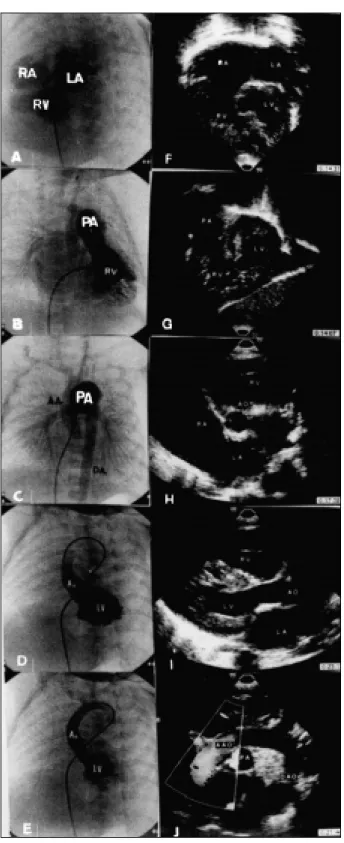
Echocardiography and cardiac catheterization (fig.1) characterized the anomaly in the setting of an absence of left atrioventricular connection with a concordant ventriculo-arterial connection. A large reversal ductal flow from huge pulmonary arteries was seen with a retrograde filling of the ascending aorta and subsequently the left ventricular cavi-ty through a remarkable aortic valve insufficiency. A small left atrium received all pulmonary veins that drained to the right atrium through two atrial septal defects of five and 2m-m in dia2m-meter. The left ventricle was s2m-mall but well for2m-med and the ascending aorta was 8mm in diameter. A rudimenta-ry aortic valve was evident at the aortic annulus.
The pressures at cardiac catheterization were: RA: 8, LA: 20, RV: 70/8, LV: 70/8, Ao: 70/30 - 43mmHg.
Arq Bras Cardiol volume 74, (nº 5), 2000
Atik et al Absence of the aortic valve associated with hypoplastic left sided heart
4 3 5 Fig. 1 - Angiographic features correlated well with echocardiographic ones in the
setting of association of defects: absence of aortic valve and hypoplastic left heart syndrome. Absence of the left atrioventricular connection with small left atrium (LA) are well seen in (a) and (f). The dilated right ventricular (RV) cavity (b,g) receives all venous return, the systemic and the pulmonary by an atrial septal defect (a) with a concordant ventriculoarterial connection (b,d,g,i). Huge pulmonary arteries (PA) are responsible for maintaining the systemic circulation including ascending aorta (AAo) and coronary arteries by a retrograde route through a large ductus (b,c). Aortic insufficiency was clearly demonstrated (e,j) with a left ventricle (LV) filling from an ascending aorta injection. The left ventricle and ascending aorta were small but well formed and the left ventricle showed a trabeculated aspect (d). Rudimentary and vestigious aortic leaflets are seen at the right posterior wall of the aortic annulus (h). Ao- ascending aorta; Dao-descending aorta; RA- right atrium.
Fig. 2 - Macroscopic view of the heart. A, Right lateral view of the great vessels. The large ascending aorta is apparent (Ao), which was anastomosed to the pulmonary arte-ry (PA). Notice the synthetic Blalock-Taussig shunt (BT), the surgically closed distal pulmonary artery (DPA), and the retroaortic projection of the left atrial appendage (LA). B, Internal view of the ascending aorta. The aortic orifice was closed by a surgical patch (arrow), and a large surgical comunication between the aorta and the pulmonary artery (asterisc) was created. C, The left ventricle has mild hypoplasia and endocardial fibroelastosis (LV). The right ventricle is enlarged and hypertrophied (RV).
diameter, the pulmonary trunk was three times bigger and the patent duct was as large as the pulmonary arteries. On operation, the left ventricular cavity was disconnected from the systemic circulation by a pericardial patch at the site where it should have encountered the aortic leaflets. A mo-dified Blalock-Taussig shunt with a 4mm Gore-Tex shunt at the right-sided heart and an atrial septal defect enlargement completed the operation.
Low cardiac output syndrome and hypoxia (pO2: 35 and oxygen saturation: 75%) were responsible for death six hours after the operation was completed.
syn-4 3 6
Atik et al
Absence of the aortic valve associated with hypoplastic left sided heart
Arq Bras Cardiol volume 74, (nº 5), 2000
terature with the absence of the aortic valve 2-4,7-9, including two with a double outlet right ventricle 2,3. Otherwise, the aortic insufficiency was remarkable for contributing to early death in the first eight days of life in ten cases reported 2-9.
Although the presence of the unusual left ventricular and ascending aorta development provoked by aortic insuf-ficiency in the case related herein, the clinical picture was si-milar to that encountered in patients with hypoplastic left-si-ded heart syndrome in which blood to coronary circulation comes from a retrograde flow from a persistent arterial duct. The hemodynamic, angiographic and echocardiogra-phic studies were very important in establishing the aortic insufficiency diagnosis, which was suspected clinically by a “to and fro” murmur.
The still challenging Norwood technique was easy to accomplish, in view of a well developed ascending aorta fo-und in this patient. As the left ventricle did not appear to contribute as a systemic pump in this case (it received blood in a retrograde manner) we decided to exclude it from the cir-culation by putting a patch at the aortic annulus.
Thus, this is just the second absence of aortic leaflet case reported that was treated surgically. Unfortunately, the downhill evolution of our patient was due to a myocardial in-farction that occurred during surgery, probably due to the anoxic arrest.
The sole survivor, described by Harada et al 10, under-went the Norwood technique.
All eleven cases reported occurred in males, which suggests X-linked factors, as has already been previously pointed out 8.
Acknowledgements
We thank Dr Vera D. Aiello for pathological assistance, Dr Andressa M. Soares for the echocardiographic analysis, Dr Luis Kajita for the angiographic diagnosis and Dr Munir Ebaid for the clinical discussion.
thetic Blalock-Taussig shunt was interposed between the right subclavian artery and the right pulmonary artery (fig. 2A). The annulus of the aortic valve measured 4mm without any vestigious valve, and the aortic orifice was closed with a surgical patch (fig. 2B). The arterial duct was ligated and mild preductal aortic coarctation was present. The valve of the fossa ovalis was surgically removed, and a 12mm atrial communication resulted. A mild hypoplasia of the left ven-tricle was also present, which had endocardial fibroelastosis (fig. 2C). The right cardiac chambers were enlarged and hy-pertrophied. The coronary arteries originated from the ascending aorta and did not have abnormalities. The histo-logical examination disclosed multiple patchy areas of re-cent myocardial infarction in both ventricles, chronic pul-monary venous hypertension, with arterial wall hypertro-phy and peripheral muscularization and acute tubular ne-crosis of the kidneys.
Discussion
Absence of cardiac valves is encountered more in the right-sided heart, mostly at the pulmonary site 1. The partial-ly unguarded mitral valve is rarepartial-ly seen, and just eleven ca-ses of aortic valve absence have been mentioned in the lite-rature 2-10.
In general, the clinical and hemodynamics conditions of unguarded valve annulus are determined by vestigial, se-verely hypoplastic and nonfunctioning leaflets giving rise to augmented cardiac and vascular structures.
In the absence of the aortic valve, a well developed left ventricle in addition to the ascending aorta become striking features even in the presence of hypoplastic left heart syn-drome, mostly demonstrated in the cases described by Ca-brera et al 6, Harada et al 10, Niwa et al 5, Lin et al 8 and by our-selves, where, incidentally, atresia of the left atrioventricu-lar valve was present in all of these cases. The left ventricle was hypoplastic in the seven other cases reported in the
li-1. Kirklin JW, Barratt-Boyes BG. Tetralogy of Fallot with absent pulmonary valve. In: Kirklin JW, Barratt-Boyes BG: Cardiac Surgery. 2nd ed. Churchill
Livings-tone: New York, 1993: 973-5.
2. Towes WH, Lortscher RH, Kelminson LL. Double outlet right ventricle with ab-sent aortic valve. Chest 1975; 68: 381-2.
3. Bierman FZ, Yeh MN, Swersky S, Martin E, Wigger JH, Fox H. Absence of the aor-tic valve: Antenatal and postnatal two-dimensional and Doppler echocardio-graphic features. J Am Coll Cardiol 1984; 3: 833-7.
4. Rossi MB, Ho SY, Tasker RC. Absent aortic valve leaflets. Int J Cardiol 1986; 11: 235-7. 5. Niwa K, Ikeda F, Miyamoto H, Nakajima H, Ando M. Absent aortic valve with
normally related great arteries. Heart Vessels 1987; 3: 104-107.
References
6. Cabrera A, Galdeano JM, Pastor E. Absence of the aortic valve cusps with mitral atresia, normal left ventricle, and intact ventricular septum. Br Heart J 1990; 63: 187-8.
7. Parikh SR, Hurwitz RA, Caldwell RL, Waller B. Absent aortic valve in hypoplas-tic left heart syndrome. Am Heart J 1990;119: 977-8.
8. Lin AE, Chin AJ. Absent aortic valve: a complex anomaly. Pediatr Cardiol 1990; 11: 195-8.
9. Nakamura S, Hatano T. A case of absent aortic valve with severe stenosis. Acta Cardiol Paediatr Jpn 1996; 12: 56-62.