Prevalence and impact of
headache in undergraduate
students in Southern Brazil
Asdrubal Falavigna1,2, Alisson Roberto Teles2, Maíra Cristina Velho2, Viviane Maria Vedana2, Roberta Castilhos da Silva2,
Thaís Mazzocchin2, Maira Basso2, Gustavo Lisbôa de Braga2
ABSTRACT
Objective: To determine the prevalence, characteristics and impact of headache among university students. Method: The criteria established by the International Headache Society were used to define the primary headache subtypes and the Migraine Disability Assessment Questionnaire (MIDAS), to assess the disability. The students were then grouped into six categories: [1] migraine; [2] probable migraine; [3] tension-type headache; [4] probable tension-type headache; [5] non-classifiable headache; [6] no headache. Results: Of all undergraduate students interviewed, 74.5% had at least one headache episode in the last three months. Regarding disability, there was a significant difference between the headache types (p<0.0001). In the post-hoc analysis, migraine was the headache type with most reported disability. Conclusion: Headache is a highly prevalent condition among the students at the University of Caxias do Sul. This disease may have a major impact on the students’ lives and in some cases, ultimately lead to educational failure.
Key words: disability, headache, prevalence, young population.
Prevalência e impacto da cefaléia em estudantes do sul do Brasil
RESUMO
Objetivo: Determinar a prevalência, características e impacto da cefaléia entre estudantes universitários. Método: Foram utilizados os critérios estabelecidos pela Sociedade Internacional de Cefaléia para definir os subtipos de cefaléia e o Migraine Disability Assessment Questionnaire (MIDAS), para avaliar a incapacidade associada. Os estudantes foram classificados em seis categorias: [1] migrânea; [2] provável migrânea; [4] cefaléia do tipo tensional; [4] provável cefaléia do tipo tensional; [5] cefaléia não classificável; [6] sem cefaléia. Resultados: De todos os estudantes entrevistados, 74,5% tiveram pelo menos um episódio de cefaléia nos últimos três meses. Em relação à incapacidade, foi encontrada uma diferença significativa entre os tipos de cefaléia (p<0,0001). Na análise post-hoc, a migrânea foi o tipo de cefaléia mais relacionada à incapacidade. Conclusão: A cefaléia é uma condição de grande prevalência entre estudantes da Universidade de Caxias do Sul. Esta doença pode ter um grande impacto na vida dos estudantes e, em alguns casos, levar a um pior desempenho acadêmico.
Palavras-chave: cefaléia, incapacidade, população jovem, prevalência.
Correspondence Asdrubal Falavigna
Rua Gen. Arcy da Rocha Nóbrega 401/602 95040-290 Caxias do Sul RS - Brasil E-mail: [email protected]
Received 23 January 2010 Received in final form 27 May 2010 Accepted 04 June 2010
1University of Caxias do Sul (UCS), Department of Neurology and Neurosurgery, Caxias do Sul RS, Brazil; 2Multidisciplinary
Academic League of Neurology and Neurosurgery of the University of Caxias do Sul, Caxias do Sul RS, (LAMNN-UCS).
Overall, 47% of the adult population presents an active headache disorder, ten-sion-type headache and migraine being the most frequent disorders, with a preva-lence of 38% and 10%, respectively1. hese
painful conditions are related to a major lack of productivity at work or at school limitation of social activities and impair-ment of quality of life2,3. Also, the
impact, implying direct costs, such as medical care (di-agnosis, treatment, medication) and on the state (public health care), and indirect costs, which involve the loss of production attributable to the illness4.
Headache disorders are diagnosed and treated conditions in certain populations, such as under-graduate students. In this speciic population, the head-aches lead to lost days of study and worse academic per-formance. Few studies were performed on undergrad-uate students. In Greece, the prevalence of migraine is 2.4%5 and in Turkey, 12.4%6. In Brazil, Bigal et al.7 found
a prevalence of 25% of migraine and 32.9% of the stu-dents reported episodic tension-type headache. he au-thors also observed that students with migraine showed a 62.7% decrease in productivity while studying, com-pared with a 24.4% decrease in those with episodic ten-sion-type headache.
There are few studies about the impact of primary headaches in these students, specially using standardized tools, such as the Migraine Disability Assessment Ques-tionnaire (MIDAS). hus, this study aims to determine the prevalence and characteristics of headache and its im-pact among undergraduate students at a private universi-ty in Southern Brazil, using the MIDAS questionnaire.
METHOD
Design and sample
his cross-sectional study was carried out at the Uni-versity of Caxias do Sul, a private uniUni-versity in Southern Brazil. After mapping of all university campus buildings, the researchers were trained to approach all of the uni-versity buildings in class periods during the morning, af-ternoon and evening shifts. he classrooms approached were randomly chosen by the researchers during the data collection. he undergraduate students were invited to participate in the study and signed a letter of consent. A structured, closed-ended questionnaire was completed during the classes. he inclusion criteria were to be under 30 years of age and to accept to participate in the study by signing the letter of consent. he study was submitted to the Ethics and Research Committee of UCS and the study began after approval (Project number 49/07).
Instrument
he following variables were collected using the struc-tured questionnaire: gender, age, course, socioeconom-ic level, presence of headache and its features in the past three months, and the headache-related disability. he so-cioeconomic level was measured by the Brazilian Asso-ciation of Research Companies (Associação Brasileira de Empresas de Pesquisa - ABEP) and divided into ive cate-gories, where the highest socioeconomic level was “A”.
he students were asked about the presence of
head-ache in the past three months. he criteria established by the International Headache Society 8 were used to
clas-sify the types of primary headaches. he following were investigated: the presence of any type of headache, fre-quency, duration, intensity, headache quality and associ-ated symptoms (nausea and/or vomiting, photophobia, phonophobia). All diferent types of aura symptoms were aggregated in one item. he students were then grouped into six categories: [1] migraine; [2] probable migraine; [3] type headache (TTH); [4] probable tension-type headache; [5] other headache; [6] no headache. he numerical rating scale ranging from zero, no pain, to ten, worst pain, assessed pain intensity.
We analyzed the headache-related disability with the Migraine Disability Assessment Questionnaire. MIDAS is a 5-question, open-response questionnaire that evaluates the headache-related functional impairment experienced by the patient. It is expressed by loss of days at work or at school, household chores, and social activity, during a 3-month period. It has already been translated and validated for the Brazilian-Portuguese language9. Even being a questionnaire
that analyses the migraine disability speciically, the MI-DAS score were previously tested in populations of nonmi-graine headache suferers. his scale has an acceptable test-retest reliability (Spearman’s correlation: 0.84) and a good internal consistency (Cronbach’s alpha: 0.83)10, supporting
the reliability of the measure in patients with nonmigraine headaches. Also, the MIDAS score was already used across a spectrum of others headache types in previous studies11,12.
Statistical analysis
All statistical analyses were conducted with SPSS 16.0 (SPSS, Chicago, IL). he categorical variables were pre-sented as proportions. he continuous variables were sub-mitted to the Kolmogorov-Smirnov test to verify normal distribution and were presented as mean plus standard deviation or median plus interquartile interval, depending on distribution. he Chi-square test was used to compare the nominal variables and ANOVA to compare the con-tinuous variables. Post-hoc analysis (Bonferroni test) was performed to assess multiple comparisons between the diferent types of headaches considering the MIDAS value.
Reliability
To assess the reliability of the instrument 53 students were randomly selected to complete the questionnaire for a second time, approximately 7 days after the irst com-pletion. he correlation between test-retest was measured by kappa index (к).
RESULTS
sur-vey respondents, 63.6% were women and the median age was 21 years. he most prevalent socioeconomic status in the population studied, according to the Brazilian Asso-ciation of Research Companies(Associação Brasileira de Empresas de Pesquisa - ABEP), was “B” and “C”, with fre-quencies of 43.8% and 37.7%, respectively. he prevalence of the types of courses was: health and biological scienc-es, 37.1%; exact sciences and engineering, 48.2%; and hu-manities and art, 14.7%. he general characteristics of the sample are presented in Table 1. Of the total students, 813 presented headache (74.5%). he headache features such as duration and frequency of headache attacks, site of pain and nausea/vomiting are described in Table 2.
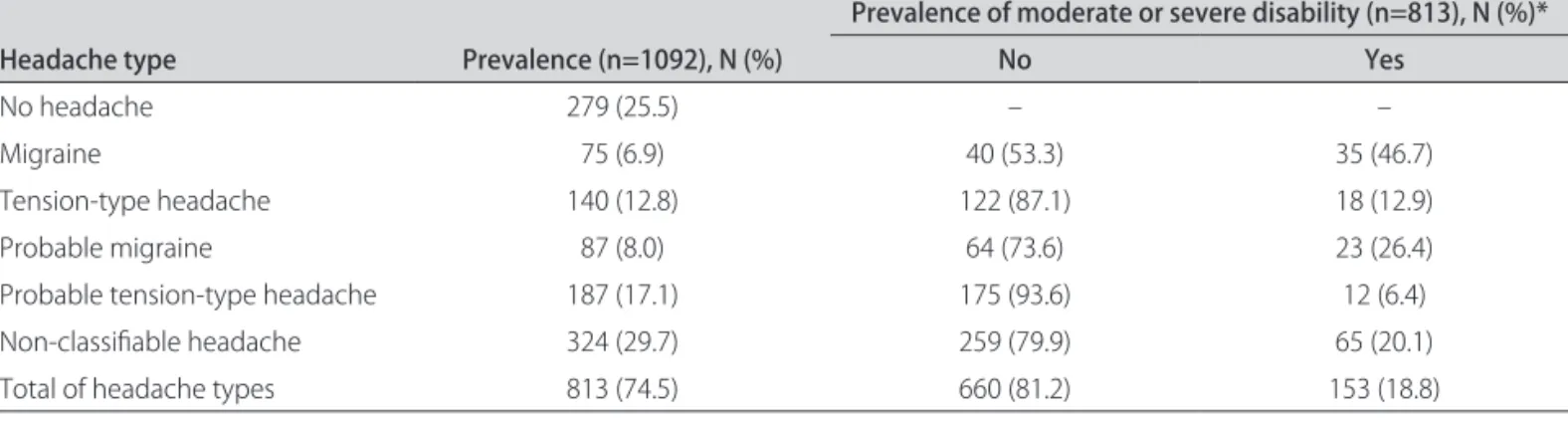
he most common primary headache was non-clas-siiable headache (29.7%). Regarding headache disability, there was a signiicant diference between the headache
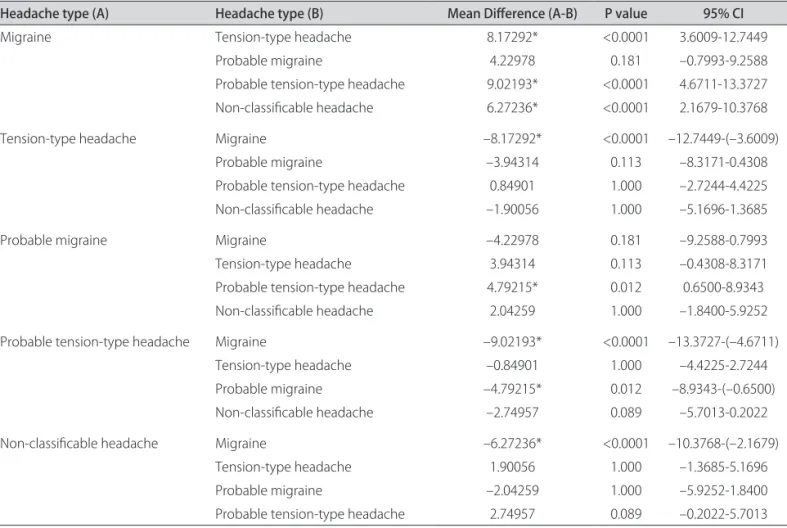
types, shown in Table 3 (p<0.0001). he students with mi-graine were the group in which more individuals reported incapacity due to pain (46.7%). Table 4 describes the post-hoc analysis, where there is a signiicant loss of days in the last three months, measured with the Migraine Dis-ability Assessment questionnaire, in the individuals who met the criteria for migraine in our study, compared with the other types of headaches. Graph 1 shows the MIDAS score in the primary headache types, described as medi-an medi-and interquartile interval.
The test-retest analysis showed a median kappa of 0.75; in 3 questions, 0.4-0.6; in 4 questions; 0.6-0.8; and in 5 questions, >0.8. hus, the questionnaire demonstrat-ed good reliability.
Table 1. General sample characteristics (n=1,092).
Female gender 63.6%
Median age (P25-P75)* 21.0 (19.0-24.0) Ethnicity
Caucasian 93.9%
Mulatto 4.8%
Black 1.1%
Asian 0.2%
Socioeconomic status
A 10.4%
B 43.8%
C 36.7%
D 8.9%
E 0.2%
Courses
Health and biological sciences 37.1% Exact sciences and engineering 48.2%
Humanities and art 14.7%
*Percentile 25- Percentile 75.
Table 2. Headache characteristics in university students (n=813). Duration of the attacks - hours (P25-P75)* 2.0 (1.0-5.0) Frequency of headache attacks
Once a week or more 40.9%
Once a month 39.3%
One time or less in three months 19.8% Site of pain
Unilateral 44.3%
Bilateral 40.0%
Other 15.8%
Quality of pain
Pulsating 55.1%
Pressing / tightening 29.7%
Stabbing 13.2%
Others 2.0%
Nausea / vomiting 35.5%
Photophobia 57.3%
Phonophobia 76.8%
Aura symptoms 25.0%
Pain worsens with daily activities 40.8%
*Percentile 25- Percentile 75.
Table 3. Prevalence of headache types and their associated disability and its associated disability y (n=813).
Headache type Prevalence (n=1092), N (%)
Prevalence of moderate or severe disability (n=813), N (%)*
No Yes
No headache 279 (25.5) – –
Migraine 75 (6.9) 40 (53.3) 35 (46.7)
Tension-type headache 140 (12.8) 122 (87.1) 18 (12.9)
Probable migraine 87 (8.0) 64 (73.6) 23 (26.4)
Probable tension-type headache 187 (17.1) 175 (93.6) 12 (6.4) Non-classiiable headache 324 (29.7) 259 (79.9) 65 (20.1) Total of headache types 813 (74.5) 660 (81.2) 153 (18.8)
Table 4. Post-hoc analysis of MIDAS mean of headache types.
Headache type (A) Headache type (B) Mean Diference (A-B) P value 95% CI
Migraine Tension-type headache 8.17292* <0.0001 3.6009-12.7449 Probable migraine 4.22978 0.181 –0.7993-9.2588 Probable tension-type headache 9.02193* <0.0001 4.6711-13.3727 Non-classiicable headache 6.27236* <0.0001 2.1679-10.3768
Tension-type headache Migraine –8.17292* <0.0001 –12.7449-(–3.6009) Probable migraine –3.94314 0.113 –8.3171-0.4308 Probable tension-type headache 0.84901 1.000 –2.7244-4.4225 Non-classiicable headache –1.90056 1.000 –5.1696-1.3685
Probable migraine Migraine –4.22978 0.181 –9.2588-0.7993
Tension-type headache 3.94314 0.113 –0.4308-8.3171 Probable tension-type headache 4.79215* 0.012 0.6500-8.9343 Non-classiicable headache 2.04259 1.000 –1.8400-5.9252
Probable tension-type headache Migraine –9.02193* <0.0001 –13.3727-(–4.6711) Tension-type headache –0.84901 1.000 –4.4225-2.7244 Probable migraine –4.79215* 0.012 –8.9343-(–0.6500) Non-classiicable headache –2.74957 0.089 –5.7013-0.2022
Non-classiicable headache Migraine –6.27236* <0.0001 –10.3768-(–2.1679) Tension-type headache 1.90056 1.000 –1.3685-5.1696 Probable migraine –2.04259 1.000 –5.9252-1.8400 Probable tension-type headache 2.74957 0.089 –0.2022-5.7013
*The mean diference is signiicant at the .05 level; MIDAS: migraine disability assessment questionnaire.
DISCUSSION
Headaches are the most common neurological symp-tom, afecting almost everyone at least once in their lives. According to Stovner et al., the overall prevalence of headache in general is 47%13. Primary headaches afect
individuals of all ages, being a major cause of impairment and lower quality of life. In undergraduate student pop-ulations, the disability provoked by headache has a nega-tive inluence on academic productivity6,7,14,15.
Of all undergraduate students interviewed, 74.5% had at least one headache episode in the last three months, a high prevalence that is in accordance with other studies1,13,16,17. In the Brazilian undergraduate
popula-tions, the lifetime prevalence was 98,5%14 and the
one-year prevalence was 57.9%7. In Spanish undergraduate
students, 91.9% of persons said that they had sufered suf-fered from headaches during the last year18.
Migraine prevalence in this study was 6.9%, which is a lower prevalence, when compared to other studies conducted in a university population. Demirkirkan et al.6
conducted a study with university students in Turkey, and demonstrated a migraine prevalence of 12.4%. In Greek undergraduate students, only 2.4% presented migraine5.
In Brazil, the migraine prevalence was 25%7. Compared
with a general population, the prevalence also varies. In Brazil, a general population study showed a prevalence of 10.7%19, and another, of 16.3%20.
Regarding tension-type headache, the frequency found in this study was 12.8%. he tension-type headache frequency varies more than migraine across the studies. he lifetime prevalence can be as high as 86%21, described
in a study conducted in a general population in Denmark, or as low as 22.9% in Brazil17. Among undergraduate
stu-dents at a Brazilian university, the one-year prevalence of episodic tension-type headache (ETTH) was 32.9%7. In a
Turkish population, the prevalence of TTH was 20.35%22.
he disparity between the overall headache prevalence and its types can be explained by the diferent methodol-ogies adopted in each study. Most of the studies show a lifetime or one-year prevalence. he spectrum of number of tension-type headache episodes varies, and an expla-nation for the lower prevalence found in our study is the fact that we describe a three-month prevalence. Also, the disparity across cultures and diferent populations investi-gated in the studies should be taken into account.
is associated with learning diiculty complaints. In anoth-er Brazilian population, 62.7% of migraineurs and 24.4% of tension-type headache suferers, when in pain, present decreased productivity while studying. Also, ifty percent of migraineurs tried to study despite the pain, compared with 53.2% of those with ETTH7. According to Curry and
Green15, sixty percent of students interviewed indicated
that headaches interfered with their usual activities. he impact of migraine on an individual’s life and in society is more discussed in literature than the tension-type headache, even with a larger prevalence. However, owing to this high prevalence of tension-type headache, the disability caused by this type of headache is greater than for migraine1. Also, Rasmussen et al.23 showed greater
absence from work owing to tension-type headache than migraine. his greater concern with migraine is probably due to factors such as the underdiagnosis of tension-type headache, the less disabling symptoms associated, and pain intensity is mild to moderate in the majority of cases.
he MIDAS questionnaire is a valuable instrument to research and quantify the extent of headache impact. To our best knowledge, there is only one study that uses this instrument in undergraduate students. All the same, this study, conducted with undergraduate students with migraine at a university in Turkey, shows that most mi-graine suferers have a major disability. Twenty-six per cent have moderate disability (grade III) and 41.4% have severe disability (grade IV), according to this study6. In
our sample, we found that 46.7% have moderate or se-vere incapacity.
Twenty-five percent of the students present aura symptoms. However, only 6.9% and 8% has migraine and probable migraine, respectively. his is due by the fact that a relevant number of students have non-classiiable head-aches, and in this percentage are included students with aura, but do not have all symptoms of probable migraine or migraine. Also, this elevated portion of sample that present non-classiied headache can be explained by how the data were collected. he face-to-face interview is more capable to diagnose this students having headache with-out classiication that the evaluation of a questionnaire. his study has some limitations. First, it was conduct-ed at a private university, where most of the students are from the higher socioeconomic levels, making it diicult to investigate headaches in undergraduate students from lower socioeconomic levels. Also, we did not evaluate the students’ academic performance.
In conclusion, this study presents the prevalence, gen-eral characteristics and impact of headache in undergrad-uate students at a private university in southern Brazil. Our indings shows relevant disability associated with
mi-graine, compared with the others types of headache re-searched in this study, which is consistent with the data found in the literature. It is necessary to identify and treat these students with headache, to improve the scholar per-formance that is often compromised in this condition.
REFERENCES
1. Jensen R, Stovner LJ. Epidemiology and comorbidity of headache. Lancet Neurol 2008;7:354-361.
2. Lipton RB, Newman IC. Epidemiology, impact, and comorbities of migraine headaches in the United States. Neurology 2003;60 (Suppl 2):S3-S8. 3. Strine TW, Chapman DP, Balluz LS. Population of U.S. study of severe
head-aches in adults: psychological distress and comorbities. Headache 2006; 46:223-232.
4. Bigal ME, Bigal JO, Bordini CA, Speciali JG. Prevalence and costs of headaches for the public health system in a town in the interior of the state of São Pau-lo. Arq Neuropsiquiatr 2001;59:504-511.
5. Mitsikostas DD, Gatzonis S, Thomas A, Kalfakis N, Illias A, Papageoergiou C. An epidemiological study of headaches among medical students in Athens. Headache 1996;36:561-564.
6. Demirkirkan MK, Ellidokuz H, Boluk A. Prevalence and clinical characteristics of migraine in university students in Turkey. Tohoku J Exp Med 2006;208: 87-92.
7. Bigal ME, Bigal JM, Betti M, Bordini CA, Speciali JG. Evaluation of the impact of migraine and episodic tension-type headache on the quality of life and per-formance of a university student population. Headache 2001;41:710-719. 8. Headache Classiication Subcommittee of the International Headache Society.
The international classiication of headache disorders. 2nd Edition (ICHD-II).
Cephalalgia 2004;24(Suppl 1):S8-S160.
9. Fragoso YD. MIDAS (Migraine Disability Assessment): a valuable tool for work-site identiication of migraine in workers in Brazil. Sao Paulo Med J 2002; 120:118-121.
10. Stewart WF, Lipton RB, Kolodner K, Liberman J, Sawyer J. Reliability of the mi-graine disability assessment score in a population-based sample of headache suferers. Cephalalgia 1999;19:107-114.
11. Gesztelyi G, Bereczki D. Primary headaches in an outpatient neurology head-ache clinic in East Hungary. Eur J Neurol 2004;11:389-395.
12. Dando WE, Branch MA, Maye JP. Headache disability in orofacial pain pa-tients. Headache 2006;46:322-326.
13. Stovner L, Hagen K, Jensen R, et al. The global burden of headache: a doc-umentation of headache prevalence and disability worldwide. Cephalalgia 2007;27:193-210.
14. Catharino AMS, Catharino FMC, Fonseca RL. Headache: prevalence and re-lationship with the academic performance of medical students. Migraneas cefaléias 2007;10:46-50.
15. Curry K, Green R. Prevalence and management of headache in a university undergraduate population. J Am Acad Nurse Pract 2007;19:378-382. 16. Domingues RB, Kuster GW, Dutra LA, Santos JG. Headache epidemiology in
Vitoria, Espirito Santo. Arq Neuropsiquiatr 2004;62:588-591.
17. Queiroz LP, Barea LM, Blank N. An epidemiological study of headache in Flo-rianopolis, Brazil. Cephalalgia 2006;26:122-127.
18. Martinez Sanchez F, Sanchez Hernandez A. [The prevalence of headaches in a university population]. Rev Sanid Hig Publica (Madr) 1992;66:313-317. 19. Pahim LS, Menezes AM, Lima R. [Prevalence and factors associated to migraine
in adult population, Southern Brazil]. Rev Saude Publica 2006;40:692-698. 20. Wiehe M, Fuchs SC, Moreira LB, Moraes RS, Fuchs FD. Migraine is more fre-quent in individuals with optimal and normal blood pressure: a population-based study. J Hypertens 2002;20:1303-1306.
21. Lyngberg AC, Rasmussen BK, Jorgensen T, Jensen R. Has the prevalence of migraine and tension-type headache changed over a 12-year period? A Dan-ish population survey. Eur J Epidemiol 2005;20:243-249.
22. Kaynak Key FN, Donmez S, Tuzun U. Epidemiological and clinical character-istics with psychosocial aspects of tension-type headache in Turkish college students. Cephalalgia 2004;24:669-674.